
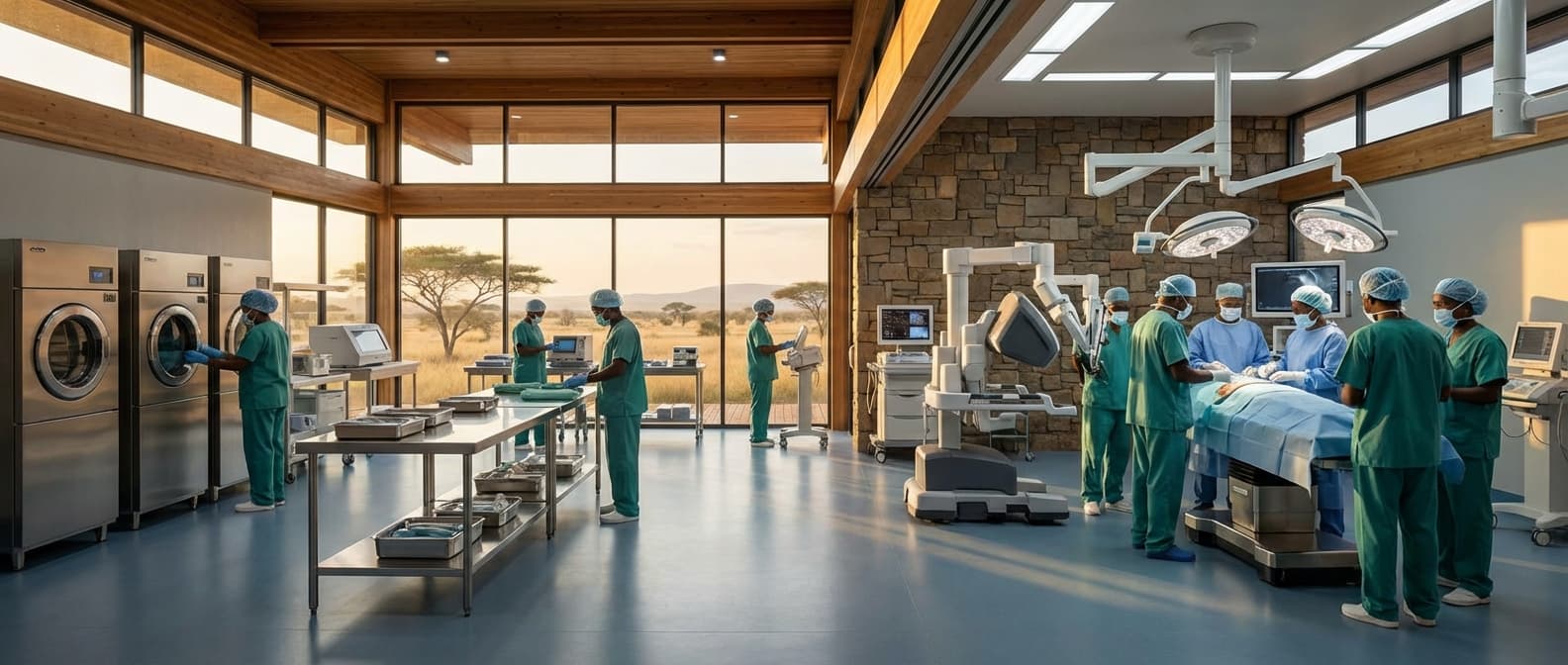
Medical Gas System Design & Installation in Sao Tome and Principe
Engineering Excellence & Technical Support
Medical gas pipeline systems: O2, N2O, air, vacuum High-standard technical execution following OEM protocols and local regulatory frameworks.
Optimized Medical Gas Supply for Enhanced Patient Care
Designed and installed a robust medical gas pipeline system for the Central Hospital of São Tomé, ensuring reliable and continuous supply of medical air, oxygen, and vacuum. Implemented advanced manifold systems with automatic changeover and remote monitoring capabilities to minimize downtime and guarantee patient safety, even in critical situations.
Compliance with International Standards in Challenging Environments
Successfully navigated and adhered to international standards (e.g., NFPA 99) for medical gas systems within the unique logistical and environmental context of São Tomé and Príncipe. This included meticulous material selection, precise installation techniques, and rigorous testing procedures to ensure the longevity and safety of the infrastructure in a tropical climate.
Localized Training and Sustainable Maintenance Protocols
Developed and delivered comprehensive training programs for local biomedical technicians and maintenance staff on the operation and upkeep of the new medical gas systems. Established sustainable maintenance protocols and provided essential spare parts inventory, empowering the hospital to independently manage and maintain the system, ensuring long-term operational efficiency and cost-effectiveness.
What Is Medical Gas System Design & Installation In Sao Tome And Principe?
Medical Gas System Design & Installation in Sao Tome and Principe refers to the specialized engineering and construction process of creating and implementing integrated networks for the safe and efficient delivery of medical gases within healthcare facilities. This encompasses the selection, sizing, routing, and integration of components for central gas sources (including bulk liquid oxygen, medical air compressors, vacuum pumps, and nitrous oxide supply), manifold systems, piping infrastructure, outlets, alarms, and control panels. The service ensures compliance with international and national safety standards, maintaining gas purity, pressure, and flow rates essential for patient care. It also involves meticulous site assessment, detailed engineering drawings, procurement of certified equipment, and on-site installation by qualified technicians. Commissioning and validation procedures are critical to verify system performance and safety before handover.
| Service/Need | Who Needs It? | Typical Use Cases |
|---|---|---|
| Design and Installation of Medical Gas Systems | Hospitals (public and private), clinics, specialized medical centers, diagnostic facilities, rehabilitation centers, and veterinary hospitals in Sao Tome and Principe. | Oxygen therapy (respiratory support), anesthesia (operating rooms), ventilation, patient suctioning, pneumatic surgical tools, cryotherapy, and laboratory applications requiring specific gas mixtures. |
| Upgrades and Retrofitting | Existing healthcare facilities in Sao Tome and Principe requiring modernization, expansion, or compliance with updated standards. | Replacing outdated systems, increasing capacity to meet growing patient demand, integrating new gas types, or enhancing safety features. |
| Maintenance and Repair | All healthcare facilities in Sao Tome and Principe utilizing medical gas systems. | Preventive maintenance to ensure system reliability, emergency repairs for unexpected failures, and routine inspections to identify potential issues. |
| Consultation and Auditing | Healthcare administrators, facility managers, and project developers in Sao Tome and Principe involved in new construction or renovation projects. | Feasibility studies, system design reviews, compliance audits, and expert advice on medical gas infrastructure planning. |
Key Components and Considerations:
- Central Gas Source: Bulk liquid cryogenic tanks, medical air compressors, vacuum pumps, nitrous oxide generators/storage.
- Manifold Systems: Automatic or manual changeover systems for cylinder or bulk supply.
- Piping Infrastructure: Medical-grade copper tubing, specialized fittings, and color-coding for gas identification (e.g., oxygen - green, medical air - yellow, vacuum - white, nitrous oxide - blue).
- Gas Outlets: Standardized connectors for various medical equipment at patient locations (e.g., hospital beds, operating rooms).
- Alarm Systems: Monitoring pressure, flow, and purity of medical gases, with audible and visual alerts.
- Pressure Regulators and Control Valves: Ensuring precise and stable gas delivery.
- Purification and Filtration: Maintaining gas quality and removing contaminants.
- Noise and Vibration Control: For compressors and pumps.
- Material Selection: Ensuring compatibility and preventing contamination.
- Regulatory Compliance: Adherence to relevant standards (e.g., NFPA 99, ISO 7396-1, local health regulations in Sao Tome and Principe).
- System Validation and Testing: Rigorous testing of pressure, flow, purity, and alarm functions.
- Training and Documentation: Providing operational and maintenance training for facility staff and comprehensive system documentation.
Who Needs Medical Gas System Design & Installation In Sao Tome And Principe?
Designing and installing a reliable medical gas system is crucial for healthcare facilities to ensure patient safety and provide effective medical treatments. In Sao Tome and Principe, various institutions and departments would significantly benefit from expert medical gas system design and installation services.
| Customer Type | Key Departments Benefiting | Specific Needs/Benefits |
|---|---|---|
| Hospitals (Public and Private) | Operating Rooms, Intensive Care Units (ICUs), Emergency Departments, Respiratory Therapy, Post-Anesthesia Care Units (PACUs), General Wards | Reliable supply of oxygen, medical air, vacuum, and potentially nitrous oxide for critical patient care, anesthesia, and life support. Compliance with international standards for patient safety. |
| Clinics and Health Centers | Minor Procedure Rooms, Outpatient Care Areas, Diagnostic Imaging | Essential for oxygen therapy in moderate cases, local anesthesia suction, and basic diagnostic procedures. Improved local healthcare delivery. |
| Surgical Centers | Operating Rooms, Recovery Rooms | High-demand for medical air for ventilation and surgical tools, oxygen for patient breathing, and vacuum for suction during procedures. Enhanced surgical safety and efficiency. |
| Emergency Medical Services (EMS) Bases | Ambulances, Dispatch Centers (for oxygen storage and distribution) | On-site oxygen supply for pre-hospital care, rapid deployment of medical gas equipment. Ensures continuity of care en route to medical facilities. |
| Rehabilitation Centers | Therapy Rooms, Patient Rooms | Oxygen therapy for patients with respiratory conditions undergoing rehabilitation. May also include specialized gas applications for certain therapies. |
| Specialized Treatment Facilities (e.g., Dialysis Centers, ICUs) | Dialysis Units, Neonatal Intensive Care Units (NICUs), Cardiac Care Units | High-precision delivery of specific medical gases (e.g., medical air for ventilators, oxygen for premature infants) and vacuum for waste removal. Critical for life-sustaining treatments and monitoring. |
Target Customers and Departments in Sao Tome and Principe Requiring Medical Gas System Design & Installation:
- Hospitals (Public and Private)
- Clinics and Health Centers
- Surgical Centers
- Emergency Medical Services (EMS) Bases
- Rehabilitation Centers
- Specialized Treatment Facilities (e.g., Dialysis Centers, Intensive Care Units)
Medical Gas System Design & Installation Process In Sao Tome And Principe
This document outlines the comprehensive workflow for the Medical Gas System Design and Installation process in Sao Tome and Principe, from initial client inquiry to project completion. The process is structured to ensure compliance with local regulations, international standards, and client-specific requirements, emphasizing safety, reliability, and efficiency.
| Stage | Description | Key Activities | Deliverables | Timeframe (Approx.) |
|---|---|---|---|---|
| The starting point where a client expresses interest and provides preliminary project information. | Client contact, initial scope definition, understanding of project needs and budget. | Meeting minutes, preliminary project brief. | 1-3 days |
| Detailed evaluation of the facility's requirements and physical site conditions. | On-site visit, review of architectural drawings, identification of gas requirements (types, quantities, locations), assessment of existing infrastructure, safety considerations. | Site survey report, detailed gas requirement list, preliminary layout sketches. | 1-2 weeks |
| Development of initial design concepts and assessment of technical and economic feasibility. | Defining system architecture, selecting main equipment (compressors, manifolds, purifiers), estimating material quantities and costs, risk assessment. | Conceptual design report, preliminary budget, risk assessment matrix. | 2-4 weeks |
| Production of comprehensive technical drawings and specifications. | Creating P&ID (Piping and Instrumentation Diagrams), layout drawings, material specifications, electrical schematics, compliance with relevant standards (e.g., ISO 7396, HTM 02-01, local regulations). | Complete engineering design package (drawings, specifications, Bill of Materials - BOM). | 4-8 weeks |
| Obtaining necessary approvals from local authorities in Sao Tome and Principe. | Submitting design documents to relevant ministries (e.g., Health, Public Works), obtaining construction permits and operational licenses. | Approved design drawings, construction permits, environmental clearances. | 4-12 weeks (highly variable) |
| Acquiring all necessary materials and equipment for the system. | Issuing purchase orders, managing supply chain, quality control of procured items, logistics to Sao Tome and Principe. | Procured materials and equipment, delivery manifests. | 8-16 weeks |
| Off-site manufacturing or assembly of system components. | Fabricating control panels, assembling gas panels, pre-testing sub-assemblies. | Pre-assembled modules, fabricated components. | 2-6 weeks |
| Physical installation of the medical gas system within the facility. | Piping installation, equipment installation, connection to existing systems, system flushing and purging, pressure testing. | Installed medical gas system, initial operational checks. | 8-20 weeks (depending on project size) |
| Ensuring the system meets all performance and safety specifications. | Leak testing, purity testing of gases, flow rate verification, alarm system testing, final functional checks by independent validators or regulatory bodies. | Test reports, validation certificates, as-built drawings. | 2-4 weeks |
| Educating facility staff on system operation and maintenance. | Training sessions for clinical and technical staff, providing operation and maintenance manuals, final project handover. | Trained personnel, O&M manuals, warranty documents, final project acceptance. | 1 week |
| Ongoing support to ensure continued system functionality. | Warranty support, scheduled maintenance, emergency repair services, spare parts management. | Maintenance contracts, service reports. | Ongoing |
Key Stages of Medical Gas System Design & Installation
- Inquiry & Initial Consultation
- Needs Assessment & Site Survey
- Conceptual Design & Feasibility Study
- Detailed Design & Engineering
- Regulatory Approvals & Permitting
- Procurement & Material Sourcing
- Fabrication & Pre-assembly (if applicable)
- On-site Installation & Commissioning
- Testing & Validation
- Training & Handover
- Post-Installation Support & Maintenance
Medical Gas System Design & Installation Cost In Sao Tome And Principe
Designing and installing a medical gas system in Sao Tome and Principe involves a complex interplay of factors that influence the overall cost. These systems are critical for healthcare facilities, providing essential gases like oxygen, medical air, nitrous oxide, and vacuum to patient care areas. The pricing is heavily influenced by the scale of the project, the specific gases required, the chosen equipment suppliers, and the prevailing economic conditions in Sao Tome and Principe. Local labor rates, import duties on specialized equipment, and the logistical challenges of transporting materials to the island nation are significant cost drivers. Furthermore, the regulatory landscape and the need for adherence to international standards (such as NFPA 99) will dictate material specifications and installation practices, thereby impacting budget.
| Cost Component | Estimated Range (in São Tomé and Príncipe Dobra - STD) | Notes |
|---|---|---|
| Design & Engineering Services | 3,000,000 - 15,000,000 STD | Varies based on complexity, consultants' fees, and scope of work. |
| Medical Gas Equipment (Manifolds, Regulators, Alarms, Outlets) | 15,000,000 - 75,000,000 STD | Depends on the number of gases, brands chosen, and quantity of outlets/terminals. |
| Piping and Fittings (Copper, etc.) | 10,000,000 - 40,000,000 STD | Cost is driven by the length of piping runs and the size of the facility. |
| Labor Costs (Installation & Skilled Technicians) | 15,000,000 - 60,000,000 STD | Reflects local wages for qualified personnel, potentially including expatriate specialists. |
| Import Duties & Taxes | 5,000,000 - 20,000,000 STD | Can be significant for imported specialized medical equipment and materials. |
| Logistics & Transportation | 3,000,000 - 10,000,000 STD | Includes shipping to the island, local transport, and potential customs handling fees. |
| Commissioning & Testing | 2,000,000 - 8,000,000 STD | Essential for ensuring system integrity and compliance. |
| Contingency (10-15%) | 5,000,000 - 20,000,000 STD | Recommended for unforeseen issues and price fluctuations. |
| Total Estimated Project Cost (Small to Medium Facility) | 58,000,000 - 248,000,000 STD | This is a broad estimate; actual costs can vary considerably. |
Key Pricing Factors for Medical Gas System Design & Installation in Sao Tome and Principe
- Scope of the Project (number of beds, types of medical areas served)
- Types and quantities of medical gases required
- Complexity of the piping network and distribution layout
- Quality and brand of medical gas equipment (e.g., manifolds, regulators, alarms, outlets)
- Material costs (copper piping, fittings, insulation, etc.)
- Labor costs (skilled technicians, engineers, project managers)
- Import duties and taxes on specialized medical equipment and materials
- Logistics and transportation costs to Sao Tome and Principe
- Regulatory compliance and certification requirements
- Site preparation and any necessary structural modifications
- Commissioning and testing procedures
- Maintenance and warranty considerations
- Currency exchange rates and local inflation
Affordable Medical Gas System Design & Installation Options
Designing and installing a medical gas system is a critical undertaking for any healthcare facility. Fortunately, there are various affordable options and strategies to manage costs without compromising safety or compliance. Understanding value bundles and implementing smart cost-saving measures are key to achieving an effective and budget-friendly medical gas infrastructure. This guide outlines key considerations for affordable medical gas system design and installation.
| Value Bundle Type | Description | Cost-Saving Benefits |
|---|---|---|
| Design-Build Bundle | Combines the design and construction phases under a single contract with one entity. | Streamlined project management, reduced risk of design-build conflicts, potentially faster completion times, and clearer cost accountability. |
| Equipment & Installation Package | Offers a bundled price for all necessary medical gas equipment (generators, compressors, manifolds, etc.) and professional installation services. | Economies of scale in equipment procurement, simplified vendor management, and often a discounted overall price compared to separate purchases. |
| Maintenance & Monitoring Service Bundle | Includes scheduled preventative maintenance, remote system monitoring, and emergency repair services under a long-term contract. | Predictable operational costs, reduced downtime, early detection of issues minimizing costly failures, and access to specialized expertise. |
| Turnkey Solution Bundle | A comprehensive package that covers everything from initial design and engineering to installation, commissioning, and initial training. | Simplifies the entire process for the facility, minimizing internal management burden, and often offering a holistic cost advantage due to integrated planning. |
Key Cost-Saving Strategies
- Phased Installation: Break down the project into manageable phases, aligning with budget cycles and facility expansion plans.
- Modular System Design: Opt for modular components that allow for easier expansion and future upgrades, reducing upfront costs and long-term investment.
- Standardized Components: Utilize readily available, standardized medical gas equipment and piping materials to benefit from economies of scale and reduce custom fabrication costs.
- Value Engineering: Actively involve experienced engineers early in the design process to identify opportunities for cost optimization without sacrificing performance or safety.
- Long-Term Maintenance Planning: Factor in the cost of routine maintenance and repairs from the outset. A well-planned maintenance schedule can prevent costly emergency repairs and extend the lifespan of the system.
- Energy-Efficient Equipment: Select energy-efficient medical gas generators and compressors to reduce operational costs over the life of the system.
- Strategic Sourcing: Obtain multiple quotes from reputable suppliers and installers to ensure competitive pricing.
- Pre-fabrication: Where feasible, pre-fabricate sections of piping and components off-site to reduce on-site labor costs and minimize disruption.
- Accurate Load Calculation: Precise calculation of medical gas demand prevents oversizing of equipment, leading to lower initial purchase and operational expenses.
- Training for In-House Staff: Invest in training for your facility's maintenance staff to handle minor repairs and routine checks, reducing reliance on external service providers for basic tasks.
Verified Providers In Sao Tome And Principe
Navigating healthcare in a foreign country can be challenging. Ensuring you access services from Verified Providers is paramount for your health and peace of mind. In Sao Tome and Principe, identifying reliable medical professionals is crucial. Franance Health stands out as a beacon of trust and quality, offering a network of credentialed and experienced healthcare providers. Their rigorous vetting process ensures that every practitioner on their platform meets the highest standards of medical excellence, ethical practice, and patient care. Choosing Franance Health means choosing a secure and dependable healthcare experience, backed by professionals who are not only qualified but also dedicated to your well-being.
| Provider Aspect | Franance Health's Verification Standard | Benefit to You |
|---|---|---|
| Medical Licenses & Certifications | Thoroughly checked and validated against recognized authorities. | Ensures providers are legally qualified and competent to practice. |
| Professional Experience | Verified through past employment records and peer references. | Guarantees access to practitioners with proven expertise in their fields. |
| Reputation & Ethical Conduct | Assessed through patient feedback and professional integrity checks. | Provides confidence in receiving respectful, ethical, and high-quality care. |
| Specialty Qualifications | Confirms specific training and accreditations for specialized fields. | Ensures you are seen by the most appropriate specialist for your condition. |
| Communication Skills (Language Proficiency) | Evaluated to ensure effective and clear communication with patients. | Facilitates understanding of diagnosis, treatment, and medical advice. |
Why Franance Health is Your Best Choice for Verified Providers in Sao Tome and Principe:
- Rigorous Vetting Process: Franance Health meticulously verifies the credentials, licenses, and experience of all their associated providers, ensuring they meet international and local standards.
- Commitment to Quality Care: Beyond qualifications, Franance Health prioritizes providers who demonstrate a strong commitment to patient-centered care, empathy, and ethical medical practices.
- Comprehensive Network: Access a wide range of specialists and general practitioners across various medical disciplines, all vetted for your convenience and needs.
- Peace of Mind: Knowing you are being treated by a verified and trusted professional eliminates the stress and uncertainty often associated with seeking healthcare abroad.
- Streamlined Access: Franance Health simplifies the process of finding and connecting with the right healthcare professionals in Sao Tome and Principe.
Scope Of Work For Medical Gas System Design & Installation
This Scope of Work (SOW) outlines the requirements for the design and installation of a medical gas system, including its associated technical deliverables and adherence to standard specifications. The project aims to establish a safe, reliable, and compliant medical gas infrastructure that meets the needs of the healthcare facility.
| Category | Description | Deliverables/Specifications |
|---|---|---|
| System Design | Development of comprehensive design documents for the medical gas system. | Detailed P&IDs (Piping and Instrumentation Diagrams) for all medical gases (e.g., Oxygen, Medical Air, Vacuum, Nitrous Oxide, etc.). Layout drawings indicating pipe routing, valve locations, and terminal units. Equipment specifications for manifolds, regulators, alarm panels, and other components. Compliance with relevant national and international standards (e.g., NFPA 99, HTM 02-01, ISO 7396 series). |
| Material Selection | Specification of appropriate materials for medical gas piping and components. | Copper piping meeting ASTM B88 (Type K or L) or equivalent standards. Brass or appropriate alloys for fittings and valves. Appropriate sealing compounds (e.g., PTFE tape or paste) compatible with medical gases. All materials to be cleaned for oxygen service as per relevant standards. |
| Installation | On-site installation of the medical gas system by qualified personnel. | Adherence to approved design drawings and specifications. Proper pipe joining techniques (soldering or brazing) as per industry best practices. Secure and properly supported pipe runs. Installation of all required equipment including manifolds, regulators, alarm systems, and terminal units. Segregation of medical gas piping from other building services where required. |
| Testing and Commissioning | Rigorous testing and commissioning to ensure system integrity, purity, and performance. | Pressure testing of all piping to specified pressures. Leak testing using appropriate methods (e.g., soap bubble, electronic leak detectors). Purity testing of gases at point of use. Alarm system functionality tests. Flow and pressure tests at terminal units. Verification of compliance with all applicable codes and standards. |
| Safety Provisions | Implementation of safety measures throughout the design and installation process. | Compliance with relevant safety regulations and lockout/tagout procedures. Proper ventilation and containment during installation. Emergency shutdown procedures and signage. Provision for fire suppression where applicable. |
| Technical Documentation | Provision of comprehensive documentation for the installed system. | As-built drawings reflecting the final installed system. Operation and Maintenance (O&M) manuals for all installed equipment. Manufacturer's data sheets and warranties. Certificates of conformity for materials and equipment. Testing and commissioning reports. |
| Training | Training for facility maintenance staff on the operation and maintenance of the medical gas system. | Hands-on training on system operation, troubleshooting, and routine maintenance. Familiarization with alarm systems and emergency procedures. Documentation of training sessions and attendee lists. |
Key Project Phases
- Phase 1: Design and Planning
- Phase 2: Procurement and Fabrication
- Phase 3: Installation and Construction
- Phase 4: Testing, Commissioning, and Handover
- Phase 5: Documentation and Training
Service Level Agreement For Medical Gas System Design & Installation
This Service Level Agreement (SLA) outlines the service commitments for the design and installation of medical gas systems. It defines response times for critical issues and outlines uptime guarantees for the operational system post-installation.
| Service Type | Response Time (Business Hours) | Resolution Target (Business Hours) | Uptime Guarantee (Post-Installation) |
|---|---|---|---|
| Critical Issue Response | 1 Hour | 4 Hours | N/A (Focus is on immediate repair) |
| Critical Issue Resolution | 4 Hours | 24 Hours | N/A (Focus is on immediate repair) |
| Urgent Issue Response | 2 Business Hours | 8 Business Hours | N/A (Focus is on prompt repair) |
| Urgent Issue Resolution | 8 Business Hours | 48 Business Hours | N/A (Focus is on prompt repair) |
| Standard Issue Response | 4 Business Hours | Next Business Day | N/A (Managed through standard service) |
| Standard Issue Resolution | Next Business Day | 3 Business Days | N/A (Managed through standard service) |
| System Uptime Guarantee | N/A | N/A | 99.9% (excluding scheduled maintenance) |
Key Definitions
- Critical Issue: Any system malfunction that renders a medical gas line unusable or significantly compromises patient safety, requiring immediate attention.
- Urgent Issue: Any system malfunction that does not immediately impact patient care but could lead to future critical issues or requires prompt resolution.
- Standard Issue: Any non-critical issue that does not pose an immediate risk to patient safety or system operability.
Frequently Asked Questions

Ready when you are
Let's scope your Medical Gas System Design & Installation in Sao Tome and Principe project in Sao Tome and Principe.

Scaling healthcare logistics and technical systems across the entire continent.