
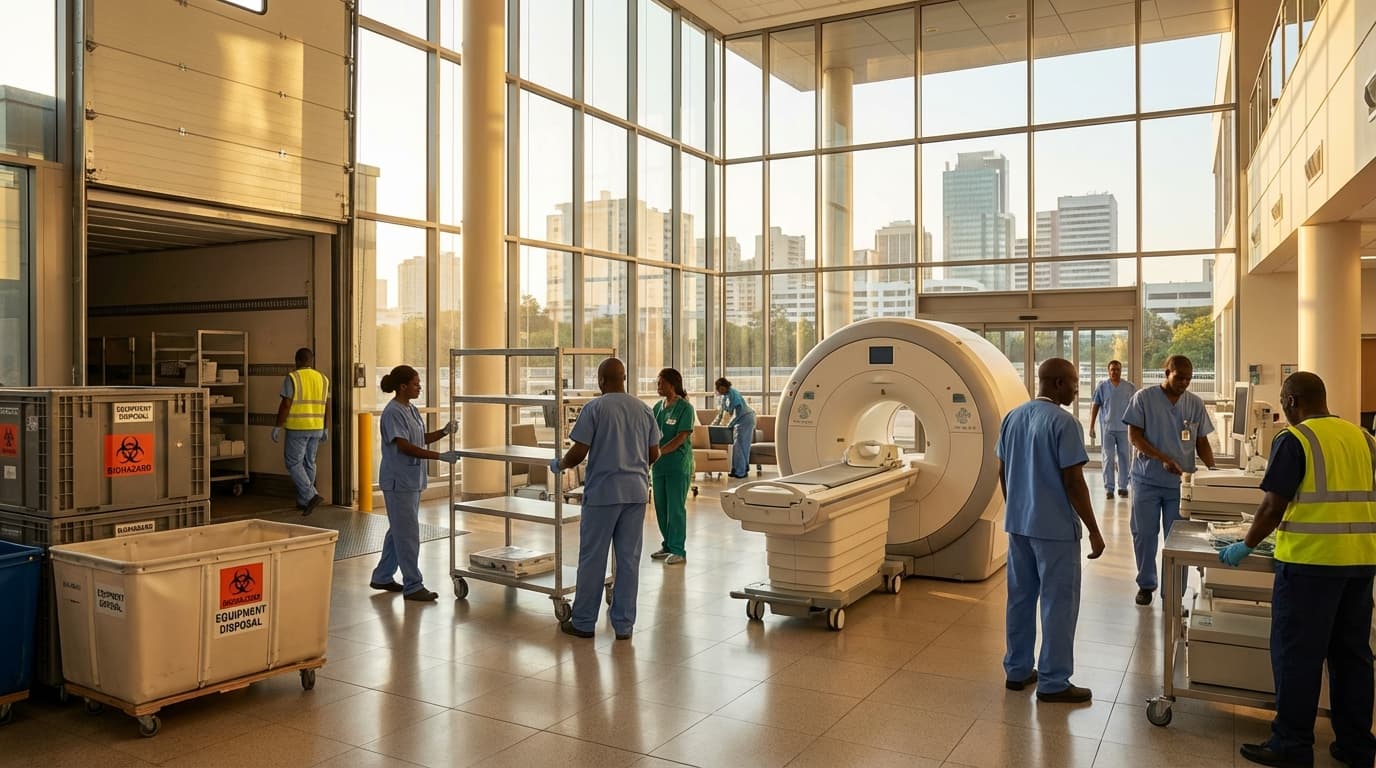
Medical E-Waste Handling & Recycling Coordination Service in Rwanda
Engineering Excellence & Technical Support
Medical E-Waste Handling & Recycling Coordination Service High-standard technical execution following OEM protocols and local regulatory frameworks.
Secure Collection & Chain of Custody
Leveraging a digitally managed fleet and GPS tracking for secure, compliant collection of medical e-waste from healthcare facilities across Rwanda, ensuring an unbroken chain of custody and preventing diversion.
Certified Data Destruction & Material Segregation
Implementing certified, multi-level data destruction protocols for sensitive medical devices and employing advanced sorting technologies to segregate hazardous materials for safe and responsible processing.
Resource Recovery & Environmental Compliance
Partnering with certified recycling facilities to maximize the recovery of valuable materials and ensure the environmentally sound disposal of non-recoverable waste, adhering to stringent Rwandan regulations and international best practices.
What Is Medical E-waste Handling & Recycling Coordination Service In Rwanda?
Medical e-waste handling and recycling coordination service in Rwanda refers to a specialized set of operations and management protocols designed to ensure the safe, compliant, and environmentally responsible collection, transportation, treatment, and disposal or recycling of electronic and electrical equipment (EEE) that has been utilized within the healthcare sector. This service addresses the unique challenges posed by medical e-waste, which often contains hazardous materials (e.g., heavy metals, flame retardants) and may also contain sensitive or data-bearing components. The service acts as a central point of contact and management for various stakeholders involved in the e-waste lifecycle within Rwandan healthcare facilities.
| Who Needs This Service? | Typical Use Cases | |||||
|---|---|---|---|---|---|---|
| Healthcare Facilities (Hospitals, Clinics, Diagnostic Centers): All healthcare providers generating e-waste from medical equipment. | Disposal of end-of-life medical imaging equipment (X-ray machines, CT scanners, MRI machines). | Handling of obsolete laboratory equipment (analyzers, centrifuges). | Management of discarded patient monitoring systems and diagnostic devices. | Recycling of medical IT equipment (servers, workstations, networking devices) used in healthcare administration and diagnostics. | Safe decommissioning and disposal of specialized surgical and therapeutic devices. | Treatment of e-waste containing cathode ray tubes (CRTs) from older medical equipment. |
| Medical Equipment Manufacturers and Distributors: Companies responsible for the lifecycle management of their products. | Extended Producer Responsibility (EPR) program implementation and compliance. | Establishing take-back programs for their used medical devices. | Ensuring the responsible disposal of returned or damaged equipment. | |||
| Government Agencies and Regulatory Bodies: Ministries of Health, Environment, and other oversight organizations. | Developing and enforcing e-waste management policies and regulations within the healthcare sector. | Monitoring the environmental impact of medical e-waste. | Ensuring public health and safety through proper waste management. | |||
| Waste Management and Recycling Companies: Specialized entities involved in e-waste processing. | Developing specialized capabilities for handling hazardous medical e-waste. | Seeking partnerships for secure collection and processing of medical e-waste streams. | Obtaining certifications for medical e-waste handling. |
Key Components of Medical E-Waste Handling & Recycling Coordination Service in Rwanda:
- Regulatory Compliance and Permitting: Ensuring adherence to national and international regulations governing hazardous waste management and e-waste recycling, including obtaining necessary permits for collection, transport, and processing.
- Inventory Management and Auditing: Establishing systems for tracking medical e-waste generation, types, quantities, and locations within healthcare facilities.
- Collection and Segregation Protocols: Developing and implementing standardized procedures for the safe collection and segregation of medical e-waste from general waste streams and other e-waste categories, often involving specialized containers and handling techniques.
- Logistics and Transportation Management: Coordinating the safe and secure transportation of medical e-waste from healthcare facilities to authorized treatment and recycling centers, adhering to strict chain-of-custody protocols.
- Treatment and Disposal Options: Identifying and managing the appropriate treatment and disposal methods for different types of medical e-waste, prioritizing environmentally sound practices such as material recovery, component refurbishment, and secure destruction of hazardous elements.
- Recycling Partner Vetting and Management: Selecting and managing partnerships with certified and reputable e-waste recycling facilities that possess the technical capabilities to process medical e-waste safely and effectively.
- Data Security and Destruction: Implementing secure protocols for the sanitization or physical destruction of any data-bearing components within medical e-waste, such as imaging devices or patient monitoring equipment.
- Stakeholder Training and Awareness: Providing education and training to healthcare personnel on proper e-waste handling, segregation, and reporting procedures.
- Reporting and Documentation: Maintaining comprehensive records of all e-waste management activities, including collection manifests, treatment certificates, and recycling reports, for regulatory and internal accountability.
- Environmental Impact Assessment and Monitoring: Evaluating and monitoring the environmental impact of e-waste management processes to ensure minimal harm and continuous improvement.
Who Needs Medical E-waste Handling & Recycling Coordination Service In Rwanda?
Medical e-waste handling and recycling coordination services are crucial for ensuring the safe, compliant, and environmentally responsible disposal of electronic and electrical equipment generated by the healthcare sector in Rwanda. This specialized service addresses the unique challenges associated with medical e-waste, which can include hazardous materials, sensitive data, and specific disposal regulations. Effective coordination is vital for minimizing environmental contamination, protecting public health, and adhering to national and international waste management standards. The service aims to bridge the gap between healthcare facilities generating this waste and authorized recycling and disposal facilities, streamlining the entire process.
| Healthcare Sector Type | Key Devices Generating E-Waste | Primary Responsible Departments |
|---|---|---|
| Public & Private Hospitals | Imaging equipment (X-ray, CT scanners, MRI), patient monitors, ventilators, lab analyzers, IT servers, computers, printers, phones. | Biomedical Engineering, IT, Administration, Procurement. |
| Diagnostic Laboratories | Automated analyzers, microscopes with electronic components, centrifuges, IT equipment, printers. | Laboratory Management, IT, Technical Support. |
| Research Institutions & Universities | Specialized scientific equipment with electronic controls, high-performance computing, lab instruments, administrative IT. | Research Support, Facilities Management, IT, Environmental Management. |
| Government Health Agencies | Office IT equipment, servers, specialized medical devices used in central facilities. | Ministry of Health departments, RBC, Waste Management Units. |
Target Customers and Departments for Medical E-Waste Handling & Recycling Coordination Service in Rwanda
- {"customer":"Public Hospitals","departments":["IT Department (for end-of-life IT equipment, imaging devices)","Biomedical Engineering Department (for medical devices, diagnostic equipment)","Administration/Procurement (for overall waste management contracts and budgeting)","Clinical Departments (for specialized medical equipment)"]}
- {"customer":"Private Hospitals and Clinics","departments":["IT Department","Biomedical Engineering Department","Administration/Management","Procurement"]}
- {"customer":"Diagnostic Laboratories","departments":["Laboratory Management","IT Department (for lab equipment with electronic components)","Maintenance/Technical Support"]}
- {"customer":"Pharmaceutical Companies (with R&D facilities or administrative offices)","departments":["Environmental Health & Safety (EHS)","Facilities Management","IT Department"]}
- {"customer":"Medical Research Institutions and Universities","departments":["Research Support Services","Facilities Management","IT Department","Environmental Management Unit"]}
- {"customer":"Government Health Agencies","departments":["Ministry of Health (various departments responsible for health infrastructure and public health)","Rwanda Biomedical Centre (RBC)","Environmental Protection Agencies (involved in waste management policy and enforcement)"]}
- {"customer":"Non-Governmental Organizations (NGOs) involved in healthcare","departments":["Operations/Logistics","Program Management","Finance/Administration"]}
- {"customer":"Medical Equipment Suppliers and Installers","departments":["Service & Maintenance Departments","Sales & Logistics (often involved in take-back programs or advising clients on disposal)"]}
Medical E-waste Handling & Recycling Coordination Service Process In Rwanda
This document outlines the Medical E-Waste Handling & Recycling Coordination Service Process in Rwanda, detailing the workflow from an initial inquiry to the final execution of the service. This service aims to ensure the safe, compliant, and environmentally sound management of medical electronic waste within the country.
| Stage | Description | Key Activities | Responsible Parties | Deliverables/Outcomes |
|---|---|---|---|---|
| Inquiry & Initial Consultation | The process begins when a healthcare facility or institution expresses interest in the medical e-waste handling and recycling services. | Receive and acknowledge inquiry, schedule initial meeting, understand client's general needs, explain service scope and benefits. | Client (Healthcare Facility/Institution), Service Provider | Understanding of client needs, preliminary service overview, scheduled next steps. |
| Site Assessment & Waste Profiling | A thorough assessment of the client's premises to understand the types, quantities, and locations of medical e-waste generated. | Conduct on-site visit, identify types of medical e-waste (e.g., old imaging equipment, laboratory devices, IT equipment from medical settings), estimate quantities, identify storage conditions, assess potential hazards. | Service Provider, Client Representative | Detailed waste inventory, identification of specific handling requirements, preliminary risk assessment. |
| Service Agreement & Quotation | Formalization of the service arrangement based on the assessment findings. | Develop a tailored quotation outlining services, pricing, timelines, and terms. Present quotation to client. Negotiate and finalize contract/service agreement. Obtain client signature. | Service Provider, Client | Signed Service Agreement, Approved Quotation. |
| Collection & Transportation | The safe and compliant removal of medical e-waste from the client's location. | Develop a collection schedule. Utilize trained personnel and appropriate vehicles for secure transport. Ensure compliance with all relevant transportation regulations (e.g., hazardous materials if applicable). | Service Provider (Logistics Team) | Collected medical e-waste, Transportation manifest, Chain of custody documentation. |
| Sorting & Segregation | Categorizing collected waste to ensure proper handling and recycling pathways. | Receive waste at a designated facility. Sort e-waste based on material type (e.g., plastics, metals, circuit boards) and potential for hazardous components. Segregate for different recycling or disposal methods. | Service Provider (Operations Team) | Segregated waste streams, Initial inventory of sorted materials. |
| Secure Storage | Temporary and safe holding of segregated waste before it is sent for recycling or disposal. | Store sorted waste in designated secure areas. Maintain appropriate environmental conditions to prevent degradation or leakage. Implement inventory management. | Service Provider (Storage Facility) | Safely stored and inventoried medical e-waste. |
| Recycling & Disposal Partner Engagement | Liaising with certified and reputable recycling and disposal facilities. | Identify and vet certified recycling partners capable of handling specific types of medical e-waste. Coordinate the transfer of waste to these partners according to established agreements. Ensure partners adhere to environmental and safety standards. | Service Provider (Partnership Management) | Waste transferred to approved recycling/disposal facilities, Confirmation of receipt by partner. |
| Documentation & Reporting | Maintaining comprehensive records throughout the entire process. | Generate reports detailing waste volumes, types, collection dates, transportation routes, and final disposition. Provide certificates of recycling/disposal. Maintain audit trails. | Service Provider (Administration & Compliance Team) | Comprehensive service reports, Certificates of destruction/recycling, Audit-ready documentation. |
| Confirmation of Service Completion | Finalizing the service and ensuring client satisfaction. | Submit final reports and documentation to the client. Obtain client confirmation of service completion and satisfaction. Address any outstanding queries or feedback. | Service Provider, Client | Client acceptance of service completion, Finalized records. |
Workflow Stages:
- Inquiry & Initial Consultation
- Site Assessment & Waste Profiling
- Service Agreement & Quotation
- Collection & Transportation
- Sorting & Segregation
- Secure Storage
- Recycling & Disposal Partner Engagement
- Documentation & Reporting
- Confirmation of Service Completion
Medical E-waste Handling & Recycling Coordination Service Cost In Rwanda
The cost of medical e-waste handling and recycling coordination services in Rwanda is influenced by several key factors. These include the volume and type of medical e-waste generated, the specific handling and disposal protocols required (e.g., segregation, sterilization, dismantling), the chosen recycling facilities and their capabilities, transportation logistics within Rwanda, and the prevailing market rates for recycled materials. Government regulations and compliance requirements also play a significant role in shaping pricing. For instance, adherence to stricter environmental and health standards may necessitate more specialized handling, increasing costs. The geographic location of waste generation and the proximity to authorized treatment, storage, and disposal facilities (TSDFs) will impact transportation expenses. Furthermore, the complexity of the electronic components within the medical devices (e.g., presence of hazardous materials like mercury or lead) will influence the cost of safe dismantling and processing.
| Service Component | Typical Cost Range (RWF - Rwandan Francs) | Notes |
|---|---|---|
| Waste Collection & Transportation (per kg/batch) | 500 - 2,000 | Varies based on distance, volume, and type of vehicle required. May include specialized handling for hazardous waste. |
| Segregation & Initial Sorting (per kg) | 100 - 500 | Cost depends on the complexity of sorting and the need for specialized trained personnel. |
| Dismantling & Hazardous Material Removal (per kg) | 500 - 3,000+ | Highly dependent on the type of medical device and the presence of hazardous components. Can be significantly higher for complex equipment. |
| Recycling Coordination & Documentation (per service agreement) | 50,000 - 500,000+ | This is a fixed or project-based fee covering coordination, compliance tracking, reporting, and liaison with authorities and recyclers. |
| Sterilization/Decontamination (if applicable, per kg/unit) | 200 - 1,000 | Required for certain types of infectious medical e-waste before further processing or disposal. |
| Landfill/Incineration Fees (for non-recyclable components, per kg) | 300 - 1,500 | Charges levied by authorized disposal facilities for residual waste. |
| Consultancy & Compliance Advisory (per hour/project) | 20,000 - 100,000+ | For expert advice on regulatory compliance, waste management strategies, and vendor selection. |
Key Pricing Factors for Medical E-Waste Handling & Recycling Coordination Services in Rwanda
- Volume and type of medical e-waste
- Handling and disposal protocols (segregation, sterilization, dismantling)
- Choice of recycling facilities and their technical capabilities
- Transportation logistics and distances within Rwanda
- Prevailing market rates for recycled materials
- Government regulations and compliance requirements
- Complexity of electronic components and presence of hazardous materials
Affordable Medical E-waste Handling & Recycling Coordination Service Options
Navigating the complex world of medical e-waste handling and recycling can be a significant challenge for healthcare organizations. This service aims to provide an affordable and streamlined solution by coordinating specialized providers and offering value-driven bundles and cost-saving strategies. Our service acts as a central point of contact, simplifying the process of compliant and environmentally responsible disposal of medical electronics, from old imaging equipment to expired diagnostic devices.
| Cost-Saving Strategy | Description | Impact on Affordability |
|---|---|---|
| Consolidated Scheduling & Route Optimization | By coordinating multiple pickups from various departments or facilities within a region, we can optimize collection routes, reducing transportation costs and emissions. | Lower transportation fees per item, less frequent logistical overhead. |
| Negotiated Bulk Pricing with Certified Recyclers | Leveraging aggregated volume from multiple clients allows us to negotiate more favorable rates with our network of certified e-waste recyclers. | Reduced processing fees due to economies of scale. |
| Refurbishment & Resale Program Integration | We identify and facilitate the refurbishment and resale of viable medical equipment, generating potential revenue that offsets disposal costs. | Potential revenue generation, significantly reducing net disposal expenses. |
| Waste Stream Analysis & Reduction Consulting | Our service includes an initial assessment to identify opportunities for reducing e-waste generation at the source, such as extending equipment lifespan or implementing better inventory management. | Proactive reduction in the volume of waste needing disposal, leading to long-term savings. |
| Compliance Auditing & Risk Mitigation | Ensuring full compliance with all regulations prevents costly fines and legal repercussions associated with improper medical e-waste disposal. | Avoidance of significant fines and legal fees. |
| Predictable Service Level Agreements (SLAs) | Clear SLAs provide predictable costs for services, allowing for better budgeting and financial planning. | Eliminates unexpected charges, enabling precise cost forecasting. |
Value Bundles for Medical E-Waste Handling & Recycling Coordination
- {"title":"Basic Compliance Bundle","description":"Essential services for routine disposal needs. Includes coordination for collection, secure transportation, and certified data destruction for standard medical electronics. Focuses on meeting regulatory requirements with minimal hassle."}
- {"title":"Standard Sustainability Bundle","description":"Combines compliance with a stronger emphasis on recycling. Includes all Basic Compliance Bundle features plus prioritization of facilities with high material recovery rates and transparent reporting on recycled content. Ideal for organizations aiming for enhanced environmental responsibility."}
- {"title":"Comprehensive Asset Management Bundle","description":"A full-service solution for managing the entire lifecycle of medical e-waste. Includes the Standard Sustainability Bundle, plus inventory management, refurbishment assessment for reusable equipment, and detailed end-of-life reporting with asset depreciation tracking. Best for organizations seeking to maximize value and minimize waste."}
- {"title":"Specialized Equipment Bundle","description":"Tailored for unique or high-value medical equipment requiring specialized handling. This bundle coordinates expert disassembly, hazardous material management, and secure disposal/recycling for items like MRI machines, CT scanners, or laboratory analytical instruments."}
Verified Providers In Rwanda
In Rwanda's burgeoning healthcare landscape, identifying truly verified and reliable healthcare providers is paramount. Franance Health stands out as a leading example, distinguished by its rigorous credentialing process and unwavering commitment to quality care. This document outlines what "verified provider" means in the Rwandan context and why Franance Health's approach makes them the premier choice for individuals and families seeking exceptional healthcare services.
| Criterion | Franance Health's Verification | Why it Matters for Patients |
|---|---|---|
| Regulatory Compliance | Franance Health proactively ensures all its facilities and services are fully aligned with and often exceed current Rwandan Ministry of Health regulations. | Guarantees that you are receiving care within a legally recognized and safe environment, protecting your rights as a patient. |
| Professional Licensing & Expertise | All medical practitioners and staff at Franance Health undergo stringent checks to confirm their licenses, certifications, and specialized training are up-to-date and legitimate. | Ensures you are treated by qualified professionals with proven expertise, minimizing the risk of medical errors and ensuring effective treatment. |
| Facility Standards & Equipment | Franance Health invests in modern, well-maintained facilities and state-of-the-art medical equipment that meets international and national safety and efficacy standards. | Provides access to advanced diagnostic and treatment capabilities, leading to more accurate diagnoses and better health outcomes. |
| Patient-Centric Care & Ethics | The credentialing process includes assessing a provider's commitment to ethical practices, patient rights, and a compassionate approach to care. | Fosters a trusting relationship where your well-being, privacy, and dignity are prioritized, leading to a more positive and effective healthcare experience. |
| Continuous Improvement | Franance Health has robust systems for ongoing staff training, performance reviews, and incorporating patient feedback to consistently elevate the quality of care. | Means you benefit from the latest medical knowledge and practices, as well as a healthcare service that is constantly striving to improve and meet your evolving needs. |
What Makes a Provider "Verified" in Rwanda?
- Regulatory Compliance: Adherence to all national health regulations and standards set by the Ministry of Health (MoH).
- Professional Licensing: Ensuring all healthcare professionals hold current and valid licenses from their respective governing bodies (e.g., Rwanda Medical Council, Rwanda Nurses and Midwives Council).
- Educational and Experiential Qualifications: Verification of academic degrees, specialized training, and relevant professional experience for all clinical staff.
- Facility Standards: Compliance with MoH guidelines for infrastructure, equipment, hygiene, and safety protocols.
- Ethical Practice: Commitment to upholding the highest ethical standards in patient care, confidentiality, and professional conduct.
- Quality Assurance Mechanisms: Implementation of internal quality control processes, patient feedback systems, and continuous professional development for staff.
Scope Of Work For Medical E-waste Handling & Recycling Coordination Service
This Scope of Work (SOW) outlines the requirements for a Medical E-Waste Handling & Recycling Coordination Service. The objective is to ensure the safe, compliant, and environmentally responsible collection, transportation, and recycling of medical electronic waste (e-waste) generated by healthcare facilities. The service will include coordination with certified recycling partners, adherence to all relevant regulations (e.g., EPA, HIPAA, state-specific environmental and medical waste laws), and comprehensive reporting to the client.
| Technical Deliverable | Standard Specification / Description | Frequency / Timing | Responsible Party |
|---|---|---|---|
| Medical E-Waste Management Plan | Detailed plan including waste identification, segregation, storage, transportation, recycling, and disposal procedures. Must comply with all applicable local, state, and federal regulations (e.g., RCRA, HIPAA for data security). Includes emergency procedures and contingency plans. | Initial development within 30 days of contract commencement; annual review and update thereafter. | Service Provider |
| Certified Recycler & Transporter Vetting Report | Documentation verifying the certifications (e.g., R2, e-Stewards), licenses, insurance, and compliance history of all engaged recyclers and transporters. Must include data destruction verification processes where applicable. | Prior to engagement of any new recycler/transporter; annually for existing partners. | Service Provider |
| Chain of Custody Records | Detailed manifests and tracking documents for each waste pick-up, from point of generation to final recycling or disposal. Records must include waste type, quantity, origin, destination, transporter information, and signatures. Must ensure data sanitization verification for devices containing Protected Health Information (PHI). | For each pick-up/shipment. | Transporter & Service Provider |
| Monthly Service Report | Summary of all e-waste collected, transported, and recycled during the month. Includes waste categories, weights, recycler locations, certificates of destruction/recycling, and any compliance issues encountered. Data must be presented in an easily understandable format. | Monthly. | Service Provider |
| Annual Performance & Compliance Report | Comprehensive report summarizing the year's e-waste management activities, including total volumes recycled, environmental impact metrics (e.g., CO2 emissions avoided), compliance audit findings (if any), and recommendations for continuous improvement. Must include data on successful data destruction for applicable devices. | Annually. | Service Provider |
| Waste Stream Audit Report | Analysis of the client's medical e-waste generation, identifying opportunities for waste reduction, improved segregation, and cost savings. May include on-site inspections. | Quarterly or as requested by client. | Service Provider |
| Data Destruction Verification Certificate | Confirmation that all electronic devices containing PHI or sensitive data have undergone approved data sanitization or destruction methods, in compliance with HIPAA and other relevant privacy regulations. | For all applicable devices collected. | Recycler & Service Provider |
| Regulatory Compliance Checklist/Audit | Internal or external audit report confirming adherence to all relevant environmental and data privacy regulations pertaining to medical e-waste. Includes recommendations for corrective actions. | Annually or bi-annually. | Service Provider (or third-party auditor) |
Key Service Components
- Waste stream assessment and profiling
- Development of collection and segregation protocols
- Coordination of pick-up schedules with certified transporters
- Verification of transporter and recycler certifications and licenses
- Oversight of secure chain of custody documentation
- Management of all regulatory compliance requirements
- Tracking and reporting of waste volumes and recycling metrics
- Client training and awareness programs on medical e-waste management
- Disaster recovery and emergency response planning for waste incidents
Service Level Agreement For Medical E-waste Handling & Recycling Coordination Service
This Service Level Agreement (SLA) outlines the performance standards and guarantees for the Medical E-Waste Handling & Recycling Coordination Service. It defines the expected response times for critical incidents and the guaranteed uptime for the coordination platform and associated communication channels.
| Metric | Severity Level | Response Time Target | Uptime Guarantee (Monthly) |
|---|---|---|---|
| Platform Availability | Critical | N/A (Focus on immediate communication) | 99.9% |
| Platform Availability | High | N/A (Focus on immediate communication) | 99.7% |
| Platform Availability | Medium | N/A (Focus on immediate communication) | 99.5% |
| Platform Availability | Low | N/A (Focus on immediate communication) | 99.0% |
| Communication Channels (Phone, Email, Portal) | Critical Incident Reported | 15 Minutes | N/A |
| Communication Channels (Phone, Email, Portal) | General Inquiry | 2 Business Hours | N/A |
Key Service Metrics
- Response Times: Defined as the time taken from the moment a critical incident is reported by the Client to the Service Provider until the Service Provider initiates investigation and acknowledges the incident.
- Uptime Guarantee: The percentage of time the core coordination platform and communication channels are available and operational, excluding scheduled maintenance.
- Critical Incident: An event that significantly impacts the Client's ability to manage or track medical e-waste disposal, leading to potential regulatory non-compliance or environmental hazards.
Frequently Asked Questions

Ready when you are
Let's scope your Medical E-Waste Handling & Recycling Coordination Service in Rwanda project in Rwanda.

Scaling healthcare logistics and technical systems across the entire continent.