
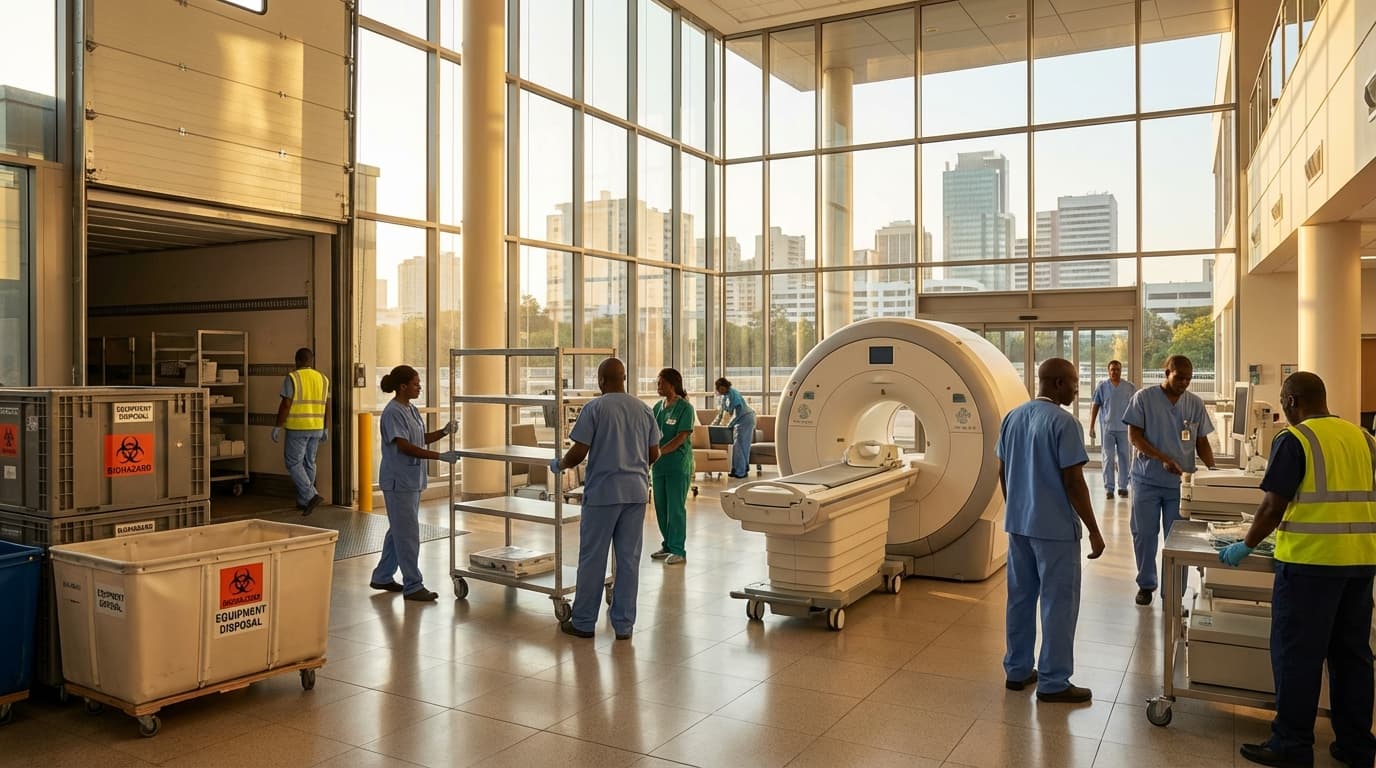
Heavy Medical Equipment De-Installation Service (MRI/CT/Cath Lab) in Rwanda
Engineering Excellence & Technical Support
Heavy Medical Equipment De-Installation Service (MRI/CT/Cath Lab) High-standard technical execution following OEM protocols and local regulatory frameworks.
Specialized De-Installation for Advanced Imaging Modalities
Our certified technicians possess deep expertise in the meticulous de-installation of high-value, sensitive medical imaging equipment such as MRI, CT scanners, and Cath Labs. We adhere to strict manufacturer guidelines and international safety protocols, ensuring the integrity and preservation of complex components for relocation or disposal, minimizing risk of damage and ensuring compliance.
End-to-End Logistics and Site Preparation in Rwanda
We offer comprehensive, end-to-end de-installation services, including detailed site assessment, structural reinforcement planning, coordinated heavy lifting, and secure transportation logistics throughout Rwanda. Our team expertly navigates local infrastructure challenges to ensure a seamless and efficient removal process, from initial disconnection to final transport from the facility.
Regulatory Compliance and Certified Decommissioning
Our service prioritizes full adherence to all Rwandan health and safety regulations, as well as international standards for medical equipment decommissioning. We provide detailed documentation, certification of de-installation, and waste management plans, ensuring your facility meets all legal and environmental requirements during the removal of MRI, CT, and Cath Lab systems.
What Is Heavy Medical Equipment De-installation Service (Mri/ct/cath Lab) In Rwanda?
Heavy Medical Equipment De-Installation Service (MRI/CT/Cath Lab) in Rwanda refers to the specialized process of safely and systematically dismantling large, complex, and often high-value medical imaging and diagnostic apparatus, such as Magnetic Resonance Imaging (MRI) scanners, Computed Tomography (CT) scanners, and Cardiac Catheterization (Cath Lab) systems, within healthcare facilities in Rwanda. This service is critical for enabling equipment relocation, disposal, upgrades, or site decommissioning. It requires a highly skilled technical team with expertise in handling sensitive electronics, heavy components, and specialized infrastructure (e.g., cryogen handling for MRI, radiation shielding for CT and Cath Labs). The process adheres to stringent safety protocols, regulatory compliance, and manufacturer-specific guidelines to prevent damage to the equipment and surrounding infrastructure, and to ensure personnel safety. The de-installation concludes with meticulous documentation and packaging for transit or storage.
| Who Needs This Service | Typical Use Cases | |||||
|---|---|---|---|---|---|---|
| Hospitals and Clinics (Public and Private) | Equipment Relocation (within or between facilities) | Equipment Upgrades (replacing older models with newer technology) | Facility Renovations or Construction | Equipment Disposal or End-of-Life Management | Decommissioning of Imaging Suites or Departments | Consolidation of Healthcare Services |
| Medical Equipment Manufacturers and Vendors | Third-Party Service Providers and Maintainers | Asset Management Companies | Government Health Ministries and Agencies |
Key Aspects of Heavy Medical Equipment De-Installation
- Assessment and Planning: Site survey, inventory, development of de-installation strategy, risk assessment.
- Disconnection and Isolation: Safe disconnection of power, cooling, data, and ancillary systems.
- Component Dismantling: Systematic disassembly of major components (e.g., magnet, gantry, detectors, control consoles).
- Cryogen Management (MRI): Safe venting or recovery of liquid helium and nitrogen.
- Shielding Removal (CT/Cath Lab): Removal of lead shielding and other radiation protection measures.
- Infrastructure Decommissioning: Disconnection from specialized plumbing, HVAC, and electrical circuits.
- Packaging and Securing: Protective wrapping, crating, and securing of all dismantled components for transport.
- Documentation: Detailed recording of the de-installation process, component inventory, and condition assessment.
- Waste Management: Proper disposal of hazardous materials and decommissioning of associated infrastructure.
- Logistics Coordination: Planning for transportation and site clearance.
Who Needs Heavy Medical Equipment De-installation Service (Mri/ct/cath Lab) In Rwanda?
For facilities in Rwanda requiring the specialized de-installation of complex medical imaging and interventional equipment like MRI, CT scanners, and Cath Labs, a dedicated service is essential. These procedures demand a high level of technical expertise, specialized tools, and adherence to strict safety protocols to ensure the equipment is safely and efficiently dismantled for relocation, decommissioning, or sale. This service is crucial for healthcare providers, imaging centers, and hospitals undertaking significant upgrades, expansions, or asset management initiatives.
| Target Customer/Department | Specific Needs Addressed | Example Scenario |
|---|---|---|
| Hospitals (Public & Private) | Decommissioning of outdated MRI/CT/Cath Lab units for replacement with newer technology. Safe removal of equipment during facility upgrades or hospital mergers. Preparation for sale or donation of functional but unneeded equipment. | A Kigali-based hospital decides to upgrade its 10-year-old CT scanner to a more advanced, faster model. The de-installation service is required to carefully remove the old scanner without damaging the surrounding infrastructure or the equipment itself. |
| Radiology & Imaging Centers | Efficient removal of MRI or CT scanners to make space for new installations. Safe disconnection and dismantling of Cath Lab equipment for relocation to a new wing or a different facility. Minimizing downtime for existing operations. | An independent imaging center in Huye is expanding its services and needs to replace its MRI machine. The de-installation service ensures the old MRI is removed swiftly, allowing for the installation of the new one with minimal disruption to patient appointments. |
| Medical Equipment Suppliers & Resellers | Acquiring used MRI, CT, or Cath Lab systems for refurbishment and resale. Ensuring equipment is professionally dismantled and packed for safe transport to their repair or storage facilities. Verifying proper disconnection and documentation. | A company specializing in refurbished medical equipment purchases a functional Cath Lab system from a Rwandan hospital. They contract a de-installation service to meticulously dismantle, label, and prepare the system for international shipping. |
| Government Health Agencies & Ministries | Managing the disposal or redistribution of medical equipment from public health facilities. Ensuring compliance with environmental and safety regulations during de-installation. Facilitating the transfer of functional equipment to underserved areas. | The Ministry of Health in Rwanda plans to equip newly built rural health centers. They identify several older but still operational CT scanners from larger urban hospitals that need to be de-installed and prepared for relocation. |
| Research Institutions & Universities | Dismantling specialized imaging equipment for research project conclusion, equipment upgrades, or relocation of research facilities. Ensuring delicate scientific instruments are handled with extreme care. | A university's medical research department is concluding a project that utilized a specific MRI scanner. The de-installation service is needed to safely remove the MRI for storage or to make way for new research equipment. |
Who Needs Heavy Medical Equipment De-Installation Service (MRI/CT/Cath Lab) in Rwanda?
- Hospitals undergoing renovation or relocation.
- Imaging centers upgrading their technology to newer models.
- Healthcare facilities decommissioning old equipment.
- Medical equipment dealers and resellers acquiring used systems.
- Research institutions transitioning their imaging capabilities.
- Government health initiatives involving equipment modernization or redistribution.
- Private clinics expanding or consolidating services.
Heavy Medical Equipment De-installation Service (Mri/ct/cath Lab) Process In Rwanda
This document outlines the comprehensive workflow for heavy medical equipment de-installation services (MRI, CT, Cath Lab) in Rwanda, from initial inquiry to final execution. The process emphasizes safety, regulatory compliance, and efficient project management to ensure a seamless transition for healthcare facilities.
| Stage | Description | Key Activities | Responsible Party | Duration (Estimated) | |
|---|---|---|---|---|---|
| The client contacts the service provider with a request for de-installation services. This stage involves understanding the client's needs and the specific equipment involved. | Initial contact, understanding equipment type and location, preliminary scope discussion. | Client, Service Provider Sales/Consultation Team | 1-3 business days | |
| A thorough evaluation of the installation site is conducted to identify any challenges, safety considerations, and necessary logistical arrangements. | On-site visit, detailed equipment inspection, power/cooling/space assessment, access route evaluation, safety hazard identification, development of a preliminary de-installation plan. | Service Provider Project Manager, Technical Team, Client Facilities Manager | 3-7 business days | |
| Based on the site assessment, a detailed proposal outlining the scope of work, timelines, costs, and terms is presented to the client. Upon agreement, a formal contract is executed. | Proposal generation, cost estimation, risk assessment, contract drafting, negotiation, contract signing. | Service Provider Sales/Project Management Team, Client Procurement/Legal Team | 5-10 business days | |
| All necessary permits, approvals, and logistical arrangements are finalized before the actual de-installation begins. | Obtaining necessary permits from relevant Rwandan authorities (e.g., Ministry of Health), securing transport vehicles, coordinating with building management, scheduling downtime with the client, ordering specialized tools/equipment, confirming safety protocols. | Service Provider Project Manager, Logistics Team, Client IT/Facilities Manager | 7-14 business days | |
| This is the core execution phase where the medical equipment is safely dismantled and disconnected by trained technicians. | Shutdown and lockout/tagout procedures, disconnection of power, water, and data cables, specialized disassembly of imaging components (e.g., MRI magnet, CT gantry), careful removal of sensitive parts, packaging of components. | Service Provider Technical De-Installation Team (Certified Technicians) | Varies based on equipment complexity (e.g., 2-5 days for MRI/CT, 1-3 days for Cath Lab) | Note: Safety is paramount. All procedures adhere to manufacturer guidelines and Rwandan safety regulations. |
| The de-installed equipment is safely packaged, loaded, and transported to its designated new location or storage facility. | Secure packaging of all components, loading onto specialized transport vehicles (e.g., with hydraulic lifts), transportation to the new site or storage, insurance for transit. | Service Provider Logistics Team, Transportation Partners | 1-5 business days (depending on distance and destination) | |
| This stage includes any agreed-upon follow-up actions after the equipment has been removed from the site. | Site clean-up, removal of any residual debris, final site inspection, provision of de-installation reports, handover of documentation. | Service Provider Project Manager, Site Crew | 1-2 business days | |
| The project is formally concluded, and final documentation and payments are processed. | Final project review, client sign-off, invoicing, payment processing, collection of client feedback. | Service Provider Project Manager, Finance Department, Client | 3-5 business days |
Key Stages of the De-Installation Process
- Inquiry and Initial Consultation
- Site Assessment and Planning
- Proposal and Contract Negotiation
- Pre-De-Installation Preparations
- Equipment Disassembly and De-Installation
- Logistics and Transportation
- Post-De-Installation Services
- Project Closure
Heavy Medical Equipment De-installation Service (Mri/ct/cath Lab) Cost In Rwanda
De-installing heavy medical equipment like MRI, CT scanners, and Cath Labs in Rwanda is a specialized service requiring expert technicians, logistical planning, and adherence to strict safety protocols. The cost for such services is influenced by several key factors, leading to a range of pricing in Rwandan Francs (RWF). This process involves careful dismantling, packaging, and preparation for transport of highly sensitive and valuable machinery. It is crucial to engage qualified professionals to ensure the integrity of the equipment and prevent damage during the de-installation process.
| Equipment Type | Estimated De-installation Cost Range (RWF) |
|---|---|
| MRI Scanner (e.g., 1.5T, 3T) | 8,000,000 - 25,000,000+ |
| CT Scanner (e.g., multi-slice) | 5,000,000 - 15,000,000+ |
| Cath Lab (including imaging systems) | 10,000,000 - 30,000,000+ |
| Other Heavy Medical Equipment (e.g., Linear Accelerators, PET Scanners - highly specialized) | 15,000,000 - 50,000,000+ |
Key Pricing Factors for Heavy Medical Equipment De-Installation in Rwanda
- Equipment Type and Complexity: Different machines have varying levels of complexity in their construction and the number of components requiring disassembly. MRI machines, for example, are typically more complex than CT scanners.
- Size and Weight of Equipment: Larger and heavier equipment necessitates more specialized lifting gear, more personnel, and a longer de-installation time, all contributing to higher costs.
- Accessibility and Site Conditions: The ease with which the equipment can be accessed within the medical facility and the general site conditions (e.g., narrow corridors, multi-story buildings, limited workspace) significantly impact labor and equipment requirements.
- Dismantling Scope: The extent to which the equipment needs to be disassembled. Full de-installation to transportable modules is more intensive than partial disassembly.
- Specialized Tools and Equipment: The requirement for specific de-installation tools, lifting equipment (cranes, hoists), and transport vehicles will affect the overall cost.
- Personnel Expertise and Number of Technicians: The de-installation requires highly skilled and experienced technicians who understand the intricacies of the specific medical equipment. The number of technicians needed will depend on the complexity and size of the job.
- Time and Urgency: If the de-installation needs to be completed on an expedited timeline, it may incur additional charges due to overtime or specialized scheduling.
- Logistics and Transportation Planning: While de-installation is the focus, the service provider often includes planning for safe removal from the site and preparation for onward transportation, which can influence pricing.
- Manufacturer or Third-Party Service: Whether the de-installation is performed by the original equipment manufacturer (OEM) or an independent specialized service provider can impact costs. OEMs may have higher rates.
- Location within Rwanda: While the core services are similar, minor variations in logistical costs might exist depending on the specific city or region within Rwanda where the de-installation is to take place.
Affordable Heavy Medical Equipment De-installation Service (Mri/ct/cath Lab) Options
Moving or de-installing large medical equipment like MRI, CT scanners, and Cath Labs is a complex and costly undertaking. Our service specializes in providing affordable solutions by offering flexible de-installation options and implementing strategic cost-saving measures. We understand the importance of minimizing downtime and budget adherence. This guide outlines our value bundles and cost-saving strategies to help you make an informed decision.
| Cost-Saving Strategy | Description | Benefit |
|---|---|---|
| Off-Peak Scheduling | Scheduling de-installations during less busy periods (e.g., weekends, holidays, or specific weekdays) often results in lower labor costs. | Reduced labor rates and minimized disruption to hospital operations. |
| Equipment Specific Expertise | Our technicians are specialized in de-installing specific MRI, CT, and Cath Lab models, leading to more efficient and faster de-installations. | Shorter project timelines and reduced labor hours. |
| Phased De-Installation Planning | Breaking down the de-installation process into manageable phases, aligning with your budget and operational needs. | Allows for budget allocation over time and reduces the immediate financial burden. |
| Client-Provided Resources | When feasible, utilizing client-provided staging areas, basic tools, or auxiliary personnel can reduce our overhead. | Direct reduction in service costs. |
| Pre-De-Installation Site Assessment | A thorough assessment before the de-installation allows for accurate planning, identification of potential challenges, and precise resource allocation. | Prevents costly on-site surprises and optimizes efficiency. |
| Bundled Service Discounts | Purchasing de-installation as part of a larger project (e.g., alongside installation or relocation) can often qualify for discounted rates. | Overall project cost reduction. |
| Material Reuse & Recycling | Where appropriate, we identify components that can be reused or responsibly recycled, potentially offsetting some disposal costs. | Environmentally conscious approach and potential cost reduction on waste management. |
Value Bundles for De-Installation Services
- {"title":"Basic De-Installation","description":"Includes essential de-installation of the primary medical equipment, disconnection of essential utilities (power, coolant), and securing components for transport. Ideal for straightforward removals where the client handles subsequent logistics."}
- {"title":"Standard De-Installation & Site Prep","description":"Encompasses the Basic De-Installation plus initial site preparation for removal (e.g., minor wall modifications, pathway clearing), basic packaging of components, and site clean-up. Suitable for facilities with moderate site complexity."}
- {"title":"Comprehensive De-Installation & Logistics Support","description":"Our premium offering. Includes Standard De-Installation & Site Prep, full equipment disassembly and meticulous packaging, coordination with transport providers, and detailed site restoration/remediation. Best for complex de-installations and clients seeking end-to-end solutions."}
- {"title":"Customizable De-Installation Packages","description":"We tailor packages to your specific needs, allowing you to select individual services or combine elements from different bundles to optimize cost and scope. This provides maximum flexibility and affordability."}
Verified Providers In Rwanda
In Rwanda's evolving healthcare landscape, identifying reliable and high-quality healthcare providers is paramount for individuals and organizations. 'Verified Providers' signifies a commitment to excellence, adherence to stringent standards, and a patient-centric approach. Among these, Franance Health stands out, not just as a credentialed provider but as a benchmark for superior healthcare services. Their accreditation and dedication to best practices in Rwanda make them an outstanding choice for comprehensive medical needs.
| Credential/Attribute | Significance | Franance Health's Commitment |
|---|---|---|
| Ministry of Health Licensing | Legal authorization to operate and adherence to national healthcare regulations. | Fully licensed and compliant with all Rwanda Ministry of Health directives. |
| Specialist Expertise | Access to a wide range of medical disciplines for comprehensive care. | Boasts a diverse team of specialists in areas such as cardiology, pediatrics, internal medicine, and more. |
| Modern Medical Equipment | Ensures accurate diagnostics and effective treatments. | Invests in up-to-date medical technology and equipment for superior diagnostic and therapeutic capabilities. |
| Patient Feedback Mechanisms | Commitment to improving services based on patient experiences. | Actively seeks and responds to patient feedback to continuously enhance service quality and patient satisfaction. |
| Inter-disciplinary Collaboration | Facilitates holistic patient care and seamless treatment plans. | Promotes strong collaboration between different medical departments and professionals to provide integrated and comprehensive care. |
Key Credentials of Verified Providers in Rwanda (Highlighting Franance Health)
- Accreditation and Licensing: All verified providers, including Franance Health, possess the necessary licenses and accreditations from the Rwanda Ministry of Health and relevant regulatory bodies. This ensures they operate legally and meet fundamental safety and quality benchmarks.
- Qualified Medical Professionals: Verified providers employ licensed and experienced doctors, nurses, and specialists. Franance Health prides itself on its team of highly skilled practitioners with diverse specializations.
- Adherence to Clinical Standards: A commitment to evidence-based practices and standardized treatment protocols is a hallmark of verified providers. Franance Health consistently implements the latest clinical guidelines to ensure optimal patient outcomes.
- Patient Safety and Infection Control: Robust protocols for patient safety and infection prevention are non-negotiable. Franance Health maintains rigorous standards to safeguard the well-being of every patient.
- Ethical Practices and Patient Rights: Verified providers operate with transparency, integrity, and respect for patient confidentiality and rights. Franance Health champions a patient-first approach, ensuring ethical conduct in all interactions.
- Continuous Professional Development: To maintain their status, verified providers engage in ongoing training and professional development. Franance Health actively invests in its staff's continuous learning to stay at the forefront of medical advancements.
Scope Of Work For Heavy Medical Equipment De-installation Service (Mri/ct/cath Lab)
This Scope of Work (SOW) outlines the requirements for the professional de-installation of heavy medical imaging equipment, specifically Magnetic Resonance Imaging (MRI), Computed Tomography (CT), and Cardiac Catheterization (Cath Lab) systems. The objective is to safely and efficiently disconnect, disassemble, and prepare these complex systems for transport or relocation, adhering to all manufacturer specifications, regulatory requirements, and best practices for safety and quality.
| Technical Deliverable | Description | Standard Specifications / Requirements |
|---|---|---|
| Pre-de-installation Report | Detailed assessment of the site, equipment condition, access routes, power requirements, and any potential challenges. | Includes site photographs, equipment serial numbers, room dimensions, and proposed de-installation sequence. Manufacturer guidelines for site assessment must be followed. |
| De-installation Plan | A step-by-step plan outlining the sequence of operations, safety protocols, personnel roles, and equipment required for the de-installation. | Must include risk assessment and mitigation strategies. Should align with manufacturer's recommended procedures and any site-specific safety regulations. |
| Equipment Shutdown & Safety Lockout/Tagout | Safe and controlled shutdown of all system power and associated utilities. | Adherence to OSHA Lockout/Tagout standards. Verification of power isolation through certified testing equipment. Confirmation of absence of stored energy (e.g., cryogens for MRI). |
| Component Disconnection & Labeling | Systematic disconnection of all electrical, pneumatic, and hydraulic connections. | Each component and cable must be clearly labeled with its origin and destination using durable, high-visibility labels. Manufacturer's wiring diagrams and connection schematics must be referenced. |
| Sub-system Disassembly | Dismantling of major system components (e.g., gantry, patient table, control consoles, power supplies) into manageable sections for transport. | Follow manufacturer's specific disassembly procedures. Use of appropriate lifting and handling equipment. Components must be secured to prevent damage during movement. |
| Coil & Cable Management | Careful removal, wrapping, and secure storage of sensitive RF coils and associated cabling. | Coils must be protected from physical damage, moisture, and electrostatic discharge. Original packaging or equivalent protective materials should be used where possible. |
| Shielding De-installation (if applicable) | Safe removal and handling of RF shielding, lead shielding, or other protective materials. | Procedures must comply with radiation safety regulations and manufacturer guidelines for shielding removal and disposal/storage. |
| Crated/Packaged Components | All disassembled components and accessories securely packaged and protected for transit. | Use of industry-standard crating and packaging materials. Moisture-resistant wrapping and shock-absorbing materials are critical. Each crate/package must be clearly labeled with contents, destination, and handling instructions. |
| De-installation Completion Report | Final report detailing all performed tasks, including dates, personnel involved, and any issues encountered. Includes photographs of the de-installed equipment and site. | Confirms adherence to the SOW and manufacturer specifications. May include a certificate of de-installation. |
| Waste Disposal/Recycling Plan | Responsible disposal or recycling of any materials removed that are not intended for reuse. | Compliance with local, state, and federal environmental regulations. |
Key Stages of De-Installation Service:
- Pre-de-installation Site Survey & Planning
- Equipment Shutdown & Power Down Procedures
- System Component Disconnection & Labeling
- Sub-system Disassembly & Preparation for Transport
- Coil & Cable Management
- Shielding Removal (if applicable)
- Site Restoration & Clean-up
- Documentation & Handover
Service Level Agreement For Heavy Medical Equipment De-installation Service (Mri/ct/cath Lab)
This Service Level Agreement (SLA) outlines the response times and uptime guarantees for the de-installation of heavy medical equipment, specifically Magnetic Resonance Imaging (MRI) scanners, Computed Tomography (CT) scanners, and Cardiac Catheterization (Cath Lab) systems. This agreement is between [Client Name] (hereinafter referred to as 'Client') and [Service Provider Name] (hereinafter referred to as 'Provider').
| Service Type | Response Time (for critical issues) | Uptime Guarantee (during active de-installation process) | Notes |
|---|---|---|---|
| MRI Scanner De-installation | Within 2 business hours of notification of critical issue impacting de-installation progress. | N/A (De-installation is a scheduled event, not a continuous operation requiring uptime. Focus is on scheduled completion.) | Definition of critical issue: Any safety hazard, significant equipment damage preventing further de-installation, or unexpected critical component failure attributed to Provider's actions. |
| CT Scanner De-installation | Within 3 business hours of notification of critical issue impacting de-installation progress. | N/A (De-installation is a scheduled event, not a continuous operation requiring uptime. Focus is on scheduled completion.) | Definition of critical issue: Any safety hazard, significant equipment damage preventing further de-installation, or unexpected critical component failure attributed to Provider's actions. |
| Cath Lab System De-installation | Within 2 business hours of notification of critical issue impacting de-installation progress. | N/A (De-installation is a scheduled event, not a continuous operation requiring uptime. Focus is on scheduled completion.) | Definition of critical issue: Any safety hazard, significant equipment damage preventing further de-installation, or unexpected critical component failure attributed to Provider's actions. |
Scope of Services
- De-installation of MRI, CT, and Cath Lab systems, including but not limited to:
- Disconnection of all power, data, and cooling lines.
- Dismantling of major components according to manufacturer specifications and safety protocols.
- Secure packaging and preparation for transport.
- Coordination with site facilities management for equipment removal pathways.
- Post-de-installation site cleaning and basic restoration of the immediate area.
Frequently Asked Questions

Ready when you are
Let's scope your Heavy Medical Equipment De-Installation Service (MRI/CT/Cath Lab) in Rwanda project in Rwanda.

Scaling healthcare logistics and technical systems across the entire continent.