
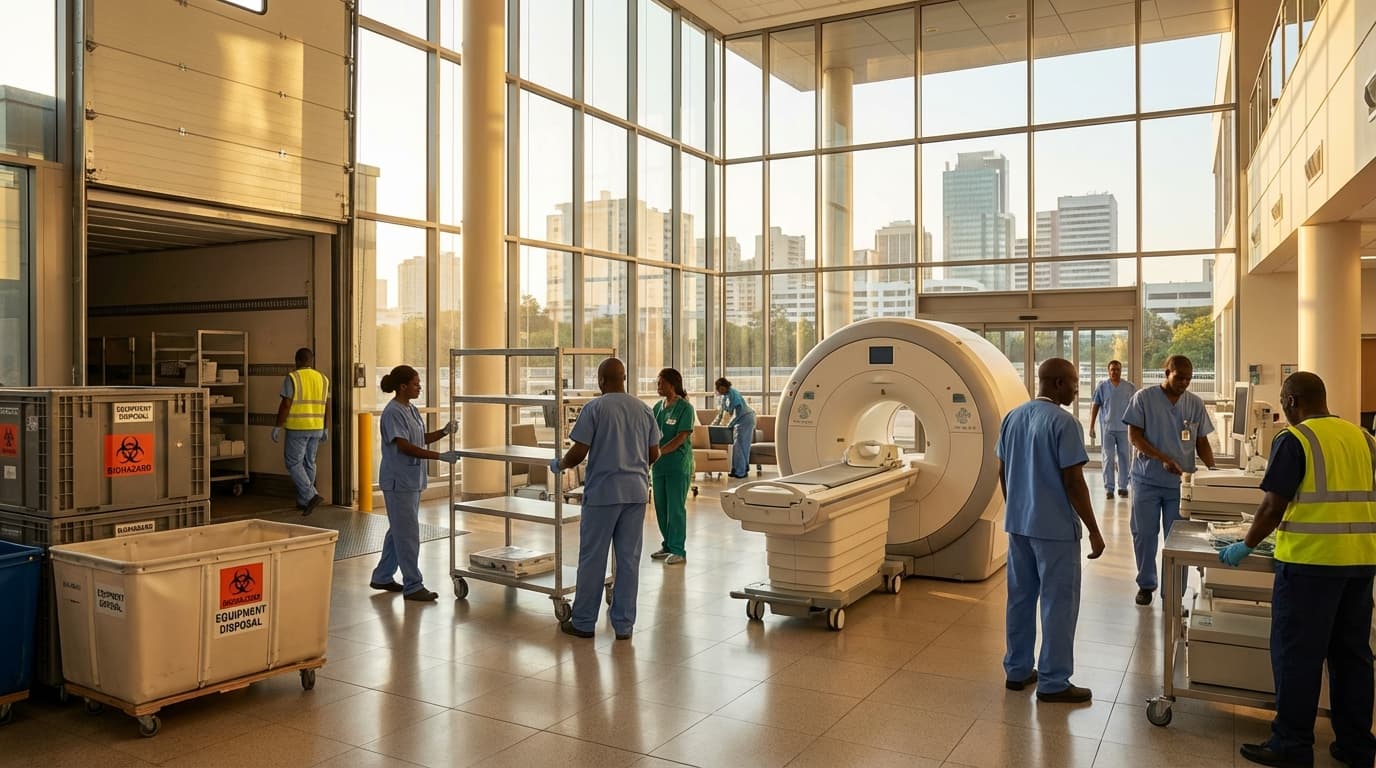
Decommissioning Service for Medical Devices in Rwanda
Engineering Excellence & Technical Support
Decommissioning Service for Medical Devices High-standard technical execution following OEM protocols and local regulatory frameworks.
Certified Data Destruction for Patient Confidentiality
Our decommissioning process employs certified data erasure techniques that meet international standards, ensuring complete and irretrievable removal of all patient data from medical devices. This safeguards sensitive information and guarantees compliance with Rwandan data privacy regulations, providing peace of mind for healthcare facilities.
Environmentally Responsible Asset Lifecycle Management
We provide end-to-end, eco-friendly decommissioning, prioritizing responsible disposal and recycling of medical device components. Our services minimize environmental impact by adhering to best practices for hazardous material handling and promoting circular economy principles, supporting Rwanda's sustainability goals.
Streamlined Regulatory Compliance and Asset Tracking
Our expert team navigates the complexities of Rwandan medical device regulations for decommissioning. We offer comprehensive documentation, asset tracking throughout the lifecycle, and certified disposal records, simplifying compliance audits and ensuring all regulatory requirements are met efficiently for healthcare providers.
What Is Decommissioning Service For Medical Devices In Rwanda?
Decommissioning Service for Medical Devices in Rwanda refers to the systematic and documented process of retiring a medical device from active use, ensuring it is rendered inoperable, data is securely erased, and disposed of or repurposed in a safe, compliant, and environmentally responsible manner. This service is crucial for healthcare facilities and organizations operating within Rwanda to adhere to regulatory requirements, maintain data privacy, and manage their asset lifecycle effectively. The process involves several key stages, including assessment, data sanitization, physical disablement, and final disposition.
| Who Needs Decommissioning Service? | Typical Use Cases | ||||||||||||
|---|---|---|---|---|---|---|---|---|---|---|---|---|---|
| Hospitals and Clinics (Public & Private) | End-of-life retirement of imaging equipment (e.g., X-ray, CT scanners, MRI) | Healthcare Facilities undergoing facility upgrades or renovations | Retirement of diagnostic laboratory equipment (e.g., analyzers, centrifuges) | Medical Device Manufacturers or Distributors (for returns, recalls, or end-of-life management) | Replacement of aging or obsolete patient monitoring systems | Research Institutions utilizing medical devices | Decommissioning of surgical suites and related instrumentation | Government Health Agencies and Ministries | Secure removal of devices containing sensitive patient information prior to disposal | Medical Device Repair and Maintenance Companies (for devices deemed irreparable or obsolete) | End-of-lease or end-of-service contract disposal of medical equipment | Third-Party Service Providers managing medical device fleets | Securely disabling and disposing of networked medical devices to prevent cyber threats |
Key Components of Medical Device Decommissioning Service:
- Asset Identification and Inventory: Cataloging the device, its current state, and its intended decommissioning path.
- Data Sanitization/Destruction: Securely removing all patient and operational data from the device's storage media, adhering to relevant privacy regulations (e.g., GDPR principles where applicable, or national data protection laws). This can involve overwriting, degaussing, or physical destruction of storage media.
- Functional Disablement: Rendering the device inoperable to prevent unauthorized use or re-activation. This may involve disabling power, removing critical components, or specific software deactivation.
- Environmental Disposal/Recycling: Managing the end-of-life disposal of the device and its components in accordance with Rwandan environmental regulations, prioritizing recycling and minimizing hazardous waste.
- Documentation and Certification: Providing comprehensive records of the entire decommissioning process, including certificates of data destruction and disposal, for audit and compliance purposes.
Who Needs Decommissioning Service For Medical Devices In Rwanda?
Decommissioning medical devices in Rwanda is a critical process for ensuring patient safety, environmental protection, and regulatory compliance. This service is essential for a variety of healthcare facilities and organizations that possess outdated, damaged, or otherwise unusable medical equipment. Proper decommissioning involves the safe and secure removal of all patient data, inactivation of any hazardous components, and responsible disposal or recycling of the device's materials. This process prevents the reuse of faulty equipment, mitigates potential health risks, and avoids the improper disposal of electronic waste.
| Customer Type | Relevant Departments / Roles | Key Needs for Decommissioning |
|---|---|---|
| Hospitals (Public & Private) | Biomedical Engineering Department, IT Department, Procurement Department, Facilities Management, Compliance Officer | Secure data erasure from imaging and diagnostic devices, safe disposal of biomedical waste, inventory management, regulatory compliance, data privacy. |
| Clinics and Health Centers | Clinic Administrator, Head Nurse, IT Support (if applicable), Procurement Officer | Safe disposal of smaller diagnostic equipment, secure data removal from any connected devices, cost-effective solutions, compliance with local regulations. |
| Diagnostic Laboratories | Laboratory Manager, IT Manager, Procurement Department, Compliance Officer | Decommissioning of analytical instruments, specialized diagnostic equipment, secure data destruction, environmental responsibility. |
| Medical Research Institutions | Research Department Head, IT Department, Procurement Department, Facilities Manager | Handling of specialized research equipment, secure data sanitization, potential for asset recovery/resale of certain components, environmental considerations. |
| Government Health Agencies | Procurement and Logistics Department, Health Infrastructure Unit, Regulatory Compliance Division | Oversight of decommissioning for public health facilities, ensuring adherence to national standards, managing large-scale disposals, promoting responsible waste management. |
| Medical Equipment Suppliers & Distributors | After-Sales Service Department, Logistics and Supply Chain Management, Compliance Department | End-of-life management for previously sold equipment, fulfilling contractual obligations, providing certified decommissioning services to their clients, managing returned or obsolete stock. |
| NGOs involved in Healthcare | Program Manager, Logistics Coordinator, Procurement Officer, Health Technical Advisor | Managing donated or acquired medical equipment, ensuring responsible disposal when no longer usable, compliance with donor requirements, supporting local health infrastructure. |
Target Customers and Departments for Medical Device Decommissioning Services in Rwanda
- Hospitals (Public and Private)
- Clinics and Health Centers
- Diagnostic Laboratories
- Medical Research Institutions
- Government Health Agencies
- Medical Equipment Suppliers and Distributors (for end-of-life management)
- Non-Governmental Organizations (NGOs) involved in healthcare
Decommissioning Service For Medical Devices Process In Rwanda
This document outlines the standard workflow for the decommissioning of medical devices in Rwanda. The process ensures that medical devices are retired safely, responsibly, and in compliance with national regulations and environmental standards. It covers the entire lifecycle from initial inquiry to final disposition.
| Stage | Description | Key Activities | Responsible Parties | Outcome |
|---|---|---|---|---|
| Inquiry & Assessment | Client identifies need and initiates contact; initial evaluation of the scope. | Initial contact, needs assessment, device identification, preliminary scope definition. | Healthcare Facility/Client, Decommissioning Service Provider | Understanding of decommissioning needs, preliminary project scope. |
| Proposal & Agreement | Service provider offers a comprehensive plan and pricing; contract is finalized. | Site survey, detailed scope definition, proposal generation, quotation, contract negotiation, signing. | Decommissioning Service Provider, Healthcare Facility/Client | Formal agreement to proceed with decommissioning services. |
| Planning & Permitting | Detailed operational plan development and necessary regulatory approvals. | Decommissioning plan creation, risk assessment, permit application, liaison with regulatory bodies. | Decommissioning Service Provider, Regulatory Authorities (e.g., MoH, REMA) | Approved decommissioning plan, all required permits secured. |
| Execution: Disassembly & Data Sanitization | Physical removal, disassembly, and secure handling of data. | Safe disconnection, disassembly, component segregation, data wiping/destruction, environmental hazard identification. | Decommissioning Service Provider (Technical Team) | Decommissioned device components, data security ensured. |
| Execution: Sorting & Disposal/Recycling | Categorization of components and appropriate handling for environmental compliance. | Material sorting (metals, plastics, electronics, hazardous waste), secure transport to licensed recyclers/disposal facilities, proper waste management. | Decommissioning Service Provider (Logistics & Waste Management Team), Licensed Recyclers/Disposal Facilities | Responsible disposal or recycling of all components according to regulations. |
| Documentation & Certification | Comprehensive record-keeping and issuance of official documents. | Creation of decommissioning logs, inventory tracking, issuance of certificates of decommissioning/destruction. | Decommissioning Service Provider (Administration & Compliance) | Complete audit trail of the decommissioning process, official certification for client records. |
| Reporting & Closure | Final review and communication of project completion to the client. | Final project report generation, submission to client, client sign-off. | Decommissioning Service Provider | Client informed of successful decommissioning, project officially closed. |
Decommissioning Service for Medical Devices Process in Rwanda
- The process begins with a formal request or inquiry from a healthcare facility or organization requiring the decommissioning of one or more medical devices.
- An initial assessment is conducted to understand the scope of work, including the type and number of devices, their condition, and the desired decommissioning outcome.
- A detailed proposal is submitted, outlining the scope, methodology, timeline, costs, and expected outcomes of the decommissioning service.
- Upon agreement and contract signing, a team is assigned to manage the decommissioning project.
- A site visit is performed to physically inspect the devices, confirm their location, and plan logistics for removal and transport.
- The decommissioning plan is finalized, including detailed steps for disassembly, data sanitization, environmental risk assessment, and disposal/recycling methods.
- Permissions and permits are obtained from relevant regulatory bodies (e.g., Ministry of Health, Rwanda Environment Management Authority - REMA) as required.
- The actual decommissioning work commences, involving safe disconnection, disassembly, and removal of components.
- For devices containing sensitive data, a robust data sanitization or destruction process is implemented to ensure patient confidentiality.
- Components are sorted based on their material composition and potential for reuse, recycling, or disposal.
- Environmentally hazardous materials are handled and disposed of according to strict environmental regulations.
- Records of the entire decommissioning process, including device serial numbers, dates, responsible personnel, and final disposition, are meticulously maintained.
- Certificates of decommissioning and/or destruction are issued to the client, confirming the completion of the service.
- Post-decommissioning reporting is provided to the client, summarizing the project and its outcomes.
Decommissioning Service For Medical Devices Cost In Rwanda
Decommissioning medical devices in Rwanda involves several critical steps, including data sanitization, physical destruction, and environmental disposal. The cost of these services is influenced by a variety of factors. These include the type and complexity of the medical device, the volume of devices to be decommissioned, the required level of data security, the location of the devices, and the specific provider offering the service. Regulatory compliance, such as adherence to Rwandan health and environmental regulations, also plays a significant role in pricing. For smaller, simpler devices, costs might be lower, while specialized equipment requiring intricate dismantling or high-security data erasure will command higher fees. The market for medical device decommissioning services in Rwanda is still developing, but it's essential for healthcare facilities to budget accurately for these essential end-of-life processes.
| Device Category | Estimated Cost Range (RWF) | Notes |
|---|---|---|
| Small Diagnostic Devices (e.g., thermometers, blood pressure monitors) | 5,000 - 20,000 | Generally straightforward, lower data security concerns. |
| Medium Imaging Equipment (e.g., basic X-ray machines, ultrasound) | 50,000 - 250,000 | Requires more specialized handling and potential data erasure. |
| Large Imaging Equipment (e.g., MRI, CT scanners) | 200,000 - 1,000,000+ | Complex dismantling, high-security data erasure, specialized transport. |
| Laboratory Equipment (e.g., centrifuges, incubators) | 15,000 - 100,000 | Depends on size, complexity, and potential biohazard handling. |
| Patient Monitoring Systems | 20,000 - 150,000 | Involves multiple components and data storage units. |
| Consumables/Accessories (e.g., old probes, cables) | Per item or bundled rates | Often priced per kilogram or per collection for bulk disposal. |
Key Pricing Factors for Medical Device Decommissioning in Rwanda:
- Type and complexity of the medical device (e.g., imaging equipment vs. basic diagnostic tools).
- Volume of devices requiring decommissioning.
- Required level of data sanitization (e.g., secure erasure vs. physical destruction).
- Location of the medical facility and the devices.
- Specific service provider and their operational overhead.
- Regulatory compliance requirements (e.g., specific disposal protocols).
- Additional services like transportation and certification.
Affordable Decommissioning Service For Medical Devices Options
Decommissioning medical devices is a critical step in their lifecycle, ensuring data security, environmental responsibility, and compliance with regulations. For healthcare facilities, finding affordable options is paramount. This guide explores value bundles and cost-saving strategies for medical device decommissioning services.
| Cost-Saving Strategy | Description | Potential Savings |
|---|---|---|
| Negotiate Volume Discounts: | If you have a significant number of devices to decommission over a period, negotiate a bulk discount with your service provider. This is especially effective for large hospitals or healthcare networks. | Up to 10-20% on total service cost. |
| Compare Multiple Bids: | Obtain quotes from several reputable decommissioning service providers. Even if a provider doesn't offer formal bundles, comparing their pricing for individual services can reveal cost-effective options. | Significant cost reduction through competitive pricing. |
| Consider Off-Peak Scheduling: | Some providers might offer slightly lower rates for decommissioning services scheduled during less busy periods, such as weekends or specific weekdays. | 5-10% reduction in service fees. |
| Inquire About Recycling Rebates: | Certain electronic components might have residual value. Ask if the provider can pass on any recycling rebates or credits for salvaged materials, effectively reducing your overall cost. | Variable, depending on device types and market value of recycled materials. |
| Bundle Internal Training with Services: | If your internal IT or biomedical teams will be involved in any part of the process, inquire if bundled training on secure decommissioning protocols can be included. This can save on external training costs. | Reduces costs associated with separate training programs. |
| Long-Term Contracts: | For ongoing decommissioning needs, a long-term contract with a single provider can often secure more favorable pricing and dedicated support. | Potential for discounted rates and priority service over the contract duration. |
| DIY Data Wiping (with validation): | For less sensitive data, explore using certified software for data wiping that your internal team can manage, followed by professional verification and physical destruction of media by a service provider. This requires careful validation of your internal processes. | Can significantly reduce costs for data sanitization portion of service. |
Understanding Value Bundles in Medical Device Decommissioning
- What are Value Bundles? Value bundles in medical device decommissioning are pre-packaged service offerings that combine multiple essential decommissioning tasks at a potentially reduced price compared to individual service bookings. They are designed to provide a comprehensive solution for a specific set of needs, offering convenience and predictability.
- Common Components of Value Bundles:
- Basic Decommissioning: Includes secure data wiping, physical destruction of storage media, and basic cleaning.
- Environmental Compliance Bundle: Adds responsible e-waste recycling and proper disposal of hazardous materials.
- Full Lifecycle Bundle: Encompasses data wiping, destruction, recycling, asset tracking, and detailed documentation for compliance.
- High-Volume Bundle: Tailored for facilities decommissioning a large number of devices, often with tiered pricing.
- Benefits of Value Bundles:
- Cost Predictability: Fixed pricing for a defined scope of services.
- Efficiency: Streamlined process with a single provider for multiple tasks.
- Comprehensive Coverage: Ensures all essential steps are addressed.
- Potential Cost Savings: Bundled services are often priced lower than acquiring them separately.
Verified Providers In Rwanda
In Rwanda's evolving healthcare landscape, distinguishing between reputable and less reliable health service providers is paramount for individuals seeking quality care. Verified providers, those who have met stringent credentialing and operational standards, offer a crucial layer of assurance. Franance Health stands out as a prime example of such a verified provider, embodying the principles of excellence and patient-centered care. Their commitment to rigorous credentialing processes, adherence to ethical practices, and focus on continuous improvement makes them a benchmark for high-quality healthcare in Rwanda.
| Credentialing Aspect | Franance Health's Commitment | Benefit to Patients |
|---|---|---|
| Licensing and Certification Verification | Thoroughly vets all medical practitioners' licenses and certifications. | Ensures that patients are treated by legally qualified and competent professionals. |
| Professional Experience Review | Assesses the depth and breadth of each practitioner's clinical experience. | Provides access to healthcare professionals with proven track records and specialized expertise. |
| Ongoing Training and Development | Facilitates continuous education and skill enhancement for all staff. | Guarantees that patients receive care informed by the latest medical knowledge and techniques. |
| Compliance with Regulatory Standards | Strictly adheres to all Rwandan healthcare regulations and quality mandates. | Offers assurance of safe and reliable healthcare services that meet legal and quality requirements. |
| Patient Feedback Mechanisms | Actively solicits and acts upon patient feedback. | Drives service improvements and ensures a responsive and patient-focused healthcare experience. |
Why Franance Health is a Top Choice for Verified Healthcare in Rwanda
- Rigorous Credentialing: Franance Health invests heavily in ensuring all its healthcare professionals possess legitimate, up-to-date licenses and certifications. This includes thorough verification of educational qualifications, specialist training, and professional experience.
- Adherence to Quality Standards: They consistently meet and often exceed national and international healthcare quality benchmarks. This encompasses patient safety protocols, infection control measures, and the implementation of evidence-based medical practices.
- Experienced and Skilled Professionals: Franance Health attracts and retains a team of highly qualified and experienced doctors, nurses, and allied health professionals. Their expertise spans various medical disciplines, ensuring comprehensive care.
- Patient-Centric Approach: A core tenet of Franance Health is their unwavering dedication to the patient's well-being. This translates into compassionate care, clear communication, and personalized treatment plans tailored to individual needs.
- Investment in Technology and Infrastructure: To provide cutting-edge medical services, Franance Health maintains modern facilities equipped with advanced diagnostic and treatment technologies, ensuring efficient and effective healthcare delivery.
- Ethical Practices and Transparency: Franance Health operates with the highest ethical standards, promoting transparency in all aspects of their services, from pricing to treatment options. Patients can trust in their integrity and commitment to their best interests.
- Commitment to Continuous Improvement: The organization actively seeks feedback and engages in ongoing professional development for its staff, ensuring they remain at the forefront of medical advancements and best practices.
Scope Of Work For Decommissioning Service For Medical Devices
This Scope of Work (SOW) outlines the requirements for the decommissioning of medical devices. It details the technical deliverables and standard specifications necessary to ensure safe, compliant, and environmentally responsible removal of medical equipment from service. The decommissioning process encompasses removal from active use, data sanitization, physical dismantling, and disposal or recycling of components.
| Stage | Description | Technical Deliverables | Standard Specifications/Compliance |
|---|---|---|---|
| Site Assessment and Planning | Initial survey to identify devices for decommissioning, assess physical constraints, safety hazards, and confirm access requirements. | Site survey report, risk assessment, detailed decommissioning plan (including timelines, resource allocation, and safety protocols). | Compliance with OSHA, HIPAA (for data security aspects), local environmental regulations, manufacturer's service manuals. |
| Notification and Scheduling | Formal notification to relevant departments, stakeholders, and regulatory bodies as required. | Confirmation of scheduled decommissioning dates and times, communication logs. | Internal hospital protocols, any relevant regulatory notification requirements. |
| Data Sanitization and Security | Secure erasure or destruction of all Protected Health Information (PHI) and sensitive data stored on or accessible by the device. | Certificate of Data Destruction (signed and dated), audit trail of sanitization process, verification reports. | HIPAA, GDPR (if applicable), NIST SP 800-88 Rev. 1 (Guidelines for Media Sanitization), hospital's IT security policies. |
| Physical Disassembly and Removal | Safe and controlled dismantling of the medical device according to manufacturer specifications and safety guidelines. | Cleaned and prepared removal path, minimal disruption to adjacent areas, safe transport of components. | Manufacturer's service and maintenance manuals, lockout/tagout procedures, appropriate PPE, safe lifting and handling techniques. |
| Component Segregation and Disposal/Recycling | Proper sorting of components based on material type (e.g., hazardous waste, metals, plastics, electronics). | Waste manifest for hazardous materials, recycling certificates for recovered materials, disposal records from certified vendors. | RCRA (Resource Conservation and Recovery Act) for hazardous waste, WEEE Directive (Waste Electrical and Electronic Equipment), local waste management regulations, vendor certifications (e.g., R2, e-Stewards). |
| Documentation and Certification | Comprehensive record-keeping of all decommissioning activities and final confirmation of completion. | Final decommissioning report summarizing all activities, including data sanitization certificates, disposal/recycling records, photographic evidence (if required), and sign-off by authorized personnel. | Internal record-keeping policies, regulatory compliance documentation, chain of custody for disposed/recycled items. |
Key Stages of Medical Device Decommissioning
- Site Assessment and Planning
- Notification and Scheduling
- Data Sanitization and Security
- Physical Disassembly and Removal
- Component Segregation and Disposal/Recycling
- Documentation and Certification
Service Level Agreement For Decommissioning Service For Medical Devices
This Service Level Agreement (SLA) outlines the response times and uptime guarantees for the Decommissioning Service for Medical Devices provided by [Your Company Name]. This SLA is an addendum to the Master Service Agreement (MSA) between [Your Company Name] and [Client Name].
| Service Component | Response Time Target | Downtime Notification | Uptime Guarantee | Remedy for Failure |
|---|---|---|---|---|
| Critical Decommissioning Operations (e.g., during active removal/sanitization of critical devices) | Within 1 hour during Business Hours, 4 hours outside Business Hours | Immediate notification required by Client. | 99.5% | Service Credit of 5% of monthly service fee for each 30-minute interval of unscheduled downtime beyond the allowed allowance. |
| Non-Critical Decommissioning Support (e.g., scheduling inquiries, documentation requests) | Within 4 business hours during Business Hours | Notification required by Client. | 99.0% | Service Credit of 2% of monthly service fee for each 24-hour period of unscheduled downtime beyond the allowed allowance. |
| Scheduled Maintenance/Downtime | Not applicable (advance notice provided) | Advance notification of at least 48 hours required via email and/or portal. | N/A | N/A |
Definitions
- Decommissioning Service: The comprehensive process of safely and securely rendering medical devices unusable and ready for disposal or recycling, including data sanitization, physical destruction (if required), and documentation.
- Downtime: Any period during which the Decommissioning Service is unavailable and unable to perform its core functions as defined in the MSA.
- Response Time: The maximum time allowed for [Your Company Name] to acknowledge and begin actively addressing a reported issue with the Decommissioning Service.
- Uptime Guarantee: The minimum percentage of time the Decommissioning Service is expected to be available and operational.
- Business Hours: [Specify your business hours, e.g., 9:00 AM to 5:00 PM, Monday through Friday, excluding national holidays].
Frequently Asked Questions

Ready when you are
Let's scope your Decommissioning Service for Medical Devices in Rwanda project in Rwanda.

Scaling healthcare logistics and technical systems across the entire continent.