
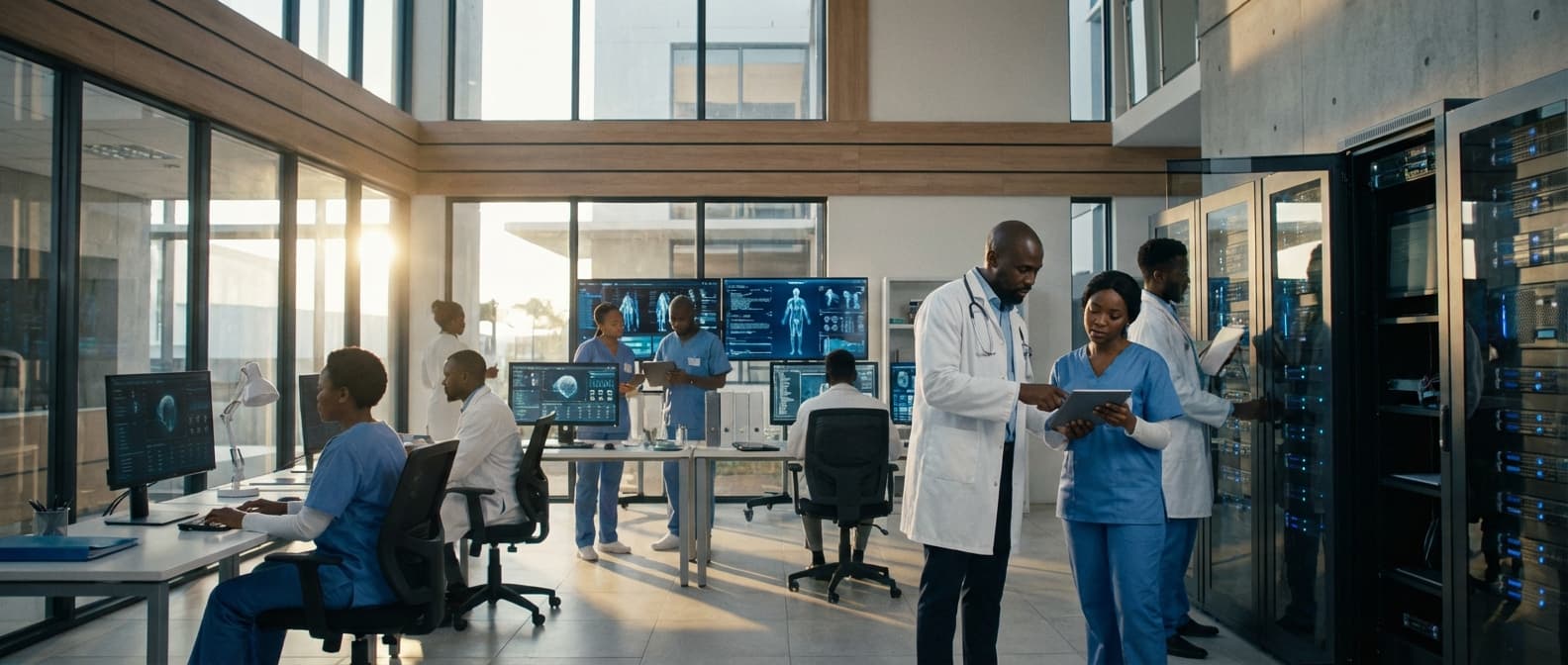
Medical IT Consultation in Rwanda
Engineering Excellence & Technical Support
Strategic technology consulting to optimize healthcare operations, streamline workflows, and integrate cutting-edge medical information systems. High-standard technical execution following OEM protocols and local regulatory frameworks.
EHR Implementation & Optimization
We streamline the adoption and refinement of Electronic Health Records (EHR) systems across Rwandan healthcare facilities, enhancing patient data management, improving clinical workflows, and ensuring compliance with national health informatics standards.
Cybersecurity & Data Privacy
Our expert team fortifies healthcare IT infrastructure in Rwanda against cyber threats, implementing robust security measures and data privacy protocols to safeguard sensitive patient information and maintain trust within the healthcare ecosystem.
Interoperability Solutions
We design and deploy scalable interoperability solutions, enabling seamless data exchange between disparate healthcare systems in Rwanda, fostering a connected and efficient health information network for improved patient care coordination.
What Is Medical It Consultation In Rwanda?
Medical IT Consultation in Rwanda refers to specialized advisory services focused on the strategic planning, implementation, optimization, and management of information technology (IT) infrastructure and solutions within the Rwandan healthcare sector. This encompasses a broad spectrum of activities aimed at enhancing healthcare delivery, improving patient outcomes, increasing operational efficiency, and ensuring data security and compliance through the effective leverage of technology.
| Who Needs Medical IT Consultation? | Typical Use Cases |
|---|---|
| Hospitals & Clinics (Public & Private): Seeking to modernize their IT infrastructure, implement EHR/EMR, improve data management, and enhance patient care delivery. | Implementing a new EHR system; migrating to cloud-based infrastructure; enhancing cybersecurity measures; integrating telemedicine services. |
| District Health Offices & Ministry of Health Departments: Aiming to improve health information systems, facilitate data collection and reporting for public health initiatives, and strengthen health surveillance. | Developing a national health data strategy; implementing a disease surveillance system; improving data interoperability between facilities; rolling out health management information systems (HMIS). |
| Research Institutions & Universities: Requiring robust IT infrastructure for data management, research analysis, and collaboration. | Setting up research data repositories; implementing secure platforms for clinical trials; facilitating data sharing for collaborative research projects. |
| Healthcare Startups & Innovators: Developing new health tech solutions and needing guidance on IT architecture, data security, and regulatory compliance. | Designing the IT architecture for a new health app; ensuring compliance with health data regulations; integrating with existing healthcare systems. |
| Non-Governmental Organizations (NGOs) in Healthcare: Implementing health programs and requiring IT support for data collection, program management, and reporting. | Deploying mobile data collection tools for community health workers; establishing IT systems for project monitoring and evaluation; integrating with government health information systems. |
| Medical Laboratories & Diagnostic Centers: Needing to streamline laboratory information systems (LIS), ensure data accuracy, and integrate with EHRs. | Implementing a Laboratory Information System (LIS); integrating LIS with hospital EHRs; ensuring compliance with diagnostic data standards. |
Key Components of Medical IT Consultation in Rwanda
- Healthcare IT Strategy Development: Defining a clear technology roadmap aligned with institutional goals, regulatory requirements (e.g., health data privacy laws), and national health informatics policies.
- Electronic Health Record (EHR) / Electronic Medical Record (EMR) System Implementation & Optimization: Advising on the selection, customization, deployment, and continuous improvement of EHR/EMR systems to streamline patient data management, clinical workflows, and decision support.
- Health Information Exchange (HIE) Integration: Facilitating the secure and interoperable exchange of patient health information between different healthcare providers, facilities, and authorized stakeholders.
- Telemedicine & Remote Patient Monitoring Solutions: Designing and implementing platforms for remote consultations, diagnostics, and continuous patient monitoring to expand access to healthcare, particularly in underserved areas.
- Healthcare Cybersecurity & Data Privacy: Assessing vulnerabilities, developing robust security frameworks, implementing compliance measures (e.g., GDPR-like principles for health data), and conducting risk assessments to protect sensitive patient information.
- IT Infrastructure Assessment & Modernization: Evaluating existing IT hardware, software, and network capabilities and recommending upgrades or replacements to support modern healthcare applications and workflows.
- Clinical Decision Support Systems (CDSS) Integration: Advising on the deployment and integration of CDSS tools to assist clinicians in diagnosis, treatment planning, and medication management.
- Health Analytics & Business Intelligence: Developing capabilities for data extraction, analysis, and reporting to derive actionable insights for operational improvement, population health management, and research.
- IT Project Management & Governance: Overseeing the lifecycle of IT projects within healthcare settings, ensuring adherence to timelines, budgets, and quality standards.
- Training & Change Management: Developing and delivering training programs for healthcare professionals on new IT systems and facilitating the adoption of technology-driven changes in clinical practice.
Who Needs Medical It Consultation In Rwanda?
In Rwanda's rapidly evolving healthcare landscape, medical IT consultation is becoming indispensable for organizations aiming to optimize patient care, streamline operations, and ensure data security. This specialized expertise bridges the gap between cutting-edge technology and effective healthcare delivery, empowering institutions to harness the full potential of digital solutions.
| Customer Type | Key Needs Addressed by Medical IT Consultation | Relevant Departments |
|---|---|---|
| Hospitals (Public and Private) | Implementation of Electronic Health Records (EHR), Picture Archiving and Communication Systems (PACS), Hospital Information Systems (HIS), cybersecurity, data analytics for operational efficiency and patient outcomes, telehealth integration. | IT Department, Administration, Clinical Departments (e.g., Radiology, Pharmacy, Laboratories), Patient Records, Finance. |
| Clinics and Health Centers | Cost-effective EHR implementation, patient scheduling systems, basic data management, secure patient communication platforms, training on digital tools. | Management, Front Desk/Reception, Clinical Staff, IT Support (if any). |
| Diagnostic Laboratories | Laboratory Information Management Systems (LIMS), integration with EHRs, data validation and quality control, secure data sharing, compliance with regulations. | Laboratory Management, IT Department, Lab Technicians, Pathologists. |
| Pharmacies | Pharmacy Management Systems, inventory control, prescription management, integration with EHRs for drug-drug interaction checks, patient data security. | Pharmacy Management, IT Department, Pharmacists, Pharmacy Technicians. |
| Medical Research Institutions | Data management platforms, secure data storage and sharing for research studies, statistical analysis tools, compliance with data privacy laws, research information systems. | Research Department, IT Department, Data Analysts, Researchers. |
| Government Health Agencies | National health information systems, data aggregation and analysis for public health surveillance, interoperability between healthcare facilities, policy development for health IT, cybersecurity strategy. | Ministry of Health Departments (e.g., Public Health Surveillance, Health Information Systems, Policy and Planning), IT Department. |
| NGOs in the Health Sector | Program management software, data collection and reporting tools for health programs, mobile health (mHealth) solutions, capacity building for local staff on IT. | Program Management, M&E Department, Field Staff, IT Support (if any). |
| Healthcare Startups and Technology Providers | Product development guidance, regulatory compliance for health tech products, scalability planning, cybersecurity best practices for new platforms. | Product Development, Engineering, Business Development, Legal/Compliance, IT Security. |
| Insurance Companies (Health Insurance) | Claims processing systems, data analytics for fraud detection and risk assessment, secure patient data integration with providers, customer relationship management (CRM) for health plans. | Claims Department, IT Department, Data Analytics, Underwriting, Customer Service. |
Target Customers for Medical IT Consultation in Rwanda
- Hospitals (Public and Private)
- Clinics and Health Centers
- Diagnostic Laboratories
- Pharmacies
- Medical Research Institutions
- Government Health Agencies
- Non-Governmental Organizations (NGOs) in the Health Sector
- Healthcare Startups and Technology Providers
- Insurance Companies (Health Insurance)
Medical It Consultation Process In Rwanda
The Medical IT Consultation Process in Rwanda is designed to be a structured and efficient workflow, ensuring that healthcare providers receive the appropriate technological solutions to enhance their operations and patient care. This process typically begins with an initial inquiry and progresses through a series of defined steps, culminating in the successful execution and implementation of IT solutions.
| Stage | Description | Key Activities | Deliverables/Outcomes | Typical Timeline (Weeks) |
|---|---|---|---|---|
| Inquiry and Initial Contact | The process begins when a healthcare institution in Rwanda expresses interest in medical IT services. | Inbound inquiry via phone, email, or website form; initial discussion to understand basic needs. | Confirmation of interest; scheduling of initial consultation. | 0-1 |
| Needs Assessment and Scoping | A detailed understanding of the client's current IT infrastructure, challenges, and specific requirements for medical IT solutions. | On-site or remote meetings with stakeholders; analysis of existing systems; identification of pain points; documentation of functional and non-functional requirements. | Needs assessment report; scope of work document; identification of potential solutions. | 1-3 |
| Proposal Development | Based on the needs assessment, a tailored proposal outlining recommended solutions, costs, and implementation strategies is created. | Researching and selecting appropriate IT solutions (EHR, PACS, telemedicine, etc.); developing technical specifications; estimating costs; defining project timelines; outlining service level agreements (SLAs). | Formal proposal document including solution details, pricing, implementation plan, and ROI projections. | 2-4 |
| Contract Negotiation and Signing | Formalizing the agreement between the IT provider and the healthcare institution. | Review and negotiation of the proposal terms, pricing, payment schedules, and contractual obligations; legal review; signing of the service contract. | Signed contract; mutual understanding of project scope and terms. | 1-2 |
| Implementation Planning | Developing a detailed roadmap for the deployment of the agreed-upon IT solutions. | Project team formation; creation of a detailed project plan (tasks, resources, dependencies); risk assessment and mitigation strategies; procurement of hardware and software. | Detailed project plan; resource allocation plan; procurement schedule. | 1-2 |
| Execution and Deployment | The actual installation, configuration, and integration of the medical IT solutions. | Hardware installation; software deployment and configuration; data migration; system integration with existing infrastructure; rigorous testing and quality assurance. | Fully functional and integrated IT system. | 4-12+ (depending on complexity) |
| Training and Knowledge Transfer | Ensuring that the healthcare staff is proficient in using the new IT systems. | Development of training materials; conducting hands-on training sessions for end-users and IT administrators; providing user manuals and documentation. | Trained staff; comprehensive user documentation. | 1-3 |
| Post-Implementation Support and Review | Providing ongoing assistance and evaluating the success of the deployed solutions. | Go-live support; troubleshooting and issue resolution; performance monitoring; gathering user feedback; conducting a post-implementation review. | Stabilized system; resolution of initial issues; feedback report. | 2-4 (initial support period) |
| Ongoing Monitoring and Optimization | Continuous management and improvement of the IT systems to ensure optimal performance and alignment with evolving needs. | Regular system health checks; performance tuning; security updates and patches; planning for future upgrades and enhancements; proactive issue identification. | Optimized IT infrastructure; improved operational efficiency; continued user satisfaction. | Ongoing |
Workflow Stages:
- Inquiry and Initial Contact
- Needs Assessment and Scoping
- Proposal Development
- Contract Negotiation and Signing
- Implementation Planning
- Execution and Deployment
- Training and Knowledge Transfer
- Post-Implementation Support and Review
- Ongoing Monitoring and Optimization
Medical It Consultation Cost In Rwanda
Medical IT consultation costs in Rwanda can vary significantly based on several factors. These include the complexity of the IT needs, the experience and reputation of the consultant or firm, the duration of the consultation, and the specific services required (e.g., EMR implementation, network security, hardware assessment, cloud migration). Pricing is typically discussed in Rwandan Francs (RWF). While there isn't a standardized public price list, a general understanding of the market can be formed by considering these influencing elements.
| Service Type | Estimated Hourly Rate (RWF) | Estimated Project Fee (RWF) |
|---|---|---|
| Initial IT Assessment/Audit | 20,000 - 50,000 | 100,000 - 300,000 |
| EMR/EHR System Selection & Implementation Strategy | 30,000 - 70,000 | 500,000 - 3,000,000+ |
| Network Design & Security Consultation | 25,000 - 60,000 | 200,000 - 1,000,000 |
| Data Management & Privacy Consultation | 25,000 - 55,000 | 150,000 - 800,000 |
| Hardware & Software Procurement Advisory | 20,000 - 45,000 | 80,000 - 400,000 |
| Cloud Migration Strategy | 30,000 - 65,000 | 300,000 - 1,500,000+ |
Key Pricing Factors for Medical IT Consultations in Rwanda:
- Consultant's Expertise and Experience: Highly specialized or seasoned IT professionals with a proven track record in the healthcare sector will command higher rates.
- Scope of Work: A comprehensive EMR system deployment will naturally cost more than a basic network security audit.
- Project Duration: The total cost is often a function of the number of hours or days required for the consultation.
- On-site vs. Remote Consultation: On-site consultations may incur additional travel and accommodation expenses.
- Technology Stack Involved: Consultations involving advanced or proprietary technologies might be more expensive.
- Urgency of the Request: Expedited services can sometimes come with a premium.
- Firm vs. Independent Consultant: Established IT consulting firms often have higher overheads, which can translate to higher prices compared to independent consultants.
Affordable Medical It Consultation Options
Navigating the complexities of medical IT can be a significant challenge for healthcare providers, especially smaller practices and those with budget constraints. Fortunately, various affordable medical IT consultation options exist, offering specialized expertise without the overhead of a full-time IT department. These options often revolve around flexible service models and strategic cost-saving measures. Understanding value bundles and implementing smart cost-saving strategies are key to maximizing your IT investment and ensuring efficient, secure, and compliant healthcare operations.
| Cost-Saving Strategy | Description | Potential Benefits |
|---|---|---|
| Leverage Remote Support | Prioritize remote troubleshooting and maintenance for immediate issue resolution, reducing on-site visit costs. | Faster response times, lower travel expenses, increased technician efficiency. |
| Adopt Cloud-Based Solutions | Transition to Software-as-a-Service (SaaS) or Platform-as-a-Service (PaaS) for reduced hardware investment and maintenance. | Predictable monthly costs, scalability, reduced capital expenditure, automatic updates. |
| Negotiate Service Level Agreements (SLAs) | Clearly define response times, uptime guarantees, and support levels in your contracts to ensure you receive the agreed-upon services. | Ensures accountability from IT providers, prevents service degradation, maximizes value for money. |
| Bundle Services from a Single Provider | Consolidate multiple IT needs with one vendor to potentially receive discounted rates and streamlined communication. | Cost savings through package deals, simplified vendor management, integrated solutions. |
| Focus on Proactive Maintenance | Invest in regular IT system maintenance and monitoring to prevent costly downtime and major issues. | Reduces emergency repair costs, minimizes disruption to patient care, extends hardware lifespan. |
| Explore Open-Source Solutions | Where appropriate, consider open-source software alternatives for certain IT functions to reduce licensing fees. | Significant cost reduction on software acquisition, flexibility and customization options. |
| Implement a Bring Your Own Device (BYOD) Policy (with Security Measures) | Allowing employees to use their personal devices for work can reduce hardware procurement costs, provided robust security protocols are in place. | Reduced hardware acquisition and maintenance costs, increased employee flexibility. |
| Outsource Specific IT Functions | Instead of hiring full-time staff for specialized roles (e.g., cybersecurity analysis), outsource these functions on an as-needed basis. | Access to specialized expertise at a lower cost than full-time hiring, pay only for what you use. |
Key Value Bundles in Medical IT Consultation
- {"title":"Managed IT Services (Remote & On-site)","description":"A comprehensive package including proactive monitoring, help desk support, cybersecurity management, data backup, and disaster recovery. This often comes with tiered pricing based on the number of users or devices."}
- {"title":"Cloud Migration & Management","description":"Services focused on transitioning your practice's data and applications to secure cloud environments (e.g., EHRs, patient portals). Bundles can include assessment, planning, migration, and ongoing cloud infrastructure management."}
- {"title":"Cybersecurity & Compliance Audits","description":"Specialized bundles designed to assess your current security posture, identify vulnerabilities, and ensure compliance with regulations like HIPAA. These often include vulnerability scanning, penetration testing, and policy development."}
- {"title":"EHR/EMR Implementation & Optimization","description":"Consultation services for selecting, implementing, and fine-tuning Electronic Health Record (EHR) or Electronic Medical Record (EMR) systems. Bundles can cover initial setup, user training, and ongoing workflow optimization."}
- {"title":"IT Strategy & Planning","description":"Advisory services to help you develop a long-term IT roadmap aligned with your practice's goals. Bundles can include needs assessments, technology selection guidance, and budgeting assistance."}
Verified Providers In Rwanda
In Rwanda's evolving healthcare landscape, ensuring access to reliable and high-quality medical services is paramount. This is where the importance of verified providers comes into play. Franance Health has emerged as a leading force, distinguished by its rigorous credentialing process and a commitment to excellence that makes them the best choice for individuals seeking dependable healthcare solutions in Rwanda.
| Credentialing Aspect | Franance Health's Approach | Benefit to Patients |
|---|---|---|
| Medical Licenses & Certifications | Mandatory verification of all current and valid licenses and certifications. | Ensures providers are legally qualified and possess the necessary expertise. |
| Educational Background | Scrutiny of academic qualifications and institutional accreditations. | Confirms a strong foundation in medical knowledge and training. |
| Professional Experience & Track Record | Review of past performance, peer endorsements, and absence of malpractice claims. | Indicates a history of competent and ethical medical practice. |
| Adherence to Standards | Assessment of compliance with national and international healthcare guidelines. | Guarantees that patients receive care aligned with best practices. |
| Continuing Professional Development | Encouragement and verification of ongoing learning and skill enhancement. | Ensures providers are up-to-date with the latest medical advancements. |
Why Franance Health Stands Out:
- Rigorous Verification Process: Franance Health employs a multi-faceted approach to verify the credentials of all its partner healthcare providers. This includes thorough checks of medical licenses, professional certifications, educational background, and a track record of ethical practice.
- Commitment to Quality Care: Beyond basic verification, Franance Health actively assesses providers based on their patient care methodologies, adherence to international medical standards, and commitment to continuous professional development.
- Comprehensive Network: Franance Health has curated a diverse network of specialists, general practitioners, and healthcare facilities across Rwanda, ensuring that patients can find the specific expertise they need, from routine check-ups to specialized treatments.
- Patient-Centric Approach: The platform is designed with the patient at its core, offering ease of access to verified providers, transparent information about services, and a focus on patient satisfaction and well-being.
- Trust and Transparency: By clearly outlining their verification criteria and partnering with reputable professionals, Franance Health builds a foundation of trust and transparency, empowering patients to make informed decisions about their health.
Scope Of Work For Medical It Consultation
This document outlines the Scope of Work (SOW) for Medical IT Consultation services. It details the objectives, tasks, technical deliverables, and standard specifications required to ensure successful implementation and optimization of IT systems within a healthcare setting. The primary goal is to enhance patient care, operational efficiency, and data security through expert IT guidance and solutions.
| Deliverable | Description | Standard Specification/Format | Acceptance Criteria |
|---|---|---|---|
| IT Infrastructure Assessment Report | Comprehensive analysis of current IT hardware, software, and network capabilities. | PDF document, including executive summary, findings, SWOT analysis, and recommendations. | Report is accurate, complete, and addresses all aspects of the current infrastructure. Recommendations are actionable and prioritized. |
| Strategic IT Roadmap | A multi-year plan for IT development, aligning with organizational goals and emerging technologies. | Presentation slides (e.g., PowerPoint) and a detailed PDF document. | Roadmap is aligned with organizational strategy, includes budget considerations, and outlines key milestones. |
| EHR Implementation/Optimization Plan | Detailed plan for selecting, implementing, or optimizing an EHR system. | Project plan document (e.g., MS Project file or similar), including phases, tasks, timelines, resources, and budget. | Plan is realistic, comprehensive, and accounts for potential challenges and user adoption. |
| Data Security & Compliance Plan | Strategies and policies to ensure data security, privacy, and compliance with HIPAA and other regulations. | Policy documents (e.g., Word) and a detailed security assessment report (PDF). | Plan addresses all relevant security threats, includes clear policies and procedures, and meets regulatory requirements. |
| Telemedicine Solution Proposal | Recommendations and a proposal for implementing or enhancing telemedicine capabilities. | Vendor comparison report, cost-benefit analysis, and technical implementation guide (PDF). | Proposal includes appropriate technologies, scalability, and user-friendly interfaces. |
| Network Design Document | Detailed design for a secure, high-performance healthcare network. | Network diagrams (e.g., Visio), IP addressing schemes, and security configurations (PDF). | Design is scalable, resilient, and adheres to industry best practices for healthcare networks. |
| Cloud Migration Strategy | Plan for migrating healthcare data and applications to the cloud. | Cloud architecture diagrams, migration timeline, security protocols, and cost analysis (PDF). | Strategy ensures data integrity, security, and compliance during and after migration. |
| Disaster Recovery Plan | Protocols and procedures for recovering IT systems and data in case of disruption. | DR plan document (e.g., Word) with defined RTO/RPO, testing procedures, and contact information. | Plan is comprehensive, regularly tested, and capable of restoring critical systems within defined timelines. |
| Medical Device Cybersecurity Assessment | Evaluation of cybersecurity risks associated with connected medical devices. | Risk assessment report (PDF) with identified vulnerabilities and mitigation strategies. | Assessment identifies critical vulnerabilities and provides practical remediation steps. |
| Training Materials | User-friendly documentation and guides for new IT systems and processes. | User manuals, quick reference guides, and presentation slides (PDF or digital format). | Materials are clear, concise, and effective in facilitating user understanding and adoption. |
Key Areas of Consultation
- IT infrastructure assessment and strategic planning.
- Electronic Health Record (EHR) system implementation, optimization, and integration.
- Data security and HIPAA compliance strategy.
- Telemedicine and remote patient monitoring solutions.
- Network design, implementation, and security.
- Cloud migration and management for healthcare data.
- IT support and managed services evaluation.
- Disaster recovery and business continuity planning.
- Medical device integration and cybersecurity.
- Compliance with relevant healthcare regulations (e.g., HITECH, ONC).
- User training and adoption strategies.
Service Level Agreement For Medical It Consultation
This Service Level Agreement (SLA) outlines the terms and conditions for medical IT consultation services provided by [Your Company Name] to [Client Company Name]. It defines the expected response times for support requests and the guaranteed uptime for critical IT systems essential for medical operations.
| Service Type | Priority Level | Response Time Commitment (within Business Hours) | Uptime Guarantee (Critical Systems) | Notes |
|---|---|---|---|---|
| Medical IT Consultation & Support | Critical (e.g., EHR system outage, security breach) | 15 minutes | 99.9% | Immediate escalation and dedicated resources for resolution. |
| Medical IT Consultation & Support | High (e.g., significant performance degradation of a Critical System, inability to access non-critical but important applications) | 1 hour | 99.9% | Focus on restoring full functionality or providing a workaround. |
| Medical IT Consultation & Support | Medium (e.g., non-critical application issues, minor system errors) | 4 business hours | 99.5% | Troubleshooting and resolution during regular business hours. |
| Medical IT Consultation & Support | Low (e.g., user account requests, minor configuration changes) | 1 business day | 99.0% | Addressed as part of routine maintenance and support. |
Key Definitions
- Business Hours: Monday to Friday, 9:00 AM to 5:00 PM [Client's Time Zone], excluding public holidays.
- Critical System: Any IT system directly impacting patient care, data integrity, or regulatory compliance, including but not limited to Electronic Health Records (EHR), Picture Archiving and Communication Systems (PACS), billing systems, and network infrastructure.
- Incident: An event that causes or may cause an interruption to a Critical System or degradation of its performance.
- Response Time: The maximum time allowed from the initial reporting of an Incident to the initiation of troubleshooting by [Your Company Name].
- Resolution Time: The target time for resolving an Incident. Actual resolution times may vary based on the complexity of the issue.
- Uptime Guarantee: The percentage of time a Critical System is operational and accessible to users.
- Scheduled Downtime: Planned maintenance or upgrades to IT systems, communicated in advance to the client.
Frequently Asked Questions

Ready when you are
Let's scope your Medical IT Consultation in Rwanda project in Rwanda.

Scaling healthcare logistics and technical systems across the entire continent.