
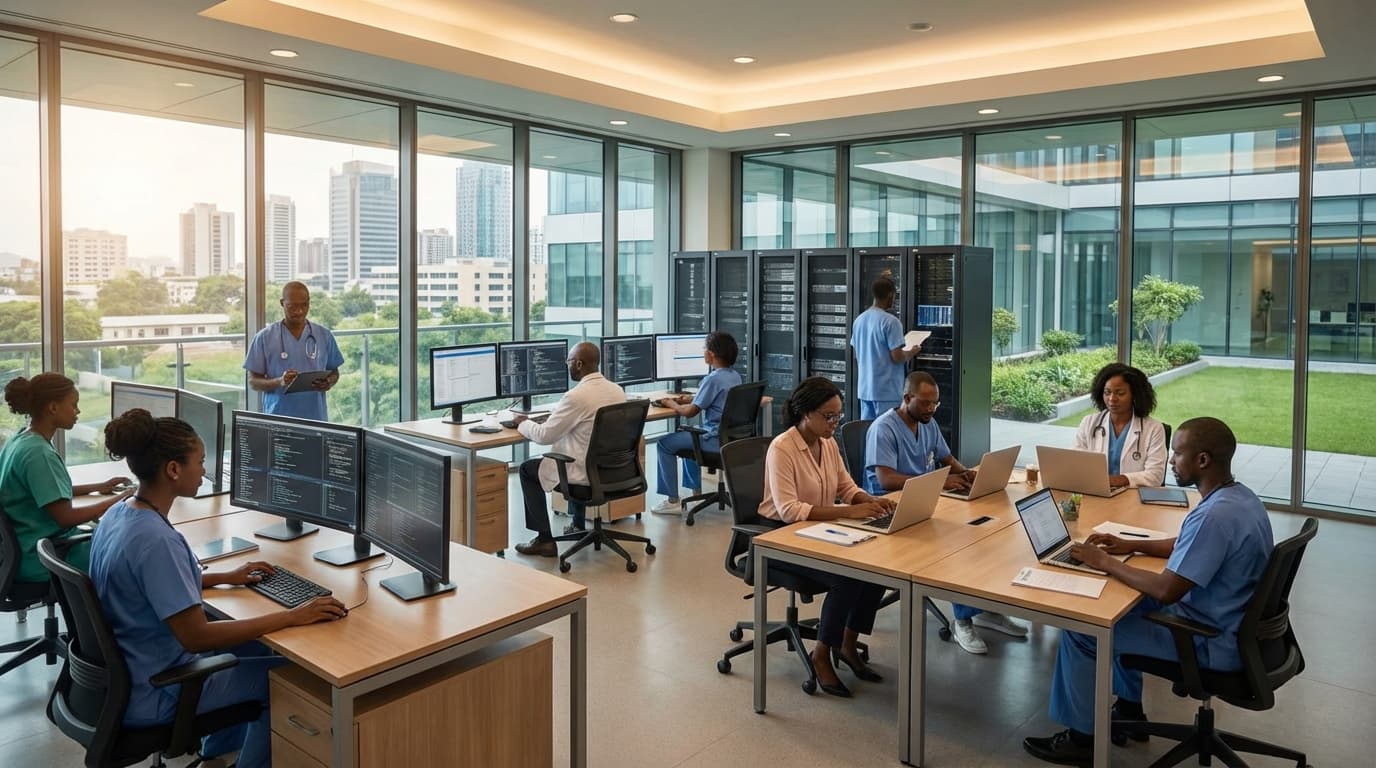
Hospital IT Integration Services in Rwanda
Engineering Excellence & Technical Support
EHR, PACS, RIS and equipment integration High-standard technical execution following OEM protocols and local regulatory frameworks.
Seamless EMR Interoperability Across Rwanda
We architect and implement robust Electronic Medical Record (EMR) integration solutions, ensuring secure and efficient data exchange between diverse healthcare facilities. Our expertise in national health information exchange (HIE) standards and FHIR enables a unified patient view, improving care coordination and reducing medical errors across Rwanda's growing healthcare landscape.
Scalable Cloud Infrastructure for Healthcare Innovation
Leveraging secure and compliant cloud platforms, we migrate and modernize hospital IT systems, offering enhanced scalability, disaster recovery, and reduced operational costs. This empowers Rwandan healthcare providers with access to advanced analytics, telehealth capabilities, and AI-driven tools for improved patient outcomes and operational efficiency.
Fortified Cybersecurity for Patient Data Protection
Our comprehensive cybersecurity strategies safeguard sensitive patient data and critical hospital infrastructure against evolving threats. We implement multi-layered security protocols, access controls, and compliance measures aligned with Rwandan data protection regulations, ensuring the trust and integrity of the digital healthcare ecosystem.
What Is Hospital It Integration Services In Rwanda?
Hospital IT Integration Services in Rwanda refer to the strategic implementation and management of interoperable information technology systems within healthcare facilities. This service aims to connect disparate healthcare IT applications, databases, and devices to facilitate seamless data exchange, improve workflow efficiency, and enhance patient care delivery. It involves the design, deployment, and ongoing maintenance of solutions that enable communication and data sharing between various systems, including Electronic Health Records (EHRs), Laboratory Information Systems (LIS), Picture Archiving and Communication Systems (PACS), billing systems, and administrative platforms. The primary objective is to create a unified digital ecosystem that provides a comprehensive view of patient information and operational data, thereby supporting better clinical decision-making, operational optimization, and regulatory compliance within the Rwandan healthcare landscape.
| Who Needs Hospital IT Integration Services in Rwanda? | Typical Use Cases |
|---|---|
| Public Hospitals: To improve efficiency, reduce duplicate testing, and enable better referral management across different departments and facilities within the public health sector. | Connecting EHRs with LIS for automated lab result reporting, reducing manual data entry errors and turnaround times. |
| Private Hospitals and Clinics: To enhance patient experience, streamline billing processes, and offer advanced diagnostic services by integrating specialized systems. | Integrating PACS with EHRs to allow clinicians to directly view and interpret medical images within the patient's record. |
| Healthcare Networks and Chains: To create a unified patient record across multiple locations, facilitating patient mobility and continuity of care. | Implementing a centralized patient portal that aggregates data from various clinical systems for patient access and engagement. |
| Government Health Ministries and Agencies: To improve health data collection, surveillance, and policy-making through aggregated and standardized data from healthcare facilities. | Enabling seamless data transfer for national health registries (e.g., disease registries, immunization registries). |
| Research Institutions and Universities: To facilitate access to anonymized or de-identified patient data for research purposes, contributing to medical advancements. | Automating the process of transferring patient demographic and basic clinical data for research cohorts. |
| Healthcare IT Vendors and System Integrators: To ensure their solutions can effectively integrate with existing or future hospital IT infrastructure in Rwanda. | Integrating financial and billing systems with clinical systems to ensure accurate and timely invoicing and revenue cycle management. |
Key Components of Hospital IT Integration Services
- Interoperability Standards Adoption: Implementing and adhering to established healthcare interoperability standards (e.g., HL7, FHIR) to ensure data can be exchanged and understood between different systems.
- Data Harmonization and Transformation: Mapping, transforming, and normalizing data from various sources into a standardized format for consistent access and analysis.
- Middleware and Integration Engine Deployment: Utilizing specialized software (e.g., integration engines, ESBs - Enterprise Service Buses) to manage the flow of data between applications.
- API Development and Management: Creating and managing Application Programming Interfaces (APIs) to enable programmatic access and data exchange between systems.
- Master Patient Index (MPI) Implementation: Establishing a unique identifier for each patient across all connected systems to prevent data duplication and ensure accuracy.
- Security and Access Control: Implementing robust security measures to protect sensitive patient data during transit and at rest, ensuring compliance with privacy regulations.
- Workflow Automation: Automating clinical and administrative workflows by connecting systems that trigger actions based on data exchange (e.g., automated lab order processing from EHR).
- Legacy System Integration: Developing strategies to integrate older, non-standardized IT systems with modern platforms.
- Real-time Data Monitoring and Analytics: Enabling real-time data visibility and facilitating advanced analytics for performance improvement and population health management.
Who Needs Hospital It Integration Services In Rwanda?
Hospital IT integration services are crucial for modern healthcare facilities in Rwanda to overcome data silos, improve patient care, and streamline operations. These services enable seamless communication between disparate IT systems, leading to enhanced efficiency, reduced errors, and better decision-making. By connecting Electronic Health Records (EHRs), laboratory information systems (LIS), Picture Archiving and Communication Systems (PACS), and billing systems, hospitals can create a unified digital ecosystem. This integration is particularly vital in a developing healthcare landscape like Rwanda's, where resources can be stretched and the need for optimized workflows is paramount.
| Target Customer Segment | Key Departments Benefiting from Integration |
|---|---|
| Public Hospitals | Admissions & Registration, Clinical Departments (e.g., Internal Medicine, Surgery, Pediatrics), Radiology, Laboratory, Pharmacy, Billing & Finance, IT Department, Management/Administration |
| Private Hospitals | Same as Public Hospitals, with potentially a stronger emphasis on patient experience and specialized services. |
| Mission-based Hospitals | Same as Public Hospitals, often with a focus on serving underserved populations and requiring robust, cost-effective solutions. |
| Large Clinics/Health Centers (with growing patient volume) | Patient Records Management, Appointment Scheduling, Basic Lab/Diagnostic Services, Pharmacy, Billing |
| Government Health Ministries/Agencies (e.g., Rwanda Biomedical Centre) | Data Management for Public Health Initiatives, Disease Surveillance, Health Information Systems, Policy Development, Resource Allocation |
| Healthcare Training Institutions | Access to anonymized patient data for educational purposes, simulation labs |
Target Customers and Departments for Hospital IT Integration Services in Rwanda:
- Hospitals (Public, Private, Mission-based)
- Clinics and Health Centers (requiring expansion of capabilities)
- Government Health Ministries and Agencies
- Research Institutions with healthcare data needs
Hospital It Integration Services Process In Rwanda
This document outlines the typical workflow for Hospital IT Integration Services in Rwanda, from initial inquiry to successful execution. The process is designed to ensure seamless integration of various IT systems within a hospital setting, enhancing operational efficiency, data management, and patient care.
| Stage | Description | Key Activities | Deliverables/Outcomes | Responsible Parties |
|---|---|---|---|---|
| The hospital expresses interest in IT integration services. | Initial contact, understanding of high-level needs, preliminary discussion of services offered. | Understanding of hospital's basic IT needs, identification of potential service provider. | Hospital Management, IT Department; Service Provider Sales/Consulting Team |
| A detailed understanding of the hospital's current IT infrastructure and future requirements. | Site visits, interviews with stakeholders (clinicians, administrators, IT staff), analysis of existing systems (EHR, HIS, PACS, etc.), mapping workflows. | Comprehensive Needs Assessment Report, Detailed Requirements Document, Gap Analysis. | Service Provider Business Analysts/Solution Architects, Hospital IT Department, Department Heads |
| Presenting a tailored solution and negotiating terms. | Developing a technical and financial proposal based on requirements, presenting the solution, negotiating scope, timelines, and costs. | Formal Proposal, Service Level Agreement (SLA), Contract. | Service Provider Project Managers/Sales Team; Hospital Procurement/Finance Department |
| Defining the project roadmap and technical architecture. | Creating a detailed project plan (tasks, timelines, resources), designing the integrated architecture, defining data migration strategies, security protocols. | Project Management Plan, Technical Architecture Design Document, Data Migration Plan, Security Plan. | Service Provider Project Managers/Technical Leads, Hospital IT Department |
| Acquiring necessary hardware, software, and deploying them. | Procuring hardware (servers, network equipment), software licenses, and deploying infrastructure according to the design. | Deployed infrastructure (hardware and software), inventory of procured items. | Service Provider Procurement Team/Field Engineers, Hospital IT Department |
| Connecting and configuring the various IT systems. | Configuring individual systems, developing and implementing interfaces between systems (e.g., HL7, FHIR), setting up data flow and synchronization. | Integrated systems, functional interfaces, configured workflows. | Service Provider Integration Specialists/Developers, Hospital IT Department |
| Ensuring all integrated systems function as expected. | Conducting unit testing, integration testing, user acceptance testing (UAT), performance testing, security testing. | Test reports, bug logs, UAT sign-off, validated integrated system. | Service Provider QA Team, Hospital End-Users/IT Department |
| Empowering hospital staff to use the integrated systems effectively. | Developing training materials, conducting user training sessions, providing system documentation, formal handover of the integrated system. | Trained staff, user manuals, system documentation, handover certificate. | Service Provider Training Team, Hospital Staff (End-Users, IT) |
| Transitioning to the live environment and providing initial support. | Phased or big-bang go-live, on-site support during the initial period, addressing immediate issues and troubleshooting. | Operational integrated system, resolved critical issues, initial support log. | Service Provider Support Team/On-site Engineers, Hospital IT Department |
| Ensuring continued system performance and improvement. | Regular system monitoring, performance tuning, software updates and patches, ongoing technical support, system audits and optimization recommendations. | Stable and optimized IT infrastructure, resolved ongoing issues, performance reports, system enhancement recommendations. | Service Provider Support Team, Hospital IT Department |
Key Stages of Hospital IT Integration Services in Rwanda
- Inquiry and Initial Consultation
- Needs Assessment and Requirement Gathering
- Proposal Development and Negotiation
- Project Planning and Design
- Procurement and Deployment
- Integration and Configuration
- Testing and Quality Assurance
- Training and Handover
- Go-Live and Post-Implementation Support
- Ongoing Maintenance and Optimization
Hospital It Integration Services Cost In Rwanda
Hospital IT integration services in Rwanda involve connecting various disparate IT systems within a healthcare facility to ensure seamless data flow, improved operational efficiency, and enhanced patient care. These services can range from basic network setup and hardware installation to complex Electronic Health Record (EHR) system implementation, telemedicine platform integration, and data analytics solutions. The cost of these services is influenced by several key factors, including the size and complexity of the hospital, the scope of integration required, the type of software and hardware involved, vendor expertise, and ongoing maintenance and support needs.
| Service Category | Estimated Price Range (RWF) | Notes |
|---|---|---|
| Basic Network Setup & Hardware Installation | 1,500,000 - 5,000,000 | For small clinics or initial infrastructure setup. |
| EHR/HIS Implementation (Small to Medium Hospital) | 10,000,000 - 50,000,000 | Includes software licensing, customization, data migration, and training. Varies significantly by vendor and complexity. |
| EHR/HIS Implementation (Large Hospital) | 50,000,000 - 200,000,000+ | For comprehensive integration across multiple departments and advanced functionalities. |
| LIS/RIS Integration | 3,000,000 - 15,000,000 | Cost depends on the complexity of integration with existing EHR/HIS. |
| Telemedicine Platform Integration | 2,000,000 - 10,000,000 | Includes platform setup, connectivity, and basic training. May be higher for advanced features. |
| Data Analytics & Reporting Solutions | 5,000,000 - 25,000,000 | Focuses on setting up dashboards, custom reports, and data warehousing. |
| Ongoing Maintenance & Support (Annual) | 5% - 15% of initial project cost | Covers software updates, technical support, and system monitoring. |
| Consultation & Needs Assessment | 500,000 - 2,000,000 | Initial phase to define requirements and scope. |
Key Pricing Factors for Hospital IT Integration Services in Rwanda
- Hospital Size and Complexity: Larger hospitals with multiple departments, specialized units, and a higher volume of patient data will naturally incur higher integration costs due to the increased number of systems to connect and the complexity of their interactions. Smaller clinics or specialized centers may have simpler requirements and thus lower costs.
- Scope of Integration: The breadth and depth of integration significantly impact pricing. Integrating basic patient registration and billing systems will be less expensive than integrating a full-fledged EHR with laboratory information systems (LIS), radiology information systems (RIS), pharmacy management, and potentially external healthcare providers.
- Software and Hardware: The cost of licensing new software (e.g., EHR, PACS, HIS) or upgrading existing ones is a major component. The need for new hardware, such as servers, network infrastructure (routers, switches, Wi-Fi), workstations, and specialized medical devices with connectivity capabilities, also adds to the overall expense.
- Vendor Expertise and Reputation: Established IT integration firms with a proven track record in the healthcare sector, particularly in Rwanda, may command higher fees due to their expertise, understanding of local regulations, and ability to deliver reliable solutions. Smaller or newer vendors might offer more competitive pricing.
- Customization and Development: Off-the-shelf solutions are generally more cost-effective than custom-developed integrations. If the hospital requires unique workflows or specific functionalities not readily available in standard packages, the cost of custom development will increase.
- Data Migration: The process of transferring existing patient data from legacy systems to new integrated platforms can be complex and time-consuming. The volume, format, and cleanliness of the data will directly influence the cost of migration services.
- Training and Support: Comprehensive training for hospital staff on the new integrated systems is crucial for successful adoption. Ongoing technical support, maintenance, and updates are also recurring costs that need to be factored in.
- Project Management: Effective project management is vital for the successful implementation of IT integration. The cost of dedicated project managers and their team's efforts contributes to the overall project expense.
- Regulatory Compliance: Ensuring that the integrated systems comply with Rwandan healthcare regulations and data privacy laws (e.g., RURA regulations) can sometimes require specialized configurations or audits, adding to the cost.
Affordable Hospital It Integration Services Options
Integrating disparate IT systems within a hospital is crucial for improving patient care, operational efficiency, and data security. However, the cost of such integration can be a significant barrier for many healthcare organizations. Fortunately, several affordable options and strategic approaches can make hospital IT integration more accessible. This includes leveraging value bundles and implementing effective cost-saving strategies. Value bundles offer pre-defined packages of services and solutions designed to meet specific integration needs at a predictable cost, often providing better value than procuring individual components. Cost-saving strategies focus on optimizing resource utilization, exploring open-source alternatives, negotiating favorable contracts, and prioritizing essential integrations to manage budget constraints effectively.
| Cost-Saving Strategy | Description | Benefit for IT Integration |
|---|---|---|
| Negotiate Volume Discounts | Leverage existing or future integration needs to secure better pricing from vendors when purchasing multiple services or licenses. | Reduced per-unit cost for integration software, hardware, and services. |
| Prioritize Integrations | Identify and focus on integrations that offer the highest impact on patient care, operational efficiency, or regulatory compliance first. | Optimized budget allocation, ensuring investment in high-value areas and avoiding unnecessary expenditure. |
| Leverage Existing Infrastructure | Explore if current IT infrastructure can be repurposed or augmented for integration needs, rather than investing in entirely new systems. | Lower capital expenditure on hardware and foundational software. |
| Phased Implementation | Break down complex integration projects into smaller, achievable phases with distinct milestones and budgets. | Spreads costs over time, allows for early wins and adjustments, and reduces the risk of large upfront investments. |
| Utilize Standardized APIs | Emphasize integration using standardized Application Programming Interfaces (APIs) like FHIR, which are designed for interoperability. | Reduces custom development effort and cost, making integrations more reusable and maintainable. |
| Cloud-Native Solutions | Opt for cloud-based integration platforms (iPaaS) that offer scalable resources and a subscription-based model. | Eliminates significant upfront hardware investment, offers flexibility, and often has a lower total cost of ownership. |
| Open-Source Technologies | Explore and utilize open-source middleware, data transformation tools, and messaging queues where appropriate. | Significantly reduces software licensing costs. |
| Managed Services & Outsourcing | Contract with third-party providers for integration design, implementation, and ongoing management. | Potentially lower operational costs by leveraging specialized expertise and economies of scale, avoiding the need for extensive in-house hiring and training. |
Affordable Hospital IT Integration Service Options & Strategies
- Value-Based Bundles: Packages that combine software, hardware, implementation, and ongoing support for specific integration goals (e.g., EHR to PACS integration bundle).
- Modular & Phased Integration: Breaking down large integration projects into smaller, manageable phases, allowing for incremental investments and quicker ROI.
- Cloud-Based Integration Platforms (iPaaS): Utilizing Software-as-a-Service (SaaS) solutions that offer scalability, reduced upfront infrastructure costs, and pay-as-you-go pricing models.
- Managed Services: Outsourcing integration management and maintenance to specialized third-party providers, often at a lower cost than maintaining an in-house team.
- Open-Source Integration Tools: Leveraging free or low-cost open-source software for specific integration tasks, reducing licensing fees.
- Interoperability Standards Adoption: Focusing on widely adopted standards like HL7 FHIR, which can simplify integration and reduce the need for custom development.
- Partnerships & Alliances: Collaborating with other healthcare organizations or vendors to share integration costs or leverage existing infrastructure.
- Retainer-Based Support: Negotiating fixed monthly fees for ongoing support and maintenance, providing predictable budgeting for integration services.
- Pre-built Connectors & Adapters: Utilizing pre-developed solutions for common system integrations, significantly reducing implementation time and cost.
Verified Providers In Rwanda
When seeking healthcare in Rwanda, ensuring you're connected with verified providers is paramount for quality and trust. Franance Health stands out as a premier platform, offering a curated network of credentialed healthcare professionals. This commitment to verification not only safeguards patient well-being but also elevates the standard of care across the nation. Understanding what 'verified' means in this context and why Franance Health's credentials are the benchmark for excellence is crucial for informed healthcare decisions.
| Verification Aspect | Franance Health's Standard | Benefit to Patients |
|---|---|---|
| Educational Background | Verified degrees, diplomas, and certifications from accredited institutions. | Ensures providers have received formal and recognized medical training. |
| Professional Licenses | Confirmed active and valid licenses from relevant Rwandan regulatory bodies. | Guarantees providers are legally authorized to practice medicine. |
| Experience and Specialization | Thorough review of past work history and documented specialized training. | Helps patients find specialists with the right expertise for their specific needs. |
| Reputation and Ethics | Includes checks for disciplinary actions and a commitment to ethical medical practice. | Promotes a safe and trustworthy healthcare experience. |
| Ongoing Performance Monitoring | Regular review of patient feedback and adherence to clinical guidelines. | Maintains a consistently high level of care from all listed providers. |
Why Franance Health's Verified Providers Represent the Best Choice:
- Rigorous Credentialing Process: Franance Health employs a multi-faceted verification system that goes beyond basic licensing. This includes thorough background checks, verification of educational qualifications, review of professional experience, and confirmation of specialized training.
- Commitment to Quality Assurance: Beyond initial verification, Franance Health actively monitors provider performance and patient feedback. This ongoing assurance mechanism ensures that all listed professionals maintain high standards of care.
- Access to Expertise: By partnering with Franance Health, patients gain access to a wide spectrum of medical specialists and general practitioners who have been meticulously vetted. This means you can be confident in the expertise of the professionals you connect with.
- Patient Safety First: The cornerstone of Franance Health's approach is patient safety. Their verification process is designed to mitigate risks and ensure that all providers adhere to ethical practices and established medical protocols.
- Transparency and Trust: Franance Health promotes transparency by clearly indicating verified providers. This fosters a sense of trust and empowers patients to make informed choices about their healthcare journey.
- Streamlined Healthcare Access: The platform simplifies the process of finding reliable healthcare, saving patients valuable time and reducing the stress associated with searching for qualified professionals.
- Upholding Professional Standards: By partnering with Franance Health, providers demonstrate their commitment to maintaining the highest professional standards, contributing to a more robust and dependable healthcare ecosystem in Rwanda.
Scope Of Work For Hospital It Integration Services
This Scope of Work (SOW) outlines the requirements for Hospital IT Integration Services. The project aims to integrate various hospital IT systems to improve data flow, enhance operational efficiency, and support better patient care. The services include system analysis, interface development, testing, deployment, and post-implementation support. Technical deliverables will adhere to industry-standard specifications to ensure interoperability and security.
| Deliverable Name | Description | Technical Specifications / Standards | Acceptance Criteria |
|---|---|---|---|
| Integration Architecture Design Document | Detailed blueprint of the integration strategy, including middleware, data flow diagrams, security protocols, and API specifications. | ISO 27001 (for security), TOGAF (for architecture principles), HIPAA (for privacy and security) | Approved by the IT steering committee; clarity and completeness of proposed architecture. |
| Interface Specifications | Documentation for each individual interface, detailing data elements, message formats, trigger events, and communication protocols. | HL7 v2.x, HL7 FHIR R4, DICOM, OpenAPI Specification (for RESTful APIs) | All specified data elements correctly mapped and validated; adherence to chosen standards. |
| Developed Integration Modules/Adapters | Software components developed to facilitate data exchange between disparate systems. | Language and framework specific to middleware chosen (e.g., Java, Python, .NET); version control (e.g., Git) | Successful compilation and unit testing; adherence to coding standards. |
| Test Plan and Test Cases | Comprehensive plan outlining testing phases (unit, integration, system, user acceptance) and detailed test scenarios. | IEEE 829 (for test documentation) | Coverage of all integration points and critical workflows; clear and repeatable test steps. |
| Integration Testing Results | Documentation of all testing conducted, including execution results, defect logs, and resolution status. | Defined defect tracking system (e.g., JIRA, Azure DevOps) | All critical and high-priority defects resolved; successful completion of all defined test cases. |
| Deployment Plan | Detailed plan for migrating the integrated solution into the production environment, including rollback procedures. | ITIL (for service transition) | Clear steps for deployment, communication plan, and defined rollback strategy. |
| Post-Implementation Support Plan | Outline of ongoing support, maintenance, and monitoring procedures for the integrated systems. | Service Level Agreements (SLAs) for support response and resolution times | Defined support contact points, escalation procedures, and monitoring tools. |
| Training Materials | Documentation and resources for end-users and IT staff on using and managing the integrated systems. | Clear, concise, and user-friendly documentation standards | Availability of comprehensive training guides and manuals. |
Key Integration Areas
- Electronic Health Record (EHR) System Integration
- Picture Archiving and Communication System (PACS) Integration
- Laboratory Information System (LIS) Integration
- Radiology Information System (RIS) Integration
- Pharmacy Management System Integration
- Billing and Financial Systems Integration
- Patient Monitoring Systems Integration
- Medical Device Integration
- Interoperability Standards Adoption (HL7, FHIR, DICOM)
Service Level Agreement For Hospital It Integration Services
This Service Level Agreement (SLA) outlines the agreed-upon levels of service, response times, and uptime guarantees for Hospital IT Integration Services. It is designed to ensure the reliable and efficient operation of integrated IT systems within the hospital, facilitating seamless data exchange between various clinical and administrative applications.
| Service Component | Severity Level | Response Time Target | Resolution Time Target | Uptime Guarantee | Notification Period |
|---|---|---|---|---|---|
| Integration Platform Monitoring | Critical (System-wide outage affecting patient care) | 15 minutes | 4 hours | 99.99% | Within 30 minutes of detection |
| Integration Platform Monitoring | High (Major functionality impacted, workarounds available) | 1 hour | 8 hours | 99.95% | Within 1 hour of detection |
| Integration Platform Monitoring | Medium (Minor functionality impacted, no significant patient care impact) | 4 hours | 24 hours | 99.90% | Within 4 hours of detection |
| Data Interface Management | Critical (All interfaces down) | 30 minutes | 3 hours | 99.98% | Within 45 minutes of detection |
| Data Interface Management | High (Key patient demographic or clinical data interface down) | 2 hours | 6 hours | 99.95% | Within 2 hours of detection |
| System Connectivity Assurance | Critical (Loss of connectivity to core EHR/LIS/RIS) | 15 minutes | 2 hours | 99.99% | Within 30 minutes of detection |
| API Gateway Availability | Critical (API Gateway unresponsive) | 15 minutes | 3 hours | 99.99% | Within 30 minutes of detection |
| Secure Data Transmission | High (Data integrity or confidentiality breach detected) | 1 hour | 4 hours | N/A (Focus on immediate containment and remediation) | Immediate notification upon suspicion |
Key Service Components
- Integration Platform Monitoring
- Data Interface Management
- System Connectivity Assurance
- API Gateway Availability
- Secure Data Transmission
Frequently Asked Questions

Ready when you are
Let's scope your Hospital IT Integration Services in Rwanda project in Rwanda.

Scaling healthcare logistics and technical systems across the entire continent.