
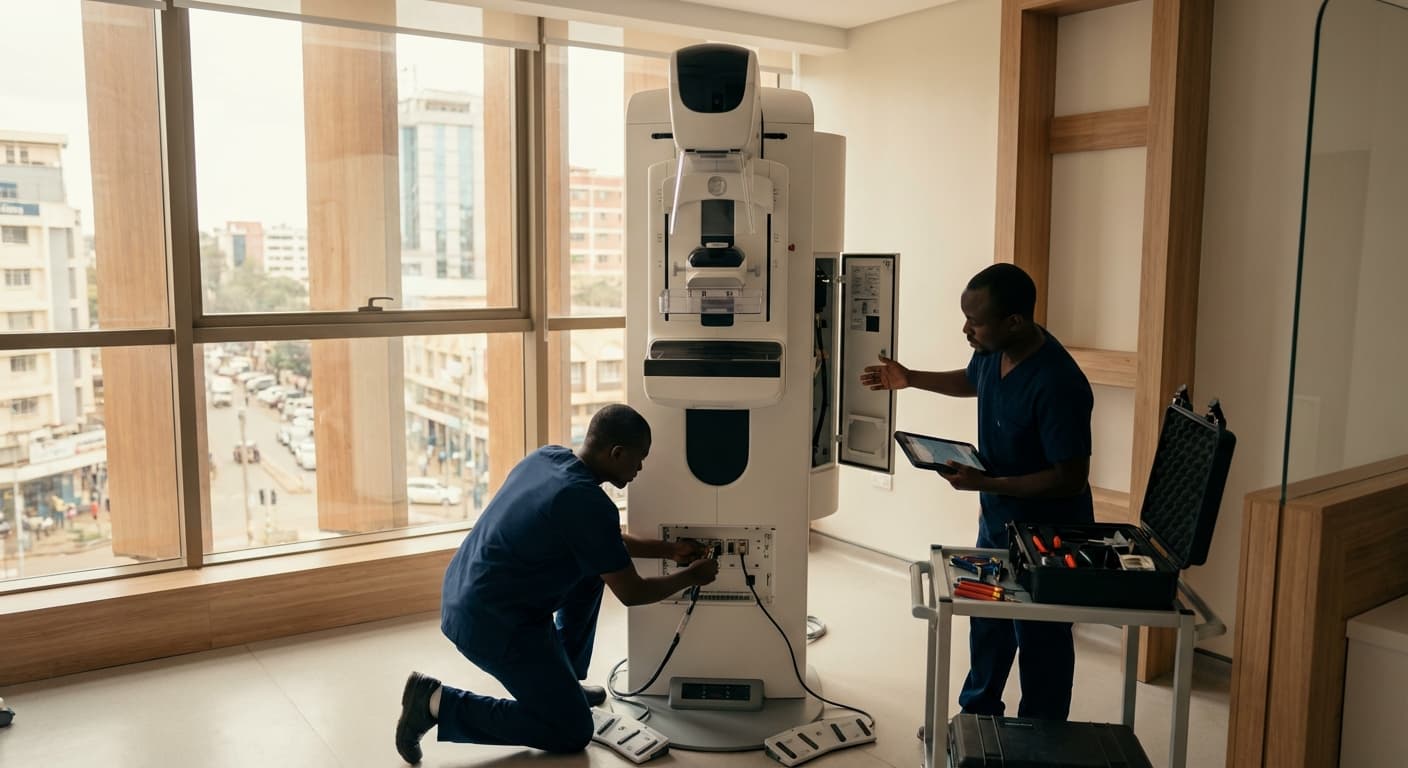
Mammography Installation Service in Rwanda
Engineering Excellence & Technical Support
Mammography Installation Service High-standard technical execution following OEM protocols and local regulatory frameworks.
Precision Imaging Expertise
Our certified technicians ensure optimal mammography unit calibration and alignment, guaranteeing high-resolution image quality for accurate early detection of breast cancer in Rwandan healthcare facilities.
Seamless Integration & Connectivity
We provide comprehensive installation and integration services, connecting new mammography systems with existing PACS and HIS networks, enabling efficient data management and immediate radiologist access across Rwanda.
Safety & Compliance Assured
Adhering to international safety standards and local regulations, our installation process prioritizes radiation safety for patients and staff, ensuring full compliance and dependable operation of mammography units throughout Rwanda.
What Is Mammography Installation Service In Rwanda?
Mammography Installation Service in Rwanda refers to the specialized process of setting up, configuring, and verifying mammography equipment within healthcare facilities. This service is crucial for ensuring that the imaging modality is operational, safe, and capable of producing diagnostic-quality mammograms, adhering to both international standards and local regulatory requirements. It encompasses the physical placement of the machine, integration with existing hospital infrastructure (including power, networking, and potentially Picture Archiving and Communication Systems - PACS), calibration, quality assurance testing, and initial training for radiographers and technicians. The objective is to facilitate early and accurate detection of breast abnormalities, thereby improving patient outcomes in breast cancer screening and diagnosis.
| Who Needs Mammography Installation Service? | Typical Use Cases | ||||
|---|---|---|---|---|---|
| Hospitals (public and private) | New breast imaging departments | Established radiology departments requiring upgrades | Clinics and diagnostic centers offering mammography services | Government health initiatives and screening programs | Research institutions incorporating mammography |
| Breast cancer screening programs (e.g., annual screenings for women over 40) | Diagnostic mammography for symptomatic patients (e.g., palpable lumps, nipple discharge) | Follow-up imaging for abnormal screening mammograms | Specific breast imaging protocols (e.g., diagnostic mammography with magnification, tomosynthesis) | Research studies involving breast imaging techniques | Quality control and assurance assessments of existing mammography units |
Key Components of Mammography Installation Service:
- Site assessment and planning
- Equipment delivery and unpacking
- Physical installation and mounting
- Electrical and network connectivity
- Radiation shielding verification
- System configuration and software setup
- Calibration and performance testing
- Quality Assurance (QA) protocols implementation
- Initial user training (radiographers, technicians, physicists)
- Integration with PACS/RIS (if applicable)
- Post-installation support and documentation
Who Needs Mammography Installation Service In Rwanda?
Mammography installation services in Rwanda are crucial for ensuring the proper functioning and effective use of these vital diagnostic tools. These services are primarily needed by healthcare facilities that are acquiring new mammography equipment or require maintenance and upgrades for existing systems. The goal is to guarantee accurate and reliable mammograms for breast cancer screening and diagnosis, ultimately contributing to improved patient outcomes in Rwanda.
| Customer Type | Primary Departments Involved | Key Needs/Reasons for Installation |
|---|---|---|
| Hospitals (Public & Private) | Radiology Department, Obstetrics & Gynecology Department, Oncology Department, Medical Engineering/Biomedical Department | Acquisition of new equipment, replacement of outdated systems, expansion of imaging services, ensuring regulatory compliance, improving diagnostic accuracy, patient throughput. |
| Diagnostic Imaging Centers | Radiology Department, Technical Operations | Setting up new facilities, upgrading to digital mammography, increasing capacity, maintaining service contracts, competitive service offerings. |
| Radiology Clinics | Radiology Department, Clinic Management | Specialized breast imaging services, catering to specific patient demographics, ensuring high-quality imaging for screening and early detection. |
| Large Medical Centers | Comprehensive Cancer Centers, Radiology Departments, Women's Health Centers | Integrating mammography into a broader suite of cancer care services, research purposes, advanced imaging techniques, handling high patient volumes. |
| Government Health Initiatives/Programs | Ministry of Health (specific departments), Public Health Agencies, District Hospitals | Implementing national screening programs, equipping public healthcare facilities in underserved areas, ensuring access to essential diagnostic services, public health surveillance. |
Target Customers & Departments for Mammography Installation Service in Rwanda
- Hospitals (Public and Private)
- Diagnostic Imaging Centers
- Radiology Clinics
- Large Medical Centers
- Government Health Initiatives/Programs
Mammography Installation Service Process In Rwanda
This document outlines the comprehensive workflow for mammography installation services in Rwanda, detailing each stage from initial client inquiry to the final handover and post-installation support. The process is designed to ensure a smooth, efficient, and compliant installation of mammography equipment, meeting the specific needs of healthcare facilities across the country.
| Phase | Key Activities | Responsible Parties | Deliverables/Outcomes | Timeline (Typical) |
|---|---|---|---|---|
| Initial contact from healthcare facility to discuss needs. Site visit (if applicable) to assess space, power, and environmental requirements. Proposal generation detailing equipment, services, and costs. | Client (Hospital/Clinic), Service Provider (Technical Sales Team) | Understanding of client requirements, Site assessment report, Formal proposal, Budget estimation. | 1-2 Weeks |
| Agreement on terms and conditions. Signing of contract. Procurement of the mammography equipment and necessary accessories. Logistics planning for delivery. | Client, Service Provider (Procurement/Legal Team) | Signed contract, Purchase Order, Equipment order confirmation, Delivery schedule. | 2-4 Weeks (Varies based on equipment lead time) |
| Client prepares the designated installation area according to specifications (e.g., structural reinforcement, radiation shielding, electrical supply, HVAC, network connectivity). Service provider may offer guidance and supervision. | Client (Facility Management, Biomedical Engineering), Service Provider (Technical Team - Guidance) | Ready installation room, Verified power supply, Adequate ventilation, Network access points. | 2-6 Weeks (Varies based on facility readiness) |
| Arranging for safe transportation of the mammography unit and accessories to the client's site. Careful unpacking and initial inspection for any visible damage. | Service Provider (Logistics Team, Installation Technicians) | Equipment safely on-site, Unpacking completed, Initial damage check report. | 1-3 Days |
| Skilled technicians assemble and install the mammography unit. Connection to power, network, and other required infrastructure. Adherence to manufacturer guidelines and local regulations. | Service Provider (Installation Technicians, Biomedical Engineers) | Mammography unit physically installed, All components connected, Basic system checks. | 3-7 Days |
| Performing precise calibration of the mammography system for optimal image quality and radiation safety. Comprehensive testing of all functions, including image acquisition, processing, and archiving. Performance verification against established standards. | Service Provider (Certified Technicians, Medical Physicists) | Calibrated mammography system, Comprehensive test reports, Image quality assessment, Radiation safety compliance report. | 2-5 Days |
| Training clinical staff (radiologists, radiographers) on the operation of the new mammography system, including image acquisition techniques, quality control procedures, and basic troubleshooting. Training for IT staff on PACS integration. | Service Provider (Application Specialists, Trainers), Client (Clinical and IT Staff) | Trained personnel, User manuals provided, Competency assessment (optional). | 3-5 Days |
| Joint inspection of the installed and tested system by the service provider and the client. Review of all documentation, including test reports and training records. Formal handover of the equipment and associated documents. | Service Provider (Project Manager), Client (Facility Management, Biomedical Engineering) | Client acceptance of the installed system, Complete documentation package, Formal handover certificate. | 1-2 Days |
| Provision of ongoing technical support, preventative maintenance services, and troubleshooting as per the service contract. Ensuring continued optimal performance and addressing any post-installation issues. | Service Provider (Technical Support Team, Maintenance Engineers) | Service Level Agreement (SLA) adherence, Regular maintenance visits, Responsive technical assistance, Ongoing system optimization. | Ongoing (as per contract) |
Mammography Installation Service Process in Rwanda
- Pre-Installation Assessment and Planning
- Site Preparation and Infrastructure Verification
- Equipment Delivery and Unpacking
- Installation and Assembly
- Calibration and Testing
- Staff Training
- Final Inspection and Handover
- Post-Installation Support and Maintenance
Mammography Installation Service Cost In Rwanda
Installing a mammography unit in Rwanda involves several key factors that influence the overall cost. These factors range from the type and complexity of the mammography equipment itself to the logistical and technical requirements of the installation. Understanding these elements is crucial for healthcare facilities planning to invest in or upgrade their diagnostic imaging capabilities. The costs are typically quoted in Rwandan Francs (RWF).
| Installation Component | Estimated Cost Range (RWF) | Notes |
|---|---|---|
| Basic Digital Mammography (FFDM) Unit (Equipment Only) | 25,000,000 - 50,000,000 | Excludes installation, training, and taxes. May be slightly lower for analog systems, but digital is standard. |
| 3D Mammography (Tomosynthesis) Unit (Equipment Only) | 50,000,000 - 100,000,000+ | Advanced features and higher resolution contribute to higher costs. |
| Installation, Commissioning & Site Preparation | 5,000,000 - 15,000,000 | Varies significantly based on room modifications, power requirements, and lead shielding needs. |
| Comprehensive Training (Radiographers & Technicians) | 2,000,000 - 5,000,000 | May be a one-time cost per session or per trainee. |
| Software & PACS Integration | 3,000,000 - 10,000,000 | Depends on the complexity of integration with existing hospital IT infrastructure. |
| First Year Maintenance & Support Contract | 2,000,000 - 6,000,000 | Annual cost, often a percentage of the equipment's purchase price. |
| Ancillary Equipment (Workstations, Viewers) | 2,000,000 - 7,000,000 | Can be bundled with the main unit or purchased separately. |
| Import Duties, VAT & Associated Fees | 15% - 30% of CIF value (approximate) | Subject to current Rwandan tax regulations and the equipment's declared value. |
| Total Estimated Installation Cost (Digital Mammography) | 40,000,000 - 90,000,000+ | This is a broad range and can be higher for 3D systems or specialized installations. |
Key Pricing Factors for Mammography Installation in Rwanda
- Equipment Cost: This is the most significant component, varying based on whether it's a basic analog, digital (FFDM), or 3D tomosynthesis system. Features like contrast enhancement capabilities and AI-powered tools also impact the price.
- Installation & Commissioning: This covers the physical setup of the machine, including any necessary structural modifications to the room (e.g., lead shielding, ventilation, power supply upgrades), calibration, and initial testing by certified technicians.
- Training: Comprehensive training for radiographers, technicians, and potentially radiologists on operating the new equipment and interpreting the images is essential and often included in the package or as a separate cost.
- Site Preparation: Costs associated with preparing the installation site, which might include electrical work, HVAC system adjustments, and ensuring adequate space and accessibility for the equipment and its accessories.
- Software & PACS Integration: The cost of mammography-specific software, including image acquisition, processing, and potentially Picture Archiving and Communication System (PACS) integration for digital archiving and retrieval of images.
- Maintenance & Support Contracts: Ongoing service agreements for preventative maintenance, repairs, and technical support are critical for ensuring the longevity and optimal performance of the equipment.
- Ancillary Equipment: This can include items like image processing workstations, viewing stations, quality control phantoms, and other necessary accessories.
- Import Duties & Taxes: For imported equipment, applicable customs duties, value-added tax (VAT), and other import-related fees will add to the overall cost.
- Geographical Location & Accessibility: Installation in remote areas or facilities with challenging access might incur higher logistical costs for transporting equipment and personnel.
- Vendor & Service Provider: Different manufacturers and local distributors will have varying pricing structures, warranty terms, and service level agreements.
Affordable Mammography Installation Service Options
Securing affordable mammography installation services is crucial for healthcare facilities looking to expand or upgrade their diagnostic imaging capabilities without breaking the budget. This involves understanding the different types of service packages available, such as value bundles, and implementing smart cost-saving strategies. Value bundles often combine installation with training, maintenance, or even initial calibration, offering a more integrated and potentially cost-effective solution than purchasing services à la carte. Strategic planning, careful vendor negotiation, and exploring refurbished equipment options are also key to managing installation expenses.
| Value Bundle Component | Included Services | Potential Cost Savings |
|---|---|---|
| Basic Installation | Physical setup, cabling, and initial power connection. | Lower upfront cost if you have in-house IT/technical staff. |
| Standard Installation + Training | Basic installation plus training for technicians and radiologists on equipment operation. | Saves on separate training fees, ensures faster clinical adoption. |
| Comprehensive Installation Bundle | Installation, initial calibration, operator training, and potentially a short-term maintenance contract. | Streamlines the process, reduces administrative overhead, offers immediate support. |
| Installation & Site Prep Bundle | Includes installation and assistance with or completion of necessary site modifications (e.g., electrical, HVAC). | Prevents delays and extra charges due to unaddressed site requirements. |
Key Considerations for Affordable Mammography Installation
- Understanding Value Bundles: Packages that integrate multiple services (installation, training, maintenance).
- Cost-Saving Strategies: Proactive measures to reduce overall installation expenditure.
- Vendor Negotiation: Discussing pricing, scope of work, and potential discounts.
- Refurbished Equipment: Considering pre-owned systems which often have lower upfront costs.
- Phased Installation: Breaking down the installation process into manageable stages if budget is a concern.
- Site Preparation: Ensuring your facility is ready to minimize on-site work and associated costs.
- Long-Term Service Agreements: Negotiating favorable terms for ongoing support.
- Leasing vs. Purchasing: Evaluating the financial implications of each model.
Verified Providers In Rwanda
In Rwanda's evolving healthcare landscape, ensuring access to verified and credible providers is paramount. Franance Health stands out as a beacon of trust, offering a network of healthcare professionals and facilities that have undergone rigorous credentialing processes. This commitment to verification not only safeguards patient well-being but also elevates the overall standard of healthcare delivery in the nation. Choosing Franance Health means opting for quality, reliability, and a patient-centric approach backed by robust vetting.
| Credentialing Aspect | Franance Health's Approach | Benefit to Patients |
|---|---|---|
| Professional Licensing and Registration | Mandatory verification of current and valid licenses from relevant Rwandan regulatory bodies (e.g., Rwanda Health Professions Council). | Ensures providers are legally qualified and authorized to practice, offering peace of mind. |
| Educational Background and Qualifications | Thorough review of academic degrees, diplomas, and specialized training certificates from accredited institutions. | Guarantees that healthcare professionals possess the necessary theoretical knowledge and practical skills. |
| Work Experience and Practice History | Verification of past employment, including reference checks and assessment of clinical experience duration and relevance. | Confirms practical competence and a proven track record in delivering healthcare services. |
| Criminal Background and Disciplinary Records | Screening for any past criminal convictions or disciplinary actions taken against the provider by professional bodies. | Protects patients by ensuring providers have a clean professional record and uphold ethical standards. |
| Continuing Professional Development (CPD) | Confirmation of ongoing participation in accredited CPD programs to stay updated with medical advancements and best practices. | Ensures patients receive care informed by the latest medical knowledge and techniques. |
| Facility Accreditation and Compliance | For partner facilities, verification of compliance with Rwandan Ministry of Health regulations, safety standards, and operational protocols. | Ensures a safe, clean, and well-equipped environment for medical procedures and patient care. |
Why Franance Health Represents the Best Choice for Verified Providers in Rwanda:
- Comprehensive Vetting Process: Franance Health employs a multi-layered approach to credentialing, scrutinizing the qualifications, experience, and ethical standing of every provider in their network.
- Commitment to Quality Standards: We ensure that all affiliated healthcare professionals and institutions adhere to the highest national and international quality of care benchmarks.
- Enhanced Patient Safety: By partnering with verified providers, Franance Health significantly reduces the risk of medical errors and ensures patients receive care from competent and licensed professionals.
- Streamlined Access to Trusted Care: Our platform simplifies the process of finding reliable healthcare services, connecting individuals with specialists and facilities they can depend on.
- Continuous Monitoring and Improvement: Franance Health's commitment extends beyond initial verification, with ongoing performance monitoring and feedback mechanisms to maintain the integrity of our network.
- Promoting Health Equity: By standardizing access to verified care, we contribute to a more equitable healthcare system for all Rwandans.
- Technological Integration for Efficiency: Leveraging technology, Franance Health enhances the transparency and accessibility of verified provider information, empowering patients with informed choices.
Scope Of Work For Mammography Installation Service
This Scope of Work (SOW) outlines the requirements for the professional installation of a new mammography system at [Hospital/Clinic Name]. The service includes all necessary technical tasks, labor, materials, and testing to ensure the system is fully operational and meets all relevant regulatory and performance standards. This document also defines the key technical deliverables and standard specifications for the installation.
| Category | Specification/Requirement | Description | Verification Method |
|---|---|---|---|
| Site Preparation | Room Dimensions & Layout | Ensure adequate space for the mammography unit, operator console, and patient workflow, adhering to manufacturer guidelines. | Site survey report, manufacturer's installation manual review. |
| Site Preparation | Environmental Conditions | Maintain specified temperature, humidity, and ventilation as per manufacturer's requirements. Ambient light control must be sufficient. | Environmental monitoring logs, visual inspection. |
| Site Preparation | Power Requirements | Dedicated, grounded, and surge-protected power supply meeting system voltage and amperage requirements. UPS backup as specified. | Electrical contractor report, system power specifications review, UPS testing. |
| Site Preparation | Radiation Shielding | Verify adequate lead shielding in walls, doors, and viewing windows to meet ALARA principles and local/national regulations. | Radiation physicist report, shielding design documentation review. |
| Installation | Physical Placement | Precise positioning of the mammography unit, X-ray tube, detector, and operator console according to manufacturer's layout. | Visual inspection against approved layout, alignment checks. |
| Installation | Mechanical Assembly | Secure and correct assembly of all mechanical components, including gantry, patient support, and armatures. | Visual inspection, functional movement tests. |
| Installation | Electrical Connections | Professional wiring of all system components to power, data, and control systems. | Electrical inspection, continuity testing. |
| Installation | Network Integration | Secure connection and configuration of the system to the hospital's PACS/RIS network, ensuring DICOM compliance. | Network connectivity tests, DICOM conformance statement review, test image transmission. |
| Commissioning & Testing | System Calibration | Perform initial calibration of X-ray generator, detector, and image processing parameters. | Calibration reports, phantom image analysis. |
| Commissioning & Testing | Image Quality Tests | Conduct tests using phantoms to assess resolution, contrast, noise, and artifact levels against manufacturer and regulatory standards. | Image quality reports, ACR accreditation phantom testing. |
| Commissioning & Testing | Performance Verification | Test all system modes (e.g., FFDM, tomo, biopsy guidance) for functionality and accuracy. | Functional test reports for all modes. |
| Commissioning & Testing | Radiation Output Consistency | Verify consistency and accuracy of radiation dose output across all selected kVp and mAs settings. | Dosimetry reports, output consistency checks. |
| Commissioning & Testing | Safety Interlocks | Test all safety interlocks (e.g., door interlocks, emergency stop buttons, patient compression limits) for proper operation. | Safety interlock test reports. |
| Commissioning & Testing | Quality Control (QC) | Establish baseline QC procedures and data as required by regulatory bodies and manufacturer. | Initial QC test results, QC manual setup. |
| Training | Operator Training | Provide comprehensive hands-on training for radiographers and technologists on system operation, image acquisition, and basic troubleshooting. | Training attendance records, post-training competency assessment. |
| Training | Technical Training | Provide basic technical training for biomedical engineering staff on system maintenance, error codes, and basic troubleshooting. | Training attendance records. |
Technical Deliverables
- Fully installed and commissioned mammography system.
- Comprehensive site preparation report.
- Successful completion of all system performance and quality control tests.
- Installation and configuration of all associated software (PACS, RIS, etc.).
- Integration with existing hospital IT infrastructure.
- User training documentation and session.
- As-built drawings and schematics.
- Warranty and service agreement documentation.
- Final acceptance certificate.
Service Level Agreement For Mammography Installation Service
This Service Level Agreement (SLA) outlines the response times and uptime guarantees for the Mammography Installation Service provided by [Your Company Name] to [Client Name]. This SLA is an appendix to the Master Services Agreement (MSA) dated [Date of MSA].
| Incident Severity | Response Time Guarantee | Resolution Time Target | Uptime Guarantee (Monthly) |
|---|---|---|---|
| Critical Incident | 2 Business Hours | 8 Business Hours | 99.8% |
| Major Incident | 4 Business Hours | 24 Business Hours | 99.8% |
| Minor Incident | 8 Business Hours | 48 Business Hours | 99.8% |
Definitions
- Installation Service: Refers to the professional services provided for the setup, configuration, and initial testing of a mammography unit at the client's designated facility.
- Critical Incident: An incident that renders the mammography unit completely inoperable, preventing any patient imaging.
- Major Incident: An incident that significantly impairs the functionality of the mammography unit, impacting a substantial portion of its capabilities or leading to a significant reduction in imaging throughput.
- Minor Incident: An incident that causes a non-critical issue, such as a minor display anomaly, a non-essential feature malfunction, or a user interface inconvenience, but does not prevent core imaging functions.
- Response Time: The maximum allowable time from the moment a support request is logged until a qualified technician begins actively working on the issue.
- Resolution Time: The maximum allowable time from the moment a support request is logged until the issue is resolved and the mammography unit is fully operational.
- Uptime Guarantee: The percentage of time the mammography unit is expected to be operational and available for use, excluding scheduled maintenance.
- Scheduled Maintenance: Pre-planned periods for routine maintenance, upgrades, or inspections, which will be communicated to the client in advance.
Frequently Asked Questions

Ready when you are
Let's scope your Mammography Installation Service in Rwanda project in Rwanda.

Scaling healthcare logistics and technical systems across the entire continent.