
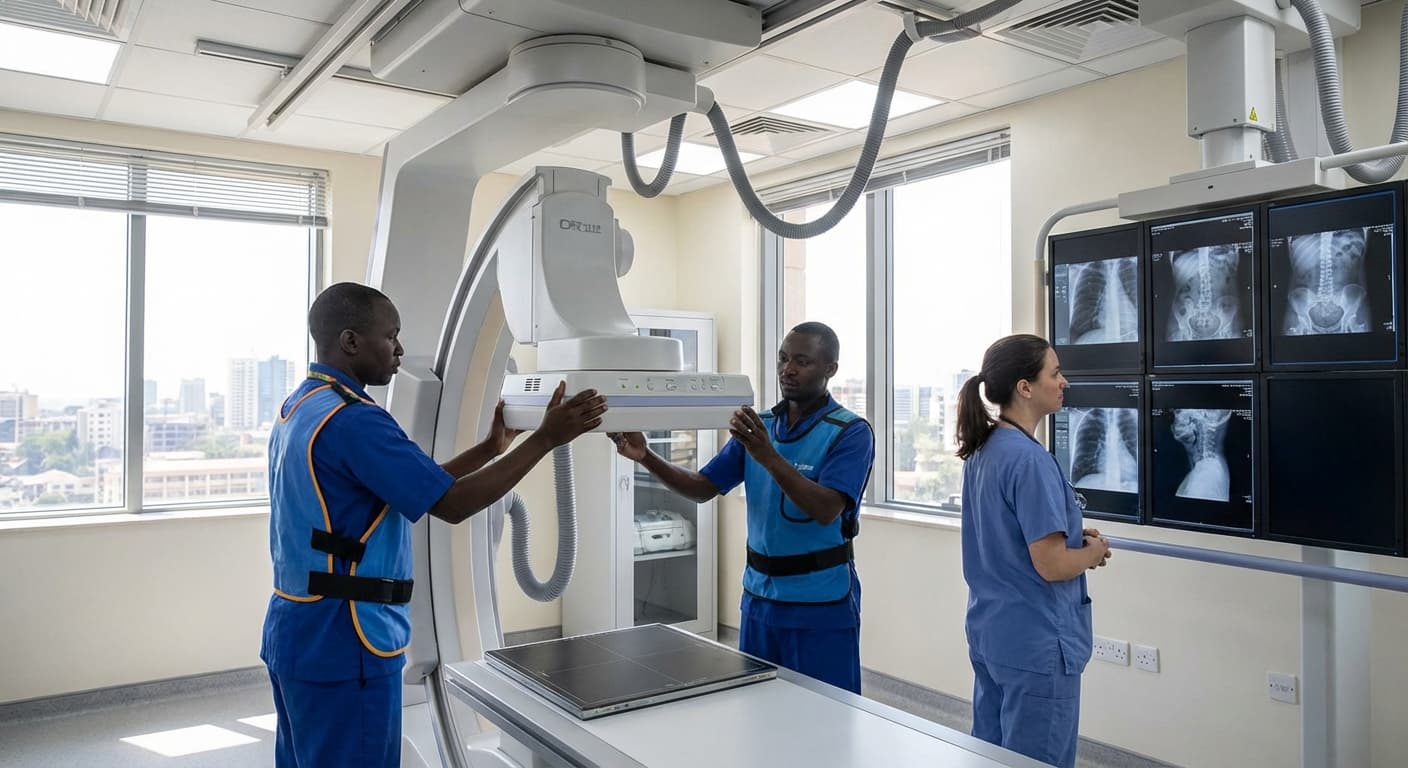
Digital X-Ray Installation Service (Fixed DR) in Rwanda
Engineering Excellence & Technical Support
Digital X-Ray Installation Service (Fixed DR) High-standard technical execution following OEM protocols and local regulatory frameworks.
Advanced Imaging Solutions
We provide state-of-the-art Fixed Digital Radiography (DR) systems, offering superior image quality and diagnostic accuracy, ensuring reliable and precise medical imaging for healthcare providers across Rwanda.
Expert Installation & Calibration
Our certified technicians deliver seamless installation and meticulous calibration of Fixed DR systems, minimizing downtime and guaranteeing optimal performance from day one, tailored to your facility's specific needs.
Comprehensive Support & Training
Beyond installation, we offer comprehensive post-installation support and operator training, empowering your medical staff with the knowledge to effectively utilize the Fixed DR system and maximize its diagnostic capabilities in Rwanda.
What Is Digital X-ray Installation Service (Fixed Dr) In Rwanda?
Digital X-Ray Installation Service (Fixed DR) in Rwanda refers to the professional and systematic process of setting up a fixed Digital Radiography (DR) system within a healthcare facility. This service encompasses the entire lifecycle from initial site assessment and equipment integration to calibration, testing, and initial user training. Fixed DR systems are permanently installed imaging devices, typically integrated into a dedicated X-ray room, providing high-resolution, immediate digital radiographic images without the need for film processing or manual image acquisition steps associated with older technologies. The service ensures the DR system is optimally configured to meet the specific clinical demands and regulatory requirements of Rwandan healthcare providers.
| Who Needs This Service? | Typical Use Cases |
|---|---|
| Hospitals (Public and Private) | General radiography for diagnostic imaging (e.g., chest X-rays, skeletal imaging, abdominal imaging). |
| Radiology Centers and Clinics | Specialized imaging procedures requiring high-throughput and immediate digital output. |
| Specialized Medical Facilities (e.g., Orthopedic Centers, Pediatric Hospitals) | Ensuring optimal image quality for specific anatomical regions and patient populations. |
| New Healthcare Facility Construction/Renovation | Incorporating state-of-the-art diagnostic imaging infrastructure from the outset. |
| Existing Facilities Upgrading from Film-Screen or CR | Transitioning to a more efficient, higher-quality digital imaging workflow. |
Key Components of Digital X-Ray Installation Service (Fixed DR):
- Site Survey and Planning: Comprehensive evaluation of the installation environment, including power supply, radiation shielding requirements, space constraints, network connectivity, and integration with existing Picture Archiving and Communication Systems (PACS) or Hospital Information Systems (HIS).
- Equipment Delivery and Unpacking: Safe and secure transport of the fixed DR components, including the X-ray generator, detector (usually a flat panel detector), support structure (e.g., wall stand, table), and associated control console.
- Mechanical and Electrical Installation: Precise mounting and alignment of all mechanical components. Installation of dedicated power lines, grounding, and integration with building management systems where applicable. This often involves specialized electricians and technicians.
- Detector Integration and Calibration: Securely integrating the digital detector with the X-ray generator and acquisition workstation. Performing precise calibration procedures to ensure accurate image acquisition, contrast, and spatial resolution.
- Software Configuration and Integration: Installation and configuration of the X-ray control software, image acquisition software, and potentially PACS/HIS integration modules. This ensures seamless workflow from image capture to archiving and retrieval.
- Radiation Safety Compliance: Verification and implementation of appropriate radiation shielding and safety protocols in accordance with Rwandan Ministry of Health regulations and international best practices. This includes dose monitoring and safety interlocks.
- System Testing and Quality Assurance (QA): Rigorous testing of all system functions, including image quality, exposure parameters, detector performance, and workflow efficiency. This often involves phantom imaging and clinical validation.
- User Training: Comprehensive training for radiographers, technicians, and radiologists on the operation of the fixed DR system, image acquisition techniques, troubleshooting common issues, and basic maintenance procedures.
- Documentation and Handover: Provision of detailed system documentation, including manuals, calibration certificates, warranty information, and site preparation reports. Formal handover of the fully operational system to the healthcare facility.
Who Needs Digital X-ray Installation Service (Fixed Dr) In Rwanda?
In Rwanda, the need for reliable and efficient digital X-ray installation services, particularly for Fixed Digital Radiography (DR) systems, is growing. These advanced imaging solutions offer significant advantages over traditional film-based X-rays, including faster image acquisition, improved diagnostic accuracy, enhanced workflow, and reduced radiation exposure for patients. This translates to better patient care and more operational efficiency for healthcare providers. The installation of these sophisticated systems requires specialized expertise to ensure optimal performance, integration with existing Picture Archiving and Communication Systems (PACS) and Electronic Health Records (EHR), and compliance with regulatory standards. Therefore, healthcare facilities and government health initiatives looking to upgrade their diagnostic imaging capabilities are prime candidates for professional Fixed DR installation services.
| Department | Key Benefits of Fixed DR Installation | Specific Needs |
|---|---|---|
| Radiology Department | Improved image quality, reduced scan times, efficient workflow, enhanced diagnostic accuracy, digital archiving and retrieval. | Integration with PACS/EHR, operator training, system calibration, network infrastructure setup. |
| Emergency Department (ER) | Rapid image acquisition for trauma cases, immediate diagnostic support, improved patient throughput. | Robust system for high-volume use, reliable performance, quick image availability for critical decisions. |
| Orthopedics Department | High-resolution imaging of bone structures, detailed visualization for fracture assessment and surgical planning. | Accurate measurement tools, ability to capture large anatomical areas, post-processing capabilities for orthopedic imaging. |
| Internal Medicine/General Wards | Diagnosis of pulmonary conditions, abdominal issues, and other non-trauma related conditions. | Versatile imaging capabilities, ease of use for routine chest X-rays and other general imaging needs. |
| Pediatrics Department | Lower radiation dose capabilities, faster imaging to minimize patient discomfort and movement, improved diagnostic accuracy for smaller anatomical structures. | Child-friendly protocols, ability to capture images quickly in cooperative and uncooperative children. |
| Surgery Department | Pre-operative and post-operative imaging for surgical planning and monitoring, intra-operative imaging support. | High-resolution imaging for detail, rapid image access to guide surgical interventions. |
Target Customers and Departments for Fixed DR Installation Services in Rwanda
- {"title":"Hospitals (Public and Private)","description":"Hospitals are the primary beneficiaries of advanced diagnostic imaging. They require these systems for routine diagnostics, emergency care, and specialized treatments across various departments. Both large urban hospitals and smaller regional facilities looking to enhance their diagnostic capabilities are key targets."}
- {"title":"Specialized Diagnostic Imaging Centers","description":"Dedicated imaging centers that focus on providing a range of radiological services to outpatients and referred patients. Upgrading to Fixed DR systems allows them to offer faster turnaround times and higher quality images, attracting more referrals."}
- {"title":"Government Health Initiatives and Ministry of Health","description":"The Rwandan government, through its Ministry of Health and various health programs, is often involved in modernizing healthcare infrastructure. Projects aimed at improving access to quality diagnostic imaging nationwide, especially in underserved areas, would necessitate the installation of Fixed DR systems."}
- {"title":"Tertiary and Referral Hospitals","description":"These facilities handle complex cases and require the most advanced imaging technology for accurate diagnosis and treatment planning. Fixed DR systems are crucial for their specialized departments."}
- {"title":"Medical Training and Research Institutions","description":"Universities and medical training centers that offer radiology programs need state-of-the-art equipment for educating future radiologists and conducting research. Accurate and efficient imaging is paramount for both."}
- {"title":"Mobile Diagnostic Units (for strategic deployment)","description":"While DR systems are typically fixed, there are scenarios where mobile units equipped with fixed DR technology are deployed strategically to reach remote populations. Installation and maintenance of such units would also be a requirement."}
Digital X-ray Installation Service (Fixed Dr) Process In Rwanda
This document outlines the typical workflow for installing a Fixed Digital Radiography (DR) X-ray system in Rwanda, from the initial customer inquiry to the final system execution and handover. The process is designed to ensure efficient and compliant installation, catering to the specific regulatory and logistical landscape of Rwanda.
| Phase | Key Activities | Responsible Parties | Typical Timeline (Weeks) |
|---|---|---|---|
| Customer expresses interest, submits basic facility details. Vendor provides preliminary information, understands basic needs, and schedules an initial consultation. | Customer (Clinic/Hospital), Vendor (Sales/Technical Team) | 0.5 - 1 |
| Detailed on-site evaluation of the X-ray room (dimensions, radiation shielding requirements, power, networking), surrounding areas, and infrastructure. Assessment of existing equipment and workflow. Preliminary system configuration planning. | Vendor (Technical Engineer, Project Manager), Customer (Radiology Head, Facility Manager) | 1 - 2 |
| Based on site assessment, vendor provides a detailed quotation including equipment, installation, training, and warranty. Negotiation and signing of the purchase and installation contract. | Vendor (Sales Team, Management), Customer (Procurement, Management) | 1 - 2 |
| Vendor procures the DR system components. Arranges international shipping to Rwanda, including customs clearance and local transportation to the installation site. | Vendor (Procurement, Logistics Team) | 4 - 12 (Varies based on lead times and shipping) |
| Customer, with guidance from the vendor, completes necessary civil works, electrical upgrades, radiation shielding verification/installation, and network infrastructure setup as per the agreed plan. | Customer (Contractors, Technicians), Vendor (Technical Advisor) | 2 - 6 (Concurrent with Procurement/Logistics) |
| DR system components arrive on-site. Careful unpacking and inspection for any transit damage. | Vendor (Installation Team), Customer (Site Personnel) | 0.5 |
| Installation of the X-ray generator, detector, table/wall stand, workstation, and all associated cabling. Ensuring precise alignment and secure mounting. | Vendor (Installation Engineers) | 1 - 2 |
| Installation and configuration of the DR imaging software (PACS/RIS integration if applicable), operating system, and device drivers. Network connectivity setup. | Vendor (Software Engineers, Network Specialists) | 0.5 - 1 |
| Comprehensive functional testing of all system components. Image quality verification and calibration according to international standards and local regulations. Dose verification checks. | Vendor (Installation Engineers, Application Specialist) | 0.5 - 1 |
| Training for radiology technologists and relevant clinical staff on system operation, image acquisition techniques, basic troubleshooting, and quality control procedures. | Vendor (Application Specialist, Trainer), Customer (Radiology Staff) | 0.5 - 1 |
| Joint inspection by vendor and customer to confirm successful installation and functionality. Sign-off of the installation report. Provision of user manuals and warranty documentation. | Vendor (Project Manager), Customer (Facility Manager, Radiology Head) | 0.5 |
| Provision of ongoing technical support, maintenance services, and spare parts as per the service contract. Remote assistance and planned preventive maintenance. | Vendor (Technical Support, Service Team), Customer (Facility IT/Biomedical Department) | Ongoing |
Digital X-Ray Installation Service (Fixed DR) Process in Rwanda
- Inquiry & Initial Consultation:
- Site Assessment & Planning:
- Quotation & Contract Finalization:
- Procurement & Logistics:
- Pre-Installation Site Preparation:
- System Delivery & Unpacking:
- Physical Installation & Cabling:
- Software Installation & Configuration:
- Testing & Calibration:
- Staff Training:
- Final Inspection & Handover:
- Post-Installation Support:
Digital X-ray Installation Service (Fixed Dr) Cost In Rwanda
The cost of installing a fixed Digital Radiography (DR) X-ray system in Rwanda can vary significantly based on several factors. These include the specific make and model of the DR equipment, the complexity of the installation site, necessary structural modifications, ancillary equipment requirements, and the service provider's expertise and geographic location within Rwanda. Fixed DR systems offer superior image quality and workflow efficiency compared to older technologies, making them a substantial investment for healthcare facilities aiming to modernize their diagnostic imaging capabilities. Understanding these pricing determinants is crucial for accurate budgeting and procurement in the Rwandan healthcare sector.
| Component/Service | Estimated Cost Range (RWF) | Notes |
|---|---|---|
| Basic Fixed DR System (Detector, Generator, Tube, Workstation) | 30,000,000 - 80,000,000 | Excludes installation, structural modifications, and import duties. Varies significantly by brand and features. |
| Premium Fixed DR System (Advanced Features, High-End Brands) | 80,000,000 - 150,000,000+ | Includes more advanced detectors, higher power generators, and integrated software suites. |
| Installation Labor & Calibration | 2,000,000 - 5,000,000 | Covers skilled technicians for physical setup, alignment, and initial testing. |
| Site Assessment & Minor Structural Modifications (e.g., electrical) | 1,000,000 - 3,000,000 | For basic adjustments to existing rooms. |
| Major Structural Modifications (e.g., lead shielding, room construction) | 5,000,000 - 20,000,000+ | Highly dependent on the existing facility's condition and specific requirements. |
| Logistics, Customs Duties & Taxes (Imported Equipment) | 10% - 30% of equipment CIF value | Variable based on import regulations and shipment costs. |
| Initial Training for Staff | 1,000,000 - 3,000,000 | For radiographers and technicians to operate the system effectively. |
| PACS/RIS Integration (if applicable) | 2,000,000 - 10,000,000+ | Depends on complexity and compatibility with existing systems. |
Key Pricing Factors for Digital X-Ray (Fixed DR) Installation in Rwanda:
- DR System Manufacturer & Model: Premium brands and advanced models with higher detector resolution, faster acquisition times, and integrated software features will command higher prices.
- Detector Type & Size: The type of flat-panel detector (e.g., CsI vs. Gadox) and its size (e.g., 14x17 inches, 17x17 inches) influence cost. Larger or more advanced detectors are typically more expensive.
- X-ray Generator Power & Tube: The power (kW) of the X-ray generator and the specifications of the X-ray tube are critical. Higher power and more advanced tubes for specific imaging needs can increase the overall system cost.
- Collimator & Grid: The type and quality of the collimator (for beam shaping) and the grid (for reducing scatter radiation) can add to the expense.
- Image Acquisition Workstation & Software: The computer hardware and specialized DICOM-compliant software for image display, processing, and management are essential components and contribute to the price.
- PACS/RIS Integration: If integration with existing Picture Archiving and Communication Systems (PACS) or Radiology Information Systems (RIS) is required, this can add complexity and cost.
- Installation Site Assessment & Structural Modifications: The existing infrastructure of the clinic or hospital plays a significant role. If the room requires shielding (lead lining), structural reinforcement, specialized electrical work, or ventilation, these costs will be additional.
- Ancillary Equipment: This may include items like ultrasound machines, contrast media injectors, or other complementary diagnostic tools that might be bundled or separately sourced.
- Logistics & Transportation: The cost of transporting the equipment from the point of origin (often imported) to the installation site within Rwanda can be substantial, including customs duties and taxes.
- Installation Labor & Expertise: The fees charged by the certified technicians and engineers responsible for the physical installation, calibration, and initial testing of the system.
- Training: Comprehensive training for radiographers and technicians on operating the new DR system and its software is usually included but can be a separate line item if extensive or specialized training is needed.
- Warranty & Support: The duration and scope of the warranty, as well as ongoing maintenance and technical support contracts, will impact the total cost of ownership.
Affordable Digital X-ray Installation Service (Fixed Dr) Options
Seeking an affordable digital X-ray installation service for your fixed Digital Radiography (DR) system? This guide outlines key considerations for value bundles and cost-saving strategies to help you make an informed decision. Investing in digital X-ray technology offers significant benefits, including improved image quality, faster diagnosis, and reduced radiation exposure. However, the initial installation cost can be a concern. We'll explore how to optimize your budget without compromising on essential services and quality.
| Value Bundle Type | Included Services | Cost-Saving Strategies |
|---|---|---|
| Basic Installation Package | DR detector integration, acquisition software setup, basic workstation configuration. | Bundle might exclude advanced PACS integration, extensive custom training. Consider if your existing infrastructure is well-suited and staff have prior digital imaging experience. |
| Standard Installation Package | Includes Basic Package + PACS/RIS integration, standard user training, basic network setup. | Good balance of essential services. May not include advanced workflow optimization or remote support subscriptions. |
| Comprehensive Installation Package | Includes Standard Package + advanced workflow customization, extended user training, network security assessment, initial system calibration and validation, and potentially a short period of remote support. | Offers the most complete solution. While seemingly higher cost, it can prevent future issues and ensure maximum efficiency, potentially saving money long-term through reduced downtime and error. |
| Customizable Installation | Allows you to select specific services based on your unique needs and budget. | Ideal for practices with specific existing infrastructure or highly experienced staff. Carefully assess what services are truly essential to avoid overspending. |
| Bundled with Equipment Purchase | Installation services are often offered at a reduced rate or as part of a package when purchasing the DR system from the same vendor. | Negotiate hard! Ensure the bundled installation meets your specific requirements and isn't just a generic offering. Compare the overall cost against purchasing equipment and installation separately. |
Key Components of a Digital X-Ray Installation:
- DR Detector Integration: Seamlessly connecting your new DR panel with existing or new X-ray generators and acquisition workstations.
- Acquisition Software Setup: Configuring the imaging software for optimal workflow, image processing, and PACS integration.
- Workstation Installation & Calibration: Setting up and calibrating the viewing and analysis workstation to ensure accurate image display.
- PACS/RIS Integration: Connecting your digital X-ray system to your Picture Archiving and Communication System (PACS) and/or Radiology Information System (RIS) for efficient data management.
- Network Configuration: Ensuring robust and secure network connectivity for image transfer and access.
- User Training: Comprehensive training for your staff on operating the new system and software.
- Site Preparation Assessment: Evaluating your existing infrastructure to ensure it meets the requirements for DR installation.
Verified Providers In Rwanda
In the evolving landscape of healthcare in Rwanda, identifying trustworthy and competent providers is paramount for individuals seeking quality medical services. Franance Health stands out as a leading entity, distinguished by its rigorous credentialing process and unwavering commitment to excellence. This document explores what makes Franance Health a preferred choice for healthcare in Rwanda.
| Credential Aspect | Franance Health Verification | Why it Matters for Patients |
|---|---|---|
| Medical Licensure and Registration | Mandatory verification of current and valid medical licenses with the Rwanda Health Professions Council (RHPC) and relevant international bodies where applicable. | Ensures providers are legally qualified and authorized to practice medicine in Rwanda, guaranteeing basic competency and adherence to regulatory standards. |
| Educational Qualifications | Scrutiny of medical degrees, diplomas, and specialty certifications from accredited institutions. | Confirms that healthcare professionals have received appropriate and recognized training, forming the foundation of their expertise. |
| Professional Experience | Verification of years of practice and relevant clinical experience in their specialty. | Indicates a proven track record and practical knowledge gained through real-world patient care, enhancing diagnostic and treatment capabilities. |
| Specialty Certifications and Fellowships | Validation of board certifications and any advanced fellowships undertaken. | Guarantees that providers possess specialized knowledge and skills in their chosen medical fields, leading to more accurate diagnoses and effective treatments for complex conditions. |
| Continuing Medical Education (CME) | Requirement for providers to demonstrate ongoing participation in accredited CME programs. | Ensures that healthcare professionals stay updated with the latest medical research, technologies, and best practices, leading to superior patient care. |
| Ethical Conduct and Professional References | Background checks and collection of professional references to assess ethical standing and past performance. | Provides assurance of a provider's integrity, professionalism, and positive reputation within the medical community, fostering trust and a safe patient environment. |
| Disciplinary Records | Inquiry into any past disciplinary actions or malpractice claims. | Safeguards patients by ensuring that providers have a clean record and have not engaged in practices that compromise patient safety or trust. |
Key Differentiators of Franance Health
- Robust Credentialing Process: Franance Health employs a multi-faceted vetting system to ensure all affiliated healthcare professionals meet the highest standards of education, training, and ethical practice.
- Commitment to Continuous Professional Development: The organization actively supports and encourages its providers to engage in ongoing learning and skill enhancement, keeping them at the forefront of medical advancements.
- Patient-Centric Approach: Franance Health prioritizes patient well-being, satisfaction, and accessibility, fostering an environment of trust and personalized care.
- Adherence to International Standards: While operating within Rwanda, Franance Health aligns its practices with internationally recognized benchmarks for healthcare quality and safety.
- Comprehensive Network: The platform offers access to a diverse range of specialists and facilities, catering to a broad spectrum of medical needs.
- Technological Integration: Franance Health leverages technology to streamline appointment booking, information access, and patient-provider communication, enhancing overall efficiency.
Scope Of Work For Digital X-ray Installation Service (Fixed Dr)
This Scope of Work (SOW) outlines the requirements for the installation of a Fixed Digital Radiography (DR) X-ray system. It details the technical deliverables, standard specifications, and the responsibilities of the service provider to ensure a successful and compliant implementation of the digital X-ray equipment.
| Category | Technical Deliverables | Standard Specifications / Requirements |
|---|---|---|
| Site Preparation | Verification of power supply, network connectivity, and structural integrity. | Compliance with electrical codes (e.g., grounding, circuit protection). Minimum required power outlets and voltage. Dedicated network port with IP address and subnet mask. Room dimensions and shielding requirements met as per radiation safety regulations. |
| Equipment Installation | Physical mounting of X-ray generator, detector, and console. | Secure and stable installation of all components. Proper alignment and positioning of the detector within the Bucky tray or on the table/wall stand. Cable management for a clean and safe environment. |
| System Integration | Connection and configuration of the Digital Detector (DR) with the X-ray generator and acquisition workstation. | Successful communication between all system components. Installation of necessary drivers and imaging software. Integration with existing Picture Archiving and Communication System (PACS) and/or Hospital Information System (HIS) if applicable. |
| Software Configuration | Installation and setup of the image acquisition software. | User-friendly interface setup. Configuration of basic imaging parameters (e.g., kVp, mAs) and protocols. Integration of DICOM (Digital Imaging and Communications in Medicine) standards for image export. |
| Calibration and Quality Assurance (QA) | Calibration of the DR detector and X-ray generator. | Ensuring accurate image brightness, contrast, and spatial resolution. Performance of standard QA tests (e.g., image uniformity, noise, artifact assessment) using phantoms and test patterns. Calibration records provided. |
| Testing and Validation | Functional testing of all system operations. | Acquisition of test images under various conditions. Verification of image processing capabilities and output. Validation of DICOM send/receive functionality (if integrated with PACS/HIS). Confirmation of compliance with manufacturer's specifications and regulatory requirements. |
| Training | User training on system operation and basic troubleshooting. | Training for radiographers and relevant technical staff. Coverage of image acquisition, processing, archiving, and basic maintenance. Provision of training materials (manuals, guides). |
| Documentation | Provision of installation report and system documentation. | Detailed installation report outlining all steps, configurations, and test results. System manuals, calibration certificates, and warranty information. As-built diagrams if modifications were made to the site. |
| Radiation Safety Compliance | Verification of radiation safety measures. | Confirmation that the installation adheres to local and national radiation protection regulations. Appropriate shielding integrity checks. Proper labeling of radiation areas. |
| Post-Installation Support | Defined period of post-installation support. | Availability of technical support for a specified duration to address any immediate issues or queries post-handover. Response time SLAs defined. |
Project Phases and Key Activities
- Site Assessment and Preparation
- Equipment Delivery and Unpacking
- Installation and Integration
- Configuration and Calibration
- Testing and Validation
- Training and Handover
- Documentation and Support
Service Level Agreement For Digital X-ray Installation Service (Fixed Dr)
This Service Level Agreement (SLA) outlines the agreed-upon service levels for the installation and initial setup of your Digital X-Ray (Fixed DR) system. It defines the expected response times and uptime guarantees to ensure the efficient and reliable operation of your new equipment.
| Service Level Component | Target | Measurement Period |
|---|---|---|
| Installation Completion Time | Within X business days of scheduled start date | Per Installation Project |
| Response Time (Critical Issue during Business Hours) | Within 4 business hours | Per Incident |
| Response Time (Critical Issue outside Business Hours) | Within 8 business hours | Per Incident |
| Response Time (Non-Critical Issue during Business Hours) | Within 8 business hours | Per Incident |
| Resolution Time (Critical Issue during Business Hours) | Within 24 business hours | Per Incident |
| Resolution Time (Critical Issue outside Business Hours) | Within 48 business hours | Per Incident |
| Resolution Time (Non-Critical Issue during Business Hours) | Within 48 business hours | Per Incident |
| System Uptime Guarantee (Post-Installation) | 99.5% | Monthly |
Key Definitions
- Installation Period: The timeframe from the scheduled commencement of physical installation to the successful completion and sign-off of the Digital X-Ray (Fixed DR) system.
- Service Outage: A period during which the Digital X-Ray (Fixed DR) system is completely unavailable for diagnostic imaging due to a failure in the core DR hardware or the primary image acquisition software, as confirmed by the Customer.
- Downtime: The cumulative duration of Service Outages within a given period.
- Response Time: The maximum time allowed for the Service Provider to acknowledge a reported issue and initiate troubleshooting or dispatch of a technician.
- Resolution Time: The maximum time allowed to restore the Digital X-Ray (Fixed DR) system to full operational status after a confirmed Service Outage.
- Business Hours: Monday to Friday, 9:00 AM to 5:00 PM (Local Time), excluding public holidays.
- Critical Issue: A Service Outage that renders the Digital X-Ray (Fixed DR) system completely unusable for all imaging procedures.
- Non-Critical Issue: Any issue that does not result in a complete Service Outage, such as minor performance degradation or peripheral malfunctions that do not prevent core imaging.
Frequently Asked Questions

Ready when you are
Let's scope your Digital X-Ray Installation Service (Fixed DR) in Rwanda project in Rwanda.

Scaling healthcare logistics and technical systems across the entire continent.