
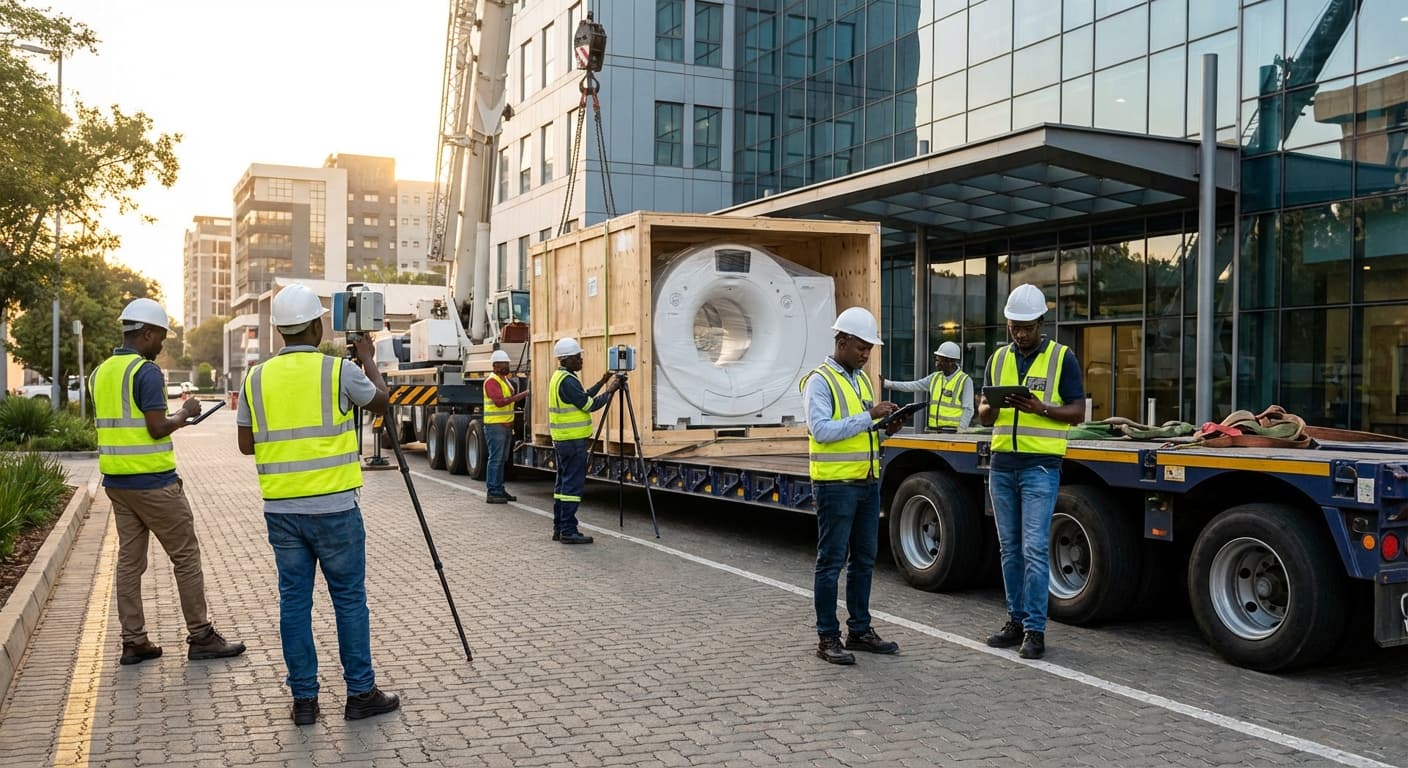
Route Survey & Rigging Plan Service for Heavy Medical Equipment in Rwanda
Engineering Excellence & Technical Support
Route Survey & Rigging Plan Service for Heavy Medical Equipment High-standard technical execution following OEM protocols and local regulatory frameworks.
Precise 3D Laser Scanning & BIM Integration
Utilizing advanced 3D laser scanning technology to capture millimeter-accurate spatial data of existing infrastructure (buildings, doorways, corridors) in Rwanda. This data is then integrated into Building Information Models (BIM) to create a detailed digital twin, enabling conflict detection and precise placement simulations for heavy medical equipment before any physical movement.
Customized Rigging & Load-Bearing Analysis
Developing bespoke rigging plans and performing rigorous load-bearing analyses tailored to the specific weight, dimensions, and fragility of heavy medical equipment (e.g., MRI machines, CT scanners). Our engineers assess structural integrity of pathways and select appropriate lifting equipment and methodologies, ensuring safe and controlled transit through Rwanda's diverse terrain and existing architectural constraints.
Comprehensive Risk Mitigation & Logistics Optimization
Implementing a multi-layered risk mitigation strategy, including site-specific hazard identification, environmental factor assessment (e.g., weather, traffic), and detailed emergency response protocols. We optimize logistics by coordinating transport, security, and personnel, ensuring efficient and secure delivery and installation of critical medical equipment across Rwanda with minimal disruption to hospital operations.
What Is Route Survey & Rigging Plan Service For Heavy Medical Equipment In Rwanda?
Route Survey & Rigging Plan Service for Heavy Medical Equipment in Rwanda involves a systematic process of assessing the feasibility and safety of transporting and installing oversized, heavy, and sensitive medical equipment within Rwanda. This service is critical for ensuring the integrity of the equipment, the safety of personnel and the public, and the efficient integration of these vital assets into healthcare facilities. The scope encompasses detailed logistical analysis, structural assessments, and the development of precise installation procedures tailored to the specific infrastructure and environmental conditions prevalent in Rwanda. This includes identifying optimal transport routes, evaluating load-bearing capacities of infrastructure (bridges, roads, building structures), and designing bespoke rigging and lifting strategies. The objective is to mitigate risks associated with complex logistics and installations, guaranteeing a successful and secure deployment of medical technology.
| Who Needs This Service? | Typical Use Cases | |||
|---|---|---|---|---|
| Hospitals & Healthcare Facilities (Public & Private): Acquiring new, high-value medical imaging systems (MRI, CT scanners), radiotherapy units, surgical robots, or modular operating theaters. | Medical Equipment Manufacturers & Suppliers: For the delivery and installation of complex equipment to client sites in Rwanda, ensuring a professional and safe handover. | Government Health Ministries & Agencies: Overseeing the procurement and deployment of large-scale medical infrastructure projects across the country. | Construction & Engineering Firms: Involved in building or renovating healthcare facilities and requiring expert planning for the integration of heavy medical equipment. | International Aid Organizations & NGOs: Deploying advanced medical technology to underserved regions in Rwanda. |
| Installation of MRI and CT Scanners: These machines are exceptionally heavy, sensitive to vibration, and require precise placement within shielded rooms. | Deployment of Linear Accelerators (LINACs) for Radiotherapy: Requiring significant structural support and specialized installation procedures within bunker-like treatment rooms. | Movement and Installation of Large X-ray Systems (e.g., C-arms, Angiography Suites): Often involving maneuvering through tight hospital corridors and precise positioning for optimal function. | Setting up Modular Operating Theaters or Laboratories: Which may require specialized lifting and precise alignment of prefabricated modules. | Relocation of Existing Heavy Medical Equipment: Within a facility or to a new site in Rwanda. |
Key Components of Route Survey & Rigging Plan Service:
- Route Feasibility Assessment: Detailed analysis of potential transport routes, considering road widths, turning radii, overhead clearances, weight restrictions (bridges, underpasses), and traffic management requirements.
- Site Infrastructure Evaluation: Comprehensive assessment of the destination facility's structural integrity, including floor loading capacities, door dimensions, elevator specifications, and internal passageway clearances.
- Load Calculation & Stability Analysis: Determination of the equipment's weight, center of gravity, and stability characteristics to inform lifting and lashing procedures.
- Rigging Equipment Specification: Selection of appropriate cranes, hoists, jacks, slings, and other lifting apparatus based on load weight, lift height, and site constraints.
- Method Statement Development: Creation of detailed, step-by-step procedures for rigging, lifting, maneuvering, and positioning the equipment, including safety protocols and contingency plans.
- Risk Assessment & Mitigation: Identification of potential hazards during transport and installation, with the development of strategies to minimize or eliminate risks.
- Permit & Regulatory Compliance: Assistance in obtaining necessary permits for oversized transport and adherence to local Rwandan regulations and safety standards.
- On-site Supervision & Execution: Provision of qualified personnel to oversee and execute the rigging and installation process, ensuring adherence to the plan.
Who Needs Route Survey & Rigging Plan Service For Heavy Medical Equipment In Rwanda?
Transporting and installing heavy medical equipment in Rwanda requires specialized expertise to ensure safety, efficiency, and compliance. Route survey and rigging plan services are crucial for navigating complex logistics, especially in challenging terrain or within sensitive healthcare facilities. This expertise is vital for anyone involved in the procurement, deployment, or maintenance of large-scale medical machinery.
| Target Customer/Department | Specific Needs & Responsibilities | Why Route Survey & Rigging Plan is Crucial |
|---|---|---|
Hospitals (Public & Private)
| Procuring, installing, and relocating large medical equipment (e.g., MRI scanners, CT scanners, linear accelerators, large X-ray machines, hospital beds, surgical robots). Need to ensure safe delivery, placement within existing structures, and integration with utilities. Must minimize disruption to patient care. | Ensures equipment can be physically maneuvered through hospital corridors, elevators, and into designated rooms without structural damage. Guarantees safe lifting and positioning of extremely heavy and sensitive machinery. Mitigates risks of accidents during installation or relocation that could impact operations or patient safety. |
Medical Equipment Suppliers & Distributors
| Responsible for the end-to-end delivery and installation of medical equipment to healthcare facilities in Rwanda. May need to handle customs clearance, transportation from ports, and final site integration. Often act as the primary point of contact for ensuring successful deployment. | Develops precise transportation routes to avoid obstacles, weight limits on bridges, and road closures. Creates detailed rigging plans for loading, unloading, and precise placement of equipment, especially in complex or confined spaces. Ensures compliance with all safety regulations during transit and installation. |
Construction & Infrastructure Companies
| Involved in building or renovating healthcare facilities. They need to incorporate the requirements for heavy medical equipment installation from the design phase through to construction. This includes ensuring adequate access points, structural support, and utility connections. | Informs structural design and building plans to accommodate the weight and dimensions of future medical equipment. Plans for safe access and temporary infrastructure during installation phases. Coordinates with equipment installers to ensure smooth integration of equipment into the facility's infrastructure. |
Government Health Ministries & Agencies
| Overseeing large-scale public health initiatives, hospital upgrades, and national equipment procurement. They need to ensure that all procured equipment can be effectively delivered, installed, and maintained across various public healthcare institutions, often in remote or underserved areas. | Ensures that procurement contracts include provisions for expert route and rigging planning, especially for projects in diverse geographical locations within Rwanda. Verifies that planned logistics are feasible and cost-effective for public sector investments. Promotes standardization of safety protocols in heavy equipment deployment. |
International Aid Organizations & NGOs
| Delivering essential medical equipment to support humanitarian efforts, disease control programs, and healthcare development in Rwanda. Often face challenges with remote locations, limited infrastructure, and tight project timelines. Requires robust planning to ensure equipment reaches its intended destination safely and efficiently. | Navigates complex logistical challenges in regions with undeveloped infrastructure. Plans for safe transport and installation of critical medical supplies in areas that may lack specialized lifting equipment. Ensures that aid effectively reaches beneficiaries by overcoming physical and operational barriers to deployment. |
Who Needs Route Survey & Rigging Plan Service for Heavy Medical Equipment in Rwanda?
- Hospitals and Healthcare Facilities
- Medical Equipment Suppliers and Distributors
- Construction and Infrastructure Companies involved in Healthcare Projects
- Government Health Ministries and Agencies
- International Aid Organizations and NGOs
Route Survey & Rigging Plan Service For Heavy Medical Equipment Process In Rwanda
This document outlines the comprehensive workflow for our Route Survey & Rigging Plan Service, specifically tailored for the intricate process of delivering and installing heavy medical equipment in Rwanda. Our service ensures a safe, efficient, and compliant transit from point of entry to the final installation site, minimizing risks and disruptions.
| Stage | Description | Key Activities | Deliverables | Timeline (Indicative) |
|---|---|---|---|---|
| Inquiry & Initial Consultation | The client contacts us with their specific project requirements regarding heavy medical equipment transport and installation in Rwanda. | Understand project scope, equipment details (dimensions, weight, fragility), origin, destination, and any known site constraints. Provide initial service overview and pricing estimate. | Initial understanding of project scope, preliminary service proposal. | 1-2 Business Days |
| Site & Route Assessment (Phase 1: Desktop & Remote) | A preliminary evaluation of potential routes and key site locations is conducted using available data and technology. | Review maps, satellite imagery, Google Street View (if available), and client-provided site plans. Identify potential major obstacles (road conditions, bridge weight limits, overhead clearances, urban access challenges). | Preliminary route feasibility assessment, identification of potential challenges, initial list of required survey points. | 2-4 Business Days |
| Detailed Route Survey (Phase 2: On-site) | Our specialized team conducts on-the-ground surveys to gather precise data for safe transit. | Physical inspection of the selected route(s). Measurement of critical dimensions (road width, bridge clearances, tunnel heights, turning radii, street furniture). Assessment of road surface conditions, gradients, and potential traffic management needs. Site inspection at both origin and destination (including access points, internal pathways, and installation locations). GPS data capture and photographic documentation of all survey points. | Detailed route survey report with measurements, photographic evidence, identification of all potential hazards and constraints, recommended route optimization. | 5-10 Business Days (depending on route complexity and number of sites) |
| Rigging & Lifting Plan Development | Based on the survey data, a comprehensive plan for safe lifting and maneuvering of the equipment is created. | Analyze equipment specifications and site survey data. Determine optimal lifting points, required rigging gear (cranes, slings, shackles, etc.), lifting procedures, stabilization requirements, and potential support vehicles. Develop detailed rigging diagrams, load calculations, and safety protocols. | Comprehensive rigging and lifting plan, including method statements, risk assessments, equipment specifications, crew roles and responsibilities. | 3-7 Business Days |
| Client Review & Approval | The developed plans are presented to the client for their review and formal approval. | Present route survey report and rigging/lifting plan to the client. Address any client queries or concerns. Obtain formal sign-off on all plans. | Approved Route Survey Report, Approved Rigging & Lifting Plan. | 2-3 Business Days |
| Permitting & Approvals | We manage the necessary permits and authorizations from relevant Rwandan authorities. | Identify and apply for all required permits (e.g., transport permits for oversized/overweight loads, road closure permits, traffic management approvals) with relevant government agencies. Coordinate with local authorities for timely processing. | All necessary permits and authorizations obtained. | Varies significantly based on local regulations and processing times (typically 7-20 Business Days, can be longer) |
| Pre-Execution Preparations | Final logistical arrangements and on-site preparations are made before the execution phase. | Mobilize specialized transport vehicles and rigging equipment. Brief the execution team on the plans and safety procedures. Coordinate with local stakeholders (police, community leaders if necessary). Ensure all safety equipment is in place and personnel are trained. | Mobilized equipment and personnel, confirmed logistics, pre-execution briefing conducted. | 1-3 Business Days |
| Execution: Transport & Rigging | The actual movement and installation of the medical equipment are carried out according to the approved plans. | Safe loading of equipment onto transport. Controlled transportation along the surveyed route, adhering to traffic management plans. Safe unloading and precise positioning of equipment at the installation site using the developed rigging plan. On-site supervision and quality control throughout the process. | Successful transport and rigging of medical equipment at the designated location. | Duration dependent on equipment size, route length, and site complexity (typically 1-5 Business Days for execution). |
| Post-Execution & Documentation | Final checks, handover, and comprehensive documentation are provided to the client. | Site cleanup and final inspection. Handover of equipment to the client. Provide a comprehensive post-execution report including photographic evidence of the completed work, any encountered issues and resolutions, and lessons learned. Final invoice and service confirmation. | Post-Execution Report, photographic evidence, service confirmation, final invoice. | 2-3 Business Days |
Workflow Stages
- Inquiry & Initial Consultation
- Site & Route Assessment (Phase 1: Desktop & Remote)
- Detailed Route Survey (Phase 2: On-site)
- Rigging & Lifting Plan Development
- Client Review & Approval
- Permitting & Approvals
- Pre-Execution Preparations
- Execution: Transport & Rigging
- Post-Execution & Documentation
Route Survey & Rigging Plan Service For Heavy Medical Equipment Cost In Rwanda
The cost of route surveys and rigging plans for heavy medical equipment in Rwanda is influenced by several factors. These include the complexity of the route, the weight and dimensions of the equipment, the distance to be covered, the type of rigging required (e.g., cranes, specialized lifting equipment), the need for temporary road modifications, site accessibility, permits and approvals, risk assessment, and the expertise of the service provider. Costs are generally quoted on a project-by-project basis.
| Service Component | Typical Price Range (RWF - Rwandan Francs) | Notes |
|---|---|---|
| Route Survey (Basic) | 150,000 - 500,000 RWF | For straightforward routes, limited distance, and standard equipment. |
| Route Survey (Complex/Extensive) | 500,000 - 2,000,000+ RWF | Involves challenging terrain, multiple route options, detailed obstacle mapping, and extensive travel. |
| Rigging Plan Development (Standard) | 200,000 - 750,000 RWF | For common equipment types with standard lifting requirements. |
| Rigging Plan Development (Specialized/Heavy-Lift) | 750,000 - 3,000,000+ RWF | For extremely heavy or unusually shaped equipment requiring advanced engineering analysis and specialized solutions. |
| Combined Route Survey & Rigging Plan Package | 500,000 - 5,000,000+ RWF | A bundled service offering. The final cost is highly dependent on the overall project scope and complexity. |
| Permits & Approvals (Estimated) | 50,000 - 500,000+ RWF | Variable depending on the specific permits required by different authorities. This is often an additional cost to the service provider's fee. |
| On-site Supervision (Daily Rate) | 100,000 - 300,000 RWF | For the service provider's team overseeing the rigging and transportation process. |
Key Pricing Factors for Route Survey & Rigging Plan Services in Rwanda:
- Complexity of the Route: Inclines, declines, narrow roads, sharp turns, and proximity to obstacles.
- Equipment Specifications: Weight, dimensions, and the number of pieces to be handled.
- Travel Distance: The total kilometers from the origin to the final destination.
- Rigging Requirements: Type and capacity of lifting equipment, number of personnel, and duration of rigging operations.
- Site Accessibility: Ease of access to loading and unloading points, terrain at the sites.
- Road Conditions & Infrastructure: State of the roads, need for temporary reinforcements or closures.
- Permits & Approvals: Costs associated with obtaining necessary permits from local authorities and road agencies.
- Risk Assessment & Mitigation: Safety protocols, insurance, and contingency planning.
- Service Provider's Expertise & Reputation: Experienced and specialized companies may command higher fees.
- Urgency of the Project: Rush jobs might incur additional charges.
Affordable Route Survey & Rigging Plan Service For Heavy Medical Equipment Options
Navigating the complexities of transporting and installing heavy medical equipment requires meticulous planning. Our Affordable Route Survey & Rigging Plan Service provides essential expertise to ensure a safe, efficient, and cost-effective installation. We specialize in identifying optimal routes, assessing site conditions, and developing detailed rigging plans to mitigate risks and minimize disruption. Understanding the diverse needs of healthcare facilities, we offer flexible value bundles and implement strategic cost-saving measures tailored to your specific project.
| Value Bundle | Included Services | Key Benefits | Ideal For |
|---|---|---|---|
| Essential Route Survey | Basic route assessment, obstacle identification, preliminary load capacity checks. | Foundation for safe transport, identifies immediate challenges. | Standard equipment moves, routine upgrades. |
| Standard Rigging Plan | Comprehensive route survey + detailed rigging plan, equipment weight and dimension analysis, initial lift point recommendations. | Ensures safe lifting and maneuvering, addresses basic rigging needs. | Moderate to heavy equipment, standard installation environments. |
| Premium All-Inclusive Package | Comprehensive route survey, detailed rigging plan, site-specific structural assessments, specialized equipment handling strategies, permit acquisition assistance, on-site supervision during critical rigging phases. | Maximum risk mitigation, full logistical support, peace of mind for complex installations. | Ultra-heavy equipment, challenging site conditions, critical infrastructure installations, high-stakes projects. |
| Customized Solutions | Tailored to specific project requirements, combining elements from other bundles or offering bespoke services. | Flexibility to meet unique needs, cost optimization for specialized scenarios. | Unique equipment types, highly specialized facility requirements, phased installations. |
Our Value Proposition: Why Choose Our Service?
- Comprehensive Route Surveys: Thoroughly assess transportation pathways, identifying potential obstacles, load restrictions, and necessary permits.
- Detailed Rigging Plans: Develop precise plans for lifting, maneuvering, and securing heavy equipment, ensuring safety and minimizing structural impact.
- Risk Mitigation: Proactively identify and address potential hazards, preventing costly delays and accidents.
- Optimized Logistics: Streamline the transportation and installation process for maximum efficiency.
- Experienced Professionals: Benefit from the expertise of our skilled surveyors and rigging specialists.
- Cost-Effective Solutions: Our focus on planning helps avoid unexpected expenses and rework.
- Reduced Downtime: Minimize disruption to your medical facility's operations.
Verified Providers In Rwanda
In Rwanda's evolving healthcare landscape, ensuring access to verified and trustworthy medical services is paramount. Franance Health stands out as a leading example of a credentialed provider, offering a comprehensive and reliable healthcare experience for individuals and families. Their commitment to quality, ethical practices, and patient-centered care makes them the preferred choice for many seeking medical attention. This document outlines the key credentials and reasons why Franance Health represents the best choice for your healthcare needs in Rwanda.
| Aspect | Franance Health's Offering | Why it Matters |
|---|---|---|
| Medical Staffing | Internationally trained and locally licensed physicians, nurses, and specialists. | Ensures access to competent and experienced healthcare professionals across various disciplines. |
| Facility Standards | Modern clinics and diagnostic centers adhering to strict hygiene and safety protocols. | Provides a safe and comfortable environment for consultations, treatments, and recovery. |
| Technology Integration | Utilizes up-to-date medical equipment and digital health records. | Facilitates accurate diagnoses, efficient treatment, and seamless patient data management. |
| Patient Experience | Focus on clear communication, empathy, and personalized care plans. | Builds trust and ensures patients feel heard, understood, and well-cared for. |
| Regulatory Oversight | Fully compliant with Rwandan Ministry of Health guidelines and inspections. | Guarantees that services meet national legal and quality standards. |
| Service Range | Comprehensive services including general practice, specialized consultations, diagnostics, and preventative care. | Offers a one-stop solution for a wide array of healthcare needs, minimizing the need to seek services elsewhere. |
Key Credentials and Strengths of Franance Health
- Regulatory Compliance: Adherence to all Rwandan Ministry of Health regulations and licensing requirements, ensuring operational legitimacy and patient safety.
- Qualified Medical Professionals: A team of highly trained and certified doctors, nurses, specialists, and allied health professionals with proven expertise.
- International Standards: Adoption of international best practices in healthcare delivery, quality assurance, and patient management.
- Advanced Technology & Equipment: Investment in modern medical equipment and diagnostic tools for accurate diagnosis and effective treatment.
- Patient-Centric Approach: Emphasis on compassionate care, clear communication, and personalized treatment plans tailored to individual patient needs.
- Robust Infrastructure: Well-equipped facilities with modern amenities, ensuring a comfortable and conducive environment for healing.
- Commitment to Continuous Improvement: Ongoing training and development for staff, coupled with regular evaluation of services to maintain high standards.
- Ethical Practice and Transparency: Upholding the highest ethical standards in medical practice and maintaining transparency in all patient interactions.
Scope Of Work For Route Survey & Rigging Plan Service For Heavy Medical Equipment
This Scope of Work (SOW) outlines the requirements for professional Route Survey and Rigging Plan Services for the transportation and installation of heavy medical equipment. The objective is to ensure the safe, efficient, and compliant movement of sensitive and high-value equipment from its origin to its final installed location, minimizing risks to personnel, equipment, and the surrounding environment. This SOW details the technical deliverables and standard specifications expected from the service provider.
| Deliverable | Description | Format/Details |
|---|---|---|
| Route Survey Report | Comprehensive analysis of transportation and installation routes, including measurements, obstacles, and risk assessment. | PDF document with detailed text, scaled drawings, photographs, and calculations. |
| Rigging Plan Document | Detailed methodology for lifting, maneuvering, and installing the equipment, including safety protocols. | PDF document with step-by-step procedures, schematics, equipment specifications, and safety plans. |
| Equipment Specification Sheets | Documentation for all proposed rigging and moving equipment. | Manufacturer datasheets or catalogues. |
| Pre-Operation Checklist | A list for verification before commencing operations. | Checklist document. |
Scope of Work Details
- 1. Project Overview:
- This project involves a comprehensive route survey and the development of a detailed rigging plan for heavy medical equipment. The equipment's weight, dimensions, fragility, and specific installation requirements necessitate meticulous planning to address potential challenges during transport and installation.
- 2. Objectives:
- Identify and mitigate all potential risks associated with the movement and installation of the heavy medical equipment.
- Develop a detailed and accurate route survey report, including all relevant measurements, constraints, and recommended pathways.
- Create a comprehensive rigging plan that outlines the precise methodology, equipment, and safety protocols for lifting, maneuvering, and positioning the equipment.
- Ensure compliance with all applicable safety regulations, industry standards, and manufacturer guidelines.
- Facilitate a smooth and efficient transportation and installation process.
- 3. Services to be Performed:
- The service provider shall perform the following activities:
- 3.1 Route Survey:
* **3.1.1 Site Inspection:** Conduct thorough on-site inspections of the origin and destination locations, including access points, internal pathways, doorways, corridors, elevators, stairwells, and final installation areas.* **3.1.2 Measurement & Data Collection:** Accurately measure all critical dimensions: equipment (length, width, height, weight), pathways (width, height clearances, turning radii), doorways, elevator capacities and internal dimensions, and any other relevant structural elements.* **3.1.3 Obstacle Identification:** Identify and document all potential obstacles along the proposed routes, including but not limited to, fixed structures, temporary obstructions, utility lines (overhead and underground), inclines/declines, and load-bearing capacity limitations.* **3.1.4 Transportation Route Assessment:** Assess the external transportation route from the point of origin to the final destination, considering road conditions, bridge clearances, turning restrictions, traffic regulations, potential for public disruption, and any necessary permits.* **3.1.5 Environmental Factors:** Consider environmental factors such as weather, ground conditions, and temperature that may impact the operation.- 3.2 Rigging Plan Development:
* **3.2.1 Equipment Analysis:** Review manufacturer specifications, technical drawings, and equipment handling manuals to understand lifting points, center of gravity, and any special handling requirements.* **3.2.2 Rigging Method Selection:** Determine the most appropriate rigging methods, considering the equipment's weight, size, fragility, and the site-specific constraints identified during the route survey.* **3.2.3 Equipment Selection:** Specify the type and capacity of all necessary lifting and moving equipment, including but not limited to, cranes, forklifts, gantries, dollies, jacks, slings, shackles, and protective materials.* **3.2.4 Step-by-Step Procedure:** Develop a detailed, step-by-step procedure for all phases of the rigging operation, including rigging, lifting, lowering, maneuvering, and final positioning.* **3.2.5 Safety Protocols:** Integrate comprehensive safety protocols, including pre-lift inspections, hazard assessments, exclusion zones, communication procedures, personnel requirements (PPE), and emergency response plans.* **3.2.6 Load Calculations:** Perform necessary load calculations to ensure the safe working load limits of all rigging equipment and structural supports are not exceeded.- 3.3 Coordination & Permitting:
* **3.3.1 Stakeholder Consultation:** Liaise with relevant stakeholders, including facility management, hospital staff, building engineers, and local authorities, to gather necessary information and obtain approvals.* **3.3.2 Permit Acquisition:** Assist in the identification and acquisition of any required permits for transportation, road closures, or specialized lifting operations.- 3.4 On-Site Supervision (Optional, as per contract):
* **3.4.1 Execution Oversight:** Provide on-site supervision during the actual rigging and installation process to ensure adherence to the developed plan and to address any unforeseen issues.- 4. Technical Deliverables:
- The following technical deliverables are expected from the service provider:
- 4.1 Route Survey Report:
* Detailed description of the proposed routes.* Scaled drawings and/or schematics illustrating the routes, clearances, and any identified obstacles.* Photographic evidence of key areas and potential challenges.* Measurement logs and calculations.* Risk assessment matrix and recommended mitigation strategies.* Recommendations for temporary modifications or route adjustments.- 4.2 Rigging Plan Document:
* Detailed step-by-step rigging and installation procedures.* Schematics illustrating rigging configurations, load paths, and equipment placement.* Specification of all required rigging equipment, including make, model, and load capacity.* Comprehensive safety plan, including hazard identification, risk mitigation, and emergency procedures.* List of required personnel and their roles/responsibilities.* Manufacturer's handling and installation guidelines incorporated.* Any required load calculations and engineering certifications.- 4.3 Equipment Specification Sheets:
* Catalogues or specification sheets for all proposed rigging and moving equipment.- 4.4 Pre-Operation Checklist:
* A comprehensive checklist for pre-operation verification of all equipment and personnel.- 5. Standard Specifications & Requirements:
- 5.1 Personnel Qualifications:
* All personnel involved in route surveying and rigging plan development must be qualified and experienced in heavy lifting operations, risk assessment, and project management.* Riggers must hold relevant certifications (e.g., NCCCO, IPAF).* Engineers involved in load calculations must be licensed and registered.- 5.2 Equipment Standards:
* All rigging and lifting equipment must be certified, inspected, and maintained in accordance with applicable national and international standards (e.g., ASME, BS EN).* Equipment must have up-to-date inspection certificates.- 5.3 Safety Regulations:
* Compliance with all relevant local, national, and international safety regulations and standards (e.g., OSHA, HSE, local building codes).- 5.4 Documentation Standards:
* All documentation must be clear, concise, accurate, and presented in a professional format.* Use of CAD software for diagrams and schematics is preferred.- 5.5 Insurance:
* The service provider must possess adequate professional liability, general liability, and worker's compensation insurance.- 5.6 Communication:
* The service provider shall maintain open and regular communication with the client's project manager throughout the project lifecycle.- 5.7 Environmental Considerations:
* The service provider shall consider and implement measures to minimize environmental impact during operations.- 6. Timeline:
- A detailed project timeline with key milestones will be provided separately.
- 7. Acceptance Criteria:
- Approval of all submitted deliverables by the client.
- Successful completion of the rigging operation as per the approved plan.
- No incidents or accidents during the operation.
- Adherence to all specified safety standards and regulations.
Service Level Agreement For Route Survey & Rigging Plan Service For Heavy Medical Equipment
This Service Level Agreement (SLA) outlines the response times and uptime guarantees for the Route Survey & Rigging Plan Service for Heavy Medical Equipment provided by [Your Company Name]. This SLA is an addendum to the Master Service Agreement (MSA) between [Your Company Name] and [Client Company Name].
| Service Component | Response Time Guarantee (Business Hours) | Uptime Guarantee |
|---|---|---|
| Initial Consultation & Site Assessment Scheduling | Within 4 business hours of confirmed request | N/A (Service dependent) |
| Delivery of Preliminary Route Survey Report | Within 48 business hours of site assessment completion | N/A (Deliverable) |
| Delivery of Final Rigging Plan | Within 72 business hours of preliminary report approval and provision of all necessary site information | N/A (Deliverable) |
| On-site Support During Rigging Operations | Guaranteed presence of certified rigging supervisor within 2 hours of scheduled start time | 99.5% availability of key personnel during scheduled rigging windows. (Excludes pre-approved maintenance or unavoidable external delays like extreme weather) |
| Post-Rigging Verification & Sign-off | Within 2 business hours of completion of rigging operations | N/A (Deliverable) |
Scope of Service
- Detailed site survey including accessibility, structural integrity assessments, and potential obstacle identification.
- Development of a comprehensive rigging plan, including equipment specifications, safety protocols, and execution procedures.
- Coordination with on-site personnel for the safe and efficient installation of heavy medical equipment.
- Post-installation verification and handover.
Frequently Asked Questions

Ready when you are
Let's scope your Route Survey & Rigging Plan Service for Heavy Medical Equipment in Rwanda project in Rwanda.

Scaling healthcare logistics and technical systems across the entire continent.