
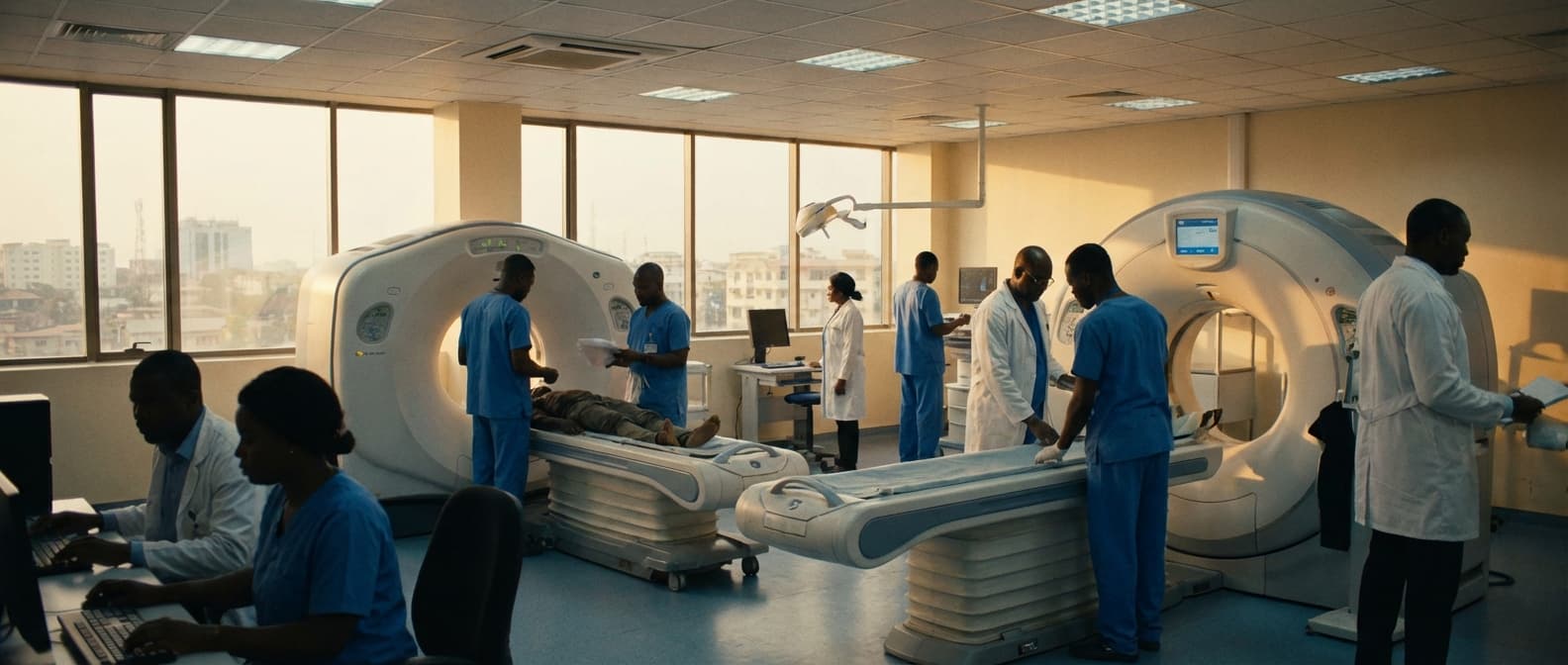
Imaging Acceptance Testing & QA in Rwanda
Engineering Excellence & Technical Support
Commissioning and periodic QA for CT/MRI/X‑ray/US/Mammo. High-standard technical execution following OEM protocols and local regulatory frameworks.
Radiology Equipment Calibration & Performance Verification
Ensuring adherence to international standards and local regulations through rigorous calibration of X-ray, CT, and MRI equipment. This includes regular image quality assessments, dose measurements, and functional checks to guarantee diagnostic accuracy and patient safety.
PACS & RIS Integration & Workflow Optimization
Validating the seamless integration and functionality of Picture Archiving and Communication Systems (PACS) and Radiology Information Systems (RIS). This involves testing data integrity, image retrieval speeds, report generation, and user interface intuitiveness to streamline radiologist workflows and improve turnaround times.
Radiation Safety Compliance & Quality Assurance
Implementing and verifying robust radiation safety protocols for all imaging modalities. This includes comprehensive QA programs for dose optimization, shielding integrity checks, and ongoing monitoring of equipment output to minimize patient and staff exposure while maintaining diagnostic efficacy.
What Is Imaging Acceptance Testing & Qa In Rwanda?
Imaging Acceptance Testing & QA in Rwanda refers to the systematic evaluation and validation of medical imaging equipment and software to ensure it meets predefined quality standards, functional requirements, and regulatory compliance within the Rwandan healthcare context. This service is crucial for verifying that imaging modalities (e.g., X-ray, CT, MRI, Ultrasound) and their associated Picture Archiving and Communication Systems (PACS) and Radiography Information Systems (RIS) perform accurately, reliably, and safely, ultimately impacting diagnostic efficacy and patient care. The process involves a suite of technical procedures, performance benchmarks, and documentation reviews designed to confirm optimal operation and adherence to international and local standards.
Who Needs It:
- Hospitals and Clinics: All healthcare facilities in Rwanda that utilize medical imaging technologies, from public institutions to private diagnostic centers and specialized clinics.
- Medical Equipment Vendors and Suppliers: Companies that import, distribute, install, and maintain imaging equipment and software in Rwanda. Acceptance testing is often a prerequisite for client handover and warranty activation.
- Government Health Ministries and Regulatory Bodies: Agencies responsible for healthcare infrastructure, patient safety, and quality assurance of medical devices. They may mandate or oversee acceptance testing to ensure public health standards are met.
- Radiology and Imaging Departments: The end-users of the equipment, requiring assurance that their tools are functioning correctly for accurate diagnosis and efficient workflow.
- IT Departments in Healthcare Facilities: Responsible for the integration and performance of PACS/RIS systems, requiring validation of data integrity, accessibility, and interoperability.
Typical Use Cases:
- New Equipment Installation: Verifying that newly acquired imaging modalities and related software (PACS/RIS) are installed correctly, calibrated appropriately, and perform according to manufacturer specifications and contractual obligations before being put into clinical use.
- System Upgrades and Replacements: Testing updated software versions, hardware replacements, or full system replacements to ensure compatibility, functionality, and data migration integrity.
- Routine Quality Assurance (QA) Programs: Implementing scheduled checks to monitor the ongoing performance, image quality, and safety of existing imaging equipment. This includes calibration verification, artifact detection, and dose assessment.
- Troubleshooting and Performance Degradation: Diagnosing and resolving issues when equipment performance is suspected to have degraded or when unexpected errors occur. Acceptance testing protocols can be adapted for diagnostic purposes.
- Regulatory Compliance Audits: Demonstrating adherence to national and international standards for medical device performance, radiation safety, and data privacy (if applicable), often required by regulatory bodies or for accreditation purposes.
- Vendor Performance Verification: Ensuring that service providers and vendors meet their contractual obligations regarding equipment uptime, response times, and resolution of issues.
| Stage | Description | Key Activities | Deliverables |
|---|---|---|---|
| Pre-acceptance/Site Readiness | Ensuring the site is prepared for equipment installation and operation. | Reviewing facility requirements (power, cooling, space), network connectivity, and compliance with local building codes. | Site readiness report, confirmation of infrastructure adequacy. |
| Factory Acceptance Test (FAT) (if applicable) | Testing performed at the manufacturer's facility before shipment. | Simulating site conditions, verifying core functionalities, and basic performance benchmarks. | FAT report, pre-shipment verification confirmation. |
| Site Acceptance Test (SAT) / Installation Qualification (IQ) | Testing performed after installation at the healthcare facility. | Verifying correct installation, power-up, system initialization, and basic functional checks. | IQ report, installation verification checklist. |
| Operational Qualification (OQ) | Testing to confirm the equipment operates as intended within its specified operational range. | Detailed functional testing, performance benchmarks, calibration checks, safety testing. | OQ report, performance validation data, safety compliance certificates. |
| Performance Qualification (PQ) | Testing to ensure the equipment consistently produces high-quality images and performs reliably under typical clinical load. | Long-term stability testing, image quality assessment with phantoms and clinical cases, workflow simulation. | PQ report, ongoing performance metrics, image quality assessment results. |
| User Acceptance Testing (UAT) | Confirmation by end-users that the system meets clinical requirements. | Clinical workflow testing, user interface evaluation, data entry and retrieval verification. | UAT sign-off, user feedback report. |
| Routine QA Monitoring | Ongoing scheduled checks to maintain performance and safety. | Regular calibration checks, image quality monitoring, dose audits, preventative maintenance. | Routine QA reports, maintenance logs, updated calibration records. |
Key Components of Imaging Acceptance Testing & QA in Rwanda
- Functional Testing: Verifying all operational modes, features, and user interface elements of imaging equipment and software.
- Performance Testing: Assessing image quality (e.g., resolution, contrast, noise), acquisition speed, reconstruction times, and system throughput against defined benchmarks.
- Calibration and Accuracy Verification: Ensuring precise measurements, correct dose delivery, and accurate image representation.
- Safety Testing: Conducting checks for radiation safety, electrical safety, and mechanical integrity, particularly crucial for modalities involving ionizing radiation.
- Interoperability Testing: Validating seamless communication and data exchange between imaging equipment, PACS, RIS, and other hospital information systems (HIS).
- Data Integrity and Archiving: Testing the reliability of image storage, retrieval, and retrieval from PACS, ensuring no data loss or corruption.
- User Acceptance Testing (UAT): Involving end-users (radiographers, radiologists) to confirm that the system meets their clinical workflow needs.
- Documentation Review: Scrutinizing user manuals, service logs, calibration certificates, and compliance documentation.
- Radiation Dose Assessment: Measuring and documenting radiation output to ensure it is within established diagnostic reference levels (DRLs) and ALARA principles.
- Artifact Analysis: Identifying and quantifying image artifacts that could impact diagnostic accuracy.
Who Needs Imaging Acceptance Testing & Qa In Rwanda?
In Rwanda's rapidly developing healthcare sector, ensuring the reliable and accurate functioning of medical imaging equipment is paramount. This is where Imaging Acceptance Testing and Quality Assurance (QA) become indispensable. These processes verify that new imaging systems meet stringent performance standards and that existing ones continue to operate within acceptable parameters. This meticulous testing prevents misdiagnoses, reduces operational downtime, and ultimately enhances patient care. Without robust Acceptance Testing and QA, healthcare providers risk investing in substandard equipment, facing unexpected repair costs, and compromising the quality of diagnostic information crucial for patient treatment.
| Target Customer/Department | Specific Needs & Benefits | Impact of Poor QA/Acceptance Testing |
|---|---|---|
| Public Hospitals (e.g., CHUK, CHUB, District Hospitals) | Ensuring accessibility and reliability of diagnostic tools for a broad patient population. Cost-effectiveness and optimized equipment lifespan. Facilitating accurate diagnosis for diverse medical conditions. | Delayed diagnoses, increased patient wait times, potential for misdiagnosis leading to incorrect treatment and adverse patient outcomes. Higher repair and maintenance costs due to undetected faults. |
| Private Hospitals & Clinics | Maintaining a competitive edge through high-quality diagnostic services. Building patient trust and reputation. Efficient patient throughput and optimized resource utilization. | Loss of patient confidence and market share. Potential for legal liabilities due to diagnostic errors. Inefficient use of expensive capital equipment. |
| Radiology Departments | Verification of image quality, dose optimization, and adherence to international standards. Ensuring equipment interoperability with Picture Archiving and Communication Systems (PACS). | Suboptimal image quality leading to missed findings or false positives. Increased radiation exposure to patients and staff. Incompatibility issues with PACS hindering workflow and data management. |
| Ministry of Health & Regulatory Bodies | Enforcing national healthcare standards. Ensuring patient safety and diagnostic accuracy across the country. Informed procurement decisions for public health initiatives. | Inconsistent quality of care across different facilities. Compromised public health outcomes. Waste of public funds on unreliable equipment. Difficulty in establishing national diagnostic benchmarks. |
| Medical Equipment Suppliers & Integrators | Demonstrating commitment to quality and customer satisfaction. Reducing post-installation service calls. Building long-term relationships with healthcare providers. | Increased number of warranty claims and service requests. Damaged reputation and loss of future business. Difficulty in securing new contracts due to performance issues. |
| Research Institutions & Universities | Guaranteeing the integrity and reproducibility of research data. Ensuring the accuracy of imaging findings for scientific studies and publications. | Invalidation of research findings due to unreliable equipment. Hindrance to scientific advancement and discovery. Reputational damage within the research community. |
Who Needs Imaging Acceptance Testing & QA in Rwanda? Target Customers and Departments
- Hospitals and Clinics: All healthcare facilities utilizing medical imaging technology.
- Radiology Departments: The primary users and beneficiaries of imaging equipment.
- Diagnostic Imaging Centers: Facilities specializing in medical imaging services.
- Government Health Ministries & Regulatory Bodies: Responsible for setting standards and ensuring quality of care.
- Medical Equipment Suppliers & Integrators: Those who procure, install, and maintain imaging systems.
- Research Institutions: Requiring accurate and reliable imaging for studies.
Imaging Acceptance Testing & Qa Process In Rwanda
This document outlines the typical workflow for Imaging Acceptance Testing and Quality Assurance (QA) processes in Rwanda. It details the steps involved from the initial inquiry about imaging equipment or services to the final execution and validation of the tests. This structured approach ensures that imaging technologies meet established standards for performance, safety, and diagnostic accuracy, crucial for healthcare delivery in Rwanda.
| Phase | Key Activities | Responsible Parties | Deliverables | Notes/Considerations for Rwanda |
|---|---|---|---|---|
| Healthcare facility identifies need for new imaging equipment or service. Define technical, clinical, regulatory, and budget requirements. Consult with radiologists, technicians, IT, and administration. | Healthcare Facility (Clinical, IT, Admin), Ministry of Health (MoH) (as applicable) | Requirements Specification Document | Consider local infrastructure limitations (power stability, internet connectivity), availability of trained personnel, and alignment with national health strategies. |
| Issue Request for Proposals (RFPs) to potential vendors. Evaluate proposals based on technical specifications, cost, service, training, and support. Shortlist vendors. | Healthcare Facility Procurement/Technical Committee | Vendor Proposals, Evaluation Matrix | Prioritize vendors with proven experience in similar healthcare settings and commitment to local support and training. |
| Negotiate contract terms, including pricing, payment schedules, warranties, service level agreements (SLAs), and acceptance criteria. Finalize and sign contract. | Healthcare Facility Legal & Procurement Teams, Vendor | Signed Contract/Purchase Agreement | Ensure contract clearly defines acceptance testing protocols and responsibilities. Consider currency fluctuations and import duties. |
| Vendor manufactures and ships the imaging equipment/system. Healthcare facility tracks shipment and coordinates customs clearance. | Vendor, Healthcare Facility Logistics & Procurement | Equipment Shipment Documentation, Customs Clearance | Anticipate potential delays in international shipping and customs processes. Ensure appropriate storage and handling upon arrival. |
| Develop detailed PAT plan, including scope, methodologies, test cases, acceptance criteria, timelines, and required resources (personnel, phantom materials). Site readiness assessment. | Healthcare Facility QA/Technical Team, Vendor Technical Team | PAT Plan, Site Readiness Report | Involve end-users (radiologists, technologists) in planning. Ensure availability of necessary consumables and test phantoms. |
| Prepare the installation site according to vendor specifications (e.g., power, cooling, shielding, network connectivity). Vendor installs the equipment/system. | Healthcare Facility Facilities/IT Team, Vendor Installation Team | Completed Site Preparation, Installed Equipment | Verify electrical safety and grounding. Ensure adequate space and environmental controls. |
| Verify that the equipment has been installed correctly according to manufacturer's specifications and design intentions. Includes documentation review, physical inspection, and basic functional checks. | Vendor Installation Team, Healthcare Facility QA/Technical Team (witnessing) | IQ Protocol, IQ Report | Confirm all components are present and correctly connected. Check serial numbers against documentation. |
| Verify that the installed equipment operates as intended within its specified operational range. Tests include checks of all operational modes, safety features, and performance parameters. May involve initial phantom scans. | Vendor Technical Team, Healthcare Facility QA/Technical Team (executing/witnessing) | OQ Protocol, OQ Report | Test all imaging modes and functionalities. Verify alarm systems and safety interlocks. |
| Verify that the equipment consistently produces diagnostic quality images meeting predefined acceptance criteria under normal operating conditions. Involves clinical scenarios and quantitative measurements using phantoms. | Healthcare Facility Radiologists & Technologists, Healthcare Facility QA/Technical Team | PQ Protocol, PQ Report, Image Quality Assessment | Use locally relevant phantoms and protocols. Ensure image quality meets diagnostic needs for common pathologies seen in Rwanda. |
| End-users (clinicians, technologists) perform tests to confirm the system meets their clinical needs and workflow requirements. Focus on usability and real-world application. | Healthcare Facility Radiologists & Technologists | UAT Test Cases, UAT Report | Simulate typical daily workload. Gather feedback on user interface and workflow efficiency. |
| Review all system documentation (manuals, service records, calibration certificates). Conduct comprehensive training for end-users and maintenance personnel. | Vendor, Healthcare Facility Training Coordinator, End-Users | Approved Documentation Set, Training Records | Ensure documentation is in a language accessible to staff. Provide ongoing training opportunities as needed. |
| Upon successful completion of all qualification phases and review of deliverables, the healthcare facility formally accepts the equipment/system. | Healthcare Facility Management, Healthcare Facility QA/Technical Team | Final Acceptance Certificate | Formal handover of responsibility to the healthcare facility. Initiate warranty and service contracts. |
| Implement regular QA checks, calibration, preventive maintenance, and performance monitoring. Adhere to MoH guidelines and international standards. | Healthcare Facility Biomedical Engineering/QA Department, Vendor Service Team | QA Logs, Maintenance Records, Performance Trend Analysis | Establish a robust QA program to ensure long-term reliable performance. Plan for eventual upgrades and replacements. |
Imaging Acceptance Testing & QA Process Workflow in Rwanda
- Inquiry & Requirements Gathering
- Vendor Selection & Proposal Submission
- Contract Negotiation & Agreement
- Equipment/System Procurement & Delivery
- Pre-Acceptance Testing (PAT) Planning
- Site Preparation & Installation
- Installation Qualification (IQ)
- Operational Qualification (OQ)
- Performance Qualification (PQ)
- User Acceptance Testing (UAT)
- Documentation Review & Training
- Final Acceptance & Sign-off
- Ongoing Quality Assurance & Maintenance
Imaging Acceptance Testing & Qa Cost In Rwanda
Imaging Acceptance Testing & QA (Quality Assurance) costs in Rwanda can vary significantly due to several factors. These include the complexity of the imaging system, the scope of testing required, the expertise of the QA professionals, and the specific vendor or service provider engaged. Generally, costs are presented in Rwandan Francs (RWF).
| Service Description | Estimated Cost Range (RWF) | Notes |
|---|---|---|
| Basic Functional Testing (per system/module) | 150,000 - 500,000 | Covers core functionalities, basic data acquisition, and display. |
| Comprehensive Acceptance Testing (including performance, usability) | 500,000 - 2,000,000 | A more in-depth evaluation of system performance, user workflows, and integration points. |
| Specialized Testing (e.g., DICOM compliance, PACS integration) | 750,000 - 3,000,000+ | Requires specialized tools and expertise, particularly for complex PACS/RIS integrations. |
| Security Testing (for imaging systems) | 400,000 - 1,500,000 | Focuses on data privacy, access control, and vulnerability assessment. |
| Hourly Rate for QA Consultant (Imaging Specialist) | 20,000 - 50,000 | This is a general range, highly dependent on experience and specific skills. |
| Project-Based Pricing (for large-scale deployments) | Negotiable (can range from several million RWF upwards) | Typically involves a detailed Statement of Work (SOW) and custom pricing. |
Key Pricing Factors for Imaging Acceptance Testing & QA in Rwanda:
- System Complexity: The more intricate the imaging hardware and software (e.g., advanced MRI, CT scanners, specialized PACS/RIS), the higher the testing effort and cost.
- Scope of Testing: This includes functional testing, performance testing, security testing, usability testing, and integration testing. A more comprehensive scope will naturally increase the price.
- Test Environment Setup: The need for dedicated test environments or simulated real-world conditions can add to the expense.
- Data Volume and Complexity: The amount and type of image data used for testing can influence the time and resources required.
- Expertise of QA Professionals: Highly specialized and experienced QA engineers with specific imaging domain knowledge will command higher rates.
- Duration of Testing: The longer the testing phase, the greater the accumulated cost.
- Vendor/Service Provider: Different companies will have varying pricing models and overheads.
- Reporting and Documentation: The level of detail and formality required in test reports can affect the cost.
- Location: While less of a factor within Rwanda, on-site testing at remote locations might incur additional travel and accommodation expenses.
- Regulatory Compliance Requirements: If specific regulatory standards (e.g., for medical devices) need to be validated, this can add complexity and cost.
Affordable Imaging Acceptance Testing & Qa Options
This document outlines affordable options for Imaging Acceptance Testing and Quality Assurance (QA), focusing on value bundles and cost-saving strategies. Ensuring your imaging equipment meets performance standards and regulatory requirements is crucial for patient safety, diagnostic accuracy, and operational efficiency. We explore how strategic planning and flexible service models can significantly reduce the cost of these essential services without compromising quality.
| Cost-Saving Strategy | Description | Value Bundle Benefit | Example |
|---|---|---|---|
| Bundled Services | Combining multiple testing and QA services into a single contract. | Reduced administrative overhead, potential for volume discounts, predictable budgeting. | A multi-year contract for IAT, annual QA, and quarterly dose audits for all CT scanners. |
| Tiered Service Levels | Offering different levels of service based on need and budget. | Allows customization to avoid paying for unnecessary services, flexible cost allocation. | Basic QA package includes core tests; premium package adds advanced image analysis and trend reporting. |
| Remote Monitoring & Diagnostics | Utilizing technology to perform some QA tasks or initial diagnostics remotely. | Reduces on-site visit frequency, faster response times for certain issues. | Remote monitoring of equipment performance parameters to flag potential issues before they require an on-site visit. |
| Proactive Maintenance Integration | Aligning QA with scheduled preventative maintenance visits. | Minimizes equipment downtime and travel costs by performing multiple tasks during a single visit. | Performing routine QA checks immediately after scheduled preventative maintenance on an MRI machine. |
| Extended Service Contracts | Negotiating longer-term contracts for both warranty and post-warranty periods. | Locks in current pricing, potentially offers better rates than year-to-year renewals, ensures service continuity. | A 5-year service contract that includes all acceptance testing and ongoing QA. |
| In-House Training & Support | Empowering internal staff with basic QA knowledge and troubleshooting skills. | Reduces reliance on external technicians for simple checks, faster resolution of minor issues. | Training radiology technologists on performing basic daily QA checks for mammography units. |
| Strategic Vendor Partnerships | Building strong relationships with imaging equipment vendors or specialized QA providers. | Access to specialized expertise, potential for preferential pricing, integrated solutions. | Partnering with a vendor for a comprehensive suite of IAT and QA services across multiple modalities. |
Key Areas of Imaging Acceptance Testing & QA
- Initial Acceptance Testing (IAT): Verifies that new equipment meets manufacturer specifications and regulatory standards before clinical use.
- Routine QA/QC (Quality Control): Regular performance checks to ensure ongoing accuracy and reliability.
- Post-Maintenance Testing: Validates that repairs or upgrades have not negatively impacted performance.
- Dose Monitoring & Optimization: Ensures radiation doses are appropriate for diagnostic quality.
- Image Quality Assessment: Evaluates spatial resolution, contrast, noise, and artifact levels.
- Safety Inspections: Verifies compliance with electrical and mechanical safety standards.
- Record Keeping & Documentation: Maintaining accurate logs for regulatory compliance and trend analysis.
Verified Providers In Rwanda
In Rwanda's evolving healthcare landscape, identifying trustworthy and high-quality healthcare providers is paramount for individuals and families seeking reliable medical services. 'Verified Providers' signifies a commitment to stringent standards, ensuring that practitioners and facilities meet established benchmarks for expertise, patient care, and operational integrity. Franance Health stands out as a leader in this domain, offering a robust network of credentialed healthcare professionals and institutions. Their rigorous vetting process and dedication to excellence make them the premier choice for anyone prioritizing their health and well-being in Rwanda. This document outlines the credentials Franance Health upholds and elucidates why this dedication to verification translates into superior healthcare outcomes for their patients.
| Credential Category | Franance Health Verification Process | Benefit to Patients |
|---|---|---|
| Professional Licensing & Certification | Thorough checks of all practitioners' licenses, specialties, and board certifications with relevant Rwandan and international authorities. | Ensures that all healthcare providers have met the minimum legal and professional requirements to practice, guaranteeing competence and expertise in their respective fields. |
| Clinical Experience & Expertise | Review of medical histories, peer endorsements, and specialized training of healthcare professionals. | Connects patients with doctors and specialists who possess the depth of experience and specific knowledge needed for their unique health concerns. |
| Facility Standards & Infrastructure | Assessment of medical facilities for cleanliness, safety protocols, equipment functionality, and adherence to hygiene standards. | Provides a safe and well-equipped environment for medical consultations, treatments, and procedures, minimizing risks and enhancing patient comfort. |
| Patient Care & Ethics | Evaluation of patient feedback mechanisms, adherence to patient rights charters, and demonstrated ethical conduct. | Guarantees a respectful, compassionate, and patient-centered approach to healthcare, where individuals' dignity and well-being are prioritized. |
| Continuous Quality Improvement | Ongoing monitoring of clinical outcomes, staff training programs, and adoption of best practices. | Ensures that patients receive care informed by the latest medical advancements and that the quality of service consistently improves over time. |
Key Franance Health Credentials
- Accreditation by recognized national and international health bodies.
- Verification of medical licenses and professional certifications.
- Demonstrated adherence to ethical medical practices and patient rights.
- Commitment to continuous professional development for all practitioners.
- Evidence of positive patient feedback and satisfaction rates.
- Compliance with Rwandan healthcare regulations and quality standards.
- Investment in modern medical technology and infrastructure.
Scope Of Work For Imaging Acceptance Testing & Qa
This document outlines the scope of work for Imaging Acceptance Testing & Quality Assurance (QA), detailing the technical deliverables and standard specifications required for successful project completion. The focus is on ensuring the imaging system meets all functional, performance, and quality requirements.
| Phase | Activity | Technical Deliverables | Standard Specifications / Metrics |
|---|---|---|---|
| Planning | Test Plan Development | Test Plan Document (including scope, objectives, test strategy, resources, schedule) | Industry best practices for test plan creation; adherence to project management standards. |
| Planning | Test Case Design | Detailed Test Cases (covering functional, performance, usability, security, integration) | Traceability to requirements; clear steps, expected results, and pass/fail criteria. |
| Execution | Functional Testing | Test Execution Logs; Defect Reports | Accuracy of image acquisition, processing, display, and manipulation features. Compliance with image display standards (e.g., DICOM Part 14). |
| Execution | Performance Testing | Performance Test Reports; Load Test Results | Image acquisition time (seconds per image); image processing time (seconds per image); system throughput (images per minute); response times (ms). |
| Execution | Image Quality Assurance | Image Quality Assessment Reports; Visual Inspection Logs | Signal-to-noise ratio (SNR); contrast-to-noise ratio (CNR); spatial resolution (lp/mm); artifact detection and severity scoring; perceptual image quality scores. |
| Execution | Integration Testing | Integration Test Reports; Interoperability Test Results | Successful data exchange with PACS/EMR; DICOM conformance; HL7 messaging validation. |
| Execution | Usability Testing | Usability Test Findings Report | Ease of use; intuitive interface; efficiency of user workflows; user satisfaction ratings. |
| Execution | Security Testing (if applicable) | Security Test Report; Vulnerability Assessment Results | Access control validation; data privacy compliance; audit trail integrity. |
| Reporting | Defect Management | Defect Log; Bug Tracking System Updates | Severity and priority assigned to each defect; timely resolution and re-testing. |
| Reporting | Test Summary Report | Comprehensive Test Summary Report (including execution status, defect summary, risks, recommendations) | Clear Go/No-Go recommendation based on test results. |
| Closure | User Acceptance Testing (UAT) | UAT Sign-off Document | Formal acceptance by end-users and stakeholders. |
Key Objectives of Imaging Acceptance Testing & QA
- Verify that the imaging system functions as per the defined requirements and specifications.
- Ensure the quality of generated images meets acceptable standards for diagnostic and archival purposes.
- Validate system performance, including speed, throughput, and resource utilization.
- Confirm successful integration with other systems (e.g., PACS, EMR).
- Identify and document defects, inconsistencies, and deviations from expected behavior.
- Provide confidence in the system's readiness for production deployment.
- Establish a baseline for ongoing QA and maintenance activities.
Service Level Agreement For Imaging Acceptance Testing & Qa
This Service Level Agreement (SLA) outlines the guaranteed response times and uptime for Imaging Acceptance Testing & Quality Assurance (QA) services provided by [Your Company Name] to [Client Company Name]. This SLA is incorporated into the Master Service Agreement (MSA) between the parties.
| Severity Level | Description | Response Time Guarantee (during Business Hours) | Target Resolution Time (during Business Hours) | Uptime Guarantee |
|---|---|---|---|---|
| Severity 1 (Critical) | Complete system outage or critical functionality failure impacting all users. No workaround available. | 15 minutes | 4 Business Hours | 99.9% Monthly |
| Severity 2 (High) | Major functionality impairment affecting a significant portion of users or a critical workflow. Potential workaround exists but is inefficient. | 30 minutes | 8 Business Hours | 99.8% Monthly |
| Severity 3 (Medium) | Minor functionality impairment or non-critical issue affecting a limited number of users. Workaround is available and reasonable. | 2 Business Hours | 2 Business Days | 99.5% Monthly |
| Severity 4 (Low) | General inquiries, feature requests, or cosmetic issues with minimal impact. | 4 Business Hours | 5 Business Days (best effort) | N/A (Support may be provided outside of core uptime guarantees) |
Key Definitions
- {"term":"Service","definition":"Refers to the Imaging Acceptance Testing & QA services, including but not limited to test plan execution, defect reporting, regression testing, performance validation, and final sign-off on imaging workflows and systems."}
- {"term":"Uptime","definition":"The percentage of time the Imaging Acceptance Testing & QA systems and associated support channels are available and operational."}
- {"term":"Downtime","definition":"The period during which the Imaging Acceptance Testing & QA systems are unavailable or inoperable, excluding Scheduled Maintenance."}
- {"term":"Scheduled Maintenance","definition":"Pre-announced periods of planned downtime for system upgrades, maintenance, or repairs. [Your Company Name] will provide at least [e.g., 48] hours' notice for Scheduled Maintenance."}
- {"term":"Response Time","definition":"The maximum time [Your Company Name] will take to acknowledge and begin addressing a reported issue or request, categorized by severity level."}
- {"term":"Severity Level","definition":"A classification of an issue or request based on its impact on the client's operations. See the 'Severity Level Definitions' table below."}
- {"term":"Business Hours","definition":"The hours during which [Your Company Name]'s support team is available, typically [e.g., Monday to Friday, 9:00 AM to 5:00 PM Local Time], excluding public holidays."}
Frequently Asked Questions

Ready when you are
Let's scope your Imaging Acceptance Testing & QA in Rwanda project in Rwanda.

Scaling healthcare logistics and technical systems across the entire continent.