
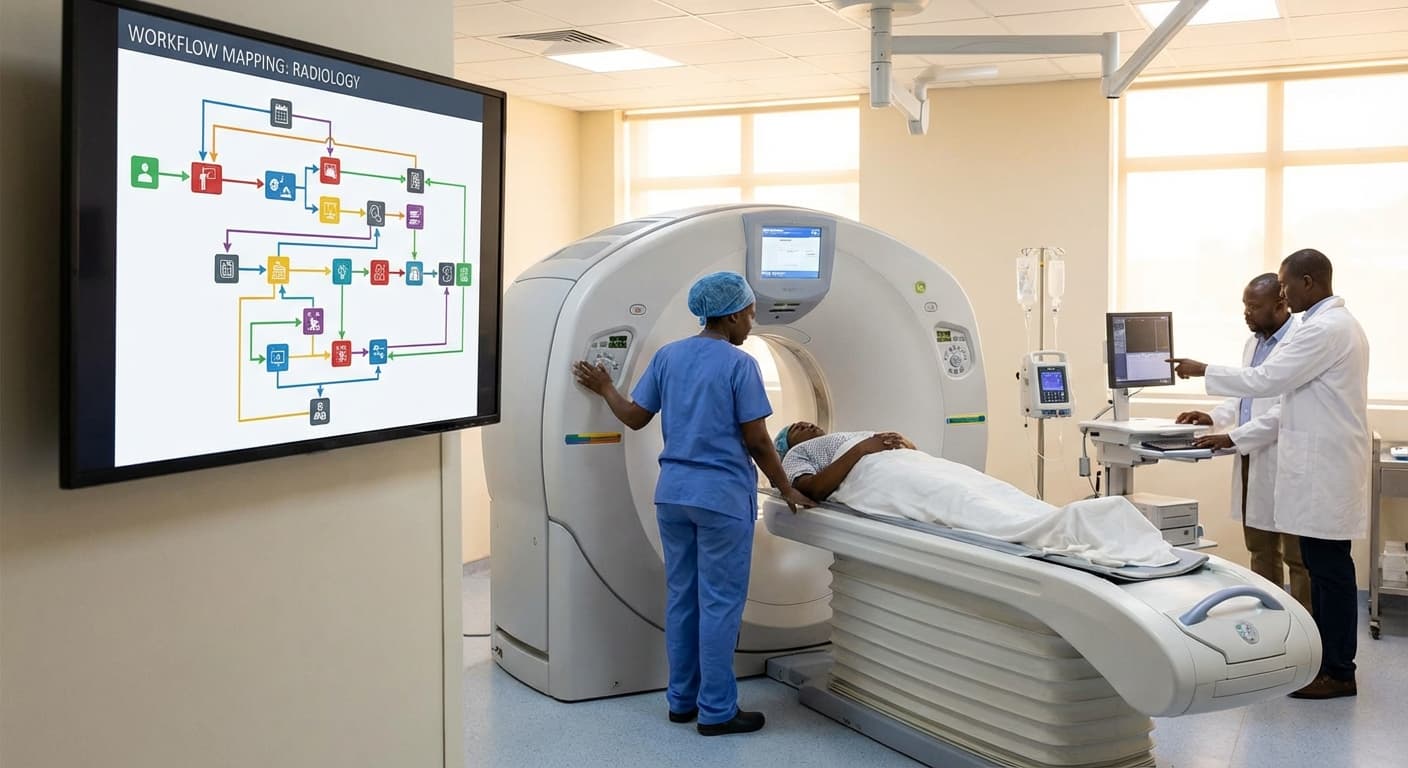
Department Workflow Mapping Service (Radiology/ICU/OT/Lab/Dialysis) in Rwanda
Engineering Excellence & Technical Support
Department Workflow Mapping Service (Radiology/ICU/OT/Lab/Dialysis) High-standard technical execution following OEM protocols and local regulatory frameworks.
Radiology Workflow Optimization
Streamlining the radiology imaging request, acquisition, interpretation, and reporting process across all Rwandan hospitals, ensuring faster turnaround times and improved patient care delivery through clear visual mapping of departmental workflows.
ICU Patient Pathway Enhancement
Mapping critical patient journeys within Intensive Care Units nationwide, identifying bottlenecks and redundancies in care delivery, admission, monitoring, and transfer processes to maximize resource utilization and patient outcomes.
Operating Theatre Resource Management
Developing comprehensive workflow maps for Operating Theatres across Rwanda to optimize surgical scheduling, equipment allocation, and staff deployment, leading to reduced waiting times and increased surgical capacity.
What Is Department Workflow Mapping Service (Radiology/icu/ot/lab/dialysis) In Rwanda?
Department Workflow Mapping Service, in the context of Rwandan healthcare facilities such as Radiology, Intensive Care Units (ICU), Operating Theaters (OT), Laboratories, and Dialysis Units, refers to the systematic process of documenting, analyzing, and optimizing the operational sequences and interdependencies of tasks, resources, and information flow within these critical departments. This service aims to identify inefficiencies, bottlenecks, and areas for improvement to enhance patient care delivery, resource utilization, and overall operational effectiveness. The methodology typically involves a multi-stage approach including data gathering (observations, interviews, document review), process modeling using standardized notation (e.g., BPMN), analysis of key performance indicators (KPIs), and the development of recommendations for process re-engineering or technological integration.
| Who Needs This Service? | Typical Use Cases |
|---|---|
| Radiology Departments: To streamline imaging request fulfillment, report generation, and image archival/retrieval, improving turnaround times for diagnostic imaging services. | Optimizing the patient pathway from referral to final report delivery. Improving efficiency of image acquisition and processing. Integrating new imaging technologies or modalities into existing workflows. Reducing radiologist reading time and improving report accuracy. |
| Intensive Care Units (ICUs): To enhance the coordination of care for critically ill patients, ensuring timely intervention and efficient resource utilization. | Mapping patient admission, transfer, and discharge processes. Optimizing the handover of patient care between shifts. Streamlining communication and information sharing among multidisciplinary teams. Improving the management of critical equipment and monitoring systems. |
| Operating Theaters (OTs): To improve surgical scheduling, resource allocation, and the efficiency of the surgical process from patient preparation to post-operative care. | Analyzing operating room utilization and scheduling efficiency. Optimizing the patient flow through the surgical suite. Ensuring adequate availability and sterile processing of surgical instruments and equipment. Improving communication and coordination among surgical teams and support staff. |
| Laboratories: To optimize sample processing, testing turnaround times, and reporting of results, ensuring accuracy and efficiency in diagnostic testing. | Mapping the pre-analytical, analytical, and post-analytical phases of laboratory testing. Improving specimen tracking and management. Reducing TAT for critical lab tests. Implementing quality control measures and troubleshooting processes. |
| Dialysis Units: To streamline patient scheduling, treatment delivery, and monitoring for patients undergoing dialysis. | Optimizing patient appointment scheduling and flow. Ensuring efficient management of dialysis machines and supplies. Streamlining the administration of medications and monitoring of vital signs. Improving patient safety and adherence to treatment protocols. |
Key Components and Stakeholders of Department Workflow Mapping Service:
- Process Documentation: Detailed visualization of existing workflows, including patient journeys, sample handling, imaging procedures, surgical processes, and treatment protocols.
- Resource Allocation Analysis: Examination of how human resources (clinicians, technicians, administrative staff), equipment, and consumables are utilized within the mapped workflows.
- Information Flow Management: Tracking the movement of patient data, test results, imaging reports, and administrative information across different stages and stakeholders.
- Bottleneck Identification: Pinpointing stages where delays, congestion, or inefficiencies occur, impacting throughput and patient wait times.
- Risk Assessment: Identifying potential failure points or deviations from standard operating procedures that could compromise patient safety or data integrity.
- Performance Measurement: Defining and tracking relevant KPIs (e.g., turnaround time, patient satisfaction, equipment utilization, error rates) to benchmark current performance and measure the impact of changes.
- Recommendations for Optimization: Proposing specific interventions, such as process standardization, technology adoption (e.g., PACS, LIS, EMR integration), staff training, or physical layout adjustments.
- Stakeholders: Healthcare administrators, department heads (Radiology, ICU, OT, Lab, Dialysis), clinical staff, IT professionals, quality improvement teams, and potentially external consultants specializing in healthcare process optimization.
Who Needs Department Workflow Mapping Service (Radiology/icu/ot/lab/dialysis) In Rwanda?
In Rwanda's evolving healthcare landscape, optimizing operational efficiency is paramount. Department workflow mapping services are crucial for identifying bottlenecks, reducing waste, and improving patient care across critical departments. This service specifically targets institutions that handle high patient volumes and complex procedures, aiming to streamline their internal processes and enhance overall service delivery.
| Department | Why Workflow Mapping is Needed | Specific Challenges Addressed |
|---|---|---|
| Radiology | Ensuring efficient patient flow from imaging request to report delivery, optimizing equipment utilization, and reducing turnaround times for diagnoses. | Long waiting times for appointments, delays in image acquisition and interpretation, inefficient reporting processes, suboptimal equipment scheduling. |
| Intensive Care Unit (ICU) | Streamlining critical patient care pathways, improving interdisciplinary communication, and ensuring timely access to resources and interventions. | Communication breakdowns between staff, delays in medication administration, inefficient patient monitoring, challenges in resource allocation (beds, ventilators). |
| Operating Theatre (OT) | Optimizing surgical scheduling, improving instrument and equipment management, and ensuring efficient patient preparation and recovery processes. | OR schedule overruns, delays in patient preparation/transport, inefficient sterilization and instrument tracking, poor communication between surgical teams and support staff. |
| Laboratory | Accelerating sample processing, improving quality control, and ensuring accurate and timely test results for patient diagnosis and treatment. | Backlogs in sample processing, potential for sample misidentification, delays in result reporting, inefficient reagent management, quality assurance gaps. |
| Dialysis | Streamlining patient scheduling, ensuring efficient treatment delivery, and optimizing resource allocation (machines, staff) for consistent and safe dialysis. | Patient scheduling conflicts, long waiting times for dialysis sessions, inefficient machine turnaround, potential for errors in treatment delivery, staff workload imbalances. |
Target Customers and Departments in Rwanda Requiring Workflow Mapping Services
- Hospitals (Public and Private)
- Tertiary Care Centers
- Specialty Clinics
- Diagnostic Laboratories
Department Workflow Mapping Service (Radiology/icu/ot/lab/dialysis) Process In Rwanda
This document outlines the standard workflow for the Department Workflow Mapping Service in Rwanda, covering Radiology, ICU, OT (Operating Theatre), Lab, and Dialysis departments. The service aims to analyze, document, and optimize the operational processes within these critical healthcare units. The workflow is structured into distinct phases, ensuring a systematic and comprehensive approach from initial inquiry to the final execution of recommendations.
| Phase | Description | Key Activities | Deliverables | Responsible Parties |
|---|---|---|---|---|
| The process begins with a healthcare facility in Rwanda expressing interest in workflow mapping services for one or more specified departments. | Initial contact, needs assessment discussion, understanding the department's current challenges, and preliminary information exchange. | Confirmation of interest, preliminary understanding of needs. | Client (Healthcare Facility), Service Provider (Workflow Mapping Team) |
| Formalizing the project's boundaries, objectives, and timeline. | Detailed discussion on the specific department(s) to be mapped, key processes to focus on, project goals (e.g., efficiency improvement, cost reduction, quality enhancement), timeline, and resource allocation. Development of a project charter or proposal. | Signed contract/agreement, detailed project plan, identified stakeholders. | Client (Healthcare Facility), Service Provider (Workflow Mapping Team) |
| Collecting comprehensive data about the current operational processes. | Conducting interviews with department staff (doctors, nurses, technicians, administrators), observing workflows, reviewing existing documentation (SOPs, patient records, equipment logs), and collecting relevant performance metrics. | Interview notes, observation logs, collected documents and data. | Service Provider (Workflow Mapping Team), Client (Department Staff) |
| Visually representing the current state of the department's workflows. | Creating process flow diagrams, swimlane diagrams, and other visual representations of 'as-is' workflows. Documenting each step, decision point, responsible party, and associated resources. | Detailed 'as-is' workflow diagrams, process narratives, comprehensive documentation. | Service Provider (Workflow Mapping Team) |
| Analyzing the documented workflows to pinpoint inefficiencies and areas for enhancement. | Identifying delays, redundancies, communication breakdowns, resource underutilization, quality issues, and potential risks within the current processes. | List of identified bottlenecks, pain points, and areas for improvement. | Service Provider (Workflow Mapping Team) |
| Proposing solutions and changes to optimize the identified workflows. | Developing 'to-be' workflow models, suggesting technology adoption, changes in staffing roles, revised procedures, training needs, and other actionable recommendations. | Proposed 'to-be' workflows, documented recommendations with justification. | Service Provider (Workflow Mapping Team) |
| Presenting the findings and recommendations to the client for review and feedback. | Formal presentation of the 'as-is' and 'to-be' workflows, identified issues, and proposed solutions to key stakeholders. Gathering feedback and ensuring alignment. | Validated 'to-be' workflows, approved recommendations. | Service Provider (Workflow Mapping Team), Client (Healthcare Facility Management & Department Heads) |
| Assisting the client in putting the recommendations into practice. | Providing guidance on implementing new procedures, training staff, configuring technology, and managing change. This phase can be tailored to the client's needs. | Implementation plan, training materials, progress reports. | Service Provider (Workflow Mapping Team), Client (Implementation Team) |
| Tracking the impact of implemented changes and ensuring sustained improvements. | Collecting data to measure the effectiveness of the implemented recommendations against predefined metrics. Adjusting strategies as needed. | Performance reports, post-implementation analysis. | Service Provider (Workflow Mapping Team), Client (Performance Monitoring Team) |
| Concluding the workflow mapping engagement. | Final report summarizing the project, delivered documentation, and formal sign-off from the client. Archiving project materials. | Final project report, signed project closure document. | Service Provider (Workflow Mapping Team), Client (Healthcare Facility) |
Workflow Phases
- Inquiry and Initial Consultation
- Scope Definition and Planning
- Information Gathering and Analysis
- Workflow Mapping and Documentation
- Identification of Bottlenecks and Improvement Areas
- Recommendation Development
- Presentation and Validation
- Implementation Support (Optional)
- Monitoring and Evaluation (Optional)
- Project Closure
Department Workflow Mapping Service (Radiology/icu/ot/lab/dialysis) Cost In Rwanda
The cost of a Department Workflow Mapping Service in Rwanda for specialized departments like Radiology, ICU, OT (Operating Theatre), Lab (Laboratory), and Dialysis can vary significantly. This service aims to optimize operational efficiency, reduce bottlenecks, and improve patient care pathways within these critical areas. Several factors influence the pricing, making it essential for institutions to seek detailed quotes based on their specific needs. The pricing is typically presented in Rwandan Francs (RWF).
| Department Type | Estimated Cost Range (RWF) | Notes |
|---|---|---|
| Radiology | 5,000,000 - 15,000,000 | Includes mapping of imaging requests, patient flow, equipment utilization, reporting, and communication channels. |
| ICU (Intensive Care Unit) | 7,000,000 - 20,000,000 | Focuses on patient admission/discharge, staff allocation, resource management, interdisciplinary communication, and critical care pathways. |
| OT (Operating Theatre) | 6,000,000 - 18,000,000 | Covers scheduling, pre-operative assessment, intra-operative procedures, post-operative care, sterile processing, and staff coordination. |
| Lab (Laboratory) | 4,000,000 - 12,000,000 | Examines sample reception, testing workflows, equipment calibration, quality control, result reporting, and turnaround times. |
| Dialysis | 4,500,000 - 13,500,000 | Involves patient scheduling, preparation, treatment protocols, equipment management, staffing, and waste management. |
Key Pricing Factors for Department Workflow Mapping Services in Rwanda:
- Scope of the Project: The complexity and extent of the workflow mapping exercise. Mapping a single sub-department versus an entire multi-unit service will have different cost implications.
- Number of Departments/Units: The more departments or distinct units to be mapped, the higher the overall cost.
- Size and Complexity of the Department: Larger departments with more staff, equipment, and patient throughput will require more extensive analysis.
- Data Collection Methodology: The chosen methods for data collection (e.g., direct observation, interviews, surveys, analysis of existing documentation, simulation modeling) will impact time and resources required.
- Level of Detail Required: The granularity of the workflow map – from high-level process flows to detailed task breakdowns and dependencies.
- Number of Stakeholders Involved: The number of staff and management personnel who need to be consulted and involved in the process.
- Software and Tools Used: The use of specialized workflow mapping software or simulation tools can add to the cost, but often provides more robust and dynamic outputs.
- Deliverables and Reporting: The format and comprehensiveness of the final report, including visual representations, recommendations, and implementation roadmaps.
- Consultant Expertise and Experience: The reputation, experience, and specialization of the consulting firm or individual consultants.
- Project Timeline: A compressed timeline may necessitate more resources and thus higher costs.
- Post-Implementation Support: Some services may include follow-up consultations or support for implementing the recommended changes.
Affordable Department Workflow Mapping Service (Radiology/icu/ot/lab/dialysis) Options
Our Affordable Department Workflow Mapping Service helps healthcare departments like Radiology, ICU, OT, Lab, and Dialysis optimize their operations for efficiency and cost savings. We provide expert analysis and visualization of your existing workflows, identifying bottlenecks, redundancies, and areas for improvement. This allows for better resource allocation, reduced wait times, and enhanced patient care.
| Service Option | Description | Key Deliverables | Ideal For | Estimated Price Range (USD)* |
|---|---|---|---|---|
| Standard Workflow Mapping | Mapping of primary departmental workflow. | Process diagrams, bottleneck report, basic recommendations. | Departments needing a foundational understanding of their processes. | $1,500 - $3,000 |
| Departmental Optimization Bundle | In-depth analysis of a single department, focusing on 2-3 key sub-processes. | Detailed process maps, cost-saving recommendations, follow-up review. | Departments seeking tangible efficiency gains and cost reductions. | $3,000 - $6,000 |
| Inter-Departmental Synergy Bundle | Mapping workflows between two connected departments. | Interconnected process maps, communication improvement strategies, joint efficiency recommendations. | Departments with critical handoffs and collaborative needs (e.g., ICU/OT, Lab/Wards). | $5,000 - $9,000 |
| Comprehensive Efficiency Overhaul | Holistic mapping and optimization of all major workflows within a department. | Root cause analysis, tailored optimization plans, implementation guidance. | Departments committed to significant, long-term operational improvements and cost savings. | $8,000 - $15,000+ |
| Customizable Project Scope | Tailored service for unique or multi-departmental needs. | Project-specific deliverables. | Organizations with specialized or large-scale workflow initiatives. | Quote-Based |
Value Bundles and Cost-Saving Strategies
- Standard Workflow Mapping: Comprehensive mapping of a single department's primary workflow. Includes process diagrams, bottleneck identification, and basic recommendations.
- Departmental Optimization Bundle: Includes Standard Workflow Mapping for one department, plus in-depth analysis of 2-3 key sub-processes, detailed cost-saving recommendations, and a follow-up review session.
- Inter-Departmental Synergy Bundle: Extends the Departmental Optimization Bundle to map the workflows between two interconnected departments (e.g., ICU and OT, or Lab and Inpatient Wards). Focuses on seamless transitions and communication improvements.
- Comprehensive Efficiency Overhaul: Maps all major workflows within a single department, identifies root causes of inefficiencies, develops tailored optimization plans, and provides implementation support guidance. This bundle offers the most significant long-term cost savings.
- Customizable Project Scope: For unique needs or multi-departmental initiatives, we offer tailored solutions with flexible pricing based on the scope and complexity of the project.
- Cost-Saving Strategies Integrated: Our service inherently focuses on cost reduction through: * Reduced Waste: Identifying and eliminating unnecessary steps, materials, and time. * Improved Resource Utilization: Ensuring staff, equipment, and supplies are used efficiently. * Decreased Wait Times: Streamlining processes to minimize patient and staff waiting. * Enhanced Throughput: Increasing the number of patients or procedures processed effectively. * Reduced Errors and Rework: Improving accuracy and reducing the need for repeat tasks. * Optimized Staffing: Aligning staffing levels with actual workflow demands.
- Technology Integration Consulting (Add-on): We can advise on the integration of relevant technologies (e.g., EMR enhancements, scheduling software, automated lab systems) to further streamline workflows and achieve greater efficiency.
- Phased Implementation Support (Add-on): For larger projects, we offer phased implementation support to guide your team through the adoption of new processes and technologies, ensuring a smooth transition and sustained benefits.
Verified Providers In Rwanda
Finding reliable and trustworthy healthcare providers is paramount for ensuring quality medical care. In Rwanda, 'Verified Providers' signifies a commitment to established standards and patient well-being. Franance Health stands out among these verified entities, not only for its adherence to rigorous credentialing processes but also for its comprehensive approach to healthcare. This introduction will explore what it means to be a Verified Provider in Rwanda and highlight the specific credentials and attributes that make Franance Health the premier choice for your healthcare needs.
| Franance Health Credential/Attribute | Why it Represents the Best Choice |
|---|---|
| Accreditation by Ministry of Health (Rwanda): | This official endorsement signifies adherence to all national healthcare standards, legal requirements, and patient care protocols, ensuring a baseline of trusted service. |
| Certified Medical Professionals: | All practitioners at Franance Health hold recognized certifications and licenses, guaranteeing expertise and competence in their respective fields, from general practice to specialized treatments. |
| Advanced Diagnostic Capabilities: | Investment in state-of-the-art medical equipment and technology allows for accurate diagnoses and effective treatment planning, setting them apart in diagnostic precision. |
| Patient-Centric Care Philosophy: | Franance Health prioritizes a holistic approach, focusing on patient comfort, clear communication, and personalized treatment plans, fostering trust and long-term well-being. |
| Commitment to Continuous Improvement: | Regular training, participation in medical research, and feedback mechanisms demonstrate an unwavering dedication to staying at the forefront of medical advancements and best practices. |
| Ethical Practice and Confidentiality: | Upholding the highest ethical standards and ensuring strict patient data confidentiality are non-negotiable tenets of their operation, providing peace of mind. |
Key Aspects of Verified Providers in Rwanda
- Regulatory Compliance: Verified providers meet and exceed national healthcare regulations and licensing requirements.
- Quality Assurance: They adhere to stringent quality assurance protocols to ensure consistent and high-standard patient care.
- Professional Standards: Verification often involves the assessment of professional qualifications, ethical conduct, and continuous professional development of their medical staff.
- Patient Safety: A core component of verification is the implementation of robust patient safety measures and protocols.
- Transparency and Accountability: Verified providers operate with a high degree of transparency, making their credentials and services readily accessible and holding themselves accountable for patient outcomes.
Scope Of Work For Department Workflow Mapping Service (Radiology/icu/ot/lab/dialysis)
This Scope of Work outlines the services to be provided for a comprehensive workflow mapping initiative across critical hospital departments: Radiology, Intensive Care Unit (ICU), Operating Theatre (OT), Laboratory, and Dialysis. The primary objective is to document existing processes, identify bottlenecks and inefficiencies, and propose optimized workflows to enhance patient care, operational efficiency, and resource utilization. This service will involve a detailed analysis of current departmental operations, including patient journeys, staff activities, equipment usage, information flow, and inter-departmental dependencies. The outcome will be a set of documented workflows, identified improvement areas, and actionable recommendations.
| Department | Key Workflow Areas to Map | Typical Deliverables (per department) | Standard Specifications |
|---|---|---|---|
| Radiology | Patient registration and appointment scheduling Image acquisition and processing Radiologist interpretation and reporting Image and report archival and retrieval Contrast media management Equipment maintenance and calibration | Current state process maps (e.g., BPMN diagrams) Data flow diagrams Stakeholder interviews and observations summary List of identified pain points and inefficiencies Recommendations for improvement High-level future state workflow proposals | Process maps will adhere to BPMN 2.0 standards. Documentation will be clear, concise, and easily understandable by clinical and administrative staff. Deliverables will be provided in digital format (e.g., PDF, editable Visio/Lucidchart files). All documentation will be version-controlled. |
| Intensive Care Unit (ICU) | Patient admission and transfer protocols Patient monitoring and vital sign tracking Medication administration and management Therapeutic interventions (e.g., ventilation, dialysis) Interdisciplinary rounds and communication Documentation of patient progress Discharge planning and transfer | Current state process maps (e.g., BPMN diagrams) Stakeholder interviews and observations summary Analysis of communication pathways List of identified pain points and inefficiencies Recommendations for improvement High-level future state workflow proposals | Process maps will adhere to BPMN 2.0 standards. Documentation will be clear, concise, and easily understandable by clinical and administrative staff. Deliverables will be provided in digital format (e.g., PDF, editable Visio/Lucidchart files). All documentation will be version-controlled. |
| Operating Theatre (OT) | Surgical scheduling and pre-operative patient preparation Patient transfer to OT and anesthesia induction Surgical procedure workflow Instrument and equipment sterilization and preparation Surgical team communication and coordination Post-operative recovery and patient transfer Waste management and decontamination | Current state process maps (e.g., BPMN diagrams) Stakeholder interviews and observations summary Analysis of resource utilization (staff, equipment) List of identified pain points and inefficiencies Recommendations for improvement High-level future state workflow proposals | Process maps will adhere to BPMN 2.0 standards. Documentation will be clear, concise, and easily understandable by clinical and administrative staff. Deliverables will be provided in digital format (e.g., PDF, editable Visio/Lucidchart files). All documentation will be version-controlled. |
| Laboratory | Sample collection and patient identification Sample accessioning and tracking Test ordering and processing Automated and manual testing procedures Quality control and assurance Reporting of results (internal and external) Specimen storage and disposal | Current state process maps (e.g., BPMN diagrams) Data flow diagrams Stakeholder interviews and observations summary Analysis of turnaround times List of identified pain points and inefficiencies Recommendations for improvement High-level future state workflow proposals | Process maps will adhere to BPMN 2.0 standards. Documentation will be clear, concise, and easily understandable by clinical and administrative staff. Deliverables will be provided in digital format (e.g., PDF, editable Visio/Lucidchart files). All documentation will be version-controlled. |
| Dialysis | Patient scheduling and pre-treatment preparation Patient assessment and vital sign monitoring Dialysis procedure initiation and execution Medication and fluid management during treatment Post-treatment monitoring and patient discharge Equipment maintenance and sterilization Waste management | Current state process maps (e.g., BPMN diagrams) Stakeholder interviews and observations summary Analysis of patient throughput List of identified pain points and inefficiencies Recommendations for improvement High-level future state workflow proposals | Process maps will adhere to BPMN 2.0 standards. Documentation will be clear, concise, and easily understandable by clinical and administrative staff. Deliverables will be provided in digital format (e.g., PDF, editable Visio/Lucidchart files). All documentation will be version-controlled. |
Key Objectives:
- To thoroughly document current state workflows for each specified department.
- To identify inefficiencies, bottlenecks, and areas for potential improvement within each workflow.
- To facilitate a shared understanding of departmental processes among stakeholders.
- To provide a foundation for process re-engineering and technology integration initiatives.
- To ensure compliance with relevant healthcare regulations and best practices.
- To improve patient safety and patient experience through streamlined processes.
- To optimize resource allocation and utilization (staff, equipment, time).
Service Level Agreement For Department Workflow Mapping Service (Radiology/icu/ot/lab/dialysis)
This Service Level Agreement (SLA) outlines the performance standards and responsibilities for the Department Workflow Mapping Service, catering to critical healthcare departments including Radiology, Intensive Care Unit (ICU), Operating Theater (OT), Laboratory, and Dialysis. The aim of this service is to ensure efficient, accurate, and timely mapping of departmental workflows to improve operational efficiency, reduce bottlenecks, and enhance patient care delivery.
| Service Component | Response Time | Uptime Guarantee |
|---|---|---|
| Initial Consultation & Project Kick-off | Within 2 business days of request | N/A (Project-based) |
| Initial Workflow Data Gathering & Analysis | Within 5 business days of access to relevant personnel/systems | N/A (Project-based) |
| Draft Workflow Diagram Submission | Within 10 business days of data gathering completion | N/A (Project-based) |
| Feedback Incorporation & Revision | Within 5 business days of receiving consolidated feedback | N/A (Project-based) |
| Final Workflow Documentation & Report Delivery | Within 3 business days of final approval | N/A (Project-based) |
| Support & Clarification Post-Delivery | Within 1 business day for critical queries, 2 business days for standard queries | 99.5% availability during standard business hours (8 AM - 5 PM, Mon-Fri) |
| Ad-hoc Workflow Review/Update Request | Within 2 business days for initial assessment, timeline provided for completion | N/A (Project-based) |
| System Accessibility for Data Extraction (if applicable) | N/A (Dependent on IT support) | 99.9% uptime during scheduled maintenance windows |
Service Scope and Objectives
- Workflow Mapping: Comprehensive analysis, documentation, and visualization of existing workflows within Radiology, ICU, OT, Lab, and Dialysis departments.
- Process Optimization: Identification of inefficiencies, redundancies, and potential areas for improvement in documented workflows.
- Technology Integration Support: Providing insights into how technology can be leveraged to enhance mapped workflows.
- Reporting and Documentation: Delivering clear, actionable reports and detailed workflow diagrams.
- Stakeholder Collaboration: Engaging with department heads, clinical staff, and IT personnel throughout the mapping process.
- Continuous Improvement: Facilitating ongoing review and refinement of workflows based on feedback and performance metrics.
Frequently Asked Questions

Ready when you are
Let's scope your Department Workflow Mapping Service (Radiology/ICU/OT/Lab/Dialysis) in Rwanda project in Rwanda.

Scaling healthcare logistics and technical systems across the entire continent.