
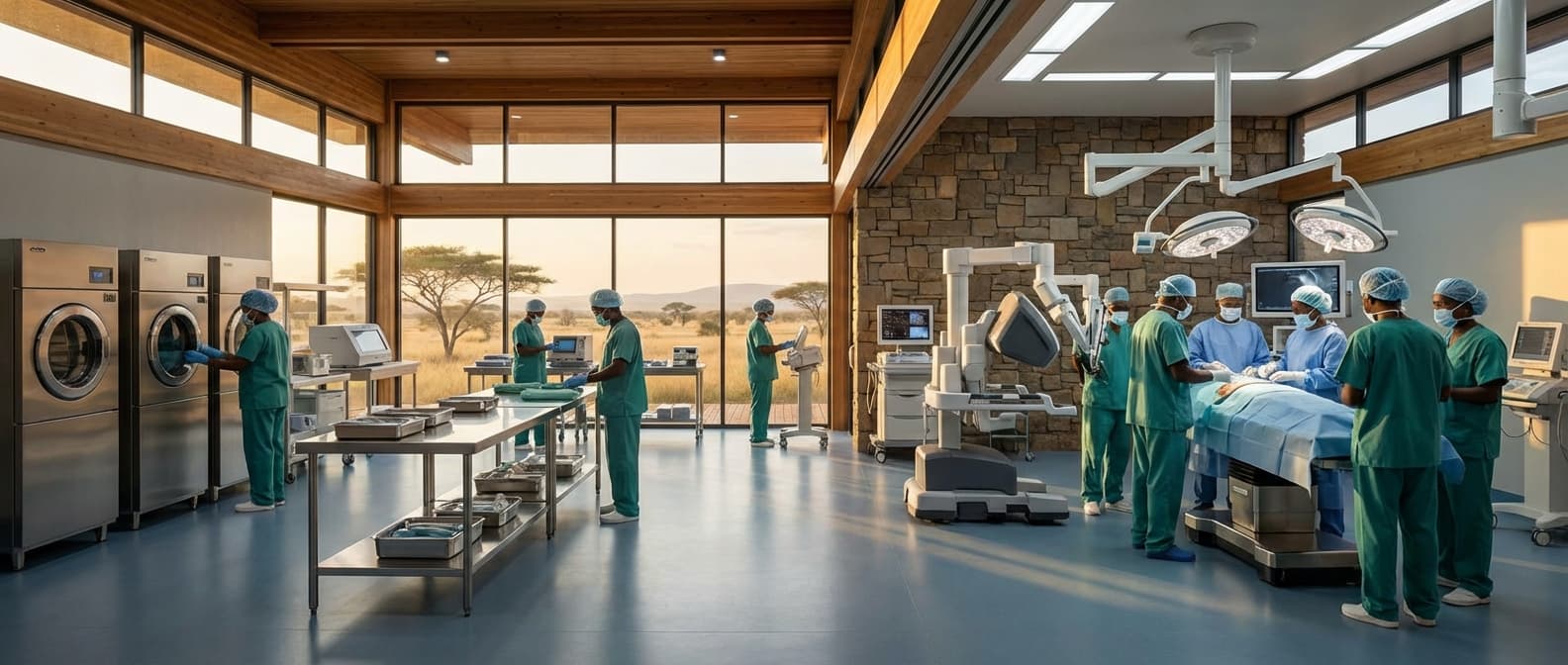
Operating Theatre Turnkey Build in Rwanda
Engineering Excellence & Technical Support
Complete OR design, equipment integration and commissioning High-standard technical execution following OEM protocols and local regulatory frameworks.
State-of-the-Art Operating Theatre Construction
Delivering fully integrated, turnkey operating theatre solutions in Rwanda, adhering to international standards for infection control, workflow efficiency, and advanced medical equipment integration. Our builds encompass structural integrity, MEP systems, and specialized finishes for optimal surgical environments.
Robust Infection Control & Air Filtration
Implementing advanced HEPA filtration systems, positive pressure differentials, and specialized laminar airflow technologies to ensure sterile environments and minimize the risk of surgical site infections, crucial for patient safety and successful surgical outcomes in Rwanda.
Seamless Medical Equipment Integration & IT Infrastructure
Expertly integrating a comprehensive range of surgical equipment, from imaging systems to robotic surgery platforms, alongside robust IT infrastructure for real-time data management, tele-medicine capabilities, and future technological scalability within Rwandan healthcare facilities.
What Is Operating Theatre Turnkey Build In Rwanda?
An Operating Theatre Turnkey Build in Rwanda refers to a comprehensive service that encompasses the complete design, construction, equipping, and commissioning of a functional operating theatre (OT) suite. This 'turnkey' approach signifies that the client receives a fully operational facility ready for immediate use, with all aspects managed by a single contractor or consortium. The service is designed to address the complexities of establishing a sterile, high-tech surgical environment, from initial architectural planning and structural modifications to the installation of specialized medical equipment, HVAC systems for infection control, lighting, and waste management infrastructure.
| Stakeholder Group | Needs and Benefits | Typical Use Cases |
|---|---|---|
| Hospitals and Clinics (Public & Private): | Enhance surgical capacity, improve patient outcomes, meet regulatory standards, attract specialized medical personnel, increase service offerings. | Establish new surgical departments, upgrade existing OT facilities, expand service lines (e.g., cardiology, neurosurgery, orthopedics), replace outdated infrastructure. |
| Government Health Ministries/Agencies: | Expand healthcare access, improve quality of care in public facilities, standardize surgical infrastructure across the nation, address critical healthcare needs. | Development of regional hospitals, establishment of specialized surgical centers, public health infrastructure improvement projects, disaster preparedness facilities. |
| Non-Governmental Organizations (NGOs) and Humanitarian Organizations: | Provide essential surgical services in underserved areas, respond to humanitarian crises, implement specialized medical programs. | Establish surgical units in remote locations, create mobile surgical units, build or refurbish OTs for specific medical missions (e.g., fistula repair, trauma care). |
| Medical Training Institutions: | Provide hands-on training facilities for surgeons, anesthetists, and nursing staff, ensure exposure to modern surgical environments and technologies. | Development of teaching hospitals, establishment of simulation centers with functional OTs, upgrading existing facilities for educational purposes. |
Service Components of an Operating Theatre Turnkey Build:
- Design and Planning: Architectural design, structural engineering, MEP (Mechanical, Electrical, Plumbing) system design, detailed layout planning considering workflow, patient safety, and infection control protocols.
- Civil Works and Construction: Site preparation, excavation, structural alterations or new construction, interior finishing (wall cladding, flooring, ceiling), ensuring compliance with national building codes and healthcare facility standards.
- Specialized HVAC and Environmental Control: Design and installation of high-efficiency HEPA filtration systems, positive/negative pressure differentials for different zones (e.g., sterile core vs. prep/recovery), temperature and humidity control, and air change rates to maintain aseptic conditions.
- Medical Gas Systems: Installation of medical air, oxygen, vacuum, and nitrous oxide pipelines with appropriate outlets, alarms, and central supply connections.
- Electrical Systems: Robust power distribution, backup generator systems, uninterruptible power supply (UPS) for critical equipment, specialized lighting (surgical lights, examination lights), and integrated power management.
- Plumbing and Drainage: Installation of sterile water systems, specialized sinks (scrub sinks), sanitary drainage with backflow prevention, and water treatment systems.
- Equipment Integration and Installation: Procurement, installation, and calibration of major surgical equipment (e.g., surgical tables, anesthesia machines, electrocautery units), imaging modalities, sterilization equipment, and patient monitoring systems.
- Sterilization and Waste Management: Design and implementation of dedicated sterilization areas (CSSD integration) and compliant medical waste management systems.
- IT and Communication Infrastructure: Installation of network cabling, communication systems (intercoms, nurse call systems), and potentially integration with Picture Archiving and Communication Systems (PACS) or Electronic Health Records (EHR).
- Commissioning and Validation: Rigorous testing of all systems and equipment to ensure functionality, safety, and compliance with regulatory requirements. This includes performance validation and handover to the client with comprehensive documentation.
Who Needs Operating Theatre Turnkey Build In Rwanda?
Operating theatre turnkey builds in Rwanda are critical for healthcare facilities seeking to establish or upgrade their surgical capabilities. These comprehensive solutions offer a rapid and efficient way to bring state-of-the-art surgical suites online, complete with all necessary infrastructure, equipment, and finishes. The demand stems from a need for modern, safe, and functional surgical environments that can support a wide range of medical procedures and meet international standards.
| Target Customer Segment | Key Departments/Needs |
|---|---|
| Public Hospitals | Expansion of existing surgical capacity, replacement of outdated facilities, equipping new hospital wings, upgrading general surgery, obstetrics, and emergency surgical departments. |
| Private Hospitals and Clinics | Establishing new premium surgical services, enhancing competitiveness with advanced technology, accommodating specialized surgeons (e.g., orthopedic, cardiac, neurosurgery), catering to elective and complex procedures. |
| Specialized Surgical Centers | Creating dedicated facilities for specific surgical disciplines, ensuring specialized equipment and environmental controls, meeting the unique requirements of minimally invasive surgery, transplants, or reconstructive surgery. |
| Missions and NGO Healthcare Facilities | Setting up essential surgical infrastructure in underserved areas, providing critical life-saving procedures, equipping facilities for mobile surgical units, and ensuring rapid deployment of surgical capabilities in emergencies. |
| New Healthcare Infrastructure Projects | Integrating operating theatres as core components of newly built hospitals, medical schools, or comprehensive healthcare complexes from the ground up, ensuring optimal design and functionality from inception. |
Who Needs Operating Theatre Turnkey Build in Rwanda?
- Public Hospitals
- Private Hospitals and Clinics
- Specialized Surgical Centers
- Missions and Non-Governmental Organization (NGO) Healthcare Facilities
- New Healthcare Infrastructure Projects
Operating Theatre Turnkey Build Process In Rwanda
The turnkey build process for an operating theatre in Rwanda involves a comprehensive workflow from the initial client inquiry to the final handover and commissioning. This process ensures all aspects of the project are managed efficiently, from design and procurement to construction, installation, and validation, meeting the specific requirements and regulatory standards of Rwandan healthcare facilities. A turnkey solution implies a single point of responsibility for the entire project, delivering a fully functional operating theatre.
| Phase | Key Activities | Key Deliverables/Outcomes | Key Stakeholders Involved |
|---|---|---|---|
| 1. Inquiry & Feasibility | Initial client contact, understanding project scope, budget, and timeline. Site visit and assessment. Needs analysis for the operating theatre (e.g., number of ORs, specialization, equipment requirements). Preliminary feasibility study and proposal generation. | Project brief, feasibility report, preliminary budget, proposal outline. | Client (Hospital/Ministry of Health), Project Manager, Technical Consultants. |
| 2. Design & Planning | Detailed architectural and engineering design. Medical equipment planning and specification. HVAC, electrical, plumbing, and IT infrastructure design. Workflow analysis and optimization. Development of detailed project plan, timeline, and budget. Obtaining necessary permits and approvals from Rwandan authorities. | Detailed design drawings (architectural, MEP, medical gas), equipment specifications, project schedule, final budget, approved permits. | Client, Project Manager, Architects, Engineers (Structural, MEP, Electrical), Medical Equipment Specialists, Regulatory Bodies. |
| 3. Procurement & Manufacturing | Sourcing and procurement of all materials, medical equipment, and specialized systems. Manufacturing of custom-built components (e.g., wall panels, surgical lights). Vendor selection and contract management. Logistics planning for international and local deliveries. | Procured materials and equipment, manufactured components, signed vendor contracts, logistics plan. | Project Manager, Procurement Specialists, Suppliers, Manufacturers, Logistics Providers. |
| 4. Site Preparation & Construction | Clearing and preparing the construction site. Demolition (if applicable). Civil works, including foundation, walls, and structural elements. Installation of building services (MEP). Interior finishing (flooring, ceiling, wall cladding). Compliance with Rwandan construction regulations and safety standards. | Completed building shell and core, installed building services, finished interior spaces. | Project Manager, Construction Site Manager, Civil Engineers, Skilled Laborers, Subcontractors. |
| 5. Installation & Integration | Installation of specialized operating theatre equipment (surgical lights, tables, booms, anesthesia machines, imaging equipment). Integration of medical gas systems, ventilation (HEPA filtration), and power supply. Installation of communication and IT systems. | Installed and connected medical equipment, integrated MEP systems, functional IT and communication infrastructure. | Project Manager, Technical Installation Teams, Medical Equipment Technicians, MEP Engineers, IT Specialists. |
| 6. Testing, Commissioning & Validation | Systematic testing of all installed equipment and systems. Performance testing of HVAC, medical gas, electrical, and IT systems. Calibration of medical equipment. Validation to ensure the operating theatre meets all functional, safety, and regulatory requirements (e.g., infection control standards). | Test reports, commissioning certificates, validation reports, compliance documentation. | Project Manager, Technical Teams, Validation Engineers, Quality Assurance Specialists, Client Representatives. |
| 7. Handover & Training | Final inspection and walkthrough with the client. Provision of all documentation (manuals, warranties, as-built drawings). Comprehensive training for hospital staff on the operation and maintenance of the equipment and facilities. Official handover of the fully functional operating theatre. | Operational operating theatre, comprehensive documentation, trained staff, handover certificate. | Project Manager, Client, Hospital Staff (Medical and Technical), Training Specialists. |
| 8. Post-Construction Support | Warranty management. Planned preventive maintenance services. Troubleshooting and repairs. Ongoing technical support. Potential for upgrades and future expansions. | Warranty services, maintenance agreements, technical support, continued operational efficiency. | Project Manager, Service Engineers, Technical Support Team, Client. |
Operating Theatre Turnkey Build Process in Rwanda: Workflow
- Phase 1: Inquiry & Feasibility
- Phase 2: Design & Planning
- Phase 3: Procurement & Manufacturing
- Phase 4: Site Preparation & Construction
- Phase 5: Installation & Integration
- Phase 6: Testing, Commissioning & Validation
- Phase 7: Handover & Training
- Phase 8: Post-Construction Support
Operating Theatre Turnkey Build Cost In Rwanda
Establishing an operating theatre (OT) in Rwanda involves a significant investment, and the turnkey build cost can vary considerably. Several factors influence the final price, making it crucial to understand these elements when budgeting. These factors range from the size and complexity of the OT to the quality of materials and finishes, and the specific medical equipment chosen. The local economic climate, availability of skilled labor, and regulatory requirements also play a role. Turnkey solutions aim to provide a complete, ready-to-use facility, encompassing design, construction, fit-out, and initial equipment installation. This comprehensive approach simplifies the process for the client but can also contribute to a higher overall cost compared to managing individual components separately.
| Cost Component | Estimated Range (RWF) | Notes |
|---|---|---|
| Design & Engineering | 5,000,000 - 15,000,000 | Varies with complexity and firm reputation |
| Construction & Civil Works | 30,000,000 - 80,000,000 | Depends on size, finishes, and structural requirements |
| HVAC & Air Filtration | 15,000,000 - 40,000,000 | Crucial for sterility; includes specialized systems |
| Medical Gases & Plumbing | 5,000,000 - 15,000,000 | Includes installation of medical gas pipelines |
| Electrical & Backup Power | 10,000,000 - 30,000,000 | Includes generators and UPS systems |
| Operating Theatre Furniture & Fit-out | 8,000,000 - 25,000,000 | Specialized cabinets, sinks, sterile surfaces |
| Surgical Lights | 5,000,000 - 20,000,000 | Single or dual dome, LED vs. halogen |
| Operating Table | 7,000,000 - 25,000,000 | Basic to advanced electric or hydraulic models |
| Anesthesia Machine & Ventilator | 10,000,000 - 30,000,000 | Essential for patient care |
| Patient Monitors | 3,000,000 - 10,000,000 | Basic to multi-parameter monitoring |
| Sterilization Equipment (Autoclave) | 5,000,000 - 15,000,000 | Essential for instrument reprocessing |
| Miscellaneous Equipment & Instruments | 10,000,000 - 40,000,000 | Surgical instruments, suction, minor equipment |
| Turnkey Project Management & Installation | 5,000,000 - 20,000,000 | Covers coordination and overall project oversight |
| Total Estimated Turnkey Cost (per OT) | 113,000,000 - 310,000,000+ | This is a broad estimate and can vary significantly based on specifications. |
Key Pricing Factors for Operating Theatre Turnkey Builds in Rwanda:
- Size and Layout: The square footage of the operating theatre, including pre-operative and post-operative areas, sterilization rooms, and staff facilities, directly impacts material and labor costs.
- Complexity of Design: Specialized features such as laminar airflow systems, integrated imaging equipment, and advanced lighting systems will increase complexity and cost.
- Quality of Finishes and Materials: High-grade, sterile-friendly materials for walls, floors, and ceilings (e.g., epoxy resin flooring, anti-microbial wall panels) are essential for infection control and are more expensive than standard building materials.
- Medical Equipment and Technology: This is often the largest single cost component. It includes surgical lights, operating tables, anesthesia machines, patient monitors, sterilization equipment, surgical instruments, and imaging devices. The level of sophistication and brand of equipment significantly affects the price.
- HVAC and Air Filtration Systems: Specialized HVAC systems with HEPA filtration are critical for maintaining sterile environments and preventing cross-contamination, representing a substantial investment.
- Plumbing and Electrical Infrastructure: Robust and specialized plumbing for waste disposal and medical gases, along with a reliable and redundant electrical system (including backup generators), are crucial and add to the cost.
- Architectural and Engineering Fees: Professional design and engineering services are required to ensure the OT meets all safety, functional, and regulatory standards.
- Labor Costs: While labor costs in Rwanda may be lower than in some developed countries, the availability of specialized construction and medical installation technicians can influence pricing.
- Regulatory Approvals and Compliance: Obtaining necessary permits and ensuring compliance with Rwandan healthcare facility regulations will incur costs.
- Contingency: It's always advisable to include a contingency fund for unforeseen expenses during the build process.
Affordable Operating Theatre Turnkey Build Options
Building an operating theatre is a significant investment, and for many healthcare facilities, cost-effectiveness is paramount. Fortunately, there are affordable operating theatre turnkey build options that provide comprehensive solutions without compromising essential quality and functionality. These options often revolve around 'value bundles' – pre-defined packages of services and equipment designed to streamline the procurement and construction process, thereby reducing overall costs. By understanding these bundles and employing strategic cost-saving measures, facilities can achieve a fully functional and compliant operating theatre efficiently.
| Value Bundle Component | Description | Cost-Saving Strategy |
|---|---|---|
| Basic Turnkey Package | Includes essential structural elements, basic ventilation (HVAC), standard lighting, and essential electrical infrastructure. Equipment is often a separate, but integrated, selection. | Focuses on core needs, avoiding unnecessary customization. Streamlined procurement and installation. |
| Standard Specialty Bundle | Expands on the basic package with specialized features for common procedures (e.g., orthopedic, general surgery). May include integrated imaging mounts, specialized ventilation, and more advanced lighting. | Leverages pre-engineered solutions for specific needs, reducing custom design time. Bulk purchasing of common specialty equipment. |
| Advanced Integrated Bundle | Offers a comprehensive solution including high-end integrated systems for imaging, robotics, and advanced patient monitoring, alongside premium finishes and robust infection control measures. | While higher in initial cost, the integration of systems from a single provider can lead to long-term operational efficiencies and reduced compatibility issues. Negotiated package pricing for multiple high-value items. |
| Phased Build-Out Option | Allows for the initial construction of a functional operating theatre with the possibility of future upgrades or additions to equipment and features. | Spreads the financial outlay over time, making it more manageable. Prioritizes essential functionality first, deferring non-critical enhancements. |
Key Components of Affordable Turnkey Operating Theatre Builds
- Modular Construction: Pre-fabricated modules are built off-site, significantly reducing on-site construction time and labor costs, and minimizing disruption to existing hospital operations.
- Standardized Design Packages: Pre-designed layouts and specifications tailored to common surgical specialties can expedite the design phase and leverage economies of scale in material sourcing.
- Integrated Equipment Procurement: Turnkey providers often have established relationships with equipment manufacturers, allowing for bundled discounts on essential surgical instruments, imaging systems, and anesthesia machines.
- Streamlined Project Management: A single point of contact for the entire build process simplifies coordination, reduces administrative overhead, and minimizes the risk of costly delays or miscommunications.
- Pre-qualified Suppliers and Contractors: Turnkey solutions typically utilize a network of vetted and experienced suppliers and contractors, ensuring quality and often securing better pricing through volume agreements.
Verified Providers In Rwanda
In Rwanda's rapidly evolving healthcare landscape, identifying trustworthy and high-quality healthcare providers is paramount. This document highlights the significance of verified providers, with a particular focus on Franance Health, explaining their credentials and why they stand out as the best choice for comprehensive and reliable healthcare services. Franance Health's commitment to excellence is reflected in their stringent adherence to regulatory standards, their investment in advanced medical technology, and their dedication to employing highly qualified and experienced medical professionals. By choosing a verified provider like Franance Health, patients can be assured of receiving safe, effective, and patient-centered care.
| Provider Type | Franance Health's Strengths | Why it Matters for Patients |
|---|---|---|
| Hospitals & Clinics | State-of-the-art facilities, specialized departments, advanced surgical capabilities. | Access to comprehensive medical and emergency care, reduced need for overseas treatment. |
| Diagnostic Laboratories | Accredited labs, utilization of advanced diagnostic technologies, stringent quality assurance. | Accurate and timely test results for effective diagnosis and treatment planning. |
| Specialist Physicians | Highly qualified and experienced specialists across various medical fields, international training. | Expert diagnosis and treatment for complex conditions, personalized care pathways. |
| Medical Professionals (Nurses, Technicians) | Certified and well-trained staff, emphasis on patient care and empathy. | Competent and compassionate support throughout the patient journey. |
| Pharmaceutical Services | Sourcing of genuine medications, strict storage and dispensing protocols. | Access to safe, effective, and affordable medicines. |
Key Credentials and Attributes of Verified Providers (and Franance Health)
- Accreditation by Rwandan Ministry of Health and relevant professional bodies.
- Adherence to strict quality control and patient safety protocols.
- Employment of licensed and board-certified medical practitioners.
- Investment in modern medical equipment and diagnostic tools.
- Commitment to continuous professional development for staff.
- Positive patient feedback and satisfaction records.
- Transparent billing practices and ethical conduct.
Scope Of Work For Operating Theatre Turnkey Build
This Scope of Work (SOW) outlines the requirements for the turnkey construction and fit-out of a state-of-the-art operating theatre. It details the technical deliverables expected from the contractor and the standard specifications that must be adhered to throughout the project. The objective is to deliver a fully functional, safe, and compliant operating theatre suite ready for immediate use.
| Category | Technical Deliverables | Standard Specifications |
|---|---|---|
| Design and Planning | Detailed architectural and engineering drawings (including HVAC, electrical, medical gas, lighting, acoustics). | Compliance with local building codes, healthcare facility guidelines (e.g., JCI, ASHRAE, HTM), and client-specific requirements. Ergonomic design principles for optimal workflow and staff safety. |
| Civil and Structural Works | Construction of theatre walls, ceiling, and floor. Radiation shielding (if applicable). Installation of anti-static and seamless flooring. | Wall and ceiling finishes to be non-porous, easy to clean, and antimicrobial. Floor to be durable, chemical-resistant, and provide adequate electrical conductivity for anti-static requirements. Structural integrity to support all equipment. |
| MEP Systems | Installation of HVAC system with HEPA filtration and positive pressure control. Medical gas pipeline system (oxygen, medical air, vacuum, nitrous oxide, etc.) with alarms and shut-off valves. Electrical power distribution system with UPS backup and isolated power supplies. Lighting system (general, surgical, examination, emergency) with dimming capabilities. | HVAC system to maintain specific temperature, humidity, and air change rates as per standards. Medical gas system to meet international standards (e.g., ISO 7396-1). Electrical system to meet relevant safety standards (e.g., IEC 60601-1). Lighting to provide optimal illumination levels and color rendering index (CRI). |
| Specialized Equipment | Installation of surgical lights, operating tables, anesthesia machines, patient monitors, imaging equipment integration (e.g., C-arm), video conferencing and recording systems, sterile processing equipment interface. | Equipment to be certified and approved for medical use. Seamless integration with existing or new IT and building management systems. Compliance with electromagnetic compatibility (EMC) standards. |
| Finishing and Interior Fit-out | Installation of doors (e.g., hermetically sealed, lead-lined), windows, cabinetry, sterile storage solutions, nurse call systems, communication panels. | Materials to be durable, non-corrosive, and easy to disinfect. Doors to ensure effective sealing and containment. Cabinetry to be designed for efficient storage and access. |
| Testing and Commissioning | Comprehensive testing of all installed systems (HVAC, medical gas, electrical, lighting, alarms, communication). Performance validation of all equipment. Validation of infection control protocols. | All tests to be documented and signed off by a qualified engineer and the client representative. Final performance reports demonstrating compliance with all specifications and operational readiness. |
| Documentation and Handover | As-built drawings, operation and maintenance manuals for all systems and equipment, training materials for staff, warranty certificates. | Documentation to be complete, accurate, and provided in both hard and soft copies. Training to be comprehensive and delivered by qualified personnel. |
Key Project Phases
- Design and Planning
- Civil and Structural Works
- MEP (Mechanical, Electrical, Plumbing) Systems Installation
- Specialized Operating Theatre Equipment Installation and Integration
- Finishing and Interior Fit-out
- Testing, Commissioning, and Handover
Service Level Agreement For Operating Theatre Turnkey Build
This Service Level Agreement (SLA) outlines the agreed-upon response times and uptime guarantees for the turnkey build and commissioning of the operating theatre. This SLA is effective from the project commencement date and remains valid until the final project handover.
| Service Component | Response Time (Business Hours) | Uptime Guarantee (Post-Commissioning) | Downtime (Scheduled Maintenance) |
|---|---|---|---|
| Overall Operating Theatre Infrastructure (Structural, HVAC, Electrical, Plumbing) | 2 Hours (for Critical Incidents) | 99.9% | Maximum 24 hours per quarter, with 7 days advance notice. |
| Specialized Medical Gas Systems | 1 Hour (for Critical Incidents) | 99.95% | Maximum 12 hours per quarter, with 7 days advance notice. |
| Imaging Equipment Integration (e.g., C-arm, X-ray) | 4 Hours (for Critical Incidents) | 99.5% | Maximum 8 hours per month, with 7 days advance notice. |
| Lighting Systems (General and Surgical) | 2 Hours (for Critical Incidents) | 99.9% | Maximum 12 hours per quarter, with 7 days advance notice. |
| Communication and Data Systems | 4 Hours (for Critical Incidents) | 99.8% | Maximum 8 hours per month, with 7 days advance notice. |
| Environmental Monitoring Systems (Temperature, Humidity, Pressure) | 2 Hours (for Critical Incidents) | 99.9% | Maximum 12 hours per quarter, with 7 days advance notice. |
| Ancillary Equipment (e.g., Sterilizers, Electrosurgical Units) | 4 Hours (for Critical Incidents) | 99.5% | Maximum 8 hours per month, with 7 days advance notice. |
Key Performance Indicators (KPIs)
- Response Time: The maximum time allowed for the service provider to acknowledge and begin addressing a reported issue.
- Uptime Guarantee: The minimum percentage of time the operating theatre is expected to be fully operational and available for use after commissioning.
- Critical Incident: An event that renders the operating theatre unusable or significantly impairs its core functionality, posing an immediate risk to patient care or project timelines.
- Non-Critical Incident: An event that affects non-essential features or aesthetics but does not prevent the primary function of the operating theatre.
Frequently Asked Questions

Ready when you are
Let's scope your Operating Theatre Turnkey Build in Rwanda project in Rwanda.

Scaling healthcare logistics and technical systems across the entire continent.