
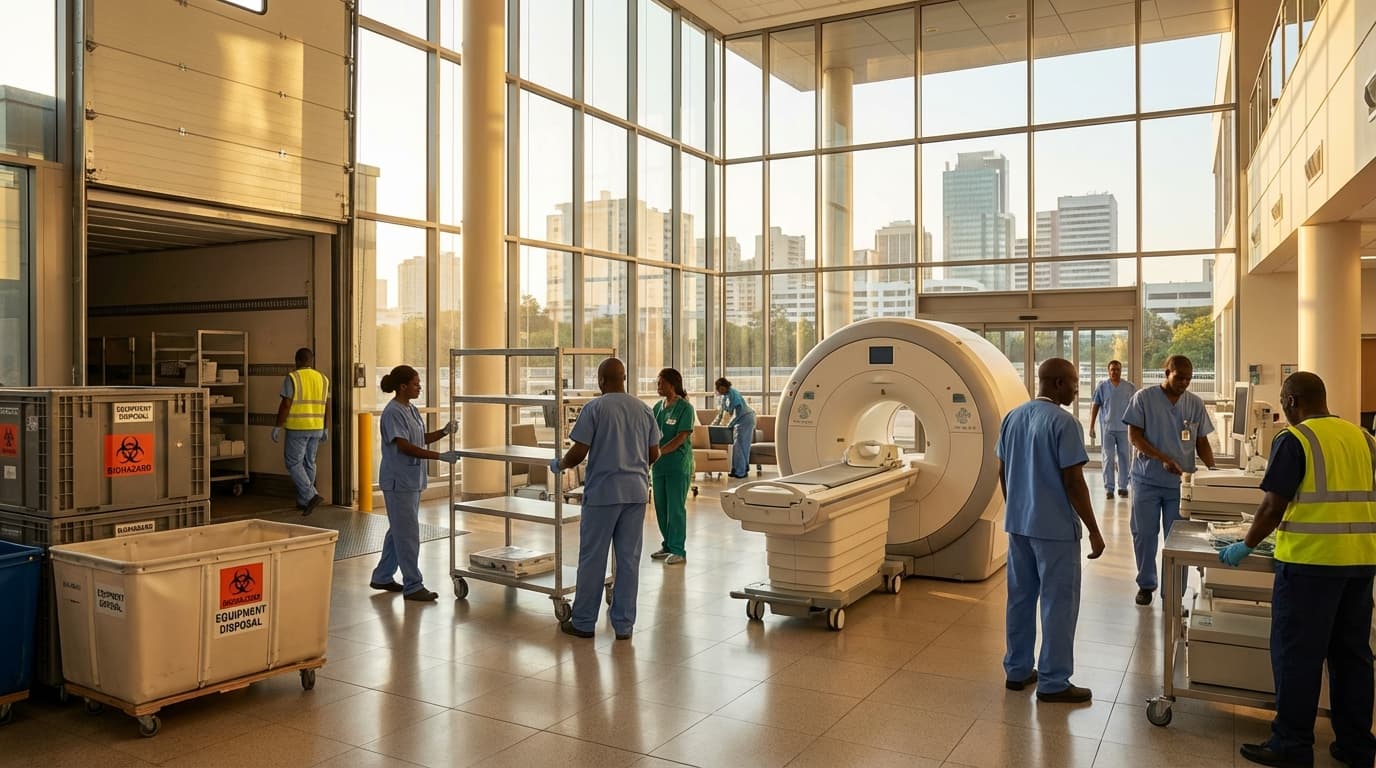
Medical Equipment Relocation Service (Move & Re-Install) in Nigeria
Engineering Excellence & Technical Support
Medical Equipment Relocation Service (Move & Re-Install) High-standard technical execution following OEM protocols and local regulatory frameworks.
Specialized Medical Equipment Transport
Our fleet is equipped with climate-controlled, vibration-dampened vehicles and advanced securing systems specifically designed to ensure the safe transit of sensitive medical equipment like MRI machines, CT scanners, and laboratory analyzers across Nigeria. We understand the critical nature of these assets and prioritize their integrity throughout the relocation process.
Certified Re-Installation & Calibration
Beyond just moving, our certified technicians provide expert re-installation and calibration services. We adhere strictly to manufacturer guidelines and industry best practices to ensure all medical equipment is returned to optimal operational status, ready for immediate use in your new facility. Our team is proficient with a wide range of advanced medical technologies.
Comprehensive Risk Management & Compliance
We offer a full suite of risk management solutions, including detailed site surveys, meticulous planning, and comprehensive insurance coverage. Our services are designed to comply with all relevant Nigerian health and safety regulations, providing you with peace of mind and minimizing operational disruption during your medical equipment relocation.
What Is Medical Equipment Relocation Service (Move & Re-install) In Nigeria?
Medical Equipment Relocation Service (Move & Re-Install) in Nigeria refers to a specialized logistical and technical process undertaken by qualified professionals to safely transport and reintegrate medical devices and apparatus from one location to another within Nigeria. This service is critical for healthcare facilities undergoing physical changes, acquisitions, or upgrades, ensuring minimal disruption to patient care and maintaining the operational integrity of sensitive medical technologies. The service encompasses comprehensive planning, expert packing, secure transportation, and meticulous re-installation, often including calibration and testing to verify optimal functionality post-relocation. The objective is to provide a seamless transition of medical assets, adhering to stringent safety regulations and manufacturer specifications.
| Who Needs the Service? | Typical Use Cases | ||
|---|---|---|---|
| Hospitals and Clinics (Public and Private) | Relocation of entire departments (e.g., Radiology, ICU, Operating Theatres) during facility renovations or expansions. | Transfer of specialized diagnostic or therapeutic equipment between hospital branches or campuses. | Acquisition or merger of healthcare facilities, requiring consolidation of medical assets. |
| Diagnostic Imaging Centers | Moving MRI scanners, CT scanners, X-ray machines, and ultrasound equipment to new or upgraded facilities. | Relocating laboratory analyzers and diagnostic equipment. | |
| Research Institutions and Universities with Medical Programs | Transferring advanced laboratory and research equipment to new buildings or specialized research centers. | ||
| Medical Equipment Manufacturers and Distributors | Delivering and installing new equipment at client sites, often requiring complex initial setup and calibration. | Moving demonstration units or returned equipment for servicing or re-deployment. | |
| Government Health Agencies | Relocating medical equipment for public health initiatives, mobile clinics, or during the establishment of new public healthcare facilities. |
Key Components of Medical Equipment Relocation (Move & Re-Install) in Nigeria
- Site Survey and Planning: Initial assessment of both origin and destination sites to identify logistical challenges, access requirements, power and environmental needs, and specific handling protocols for each piece of equipment.
- Decommissioning and Preparation: Safe disconnection of equipment from power, data, and auxiliary systems. Cleaning, disassembly (where applicable and permitted by manufacturer), and protective wrapping or crating of components.
- Specialized Packing and Crating: Utilization of custom-built crates, anti-static materials, shock-absorbent padding, and environmental controls (e.g., humidity monitoring) to safeguard sensitive medical instruments during transit.
- Secure Transportation: Employing vehicles equipped for the safe transport of delicate machinery, often including climate control and specialized lifting equipment. Adherence to roadworthiness regulations and traffic laws within Nigeria.
- Re-installation and Integration: Precise positioning of equipment at the new site, reconnection to power, data networks, and other necessary infrastructure. This phase often involves recommissioning and alignment procedures.
- Calibration and Testing: Performing manufacturer-recommended calibration procedures to ensure the equipment meets its original performance specifications. Comprehensive functional testing and validation to confirm accurate operation.
- Documentation and Training: Providing detailed documentation of the relocation process, including pre and post-relocation reports. Offering training to facility staff on any operational changes or new configurations resulting from the relocation.
- Regulatory Compliance: Ensuring all aspects of the relocation adhere to Nigerian health and safety regulations, as well as any specific guidelines pertaining to medical device handling and installation.
Who Needs Medical Equipment Relocation Service (Move & Re-install) In Nigeria?
Moving and re-installing medical equipment is a complex and critical process that requires specialized expertise. In Nigeria, various entities and departments face the need for such services, driven by a range of factors from facility upgrades to relocation and expansion. Properly handling this sensitive equipment ensures minimal downtime, maintains calibration, and guarantees operational readiness in its new environment.
| Target Customer/Department | Specific Needs & Scenarios | Key Considerations |
|---|---|---|
| Public Hospitals | Renovations, upgrades, new wing construction, transfer of equipment between branches or districts, replacement of old units. | Budget constraints, ensuring minimal disruption to patient care, adherence to government procurement and logistical protocols, need for certified technicians. |
| Private Hospitals & Clinics | Expansion of services, relocation to larger facilities, upgrading to state-of-the-art equipment, setting up new branches, departmental restructuring. | Minimizing patient inconvenience, maintaining high standards of service, rapid turnaround time, advanced equipment handling expertise, data security during transfer. |
| Diagnostic Centers & Laboratories | Acquisition of new imaging or testing equipment, relocation due to lease expiry or expansion, upgrading to higher capacity machines, consolidation of multiple sites. | Precision in handling sensitive diagnostic tools (e.g., MRI, CT scanners, X-ray machines), maintaining calibration, ensuring minimal downtime for patient services, specialized transport for delicate components. |
| Research Institutions & Universities | Setting up new research labs, upgrading existing facilities, relocating specialized equipment for specific projects, inter-departmental transfers. | Handling of research-grade equipment, ensuring accuracy and integrity of research data, compliance with academic safety standards, potential need for specialized environmental controls during moves. |
| Government Health Agencies | Distribution of equipment to underserved areas, centralizing or decentralizing services, responding to public health emergencies requiring rapid deployment of medical assets. | Large-scale logistics, coordination with multiple stakeholders, compliance with national health policies, ensuring equitable distribution of resources. |
| Medical Equipment Manufacturers/Distributors | Initial installation of new equipment at client sites, relocation of demo units for sales purposes, servicing and upgrading equipment at customer locations. | Brand representation, adherence to manufacturer's installation guidelines, warranty considerations, technical proficiency with specific makes and models. |
Who Needs Medical Equipment Relocation Service (Move & Re-Install) in Nigeria?
- Hospitals (Public and Private)
- Diagnostic Centers & Laboratories
- Specialty Clinics (e.g., Cardiology, Oncology, Radiology)
- Research Institutions & Universities (with medical faculties)
- Government Health Agencies & Ministries
- Non-Governmental Organizations (NGOs) with healthcare initiatives
- Medical Equipment Manufacturers & Distributors (for installation and relocation of demo units or sold equipment)
- Emergency Services (e.g., Ambulance services requiring equipment relocation)
- Military and Defense Health Services
Medical Equipment Relocation Service (Move & Re-install) Process In Nigeria
Moving and re-installing medical equipment in Nigeria is a complex process that requires specialized knowledge, meticulous planning, and strict adherence to safety and regulatory standards. This service is crucial for healthcare facilities undergoing renovations, expansions, or relocations, and for ensuring the continuity of patient care. The workflow can be broadly categorized into several key stages, starting from the initial client inquiry and culminating in the successful re-installation and handover of the equipment.
| Stage | Description | Key Activities | Deliverables | Considerations |
|---|---|---|---|---|
| Inquiry & Consultation | The initial contact from a client seeking medical equipment relocation services. | Client outlines relocation needs, types of equipment, and timelines. Service provider gathers preliminary information. | Understanding of client requirements, initial scope definition. | Urgency of relocation, types of equipment (e.g., imaging, laboratory, surgical), facility type (hospital, clinic, research lab). |
| Site Survey & Assessment | A physical visit to the origin and destination sites to thoroughly evaluate the relocation scope. | Detailed inventory of all equipment, assessment of access routes, space constraints, power requirements, environmental controls (HVAC, humidity), structural integrity for heavy equipment, and potential hazards. | Comprehensive site survey report, detailed equipment list with specifications, identification of any special handling requirements. | Permission to access both sites, availability of key personnel at the facility, accurate floor plans of both locations. |
| Quotation & Contract | Based on the site survey, a detailed proposal and pricing are provided to the client. | Preparation of a formal quotation outlining services, scope, timeline, and costs. Negotiation and finalization of a service contract that specifies terms, conditions, liabilities, insurance, and payment schedules. | Formal quotation, signed service contract, agreed-upon timeline and budget. | Clarity on inclusions and exclusions in the quote, insurance coverage for equipment during transit, payment milestones. |
| Planning & Preparation | Developing a detailed operational plan for the entire relocation process. | Creation of a project plan, scheduling of personnel and resources, procurement of specialized packing materials, confirmation of transportation logistics (e.g., specialized vehicles, cranes if needed), communication with relevant authorities for permits if required, and pre-relocation communication with facility staff. | Detailed project plan, resource allocation schedule, confirmed transportation arrangements, pre-relocation briefing materials. | Coordination with hospital/clinic departments to minimize disruption to patient care, identification of critical equipment requiring immediate attention. |
| De-installation | The careful disconnection and dismantling of medical equipment from its operational environment. | Safe disconnection of power, water, gas, and data lines. Expert dismantling of complex machinery, adhering to manufacturer guidelines and safety protocols. Documentation of the de-installation process. | Equipment safely disconnected and prepared for packing. | Presence of trained biomedical engineers and technicians specializing in the specific equipment, use of appropriate tools and safety gear. |
| Packaging & Transportation | Protecting the equipment during transit to prevent damage. | Utilizing custom-designed crates, specialized padding, anti-static materials, and shock-absorbing packaging. Secure loading onto appropriate transport vehicles (e.g., climate-controlled trucks for sensitive equipment). Real-time tracking of shipments. | Equipment securely packaged and transported to the destination. | Adherence to international standards for packaging of sensitive equipment, understanding of Nigerian road conditions and potential delays. |
| Re-installation & Testing | Reassembling and reconnecting the equipment at the new location. | Positioning of equipment according to the new facility layout. Reconnecting all utilities, power, and data. Performing initial operational tests to ensure basic functionality. | Equipment assembled and powered on, initial functional checks completed. | Ensuring the new location has the correct utility infrastructure (power outlets, ventilation, etc.), availability of qualified technicians for specific equipment. |
| Calibration & Certification | Ensuring the equipment meets its precise operational specifications and regulatory requirements. | Performing detailed calibration procedures using certified test equipment. Conducting comprehensive performance validation and diagnostic tests. Obtaining necessary certifications from relevant regulatory bodies or manufacturers. | Equipment calibrated and certified to manufacturer specifications and regulatory standards. | Availability of accredited calibration services, understanding of Nigerian health regulations for medical equipment. |
| Client Handover & Training | The formal transfer of responsibility for the re-installed equipment to the client. | Demonstration of the fully functional equipment. Providing training to the client's staff on the operation and basic maintenance of the re-installed equipment. Handing over all relevant documentation, including calibration certificates and user manuals. | Client personnel trained, all documentation provided, successful handover of equipment. | Ensuring client staff are comfortable with the equipment, availability of post-installation support information. |
| Post-Relocation Support | Providing ongoing assistance and addressing any issues that may arise after relocation. | On-call technical support, troubleshooting assistance for any initial problems, follow-up inspections to ensure long-term functionality. Addressing any warranty-related concerns. | Client satisfaction, smooth integration of equipment into the new environment. | Clear warranty terms and conditions, defined escalation procedures for issues. |
Medical Equipment Relocation Service (Move & Re-Install) Process in Nigeria
- Inquiry & Consultation
- Site Survey & Assessment
- Quotation & Contract
- Planning & Preparation
- De-installation
- Packaging & Transportation
- Re-installation & Testing
- Calibration & Certification
- Client Handover & Training
- Post-Relocation Support
Medical Equipment Relocation Service (Move & Re-install) Cost In Nigeria
Relocating medical equipment in Nigeria, whether it's a single specialized unit or an entire clinic's inventory, requires careful planning and execution. The cost of these "Move & Re-Install" services can vary significantly due to a multitude of factors, making it essential for healthcare providers to obtain detailed quotes. This service typically involves specialized handling, transportation, and re-setup of sensitive and often heavy equipment. The pricing is influenced by the type and size of the equipment, the distance of the move, the level of disassembly and reassembly required, and the expertise of the relocation company. Insurance and any necessary permits also contribute to the overall cost. Understanding these elements will help in budgeting accurately for such critical operational transitions within Nigeria.
| Equipment Category | Estimated Price Range (NGN) | Notes |
|---|---|---|
| Small Equipment (e.g., Microscopes, BP Monitors, ECG Machines) | ₦50,000 - ₦250,000 | Relatively straightforward, minimal disassembly. Cost depends heavily on distance. |
| Medium Equipment (e.g., Ultrasound Machines, Small X-ray Units, Dialysis Machines) | ₦200,000 - ₦1,000,000 | May require some disassembly and specialized handling. Distance and complexity are key. |
| Large/Complex Equipment (e.g., MRI Scanners, CT Scanners, Large X-ray Systems, Ventilators) | ₦800,000 - ₦10,000,000+ | Significant disassembly/reassembly, highly specialized teams, specialized transport, and insurance are mandatory. Costs can escalate dramatically with the size and technicality of the equipment and the distance. |
| Full Clinic/Hospital Ward Relocation (Multiple Items) | ₦1,000,000 - ₦20,000,000+ | This is a comprehensive service involving multiple equipment types, logistics planning, and potentially extended service periods. Price is highly variable based on the scale of the operation. |
Key Factors Influencing Medical Equipment Relocation Costs in Nigeria:
- Equipment Type and Size: Larger, heavier, and more complex equipment (e.g., MRI machines, CT scanners, large X-ray units) naturally incur higher costs due to specialized handling and transportation requirements.
- Distance of Relocation: The geographical distance between the pickup and delivery locations is a primary cost driver. Longer distances translate to higher fuel, labor, and logistics expenses.
- Disassembly and Reassembly Complexity: Intricate equipment often requires expert technicians for safe disassembly and precise reassembly. The more complex the process, the higher the labor costs.
- Specialized Handling Requirements: Some equipment may need climate-controlled transport, vibration dampening, or specific lifting equipment, all of which add to the price.
- Number of Items: Relocating a single piece of equipment will differ in cost from moving an entire hospital ward or a full clinic.
- Accessibility of Locations: Difficult access at either the pickup or delivery site (e.g., narrow doorways, multiple floors without elevators, poor road conditions) can increase labor and time, thus affecting cost.
- Insurance: Adequate insurance coverage for high-value medical equipment during transit is crucial and will be factored into the quote.
- Downtime and Scheduling: If the relocation needs to be completed within a tight timeframe or outside of normal business hours, it may incur premium charges.
- Company's Expertise and Reputation: Established companies with a proven track record in handling sensitive medical equipment often command higher prices due to their reliability and specialized skills.
- Additional Services: This can include packing materials, rigging, unpacking, basic installation checks, and waste disposal of old packing materials.
Affordable Medical Equipment Relocation Service (Move & Re-install) Options
Moving sensitive and often expensive medical equipment requires specialized care and expertise. Our Affordable Medical Equipment Relocation Service (Move & Re-Install) is designed to provide a seamless and cost-effective solution for healthcare facilities, clinics, and individual practitioners. We understand the critical nature of your equipment and the importance of minimizing downtime. Our service includes careful packing, secure transportation, and precise re-installation to ensure your operations resume with minimal disruption.
| Value Bundle | Description | Included Services | Estimated Price Range (USD) |
|---|---|---|---|
| Basic Move & Re-Install | Standard relocation for non-specialized equipment. | Dismantling (if applicable), secure packing, transportation, unpacking, basic re-assembly, and functional check. | $800 - $2,500 |
| Advanced Move & Re-Install | For moderately complex equipment requiring more specialized handling. | All Basic services PLUS: advanced padding, specialized crating, on-site calibration check (if readily available), and liaison with technical support (if needed for re-calibration). | $1,500 - $5,000 |
| Premium Move & Re-Install | For highly sensitive, complex, or high-value equipment. | All Advanced services PLUS: specialized environmental controls during transit, secure storage (if needed), on-site expert supervision during re-installation, and coordination for full manufacturer recalibration. | $3,000 - $10,000+ |
Why Choose Our Medical Equipment Relocation Service?
- Expert Handling: Trained professionals with experience in moving delicate medical devices.
- Comprehensive Insurance: Full coverage for your equipment during transit.
- Specialized Equipment: Use of climate-controlled vehicles and appropriate packing materials.
- On-Time Delivery & Installation: Minimizing operational downtime.
- Cost-Effective Solutions: Value-driven pricing and flexible options.
- Discreet & Secure: Maintaining patient privacy and equipment integrity.
Verified Providers In Nigeria
In Nigeria's rapidly evolving healthcare landscape, identifying reliable and competent healthcare providers is paramount. This is where Franance Health emerges as a distinguished name, setting a benchmark for quality and trustworthiness. Franance Health's rigorous credentialing process ensures that all their affiliated medical professionals and facilities meet the highest standards of expertise, ethical practice, and patient care. Choosing Franance Health means opting for a network that prioritizes your well-being through verified excellence.
| Credential Type | Franance Health Verification Process | Benefit to Patient |
|---|---|---|
| Medical License | Confirmed validity with the Medical and Dental Council of Nigeria (MDCN). | Ensures the provider is legally authorized to practice. |
| Specialist Certifications | Verification of board certifications from recognized medical bodies. | Confirms expertise in a particular medical field. |
| Educational Background | Review of degrees and diplomas from accredited institutions. | Assures foundational medical knowledge and training. |
| Professional Experience | Validation of past employment and clinical practice history. | Indicates practical application of skills and knowledge. |
| Facility Accreditation | Inspection of adherence to national and international healthcare standards. | Guarantees a safe and well-equipped environment for treatment. |
Why Franance Health Credentials Represent the Best Choice:
- Stringent Qualification Verification: Franance Health meticulously checks medical licenses, certifications, and academic achievements of all providers.
- Experience and Specialization Validation: They ensure providers possess the necessary experience and specialization for their respective fields.
- Ethical Practice Audits: A commitment to ethical conduct and patient-centered care is a core component of their vetting process.
- Facility Compliance: For healthcare facilities, Franance Health verifies adherence to safety regulations, hygiene standards, and advanced medical equipment.
- Continuous Professional Development: Providers within the Franance Health network are encouraged and often required to engage in ongoing training and education.
- Patient Feedback Integration: While not solely based on it, Franance Health may consider aggregated patient feedback to ensure consistent quality.
- Transparency and Accessibility: Franance Health provides clear information about provider credentials, making it easier for patients to make informed decisions.
Scope Of Work For Medical Equipment Relocation Service (Move & Re-install)
This Scope of Work (SOW) outlines the services required for the professional relocation and re-installation of medical equipment. The service provider will be responsible for the safe and efficient dismantling, transportation, and re-installation of designated medical equipment from its current location to the new facility. The project aims to minimize downtime and ensure the equipment is fully functional post-installation, adhering to all relevant technical specifications and safety standards.
| Category | Technical Deliverable | Standard Specification/Requirement | Notes |
|---|---|---|---|
| Site Survey & Planning | Detailed site assessment report for origin and destination locations. | Assessment of access routes, spatial requirements, power/utility availability, and potential hazards. Includes a detailed move plan, risk assessment, and timeline. | To be completed within 5 business days of contract signing. |
| Dismantling and Preparation | Professional dismantling of specified medical equipment. | Adherence to manufacturer's recommended procedures for disassembly. Proper labeling of all components, cables, and accessories. | Requires certified technicians for specific equipment types. |
| Dismantling and Preparation | Cleaning and decontamination of equipment surfaces. | Standard hospital-grade disinfectants. Compliance with infection control protocols. | As per facility's infection control guidelines. |
| Packaging and Transportation | Secure and protective packaging of all dismantled equipment and components. | Use of anti-static, shock-absorbent, and moisture-resistant materials. Custom crating where necessary for delicate or oversized items. | Packaging materials to meet industry best practices for medical equipment. |
| Packaging and Transportation | Safe and secure transportation of equipment. | Climate-controlled and GPS-tracked vehicles. Experienced drivers with handling of sensitive equipment. Compliance with all transportation regulations. | Proof of insurance for all transported equipment is mandatory. |
| Unloading and Positioning | Careful unloading and positioning of equipment at the new location. | Precise placement according to the approved move plan. Use of appropriate lifting equipment (e.g., hydraulic lifts, pallet jacks). | Confirmation of placement by designated facility representative. |
| Re-installation and Calibration | Re-assembly and re-installation of medical equipment. | Following manufacturer's specifications and service manuals. Reconnection of all necessary utilities (power, data, medical gases, etc.). | Qualified technicians with relevant certifications are required. |
| Re-installation and Calibration | Calibration and performance verification of re-installed equipment. | Utilizing calibrated test equipment. Ensuring equipment meets manufacturer's performance specifications. Generation of calibration certificates. | Calibration certificates to be provided to the client upon completion. |
| Testing and Handover | Comprehensive functional testing of all re-installed equipment. | Simulating normal operating conditions. Documenting test results and any observed anomalies. | Testing to be witnessed by facility staff where applicable. |
| Testing and Handover | Final handover and sign-off. | Presentation of all documentation: move plan, risk assessment, calibration certificates, test reports. Training for facility staff on any operational changes or considerations post-move. | Formal sign-off by designated client representative. |
Key Project Phases
- Site Survey and Planning
- Dismantling and Preparation
- Packaging and Transportation
- Unloading and Positioning
- Re-installation and Calibration
- Testing and Handover
Service Level Agreement For Medical Equipment Relocation Service (Move & Re-install)
This Service Level Agreement (SLA) outlines the performance standards and guarantees for the Medical Equipment Relocation Service (Move & Re-Install) provided by [Provider Name] to [Client Name]. This SLA defines response times for issues, uptime guarantees for critical equipment post-re-installation, and the procedures for reporting and resolving service disruptions.
| Service Component | Definition | Guaranteed Response Time | Resolution Target Time | Escalation Procedure |
|---|---|---|---|---|
| Critical Equipment Uptime (Post Re-Install) | Ensuring essential medical equipment (defined in Appendix A) is fully operational and meeting manufacturer specifications after re-installation. | N/A (This is a post-resolution guarantee) | 99.5% Uptime within 24 hours of completion of re-installation for critical equipment. | If uptime falls below 99.5% within the first 72 hours post-re-installation, immediate on-site technical support will be dispatched. |
| Non-Critical Equipment Uptime (Post Re-Install) | Ensuring non-essential medical equipment (defined in Appendix B) is functional after re-installation. | N/A (This is a post-resolution guarantee) | 98% Uptime within 48 hours of completion of re-installation for non-critical equipment. | If uptime falls below 98% within the first 72 hours post-re-installation, technical support will be dispatched within 4 business hours. |
| Service Disruption Reporting | Client reporting an issue impacting equipment functionality or the relocation process. | 1 hour for initial acknowledgment and assessment via phone or email. | N/A (Response time) | Client to contact [Provider Name] Service Desk at [Phone Number] or [Email Address]. Include ticket number for tracking. |
| Technical Support - Critical Equipment Issue | On-site or remote technical assistance required for a critical equipment malfunction post-re-installation. | 2 hours for on-site dispatch if remote troubleshooting is unsuccessful. | Resolution within 8 business hours of on-site arrival. | If resolution target is not met, escalation to Senior Technician and Service Manager. |
| Technical Support - Non-Critical Equipment Issue | On-site or remote technical assistance required for a non-critical equipment malfunction post-re-installation. | 4 business hours for on-site dispatch if remote troubleshooting is unsuccessful. | Resolution within 16 business hours of on-site arrival. | If resolution target is not met, escalation to Senior Technician. |
| Relocation Process Support (During Move) | On-site assistance required for unexpected issues or questions during the physical relocation process. | 30 minutes for on-site presence if requested. | N/A (On-site presence) | Client to request via designated Project Manager. If Project Manager is unavailable, call [Provider Name] Operations Manager. |
Scope of Service
- Comprehensive relocation of specified medical equipment from the origin site to the destination site.
- Safe dismantling and packaging of equipment at the origin site.
- Secure transportation of equipment.
- Careful unpacking and re-installation of equipment at the destination site.
- Initial functional testing and calibration post-re-installation.
- On-site technician support during the relocation process.
- Post-relocation support for a defined period.
Frequently Asked Questions

Ready when you are
Let's scope your Medical Equipment Relocation Service (Move & Re-Install) in Nigeria project in Nigeria.

Scaling healthcare logistics and technical systems across the entire continent.