
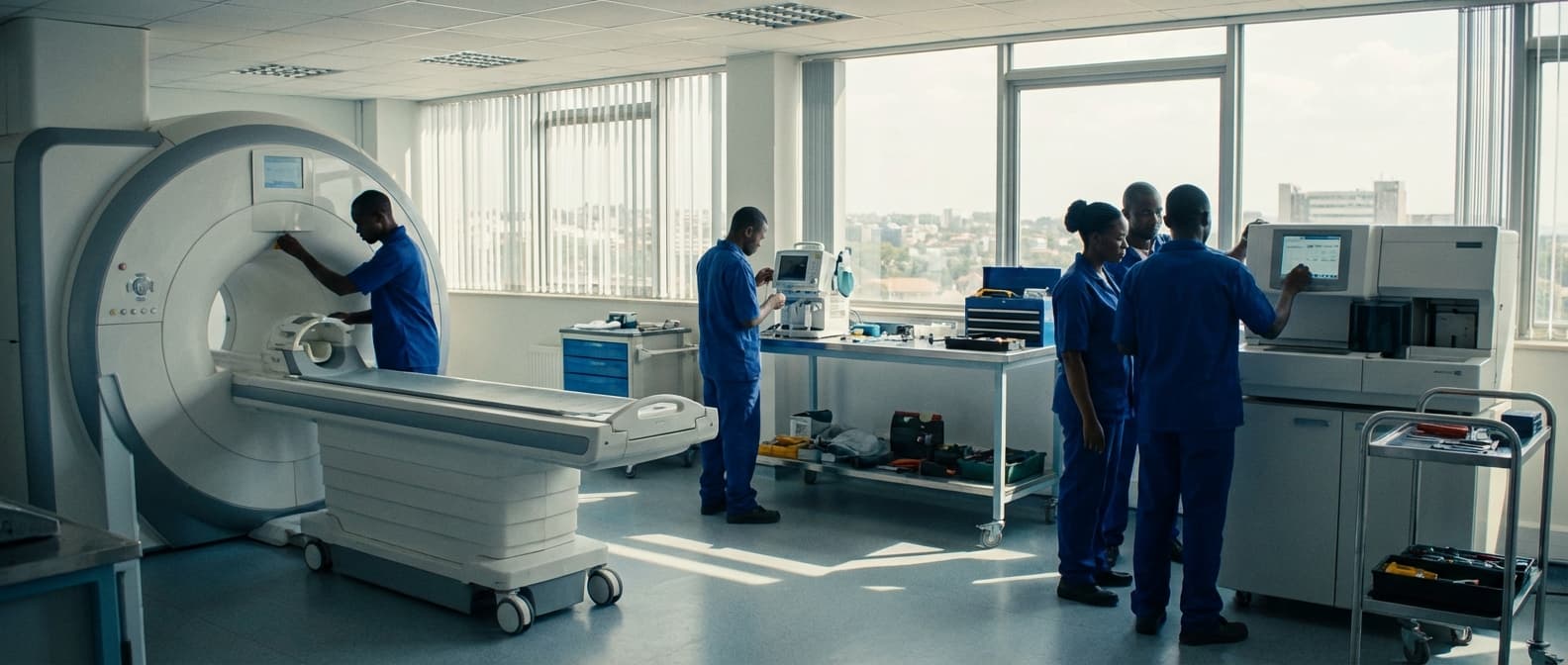
Uptime, Downtime & Root-Cause Analysis Reporting Service in Nigeria
Engineering Excellence & Technical Support
Uptime, Downtime & Root-Cause Analysis Reporting Service High-standard technical execution following OEM protocols and local regulatory frameworks.
24/7 Proactive Uptime Monitoring
Leveraging advanced synthetic and real-user monitoring, our service ensures continuous visibility into your critical systems. We provide real-time alerts and performance metrics, guaranteeing minimal downtime and maximizing operational efficiency across your Nigerian operations.
Rapid Downtime Incident Response
When outages occur, our specialized Nigerian-based teams are equipped for swift, localized incident response. We prioritize minimizing Mean Time To Resolution (MTTR) with our proven methodologies, restoring your services quickly and efficiently.
Data-Driven Root-Cause Analysis
We go beyond just identifying problems. Our comprehensive reporting service provides deep-dive root-cause analysis, utilizing historical data and advanced analytics. This empowers your Nigerian business with actionable insights to prevent future recurrences and optimize system resilience.
What Is Uptime, Downtime & Root-cause Analysis Reporting Service In Nigeria?
In the context of IT infrastructure and operational management within Nigeria, Uptime, Downtime & Root-Cause Analysis Reporting Services refer to the systematic monitoring, documentation, and investigation of the operational status and failures of critical systems and applications. Uptime denotes the period during which a system or service is fully operational and accessible to users. Downtime signifies the period when a system or service is unavailable or non-functional, preventing its intended use. Root-Cause Analysis (RCA) is a structured problem-solving methodology employed to identify the fundamental underlying causes of a failure or incident, rather than just addressing its immediate symptoms. This service is crucial for ensuring business continuity, optimizing performance, and mitigating future disruptions. It involves the collection of logs, performance metrics, error codes, and user feedback, followed by in-depth analysis to pinpoint the exact reasons for outages.
| Service Component | Description | Key Metrics/Deliverables | Typical Use Cases in Nigeria | |
|---|---|---|---|---|
| Uptime Monitoring | Continuous surveillance of system availability and performance against predefined Service Level Agreements (SLAs). | Uptime percentage (e.g., 99.9%, 99.99%), Mean Time Between Failures (MTBF), system responsiveness. | Ensuring uninterrupted e-commerce transactions during peak shopping seasons; verifying consistent availability of mobile network services. | Ensuring consistent availability of online banking services to customers; monitoring uptime of critical government web portals. |
| Downtime Tracking & Reporting | Recording the duration, frequency, and impact of system outages. | Downtime duration, Mean Time To Recover (MTTR), number of incidents, impact assessment (e.g., lost revenue, customer dissatisfaction). | Quantifying the financial impact of website outages for online retailers; identifying recurring network connectivity issues affecting businesses. | Assessing the impact of service disruptions on customer service centers; documenting service interruptions for regulatory compliance. |
| Root-Cause Analysis (RCA) | Investigating incidents to determine the fundamental causes, preventing recurrence. | Detailed incident reports, causal factor identification, preventative action plans, lessons learned. | Identifying the underlying cause of a server crash in a fintech platform; analyzing a data breach to understand the security vulnerabilities exploited. | Investigating the reason for a sudden drop in network speed affecting a large enterprise; analyzing a software bug causing repeated application failures. |
| Reporting & Dashboards | Presenting monitoring data, downtime events, and RCA findings in an accessible and actionable format. | Real-time dashboards, scheduled performance reports, incident summaries, SLA compliance reports. | Providing clients with transparent reports on the performance of their hosted applications; presenting to management the overall health of IT infrastructure. | Informing stakeholders about service availability and IT operational efficiency; demonstrating compliance with IT governance frameworks. |
Who Needs Uptime, Downtime & Root-Cause Analysis Reporting Service in Nigeria?
- Businesses heavily reliant on digital platforms and online services (e.g., e-commerce, fintech, telecommunications, banking).
- Organizations with mission-critical applications and infrastructure where even brief interruptions can lead to significant financial losses or reputational damage.
- IT departments responsible for maintaining the availability and performance of servers, networks, software, and cloud-based resources.
- Managed Service Providers (MSPs) offering IT support and infrastructure management to their clients.
- Government agencies and public sector organizations that provide essential services to citizens.
- Cloud service providers operating data centers and offering services within Nigeria.
Who Needs Uptime, Downtime & Root-cause Analysis Reporting Service In Nigeria?
In today's rapidly evolving digital landscape, reliable and continuous operation of IT systems is paramount for business success. Downtime, even for short periods, can lead to significant financial losses, reputational damage, and decreased customer satisfaction. Uptime, Downtime & Root-Cause Analysis Reporting Services are crucial for organizations in Nigeria to proactively monitor their systems, quickly identify and resolve issues, and implement preventative measures. These services provide valuable insights into system performance, pinpointing the exact reasons for disruptions and offering actionable recommendations to improve overall IT resilience.
| Target Customer Segment | Key Departments & Their Needs |
|---|---|
| Large Enterprises (e.g., Banks, Telecommunications, Oil & Gas) | IT Operations/Infrastructure: Requires detailed uptime/downtime metrics, performance bottlenecks identification, proactive maintenance scheduling, and rapid incident response. Business Continuity/Disaster Recovery: Needs comprehensive data to assess the impact of downtime, refine recovery plans, and ensure minimal business disruption. Risk Management: Seeks reports to quantify risks associated with IT failures and demonstrate compliance with regulatory requirements. Customer Service: Relies on reports to understand service availability and proactively communicate with customers during outages. |
| Small and Medium-sized Enterprises (SMEs) | Owner/CEO/Managing Director: Needs a clear understanding of IT system reliability, its impact on revenue and productivity, and the ROI of IT investments. IT Manager/Support Staff: Requires straightforward reports to quickly diagnose and fix issues, optimize limited resources, and prevent recurring problems. Sales & Marketing: Benefits from knowing that their online presence and customer-facing systems are consistently available. |
| E-commerce Businesses & Online Service Providers | E-commerce Operations: Demands near-perfect uptime to maximize sales, minimize cart abandonment, and ensure smooth transaction processing. Web Development/DevOps: Needs detailed logs and analysis to identify and fix bugs, optimize website performance, and manage deployments effectively. Marketing: Relies on consistent website availability for campaigns and customer engagement. |
| Government Agencies & Public Sector | IT Departments: Concerned with the reliability of public service delivery platforms, data security, and efficient resource management. Department Heads: Require assurance that critical systems supporting their operations are consistently available for citizen services. Procurement: Looks for cost-effective solutions that guarantee service level agreements (SLAs). |
| Financial Institutions (Banks, Fintechs) | Core Banking Operations: Critical need for 24/7 uptime to prevent financial losses and maintain customer trust. IT Security: Reports help identify vulnerabilities that could lead to downtime or data breaches. Compliance Officers: Need accurate records to demonstrate adherence to strict financial regulations regarding system availability. |
Who Needs Uptime, Downtime & Root-Cause Analysis Reporting Service in Nigeria?
- Businesses of all sizes relying on IT infrastructure for operations.
- Organizations with critical online services or e-commerce platforms.
- Companies experiencing frequent or prolonged IT disruptions.
- Entities aiming to optimize IT resource allocation and performance.
- Organizations seeking to improve customer trust and satisfaction through reliable service delivery.
Uptime, Downtime & Root-cause Analysis Reporting Service Process In Nigeria
This document outlines the standard workflow for the Uptime, Downtime & Root-Cause Analysis (RCA) Reporting Service in Nigeria. This process ensures a systematic approach to identifying, documenting, and resolving service interruptions, providing valuable insights for continuous improvement.
| Stage | Description | Key Activities | Responsible Party | Deliverables | Timeline |
|---|---|---|---|---|---|
| Initial contact and understanding of the service disruption. | Receive inquiry (client or internal). Define the scope of the incident (systems affected, duration, impact). Assign a case/ticket number. Initial assessment of severity. | Client/Service Desk/Operations Team | Incident logged and assigned. Initial severity assessment. | Immediate upon incident detection/reporting. |
| Gathering all relevant information surrounding the downtime. | Collect logs, error messages, performance metrics, user reports, network traffic data. Interview relevant personnel (engineers, support staff, users). Validate the accuracy and completeness of collected data. | Technical Team/NOC/Support Engineers | Comprehensive log files. Validated incident details. Timeline of events. | Within 1-4 hours of initial inquiry, depending on complexity. |
| Determining the fundamental reason(s) for the downtime. | Utilize RCA methodologies (e.g., 5 Whys, Fishbone Diagram, Fault Tree Analysis). Analyze the collected data to identify contributing factors. Isolate the primary cause(s) of the failure. | RCA Specialist/Senior Engineers | Identified root cause(s). Supporting evidence for the identified cause(s). | Within 2-8 hours of data validation, depending on complexity. |
| Documenting the incident, its impact, and the findings of the RCA. | Compile all gathered information into a structured report. Include incident summary, timeline of events, impact assessment, identified root cause(s), and preliminary recommendations. | RCA Specialist/Technical Writer | Draft RCA Report. | Within 2-4 hours of completing the RCA. |
| Ensuring the accuracy and completeness of the RCA report before dissemination. | Internal review by technical leads and management. Review by the client (if applicable). Incorporate feedback and make necessary revisions. | Technical Management/Client Representatives | Approved RCA Report. | Within 24-48 hours of draft report submission. |
| Developing and executing strategies to prevent recurrence and address immediate issues. | Define corrective actions based on RCA findings. Establish action owners and deadlines. Implement corrective and preventive measures. Monitor the effectiveness of implemented actions. | Relevant Department Heads/Action Owners | Action Plan. Implemented corrective/preventive measures. | Concurrent with report approval, implementation timelines vary. |
| Confirming the resolution of the incident and the effectiveness of implemented actions. | Verify that the service is fully restored and stable. Assess the impact of implemented actions. Obtain client confirmation of satisfaction (if applicable). Formally close the incident ticket. | Service Desk/Operations Team/Project Manager | Incident closure confirmation. Client sign-off (if applicable). | Once corrective actions are verified and the incident is deemed resolved. |
| Storing the RCA report and associated documentation for future reference and trend analysis. | Store the final RCA report, incident logs, and action plans in a designated repository. Ensure data integrity and accessibility for future audits and learning. | Document Control/IT Operations | Archived RCA Report and associated documentation. | Upon closure of the incident. |
Uptime, Downtime & Root-Cause Analysis Reporting Service Process in Nigeria: Workflow
- Inquiry & Scoping
- Data Collection & Validation
- Root-Cause Analysis (RCA)
- Report Generation
- Review & Approval
- Action Planning & Implementation
- Follow-up & Closure
- Archiving
Uptime, Downtime & Root-cause Analysis Reporting Service Cost In Nigeria
The cost of Uptime, Downtime, and Root-Cause Analysis (RCA) reporting services in Nigeria is influenced by several key factors. Businesses seeking these services aim to understand and improve their operational reliability, minimize disruptions, and identify the underlying causes of failures. The pricing reflects the complexity, scope, and expertise involved in delivering these critical insights.
Key Pricing Factors:
- Scope of Services: This is the most significant driver. Are you looking for real-time monitoring with instant alerts, historical trend analysis, in-depth incident investigation, or a combination? A broader scope naturally commands a higher price.
- Number of Systems/Assets Monitored: The more servers, applications, networks, or physical assets being monitored and analyzed, the more resources (software, personnel) are required, increasing costs.
- Complexity of Infrastructure: Analyzing a simple web server is less complex than diagnosing issues across a distributed cloud environment, a complex manufacturing floor, or a large enterprise network with diverse technologies.
- Level of Expertise & Experience: Highly skilled engineers and analysts with a proven track record in IT operations, incident management, and RCA command higher rates. Certifications and specialized knowledge are valuable.
- Reporting Frequency & Detail: Whether you need daily summaries, weekly deep dives, or on-demand incident reports, and the level of detail (e.g., technical logs, business impact assessment, recommended actions) will affect pricing.
- Tooling & Technology: The sophistication of the monitoring and analysis tools used by the service provider. Proprietary or advanced AI-driven tools might incur higher licensing or development costs, which are passed on.
- Service Level Agreements (SLAs): Guarantees on response times for incidents, resolution times, and reporting accuracy will influence the cost. Higher SLAs typically mean higher prices.
- Customization & Integration: If the service needs to be tailored to specific business processes or integrated with existing IT Service Management (ITSM) tools, additional development and configuration costs will apply.
- Support & Availability: 24/7 support for critical incidents will be priced differently than standard business hours support.
- Provider Type: Whether you engage a freelance consultant, a small local IT firm, or a larger, established IT services company can lead to varying price points.
Pricing Ranges in Nigerian Naira (NGN):
It's important to note that these are estimated ranges and can vary significantly based on the specific vendor, the exact requirements of the project, and current market conditions in Nigeria.
- Basic Uptime Monitoring & Reporting (e.g., website, single server): This often involves simple ping tests and basic performance metrics.
* **Monthly:** ₦15,000 - ₦50,000
* **Annual:** ₦150,000 - ₦500,000
- Comprehensive Uptime & Downtime Reporting with Basic RCA (e.g., small business IT infrastructure, multiple servers/applications): This includes more detailed performance monitoring, incident logging, and initial analysis of common issues.
* **Monthly:** ₦50,000 - ₦200,000
* **Annual:** ₦500,000 - ₦2,000,000
- Advanced Uptime, Downtime, and In-depth Root-Cause Analysis Services (e.g., enterprise-level, critical systems, cloud environments, complex networks): This involves sophisticated monitoring tools, dedicated expert analysts, proactive threat detection, and detailed forensic analysis for significant incidents.
* **Monthly Retainer:** ₦200,000 - ₦1,000,000+
* **Project-Based (per incident/deep dive analysis):** ₦100,000 - ₦500,000+ per significant incident.
* **Annual Contracts (comprehensive services):** ₦2,000,000 - ₦10,000,000+
- Consulting & Advisory on RCA Framework Implementation: For organizations looking to build their internal RCA capabilities.
* **Hourly Rate:** ₦15,000 - ₦50,000 per hour.
* **Project Rate:** ₦500,000 - ₦5,000,000+ depending on the scope of the framework development and training.
When seeking proposals, it is crucial for Nigerian businesses to clearly define their requirements, the number and type of assets to be monitored, the desired level of detail in reporting, and the expected response times to ensure accurate and competitive pricing.
| Service Tier | Description | Estimated Monthly Cost (NGN) | Estimated Annual Cost (NGN) | Notes |
|---|---|---|---|---|
| Basic Monitoring & Reporting | Simple uptime checks, basic performance metrics for individual assets (e.g., website). | ₦15,000 - ₦50,000 | ₦150,000 - ₦500,000 | Ideal for very small businesses or single critical assets. |
| Standard Monitoring & Basic RCA | Comprehensive uptime/downtime tracking, performance monitoring, incident logging, and initial analysis for small to medium business infrastructure. | ₦50,000 - ₦200,000 | ₦500,000 - ₦2,000,000 | Covers multiple servers, applications, and basic troubleshooting assistance. |
| Advanced Monitoring & In-depth RCA | Sophisticated monitoring, proactive anomaly detection, detailed incident investigation, full root-cause analysis, and actionable recommendations for enterprise environments and critical systems. | ₦200,000 - ₦1,000,000+ | ₦2,000,000 - ₦10,000,000+ | Includes expert analysts, advanced tooling, and often 24/7 support. Project-based RCA can be additional. |
| Consulting & Framework Development | Expert guidance on implementing internal RCA processes, best practices, and training. | N/A (Project-based or hourly) | N/A (Project-based or hourly) | Hourly rates typically range from ₦15,000 - ₦50,000. Project costs vary widely. |
Factors Influencing Uptime, Downtime & RCA Reporting Service Costs in Nigeria
- Scope of Services (Monitoring, Alerting, Incident Analysis, RCA)
- Number of Systems/Assets Monitored
- Complexity of IT Infrastructure (On-Premise, Cloud, Hybrid)
- Level of Expertise and Experience of the Service Provider
- Frequency, Detail, and Format of Reporting
- Investment in Monitoring and Analysis Tools
- Service Level Agreements (SLAs) and Availability Guarantees
- Customization and Integration with Existing Systems
- 24/7 Support vs. Business Hours Support
- Type and Reputation of the Service Provider (Freelancer, Local Firm, Enterprise)
Affordable Uptime, Downtime & Root-cause Analysis Reporting Service Options
This service provides comprehensive reporting on system uptime, downtime events, and detailed root-cause analysis (RCA) to help organizations understand and mitigate operational disruptions. We offer flexible value bundles designed to meet various needs and budgets, alongside cost-saving strategies to maximize your investment.
| Bundle Name | Key Features | Target Audience | Cost Savings Strategies |
|---|---|---|---|
| Basic Uptime Monitor | Scheduled uptime reports (daily/weekly) | Startups, Small Businesses | Annual subscription discounts, minimal feature set reduces overhead. |
| Standard Uptime & Downtime Analysis | Downtime incident logging, basic RCA, customizable alerts | Growing Businesses, Mid-sized Companies | Tiered pricing based on monitored assets, bundling with other IT services, early bird discounts. |
| Advanced Uptime, Downtime & RCA | Real-time monitoring, in-depth RCA, anomaly detection, remediation suggestions | Mission-Critical Operations, Enterprises | Volume discounts for multiple deployments, longer contract terms for preferential rates, integration partnerships for reduced setup costs. |
| Custom Enterprise Solution | Full customization, dedicated support, advanced analytics | Large Enterprises, Unique Requirements | Negotiated long-term contracts, bespoke feature prioritization to avoid unnecessary costs, proof-of-concept pilots to validate value before full commitment. |
Value Bundles & Features
- {"title":"Basic Uptime Monitor","description":"Essential uptime tracking with scheduled reports. Ideal for startups and small businesses prioritizing foundational monitoring."}
- {"title":"Standard Uptime & Downtime Analysis","description":"Includes Basic features plus detailed downtime incident logging, basic RCA summaries, and customizable alert thresholds. Suitable for growing businesses needing incident visibility."}
- {"title":"Advanced Uptime, Downtime & RCA","description":"Our most comprehensive package. Features real-time monitoring, in-depth RCA with historical trend analysis, proactive anomaly detection, and automated remediation suggestions. Perfect for mission-critical operations and enterprise-level support."}
- {"title":"Custom Enterprise Solution","description":"Tailored reporting, integration with existing IT infrastructure, dedicated account management, and advanced analytics to meet specific business objectives."}
Verified Providers In Nigeria
Navigating healthcare in Nigeria can be a complex undertaking, with many seeking reliable and trustworthy medical services. In this landscape, "Verified Providers" emerge as a crucial indicator of quality and assurance. Franance Health stands out as a leading platform dedicated to connecting individuals with these verified healthcare professionals. This document outlines why choosing Franance Health's verified providers represents the best decision for your health needs in Nigeria.
| Criteria | Franance Health Verification Standard | Benefit to Patient |
|---|---|---|
| Professional Licensing | Mandatory verification of current and valid medical licenses with relevant Nigerian bodies (e.g., MDCN, NUC). | Ensures providers are legally qualified and authorized to practice, guaranteeing a baseline of competence. |
| Academic & Professional Qualifications | Thorough review of degrees, diplomas, specialist certifications, and postgraduate training. | Confirms providers possess the necessary knowledge and skills for their chosen field. |
| Practice History & Reputation | Inquiry into past performance, ethical standing, and disciplinary records (where accessible). | Identifies providers with a consistent record of good practice and patient care. |
| Specialization Confirmation | Verification of specific areas of expertise and advanced training. | Allows patients to confidently seek out and receive treatment from specialists best suited to their needs. |
| Continuing Professional Development (CPD) | Assessment of engagement with ongoing training and educational activities. | Indicates a commitment to staying updated with the latest medical advancements and techniques. |
Why Franance Health's Verified Providers are the Best Choice:
- Rigorous Verification Process: Franance Health employs a multi-stage, stringent verification process for all its listed providers. This goes beyond simple registration, encompassing checks on licenses, qualifications, certifications, and professional standing. This ensures that only genuinely competent and legitimate healthcare professionals are featured.
- Uncompromised Quality of Care: By selecting a Franance Health verified provider, you are assured of receiving care that meets high professional standards. Our vetting process prioritizes practitioners with proven track records, a commitment to ethical practice, and adherence to established medical guidelines.
- Access to Specialized Expertise: The Nigerian healthcare sector is vast and diverse. Franance Health's verification system helps users easily identify specialists in various fields. Whether you need a seasoned surgeon, a dedicated pediatrician, or a compassionate therapist, our verified network ensures you find the right expertise.
- Enhanced Patient Safety and Trust: Trust is paramount in healthcare. The "Verified Provider" badge on Franance Health signifies a commitment to patient safety. It offers peace of mind, knowing you are engaging with professionals who have met established benchmarks for competence and ethical conduct.
- Streamlined Healthcare Navigation: Finding the right doctor can be time-consuming and frustrating. Franance Health simplifies this process. Our verified provider directory allows you to search, compare, and book appointments with confidence, saving you valuable time and reducing stress.
- Commitment to Continuous Improvement: Franance Health doesn't just verify providers once. We have mechanisms in place for ongoing monitoring and feedback, encouraging continuous professional development and ensuring that our listed providers maintain their high standards.
- Empowering Informed Decisions: Our platform provides detailed profiles of verified providers, including their specializations, experience, and patient reviews. This empowers you to make informed decisions about your healthcare based on comprehensive information.
Scope Of Work For Uptime, Downtime & Root-cause Analysis Reporting Service
This document outlines the Scope of Work (SOW) for a comprehensive Uptime, Downtime, and Root-Cause Analysis (RCA) Reporting Service. The service aims to provide clients with detailed insights into their system's availability, identify the causes of any disruptions, and recommend preventative measures. This SOW defines the technical deliverables and standard specifications expected from the service provider.
| Section | Description | Key Deliverables | Standard Specifications / Requirements | |||
|---|---|---|---|---|---|---|
| Uptime/Downtime Monitoring & Reporting | Continuous or scheduled monitoring of critical system components to track availability. | Daily/Weekly/Monthly Uptime/Downtime Reports. | Metrics: Uptime Percentage (%), Downtime Duration (HH:MM:SS), Number of Incidents. | Monitoring Tools: Agent-based, agentless, synthetic monitoring, log analysis. | Reporting Frequency: Configurable (e.g., daily, weekly, monthly). | Data Retention: Minimum 12 months. |
| Incident Detection & Alerting | Proactive identification of system anomalies and failures. | Incident Alert Notifications. | Alerting Channels: Email, SMS, Slack, PagerDuty, etc. | Alert Thresholds: Configurable based on severity and impact. | SLO/SLA Integration: Ability to track against defined Service Level Objectives/Agreements. | |
| Root-Cause Analysis (RCA) | In-depth investigation into the underlying reasons for system downtime or performance degradation. | Detailed Root-Cause Analysis Reports for each significant incident. | RCA Methodology: e.g., 5 Whys, Fishbone Diagram, Fault Tree Analysis. | Analysis Scope: Infrastructure, application, network, third-party dependencies. | Evidence Gathering: Logs, configuration changes, performance metrics, user reports. | |
| Recommendations & Remediation | Actionable steps to address the identified root causes and prevent recurrence. | Recommendations Section within RCA Reports. | Specific, Measurable, Achievable, Relevant, Time-bound (SMART) recommendations. | Prioritization of recommendations based on impact and effort. | Follow-up on implemented recommendations (optional, based on service tier). | |
| Reporting & Dashboarding | Centralized platform for viewing all reports and performance metrics. | Executive Summary Reports. | Interactive Dashboards with real-time and historical data. | Customizable dashboards based on user roles and needs. | Data Visualization: Charts, graphs, trend lines. | Accessibility: Web-based portal, secure access. |
| Service Management & Communication | Ongoing management of the reporting service and clear communication with the client. | Regular Service Review Meetings. | Designated Point of Contact (POC) for the service provider. | Escalation Procedures: Clearly defined for critical issues. | Knowledge Base: Repository of common issues and solutions. | |
| Security & Compliance | Ensuring the security of client data and adherence to relevant regulations. | Data Encryption: In transit and at rest. | Access Control: Role-based access to reporting platforms. | Compliance: Adherence to GDPR, HIPAA, SOC 2, etc. (as applicable). | Confidentiality Agreements. |
Key Objectives of the Service
- To accurately monitor and report on system uptime and downtime.
- To conduct thorough root-cause analysis for all identified incidents.
- To provide actionable recommendations for improving system reliability and preventing future downtime.
- To maintain a historical record of uptime, downtime, and RCA findings for trend analysis.
- To ensure clear and concise communication of findings to stakeholders.
Service Level Agreement For Uptime, Downtime & Root-cause Analysis Reporting Service
This Service Level Agreement (SLA) outlines the guaranteed uptime, acceptable downtime, and response times for the Uptime, Downtime & Root-Cause Analysis Reporting Service (hereinafter referred to as the 'Service'). It also details the process for root-cause analysis reporting.
| Service Component | Uptime Guarantee | Monthly Downtime Allowance (Max) | Response Time for Critical Incidents (P1) | Response Time for Major Incidents (P2) | Response Time for Minor Incidents (P3) |
|---|---|---|---|---|---|
| Core Reporting Engine | 99.95% | ~2.2 hours | 15 minutes | 1 hour | 4 hours |
| Data Ingestion & Processing | 99.9% | ~4.3 hours | 30 minutes | 2 hours | 8 hours |
| Customer-Facing Dashboard | 99.9% | ~4.3 hours | 30 minutes | 2 hours | 8 hours |
Key Definitions
- Uptime: The percentage of time the Service is available and functioning as intended.
- Downtime: The percentage of time the Service is unavailable or not functioning as intended.
- Scheduled Downtime: Planned maintenance or upgrades that are communicated to the Customer in advance.
- Unscheduled Downtime: Any downtime that is not pre-announced as Scheduled Downtime.
- Service Credit: A monetary credit applied to the Customer's account as compensation for failing to meet the Uptime Guarantee.
- Incident: Any event that causes a disruption to the Service, resulting in Downtime.
- Root-Cause Analysis (RCA): A systematic process for identifying the underlying causes of an Incident to prevent recurrence.
Frequently Asked Questions

Ready when you are
Let's scope your Uptime, Downtime & Root-Cause Analysis Reporting Service in Nigeria project in Nigeria.

Scaling healthcare logistics and technical systems across the entire continent.