
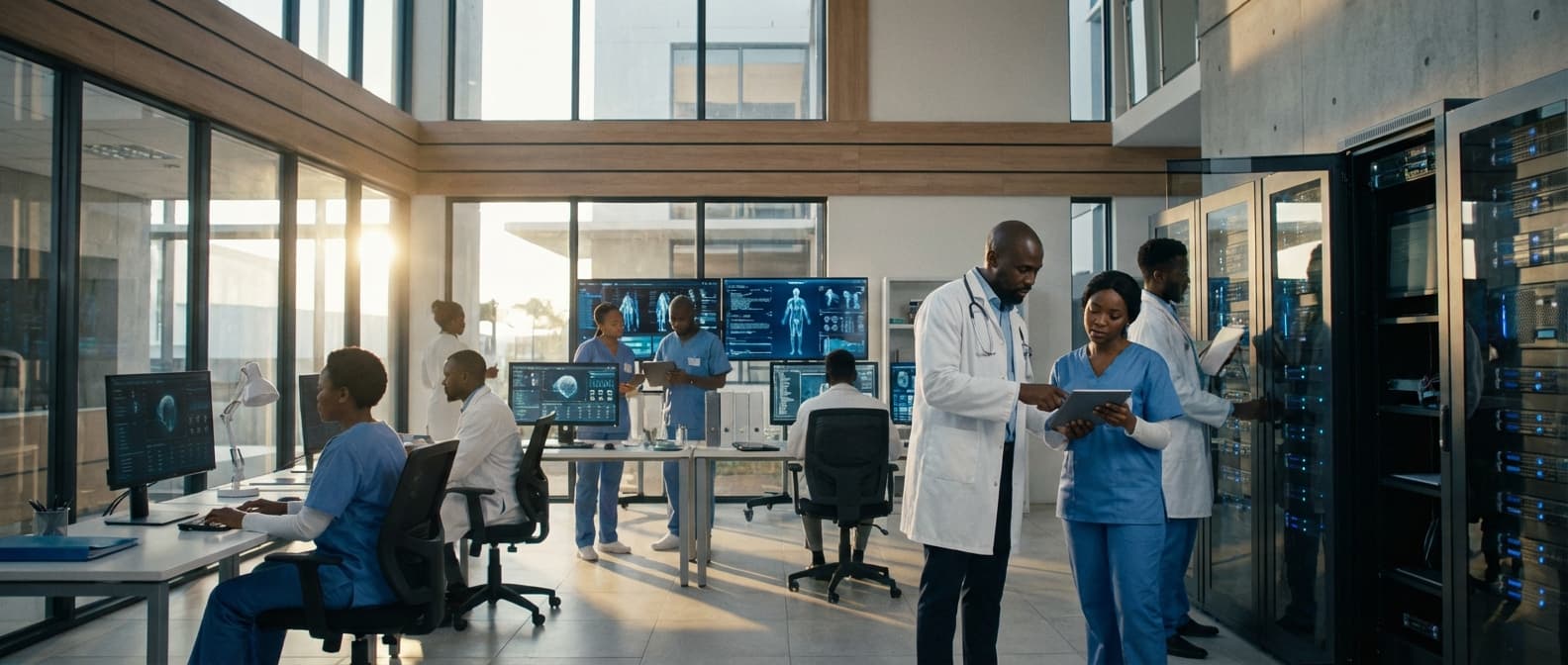
Medical IT Consultation in Nigeria
Engineering Excellence & Technical Support
Strategic technology consulting to optimize healthcare operations, streamline workflows, and integrate cutting-edge medical information systems. High-standard technical execution following OEM protocols and local regulatory frameworks.
Robust Cybersecurity Frameworks
We design and implement cutting-edge cybersecurity strategies tailored to the unique threat landscape in Nigeria, safeguarding patient data, hospital systems, and ensuring regulatory compliance with NCDC and NDPR guidelines.
Scalable Cloud Migration & Management
Our expertise in secure cloud solutions empowers Nigerian healthcare providers to transition to scalable, cost-effective, and highly available IT infrastructures, enabling seamless access to electronic health records (EHRs) and advanced diagnostic tools.
EHR Implementation & Optimization
We facilitate the successful adoption and refinement of Electronic Health Record systems, improving clinical workflows, reducing medical errors, and enhancing data analytics for better patient care and operational efficiency within Nigerian hospitals.
What Is Medical It Consultation In Nigeria?
Medical IT Consultation in Nigeria refers to specialized advisory services focused on the strategic planning, implementation, optimization, and management of information technology (IT) systems within healthcare organizations in Nigeria. This discipline bridges the gap between healthcare delivery and technological advancement, aiming to enhance operational efficiency, improve patient care outcomes, ensure data security and privacy, and support regulatory compliance within the Nigerian healthcare landscape. It encompasses a broad spectrum of IT-related needs unique to the sector, considering the local infrastructure, economic realities, and regulatory framework.
| Who Needs Medical IT Consultation? | Typical Use Cases |
|---|---|
| Hospitals (Public and Private): | Implementing or upgrading EHR/EMR systems; enhancing cybersecurity to protect patient records; integrating PACS and LIS for streamlined diagnostics; deploying HIS for operational management. |
| Clinics & Diagnostic Centers: | Selecting and implementing affordable yet functional practice management software; establishing secure patient data storage; exploring telemedicine for patient outreach. |
| Tertiary Healthcare Institutions & Research Centers: | Developing robust research data management platforms; implementing advanced imaging and diagnostic IT solutions; ensuring high-performance computing for research. |
| Government Health Agencies & Ministries: | Developing national health information strategies; implementing e-health initiatives; establishing data analytics platforms for public health surveillance; ensuring interoperability across public health systems. |
| Pharmaceutical Companies & Medical Device Manufacturers: | Implementing IT solutions for clinical trial management; ensuring data integrity and security for product development and post-market surveillance. |
| Healthcare Startups: | Designing scalable IT infrastructure from inception; selecting appropriate software solutions for early-stage operations; ensuring compliance with regulatory standards. |
| NGOs & International Health Organizations: | Deploying IT solutions for remote health programs; managing data for health interventions; ensuring data security in challenging environments. |
Key Components of Medical IT Consultation in Nigeria
- Needs Assessment & Strategic Planning: Evaluating existing IT infrastructure, identifying gaps, and developing a roadmap for technology adoption aligned with organizational goals and healthcare priorities.
- System Selection & Implementation: Advising on and overseeing the procurement and deployment of Electronic Health Records (EHR/EMR) systems, Picture Archiving and Communication Systems (PACS), Laboratory Information Systems (LIS), Hospital Information Systems (HIS), and other specialized healthcare software.
- Infrastructure Design & Management: Designing and managing robust, scalable, and secure IT infrastructure, including networks, servers, data storage, and cloud solutions tailored for the healthcare environment.
- Cybersecurity & Data Privacy: Implementing and enforcing stringent cybersecurity measures to protect sensitive patient data (PHI) in compliance with Nigerian data protection laws (e.g., NDPR) and international best practices (e.g., HIPAA, GDPR principles).
- Telemedicine & Remote Healthcare Solutions: Advising on and implementing technologies to support virtual consultations, remote patient monitoring, and e-health initiatives, crucial for expanding access to care in diverse geographical regions.
- Interoperability & Data Exchange: Facilitating seamless data sharing between different healthcare systems and providers to improve care coordination and reduce medical errors.
- IT Policy Development & Governance: Establishing clear IT policies, procedures, and governance frameworks to ensure responsible and effective technology utilization.
- Training & Change Management: Providing comprehensive training for healthcare professionals on new IT systems and managing the organizational change associated with technology adoption.
- Compliance & Regulatory Adherence: Ensuring IT systems and practices meet the requirements of Nigerian health regulatory bodies and relevant legislation.
- Budgeting & Cost Optimization: Developing cost-effective IT strategies and managing IT budgets to maximize return on investment (ROI).
Who Needs Medical It Consultation In Nigeria?
Medical IT consultation in Nigeria is essential for a wide range of healthcare organizations and professionals aiming to optimize their technological infrastructure, improve patient care, and ensure compliance with evolving regulations. Whether it's implementing Electronic Health Records (EHRs), enhancing cybersecurity, or leveraging data analytics for better decision-making, expert IT guidance is crucial.
| Customer Type | Key Departments/Stakeholders Requiring IT Consultation |
|---|---|
| Hospitals (Public & Private) | IT Department, Administration, Clinical Departments (e.g., Radiology, Pathology, Pharmacy, Wards), Patient Records Department, Finance, Compliance Officers |
| Specialty Clinics | Clinic Management, IT Support (if any), Clinicians, Administrative Staff, Patient Registration |
| Diagnostic Laboratories & Imaging Centers | Laboratory Management, IT Staff, Technicians, Radiologists, Administrative Personnel |
| Pharmacies | Pharmacy Management, IT/Software Vendors, Pharmacists, Inventory Management |
| Health Maintenance Organizations (HMOs) | IT Department, Operations, Claims Processing, Member Services, Data Analytics |
| Government Health Agencies | IT Department, Policy Makers, Public Health Informatics, Data Management Units |
| Medical Research Institutions | IT Department, Research Teams, Data Management, Bioinformatics |
| Telemedicine Providers | Platform Developers, Operations Team, Clinical Staff, IT Security |
| Individual Practitioners & Small Clinics | Clinic Owner/Practitioner, Administrative Assistant, Receptionist |
Target Customers for Medical IT Consultation in Nigeria
- Hospitals (both public and private)
- Specialty Clinics (e.g., cardiology, oncology, diagnostics)
- Diagnostic Laboratories and Imaging Centers
- Pharmacies
- Health Maintenance Organizations (HMOs)
- Government Health Agencies and Ministries
- Medical Research Institutions
- Telemedicine Providers
- Individual Medical Practitioners and Small Clinics
Medical It Consultation Process In Nigeria
The medical IT consultation process in Nigeria, like in many other regions, involves a structured workflow designed to address the specific technology needs of healthcare providers. This process is crucial for optimizing patient care, enhancing operational efficiency, and ensuring data security within the Nigerian healthcare landscape, which often faces unique challenges such as infrastructure limitations and varying levels of digital literacy. The workflow typically begins with an initial inquiry and culminates in the successful execution and ongoing support of implemented IT solutions.
| Stage | Description | Key Activities in Nigeria | Potential Challenges in Nigeria |
|---|---|---|---|
| Inquiry & Initial Contact | The client (hospital, clinic, pharmacy) reaches out to a medical IT consultancy firm with a need or problem. | Phone calls, emails, website forms, referrals. Initial discussion to understand the general scope of the need. | Lack of readily available information on reputable medical IT consultants. Initial communication barriers due to varying internet access. |
| Needs Assessment & Discovery | A thorough understanding of the client's current IT infrastructure, workflows, challenges, and objectives. | On-site visits, interviews with stakeholders (doctors, nurses, administrators), review of existing systems, documentation analysis. | Limited existing IT documentation. Difficulty in accessing all relevant personnel due to busy schedules. Potential resistance to sharing operational details. |
| Proposal Development | Based on the needs assessment, the consultancy develops a tailored solution proposal outlining recommended IT systems, services, costs, and timelines. | Detailed breakdown of hardware, software, network infrastructure, cybersecurity measures, and integration services. Cost-benefit analysis specific to Nigerian market pricing. | Accurate cost estimation for hardware and software in a fluctuating currency market. Underestimating the complexity of existing legacy systems. |
| Contract Negotiation & Agreement | Review and agreement on the terms of service, deliverables, payment schedules, and contractual obligations. | Clear definition of scope, service level agreements (SLAs) tailored to local context, payment milestones, and intellectual property rights. | Delays in contract finalization. Ambiguity in contract terms leading to future disputes. Ensuring compliance with local business and tax regulations. |
| Solution Design & Planning | Detailed technical design and project planning for the chosen IT solution. | Architectural diagrams, system integration plans, data migration strategies, cybersecurity protocols, and a phased implementation roadmap. | Designing for unreliable power supply (need for robust UPS and generators). Planning for limited and/or expensive internet bandwidth. Integrating with existing, often outdated, hospital equipment. |
| Implementation & Deployment | The actual installation, configuration, and integration of the IT solution. | Hardware installation, software deployment, network setup, system integration, and data migration. Localized software configuration where necessary. | Logistical challenges in transporting hardware to remote locations. Dependence on local vendors for installation and maintenance. Potential for customs delays on imported equipment. |
| Training & User Adoption | Educating end-users on how to effectively use the new IT systems. | On-site training sessions, workshops, creation of user manuals in appropriate languages, and role-based training. | Varying levels of digital literacy among healthcare staff. Language barriers. Resistance to change and adoption of new technologies. Need for ongoing refresher training. |
| Testing & Quality Assurance | Ensuring the deployed solution functions correctly and meets the defined requirements. | Unit testing, integration testing, user acceptance testing (UAT) with real-world scenarios, and performance testing. | Ensuring testing covers scenarios specific to Nigerian healthcare practices. Difficulty in replicating all possible real-world network and power fluctuations during testing. |
| Go-Live & Transition | The official launch of the new IT system and the handover from the project team to the operational team. | Phased rollout or big-bang approach. Comprehensive support during the initial go-live period. Monitoring system performance closely. | Potential for unexpected technical glitches post-launch. Ensuring adequate on-site support availability during critical initial phases. |
| Post-Implementation Support & Optimization | Ongoing maintenance, troubleshooting, and continuous improvement of the IT solution. | Remote and on-site technical support, software updates, system monitoring, performance tuning, and periodic reviews for further optimization. Disaster recovery planning. | Limited availability of specialized IT support staff in certain regions. High cost of ongoing maintenance contracts. Need for proactive cybersecurity measures against evolving threats. |
Key Stages of the Medical IT Consultation Process in Nigeria
- Inquiry & Initial Contact
- Needs Assessment & Discovery
- Proposal Development
- Contract Negotiation & Agreement
- Solution Design & Planning
- Implementation & Deployment
- Training & User Adoption
- Testing & Quality Assurance
- Go-Live & Transition
- Post-Implementation Support & Optimization
Medical It Consultation Cost In Nigeria
The cost of medical IT consultation in Nigeria can vary significantly depending on a multitude of factors. These factors range from the complexity of the required IT services to the experience and reputation of the IT provider. Understanding these elements is crucial for healthcare organizations seeking to budget effectively for their IT needs. The primary drivers influencing pricing include the scope of the project, the level of expertise required, the duration of the consultation, and the specific IT solutions being considered. For instance, a consultation for basic network setup will be considerably less expensive than one for implementing a complex Electronic Health Record (EHR) system or cybersecurity overhaul. Location within Nigeria can also play a role, with services in major economic hubs like Lagos and Abuja potentially commanding higher rates due to increased operational costs and demand.
| Service Type | Typical Range (NGN) | Notes |
|---|---|---|
| Initial IT Needs Assessment/Audit | ₦50,000 - ₦250,000 | Basic evaluation of current IT infrastructure and identification of immediate needs. |
| Network Design & Implementation (Small Clinic) | ₦150,000 - ₦500,000 | Includes planning, setup, and basic configuration of network for a few devices. |
| EHR/EMR System Consultation (Planning & Selection) | ₦200,000 - ₦1,000,000+ | Involves understanding requirements, vendor evaluation, workflow analysis, and strategic planning. Costs can escalate significantly with complexity. |
| Cybersecurity Risk Assessment & Strategy | ₦100,000 - ₦750,000 | Focuses on identifying vulnerabilities and developing a security framework for patient data protection. |
| Cloud Migration Strategy | ₦150,000 - ₦600,000 | Consultation on moving data and applications to cloud-based platforms. |
| IT Support & Managed Services (Initial Consultation) | ₦75,000 - ₦300,000 | Discussing ongoing IT maintenance, helpdesk, and proactive monitoring plans. |
| Specialized Medical Software (e.g., PACS) Integration | ₦300,000 - ₦1,500,000+ | Consultation for integrating complex medical imaging or specialized departmental software. |
Key Pricing Factors for Medical IT Consultation in Nigeria
- Scope and Complexity of Services: The more intricate and broad the IT needs, the higher the consultation cost.
- Provider's Experience and Reputation: Established firms with a proven track record in healthcare IT often charge more.
- Duration of Engagement: The length of time required for consultation directly impacts the overall fee.
- Specific Technologies/Solutions: Implementing specialized software (like EHRs, PACS) or hardware requires deeper expertise and thus higher costs.
- Geographic Location: Major cities may have higher rates than smaller towns.
- Level of Customization: Bespoke IT solutions tailored to a specific clinic's needs will be more expensive than off-the-shelf configurations.
- Support and Maintenance: While not strictly consultation, discussions around ongoing support can influence the initial engagement cost.
- Urgency of the Project: Expedited consultations or implementations may incur premium charges.
Affordable Medical It Consultation Options
For healthcare organizations seeking to optimize their IT infrastructure and operations without breaking the bank, affordable medical IT consultation options are increasingly accessible. These solutions often revolve around understanding the unique value proposition of various service models and implementing smart cost-saving strategies. Value bundles, in particular, offer a structured approach to acquiring comprehensive IT support at a predictable and often reduced cost compared to ad-hoc services. These bundles are designed to cover a range of essential IT needs for medical practices, from cybersecurity and data management to compliance and hardware maintenance.
| Cost-Saving Strategy | Description | Example Application in Medical IT |
|---|---|---|
| Value Bundling | Purchasing a package of integrated IT services for a set price. | A bundle might include managed IT support, cybersecurity monitoring, HIPAA compliance assistance, and cloud backup for a monthly fee. |
| Managed Services Provider (MSP) Contracts | Outsourcing IT functions to a third-party provider on a subscription basis. | An MSP can manage your entire IT infrastructure, including servers, networks, and end-user devices, for a predictable monthly cost. |
| Cloud-Based Solutions | Utilizing cloud services for data storage, applications, and infrastructure. | Migrating Electronic Health Records (EHR) systems to the cloud can reduce hardware maintenance costs and offer greater scalability. |
| Open-Source Software | Using freely available software with no licensing fees. | Exploring open-source alternatives for practice management software or secure communication platforms. |
| Remote Support and Monitoring | Providing IT assistance and system oversight remotely. | Enables quick issue resolution for common problems, reducing the need for on-site visits and associated travel costs. |
| Strategic Hardware Refresh Cycles | Planning and implementing hardware upgrades at optimal intervals. | Instead of replacing all equipment at once, stagger upgrades based on necessity and budget, potentially leveraging leasing options. |
| Consolidated Vendor Management | Working with a single IT partner for multiple services. | A single vendor can offer bundled solutions, streamlining communication and potentially securing volume discounts. |
Key Benefits of Value Bundles
- Predictable Budgeting: Fixed monthly or annual fees allow for easier financial planning.
- Comprehensive Coverage: Bundles typically encompass multiple IT services, ensuring all critical areas are addressed.
- Proactive Support: Many bundles include proactive monitoring and maintenance, preventing issues before they arise.
- Access to Expertise: Gain access to a team of specialized IT professionals without the overhead of hiring full-time staff.
- Scalability: Bundles can often be scaled up or down to meet changing organizational needs.
- Reduced Risk: Outsourcing to experienced IT providers can mitigate security and compliance risks.
Verified Providers In Nigeria
In Nigeria's growing healthcare landscape, distinguishing between reputable and less reliable providers is crucial for ensuring quality care. Franance Health has emerged as a leader, consistently demonstrating a commitment to excellence and patient well-being. This document outlines Franance Health's key credentials and explains why they represent the best choice for healthcare services in Nigeria.
| Credential | Significance for Patients | Franance Health's Commitment |
|---|---|---|
| NHIS Accreditation | Ensures access to a wide range of services under the national health insurance scheme, guaranteeing affordability and accessibility. | Met and exceeded all NHIS requirements for quality of care, financial stability, and patient rights. |
| Certified Medical Professionals | Patients receive care from highly skilled and knowledgeable doctors, nurses, and specialists who are experts in their respective fields. | Employs a rigorous vetting process for all staff and mandates continuous professional development. |
| State-of-the-Art Facilities | Access to advanced diagnostic tools and treatment technologies leads to more accurate diagnoses and effective medical interventions. | Regularly updates its medical equipment and maintains stringent hygiene protocols. |
| Patient-Centric Approach | Patients feel heard, respected, and involved in their treatment decisions, leading to a more positive and less stressful healthcare experience. | Prioritizes patient feedback and actively trains staff in empathetic communication and care delivery. |
| Positive Patient Outcomes | Indicates a high probability of successful treatment, recovery, and overall improved health for patients. | Continuously monitors and evaluates treatment success rates to identify areas for improvement. |
Franance Health's Key Credentials
- Accreditation by National Health Insurance Scheme (NHIS): Franance Health is fully accredited by the NHIS, signifying adherence to rigorous standards for service delivery, infrastructure, and ethical practices.
- Certified Medical Professionals: All healthcare practitioners at Franance Health undergo rigorous certification processes and continuous professional development to ensure they are up-to-date with the latest medical advancements.
- State-of-the-Art Facilities: Franance Health invests in modern medical equipment and maintains a clean, safe, and well-equipped environment conducive to effective diagnosis and treatment.
- Patient-Centric Approach: A core tenet of Franance Health is its unwavering focus on patient satisfaction, comfort, and clear communication throughout their healthcare journey.
- Positive Patient Testimonials and Outcomes: Consistent positive feedback from patients and a track record of successful treatment outcomes underscore the quality of care provided.
- Adherence to Ethical Medical Practices: Franance Health strictly upholds ethical medical codes, ensuring transparency, confidentiality, and respect for patient autonomy.
- Partnerships with Reputable Medical Institutions: Collaborations with other well-regarded healthcare entities further validate Franance Health's commitment to quality and accessibility.
Scope Of Work For Medical It Consultation
This Scope of Work (SOW) outlines the technical deliverables and standard specifications for a Medical IT Consultation project. The consultation aims to assess, recommend, and plan for improvements in the existing medical IT infrastructure and services, ensuring compliance with industry standards and regulatory requirements, and enhancing overall operational efficiency and patient care.
| Deliverable | Description | Standard Specifications/Key Considerations | Format/Output |
|---|---|---|---|
| Current State IT Infrastructure Audit Report | Comprehensive review of existing hardware, software, networks, and security systems. | HIPAA compliance, interoperability standards (HL7, FHIR), data security protocols, network latency, server utilization, system uptime. Identification of single points of failure and outdated technologies. | Detailed written report with executive summary, findings, and risk assessment. |
| User Needs and Requirements Document | Documentation of functional and non-functional requirements from various stakeholders (clinicians, administrators, IT staff, patients). | Usability, performance, scalability, security, accessibility (ADA compliance), integration capabilities, workflow optimization, regulatory compliance (e.g., Meaningful Use, ONC certifications). | Structured document with use cases, user stories, and detailed requirement specifications. |
| Future State IT Architecture Design | Proposed architecture for a robust, secure, and scalable medical IT environment. | Cloud vs. on-premises considerations, data flow diagrams, network topology, server virtualization, storage solutions, disaster recovery and business continuity plans. Adherence to relevant IT frameworks (e.g., NIST, ITIL). | Diagrams (e.g., UML, BPMN), technical schematics, and a written architectural overview. |
| Technology Recommendation Report | Evaluation and recommendation of specific hardware, software, and cloud services. | Vendor reputation, cost-effectiveness, total cost of ownership (TCO), support models, licensing, interoperability with existing systems, security certifications, compliance with healthcare regulations. | Comparative analysis table, product briefs, and a justified recommendation narrative. |
| Implementation Plan and Project Roadmap | Detailed plan for the phased deployment of recommended IT solutions. | Project timelines, resource allocation, phased rollout strategy, risk mitigation strategies, training plans, change management protocols, budget estimates. | Gantt chart, project schedule, budget breakdown, and a risk register. |
| Security and Compliance Assessment Report | Evaluation of current security posture and recommendations for compliance with healthcare regulations. | HIPAA Security Rule, HITECH Act, NIST Cybersecurity Framework, penetration testing results, vulnerability assessments, access control policies, encryption standards. | Written report with identified vulnerabilities, recommended remediation steps, and a compliance gap analysis. |
| Disaster Recovery and Business Continuity Plan | Strategy for maintaining IT operations during disruptive events. | Recovery Time Objective (RTO), Recovery Point Objective (RPO), data backup and restoration procedures, failover mechanisms, communication plans, testing protocols. | Written plan with defined procedures and roles. |
| Training Materials and Knowledge Transfer Documentation | Resources for end-users and IT staff to effectively manage and utilize new systems. | User manuals, administrator guides, FAQs, training presentations, operational procedures. Clear and concise language, role-specific content. | Digital documents, presentations, and interactive training modules. |
Key Project Phases and Objectives
- Phase 1: Assessment and Analysis
- Phase 2: Requirements Gathering and Prioritization
- Phase 3: Solution Design and Architecture
- Phase 4: Technology Selection and Vendor Evaluation
- Phase 5: Implementation Planning and Roadmap Development
- Phase 6: Documentation and Knowledge Transfer
Service Level Agreement For Medical It Consultation
This Service Level Agreement (SLA) outlines the commitment of [Consulting Company Name] (the 'Provider') to [Healthcare Organization Name] (the 'Client') regarding medical IT consultation services. This SLA focuses on response times for support requests and uptime guarantees for critical IT systems managed by the Provider.
| Service/System | Priority Level | Response Time Target (Initial Contact) | Resolution Time Target | Uptime Guarantee |
|---|---|---|---|---|
| Critical Systems (e.g., EHR, PACS, Network Infrastructure) | 1 - Urgent (System Outage, Patient Safety Risk) | 30 minutes | 2 hours | 99.9% |
| Critical Systems (e.g., EHR, PACS, Network Infrastructure) | 2 - High (Significant Performance Degradation, Workflow Disruption) | 1 hour | 4 hours | 99.9% |
| Non-Critical Systems (e.g., Administrative Software, Reporting Tools) | 3 - Medium (Minor Functionality Issue, Non-Urgent Request) | 4 business hours | 1 business day | 99.5% |
| General IT Consultation (Non-Incident Related) | 4 - Low (Routine Inquiries, Planning, Project Support) | 1 business day | N/A (Dependent on Client Scope) | N/A |
Key Service Metrics
- This SLA is effective as of [Start Date] and will remain in effect until terminated by either party as per the terms of the Master Service Agreement.
- All times are referenced in [Time Zone, e.g., Eastern Standard Time (EST)].
- Service hours for consultation support are defined as [e.g., Monday - Friday, 8:00 AM - 6:00 PM].
Frequently Asked Questions

Ready when you are
Let's scope your Medical IT Consultation in Nigeria project in Nigeria.

Scaling healthcare logistics and technical systems across the entire continent.