
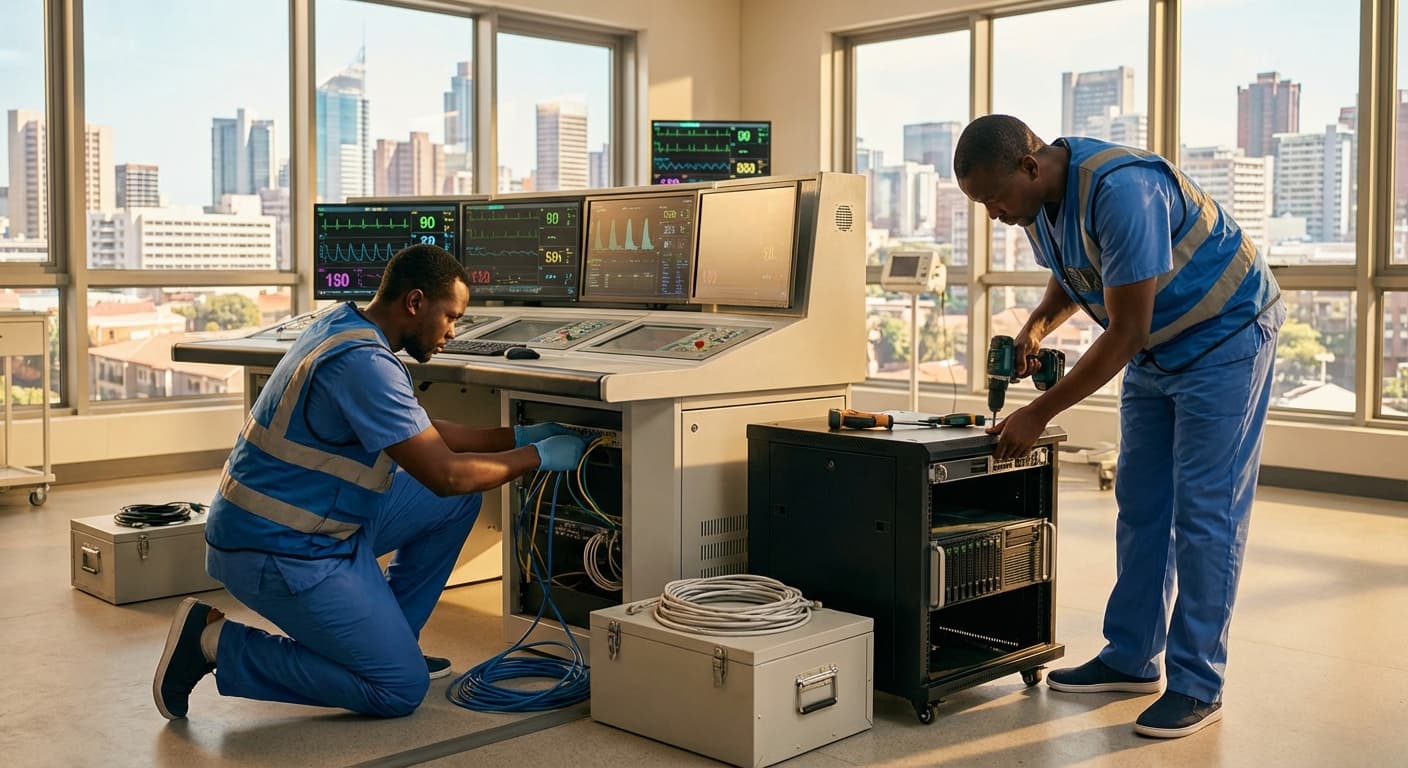
ICU Central Monitoring Station Installation Service in Nigeria
Engineering Excellence & Technical Support
ICU Central Monitoring Station Installation Service High-standard technical execution following OEM protocols and local regulatory frameworks.
Robust Network Infrastructure
We design and implement high-availability, secure, and scalable network architectures specifically for critical ICU environments, ensuring uninterrupted data flow and reliable real-time patient monitoring across all connected devices and workstations in Nigeria.
Seamless Device Integration
Our expert technicians ensure flawless integration of diverse patient monitoring devices (ventilators, ECGs, SpO2 monitors, etc.) with central stations, leveraging industry-standard protocols and custom middleware to provide a unified and comprehensive patient overview for healthcare professionals in Nigerian hospitals.
Redundant Power & Data Backup
We implement comprehensive uninterruptible power supply (UPS) systems and robust data backup solutions, guaranteeing continuous operation and data integrity for your ICU Central Monitoring Station even during power outages or system failures common in some regions of Nigeria.
What Is Icu Central Monitoring Station Installation Service In Nigeria?
ICU Central Monitoring Station Installation Service in Nigeria refers to the specialized provision and setup of integrated systems designed to continuously observe and analyze physiological data from multiple Intensive Care Unit (ICU) beds within a healthcare facility. This service encompasses the deployment of hardware (servers, workstations, networking infrastructure, display units), software (patient monitoring platforms, data acquisition systems, alarm management solutions), and the intricate configuration required to establish a centralized hub for real-time patient oversight. The objective is to enable a dedicated team of clinicians to remotely monitor the vital signs and critical parameters of numerous ICU patients from a single location, facilitating rapid response to deteriorating conditions and enhancing overall patient care efficiency and safety. This service is crucial for modern, high-acuity healthcare environments.
| Need For Service | Typical Use Cases |
|---|---|
| Hospitals with Multiple ICU Beds: Facilities with a significant number of ICU beds benefit from consolidated monitoring to optimize staffing and response times. | Large-Scale Hospitals and Tertiary Care Centers: These institutions often house extensive ICUs requiring a centralized approach to manage patient loads effectively. |
| Facilities Aiming for Enhanced Patient Safety: Centralized monitoring allows for proactive identification of subtle changes in patient status, reducing the risk of adverse events. | Specialized ICUs (e.g., Cardiac, Neuro, Surgical): Dedicated monitoring stations can be tailored to display specific parameters relevant to the specialty, enhancing diagnostic capabilities. |
| Healthcare Institutions Seeking Operational Efficiencies: Streamlining monitoring processes reduces the need for individual bedside checks for every parameter, freeing up nursing staff for direct patient care. | Trauma Centers and Emergency Departments: Rapid assessment and continuous monitoring of multiple critically ill patients upon arrival. |
| Hospitals Implementing Advanced Medical Technologies: Integration of central monitoring with other diagnostic and therapeutic systems (e.g., ventilators, infusion pumps) for a holistic patient view. | Pediatric and Neonatal ICUs: Close and continuous monitoring of vulnerable patient populations where even minor physiological shifts can be critical. |
| Organizations Prioritizing Data-Driven Clinical Decision-Making: Centralized data collection supports trend analysis, research, and quality improvement initiatives. | Remote or Rural Hospitals with Limited Specialist Staff: Enabling more experienced clinicians to remotely oversee patients in less staffed ICUs. |
| Compliance with International Healthcare Standards: Meeting regulatory requirements for continuous patient monitoring and data management. | Disaster Preparedness and Mass Casualty Incidents: Efficiently managing and monitoring a surge in critically ill patients. |
Key Components and Scope of ICU Central Monitoring Station Installation Service:
- System Design and Planning: Architectural planning for network integration, hardware placement, and software interoperability with existing hospital IT infrastructure (e.g., Electronic Health Records - EHR).
- Hardware Deployment: Installation and configuration of central servers, dedicated workstations for monitoring staff, high-resolution display systems, and network switches/routers.
- Software Installation and Configuration: Deployment of patient monitoring software, including vital signs acquisition, waveform display, trend analysis, and configurable alarm parameters.
- Network Integration: Establishing robust and secure network connectivity between ICU bedside monitors, central station servers, and other relevant hospital systems.
- Calibration and Testing: Rigorous testing and calibration of all hardware and software components to ensure accurate data acquisition and reliable alarm functionality.
- User Training: Comprehensive training for physicians, nurses, and technicians on the operation, interpretation of data, and alarm management protocols of the central monitoring system.
- Post-Installation Support and Maintenance: Ongoing technical support, software updates, troubleshooting, and preventative maintenance services.
- Integration with Alarm Management Systems: Setting up direct interfaces for alarm notifications to be disseminated to appropriate personnel via pagers, mobile devices, or ward communication systems.
- Data Archiving and Retrieval: Implementation of secure data storage solutions for historical patient monitoring data for review, research, and legal compliance.
Who Needs Icu Central Monitoring Station Installation Service In Nigeria?
In Nigeria's rapidly developing healthcare sector, the need for advanced patient monitoring is paramount. ICU Central Monitoring Station Installation Services play a crucial role in enabling healthcare facilities to provide high-level critical care. These services are essential for hospitals and medical centers looking to enhance their Intensive Care Unit (ICU) capabilities by centralizing and efficiently managing patient vital signs data. This allows for real-time observation, immediate response to critical events, and improved patient outcomes, especially in high-acuity environments. Facilities with the ambition to offer state-of-the-art critical care services, regardless of their current size, can benefit significantly from this specialized installation.
| Department | Specific Needs & Benefits | Key Personnel Involved |
|---|---|---|
| Intensive Care Unit (ICU) | Centralized real-time monitoring of multiple critically ill patients, early detection of deterioration, improved staff efficiency, reduced alarm fatigue, enhanced data logging for analysis and research. | Intensivists, ICU Nurses, Biomedical Engineers, IT Support Staff, Hospital Administrators. |
| Emergency Department (ED) / Accident & Emergency (A&E) | Seamless transition of critically ill patients from ED to ICU, continuous monitoring during transfer, early identification of patients requiring ICU admission. | ED Physicians, ED Nurses, Critical Care Nurses, Biomedical Engineers, IT Support Staff. |
| Anesthesiology Department | Monitoring of patients in post-anesthesia care units (PACUs) who may require intensive monitoring, integration with operating room monitoring systems. | Anesthesiologists, PACU Nurses, Biomedical Engineers, IT Support Staff. |
| Cardiology Department | Monitoring of patients with acute cardiac conditions in CCU/ICU settings, continuous ECG monitoring, hemodynamic assessment. | Cardiologists, Cardiac Nurses, Intensivists, Biomedical Engineers, IT Support Staff. |
| Neurosurgery Department | Monitoring of patients with severe head injuries or neurological conditions requiring close observation and management of intracranial pressure. | Neurosurgeons, Neurologists, Intensivists, Critical Care Nurses, Biomedical Engineers, IT Support Staff. |
| Biomedical Engineering Department | Installation, calibration, maintenance, and troubleshooting of the central monitoring system and connected bedside monitors. Ensuring system integration and reliability. | Biomedical Engineers, IT Network Administrators, Service Technicians. |
| Information Technology (IT) Department | Integration of the monitoring system with hospital information systems (HIS), electronic medical records (EMR), ensuring network security, data integrity, and remote access capabilities. | IT Network Administrators, Systems Analysts, Data Security Specialists. |
| Hospital Administration / Management | Strategic investment in advanced technology to improve patient care quality, enhance hospital reputation, optimize resource allocation, and ensure regulatory compliance. | Hospital CEOs, Medical Directors, Chief Nursing Officers, Procurement Managers. |
Target Customers for ICU Central Monitoring Station Installation Services in Nigeria:
- Hospitals (Public and Private)
- Tertiary Healthcare Institutions
- Specialty Clinics (e.g., Cardiac, Neurosurgery)
- Teaching Hospitals
- Medical Research Centers
- Large Corporate Health Centers
Icu Central Monitoring Station Installation Service Process In Nigeria
This document outlines the comprehensive workflow for the installation service of an ICU Central Monitoring Station in Nigeria, from the initial client inquiry to the final project execution and handover. The process is designed to ensure a seamless, efficient, and client-centric experience, adhering to all relevant technical standards and local regulations.
| Phase | Key Activities | Key Deliverables | Estimated Timeline (Weeks) |
|---|---|---|---|
| Phase 1: Inquiry & Pre-Sales | Client consultation, Site Survey, Proposal Generation, Contract Signing | Detailed Proposal, Signed Contract | 1-3 |
| Phase 2: Planning & Procurement | Project Kick-off, Technical Design, Equipment Procurement, Site Preparation | Project Plan, Procurement Orders, Prepared Site | 2-6 |
| Phase 3: Installation & Configuration | Hardware Installation, Cabling, Software Setup, Network Integration | Installed & Configured System | 3-8 |
| Phase 4: Testing, Training & Handover | System Testing, UAT, Staff Training, Documentation | Tested System, Trained Staff, Handover Documentation | 2-4 |
| Phase 5: Post-Installation Support | Warranty Support, Maintenance, Updates | Ongoing System Reliability | Continuous (as per contract) |
ICU Central Monitoring Station Installation Service Workflow
- {"items":["Client Inquiry Received: Initial contact from the hospital or healthcare facility regarding their need for an ICU Central Monitoring Station installation.","Initial Consultation & Needs Assessment: Understanding the client's specific requirements, existing infrastructure, number of patient monitoring beds, desired features, and budget.","Site Survey & Feasibility Study: A technical team visits the proposed installation site to assess space availability, power supply, network infrastructure, and any potential challenges.","System Design & Proposal Generation: Based on the needs assessment and site survey, a detailed system design is created, including hardware, software, networking, and cabling requirements. A comprehensive proposal with cost breakdown and timeline is then prepared.","Proposal Presentation & Negotiation: The proposal is presented to the client, addressing any questions and concerns. Negotiations on scope, pricing, and terms are conducted.","Contract Signing & Agreement: Upon mutual agreement, a formal contract is signed, outlining the scope of work, deliverables, payment schedule, and warranty."],"title":"Phase 1: Inquiry & Pre-Sales"}
- {"items":["Project Kick-off Meeting: A formal meeting with the client's project team to align on roles, responsibilities, communication protocols, and detailed project plan.","Detailed Technical Design & Engineering: Finalizing the engineering drawings, wiring diagrams, network topology, and installation schematics.","Procurement of Equipment & Materials: Ordering all necessary hardware (monitoring units, central station server, displays, networking equipment), software licenses, cabling, and installation accessories.","Logistics & Importation (if applicable): Managing the shipment and customs clearance of equipment into Nigeria.","Pre-installation Site Preparation: Ensuring the designated installation area is ready, including any necessary civil works, electrical upgrades, or network cabling runs."],"title":"Phase 2: Planning & Procurement"}
- {"items":["Equipment Delivery & Staging: Receiving and inspecting all procured equipment at the site or a designated staging area.","Hardware Installation: Physically installing patient monitoring units at each bedside, the central monitoring station server, displays, and network devices.","Cabling & Wiring: Laying and connecting all necessary network, power, and data cables according to the design schematics.","Software Installation & Configuration: Installing the central monitoring station software on the server and configuring it to recognize and communicate with all connected patient monitors.","Network Integration: Connecting the monitoring system to the hospital's existing network infrastructure, ensuring secure and reliable data transmission.","System Calibration & Initial Testing: Performing initial checks to ensure all components are functioning correctly and data is being received accurately."],"title":"Phase 3: Installation & Configuration"}
- {"items":["System Integration Testing: Comprehensive testing of the entire system to verify data flow, alarm functionality, data recording, and remote access capabilities.","User Acceptance Testing (UAT): The client's clinical and IT staff test the system to confirm it meets their operational needs and requirements.","Clinical Workflow Integration: Ensuring the system seamlessly integrates with the hospital's existing clinical workflows and electronic health records (EHR) if applicable.","Staff Training: Providing comprehensive training to hospital staff (nurses, doctors, IT personnel) on the operation, maintenance, and troubleshooting of the central monitoring station.","Documentation & Handover: Providing the client with all relevant technical documentation, user manuals, maintenance guides, and warranty information. Formal handover of the installed system.","Project Closure: Finalizing all project documentation, obtaining client sign-off, and closing out the project."],"title":"Phase 4: Testing, Training & Handover"}
- {"items":["Warranty Period: Providing technical support and maintenance services as per the contract during the warranty period.","Remote & On-site Support: Offering ongoing technical assistance, troubleshooting, and software updates.","Preventive Maintenance: Scheduled visits for system checks and maintenance to ensure optimal performance.","Future Upgrades & Expansion: Providing support for future system upgrades or expansion as the hospital's needs evolve."],"title":"Phase 5: Post-Installation Support"}
Icu Central Monitoring Station Installation Service Cost In Nigeria
Installing an ICU Central Monitoring Station in Nigeria involves a multifaceted approach to pricing. Several key factors influence the overall cost, making it crucial for healthcare facilities to understand these elements to budget effectively. These factors range from the complexity and brand of the equipment to the specific site preparation requirements and the expertise of the installation team. The goal of a central monitoring station is to provide a centralized hub for real-time patient data from multiple ICU beds, enabling critical care teams to monitor vital signs, manage alarms, and respond swiftly to patient deterioration. The cost breakdown generally includes hardware, software, installation labor, training, and ongoing maintenance. Negotiations and the specific vendor chosen will also play a significant role in the final price. It's important to obtain detailed quotes from multiple reputable suppliers and installers to ensure competitive pricing and the best value for the investment.
| Cost Component | Estimated Range (NGN) | Notes |
|---|---|---|
| Central Monitoring Console(s) | 2,000,000 - 15,000,000+ | Varies significantly by brand, features, and number of screens/users. |
| Bedside Patient Monitors (per unit) | 800,000 - 4,000,000+ | Depends on parameters monitored (ECG, SpO2, NIBP, IBP, EtCO2, etc.), brand, and portability. |
| Sensors & Accessories (per bed) | 100,000 - 500,000+ | Includes ECG leads, SpO2 sensors, BP cuffs, temperature probes, etc. |
| Software Licensing (one-time/annual) | 1,000,000 - 10,000,000+ | Can be a substantial cost, often based on features and number of beds/users. |
| Installation Labor & Setup | 500,000 - 3,000,000+ | Depends on complexity, team size, and travel if applicable. |
| Site Preparation & Infrastructure | 200,000 - 2,000,000+ | Includes electrical, networking, and potential minor construction. |
| Training (staff) | 300,000 - 1,500,000+ | Covers trainers' fees, materials, and staff time. |
| Warranty & Initial Maintenance | Included in equipment cost or separate 5-15% of equipment cost annually | Essential for ensuring system reliability. |
| Project Management | 300,000 - 1,000,000+ | For larger, more complex installations. |
| Total Estimated Installation Cost (per ICU bay, excluding ongoing maintenance) | 5,200,000 - 37,500,000+ NGN (for a 4-bed ICU, for example) | This is a rough estimate and can vary dramatically. A comprehensive quote is essential. |
Key Pricing Factors for ICU Central Monitoring Station Installation in Nigeria
- Equipment Costs: This is the most significant component. It includes the central monitoring console(s), bedside patient monitors (for each ICU bed), associated sensors (ECG, SpO2, NIBP, respiration, temperature), cabling, and potentially server infrastructure for data storage and analysis. The brand reputation, advanced features (e.g., advanced waveform analysis, drug calculation modules), and the number of beds to be monitored directly impact this cost.
- Software Licensing: The central monitoring system will have associated software for data acquisition, display, analysis, and alarm management. Licensing fees can be a one-time purchase or an annual subscription, often tiered based on the number of users or features enabled.
- Installation Labor & Expertise: This covers the cost of skilled biomedical engineers and technicians to physically install the equipment, connect it to existing hospital networks (if applicable), configure the software, and perform initial calibration. The complexity of the installation, the need for structural modifications, and the installation team's experience are all factored in.
- Site Preparation & Infrastructure: Hospitals may need to undertake modifications to accommodate the new system. This could include upgrading electrical outlets, ensuring adequate network connectivity (wired or wireless), and potentially creating dedicated IT infrastructure for the monitoring system. The cost of these preparations can vary greatly depending on the existing state of the facility.
- Training: Comprehensive training for nursing staff, doctors, and biomedical technicians on operating the central monitoring system, interpreting data, and responding to alarms is essential. This cost typically includes the trainer's fees, materials, and the time staff spend in training.
- Warranty & Maintenance Contracts: Post-installation, ongoing support is crucial. This includes warranty periods for the equipment and optional annual maintenance contracts that cover routine checks, software updates, and emergency repairs. These contracts are vital for ensuring system uptime and longevity.
- Vendor & Supplier Markups: Different vendors and suppliers will have varying markups on equipment and services. Choosing established and reputable vendors is recommended, but their pricing might be higher. Comparing quotes is therefore essential.
- Project Management: For larger installations, a dedicated project manager might be required to oversee the entire process, ensuring timely completion and efficient coordination between different stakeholders.
Affordable Icu Central Monitoring Station Installation Service Options
Installing an Intensive Care Unit (ICU) central monitoring station is a critical investment for any healthcare facility, ensuring continuous patient oversight and rapid response to critical events. This service involves setting up a robust system that aggregates vital signs data from multiple bedside monitors, displaying it on a central console for a dedicated nursing team. When considering installation, understanding value bundles and cost-saving strategies is paramount to achieving both operational excellence and financial prudence. This guide explores options to make ICU central monitoring station installation both affordable and highly effective.
| Value Bundle Option | Description | Included Services/Hardware | Potential Cost Savings |
|---|---|---|---|
| Basic Connectivity Bundle | Focuses on core functionality for essential patient monitoring. | Central server, basic workstations, network cabling, initial setup, standard software. Excludes advanced features or extensive data storage. | Lower upfront hardware cost. Reduced need for advanced features initially, allowing for phased upgrades. |
| Integrated Workflow Bundle | Optimizes data flow and integration with existing EMR/EHR systems. | Includes Basic Connectivity Bundle plus EMR/EHR integration modules, enhanced reporting tools, and advanced alarm notification options. | Improved efficiency reduces nursing time spent on data entry. Potential for better clinical decision-making leading to improved patient outcomes (indirect cost saving). |
| Comprehensive Care Bundle | The most robust option, designed for high-acuity ICUs with extensive data needs and future-proofing. | Includes Integrated Workflow Bundle plus expanded data storage, advanced analytics, redundant systems for high availability, and extended training programs. | Future-proofs the investment, reducing the need for major upgrades soon. Redundancy minimizes downtime, preventing costly patient care disruptions. |
| Modular Upgrade Path | Allows for a phased installation, starting with essential components and adding features later. | Initial purchase of core components with the option to purchase add-on modules (e.g., advanced analytics, specialized waveform display) as budget allows. | Spreads out the capital expenditure. Allows for adaptation to evolving needs and technologies without re-installing the entire system. |
Key Components of an ICU Central Monitoring Station Installation
- Central server and workstation(s) for data aggregation and display
- Network infrastructure (cabling, switches, routers)
- Bedside monitor integration hardware and software
- User interface and alarm management software
- Data archiving and retrieval systems
- Installation, configuration, and testing by qualified technicians
- Training for clinical and IT staff
- Ongoing maintenance and support contracts
Verified Providers In Nigeria
In Nigeria's dynamic healthcare landscape, ensuring access to reliable and skilled medical professionals is paramount. The term 'Verified Providers' signifies healthcare practitioners who have undergone a rigorous vetting process, guaranteeing their qualifications, licenses, and ethical standards. Among these, Franance Health stands out as a beacon of excellence. Their commitment to stringent credentialing and continuous professional development positions them as the superior choice for individuals seeking dependable and high-quality medical care. This document outlines the credentials and reasons why Franance Health represents the best choice for verified healthcare providers in Nigeria.
| Credential/Aspect | Franance Health's Standard | Why it Matters for Patients |
|---|---|---|
| License & Registration Verification | Mandatory verification of current and valid licenses with relevant Nigerian medical councils (e.g., Medical and Dental Council of Nigeria - MDCN). | Ensures providers are legally permitted to practice and meet basic competency requirements, protecting patients from unqualified individuals. |
| Educational Background | Thorough vetting of medical degrees, diplomas, and postgraduate qualifications from accredited institutions. | Confirms that providers have received a foundational and specialized education from recognized and reputable sources. |
| Specialty Certifications | Verification of all claimed specialist qualifications and certifications. | Guarantees that providers possess the advanced knowledge and skills for specific medical fields, leading to more accurate diagnoses and treatments. |
| Professional Experience | Detailed review of work history, including roles, responsibilities, and periods of practice. | Assesses the practical application of knowledge and skills, indicating a level of experience and familiarity with common and complex cases. |
| Continuing Professional Development (CPD) | Active monitoring and requirement of ongoing CPD activities as mandated by regulatory bodies. | Ensures providers remain updated with the latest medical advancements, techniques, and best practices, offering patients the most current and effective care. |
| Ethical Compliance & Disciplinary Records | Background checks for any history of ethical breaches or disciplinary actions. | Provides assurance of a provider's commitment to patient welfare, confidentiality, and professional integrity, fostering trust and safety. |
| Patient Feedback Integration | Incorporation of patient feedback mechanisms (where applicable) into ongoing evaluation. | Offers a layer of accountability and transparency, reflecting the provider's commitment to patient satisfaction and service quality. |
Franance Health's Verification Process Highlights
- Comprehensive Educational and Professional Background Checks
- Validation of Medical Licenses and Registrations with Regulatory Bodies (e.g., MDCN)
- Verification of Specialty Certifications and Fellowships
- Thorough Reference Checks and Past Performance Assessments
- Adherence to Ethical Medical Practice Standards
- Ongoing Continuing Professional Development (CPD) Monitoring
Scope Of Work For Icu Central Monitoring Station Installation Service
This Scope of Work (SOW) outlines the requirements for the installation of an Intensive Care Unit (ICU) Central Monitoring Station (CMS) service. It details the technical deliverables, standard specifications, and project phases involved in ensuring a fully operational and integrated CMS within the specified ICU environment. The primary objective is to provide continuous, real-time patient vital sign monitoring and data management to enhance patient care and clinical decision-making.
| Technical Deliverable | Description | Standard Specification / Requirement | Acceptance Criteria |
|---|---|---|---|
| Central Monitoring Station (CMS) Hardware | All required server(s), workstations, display monitors, network switches, and associated peripherals for the CMS. | High-availability server architecture (e.g., redundant power supplies, RAID storage). Minimum 24-inch high-resolution displays. Medical-grade networking equipment. Compliance with relevant healthcare IT security standards (e.g., HIPAA, GDPR). | Hardware is fully functional, meets specified performance benchmarks, and is certified for medical use. |
| Patient Monitoring Devices | Integration of existing or provision of new patient monitors (bedside devices) with the CMS. | Monitors must support standard data protocols (e.g., HL7, DICOM, proprietary APIs). Compatibility with existing hospital network infrastructure. Battery backup for all bedside monitors. | All connected patient monitors successfully transmit real-time data to the CMS without interruption. |
| Network Infrastructure | Installation and configuration of a robust and secure network to support data transmission between bedside monitors and the CMS. | Dedicated VLAN for patient monitoring data. High-speed, low-latency network connections (e.g., Gigabit Ethernet). Network security measures including firewalls, intrusion detection/prevention systems. Adequate bandwidth to handle peak data loads. | Network performs within specified latency and throughput requirements. All network components are secured and configured according to hospital policy. |
| CMS Software and Database | Installation, configuration, and licensing of the CMS software and its associated database. | Software must be the latest stable version from the vendor. Database configured for optimal performance and data retention. Compliance with data integrity and security standards. | Software is installed and licensed. Database is functional and accessible. All core CMS features are operational. |
| Data Integration (EHR/HIS) | Successful integration of the CMS with the hospital's Electronic Health Record (EHR) or Hospital Information System (HIS). | Bi-directional data flow (e.g., patient demographics from EHR to CMS, vital sign trends from CMS to EHR). Standardized data mapping and communication protocols (e.g., HL7 v2.x or FHIR). | Patient demographic data is accurately populated in CMS. Vital sign data is successfully transmitted and viewable within the EHR. No data corruption or loss. |
| Alarm Management System | Configuration and testing of the CMS alarm system to alert clinical staff to critical patient events. | Configurable alarm thresholds for various parameters. Different alarm levels (e.g., advisory, warning, critical). Auditable alarm logs. Integration with hospital paging or notification systems (optional). | Alarms trigger correctly based on predefined parameters. Alarm notifications are received by designated personnel. Alarm logs are accurately recorded. |
| User Interface and Reporting | Configuration of user roles, permissions, and reporting functionalities within the CMS. | Role-based access control. Customizable dashboards and views. Generation of standard and ad-hoc reports on patient vital signs and trends. | Users can access the system with appropriate permissions. Reports can be generated and exported accurately. Dashboards display relevant information. |
| System Documentation | Comprehensive documentation for the installed CMS, including installation guides, configuration manuals, user guides, and maintenance procedures. | Documentation must be up-to-date, clear, and comprehensive. Includes network diagrams, IP addressing schemes, and troubleshooting guides. | All required documentation is provided in the agreed-upon format and is accurate and complete. |
| Training Materials and Sessions | Development and delivery of training for clinical and IT staff on CMS operation, maintenance, and troubleshooting. | Tailored training programs for different user groups. Hands-on training sessions. Post-training assessments. | Staff demonstrate proficiency in using and managing the CMS after training. |
| Post-Installation Support Plan | A clearly defined plan for ongoing technical support, maintenance, and system updates. | Defined service level agreements (SLAs) for response and resolution times. Scheduled preventative maintenance. Procedures for software updates and patching. | Support plan is documented and agreed upon. Initial support period is covered as per contract. |
Project Phases and Key Activities
- Phase 1: Planning and Design
- Phase 2: Procurement and Staging
- Phase 3: Installation and Cabling
- Phase 4: System Configuration and Integration
- Phase 5: Testing, Validation, and Go-Live
- Phase 6: Training and Handover
- Phase 7: Post-Installation Support
Service Level Agreement For Icu Central Monitoring Station Installation Service
This Service Level Agreement (SLA) outlines the response times and uptime guarantees for the installation of the ICU Central Monitoring Station. This SLA is an addendum to the Master Services Agreement (MSA) between [Your Company Name] (hereinafter referred to as "Provider") and [Client Company Name] (hereinafter referred to as "Client").
| Service Component | Response Time Guarantee | Uptime Guarantee | Remedy for Failure |
|---|---|---|---|
| Critical System Failure (complete loss of central monitoring functionality) | Within 1 hour for initial diagnosis, and within 4 hours for dispatch of qualified technician. | 99.9% monthly uptime. | Service Credits equivalent to 10% of monthly service fee for each incident of downtime exceeding 1 hour. For downtime exceeding 4 hours, service credits will be 20% of the monthly service fee per 24-hour period of continuous downtime. |
| Major System Malfunction (partial loss of functionality, e.g., data not updating for multiple beds) | Within 2 hours for initial diagnosis, and within 8 hours for dispatch of qualified technician. | 99.5% monthly uptime. | Service Credits equivalent to 5% of monthly service fee for each incident of downtime exceeding 2 hours. For downtime exceeding 8 hours, service credits will be 10% of the monthly service fee per 24-hour period of continuous downtime. |
| Minor System Issue (e.g., alarm notification delay, minor display anomaly, single bed data issue) | Within 4 business hours for initial diagnosis, and within 24 business hours for resolution or mitigation. | N/A (Focus is on timely resolution). | No service credits, but proactive communication and diligent effort to resolve the issue within the defined timeframe. |
| Technical Support and Inquiries (non-critical issues) | Within 8 business hours for acknowledgement and triage. | N/A (Focus is on timely response). | No service credits, but commitment to address inquiries within a reasonable timeframe. |
Scope of Service
- Installation of ICU Central Monitoring Station hardware and software.
- Configuration and integration with existing hospital network infrastructure (as per agreed-upon specifications).
- Initial system testing and validation.
- User training for basic operation and monitoring.
- Post-installation support for a period of [Number] days following project sign-off.
Frequently Asked Questions

Ready when you are
Let's scope your ICU Central Monitoring Station Installation Service in Nigeria project in Nigeria.

Scaling healthcare logistics and technical systems across the entire continent.