
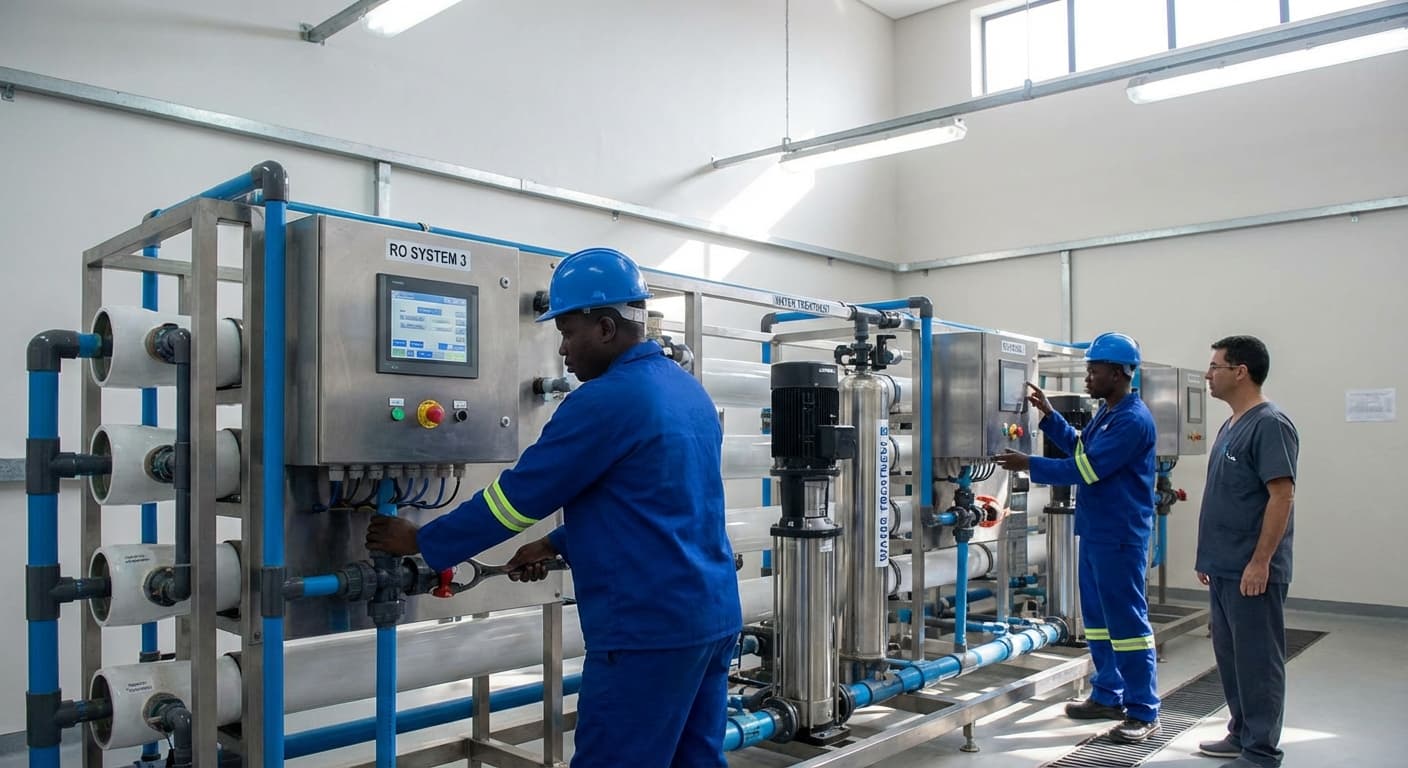
Dialysis RO/Water Treatment Plant Installation Service in Nigeria
Engineering Excellence & Technical Support
Dialysis RO/Water Treatment Plant Installation Service High-standard technical execution following OEM protocols and local regulatory frameworks.
Optimized Water Purity for Superior Dialysis Outcomes
We engineer and install state-of-the-art Reverse Osmosis (RO) and water treatment systems specifically designed for dialysis facilities in Nigeria. Our solutions exceed regulatory standards, guaranteeing the ultra-pure water essential for patient safety and maximizing treatment efficacy, minimizing the risk of complications.
Robust, Locally-Adapted Engineering & Design
Our team leverages deep understanding of Nigerian operational environments to deliver robust, resilient, and cost-effective dialysis water treatment plants. We prioritize reliable components and intelligent design, ensuring consistent performance even in challenging conditions, backed by comprehensive local installation and ongoing support.
Comprehensive Compliance & Lifecycle Management
We provide end-to-end installation services, ensuring full adherence to international water quality standards and local health regulations. Our commitment extends beyond installation, offering proactive maintenance plans and technical support to guarantee the long-term operational integrity and compliance of your dialysis water treatment infrastructure.
What Is Dialysis Ro/water Treatment Plant Installation Service In Nigeria?
Dialysis RO/Water Treatment Plant Installation Service in Nigeria refers to the specialized engineering and technical service of designing, procuring, installing, commissioning, and maintaining reverse osmosis (RO) and other water purification systems specifically tailored for dialysis facilities. These systems are critical for producing ultrapure water, a vital medical input for hemodialysis and other renal replacement therapies, ensuring patient safety and treatment efficacy. The service encompasses a comprehensive approach to water quality management, adhering to stringent international and local medical standards.
| Entity | Need for Service | Typical Use Cases |
|---|---|---|
| Dialysis Centers (Public and Private): | Critical need for a consistent supply of ultrapure water to perform hemodialysis and other renal therapies safely and effectively. Contaminated water can lead to serious patient complications and infections. | Hemodialysis Units: Production of dialysate fluid for chronic and acute hemodialysis patients. Peritoneal Dialysis (PD) Centers: While PD often uses pre-packaged solutions, some facilities may utilize treated water for specific preparations or rinsing. Hospital Nephrology Departments: Integrated dialysis units within hospitals require reliable water treatment for both inpatient and outpatient dialysis procedures. |
| Hospitals with Renal Units: | To support in-house dialysis services, reducing reliance on external suppliers and ensuring immediate availability of treated water for critical care. | Acute Hemodialysis: For patients in intensive care units (ICUs) or other critical care settings. Elective Dialysis: For scheduled treatments for chronic kidney disease (CKD) patients. |
| Medical Device Manufacturers and Suppliers: | Companies that install and maintain dialysis machines often require integrated water treatment solutions to offer a complete service package to their clients. | Bundled Equipment and Water Systems: Offering a turnkey solution to dialysis providers. Technical Support and Servicing: Providing expertise on both dialysis machines and their water supply. |
| Government Health Agencies and Ministries of Health: | For equipping public healthcare facilities, ensuring standardized and safe dialysis services across the nation, particularly in underserved regions. | Establishment of New Dialysis Units: Outfitting new medical facilities. Upgrade of Existing Infrastructure: Replacing or upgrading outdated water treatment systems in public hospitals. |
Key Components of the Service
- Site Assessment and Water Quality Analysis: Thorough evaluation of the existing water source (municipal, borehole, etc.) to determine its chemical, biological, and particulate contaminants. This dictates the appropriate treatment train design.
- System Design and Engineering: Development of customized RO systems, often incorporating pre-treatment (filtration, softening, carbon adsorption) and post-treatment (UV sterilization, deionization) stages to meet specific dialysis water requirements (e.g., AAMI, ISO standards).
- Equipment Procurement and Supply: Sourcing and delivery of high-quality RO membranes, pumps, filters, storage tanks, piping, control systems, and ancillary equipment from reputable manufacturers.
- Installation and Plumbing: Precision installation of all system components, including piping, electrical connections, and structural integration within the dialysis facility, ensuring leak-free operation and compliance with sanitary standards.
- Commissioning and Validation: Rigorous testing and calibration of the installed system to verify performance parameters, water purity, flow rates, and alarm functionalities. This includes a validation process to confirm the system meets all specified medical standards.
- Operator Training: Comprehensive training for facility staff on the operation, routine maintenance, troubleshooting, and water quality monitoring procedures of the installed plant.
- Ongoing Maintenance and Support: Provision of preventative maintenance services, emergency repairs, spare parts supply, and remote monitoring to ensure continuous, reliable operation and compliance.
Who Needs Dialysis Ro/water Treatment Plant Installation Service In Nigeria?
Dialysis centers across Nigeria are in constant need of reliable, high-quality water treatment solutions to ensure the safety and efficacy of their treatments. This necessitates the installation and maintenance of specialized Reverse Osmosis (RO) and water treatment plants. These plants are not just about compliance; they are fundamental to patient well-being and the operational integrity of dialysis services.
| Target Customer Type | Relevant Departments/Stakeholders | Key Needs/Concerns |
|---|---|---|
| Hospitals (Public and Private) | Nephrology Department, Biomedical Engineering Department, Procurement Department, Facility Management, Hospital Administration | Consistent supply of ultrapure water for dialysis, compliance with health regulations (e.g., National Association of Nephrology, Nigeria - NAN guidelines), cost-effectiveness, reliable service and maintenance, minimizing downtime, upgrading existing systems, ensuring patient safety. |
| Dedicated Dialysis Clinics | Clinic Director/Manager, Lead Nephrologist, Biomedical Technician, Operations Manager, Purchasing Officer | Specialized water treatment for hemodialysis, meeting regulatory standards, space optimization for RO units, long-term operational efficiency, technician training for basic maintenance, emergency repair services. |
| Specialty Kidney Treatment Centers | Medical Director, Head of Nursing, Facility Manager, IT/Technical Support (if applicable) | Advanced water purification technologies, integration with existing dialysis machines, data logging and monitoring capabilities, ensuring water quality for specific dialysis modalities, scalability for future expansion. |
| Research Institutions with Dialysis Facilities | Principal Investigators, Research Coordinators, Laboratory Managers, Facilities Management | High-purity water for research purposes beyond patient treatment, consistency in water quality for experimental reproducibility, specialized filtration requirements, compliance with research ethics and standards. |
Who Needs Dialysis RO/Water Treatment Plant Installation Service in Nigeria?
- Hospitals (Public and Private)
- Dedicated Dialysis Clinics
- Specialty Kidney Treatment Centers
- Research Institutions with Dialysis Facilities
Dialysis Ro/water Treatment Plant Installation Service Process In Nigeria
This document outlines the typical workflow for Dialysis Reverse Osmosis (RO)/Water Treatment Plant Installation Services in Nigeria, from initial inquiry to final execution and handover.
| Stage | Description | Key Activities | Deliverables/Outcomes |
|---|---|---|---|
| Inquiry & Initial Consultation | The client (e.g., hospital, clinic) expresses interest in a dialysis RO/water treatment plant. | Client contacts the service provider. Provider gathers basic information about the client's needs, existing infrastructure, and expected capacity. | Understanding of client's immediate needs and project scope. |
| Site Assessment & Requirements Gathering | Detailed evaluation of the client's facility to determine specific installation requirements. | On-site visit by technical team. Assessment of water source quality (raw water analysis), available space, power supply, drainage, and existing plumbing. Detailed discussion with clinical and technical staff. | Comprehensive site survey report. Precise understanding of water quality parameters, space constraints, and technical specifications required for the plant. |
| Proposal & Quotation | Based on the assessment, a tailored proposal and cost estimate are prepared. | Development of system design (including RO, pre-treatment, post-treatment, storage, distribution). Formulation of detailed equipment list. Calculation of installation costs, equipment costs, and projected operational costs. Presentation of the proposal to the client. | Detailed technical proposal. Itemized quotation. Project timeline overview. |
| Contract & Agreement | Formalizing the engagement with a legally binding contract. | Client reviews and approves the proposal. Negotiation of terms and conditions. Signing of the installation and supply contract. Payment of initial deposit. | Signed contract agreement. Secured project commitment. |
| Design & Engineering | Finalizing the detailed technical design of the RO plant. | Detailed engineering drawings (P&IDs, electrical schematics, civil work requirements). Selection of specific components and materials. Finalization of system layout. | Approved engineering drawings and specifications. |
| Procurement & Logistics | Acquiring all necessary equipment, materials, and components. | Ordering of RO membranes, pumps, filters, tanks, piping, control systems, etc. Arranging for transportation and delivery to the client's site. | All required equipment and materials delivered to site. |
| Installation & Commissioning | Physical installation of the RO plant and associated systems. | Site preparation (civil works, electrical connections). Assembly and installation of RO modules, pre-treatment units, post-treatment systems, storage tanks, and distribution network. Initial power-up and system checks. | Physically installed and connected RO/water treatment plant. |
| Testing & Validation | Ensuring the plant operates to specifications and produces water of the required quality. | Performing operational tests (e.g., flow rate, pressure, power consumption). Water quality testing at various stages (pre-treatment, post-RO, final output). Verification against international dialysis water standards (e.g., AAMI, ISO). | Validated water quality report. Performance certification. |
| Training & Handover | Educating the client's staff on plant operation and maintenance. | Conducting training sessions for biomedical engineers and technicians on operation, routine maintenance, troubleshooting, and safety procedures. Formal handover of the plant with all documentation. | Trained operational staff. Comprehensive Operation & Maintenance (O&M) manuals. Warranty certificates. |
| Post-Installation Support & Maintenance | Ongoing support to ensure the plant's continued optimal performance. | Scheduled preventive maintenance. Reactive maintenance services (troubleshooting and repairs). Supply of consumables (e.g., RO membranes, filters). Remote monitoring and support. | Continued reliable operation of the water treatment plant. Extended equipment lifespan. |
Key Stages of Dialysis RO/Water Treatment Plant Installation Service
- Inquiry & Initial Consultation
- Site Assessment & Requirements Gathering
- Proposal & Quotation
- Contract & Agreement
- Design & Engineering
- Procurement & Logistics
- Installation & Commissioning
- Testing & Validation
- Training & Handover
- Post-Installation Support & Maintenance
Dialysis Ro/water Treatment Plant Installation Service Cost In Nigeria
Installing a Reverse Osmosis (RO) water treatment plant for dialysis facilities in Nigeria involves a range of costs influenced by several critical factors. These include the capacity of the plant (measured in liters per hour or day), the complexity of the treatment process, the quality of components used, the brand of equipment, and the geographical location within Nigeria for installation and transportation. Furthermore, the required pre-treatment stages (e.g., sediment filtration, carbon filtration, water softening) significantly impact the overall price. The level of automation and control systems, as well as any specific certifications or compliance requirements, will also contribute to the final cost. Ongoing maintenance, operational costs (like consumables and electricity), and potential training for staff are additional considerations beyond the initial installation.
| Service Component | Estimated Cost Range (NGN) | Notes |
|---|---|---|
| Small Capacity RO Plant (e.g., 50-100 LPH) | ₦1,500,000 - ₦3,500,000 | Suitable for smaller clinics or backup systems. Includes basic pre-treatment and RO. |
| Medium Capacity RO Plant (e.g., 150-300 LPH) | ₦3,500,000 - ₦8,000,000 | Common for standard dialysis centers. May include advanced pre-treatment and dual-stage RO. |
| Large Capacity RO Plant (e.g., 500+ LPH) | ₦8,000,000 - ₦25,000,000+ | For larger hospitals or high-volume dialysis centers. Custom configurations with advanced features. |
| Pre-Treatment Modules (Sediment, Carbon, Softeners) | ₦300,000 - ₦1,500,000 | Cost varies based on the number of stages and capacity. |
| RO Membranes (Replacement Set) | ₦150,000 - ₦500,000 | Depends on brand and capacity. A recurring cost. |
| UV Sterilization Unit | ₦100,000 - ₦400,000 | Essential for ensuring microbial safety. |
| Installation & Commissioning Labor | ₦200,000 - ₦1,000,000+ | Varies with complexity, location, and provider's rates. |
| Site Preparation (Minor) | ₦100,000 - ₦500,000 | Includes basic plumbing and electrical connections. Major structural work is extra. |
| Annual Maintenance Contract (AMC) | ₦300,000 - ₦1,500,000+ | Covers routine checks, filter replacements, and emergency support. Often a percentage of the initial cost. |
Key Pricing Factors for Dialysis RO/Water Treatment Plant Installation in Nigeria
- Plant Capacity (LPH/LPD)
- Number and Type of Treatment Stages (e.g., pre-filtration, RO membranes, UV sterilization, post-filtration)
- Quality and Brand of Components (membranes, pumps, filters, control panels)
- Automation and Control Systems
- Geographical Location of Installation (transportation, accessibility)
- Site Preparation Requirements
- Permits and Approvals
- Installation Labor and Expertise
- Testing and Commissioning
- After-Sales Support and Warranty
- Optional: Specific certifications or regulatory compliance needs
Affordable Dialysis Ro/water Treatment Plant Installation Service Options
Setting up an affordable dialysis RO/Water Treatment Plant is crucial for ensuring patient safety and treatment efficacy. Our service offers flexible installation options designed to meet your budget without compromising on quality or compliance. We understand that cost is a significant factor, so we've developed value bundles and cost-saving strategies to make high-quality water treatment accessible.
| Cost-Saving Strategy | Description | Benefit |
|---|---|---|
| Phased Installation | Install the core RO system now and add advanced features or higher capacity units later as budget allows. | Spreads out initial investment, allowing for immediate operation with future upgrade potential. |
| Leasing Options | Explore equipment leasing rather than outright purchase, often including maintenance contracts. | Reduces upfront capital expenditure, provides predictable monthly costs, and may include maintenance. |
| Refurbished Equipment (with warranty) | Consider certified refurbished RO units or components that have been thoroughly tested and come with a warranty. | Significantly lower initial cost compared to new equipment, while still offering reliability. |
| Modular System Design | Opt for systems that allow for easy expansion or replacement of individual components. | Reduces long-term upgrade costs and simplifies maintenance by allowing targeted component replacement. |
| Energy-Efficient Models | Choose RO systems with higher energy efficiency ratings. | Lower operational electricity bills over the lifespan of the plant. |
| Bulk Purchasing of Consumables | Purchase replacement filters and membranes in larger quantities for potential discounts. | Reduces recurring operational costs for consumables. |
| Remote Monitoring & Diagnostics | Utilize systems with remote monitoring capabilities to identify issues proactively before they become major problems. | Minimizes downtime and costly emergency repair services. |
Value Bundles for Dialysis RO/Water Treatment Plant Installation
- {"title":"Basic Essentials Bundle","features":["Standard Reverse Osmosis Unit (capacity tailored to needs)","Essential Pre-treatment Filters (sediment, carbon)","Basic Storage Tank","Standard Installation & Commissioning","Basic Training for Staff"],"description":"This bundle is perfect for smaller clinics or those with a tight budget. It includes the core components for a functional RO system, focusing on reliable water purification for dialysis."}
- {"title":"Standard Care Bundle","features":["High-Efficiency Reverse Osmosis Unit","Advanced Pre-treatment (including water softener if applicable)","UV Sterilization/Disinfection Module","Medium Capacity Storage Tank with Level Control","Comprehensive Installation & Commissioning","Extended Staff Training & Basic Support"],"description":"A balanced option offering enhanced performance and longevity. It incorporates upgraded components and additional features for improved water quality and operational efficiency."}
- {"title":"Premium Performance Bundle","features":["Ultra-High Purity Reverse Osmosis Unit","Multi-Stage Pre-treatment with Automatic Backwashing","Double UV Sterilization/Disinfection","Large Capacity Storage Tank with Redundancy Options","Automated Monitoring & Alarm Systems","Full Installation, Commissioning, and System Validation","Comprehensive Training and Priority Technical Support"],"description":"Designed for facilities prioritizing maximum reliability, advanced features, and long-term cost savings. This bundle includes top-of-the-line equipment and proactive maintenance features."}
Verified Providers In Nigeria
In Nigeria's dynamic healthcare landscape, identifying reliable and trustworthy medical service providers is paramount. Franance Health stands out as a beacon of excellence, meticulously vetting its network of healthcare professionals and facilities. This commitment to rigorous credentialing ensures that patients receive not only quality care but also the peace of mind that comes with knowing they are in expert hands. Choosing a Franance Health verified provider means opting for a healthcare experience defined by professionalism, ethical practice, and patient-centeredness.
| Credentialing Aspect | Franance Health Verification Process | Benefit to Patients |
|---|---|---|
| Medical License & Registration | Strict verification of current and valid medical licenses with relevant Nigerian medical councils. | Ensures providers are legally qualified and authorized to practice medicine. |
| Professional Qualifications & Training | Thorough review of educational degrees, specialized training, and certifications from reputable institutions. | Guarantees access to specialists with appropriate expertise for diverse medical needs. |
| Clinical Experience | Assessment of prior work experience, including duration and areas of specialization, often with references. | Confirms practical application of knowledge and skills in real-world healthcare settings. |
| Reputation & Disciplinary Records | Background checks and inquiries into any past disciplinary actions or malpractice claims. | Protects patients from providers with a history of unethical or substandard conduct. |
| Facility Standards (for hospitals/clinics) | Inspection and evaluation of infrastructure, equipment, hygiene, and safety protocols. | Ensures a safe, clean, and well-equipped environment for medical procedures and patient care. |
Why Franance Health Credentials Matter:
- Unwavering commitment to quality and safety standards.
- Access to highly skilled and experienced medical professionals.
- Ensured adherence to ethical medical practices.
- Streamlined and efficient healthcare access.
- Enhanced patient trust and confidence in providers.
Scope Of Work For Dialysis Ro/water Treatment Plant Installation Service
This Scope of Work (SOW) outlines the requirements for the installation of a Dialysis Reverse Osmosis (RO)/Water Treatment Plant. It details the technical deliverables, standard specifications, and the responsibilities of both the client and the contractor to ensure a successful and compliant installation. The primary objective is to provide ultra-pure water for hemodialysis treatments, meeting all relevant international and local health and safety standards. This includes the supply, installation, commissioning, and initial training for the operation and maintenance of the entire water treatment system.
| Section | Description | Standard Specifications / Deliverables |
|---|---|---|
| Detailed design of the RO/Water Treatment Plant based on the required water quality, flow rate, and site conditions. |
|
| Procurement and delivery of all necessary components for the RO/Water Treatment Plant. |
|
| Ensuring the installation site is ready for the equipment. |
|
| Physical installation and connection of all system components. |
|
| Functional testing of the system to ensure optimal performance. |
|
| Ensuring the system meets all regulatory and performance requirements. |
|
| Training for the client's personnel on operation and basic maintenance. |
|
| Provision of all necessary project documentation and formal handover. |
|
Key Stages of the Project
- Project Initiation & Site Survey
- System Design & Engineering
- Procurement & Delivery of Equipment
- Site Preparation & Civil Works
- Installation of Water Treatment Plant
- Piping & Electrical Connections
- Testing & Commissioning
- Validation & Certification
- Operator Training
- Handover & Documentation
Service Level Agreement For Dialysis Ro/water Treatment Plant Installation Service
This Service Level Agreement (SLA) outlines the performance standards and commitment for the installation of Dialysis Reverse Osmosis (RO) and Water Treatment Plants by [Your Company Name] for [Client Name]. It defines response times for technical support and uptime guarantees for the installed systems to ensure consistent availability for dialysis treatments.
| Service Component | Target Response Time (Business Hours) | Uptime Guarantee (%) |
|---|---|---|
| Initial Contact for Installation Support (Critical Issue) | 2 Hours | N/A |
| Initial Contact for Installation Support (Non-Critical Issue) | 4 Business Hours | N/A |
| On-site Technician Arrival (Critical Issue) | 8 Business Hours | N/A |
| On-site Technician Arrival (Non-Critical Issue) | 24 Business Hours | N/A |
| Installed RO/Water Treatment Plant Uptime (Post-Commissioning) | N/A | 98% |
| Scheduled Preventive Maintenance | As per agreed schedule | N/A |
Key Service Areas
- Installation Project Management
- On-site Installation and Commissioning
- Technical Support and Troubleshooting
- System Uptime Guarantees
Frequently Asked Questions

Ready when you are
Let's scope your Dialysis RO/Water Treatment Plant Installation Service in Nigeria project in Nigeria.

Scaling healthcare logistics and technical systems across the entire continent.