
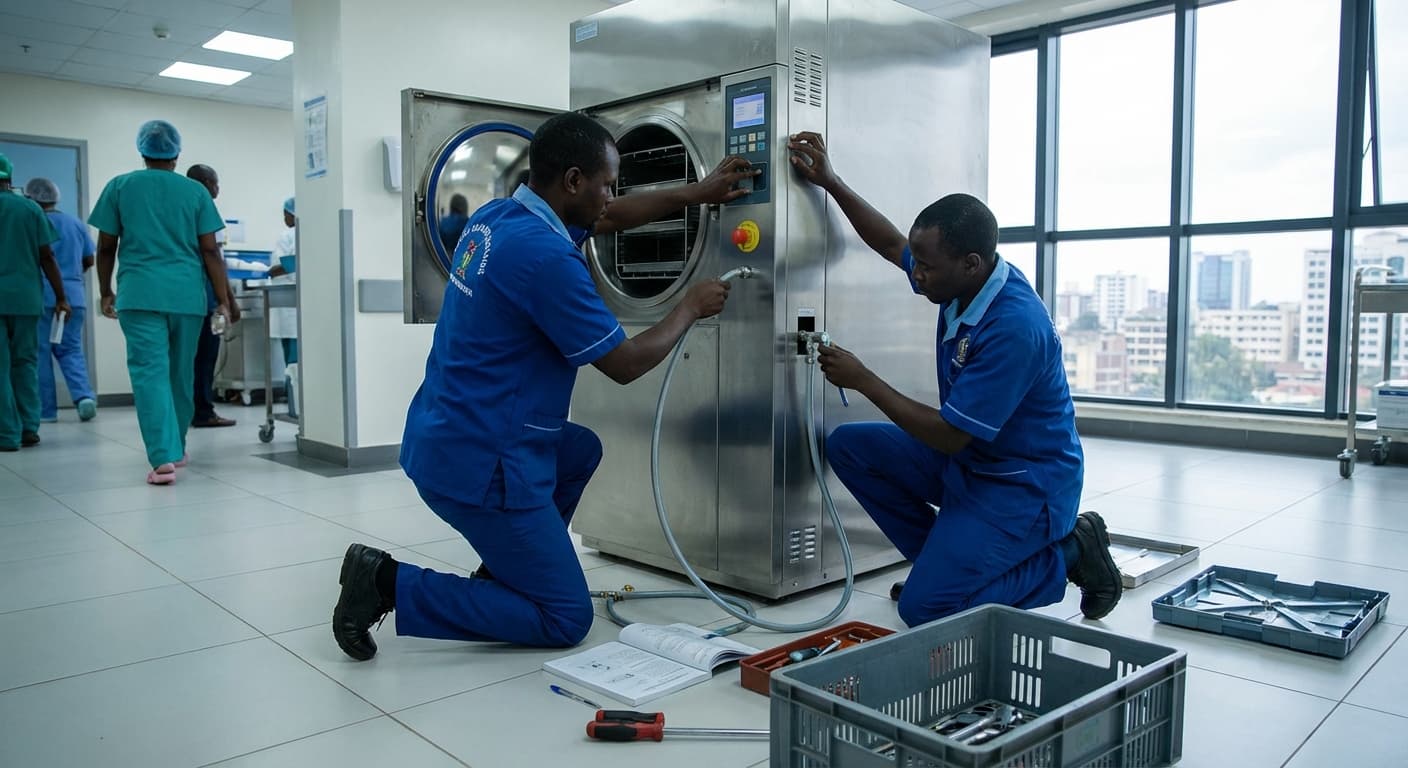
Autoclave & Sterilizer Installation Service in Nigeria
Engineering Excellence & Technical Support
Autoclave & Sterilizer Installation Service High-standard technical execution following OEM protocols and local regulatory frameworks.
Certified Autoclave & Sterilizer Technicians
Our installation team comprises highly trained and certified engineers with extensive expertise in handling a wide range of autoclave and sterilizer models. We adhere to international safety and performance standards, ensuring your equipment is installed correctly and efficiently, minimizing downtime and maximizing operational lifespan.
Comprehensive Site Assessment & Planning
Before installation, we conduct a thorough site assessment to evaluate your facility's infrastructure, power supply, ventilation, and space requirements. This meticulous planning ensures optimal placement, integration with existing systems, and compliance with all local building codes and safety regulations for a seamless and compliant installation.
Rigorous Validation & Performance Testing
Post-installation, we perform comprehensive validation and performance testing to confirm that your autoclave or sterilizer operates at peak efficiency and meets all sterilization efficacy requirements. This includes calibration checks, cycle verification, and documentation of results, providing you with absolute confidence in your equipment's reliability and safety.
What Is Autoclave & Sterilizer Installation Service In Nigeria?
Autoclave & Sterilizer Installation Service in Nigeria refers to the professional provision of services focused on the proper setup, configuration, and initial validation of autoclaves and other sterilization equipment within healthcare facilities, laboratories, and other regulated environments across Nigeria. This service ensures that the critical equipment, designed to eliminate or inactivate all forms of microbial life, including spores, is installed according to manufacturer specifications and relevant regulatory standards, guaranteeing its optimal performance and the safety of its operation. The service encompasses a range of technical activities, from site assessment and equipment positioning to electrical and plumbing connections, initial testing, and operator training. The primary objective is to achieve a validated sterile state for instruments and materials, thereby preventing the transmission of infections and ensuring the integrity of scientific and medical processes.
| Who Needs This Service? | Typical Use Cases |
|---|---|
| Hospitals & Clinics: Operating theatres, dental clinics, diagnostic laboratories, sterilization departments (CSSD/CSD). | Sterilization of surgical instruments, medical devices, laboratory glassware, and other reusable medical supplies. |
| Diagnostic & Research Laboratories: Microbiology labs, pathology labs, biotechnology facilities. | Sterilization of media, culture dishes, instruments, and waste materials to prevent cross-contamination and ensure experimental integrity. |
| Pharmaceutical & Biotechnology Companies: Quality control laboratories, manufacturing facilities. | Sterilization of equipment, packaging materials, and production components to meet stringent regulatory requirements for product safety and efficacy. |
| Veterinary Clinics & Animal Research Facilities: | Sterilization of surgical instruments and equipment for animal care. |
| Dialysis Centers: | Sterilization of dialyzers and associated equipment (though single-use is prevalent, reusable components may exist). |
| Any facility requiring validated microbial inactivation for reusable items or waste streams. | Sterilization of sharps, biological waste, and contaminated materials prior to disposal or further processing. |
Key Components of Autoclave & Sterilizer Installation Service
- Site Assessment & Planning: Evaluating the proposed installation location for adequacy of space, ventilation, power supply (voltage, amperage, dedicated circuits), water supply, drainage, and structural integrity to support the weight and operation of the sterilizer. Planning the optimal placement for workflow efficiency and accessibility.
- Unpacking & Positioning: Carefully removing the sterilizer from its packaging, inspecting for any transit damage, and precisely positioning it according to design schematics and safety clearances.
- Mechanical & Electrical Connections: Connecting the sterilizer to the facility's utility infrastructure. This includes secure electrical hookups to dedicated circuits, ensuring proper grounding, and in the case of steam autoclaves, connecting to steam supply lines, chilled water for condensation, and drain lines. For other sterilizer types (e.g., ETO, H2O2), this involves connections to gas supplies and ventilation systems.
- System Checks & Calibration: Performing initial power-on sequences, checking all mechanical components for smooth operation, and verifying critical parameters like temperature, pressure, and cycle times against manufacturer specifications. Calibration of sensors and control systems to ensure accuracy.
- Leak Testing & Performance Verification: Conducting tests to ensure the integrity of the sterilization chamber and associated piping, checking for leaks that could compromise the sterilization process or pose a safety hazard. Running initial test cycles to verify operational parameters.
- Validation & Documentation: Executing Installation Qualification (IQ) protocols to confirm that the equipment has been installed correctly according to the manufacturer's design and recommendations. Generating comprehensive installation reports and certificates.
- Operator Training: Providing fundamental training to the facility's personnel on the safe and correct operation of the newly installed sterilizer, including pre-use checks, routine maintenance procedures, understanding cycle parameters, and emergency protocols.
Who Needs Autoclave & Sterilizer Installation Service In Nigeria?
Autoclave and sterilizer installation services are critical for ensuring the safety, hygiene, and operational efficiency of a wide range of facilities in Nigeria. These specialized installations prevent the spread of infections, guarantee the integrity of scientific research, and maintain the highest standards in healthcare and other sensitive environments. The demand for these services stems from institutions that rely on sterile equipment for their core operations.
| Target Customer Type | Key Departments/Functions | Reason for Installation Service |
|---|---|---|
| Hospitals | Operating Theatres, Central Sterile Supply Department (CSSD), Dental Units, Laboratories | Ensuring surgical instruments and medical devices are sterile to prevent Healthcare-Associated Infections (HAIs). |
| Clinics (General & Specialist) | Treatment Rooms, Minor Procedure Areas, Laboratories | Maintaining hygiene standards for instruments and consumables used in patient care. |
| Diagnostic Laboratories | Microbiology, Pathology, Molecular Biology Labs | Sterilizing culture media, glassware, and tools to prevent contamination and ensure accurate diagnostic results. |
| Pharmaceutical Companies | Quality Control Labs, Manufacturing Units (Sterile Production) | Validating and installing sterilizers for product packaging, processing equipment, and laboratory supplies. |
| Research Institutes | Life Sciences Labs, Chemistry Labs, Biotechnology Labs | Providing sterile environments and equipment for experiments, preventing cross-contamination. |
| Dental Practices | Treatment Rooms, Sterilization Areas | Ensuring all instruments and materials coming into contact with patients are free from pathogens. |
| Veterinary Hospitals | Operating Rooms, Treatment Areas, Labs | Maintaining sterile conditions for surgical procedures and diagnostics on animals. |
| Tertiary Institutions (Universities/Colleges) | Science & Medical Faculties, Research Labs | Equipping laboratories for practical training and research activities in various scientific disciplines. |
Target Customers and Departments Requiring Autoclave & Sterilizer Installation Services in Nigeria
- {"title":"Healthcare Facilities","description":"The backbone of sterile equipment needs. Hospitals, clinics, and dental practices depend heavily on autoclaves and sterilizers for surgical instruments, medical devices, and laboratory equipment."}
- {"title":"Research and Development Laboratories","description":"Universities, private research institutions, and R&D departments within companies require sterilized consumables and equipment for accurate and reliable experimental results."}
- {"title":"Pharmaceutical Manufacturing","description":"Companies involved in drug production must adhere to strict sterile manufacturing processes, necessitating the use of properly installed and validated sterilization equipment."}
- {"title":"Food and Beverage Industry (Specific Applications)","description":"While not as universal as healthcare, certain food processing facilities that require high-level sterilization for packaging materials or specific ingredients will need these services."}
- {"title":"Veterinary Clinics and Animal Hospitals","description":"Similar to human healthcare, veterinary practices require sterile surgical instruments and equipment for animal care."}
- {"title":"Beauty and Tattoo Parlors (High-End)","description":"Reputable establishments prioritizing client safety and hygiene may invest in professional sterilization equipment for tools and implements."}
- {"title":"Educational Institutions (Science Departments)","description":"Universities and colleges with biology, chemistry, and medical science departments often have laboratories that require autoclaves for student practicals and research."}
Autoclave & Sterilizer Installation Service Process In Nigeria
This document outlines the comprehensive workflow for Autoclave and Sterilizer Installation Services in Nigeria, covering the entire process from initial customer inquiry to successful execution and post-installation support. We aim to provide a clear, efficient, and transparent service, ensuring your critical sterilization equipment is installed and operational to the highest standards.
| Stage | Key Activities | Responsible Party | Deliverables/Outcomes | Notes |
|---|---|---|---|---|
| 1. Inquiry & Initial Consultation | Customer expresses interest in autoclave/sterilizer installation. Initial discussion to understand needs, equipment type, intended use, and location. Information gathering on existing infrastructure (power, water, ventilation). | Customer, Service Provider Sales/Technical Team | Understanding of customer requirements, preliminary project scope, and initial advice. | This stage can be conducted via phone, email, or video call. |
| 2. Site Assessment & Quotation | A qualified technician visits the installation site to conduct a thorough assessment. This includes verifying power supply, water availability, drainage, ventilation, and physical space. A detailed technical proposal and quotation are prepared based on the assessment and customer requirements. | Service Provider Technical Team, Customer | Detailed site assessment report, comprehensive quotation including equipment, labor, materials, and any necessary modifications. | Accurate site assessment is crucial for a smooth installation and to avoid unexpected costs. |
| 3. Order Confirmation & Scheduling | Customer reviews and accepts the quotation. Formal order is placed. Installation date and time are mutually agreed upon and scheduled. Logistics for equipment delivery (if applicable) are arranged. | Customer, Service Provider Operations/Sales Team | Confirmed order, signed contract/agreement, scheduled installation date. | Clear communication on lead times for equipment and scheduling availability is important. |
| 4. Pre-Installation Preparation | Service provider prepares all necessary tools, equipment, and materials. If applicable, the autoclave/sterilizer is delivered to the site. Any necessary preparatory work on the site (e.g., minor electrical or plumbing adjustments) is completed. | Service Provider Technical Team, Logistics | All required tools and materials on-site, equipment delivered and ready, site prepared for installation. | Customer should ensure the designated installation area is accessible and clear. |
| 5. On-Site Installation & Commissioning | Certified technicians install the autoclave/sterilizer according to manufacturer specifications and relevant safety standards. This includes plumbing, electrical connections, and any necessary structural modifications. Rigorous testing and calibration (commissioning) are performed to ensure optimal performance and safety. | Service Provider Certified Technicians | Fully installed and operational autoclave/sterilizer, successful commissioning report, calibration certificates. | Adherence to Nigerian safety regulations and building codes is paramount. |
| 6. Training & Handover | Comprehensive training is provided to the designated personnel on the operation, basic maintenance, and safety procedures of the installed autoclave/sterilizer. All relevant documentation (manuals, warranty information) is handed over to the customer. | Service Provider Certified Technicians/Trainers, Customer Staff | Trained personnel, handover of all relevant documentation, signed acceptance of work. | Adequate training is vital for the longevity and safe operation of the equipment. |
| 7. Post-Installation Support & Warranty | Ongoing support is available for troubleshooting and technical assistance. The warranty period commences, covering potential defects or issues. Preventative maintenance plans can be discussed and implemented. | Service Provider Technical Support & Maintenance Team, Customer | Ongoing support, warranty coverage, potential service agreements. | Proactive maintenance can significantly reduce downtime and extend equipment life. |
Autoclave & Sterilizer Installation Service Process in Nigeria
- 1. Inquiry & Initial Consultation:
- 2. Site Assessment & Quotation:
- 3. Order Confirmation & Scheduling:
- 4. Pre-Installation Preparation:
- 5. On-Site Installation & Commissioning:
- 6. Training & Handover:
- 7. Post-Installation Support & Warranty:
Autoclave & Sterilizer Installation Service Cost In Nigeria
Installing an autoclave or sterilizer in Nigeria involves several factors that influence the overall cost. These specialized pieces of equipment require professional installation to ensure safety, functionality, and compliance with health regulations. The price can vary significantly based on the type of unit, its size and complexity, the location of installation, and the service provider's expertise. Additional services like initial setup, testing, and user training also contribute to the final bill. It's crucial to obtain detailed quotes from reputable service providers to get an accurate estimate for your specific needs.
| Service Type/Component | Estimated Price Range (NGN - Nigerian Naira) | Notes |
|---|---|---|
| Basic Autoclave/Sterilizer Installation (Small Units) | 50,000 - 150,000 | Includes basic mounting, electrical connection, and initial testing for smaller benchtop models. |
| Medium to Large Autoclave/Sterilizer Installation | 150,000 - 500,000+ | For larger units requiring more complex electrical, plumbing, and potentially structural adjustments. |
| Complex Installations (Industrial/Hospital Grade) | 500,000 - 1,500,000+ | Involves extensive modifications, specialized ventilation, integration with existing systems, and significant safety protocols. |
| Plumbing Modifications/Upgrades | 20,000 - 100,000+ | Dependent on the extent of work needed for water supply and drainage. |
| Electrical Modifications/Upgrades | 30,000 - 150,000+ | If the existing power supply is insufficient or requires dedicated circuits. |
| Ventilation/Exhaust System Installation | 50,000 - 300,000+ | Crucial for certain sterilizer types to dissipate heat and steam safely. |
| Testing, Calibration & Certification | 20,000 - 80,000 | Ensuring the unit operates within specified parameters for effective sterilization. |
| User Training | 15,000 - 50,000 | Hands-on training for staff on operation and basic maintenance. |
| Site Survey & Consultation | 10,000 - 30,000 | Often waived or deducted from the final installation cost if service is booked. |
Key Pricing Factors for Autoclave & Sterilizer Installation Services in Nigeria:
- Type of Sterilization Equipment (Autoclave, Dry Heat Sterilizer, etc.)
- Capacity and Size of the Unit (Small benchtop vs. large industrial units)
- Complexity of Installation (e.g., plumbing, electrical modifications, ventilation requirements)
- Location of Installation (Accessibility, distance from service provider's base)
- Site Preparation Requirements (e.g., need for dedicated space, reinforced flooring)
- Electrical and Plumbing Requirements (Upgrades or new installations)
- Ventilation and Exhaust Systems
- Testing and Calibration Services
- User Training and Demonstration
- Warranty and After-Sales Support
- Service Provider's Reputation and Experience
- Urgency of Installation
Affordable Autoclave & Sterilizer Installation Service Options
Finding reliable and affordable autoclave and sterilizer installation services is crucial for maintaining a sterile environment in medical, dental, and laboratory settings. This guide explores various service options, highlighting the value of bundled services and effective cost-saving strategies to ensure you get the best return on your investment.
| Cost-Saving Strategy | Description | Potential Benefit |
|---|---|---|
| Bundle Installation with Equipment Purchase | Many manufacturers and suppliers offer discounted or included installation when you purchase your autoclave or sterilizer from them. | Reduces overall acquisition cost, simplifies logistics. |
| Negotiate Value-Added Services | Instead of paying extra for every small service, negotiate for included benefits like extended warranty, free initial training, or expedited service calls. | Increases perceived value, prevents unexpected charges. |
| Compare Multiple Quotes | Obtain detailed quotes from at least three reputable installation service providers. Compare not just the price, but the scope of work and included services. | Ensures competitive pricing, prevents overpaying. |
| Consider Off-Peak Scheduling | If your facility allows, scheduling installation during slower periods might result in lower labor rates or more flexible technician availability. | Potentially lower labor costs, easier scheduling. |
| Inquire About Package Deals | Ask about bundled packages that combine installation, initial maintenance, and validation services. These are often more cost-effective than purchasing services individually. | Significant savings on combined services. |
| DIY Basic Preparations (if feasible) | In some cases, you might be able to perform simple site preparations (clearing space, ensuring access) yourself, reducing the service provider's labor time. Consult with the provider first. | Reduced on-site labor time, potential cost savings. |
| Leverage Existing Maintenance Contracts | If you have an ongoing maintenance contract with a provider, inquire if installation services are offered at a reduced rate or as part of an upgrade package. | Discounted installation for loyal customers. |
Understanding Autoclave & Sterilizer Installation Services
- Basic Installation: This typically includes the physical setup of the autoclave or sterilizer, connecting it to necessary utilities (water, power, drainage), and initial functional testing.
- Standard Installation: Builds upon basic installation by adding calibration services, initial user training on operation and basic maintenance, and a post-installation inspection.
- Comprehensive Installation: Encompasses standard installation features plus advanced training, integration with existing facility systems (e.g., ventilation, data logging), and a more thorough validation process to meet specific regulatory requirements.
- Maintenance Contracts: Often offered alongside installation, these provide scheduled preventative maintenance, emergency repair services, and sometimes replacement parts, ensuring long-term operational efficiency and minimizing downtime.
- Decommissioning & Relocation: Services to safely remove an old unit and install a new one, or to move an existing unit to a new location within or between facilities. This can be bundled with new unit installation.
- Validation & Certification: Essential for many regulated industries, these services ensure the sterilizer meets required performance standards and can be documented for compliance purposes. Often offered as a separate or bundled service.
Verified Providers In Nigeria
Navigating the healthcare landscape in Nigeria can be a daunting task. Ensuring you receive quality care from trustworthy professionals is paramount. This is where the concept of 'Verified Providers' becomes crucial. Verified Providers have undergone rigorous checks and met specific standards, offering a higher degree of assurance to patients. Among these, Franance Health stands out, embodying the core principles of reliability, expertise, and patient-centricity.
| Provider Type | Franance Health Verification Focus | Key Benefit for Patients |
|---|---|---|
| General Practitioners | Valid medical license, proven experience, adherence to ethical guidelines. | Reliable first point of contact for common health issues, comprehensive health assessments. |
| Specialist Physicians (e.g., Cardiologists, Dermatologists) | Board certification, specialized training, published research (where applicable), patient feedback. | Access to expert diagnosis and treatment for complex medical conditions. |
| Surgeons | Surgical board certification, extensive surgical experience, low complication rates, strong peer reviews. | Safe and effective surgical interventions with a focus on recovery. |
| Dentists | Dental council registration, specialization in areas like orthodontics or periodontics, patient satisfaction with cosmetic and restorative treatments. | Comprehensive oral health care, from routine check-ups to advanced dental procedures. |
| Diagnostic Centers | Accreditation by relevant health bodies, quality control measures for equipment and procedures, qualified technicians and radiologists. | Accurate and timely diagnostic results crucial for effective treatment planning. |
Why Franance Health is a Top Choice for Verified Providers in Nigeria:
- Rigorous Credentialing Process: Franance Health employs a multi-layered vetting system that goes beyond basic licensing. This includes verification of educational qualifications, professional experience, ethical conduct, and continuous professional development.
- Commitment to Quality Care: The organization prioritizes patient outcomes and satisfaction. They partner with healthcare professionals who demonstrate a consistent track record of delivering excellent medical services.
- Specialized Expertise: Franance Health actively seeks out and partners with providers who possess specialized knowledge and skills in various medical fields, ensuring patients have access to the right expertise for their needs.
- Patient-Centric Approach: Their network is built on a foundation of empathy and understanding. Verified providers associated with Franance Health are committed to clear communication, patient education, and personalized treatment plans.
- Transparency and Accountability: Franance Health maintains a transparent system, allowing patients to access information about their providers' credentials and ensuring a high level of accountability within their network.
- Access to Advanced Facilities: Where applicable, Franance Health aims to connect patients with verified providers who utilize modern diagnostic and treatment facilities, contributing to more effective healthcare delivery.
Scope Of Work For Autoclave & Sterilizer Installation Service
This Scope of Work (SOW) outlines the requirements for the installation services of an Autoclave and Sterilizer. It defines the technical deliverables, standard specifications, and responsibilities of the service provider and the client to ensure successful and compliant installation. The objective is to deliver a fully functional and calibrated sterilization unit ready for operation.
| Task Description | Deliverable | Standard Specification / Requirement | Client Responsibility | Service Provider Responsibility |
|---|---|---|---|---|
| Site Preparation and Assessment | Pre-installation site report | Adequate space, power, water supply, drainage, ventilation, and structural support identified. Compliance with manufacturer's site requirements and local building codes. | Provide access to the installation site. | Conduct a pre-installation site assessment and provide a report on readiness or required modifications. |
| Unpacking and Inspection | Inventory and damage report | Unit free from visible damage. All accessories and components present as per packing list. | Be present during unpacking if possible. | Carefully unpack the unit, inspect for any shipping damage, and verify all components against the packing list. |
| Unit Positioning and Leveling | Positioned and leveled unit | Unit placed in the designated location and precisely leveled to prevent operational issues and ensure stability. | Provide the exact placement location. | Physically move and position the unit, ensuring it is stable and properly leveled. |
| Electrical Connections | Tested electrical connection | Connection to power source compliant with manufacturer's voltage, amperage, and wiring requirements. Use of appropriate circuit breakers and grounding. | Ensure a dedicated and correctly rated electrical outlet/connection is available near the installation site. | Connect the unit to the electrical supply, ensuring safety and compliance with electrical codes. |
| Water Supply and Drainage Connections | Tested water and drain lines | Connections to potable water supply and suitable drainage system. Use of approved piping materials and leak-free joints. Flow rates and pressure within manufacturer's specifications. | Ensure availability of potable water supply and a properly trapped and vented drainage point. | Connect water inlet and drain lines, ensuring no leaks and compliance with plumbing codes. |
| Steam/Gas Connections (if applicable) | Tested steam/gas lines | Connection to steam generator or gas supply (e.g., ethylene oxide) with appropriate regulators, safety valves, and pressure ratings. Leak-free and compliant with relevant safety standards. | Ensure availability and proper functioning of steam generator or gas supply. | Connect steam or gas lines, ensuring all safety features and pressure requirements are met. |
| Ventilation and Exhaust (if applicable) | Functional ventilation system | Proper connection to an exhaust system to safely vent steam, fumes, or gases generated during operation. Compliance with environmental and safety regulations. | Ensure a suitable location for exhaust ducting and access to the outside or designated exhaust area. | Connect and test the unit's ventilation/exhaust system. |
| Initial Power-On and System Checks | Successful power-on report | Unit powers on without error messages. Basic system functions (e.g., door interlock, basic controls) operate as expected. | Provide power to the designated connection point. | Perform initial power-on and verify fundamental system responses. |
| Operational Testing and Cycle Simulation | Test cycle report | Run at least one complete sterilization cycle (or simulation thereof) using appropriate test parameters. Verify temperature, pressure, and time accuracy. | Provide necessary consumables for testing (e.g., distilled water, test packs if required). | Conduct operational tests, including a full cycle simulation, to verify performance against specifications. |
| Calibration and Verification | Calibration certificate | If specified, perform calibration of critical parameters (temperature, pressure) using traceable calibration equipment. Verification of sensor accuracy. | Provide access to existing calibration equipment if available and agreed upon. | Perform calibration and provide a certificate of calibration for key parameters. |
| Safety Feature Testing | Safety feature test report | Test all safety interlocks, pressure relief valves, emergency stops, and alarms to ensure proper functionality. | Be available to witness safety feature tests. | Systematically test all safety features to confirm their operational readiness. |
| User Training | Training session completion record | Provide comprehensive training to designated client personnel covering basic operation, loading procedures, cycle selection, troubleshooting, and routine cleaning/maintenance. | Designate personnel for training and ensure their attendance. | Deliver a hands-on training session tailored to the specific unit and client needs. |
| Documentation and Handover | Installed unit documentation package | Provide all relevant manuals (operation, maintenance, installation), warranty information, test reports, and calibration certificates. Formal handover of the operational unit. | Sign off on the completion of the installation and handover documentation. | Compile and deliver all required documentation. Conduct a formal handover of the fully installed and tested unit. |
Key Objectives
- Ensure safe and proper installation of the Autoclave/Sterilizer unit.
- Verify all connections (electrical, water, drain, steam/gas if applicable) are made according to manufacturer specifications and local codes.
- Perform initial testing and calibration to confirm operational readiness.
- Provide training to designated client personnel on the operation and basic maintenance.
- Ensure all safety features are functional and meet regulatory standards.
Service Level Agreement For Autoclave & Sterilizer Installation Service
This Service Level Agreement (SLA) outlines the response times and uptime guarantees for the Autoclave & Sterilizer Installation Service provided by [Your Company Name]. This SLA aims to ensure the timely and efficient installation of your autoclaves and sterilizers, minimizing disruption to your operations.
| Service | Response Time (for critical issues) | Uptime Guarantee |
|---|---|---|
| Autoclave & Sterilizer Installation & Initial Testing | Within 4 business hours of issue report | N/A (Installation is a one-time service. Issues during installation are addressed under response times.) |
| Emergency Support During Installation | Within 2 business hours of issue report | N/A |
| Post-Installation Technical Support (within warranty period) | Within 8 business hours of issue report | 99.5% uptime for the installed equipment (dependent on equipment manufacturer's warranty and terms) |
Scope of Service
- On-site installation of new autoclaves and sterilizers.
- Integration with existing facility infrastructure (e.g., plumbing, electrical, ventilation).
- Initial testing and calibration.
- Basic operational training for designated personnel.
- Troubleshooting during the installation phase.
Frequently Asked Questions

Ready when you are
Let's scope your Autoclave & Sterilizer Installation Service in Nigeria project in Nigeria.

Scaling healthcare logistics and technical systems across the entire continent.