
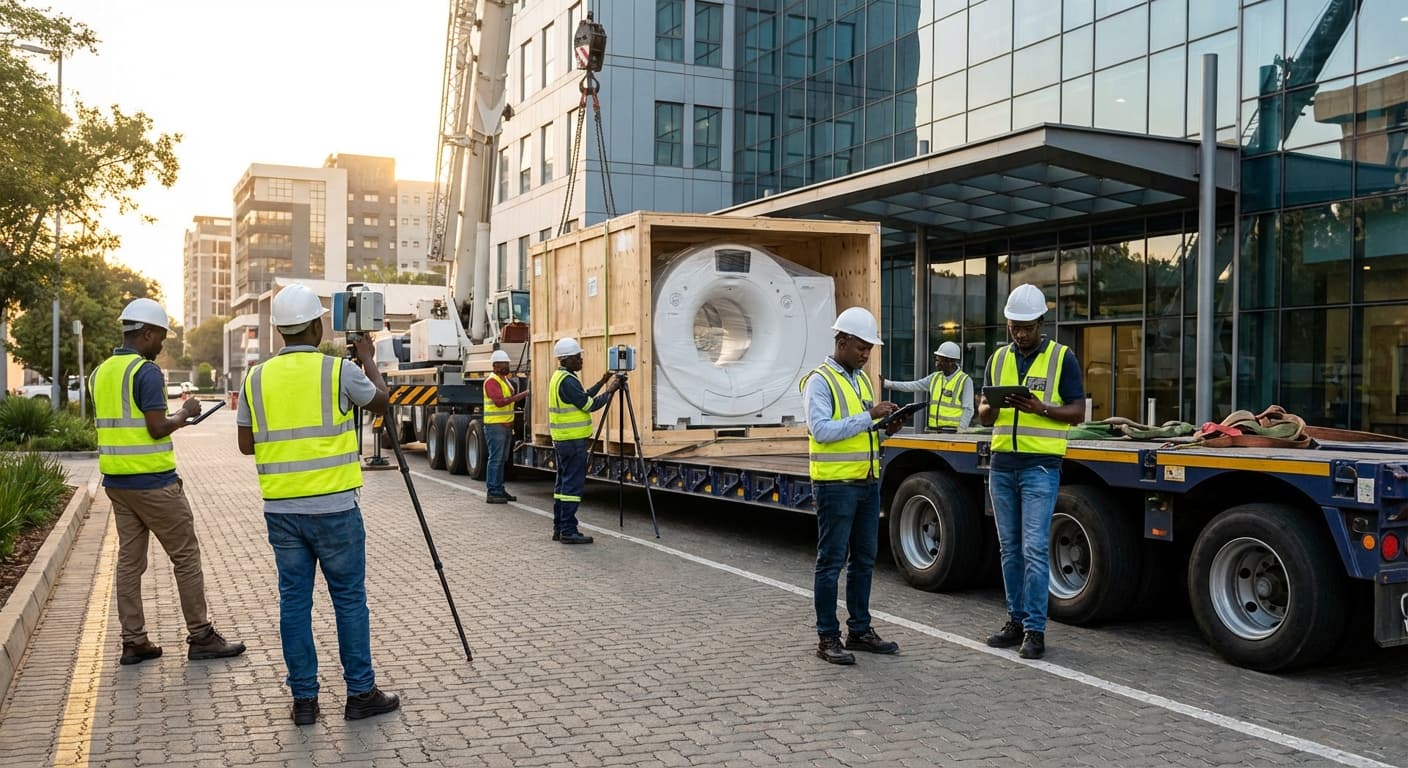
Route Survey & Rigging Plan Service for Heavy Medical Equipment in Nigeria
Engineering Excellence & Technical Support
Route Survey & Rigging Plan Service for Heavy Medical Equipment High-standard technical execution following OEM protocols and local regulatory frameworks.
Precision Route Planning & Obstacle Mitigation
Leveraging advanced GIS and 3D modeling, we meticulously map and analyze transport routes across Nigeria's diverse terrains. Our service identifies and plans for all potential obstacles, including low bridges, tight turns, utility lines, and challenging road conditions, ensuring the safest and most efficient path for your heavy medical equipment.
Engineered Lifting & Rigging Solutions
Our specialized rigging plans are developed by certified engineers, considering the precise weight, dimensions, and center of gravity of your medical equipment. We specify the optimal lifting equipment, rigging gear, and handling procedures to guarantee secure and stable transport from origin to final installation, mitigating all risks of damage or personnel injury.
Integrated Logistics & Permitting Coordination
We manage the entire logistical chain, including securing all necessary permits and approvals from relevant Nigerian authorities for oversize and overweight transport. Our service ensures seamless coordination between transport, rigging, site preparation, and installation teams, providing a comprehensive and compliant solution for your critical medical equipment deployment.
What Is Route Survey & Rigging Plan Service For Heavy Medical Equipment In Nigeria?
Route Survey & Rigging Plan Service for Heavy Medical Equipment in Nigeria refers to a specialized logistical and engineering undertaking focused on the safe and efficient transportation and installation of oversized, high-value, and often sensitive medical apparatus within Nigeria. This service integrates detailed route analysis with meticulous rigging and lifting strategies to mitigate risks inherent in navigating complex urban and rural infrastructure, and to ensure the structural integrity of both the equipment and its final installation environment. The objective is to provide a comprehensive, end-to-end solution for the movement and placement of critical healthcare technology, from point of entry or origin to its operational site.
| Who Needs This Service? | Typical Use Cases | |||||
|---|---|---|---|---|---|---|
| Hospitals and Healthcare Facilities (Public and Private): Procurement of new imaging systems (MRI, CT scanners), radiotherapy units, large-scale laboratory equipment, surgical robots, and modular operating theaters. | Installation of large-scale diagnostic imaging equipment (e.g., MRI suites, CT scanners) in new hospital wings or retrofitted spaces. | Relocation of heavy medical machinery within a facility or between campuses. | Transport and installation of specialized patient care equipment such as linear accelerators for oncology treatment. | Delivery and commissioning of advanced surgical suites and robotic surgery systems. | Deployment of diagnostic and therapeutic equipment in remote or underserved regions of Nigeria. | Emergency replacement or upgrade of critical medical infrastructure. |
| Medical Equipment Manufacturers and Distributors: Companies involved in the sale, import, and installation of sophisticated medical technology in Nigeria. | Project Management Firms: Overseeing the construction or renovation of healthcare infrastructure and requiring the integration of heavy medical equipment. | |||||
| Government Health Agencies: Implementing national healthcare initiatives that involve the deployment of advanced medical devices across the country. | Non-Governmental Organizations (NGOs) and Charities: Establishing or upgrading medical facilities, often in resource-constrained environments. |
Key Components of the Service:
- Route Reconnaissance and Assessment: Involves detailed site visits and data collection to identify optimal transportation pathways, considering factors such as road width, height restrictions (bridges, overpasses, utility lines), weight limits, turning radii, gradient, surface conditions, traffic patterns, and potential obstructions. This phase also includes obtaining necessary permits and coordinating with local authorities.
- Risk Analysis and Mitigation: A thorough assessment of potential hazards along the chosen route and at the destination, including but not limited to, structural integrity of roads and bridges, environmental conditions (weather), security concerns, and site-specific access limitations. Mitigation strategies are developed to address identified risks.
- Rigging and Lifting Plan Development: Engineering design and procedural planning for the lifting, securing, and maneuvering of the heavy medical equipment. This includes specifying the appropriate lifting equipment (cranes, gantries, forklifts), rigging gear (slings, shackles, spreader bars), load balancing calculations, and detailed step-by-step procedures for each phase of the lifting and placement operation.
- Transportation Logistics Management: Coordination of specialized transport vehicles (low-loaders, multi-axle trailers), escort vehicles, and pilot cars. This includes scheduling, route optimization for the convoy, and real-time tracking during transit.
- Site Preparation and Access: Ensuring the destination site is prepared for the equipment's arrival, including clearance of access routes, reinforcement of flooring or structural supports if necessary, and provision of a stable and secure staging area.
- Equipment Installation and Positioning: The actual execution of the rigging and lifting plan to precisely position the medical equipment in its designated operational location, adhering to manufacturer specifications and any site-specific constraints.
- De-rigging and Site Restoration: The safe dismantling of rigging equipment and, where applicable, the restoration of the site to its original condition.
- Documentation and Compliance: Comprehensive record-keeping of all surveys, plans, permits, and execution logs, ensuring compliance with relevant safety standards and regulations.
Who Needs Route Survey & Rigging Plan Service For Heavy Medical Equipment In Nigeria?
In Nigeria, the successful and safe transportation and installation of heavy medical equipment, from MRI scanners and CTs to large-scale laboratory analyzers and surgical robots, is a complex undertaking. This is where specialized Route Survey & Rigging Plan Services become indispensable. These services ensure that the entire process, from identifying the best transport path to the precise lifting and placement of the equipment, is meticulously planned and executed. This minimizes risks of damage, delays, and safety hazards, ultimately protecting significant investments and ensuring patient care continuity.
| Target Customer/Department | Specific Needs and Responsibilities | Why Route Survey & Rigging Plan is Crucial |
|---|---|---|
| Hospitals (Public & Private) | Procurement, Biomedical Engineering, Facilities Management, Clinical Departments (Radiology, Surgery, etc.) | Ensuring uninterrupted patient services, protecting high-value assets, preventing structural damage during installation, meeting regulatory compliance. |
| Diagnostic Centers & Laboratories | Operations Management, Technical Teams, Procurement | Minimizing downtime for critical diagnostic services, safeguarding sensitive equipment, efficient space utilization. |
| Medical Equipment Suppliers & Distributors | Logistics, Project Management, Installation & Commissioning Teams | Fulfilling contractual obligations, minimizing liability for transit damage, ensuring timely and safe delivery and setup, maintaining client satisfaction. |
| Construction Companies (Healthcare Projects) | Project Management, Site Management, Health & Safety Officers | Integrating equipment installation into construction timelines, ensuring building infrastructure can support the weight and access requirements, preventing delays to project completion. |
| Government Health Agencies & Ministries | Procurement, Project Implementation, Infrastructure Development | Ensuring efficient allocation of public funds, facilitating the rollout of advanced medical technology to underserved areas, upholding public health standards. |
| International Aid Organizations & NGOs | Program Management, Logistics, Procurement | Maximizing the impact of donated equipment, ensuring successful deployment in challenging environments, efficient utilization of donor funds. |
Who Needs Route Survey & Rigging Plan Service for Heavy Medical Equipment in Nigeria?
- Hospitals (Public and Private)
- Diagnostic Centers and Laboratories
- Medical Equipment Suppliers and Distributors
- Construction Companies undertaking healthcare facility projects
- Government Health Agencies and Ministries
- International Aid Organizations and NGOs
Route Survey & Rigging Plan Service For Heavy Medical Equipment Process In Nigeria
This document outlines the comprehensive workflow for our Route Survey & Rigging Plan Service for the process of transporting and installing heavy medical equipment in Nigeria. Our service is designed to ensure a safe, efficient, and compliant installation, minimizing risks and disruptions. The process begins with an initial inquiry and culminates in the successful execution of the rigging and installation plan.
| Stage | Key Activities | Deliverables | Client Involvement | Timeline Estimate |
|---|---|---|---|---|
| Client expresses interest in services. Discussion of project scope, equipment details (weight, dimensions, sensitivity), site location(s) in Nigeria, and desired timeline. Initial risk assessment. | Understanding of project requirements, preliminary scope definition. | Provide project details, discuss needs and expectations. | 1-2 Business Days |
| Detailed collection of equipment specifications, manufacturer's installation guidelines, site blueprints, building access points, internal layout, power requirements, and potential obstacles. On-site pre-assessment (if feasible/required). | Comprehensive equipment and site data compilation. | Provide all relevant technical documentation and site access. | 2-5 Business Days |
| Physical survey of proposed transport routes: road conditions, bridge load capacities, overhead clearances (power lines, trees), turning radii, road width restrictions, traffic patterns, and potential environmental factors. Assessment of site access and internal movement paths. | Detailed route map with identified hazards and mitigation strategies, site access feasibility report. | Grant site access, provide local contact person for survey team. | 3-7 Business Days (depending on route complexity and number of sites) |
| Creation of a detailed rigging plan including: lifting points, crane selection (type, capacity, reach), lifting gear (slings, shackles, spreaders), rigging sequence, safety protocols, personnel roles and responsibilities, emergency procedures, and a comprehensive risk management plan. | Comprehensive Rigging & Installation Plan document, including CAD drawings, equipment specifications, and safety checklists. | Review preliminary plan for understanding and feasibility. | 5-10 Business Days |
| Presentation of the developed route survey findings and rigging plan to the client. Discussion of any concerns, adjustments, and finalization of the plan. Client formal approval of the plan. | Approved Rigging & Installation Plan. | Thorough review and formal sign-off on the plan. | 2-3 Business Days |
| Securing necessary permits for road closures, escorts, or specialized transport from relevant Nigerian authorities. Coordination of all logistics, including transportation, crane mobilization, and personnel scheduling. | All required permits and confirmed logistics schedule. | Assist in identifying local contacts for permit acquisition, provide necessary information for applications. | Varies significantly based on permit requirements (can be weeks to months) |
| Deployment of trained rigging crew and necessary equipment. Strict adherence to the approved rigging plan and safety protocols. Safe lifting, maneuvering, and positioning of the heavy medical equipment at its final location. Installation according to manufacturer's specifications. | Successful and safe rigging and installation of the medical equipment. | On-site presence for oversight and decision-making (if required), immediate communication of any issues. | 1-3 Days (per equipment piece/major phase) |
| Final inspection of the installed equipment. Documentation of the installation process, including photos and reports. Client sign-off on the completed service. Debrief and lessons learned. | Installation completion report, photos, client sign-off documentation. | Final inspection, sign-off on completed work. | 1-2 Business Days |
Service Workflow Stages
- Inquiry & Initial Consultation
- Information Gathering & Site Assessment
- Route Survey & Analysis
- Rigging Plan Development
- Client Review & Approval
- Permitting & Logistics Coordination
- Execution: Rigging & Installation
- Post-Installation & Handover
Route Survey & Rigging Plan Service For Heavy Medical Equipment Cost In Nigeria
Estimating the cost for route survey and rigging plan services for heavy medical equipment in Nigeria involves a complex interplay of factors. These services are crucial for ensuring the safe and efficient transportation and installation of sensitive, high-value equipment. The pricing is not standardized and will vary significantly based on the specifics of the project. Key determinants include the weight and dimensions of the equipment, the complexity of the route, accessibility challenges, required specialized equipment, the level of risk involved, and the expertise of the service provider.
| Service Component | Estimated Cost Range (NGN - Nigerian Naira) | Notes |
|---|---|---|
| Initial Route Assessment & Feasibility Study | ₦150,000 - ₦500,000+ | Covers preliminary evaluation of route options, identification of potential challenges, and initial recommendations. |
| Detailed Route Survey & Mapping | ₦300,000 - ₦1,500,000+ | Involves detailed measurements, photographic documentation, identification of critical points, and creation of detailed route maps. Price increases with distance and complexity. |
| Rigging Plan Development (including CAD drawings & risk assessment) | ₦400,000 - ₦2,000,000+ | This is highly dependent on the equipment's complexity, weight, and the technical requirements of the rigging. Includes structural analysis and safety protocols. |
| Site Inspection & Preparation Recommendations | ₦100,000 - ₦400,000 | Assessing loading/unloading points, identifying required modifications (e.g., reinforcement of floorings, temporary ramps). |
| Coordination with Authorities & Permit Acquisition | ₦200,000 - ₦1,000,000+ | Cost of application fees, facilitation, and potential delays in obtaining necessary permits for oversized loads, road closures etc. |
| Contingency Planning & Emergency Response Plan | ₦50,000 - ₦250,000 | Developing protocols for unforeseen events during the survey or rigging process. |
| Comprehensive Service Package (Route Survey + Rigging Plan + Site Prep + Permits) | ₦1,000,000 - ₦7,000,000+ | A bundled offering that provides a more complete solution. The upper limit can be significantly higher for extremely large or complex projects. |
Key Pricing Factors for Route Survey & Rigging Plan Services in Nigeria:
- Equipment Characteristics: Weight, dimensions, fragility, and any specific handling requirements.
- Route Complexity: Urban vs. rural, road conditions, traffic congestion, presence of obstacles (bridges, power lines, narrow streets).
- Accessibility: Ease of access to the loading and unloading points, need for temporary road modifications or closures.
- Specialized Equipment: Requirements for cranes, heavy-duty trucks, specialized lifting gear, and skilled operators.
- Risk Assessment & Insurance: Level of risk associated with the transport and rigging, impacting insurance premiums.
- Labor & Expertise: Number of personnel required, their skill level (certified riggers, engineers), and duration of the job.
- Permits & Approvals: Costs associated with obtaining necessary permits from local authorities for oversized loads and road closures.
- Site Survey Scope: Extent of the route survey (distance, number of checkpoints) and the detail required in the rigging plan.
- Urgency & Timeline: Rush jobs may incur premium charges.
- Provider Reputation & Experience: Established and highly reputable companies often command higher fees.
Affordable Route Survey & Rigging Plan Service For Heavy Medical Equipment Options
Navigating the complexities of transporting and installing heavy medical equipment requires meticulous planning and execution. Our Affordable Route Survey & Rigging Plan Service is designed to provide you with comprehensive, cost-effective solutions. We understand the critical nature of medical equipment and the potential disruptions caused by logistical missteps. Our service focuses on ensuring a smooth, safe, and budget-friendly process from origin to final placement. We achieve this through detailed route analysis, expert rigging assessments, and strategic planning to minimize risks and avoid costly delays or damages.
| Value Bundle | Description | Cost-Saving Strategies Employed | Ideal For |
|---|---|---|---|
| Essential Route & Rigging Plan | Covers a single, straightforward move of one piece of heavy medical equipment. Includes a primary route assessment and a standard rigging plan. | Optimization of standard equipment, streamlined process, identification of obvious logistical challenges. | Single, less complex equipment moves, smaller clinics, or basic installations. |
| Comprehensive Move Management Bundle | Includes detailed route surveys for multiple potential paths, advanced rigging assessments considering various environmental factors, and a detailed step-by-step execution plan. | Proactive identification of costliest risks, efficient resource allocation, pre-negotiated vendor rates (if applicable), avoidance of specialized permits where possible. | Multiple equipment transports, large hospital systems, or complex multi-stage installations. |
| Emergency/Expedited Service Bundle | Prioritized route surveys and rigging plan development for urgent equipment relocations or installations. Includes 24/7 consultation. | Leveraging existing data, rapid assessment, flexible resource deployment, minimizing delay-related costs. | Urgent equipment replacements, unexpected facility changes, or time-sensitive projects. |
| Site-Specific Installation Planning | Focuses on the final placement and installation of equipment within a specific medical facility, including access points, floor load capacity analysis, and final rigging for positioning. | Optimizing internal workflows, precise equipment specification to avoid over-engineering, integration with existing facility infrastructure. | New equipment installations or relocations within existing facilities where precise placement is critical. |
Key Service Components and Value Proposition
- Comprehensive Route Surveys: We meticulously analyze potential transport routes, identifying any obstacles, restrictions (e.g., bridge heights, weight limits, narrow streets), and traffic patterns that could impact delivery timelines or require special permits. This proactive approach prevents costly detours and last-minute logistical nightmares.
- Detailed Rigging & Installation Plans: Our experienced rigging specialists develop precise plans for lifting, maneuvering, and securing your heavy medical equipment. This includes specifying the appropriate equipment (cranes, forklifts, specialized dollies), anchor points, and safety procedures to ensure zero damage during transit and installation.
- Risk Assessment & Mitigation: We identify potential risks at every stage of the process, from site access to final positioning, and develop strategies to mitigate them. This includes contingency planning for unforeseen circumstances.
- Cost Optimization Focus: Our entire service is geared towards identifying and implementing cost-saving measures without compromising safety or efficiency. This might involve recommending alternative routes, optimizing rigging strategies, or coordinating with your on-site teams.
- Compliance & Safety Assurance: We ensure all plans adhere to relevant safety regulations and industry best practices, providing you with peace of mind and avoiding potential fines or liabilities.
- Reduced Downtime & Disruption: By providing a clear, actionable plan, we minimize the chances of delays, equipment damage, or operational disruptions, allowing your medical facility to resume full functionality as quickly as possible.
Verified Providers In Nigeria
Navigating the Nigerian healthcare landscape can be challenging, and for many, finding reliable and competent healthcare providers is paramount. This is where the importance of verified providers comes into play. When seeking specialized medical services, such as those offered by Franance Health, understanding their credentials and the rigorous verification processes they undergo is crucial. Franance Health stands out not just for its commitment to quality but for its demonstrably high standards, making them a top choice for patients seeking exceptional care.
| Credential Type | Verification Process | Franance Health Standard |
|---|---|---|
| Medical Licenses | Cross-referencing with Medical and Dental Council of Nigeria (MDCN) and relevant international boards. | Mandatory up-to-date licenses from accredited bodies, with regular re-verification. |
| Specialist Certifications | Validation of postgraduate qualifications from recognized universities and professional bodies. | Verification of fellowships, residencies, and specialized diplomas with issuing institutions. |
| Continuing Professional Development (CPD) | Review of attendance records and participation in accredited workshops, seminars, and courses. | Evidence of active engagement in CPD activities, often exceeding minimum requirements. |
| Ethical Conduct & Disciplinary Records | Background checks and inquiries with professional regulatory bodies for any disciplinary actions. | Zero tolerance for ethical breaches; comprehensive background checks are standard. |
| Clinical Experience | Verification of past employment and roles with previous healthcare institutions. | Thorough assessment of clinical experience, particularly in specialized areas, through reference checks and verifiable work history. |
Why Franance Health Credentials Matter
- Rigorous Qualification Verification: Franance Health ensures all its medical professionals possess legitimate and current licenses and certifications from recognized national and international bodies.
- Specialized Expertise: Beyond general medical practice, Franance Health prioritizes practitioners with proven specialization and advanced training in their respective fields, ensuring you receive care from experts.
- Commitment to Continuous Professional Development: The organization actively encourages and supports its staff in ongoing training and the adoption of the latest medical advancements and techniques.
- Patient-Centric Approach: Verified providers at Franance Health are assessed not only on their technical skills but also on their ability to provide compassionate, ethical, and patient-centered care.
- Adherence to Best Practices: Franance Health aligns with and often exceeds national and international healthcare standards, ensuring a safe and effective treatment environment.
Scope Of Work For Route Survey & Rigging Plan Service For Heavy Medical Equipment
This Scope of Work (SOW) outlines the requirements for comprehensive route survey and rigging plan services necessary for the safe and efficient transportation and installation of heavy medical equipment at the specified site. The objective is to identify potential risks, develop detailed logistical plans, and ensure compliance with all relevant safety regulations and manufacturer specifications.
| Task/Activity | Description | Deliverables | Standard Specifications/Guidelines |
|---|---|---|---|
| Route Survey & Assessment | Detailed inspection of all potential routes from the offloading point to the final installation room, including external access, internal pathways, doorways, corridors, elevators, and stairwells. Identification of any obstructions, load-bearing limitations, and potential site modifications required. | Route survey report including: site maps, photographic evidence, detailed measurements, identified hazards, proposed route(s), and recommendations for site preparation. | Relevant local building codes, transportation regulations, manufacturer's equipment dimensions and weight, and OSHA/equivalent safety standards for site access. |
| Rigging & Lifting Plan Development | Creation of specific rigging and lifting plans for each piece of medical equipment. This includes determining appropriate lifting gear (cranes, hoists, slings, shackles), calculating load capacities, specifying rigging configurations, and outlining safe lifting procedures. | Detailed rigging and lifting plans for each equipment item, including: CAD drawings, equipment lift plans, load calculations, rigging gear specifications, and pre-lift inspection checklists. | Manufacturer's equipment specifications (weight, dimensions, center of gravity, lifting points), engineering standards for rigging (e.g., ASME B30 series), and best practices for heavy lifting operations. |
| Load Bearing Capacity Verification | Assessment and verification of the load-bearing capacity of floors, supporting structures, and any temporary platforms or supports to be used during the rigging and installation process. | Structural assessment report, including any necessary calculations or engineering sign-offs for load-bearing elements. | Relevant structural engineering codes (e.g., AISC, Eurocodes), manufacturer's structural specifications, and professional engineering consultation if required. |
| Risk Assessment & Mitigation Plan | Comprehensive identification of all potential risks associated with the transportation, rigging, and installation of the equipment (e.g., damage to equipment, injury to personnel, site damage). Development of a detailed mitigation plan for each identified risk. | Risk assessment report including identified risks, their potential impact, and proposed mitigation strategies. Emergency response plan. | Industry best practices for risk management in heavy lifting and logistics, site-specific safety protocols, and emergency preparedness guidelines. |
| Coordination & Communication Plan | Establishment of clear communication channels and protocols between the survey/rigging team, site personnel, equipment manufacturers, and any other relevant stakeholders. Development of a schedule and coordination plan for all activities. | Coordination plan outlining key stakeholders, communication matrix, meeting schedules, and a detailed project timeline. Site access and work permit procedures. | Site-specific access control policies, work permit systems, and effective project management communication methodologies. |
| Site Preparation Recommendations | Providing clear recommendations for any necessary site modifications or preparations prior to equipment arrival, such as temporary bracing, floor protection, widening of doorways, or utility disconnections/reconnections. | Specific recommendations for site preparation, including detailed drawings or specifications for any required modifications. | Manufacturer's installation requirements, building codes, and best practices for protecting existing site infrastructure. |
| Final Report & As-Built Documentation | Compilation of all survey data, rigging plans, risk assessments, and site preparation recommendations into a comprehensive final report. Provision of as-built documentation upon completion of the rigging and installation phase. | Comprehensive final SOW report, including all technical deliverables. As-built documentation for rigging and route utilized. | Professional report formatting, clear documentation standards, and adherence to project archival requirements. |
Key Objectives
- To conduct thorough route surveys from delivery point to final installation location.
- To develop detailed rigging and lifting plans for each piece of heavy medical equipment.
- To identify and mitigate all potential logistical and safety hazards.
- To ensure compliance with all applicable local, national, and international safety standards.
- To provide all necessary technical documentation for the successful execution of the transportation and installation.
- To minimize disruption to existing site operations during the project.
Service Level Agreement For Route Survey & Rigging Plan Service For Heavy Medical Equipment
This Service Level Agreement (SLA) outlines the response times and uptime guarantees for the Route Survey & Rigging Plan Service specifically for the installation of heavy medical equipment. This service is critical to ensuring the safe and efficient delivery and placement of sensitive and high-value medical devices. The aim is to minimize downtime, prevent damage, and facilitate timely operational readiness.
| Service Component | Service Level Objective | Measurement Metric | Reporting Frequency |
|---|---|---|---|
| Critical Service Request Response | Initiation of work within 4 business hours | Time from formal request submission to commencement of active work (acknowledgment + initial action) | On-demand (upon request) |
| Standard Service Request Response | Initiation of work within 1 business day | Time from formal request submission to commencement of active work (acknowledgment + initial action) | On-demand (upon request) |
| Information Request Response | Initial response within 4 business hours | Time from formal request submission to initial engagement or information provision | On-demand (upon request) |
| Survey & Planning Team Availability | 99.5% during business hours | Percentage of scheduled business hours during which the service team is available to respond to requests. | Monthly |
| Rigging Plan Delivery Timeliness | Within 3 business days of survey completion | Time from survey completion to formal delivery of the rigging plan document. | Per project |
Service Level Objectives
- {"items":["Critical Service Request (e.g., immediate installation delay due to unforeseen route issue): Acknowledgment and commencement of work within 4 business hours.","Standard Service Request (e.g., pre-installation route survey for scheduled delivery): Acknowledgment and commencement of work within 1 business day (8 business hours).","Information Request (e.g., clarification on existing plan): Acknowledgment and provision of initial response within 4 business hours."],"title":"Response Times","description":"Refers to the time taken from when a service request is formally submitted by the Client to when the Service Provider acknowledges the request and initiates engagement."}
- {"items":["Availability of Survey & Planning Team: 99.5% availability during standard business hours (Monday-Friday, 9 AM - 5 PM local time), excluding scheduled maintenance and public holidays. This translates to a maximum of 4 hours of unscheduled downtime per month.","Timeliness of Plan Delivery: Rigging plans will be delivered within 3 business days of the completion of the site survey, unless otherwise agreed upon in the project scope for complex installations."],"title":"Uptime Guarantees","description":"Refers to the availability of the Service Provider's personnel and resources to perform the agreed-upon route survey and rigging plan generation. This does not guarantee the physical availability of the equipment itself, but the service to support its installation."}
Frequently Asked Questions

Ready when you are
Let's scope your Route Survey & Rigging Plan Service for Heavy Medical Equipment in Nigeria project in Nigeria.

Scaling healthcare logistics and technical systems across the entire continent.