
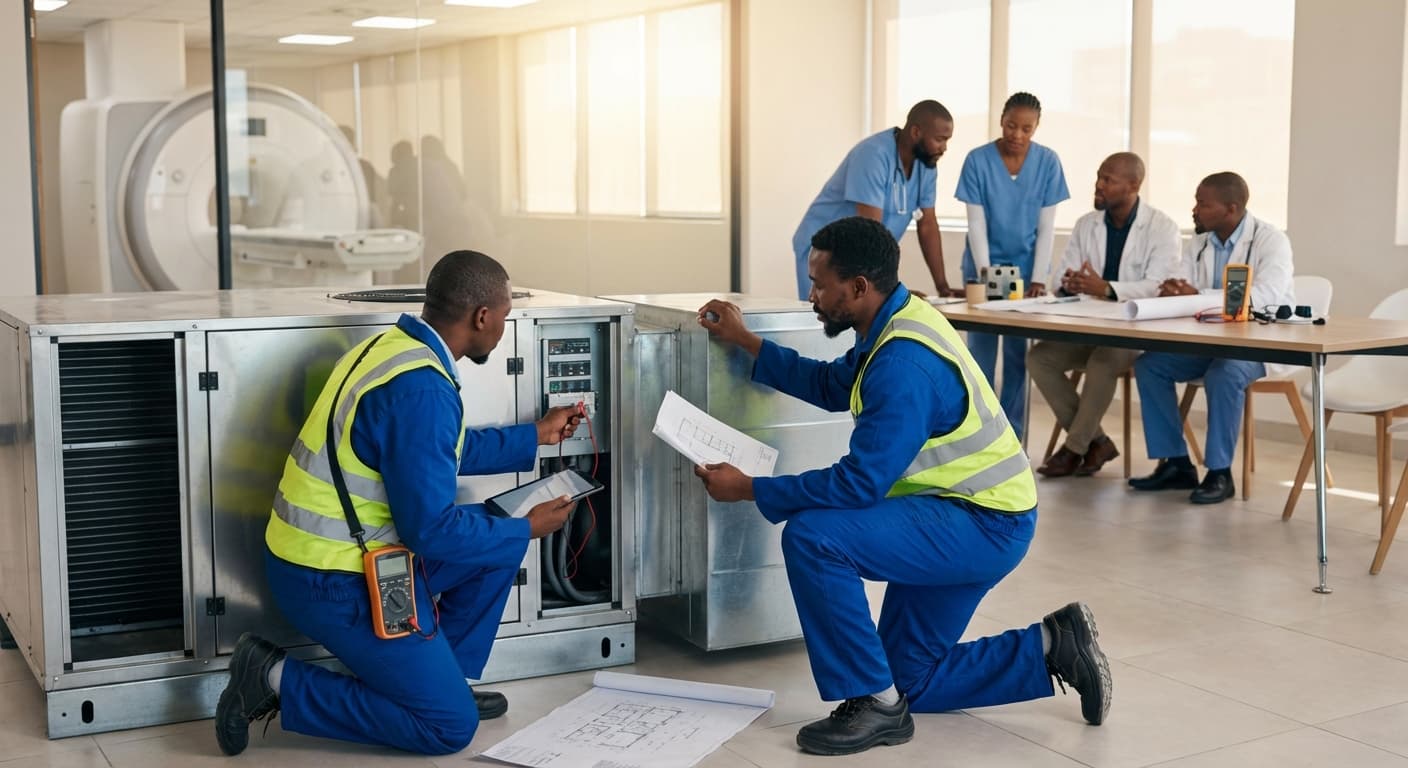
Site Readiness Assessment Service (Space/Access/HVAC/Power/Shielding) in Nigeria
Engineering Excellence & Technical Support
Site Readiness Assessment Service (Space/Access/HVAC/Power/Shielding) High-standard technical execution following OEM protocols and local regulatory frameworks.
Optimized Site Selection for Space & Access
Leveraging advanced geospatial analysis and local regulatory expertise, we identify optimal locations for your infrastructure in Nigeria, ensuring ample space for equipment, future expansion, and seamless physical access for maintenance and operations. Our assessments account for terrain, accessibility, and potential environmental factors to guarantee long-term viability.
Robust Power & HVAC Infrastructure Planning
We conduct in-depth power grid analysis and HVAC load calculations tailored to Nigeria's climate and specific site requirements. Our service ensures reliable, scalable power solutions and efficient cooling systems, mitigating risks of downtime and optimizing energy consumption for critical infrastructure, from data centers to telecommunication hubs.
Comprehensive Shielding & Environmental Risk Assessment
Our experts evaluate potential electromagnetic interference (EMI), radio frequency interference (RFI), and other environmental hazards. We provide actionable recommendations for shielding solutions and mitigation strategies to protect your sensitive equipment and ensure operational integrity in diverse Nigerian environments, from urban centers to remote installations.
What Is Site Readiness Assessment Service (Space/access/hvac/power/shielding) In Nigeria?
The Site Readiness Assessment Service (Space/Access/HVAC/Power/Shielding) in Nigeria is a comprehensive evaluation of a proposed or existing physical location to determine its suitability and capacity for the deployment, operation, and maintenance of critical infrastructure. This service meticulously scrutinizes several key domains to ensure the site can support the intended technological or operational requirements. The assessment aims to identify potential deficiencies, risks, and necessary upgrades proactively, thereby mitigating project delays, cost overruns, and operational failures. The scope encompasses the physical layout and available volume (Space), the ease of ingress and egress for personnel, equipment, and materials (Access), the environmental control systems for temperature, humidity, and air quality (HVAC), the provision and reliability of electrical power, including capacity and redundancy (Power), and the measures in place or required to protect against electromagnetic interference or radiation (Shielding).
| Component | Definition | Who Needs It | Typical Use Cases |
|---|---|---|---|
| Space Assessment | Evaluation of the physical dimensions, layout, and volumetric capacity of the facility to accommodate planned equipment, cabling, walkways, and future expansion. This includes assessing floor loading capacity, ceiling height, and available rack space. | Data center operators, telecommunications providers, cloud service providers, IT infrastructure managers, research institutions, and any organization deploying significant physical IT or specialized equipment. | Planning a new data center build or expansion, deploying new server racks and networking equipment, establishing a colocation facility, or planning for a disaster recovery site. |
| Access Assessment | Analysis of physical pathways for ingress and egress, including loading docks, doorways, corridors, elevators, and stairwells. It assesses the ability to transport equipment of various sizes and weights to and from the designated installation areas, as well as accessibility for maintenance personnel and emergency services. | Organizations involved in frequent equipment deployment or relocation, companies with large or heavy IT assets, and those operating in densely populated urban environments. | Installation of large mainframe servers or network switches, movement of sensitive or oversized equipment, ensuring compliance with accessibility regulations, and planning for emergency evacuation routes. |
| HVAC Assessment | Detailed review of the Heating, Ventilation, and Air Conditioning systems to ensure they can maintain optimal environmental conditions (temperature, humidity, air quality) for the operational integrity of sensitive electronic equipment. This includes assessing cooling capacity, airflow management, redundancy, and filtration. | Data centers, server rooms, telecommunications equipment rooms, laboratories with sensitive instruments, and any facility housing high-density computing or sensitive electronics. | Ensuring stable operating temperatures for servers to prevent thermal shutdown, managing humidity levels to avoid electrostatic discharge or condensation, and maintaining clean environments in dust-sensitive areas. |
| Power Assessment | An in-depth examination of the site's electrical infrastructure, including available power capacity, voltage stability, grounding, UPS (Uninterruptible Power Supply) capabilities, generator backup systems, and power distribution units (PDUs). It identifies potential power quality issues and ensures sufficient redundancy. | All organizations operating critical IT infrastructure, financial institutions, healthcare providers, telecommunications networks, and any business relying on continuous power supply. | Determining the feasibility of deploying new high-power-consuming equipment, evaluating the need for UPS upgrades or generator installations, assessing the risk of power outages, and ensuring compliance with power redundancy standards (e.g., Tier levels). |
| Shielding Assessment | Evaluation of the site's susceptibility to or emission of electromagnetic interference (EMI) or radio frequency interference (RFI). This includes assessing the need for electromagnetic shielding for sensitive equipment or for compliance with regulatory requirements, and evaluating existing shielding effectiveness. | Organizations operating in environments with high levels of electromagnetic noise, facilities housing sensitive scientific or medical equipment, telecommunications base stations, and military or government installations requiring high levels of signal integrity. | Protecting sensitive data transmission equipment from interference, ensuring the accuracy of scientific instruments, preventing unauthorized signal interception, and complying with regulations for emitting electronic devices. |
Key Components of Site Readiness Assessment:
- Space Assessment
- Access Assessment
- HVAC Assessment
- Power Assessment
- Shielding Assessment
Who Needs Site Readiness Assessment Service (Space/access/hvac/power/shielding) In Nigeria?
Site Readiness Assessment is a crucial service for any organization in Nigeria planning to establish or upgrade critical infrastructure. It systematically evaluates existing site conditions against the specific requirements of a new project, ensuring that the location can effectively and efficiently support the intended operations. This service is particularly vital for projects involving the installation of specialized equipment or facilities that have stringent environmental, power, cooling, and security demands. By identifying potential challenges and recommending mitigation strategies early on, it prevents costly delays, budget overruns, and operational failures.
| Target Customer | Key Departments Involved |
|---|---|
| Data Center Operators | IT Operations, Facilities Management, Network Engineering, Security |
| Telecommunication Providers | Network Planning, Site Acquisition, Operations & Maintenance, Engineering |
| Hospitals & Clinics (especially those with advanced medical equipment) | Facilities Management, Biomedical Engineering, IT Department, Radiology Department |
| Research Institutions & Universities | Facilities Management, IT Department, Specific Research Department Heads, Procurement |
| Manufacturing Companies | Production Engineering, Facilities Management, IT Department, Quality Control |
| Government Agencies (Defense, Intelligence, Critical Infrastructure) | Procurement, Facilities Management, IT Security, Operations Command Centers |
| Financial Institutions (for data centers/disaster recovery sites) | IT Infrastructure, Information Security, Facilities Management, Business Continuity Planning |
Who Needs Site Readiness Assessment Service in Nigeria?
- Organizations planning to establish new data centers or upgrade existing ones.
- Telecommunication companies expanding their network infrastructure and base stations.
- Healthcare providers setting up advanced medical imaging facilities (e.g., MRI, CT scanners).
- Research and development institutions requiring specialized laboratory environments.
- Manufacturing companies introducing new, sensitive production lines.
- Government agencies implementing critical national infrastructure projects (e.g., command centers, security installations).
- Companies involved in high-security operations needing controlled environments and physical security.
- Any business requiring reliable and stable power, cooling, and physical access for mission-critical equipment.
Site Readiness Assessment Service (Space/access/hvac/power/shielding) Process In Nigeria
The Site Readiness Assessment Service in Nigeria, encompassing Space, Access, HVAC, Power, and Shielding, is a crucial step in ensuring a proposed facility, such as a data center, telecommunications hub, or research laboratory, is physically and technically prepared for its intended purpose. This service provides a comprehensive evaluation to identify any potential challenges or requirements before significant investment is made. The workflow is designed to be systematic, ensuring all critical aspects are addressed from the initial client inquiry to the final report and recommendations.
| Assessment Area | Key Considerations | Typical Deliverables/Findings |
|---|---|---|
| Space | Overall footprint available, potential for expansion, floor loading capacity, ceiling heights, internal layout suitability, seismic considerations. | Adequate space for equipment, cabling routes, rack layouts, operational areas, future growth projections, structural integrity assessment. |
| Access | Physical access for personnel and equipment (entrances, corridors, elevators, loading docks), security access points, accessibility for maintenance and emergency services. | Confirmation of clear pathways for equipment delivery and installation, security protocols review, emergency egress analysis. |
| HVAC (Heating, Ventilation, and Air Conditioning) | Existing HVAC capacity, suitability for required temperature and humidity control, redundancy, air filtration levels, potential for new installations. | Assessment of current cooling/heating loads, recommendation for upgrades or new systems, humidity control capabilities, airflow analysis. |
| Power | Available grid power capacity, reliability of the power supply, existing electrical infrastructure (substations, transformers, cabling), potential for backup power (generators, UPS), earthing and lightning protection. | Evaluation of power supply adequacy, identification of potential power quality issues, recommendations for capacity upgrades, backup power solutions, and electrical safety compliance. |
| Shielding | Electromagnetic Interference (EMI) shielding requirements, Radio Frequency (RF) shielding needs, acoustic noise levels, radiation shielding (if applicable). | Assessment of existing shielding measures, identification of potential EMI/RFI sources, recommendations for shielding solutions to meet specific project needs (e.g., for sensitive equipment or sensitive environments). |
Site Readiness Assessment Service Workflow in Nigeria
- Inquiry & Initial Consultation: The process begins with a client expressing interest in the Site Readiness Assessment Service. This involves an initial discussion to understand the client's project scope, objectives, and the specific site(s) under consideration.
- Scope Definition & Proposal: Based on the initial consultation, a detailed scope of work is defined. This includes specifying the key areas to be assessed (Space, Access, HVAC, Power, Shielding), the level of detail required, and any specific client concerns. A formal proposal outlining the services, methodology, timeline, and cost is then presented to the client for approval.
- Information Gathering (Pre-Site Visit): Once the proposal is accepted, the service provider requests relevant documentation from the client. This may include site plans, existing infrastructure details (if any), power utility information, building specifications, and any known environmental factors.
- On-Site Assessment & Data Collection: A team of qualified engineers and technicians visits the proposed site. This is the core data collection phase where each of the five key areas is meticulously examined:
- Data Analysis & Gap Identification: The collected data from the on-site assessment and client documentation is thoroughly analyzed. This stage involves comparing the existing site conditions against the client's project requirements and industry best practices.
- Report Generation: A comprehensive Site Readiness Assessment Report is compiled. This report details the findings for each assessed area, highlights any identified gaps, risks, or deficiencies, and provides specific recommendations.
- Presentation & Discussion: The generated report is presented to the client, typically in a formal meeting. This session allows for a detailed walkthrough of the findings, clarification of any ambiguities, and discussion of the proposed solutions.
- Recommendations & Next Steps: Based on the report and client feedback, the service provider offers actionable recommendations. These might include infrastructure upgrades, modifications to the site layout, procurement of specific equipment, or further detailed studies. The client then decides on the subsequent steps based on these recommendations.
- Project Closure (for the assessment): The assessment service concludes with the finalization of recommendations and confirmation of client understanding. The service provider archives all project-related data and documentation.
Site Readiness Assessment Service (Space/access/hvac/power/shielding) Cost In Nigeria
Assessing site readiness for specialized installations like data centers, laboratories, or broadcasting studios requires a thorough evaluation of several critical infrastructure components. In Nigeria, the cost of a Site Readiness Assessment Service (SRAS) covering Space, Access, HVAC, Power, and Shielding can vary significantly based on numerous factors. This service is crucial to ensure a location can adequately support the intended technology, preventing costly retrofits and operational issues. The assessment typically involves on-site inspections, documentation review, and expert analysis to identify any deficiencies and recommend solutions.
| Service Component | Typical Cost Range (NGN) | Notes |
|---|---|---|
| Site Readiness Assessment Service (Comprehensive) | ₦500,000 - ₦5,000,000+ | Covers all aspects: Space, Access, HVAC, Power, Shielding. Varies greatly based on project scale and location. |
| Space Assessment | ₦100,000 - ₦400,000 | Evaluating available space, layout suitability, expansion potential, and environmental factors. |
| Access Assessment | ₦80,000 - ₦300,000 | Examining entry/exit points, load capacity of routes, and security considerations. |
| HVAC Assessment | ₦150,000 - ₦600,000 | Analyzing existing cooling, ventilation, and humidity control systems; identifying capacity and redundancy needs. |
| Power Assessment | ₦200,000 - ₦800,000 | Evaluating existing power supply, capacity, redundancy (generators, UPS), grounding, and electrical infrastructure. |
| Shielding Assessment (EMI/RFI/Radiation) | ₦150,000 - ₦1,000,000+ | Assessing the need for and adequacy of electromagnetic interference, radio frequency interference, or radiation shielding. |
Key Factors Influencing Site Readiness Assessment Costs in Nigeria
- Scope and Complexity of the Project: The size and technical requirements of the planned installation (e.g., small server room vs. large data center) directly impact the assessment's depth and duration.
- Geographic Location: Costs can differ between major cities like Lagos, Abuja, and Kano, and more remote or rural areas due to travel, logistics, and local labor rates.
- Existing Infrastructure Condition: The current state of the site's space, access routes, HVAC systems, power supply, and any existing shielding will influence the investigation and reporting effort.
- Level of Detail Required: The client's specific needs for the assessment (e.g., a high-level overview vs. a detailed technical report with engineering specifications) will affect the time and expertise involved.
- Consultant's Experience and Reputation: Highly experienced and reputable assessment firms or individual consultants may command higher fees.
- Number of Sites to be Assessed: If multiple locations are being evaluated, there might be economies of scale, but the cumulative cost will increase.
- Urgency of the Assessment: Rush or expedited assessments often incur premium charges.
- Specific Shielding Requirements: The type and extent of shielding needed (e.g., EMI/RFI shielding, radiation shielding) can be a specialized and costly aspect of the assessment.
- Report Deliverables: The format and comprehensiveness of the final report (e.g., basic findings vs. detailed schematics, cost estimations for remediation) will influence pricing.
Affordable Site Readiness Assessment Service (Space/access/hvac/power/shielding) Options
Our Affordable Site Readiness Assessment Service provides a comprehensive evaluation of your potential installation space, ensuring it meets all necessary requirements for optimal performance and longevity. We focus on key infrastructure elements including Space, Access, HVAC, Power, and Shielding. Our goal is to identify potential bottlenecks and compliance issues early, saving you significant time and money down the line by preventing costly retrofits or delays. We offer flexible service packages tailored to your specific needs and budget.
| Value Bundle | Description | Key Benefits | Starting Price |
|---|---|---|---|
| Basic Readiness Check | Essential evaluation of Space, Access, and fundamental Power requirements. Ideal for simpler installations or preliminary assessments. | Identifies major physical constraints and basic power needs. Quick and cost-effective first step. | $500 |
| Standard Infrastructure Assessment | Comprehensive assessment of Space, Access, HVAC, and Power. Includes detailed analysis of environmental controls and electrical capacity. | Ensures all critical infrastructure is adequately provisioned. Prevents common installation roadblocks. | $950 |
| Advanced Site Compliance & Shielding | Full assessment including Space, Access, HVAC, Power, and specific Shielding requirements. Includes recommendations for compliance with industry standards. | Guarantees readiness for complex or sensitive installations. Minimizes risk of interference and downtime. | $1500 |
| Customizable Package | Tailored assessment based on your unique project needs. Mix and match assessment areas for a precise fit. | Maximize value by focusing only on what's essential for your project. Ultimate cost control. | Priced per assessment area |
Key Assessment Areas:
- Space & Layout: Evaluating physical dimensions, clearance, and accessibility for equipment installation and maintenance.
- Access & Logistics: Assessing entry points, pathways, and crane/lift requirements for safe and efficient equipment movement.
- HVAC & Environmental Control: Verifying adequate cooling capacity, air circulation, humidity control, and temperature stability.
- Power & Electrical Infrastructure: Reviewing power availability, capacity, distribution, grounding, and backup power solutions.
- Shielding & Interference: Assessing requirements for electromagnetic interference (EMI) or radio frequency interference (RFI) shielding, if applicable.
Verified Providers In Nigeria
In Nigeria, navigating the healthcare landscape can be challenging. However, there are healthcare providers who stand out due to their rigorous credentialing processes and commitment to quality care. Franance Health has emerged as a leader in this regard, establishing a network of verified providers who meet stringent criteria. This ensures that patients receive reliable and high-quality medical services, making Franance Health's network the best choice for accessible and trustworthy healthcare in Nigeria.
| Provider Type | Franance Health Verification Criteria | Why it Matters for Patients |
|---|---|---|
| Hospitals | Accreditation by relevant national/international bodies, presence of qualified specialists, adherence to hygiene and safety protocols, modern equipment. | Ensures access to comprehensive medical services, surgical procedures, and emergency care with confidence in the facility's standards. |
| Clinics | Licensed practitioners, well-maintained facilities, availability of essential diagnostic tools, patient feedback mechanisms. | Provides reliable primary healthcare, specialized consultations, and diagnostic services in a comfortable and accessible setting. |
| Laboratories | Certified technicians, use of calibrated equipment, adherence to quality control standards, timely and accurate result delivery. | Guarantees trustworthy diagnostic test results crucial for accurate diagnosis and effective treatment planning. |
| Pharmacies | Registered pharmacists, proper storage of medications, availability of genuine and quality-assured drugs, ethical dispensing practices. | Ensures access to safe, effective, and authentic medications, reducing the risk of counterfeit or substandard drugs. |
| Specialist Doctors | Verified medical degrees, board certifications in their respective specialties, active licenses to practice, positive peer reviews. | Connects patients with highly skilled and experienced medical professionals for specific health concerns, leading to better treatment outcomes. |
Key Benefits of Choosing Franance Health Verified Providers:
- Guaranteed Quality of Care
- Patient Safety and Trust
- Access to Specialized Expertise
- Streamlined Healthcare Experience
- Cost-Effectiveness and Transparency
Scope Of Work For Site Readiness Assessment Service (Space/access/hvac/power/shielding)
This Scope of Work (SOW) outlines the services for conducting a comprehensive Site Readiness Assessment. The assessment will evaluate the suitability of a proposed site for hosting specific technical infrastructure by examining key environmental and utility aspects. The goal is to identify potential challenges, risks, and required upgrades to ensure successful deployment and operation. This SOW covers the assessment of Space, Access, HVAC, Power, and Shielding. Technical deliverables will include detailed reports, schematics, and compliance matrices. Standard specifications will be referenced from relevant industry codes and best practices.
| Category | Description | Key Assessment Areas | Deliverables | Standard Specifications/References |
|---|---|---|---|---|
| Space | Assessment of available physical space for equipment installation and future expansion. | Floor space, ceiling height, rack layout, cable management pathways, seismic bracing provisions. | Space utilization report, detailed floor plan with proposed equipment layout, rack elevation drawings. | TIA-942 (Telecommunications Infrastructure Standard for Data Centers), local building codes, seismic zone requirements. |
| Access | Evaluation of physical and logistical access to the site for construction, equipment delivery, and maintenance. | Entry points, door sizes, elevator capacity, corridor width, loading dock availability, security access procedures. | Access logistics report, recommendations for equipment delivery routes, access control requirements. | Local fire and safety regulations, building management guidelines, security protocols. |
| HVAC (Heating, Ventilation, and Air Conditioning) | Assessment of existing or required HVAC capacity to maintain optimal operating temperatures and humidity for equipment. | Current HVAC system capacity, airflow, temperature and humidity control capabilities, redundancy, air filtration, CRAC/CRAH unit specifications. | HVAC assessment report, heat load calculations, recommended HVAC upgrade specifications, airflow diagrams. | ASHRAE (American Society of Heating, Refrigerating and Air-Conditioning Engineers) standards, data center environmental guidelines (e.g., ASHRAE TC 9.9), local environmental regulations. |
| Power | Evaluation of existing power infrastructure and capacity to support the proposed equipment load. | Utility power availability, existing electrical panels, UPS capacity, generator capacity and fuel storage, power distribution units (PDUs), grounding, surge protection. | Power assessment report, power load calculations, recommended power upgrade specifications, single-line diagrams of power distribution. | NEC (National Electrical Code), local electrical codes, utility company standards, UPS and generator manufacturer specifications, grounding standards (e.g., ANSI/IEEE). |
| Shielding | Assessment of site's susceptibility to or contribution of electromagnetic interference (EMI) or radio frequency interference (RFI), and any required shielding measures. | Location relative to sources of EMI/RFI, existing shielding (e.g., RF-shielded rooms), potential for interference from external sources, required shielding for sensitive equipment. | EMI/RFI assessment report, recommended shielding solutions, material specifications, compliance verification. | FCC (Federal Communications Commission) regulations, specific industry standards for sensitive equipment (e.g., medical, defense), EMI/RFI mitigation best practices. |
Scope of Work Summary
- Site Readiness Assessment for new infrastructure deployment.
- Evaluation of critical site parameters: Space, Access, HVAC, Power, and Shielding.
- Identification of existing conditions, potential risks, and required upgrades.
- Provision of technical deliverables and adherence to standard specifications.
Service Level Agreement For Site Readiness Assessment Service (Space/access/hvac/power/shielding)
This Service Level Agreement (SLA) outlines the guaranteed response times and uptime for the Site Readiness Assessment Service. This service encompasses the evaluation of space, access, HVAC, power, and shielding infrastructure required for the deployment of [Client's specific infrastructure or equipment, e.g., server racks, scientific instruments, etc.]. The objective is to ensure timely identification of any infrastructure gaps or issues that could impact project timelines and operational success.
| Service Component | Response Time Guarantee | Uptime Guarantee |
|---|---|---|
| Initial Site Readiness Report (after site visit and data collection) | Within 5 business days | N/A (This is a one-time assessment delivery) |
| Response to Clarification Questions on Initial Report | Within 1 business day | N/A |
| Assessment of Subsequent Site Changes or Re-assessments | Within 3 business days | N/A |
| Availability of Assessment Team for On-site Consultations (during agreed-upon hours) | Scheduled within 2 business days of request | 99.5% Availability during scheduled consultation times |
| Availability of Assessment Tools and Platforms (for remote data review, if applicable) | 99.9% Uptime | 99.9% Uptime |
Scope of Service
- Space assessment (physical dimensions, layout, and environmental considerations)
- Access assessment (entry/exit points, pathways, and any required modifications)
- HVAC assessment (capacity, redundancy, temperature/humidity control, and air filtration)
- Power assessment (capacity, distribution, redundancy, UPS, and generator readiness)
- Shielding assessment (EMC, RF, EMI, or radiation shielding requirements and existing capabilities)
Frequently Asked Questions

Ready when you are
Let's scope your Site Readiness Assessment Service (Space/Access/HVAC/Power/Shielding) in Nigeria project in Nigeria.

Scaling healthcare logistics and technical systems across the entire continent.