
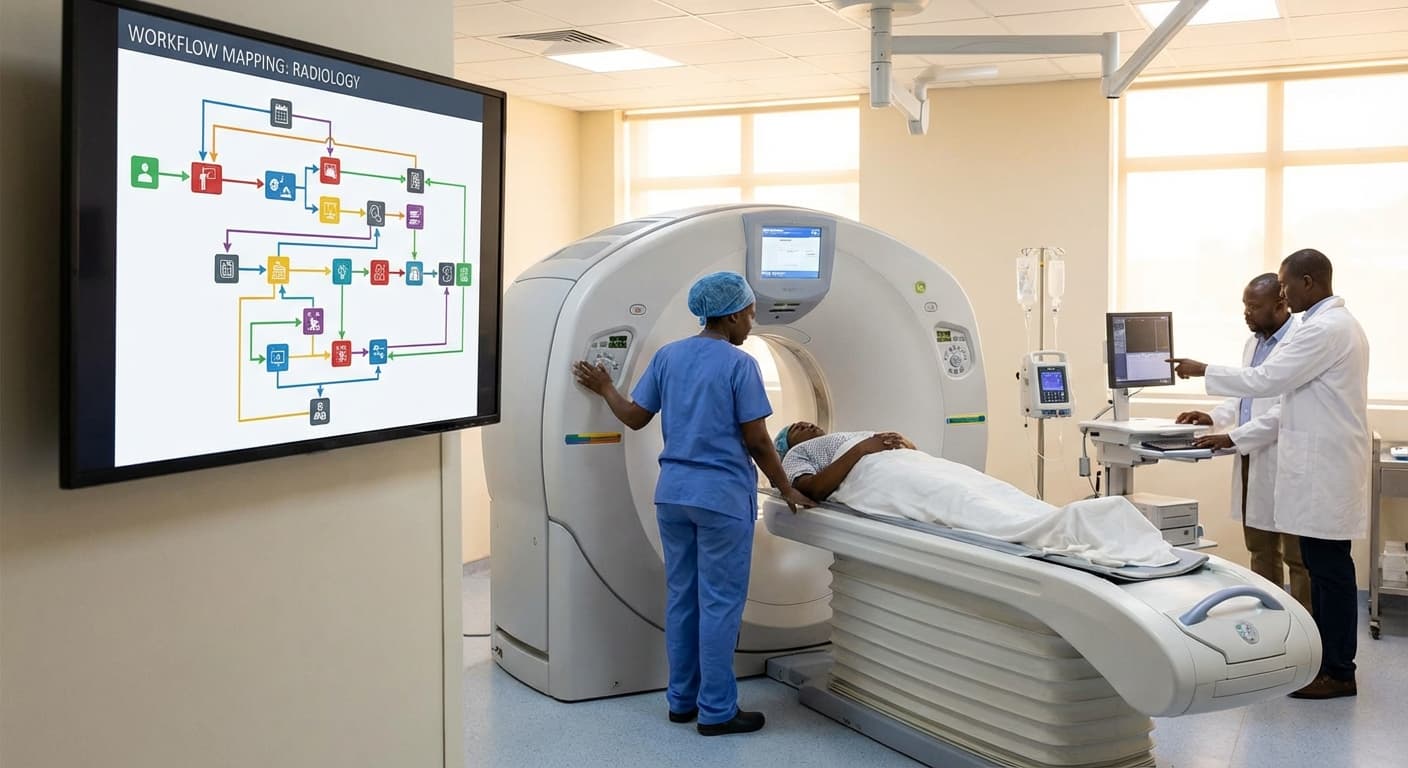
Department Workflow Mapping Service (Radiology/ICU/OT/Lab/Dialysis) in Nigeria
Engineering Excellence & Technical Support
Department Workflow Mapping Service (Radiology/ICU/OT/Lab/Dialysis) High-standard technical execution following OEM protocols and local regulatory frameworks.
Streamlined Radiology Reporting & Turnaround Times
Our workflow mapping optimizes the entire radiology process, from patient registration and image acquisition to interpretation and report generation. This reduces delays, improves radiologist efficiency, and significantly accelerates report turnaround times for critical cases in Nigerian hospitals.
Enhanced ICU Patient Flow & Resource Allocation
We map the complex patient journey within the ICU, identifying bottlenecks and ensuring seamless transitions between care areas. This facilitates better resource allocation, reduces patient wait times for critical interventions, and improves overall patient outcomes in Nigerian ICU settings.
Optimized Operating Theatre Scheduling & Efficiency
Our service meticulously maps the Operating Theatre workflow, from pre-operative patient preparation to post-operative recovery. By identifying inefficiencies in scheduling, equipment utilization, and staff coordination, we empower Nigerian hospitals to maximize OT capacity, minimize cancellations, and improve surgical throughput.
What Is Department Workflow Mapping Service (Radiology/icu/ot/lab/dialysis) In Nigeria?
Department Workflow Mapping Service, within the context of Nigerian healthcare facilities such as Radiology, Intensive Care Units (ICU), Operating Theatres (OT), Laboratories, and Dialysis Centers, is a systematic and analytical process designed to document, visualize, and optimize the flow of tasks, information, materials, and patients within a specific clinical department. It involves a detailed examination of current operational procedures to identify bottlenecks, inefficiencies, redundancies, and areas for improvement. The service aims to enhance patient care delivery, resource utilization, staff productivity, and overall departmental performance through a structured understanding of existing workflows. This service is essential for any department seeking to standardize processes, implement new technologies, comply with regulatory requirements, or achieve measurable operational improvements.
| Department | Who Needs the Service | Typical Use Cases |
|---|---|---|
| Radiology | Radiology Department Heads, Hospital Administrators, Quality Improvement Officers | Optimizing patient throughput for imaging studies, reducing report turnaround times, integrating new imaging modalities, improving PACS/RIS workflow, standardizing contrast media administration protocols. |
| Intensive Care Unit (ICU) | ICU Medical Directors, Nursing Supervisors, Hospital Operations Managers | Streamlining patient admission/transfer processes, improving interdisciplinary communication, optimizing medication administration workflows, managing critical equipment availability, reducing alarm fatigue through alert management optimization. |
| Operating Theatre (OT) | Chief of Surgery, Theatre Managers, Anesthesiologists, Scrub Nurses | Improving surgical scheduling efficiency, optimizing patient flow into and out of the OR, standardizing surgical instrument preparation and sterilization workflows, managing operating room utilization, reducing surgical case delays. |
| Laboratory | Laboratory Directors, Chief Technologists, Hospital Quality Assurance Personnel | Enhancing specimen accessioning and tracking, optimizing sample processing and testing workflows, integrating LIS/EMR for seamless data transfer, reducing test result turnaround times, improving quality control procedures. |
| Dialysis Center | Nephrology Department Heads, Dialysis Unit Managers, Patient Flow Coordinators | Optimizing patient scheduling and appointment management, streamlining pre-treatment patient preparation, improving dialysis machine allocation and turnaround, managing fluid and supply inventory, ensuring compliance with infection control protocols. |
Key Components of Department Workflow Mapping Service:
- As-Is Process Documentation: Comprehensive recording of current departmental procedures, including stakeholder roles, decision points, data flow, physical movement of patients and materials, and interdependencies.
- Process Analysis and Bottleneck Identification: Utilizing analytical tools and techniques (e.g., value stream mapping, spaghetti diagrams, simulation) to pinpoint inefficiencies, delays, and areas of high resource consumption or low throughput.
- To-Be Process Design: Development of optimized and streamlined workflows based on identified improvements, incorporating best practices, technological advancements, and strategic departmental goals.
- Performance Metrics Definition: Establishing key performance indicators (KPIs) to measure the effectiveness of the current and redesigned workflows.
- Technology Integration Assessment: Evaluating the role of existing and potential technologies (e.g., Picture Archiving and Communication Systems (PACS), Laboratory Information Systems (LIS), Electronic Health Records (EHRs), real-time location systems (RTLS)) in optimizing workflows.
- Training and Implementation Support: Providing guidance and resources for the successful adoption and implementation of redesigned workflows and associated technologies.
Who Needs Department Workflow Mapping Service (Radiology/icu/ot/lab/dialysis) In Nigeria?
In Nigeria's dynamic healthcare landscape, optimizing departmental operations is crucial for delivering efficient, high-quality patient care. Department Workflow Mapping Services are specifically designed to identify bottlenecks, streamline processes, and enhance productivity within critical hospital units. These services are invaluable for any healthcare institution aiming to improve resource allocation, reduce wait times, and elevate patient satisfaction. The primary beneficiaries are hospitals and diagnostic centers seeking to modernize their operational frameworks and ensure seamless patient journeys through specialized departments.
| Target Customer/Department | Why They Need Workflow Mapping | Specific Benefits | Examples of Workflow Issues Addressed |
|---|---|---|---|
| Radiology Departments | High volume of imaging requests, complex equipment, and multi-step diagnostic processes. | Reduced patient wait times for scans and results, optimized equipment utilization, improved radiologist productivity, enhanced report turnaround. | Long queues for MRI/CT scans, delays in image interpretation, inefficient patient scheduling, communication gaps between technicians and radiologists. |
| Intensive Care Units (ICU) | Critical patient acuity, rapid decision-making, multidisciplinary team coordination, and resource-intensive care. | Improved interdisciplinary communication, faster response times to critical events, optimized bed management, reduced staff burnout through efficient task allocation. | Delays in physician rounds, inefficient medication administration, poor communication during patient handovers, suboptimal resource deployment (ventilators, monitors). |
| Operating Theatres (OT) | Complex surgical procedures, stringent sterilization protocols, tight scheduling, and coordination of multiple surgical teams. | Maximized operating room utilization, reduced surgical delays, improved patient safety through standardized protocols, efficient management of surgical supplies. | Overbooked ORs, prolonged setup and cleanup times, delays in instrument sterilization, inefficient patient transfer to and from the OR. |
| Laboratory Departments | High volume of tests, sample integrity requirements, complex analytical processes, and critical result reporting. | Faster turnaround times for test results, improved sample tracking and integrity, optimized instrument usage, reduced errors in sample processing and reporting. | Backlogs in sample processing, delays in critical test results, sample mix-ups, inefficient phlebotomy services, underutilization of analytical equipment. |
| Dialysis Centers | Scheduled patient treatments, continuous monitoring, specific equipment needs, and infection control protocols. | Optimized patient scheduling and session management, efficient equipment maintenance and utilization, improved patient comfort and safety, streamlined staff workload. | Long wait times for dialysis slots, insufficient or malfunctioning dialysis machines, delays in patient preparation and post-treatment care, inadequate infection control measures. |
Who Needs Department Workflow Mapping Service in Nigeria?
- Hospitals aiming to improve efficiency and reduce operational costs.
- Diagnostic and specialized centers seeking to optimize patient flow and turnaround times.
- Healthcare facilities experiencing bottlenecks or delays in specific departments.
- Organizations focused on enhancing patient safety and reducing medical errors.
- Institutions looking to implement new technologies or protocols effectively.
- New hospital setups or expansions requiring robust operational blueprints.
- Government and private healthcare providers committed to service excellence.
Department Workflow Mapping Service (Radiology/icu/ot/lab/dialysis) Process In Nigeria
This document outlines the typical workflow for engaging the Department Workflow Mapping Service for various critical hospital departments (Radiology, ICU, OT, Lab, Dialysis) within Nigeria. The service aims to analyze, document, and optimize existing processes to enhance efficiency, reduce errors, and improve patient care.
| Stage | Description | Key Activities | Responsible Parties | Deliverables/Outcomes | Typical Timeline |
|---|---|---|---|---|---|
| The hospital or department expresses interest in the workflow mapping service and seeks to understand its benefits and scope. This stage involves initial discussions to assess needs and suitability. | Contacting the service provider, scheduling introductory meetings, defining preliminary objectives, understanding service offerings and pricing. | Hospital Management/Department Head, Service Provider Sales/Consultant | Understanding of service capabilities, preliminary proposal, quotation, agreement to proceed. | 1-3 Business Days |
| A more detailed understanding of the specific department's current workflows, challenges, and desired outcomes is gathered. This helps in defining the scope of the project. | On-site visits, interviews with key personnel, observation of current processes, review of existing documentation (SOPs, forms), identification of pain points and areas for improvement. | Department Staff (Doctors, Nurses, Technicians, Administrators), Service Provider Consultants | Detailed needs assessment report, defined project scope, confirmed objectives, identification of key stakeholders. | 1-2 Weeks |
| Comprehensive data is collected on existing workflows, including patient journeys, material flow, information systems, and resource utilization. This data is then analyzed. | Process mapping (using tools like BPMN), data logging (patient wait times, equipment usage, error rates), interviews and focus groups, stakeholder workshops to validate findings. | Service Provider Consultants, Department Staff | Documented 'As-Is' workflow diagrams, identified bottlenecks, inefficiencies, and areas of risk, preliminary analysis of performance metrics. | 2-4 Weeks |
| Based on the analysis, the service provider collaboratively designs optimized 'To-Be' workflows that address identified issues and align with best practices. | Brainstorming sessions with stakeholders, development of new process flows, redesign of forms and templates, integration of technology solutions (if applicable), risk assessment of new workflows. | Service Provider Consultants, Department Staff, IT Department (if applicable) | Documented 'To-Be' workflow diagrams, revised Standard Operating Procedures (SOPs), recommendations for system or equipment upgrades, identified Key Performance Indicators (KPIs) for the new processes. | 2-4 Weeks |
| A detailed plan is developed for the implementation of the new 'To-Be' workflows. | Creation of an implementation roadmap, defining training needs, resource allocation, change management strategies, establishment of a pilot testing phase (if applicable), communication plan. | Service Provider Consultants, Department Management, HR Department | Detailed implementation plan, training materials, change management strategy, communication plan, pilot testing plan (if applicable). | 1-2 Weeks |
| Department staff are trained on the new workflows and supported through the transition to minimize resistance and ensure adoption. | Conducting training sessions for all relevant staff, providing ongoing support and coaching, addressing staff concerns, reinforcing new procedures. | Service Provider Trainers/Consultants, Department Supervisors | Trained staff, increased staff buy-in and confidence, reduced resistance to change. | Ongoing during implementation (duration varies) |
| The new workflows are implemented, and their performance is monitored against the defined KPIs. | Roll-out of new processes, ongoing observation of workflow execution, data collection on new KPIs, regular feedback sessions with staff. | Department Staff, Department Management, Service Provider Consultants | Successfully implemented new workflows, initial performance data against KPIs, identification of any immediate issues or adjustments needed. | 2-4 Weeks (initial phase) |
| The implemented workflows are evaluated for effectiveness, and further refinements are made based on performance data and feedback. | Analysis of performance data against KPIs, collection of post-implementation feedback, identification of areas for further optimization, conducting follow-up workshops. | Service Provider Consultants, Department Management, Department Staff | Post-implementation evaluation report, refined workflow documentation, recommendations for continuous improvement, final project report. | 1-2 Weeks (post-execution) |
Key Departments Covered
- Radiology Department
- Intensive Care Unit (ICU)
- Operating Theatre (OT)
- Laboratory Services
- Dialysis Unit
Department Workflow Mapping Service (Radiology/icu/ot/lab/dialysis) Cost In Nigeria
Mapping departmental workflows in critical healthcare units like Radiology, ICU, OT, Lab, and Dialysis in Nigeria is a specialized service crucial for optimizing efficiency, reducing errors, and improving patient care. The cost of such a service is influenced by several factors, leading to a range of pricing in Nigerian Naira (NGN). These factors include the complexity of the department's current processes, the size and scope of the department, the level of detail required in the mapping, the experience and reputation of the consulting firm or individual, and the duration of the engagement. Typically, a comprehensive workflow mapping project involves several stages: initial assessment, data gathering (interviews, observation, document review), process analysis, workflow diagram creation, identification of bottlenecks and inefficiencies, recommendations for improvement, and final documentation. The pricing structure can be project-based, hourly, or retainer-based, depending on the client's needs and the consultant's model. Smaller departments with relatively straightforward processes might incur lower costs, while larger, more complex units with intricate interdependencies will naturally command higher fees. Furthermore, the geographical location within Nigeria, potential travel and accommodation expenses for consultants, and the need for specialized software or tools for visualization and analysis can also contribute to the overall cost. Given these variables, the cost of departmental workflow mapping in Nigeria can vary significantly. It's essential for healthcare institutions to obtain detailed proposals from several reputable service providers to accurately assess costs for their specific requirements.
| Department Type | Estimated Cost Range (NGN) | Notes |
|---|---|---|
| Radiology Department | 500,000 - 2,000,000+ | Complexity can vary based on imaging modalities and patient throughput. |
| Intensive Care Unit (ICU) | 700,000 - 3,000,000+ | High complexity due to critical patient management and multidisciplinary team involvement. |
| Operating Theatre (OT) | 600,000 - 2,500,000+ | Involves intricate scheduling, patient flow, and sterile environment protocols. |
| Laboratory | 400,000 - 1,500,000+ | Depends on the range of tests performed and automation levels. |
| Dialysis Unit | 450,000 - 1,800,000+ | Focus on patient scheduling, equipment maintenance, and infection control. |
| Comprehensive Hospital-Wide Mapping (Multiple Departments) | 3,000,000 - 10,000,000+ | Significant undertaking requiring extensive resources and time. |
Key Pricing Factors for Departmental Workflow Mapping in Nigeria:
- Departmental Complexity: The number of steps, decision points, and interdependencies within the workflow.
- Department Size and Scope: The number of staff involved, patient volume, and the range of services offered.
- Level of Detail: Whether the mapping is high-level or granular, including every micro-step.
- Consultant's Experience and Reputation: Established firms or highly sought-after consultants often charge more.
- Duration of Engagement: The time required for assessment, analysis, and implementation support.
- Data Gathering Methods: Intensity of interviews, observations, and document analysis.
- Reporting and Deliverables: The format and comprehensiveness of the final workflow maps and recommendations.
- Geographical Location: Travel and accommodation costs for consultants if not local.
- Technology and Tools: Use of specialized software for process modeling and visualization.
- Additional Services: Involvement in implementation, training, or ongoing monitoring.
Affordable Department Workflow Mapping Service (Radiology/icu/ot/lab/dialysis) Options
Our affordable Department Workflow Mapping Service provides a comprehensive and cost-effective solution for optimizing processes within key hospital departments including Radiology, Intensive Care Unit (ICU), Operating Theatre (OT), Laboratory, and Dialysis. We specialize in identifying bottlenecks, streamlining operations, and enhancing efficiency through detailed workflow analysis and visualization. Our service empowers your department to reduce waste, improve patient care, and achieve significant cost savings.
| Cost-Saving Strategy | Description | Impact Area |
|---|---|---|
| Bottleneck Identification and Resolution | Precisely pinpointing and addressing stages where work piles up, causing delays and increased resource utilization. | Reduced turnaround times, improved patient throughput, optimized staff allocation. |
| Waste Reduction (Muda Elimination) | Identifying and eliminating non-value-adding activities such as unnecessary movement, waiting, overproduction, and rework. | Lowered operational costs, decreased material waste, optimized inventory management. |
| Standardization of Processes | Developing and implementing consistent, repeatable procedures across all staff and shifts to minimize errors and variations. | Improved quality of care, reduced medical errors, enhanced staff training efficiency. |
| Technology Integration Opportunities | Mapping workflows to identify areas where technology (e.g., EMR integration, automation tools) can significantly improve speed and accuracy. | Increased automation, reduced manual data entry, enhanced data accuracy and accessibility. |
| Optimized Staff Allocation and Skill Utilization | Ensuring staff are deployed to tasks where their skills are best utilized, minimizing idle time and over-reliance on specific individuals. | Improved staff morale, reduced burnout, increased productivity, lower overtime costs. |
| Reduced Patient Wait Times | Streamlining patient journeys through departments leads to quicker access to diagnostic tests, procedures, and treatments. | Enhanced patient satisfaction, improved clinical outcomes, increased departmental capacity. |
Value Bundles for Department Workflow Mapping
- {"title":"Essential Workflow Audit (Single Department)","description":"Ideal for departments needing a foundational understanding of their current processes. Includes detailed mapping of one core workflow, identification of major inefficiencies, and a report with actionable recommendations. Suitable for smaller departments or initial optimization efforts."}
- {"title":"Comprehensive Department Optimization (Multiple Workflows)","description":"Designed for departments requiring a deeper dive into their operational landscape. Maps multiple critical workflows within a single department, identifies interdependencies, and provides a more in-depth analysis of potential improvements, automation opportunities, and training needs."}
- {"title":"Inter-Departmental Process Integration","description":"Focuses on optimizing workflows that span across two or more departments (e.g., Radiology to OT, Lab to ICU). Crucial for seamless patient transitions and efficient information exchange, leading to reduced delays and improved patient safety."}
- {"title":"Full Departmental Transformation Package","description":"Our most robust offering, encompassing a holistic review of all major workflows within a department or across multiple related departments. Includes advanced analytics, simulation modeling, and strategic implementation planning for maximum impact and sustained efficiency gains."}
Verified Providers In Nigeria
In Nigeria, the healthcare landscape is rapidly evolving, with a growing demand for reliable and high-quality medical services. Finding 'verified providers' is paramount to ensuring patient safety and effective treatment. Franance Health stands out as a beacon of trust and excellence in this domain. Their commitment to rigorous credentialing, ethical practices, and patient-centric care makes them the definitive best choice for medical services across Nigeria. This document outlines Franance Health's credentials and the compelling reasons why they represent the pinnacle of verified healthcare providers in the nation.
| Why Franance Health is the Best Choice | Supporting Credentials/Practices |
|---|---|
| Uncompromising Patient Safety: | Rigorous physician vetting, adherence to medical best practices, and state-of-the-art equipment minimize risks and ensure safe procedures. |
| Evidence-Based and Advanced Medical Care: | Continuous professional development for staff ensures patients receive treatments based on the latest medical research and techniques. |
| Trust and Reliability: | Accreditation from reputable health bodies and a strong track record of ethical conduct build unwavering trust with patients and the community. |
| Holistic Patient Experience: | Commitment to ethical practices, transparent communication, and responsive patient feedback systems create a supportive and patient-centric healthcare journey. |
| Access to Comprehensive Services: | A wide network of verified specialists and well-equipped facilities cater to a broad spectrum of healthcare needs. |
Key Franance Health Credentials and Differentiators
- Accreditation by National and International Health Bodies: Franance Health adheres to the highest standards of healthcare delivery, evidenced by their accreditation from recognized national bodies like the Medical and Dental Council of Nigeria (MDCN) and relevant state health ministries, as well as striving for international benchmarks where applicable.
- Rigorous Physician and Staff Vetting: Every medical professional associated with Franance Health undergoes a stringent vetting process. This includes verification of their licenses, certifications, educational backgrounds, and practical experience, ensuring only qualified and competent individuals are part of their network.
- Continuous Professional Development (CPD) Mandate: Franance Health mandates and facilitates ongoing professional development for all its healthcare practitioners. This ensures they remain at the forefront of medical advancements, new techniques, and best practices, providing patients with cutting-edge care.
- Adherence to Ethical Medical Practices: Integrity and ethical conduct are cornerstones of Franance Health's operations. They uphold a strict code of ethics, prioritizing patient well-being, confidentiality, and informed consent in all interactions.
- Robust Quality Assurance and Patient Feedback Systems: Franance Health implements comprehensive quality assurance protocols to continuously monitor and improve service delivery. They actively solicit and incorporate patient feedback to address any concerns and enhance the overall patient experience.
- State-of-the-Art Infrastructure and Equipment: Franance Health invests in modern medical facilities and advanced diagnostic and treatment equipment. This ensures accurate diagnoses, effective treatments, and a comfortable environment for patients.
- Transparent Pricing and Billing: A key aspect of being a trusted provider is transparency. Franance Health is committed to clear and honest pricing structures, ensuring patients understand all costs associated with their treatment.
Scope Of Work For Department Workflow Mapping Service (Radiology/icu/ot/lab/dialysis)
This Scope of Work (SOW) outlines the services to be provided for a comprehensive workflow mapping initiative across key hospital departments: Radiology, Intensive Care Unit (ICU), Operating Theatre (OT), Laboratory (Lab), and Dialysis. The objective is to meticulously document, analyze, and optimize existing workflows to enhance efficiency, reduce errors, improve patient care, and facilitate the seamless integration of new technologies or process improvements. This SOW details the project objectives, scope, deliverables, and standard specifications.
| Department | Key Activities to be Mapped | Specific Focus Areas for Analysis |
|---|---|---|
| Radiology | Patient registration and scheduling, Image acquisition (X-ray, CT, MRI, Ultrasound), Image processing and interpretation, Report generation and distribution, PACS management, Interventional procedures. | Patient throughput, Reporting turnaround times, Equipment utilization, PACS integration and data flow, Radiation dose management, Protocol standardization. |
| ICU | Patient admission and transfer, Monitoring and data collection (vitals, ventilators, etc.), Medication administration, Doctor's rounds and order entry, Nursing care procedures, Communication protocols (handovers, consultations), Discharge planning. | Patient monitoring efficiency, Alarm fatigue mitigation, Medication safety, Interdisciplinary team collaboration, Resource allocation, Documentation completeness and accuracy. |
| Operating Theatre (OT) | Pre-operative patient preparation, Surgical scheduling and room allocation, Intra-operative procedures (anesthesia, surgery), Instrument and equipment management, Sterilization processes, Post-operative patient recovery and transfer, Waste management. | Surgical case turnaround times, Sterilization and supply chain efficiency, Equipment availability and maintenance, Anesthesia workflow, Communication between surgical team and recovery staff, Infection control protocols. |
| Laboratory (Lab) | Specimen collection and accessioning, Sample processing and analysis (hematology, chemistry, microbiology, etc.), Quality control procedures, Result validation and reporting, LIS integration, Inventory management. | Specimen integrity and handling, Test turnaround times, Instrument calibration and maintenance, Quality assurance and control, Result accuracy and reporting turnaround, Staffing and workload distribution. |
| Dialysis | Patient pre-treatment assessment, Dialysis machine setup and preparation, Patient connection and monitoring during treatment, Medication administration, Post-treatment patient care and documentation, Machine and room cleaning/disinfection, Scheduling and patient flow. | Patient safety and comfort, Treatment adherence and completion rates, Machine utilization and maintenance, Medication reconciliation, Staff-patient ratios, Infection prevention and control during procedures. |
Standard Specifications
- {"title":"Notation Standard","description":"Business Process Model and Notation (BPMN) 2.0 will be the primary standard for workflow diagramming, ensuring consistency and industry recognition. Swimlane diagrams will be used to clearly delineate responsibilities."}
- {"title":"Tooling","description":"The chosen workflow mapping software will be industry-standard and capable of supporting BPMN 2.0. Examples include Bizagi Modeler, Lucidchart, Microsoft Visio (with BPMN stencils), or similar."}
- {"title":"Data Capture","description":"Information captured will include: process name, step description, responsible role/actor, involved systems/applications, input/output data, decision criteria, time estimates (if available), and any relevant risks or controls."}
- {"title":"Level of Detail","description":"Workflows will be mapped at a level of detail sufficient to understand the end-to-end process and identify actionable improvement areas. Typically, this will be 'Level 3' or 'Level 4' process mapping, depending on complexity."}
- {"title":"Naming Conventions","description":"Consistent and descriptive naming conventions will be applied to all diagrams, elements, and documentation for clarity and ease of navigation."}
- {"title":"Review and Validation","description":"Each mapped workflow will undergo a formal review and validation process with key stakeholders from the respective department to ensure accuracy and completeness."}
- {"title":"Deliverable Format","description":"Workflow diagrams will be delivered in editable electronic formats (e.g.,
.bpmn,.vsdx,.lucidchart) and as static image files (e.g.,.png,.pdf). Reports will be delivered in.pdfformat."} - {"title":"Security and Confidentiality","description":"All project data and documentation will be handled with the utmost confidentiality and in compliance with all relevant healthcare data privacy regulations (e.g., HIPAA)."}
- {"title":"Version Control","description":"A clear version control system will be implemented for all deliverables to track changes and maintain historical records."}
Service Level Agreement For Department Workflow Mapping Service (Radiology/icu/ot/lab/dialysis)
This Service Level Agreement (SLA) outlines the guaranteed response times and uptime for the Department Workflow Mapping Service. This service is designed to provide comprehensive mapping of departmental workflows across Radiology, Intensive Care Unit (ICU), Operating Theatre (OT), Laboratory (Lab), and Dialysis units. The objective is to enhance efficiency, identify bottlenecks, and facilitate process improvement.
| Service Component | Response Time Guarantee (Business Hours) | Uptime Guarantee (Monthly) |
|---|---|---|
| Workflow Mapping Project Initiation & Planning | 4 Business Hours | N/A (Service availability is critical for this phase) |
| Data Collection & Analysis Support | 8 Business Hours | 99.5% |
| Workflow Visualization & Reporting Delivery | 2 Business Days | 99.5% |
| Ad-hoc Workflow Query/Clarification | 6 Business Hours | 99.5% |
| Service Availability (General Access to Project Data & Tools) | N/A | 99.8% |
Service Scope and Definitions
- Department Workflow Mapping Service: The provision of documented, analyzed, and visualized workflows for the specified departments. This includes process identification, stakeholder interviews, data collection, analysis, and reporting.
- Radiology: Imaging and diagnostic procedures.
- ICU (Intensive Care Unit): Critical care services for severely ill patients.
- OT (Operating Theatre): Surgical procedures and related services.
- Lab (Laboratory): Diagnostic testing and analysis of biological samples.
- Dialysis: Renal replacement therapy.
- Downtime: Any period during which the Workflow Mapping Service is unavailable to the user due to system failures, scheduled maintenance, or other unforeseen issues.
- Response Time: The maximum time allowed for the service provider to acknowledge and begin addressing a reported issue or request.
- Uptime Guarantee: The percentage of time the Workflow Mapping Service is expected to be available and operational.
- Scheduled Maintenance: Planned periods of system downtime for updates, upgrades, or routine maintenance, communicated in advance.
Frequently Asked Questions

Ready when you are
Let's scope your Department Workflow Mapping Service (Radiology/ICU/OT/Lab/Dialysis) in Nigeria project in Nigeria.

Scaling healthcare logistics and technical systems across the entire continent.