
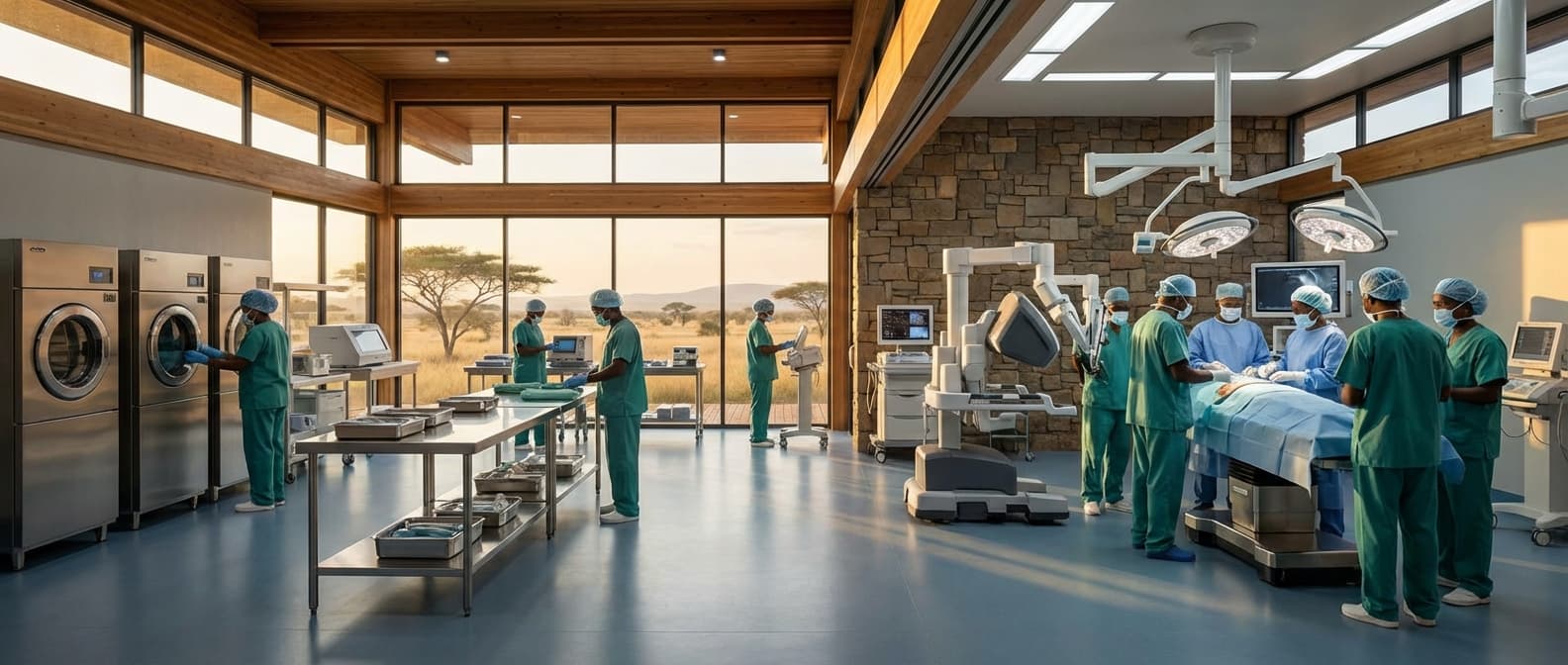
CSSD Design & Validation in Nigeria
Engineering Excellence & Technical Support
CSSD workflow design, validation and process development High-standard technical execution following OEM protocols and local regulatory frameworks.
Advanced Sterilization & Decontamination Protocols
Implementing and validating cutting-edge CSSD workflows utilizing state-of-the-art steam, low-temperature (EtO/VHP), and irradiation sterilization technologies, adhering to international standards (ISO 13485, AAMI ST) tailored for Nigeria's healthcare landscape. Focus on optimizing cycle times, efficacy, and staff safety.
Comprehensive Validation & Quality Assurance Frameworks
Designing and executing rigorous validation protocols for all CSSD equipment and processes, including IQ, OQ, and PQ. Establishing robust quality assurance systems with integrated traceability, incident management, and continuous improvement loops to ensure the highest levels of patient safety and compliance with Nigerian healthcare regulations.
Optimized CSSD Layouts & Workflow Engineering
Expert design of functional and efficient CSSD layouts that ensure logical workflow progression, minimize cross-contamination risks, and maximize throughput. Incorporating best practices in material handling, environmental controls (HVAC), and waste management to create a safe and productive sterile processing environment.
What Is Cssd Design & Validation In Nigeria?
Central Sterile Services Department (CSSD) Design & Validation in Nigeria refers to the comprehensive process of conceptualizing, planning, engineering, and subsequently verifying the operational efficacy and compliance of a sterile processing facility. This service is critical for healthcare institutions to ensure the safety and effectiveness of reusable medical devices through proper sterilization and reprocessing. It encompasses architectural layout, equipment selection, workflow optimization, and adherence to international and national standards governing sterile processing. Validation confirms that the designed systems and implemented processes consistently achieve the intended sterile outcomes.
| Service Aspect | Description | Target Audience | Typical Use Cases |
|---|---|---|---|
| CSSD Design | The engineering and architectural planning of a sterile processing facility, ensuring optimal workflow, infection control, and equipment integration. | Hospitals (public and private), clinics with surgical facilities, medical research institutions, healthcare consulting firms. | Construction of new healthcare facilities, renovation or expansion of existing hospitals, establishment of specialized surgical centers, creation of central sterile supply facilities for multiple healthcare sites. |
| CSSD Validation | The systematic process of testing and documenting that the designed CSSD facility, equipment, and operational processes consistently achieve the required standards for sterilization and product safety. | Healthcare facilities that operate or intend to operate a CSSD, regulatory bodies overseeing healthcare quality, medical device manufacturers (for their reprocessing instructions). | Commissioning of new sterilization equipment, verification after maintenance or repair of sterilization equipment, periodic revalidation to ensure ongoing compliance, implementation of new sterilization cycles or processes, response to quality control failures or audits. |
| Integrated CSSD Design & Validation Service | A holistic service that encompasses both the initial design and subsequent validation, providing a turnkey solution for establishing or upgrading CSSD operations. | Comprehensive range of healthcare providers requiring robust sterile processing capabilities, organizations seeking to ensure compliance with international quality standards. | Setting up a state-of-the-art CSSD from inception, upgrading an outdated sterile processing department, ensuring compliance for accreditation and licensing, improving patient safety and reducing healthcare-associated infections. |
Key Components of CSSD Design & Validation
- Needs Assessment & Functional Programming: Defining the scope, volume, and types of instruments to be processed, as well as the required throughput.
- Architectural & Spatial Design: Optimizing layout for unidirectional workflow (decontamination, packaging, sterilization, storage), segregation of clean and dirty areas, ventilation (HVAC), and infection control principles.
- Equipment Specification & Selection: Identifying appropriate washers, sterilizers (steam, low-temperature, etc.), instrument tracking systems, and ancillary equipment based on workload, technology, and regulatory requirements.
- Workflow & Process Engineering: Developing Standard Operating Procedures (SOPs) for all stages of sterile processing, including receiving, cleaning, disinfection, inspection, assembly, packaging, sterilization, storage, and distribution.
- Validation Protocol Development: Creating detailed plans for Installation Qualification (IQ), Operational Qualification (OQ), and Performance Qualification (PQ) to verify equipment and process performance.
- Installation Qualification (IQ): Verifying that equipment is installed correctly according to manufacturer specifications and design requirements.
- Operational Qualification (OQ): Testing the equipment at its operational limits to ensure it performs as intended across its specified range.
- Performance Qualification (PQ): Documenting and demonstrating that the installed equipment and integrated processes consistently produce sterile items that meet predetermined specifications, often using biological indicators (BIs) and chemical indicators (CIs).
- Regulatory Compliance Review: Ensuring adherence to relevant Nigerian healthcare regulations, WHO guidelines, AAMI standards, and other applicable international best practices.
- Staff Training & Competency Assessment: Developing and implementing training programs for CSSD personnel on equipment operation, SOPs, and infection control.
- Post-Validation Monitoring & Revalidation: Establishing a schedule for routine monitoring, calibration, and periodic revalidation to maintain compliance and optimal performance.
Who Needs Cssd Design & Validation In Nigeria?
Central Sterile Supply Departments (CSSDs) are critical hubs in healthcare facilities, responsible for the decontamination, sterilization, and supply of medical devices. In Nigeria, like anywhere else in the world, the effectiveness and safety of patient care are directly linked to the robust functioning of the CSSD. Therefore, specialized CSSD design and validation services are not a luxury but a necessity for a wide range of healthcare providers. These services ensure that CSSDs are not only compliant with international and local standards but also operate efficiently, minimize infection risks, and ultimately contribute to better patient outcomes. Without proper design and ongoing validation, CSSDs can become bottlenecks, compromise sterile supplies, and pose significant risks to patients and healthcare workers.
| Target Customer Type | Specific Departments/Roles |
|---|---|
| Hospitals (Public & Private) | CSSD Management & Staff, Infection Prevention & Control Department, Quality Assurance Department, Engineering & Facilities Management, Surgical Departments, Intensive Care Units (ICUs), Emergency Departments, Procurement Department. |
| Clinics & Diagnostic Centers (Large Scale) | CSSD Supervisors, Lead Nurses/Technicians, Operations Managers, Biomedical Engineering. |
| Tertiary Healthcare Institutions/Teaching Hospitals | Head of CSSD, Chief Medical Director's Office, Director of Nursing Services, Quality Management Unit, Estates Department, All Clinical Departments requiring sterile instruments. |
| Specialty Hospitals (e.g., Surgical, Oncology) | CSSD Director, Clinical Department Heads (Surgery, Oncology), Patient Safety Officer, Biomedical Engineers. |
| Government Health Ministries & Agencies | Regulatory Compliance Officers, Hospital Administrators, Public Health Inspectors, Directors of Healthcare Services. |
| International Health Organizations & NGOs | Program Managers for healthcare infrastructure, Technical Advisors on infection control, Project Managers for facility upgrades. |
| Medical Equipment Suppliers & Manufacturers | Sales and Technical Support Teams, Product Development, Installation and Commissioning Teams. |
Who Needs CSSD Design & Validation in Nigeria?
- Healthcare facilities of all sizes and types.
- Organizations seeking to improve patient safety and reduce healthcare-associated infections (HAIs).
- New hospital constructions or expansions.
- Existing facilities undergoing renovations or upgrades of their CSSD.
- Institutions aiming for international accreditation or adherence to global best practices.
- Government health agencies and regulatory bodies overseeing healthcare quality.
- Manufacturers and suppliers of CSSD equipment and consumables.
Cssd Design & Validation Process In Nigeria
The design and validation of a Central Sterile Supply Department (CSSD) in Nigeria is a multi-stage process aimed at ensuring the safe and efficient sterilization of medical instruments. This workflow, from initial inquiry to final execution, involves a collaboration between healthcare facilities, CSSD specialists, equipment manufacturers, and regulatory bodies.
| Stage | Description | Key Activities | Key Stakeholders | Nigerian Context Considerations |
|---|---|---|---|---|
| The process begins with a healthcare facility identifying the need for a new CSSD or upgrading an existing one. This involves understanding the current surgical procedures, instrument types, patient volume, and anticipated future needs. | Site visit, discussion with hospital management and clinical staff, review of existing infrastructure, definition of scope and budget. | Healthcare Facility Management, Clinical Department Heads, CSSD Project Lead, Potential CSSD Consultants. | Understanding the specific types of surgical procedures performed locally, availability of skilled personnel for operation and maintenance, local waste management practices for contaminated materials. |
| Based on the needs assessment, a preliminary layout and functional requirements for the CSSD are developed. This stage focuses on workflow, space allocation, and basic operational principles. | Developing preliminary floor plans, defining work zones (decontamination, preparation & packing, sterilization, storage, dispatch), identifying key equipment types needed, adherence to international standards (e.g., ISO 13485, AAMI ST guidelines) with local adaptation. | CSSD Consultants/Designers, Architects, Biomedical Engineers, Hospital Management. | Ensuring adequate ventilation and infection control measures are incorporated from the outset, considering potential power supply fluctuations and the need for backup generators, planning for water quality and availability. |
| This stage involves the creation of detailed architectural and engineering drawings, precise equipment specifications, and selection of specific sterilizers, washers, dryers, and other necessary equipment. | Finalizing layout and detailed schematics, specifying materials and finishes, obtaining quotes from reputable equipment manufacturers and suppliers, considering energy efficiency and ease of maintenance. | Architects, Mechanical & Electrical Engineers, Plumbing Engineers, CSSD Specialists, Procurement Department, Equipment Vendors. | Prioritizing equipment with good local support and availability of spare parts, ensuring compatibility with existing infrastructure and power grid, obtaining necessary import permits and adhering to Nigerian customs regulations. |
| Once the design is finalized and equipment selected, the procurement process is initiated. This involves placing orders, managing logistics, and overseeing the installation of all CSSD equipment and infrastructure. | Issuing purchase orders, coordinating shipping and customs clearance, supervising installation by vendors, conducting initial checks on equipment functionality. | Procurement Department, Logistics Managers, Equipment Vendors, Installation Teams, Biomedical Engineers. | Navigating potential delays in shipping and customs, ensuring qualified local technicians are involved in installation and initial setup, providing robust training for installation teams. |
| This critical phase verifies that the installed equipment and systems perform according to manufacturer specifications and design intent. It involves a series of tests and checks. | Performance testing of all equipment (e.g., sterilizer cycle validation, washer efficacy tests), verification of utilities (water, steam, electricity), ensuring safety features are functional. | Biomedical Engineers, Equipment Vendors, CSSD Technicians, Quality Assurance Team. | Ensuring the availability of qualified personnel to conduct and document these tests, using internationally recognized protocols and adapting them to local resources and conditions. |
| Validation confirms that the entire CSSD process consistently produces sterile instruments. This involves rigorous testing and comprehensive documentation. | Process validation (IQ, OQ, PQ - Installation Qualification, Operational Qualification, Performance Qualification), developing Standard Operating Procedures (SOPs), staff training on SOPs and equipment operation, establishing quality control protocols. | CSSD Management, Quality Assurance Department, Infection Control Committee, External Validation Consultants (if required). | Developing SOPs in both English and potentially local languages for clarity, ensuring documentation meets the requirements of Nigerian health authorities and any relevant international accreditation bodies, comprehensive training programs for staff, including ongoing competency assessments. |
| The CSSD's performance is continuously monitored to ensure ongoing sterility. Regular maintenance and periodic re-validation are essential to maintain compliance and efficiency. | Routine monitoring of sterilization cycles (e.g., Bowie-Dick tests, biological indicators), regular equipment maintenance, periodic audits and re-validation of processes, continuous staff training and competency checks. | CSSD Technicians, Biomedical Engineers, Quality Assurance Department, Infection Control Committee, Regulatory Inspectors. | Establishing a schedule for preventive maintenance, ensuring a readily available supply of consumables for monitoring, maintaining records for inspection by regulatory bodies, adapting to any changes in national health regulations or guidelines. |
CSSD Design & Validation Process Workflow in Nigeria
- Initial Inquiry & Needs Assessment
- Conceptual Design & Planning
- Detailed Design & Equipment Selection
- Procurement & Installation
- Commissioning & Qualification
- Validation & Documentation
- Ongoing Monitoring & Re-validation
Cssd Design & Validation Cost In Nigeria
Designing and validating a Central Sterile Services Department (CSSD) in Nigeria involves a complex interplay of factors that significantly influence the overall cost. These costs can be broadly categorized into design, equipment, installation, validation, and ongoing operational expenses. The pricing is highly dependent on the scale of the facility, the types of procedures it will support, the level of automation desired, and the specific location within Nigeria. Local currency (Nigerian Naira, NGN) pricing is subject to fluctuation due to inflation and import duties on specialized equipment. It's crucial for healthcare facilities to engage with experienced CSSD consultants and equipment suppliers who can provide accurate, tailored quotes.
| Category | Estimated Range (NGN) | Notes |
|---|---|---|
| CSSD Design & Consultancy | 5,000,000 - 25,000,000+ | Dependent on project complexity, size, and consultant experience. |
| Basic Equipment (Manual/Semi-Automated) | 50,000,000 - 150,000,000 | Includes 1-2 autoclaves, washer-disinfector, drying cabinets, workbenches, etc. for a small to medium facility. |
| Advanced/Automated Equipment | 150,000,000 - 500,000,000+ | For larger hospitals, includes multiple advanced sterilizers (EtO, H2O2), automated washer-disinfectors, tracking systems, etc. |
| Infrastructure Modifications & Fit-Out | 20,000,000 - 100,000,000+ | Varies significantly based on existing building condition and required upgrades (flooring, ventilation, plumbing, electrical). |
| Installation & Commissioning | 5,000,000 - 20,000,000+ | Professional installation and initial setup of equipment. |
| Validation & Testing | 3,000,000 - 15,000,000+ | Essential for regulatory compliance. Covers IQ, OQ, PQ for all equipment. |
| Staff Training | 1,000,000 - 5,000,000+ | Training on equipment, procedures, and infection control. |
| Contingency & Miscellaneous | 10-15% of total project cost | For unforeseen expenses and minor additions. |
Key Pricing Factors for CSSD Design & Validation in Nigeria
- Scope and Size of the CSSD: Larger departments with higher throughput require more space, equipment, and personnel, leading to increased costs.
- Level of Automation: Manual cleaning and sterilization processes are less expensive upfront but more labor-intensive. Automated systems (e.g., washer-disinfectors, sterilizers, tracking software) offer higher efficiency but come with a significant initial investment.
- Types of Sterilization Equipment: Different sterilization modalities (e.g., steam autoclaves, low-temperature sterilizers like EtO or H2O2 plasma) have varying capital costs and operational requirements.
- Building Infrastructure and Modifications: This includes costs for renovation, specialized flooring, ventilation systems, water supply, drainage, and electrical infrastructure to meet CSSD standards.
- Material and Finish Quality: High-grade, durable, and easily cleanable materials are essential for CSSD environments, impacting material costs.
- Consultancy Fees: Engaging experienced CSSD designers, engineers, and validation specialists is crucial for compliance and efficiency, and their fees vary.
- Equipment Procurement and Import Duties: Most advanced CSSD equipment is imported, incurring significant import duties, taxes, and shipping costs, which are a major cost driver.
- Installation and Commissioning: Professional installation of complex machinery and integration of systems require specialized technicians.
- Validation and Testing Services: Independent validation of equipment and processes to international standards (e.g., ISO 13485, HTM 01-01) is a mandatory and often expensive step.
- Training of Staff: Comprehensive training for CSSD personnel on equipment operation, maintenance, and infection control protocols is a necessary investment.
- Location and Supplier Choice: Costs can vary between major cities and more remote areas, and different suppliers may offer competitive pricing.
- Regulatory Compliance Requirements: Adhering to Nigerian health regulations and international best practices dictates the quality and type of equipment and infrastructure, influencing costs.
Affordable Cssd Design & Validation Options
Designing and validating a Central Sterile Supply Department (CSSD) is crucial for infection control and patient safety. However, the costs associated with proper design and ongoing validation can be a significant concern for healthcare facilities, especially those with budget constraints. This guide explores affordable CSSD design principles and validation options, focusing on value bundles and cost-saving strategies.
| Value Bundle / Strategy | Description | Cost-Saving Aspect |
|---|---|---|
| "Phased-In" CSSD Design | Designing the CSSD with future expansion in mind, but implementing only the essential components initially. This might involve 'hard-piping' for future equipment or dedicating space for later additions. | Reduces upfront capital expenditure. Allows for gradual investment as patient volume or service offerings grow. |
| Combined Equipment & Service Packages | Manufacturers often offer packages that bundle sterilization equipment (e.g., autoclaves, washer-disinfectors) with initial installation, training, and a period of preventative maintenance or validation. | Negotiated discounts on bundled items. Streamlined procurement and implementation. Predictable operational costs. |
| Validation Service Retainers / Long-Term Contracts | Securing a service contract with a validation provider for a set period (e.g., 3-5 years) for routine performance qualifications (PQ) and calibration of sterilization equipment. | Volume discounts on validation services. Reduced administrative overhead of ad-hoc contracting. Guaranteed availability of validation services. |
| 'Train-the-Trainer' Programs for Validation | Investing in a program where key CSSD personnel are trained by a validation expert to perform certain routine internal checks and calibrations, under the guidance of the external validator. | Reduces the frequency and cost of external validation for less complex tasks. Empowers internal staff and improves understanding of equipment performance. |
| 'Lean' Process Optimization for Workflow | Implementing Lean principles to analyze and optimize the flow of instruments through the CSSD, from decontamination to sterile storage. This includes minimizing unnecessary movement, reducing bottlenecks, and standardizing procedures. | Increased staff efficiency. Reduced reprocessing errors. Improved turnaround times, potentially reducing the need for excess instrument sets. |
| Strategic Use of Disposable vs. Reusable Supplies | Carefully evaluating the cost-benefit of using disposable instruments or components versus reusable ones, considering cleaning, sterilization, and maintenance costs for reusables. | Lower upfront investment for disposables. Reduced labor and utility costs associated with reprocessing reusables. |
| Shared Resource Models (Inter-Facility) | For smaller or rural facilities, exploring partnerships with larger hospitals or specialized service providers to share high-cost sterilization equipment or validation services. | Avoids the capital cost of purchasing and maintaining expensive equipment. Access to advanced validation expertise without direct investment. |
| Energy-Efficient Equipment & Practices | Selecting sterilization equipment with good energy efficiency ratings and implementing practices like optimizing cycle times and ensuring proper insulation. | Reduced utility costs (electricity, water, steam). |
Key Considerations for Affordable CSSD Design & Validation
- Needs Assessment: Thoroughly understanding the facility's current and future sterilization needs is paramount to avoid over-engineering or under-resourcing.
- Modular Design: Opting for modular or scalable CSSD layouts allows for phased implementation and future expansion, minimizing initial capital outlay.
- Efficient Workflow: Prioritizing a logical workflow from dirty to clean areas reduces cross-contamination risks and optimizes staff time, indirectly saving costs.
- Technology Selection: Choosing appropriate, not necessarily the most expensive, sterilization technologies that meet regulatory requirements and throughput needs.
- Strategic Outsourcing: Evaluating which CSSD processes might be more cost-effectively outsourced to specialized providers.
- Training & Competency: Investing in comprehensive staff training ensures correct operation of equipment and adherence to protocols, preventing costly errors and rework.
- Preventative Maintenance: Implementing a robust preventative maintenance schedule for sterilization equipment reduces unexpected breakdowns and prolongs equipment lifespan.
- Validation Partnerships: Collaborating with validation service providers to bundle services or negotiate long-term contracts.
- Standardization: Adopting standardized processes and documentation streamlines validation efforts and reduces variability.
Verified Providers In Nigeria
In Nigeria's evolving healthcare landscape, identifying trusted and competent medical professionals is paramount. Verified providers offer a crucial layer of assurance, ensuring patients receive high-quality care. Franance Health stands out as a leading platform dedicated to connecting individuals with such verified healthcare professionals. Their stringent credentialing process, commitment to patient well-being, and focus on accessibility make them the premier choice for anyone seeking reliable healthcare services in Nigeria.
| Criteria | Franance Health's Approach | Benefit to Patients |
|---|---|---|
| Provider Qualification | Mandatory verification of medical licenses, certifications, and educational degrees. | Assurance of competence and adherence to professional standards. |
| Professional Ethics | Emphasis on ethical practice and patient-centered care during the vetting process. | Trustworthy interactions and respectful treatment. |
| Specialty Expertise | Verification of specific specializations and accreditations. | Access to highly skilled professionals for specific medical needs. |
| Reputation and Experience | Consideration of professional history and, where possible, patient feedback mechanisms. | Confidence in providers with proven track records. |
| Platform Integration | Seamless integration of verified providers onto a user-friendly digital platform. | Convenient searching, booking, and access to healthcare services. |
Why Franance Health is Your Best Choice for Verified Providers in Nigeria:
- Rigorous Vetting Process: Franance Health employs a multi-faceted verification system that goes beyond basic qualifications. This includes checking medical licenses, professional certifications, educational backgrounds, and, where applicable, specialist accreditations.
- Commitment to Patient Safety and Quality: By partnering exclusively with verified providers, Franance Health prioritizes your safety and guarantees access to experienced and ethical medical practitioners who adhere to the highest standards of care.
- Comprehensive Range of Specialties: Whether you need a general practitioner, a specialist surgeon, a pediatrician, or a mental health professional, Franance Health offers a broad spectrum of verified providers to meet diverse healthcare needs.
- User-Friendly Platform and Seamless Experience: The Franance Health platform is designed for ease of use, allowing patients to search, book appointments, and access information about verified providers efficiently.
- Focus on Accessibility and Affordability: Franance Health strives to make quality healthcare accessible to more Nigerians by connecting them with providers who offer transparent pricing and a range of service options.
- Continuous Monitoring and Feedback: Beyond initial verification, Franance Health may implement systems for ongoing provider evaluation and patient feedback, ensuring continued adherence to quality standards.
Scope Of Work For Cssd Design & Validation
This Scope of Work (SOW) outlines the design, validation, and technical deliverables required for the Central Sterile Supply Department (CSSD). It also specifies the standard specifications that will govern these processes and the final deliverables. The project aims to establish a state-of-the-art CSSD facility that adheres to the highest international standards for sterilization and infection control.
| Deliverable Type | Description | Associated Phase | Standard Specification Reference |
|---|---|---|---|
| Design Basis Report | Defines the overarching principles, operational requirements, space allocation, workflow, and regulatory compliance for the CSSD. | Phase 1 | ISO 13485, HTM 01-01, AAMI ST79 |
| Architectural & Engineering Drawings | Includes floor plans, elevations, sections, HVAC, plumbing, electrical, and medical gas schematics specific to CSSD workflow and safety. | Phase 2 | Local Building Codes, NFPA 99, ASHRAE Standards |
| Equipment Specifications & Schedules | Detailed technical specifications for all CSSD equipment (e.g., washers, disinfectors, sterilizers, drying cabinets, packaging systems). | Phase 2 | Manufacturer Specifications, EN 285, AAMI TIR30 |
| Workflow Diagrams & Process Maps | Visual representation of the entire CSSD workflow from receiving soiled instruments to sterile storage and distribution. | Phase 2 | Lean Manufacturing Principles, Standard Operating Procedures (SOPs) |
| Validation Master Plan (VMP) | Outlines the overall strategy for validating all CSSD equipment and processes. | Phase 4 | GHTF SG1/N065:2004, FDA 21 CFR Part 11 |
| Installation Qualification (IQ) Protocols | Documents that verify the equipment has been installed correctly according to manufacturer specifications and design. | Phase 4 | ISPE Baseline Guide: Commissioning and Qualification |
| Operational Qualification (OQ) Protocols | Documents that verify the equipment operates within its defined parameters and range. | Phase 4 | ISPE Baseline Guide: Commissioning and Qualification |
| Performance Qualification (PQ) Protocols | Documents that verify the equipment consistently performs as intended under actual or simulated use conditions. | Phase 4 | ISPE Baseline Guide: Commissioning and Qualification |
| Sterilization Cycle Development & Validation Reports | Includes development of appropriate sterilization cycles for various instrument types and validation of their efficacy. | Phase 4 | ISO 11135 (for EtO), ISO 17665 (for Steam), ISO 14937 (for other methods) |
| Cleaning and Disinfection Validation Reports | Validation of cleaning and disinfection processes to ensure effective removal of organic matter and reduction of microbial load. | Phase 4 | AAMI ST79, EN ISO 15883 Series |
| Sterile Barrier System (SBS) Validation Reports | Validation of the effectiveness of packaging materials and methods in maintaining sterility. | Phase 4 | EN ISO 11607 Series |
| Environmental Monitoring Reports | Validation of environmental parameters (temperature, humidity, air changes) and microbial monitoring of the CSSD environment. | Phase 4 | ISO 14644 Series, HTM 01-01 |
| Standard Operating Procedures (SOPs) | Comprehensive set of documented procedures for all CSSD operations, including receiving, cleaning, disinfection, packaging, sterilization, storage, and distribution. | Phase 5 | Internal Quality Management System, ISO 13485 |
| Training Manuals & Records | Materials and documentation for training CSSD personnel on all procedures and equipment operation. | Phase 5 | Organizational Training Policies |
| Risk Management File | Documentation of identified risks and mitigation strategies throughout the design, validation, and operational phases. | All Phases | ISO 14971 |
| As-Built Drawings | Updated drawings reflecting the final installed configuration of the CSSD. | Phase 6 | Project Management Standards |
| Project Closeout Report | Summary of project activities, final validation reports, lessons learned, and handover documentation. | Phase 6 | Project Management Standards |
Key Project Phases
- Phase 1: Conceptualization & Planning
- Phase 2: Detailed Design & Engineering
- Phase 3: Procurement & Construction
- Phase 4: Equipment Validation & Commissioning
- Phase 5: Operational Validation & Training
- Phase 6: Project Closeout
Service Level Agreement For Cssd Design & Validation
This Service Level Agreement (SLA) outlines the guaranteed response times and uptime for CSSD (Central Sterile Supply Department) Design & Validation services. It defines the expected levels of service performance and the remedies available to the client in case of non-compliance.
| Service Component | Response Time Guarantee | Uptime Guarantee (for remote support/monitoring systems) | Service Credits |
|---|---|---|---|
| Initial Consultation/Design Review Request | Within 4 business hours | N/A | N/A |
| Design Document Submission (Draft) | Within 5 business days of client input | N/A | N/A |
| Response to Clarification Questions (Design) | Within 8 business hours | N/A | N/A |
| Validation Protocol Draft Submission | Within 7 business days of design finalization | N/A | N/A |
| Response to Clarification Questions (Validation) | Within 4 business hours | N/A | N/A |
| On-site Validation Execution (Scheduled) | N/A (covered by project schedule) | N/A | N/A |
| Remote Support for Validation Equipment (if applicable) | Within 2 business hours | 99.5% | 5% of monthly fee for each 2-hour downtime incident exceeding 4 hours |
| Post-Validation Report Submission | Within 10 business days of completion of validation testing | N/A | N/A |
| Emergency Technical Support (Critical Issues) | Within 1 business hour | N/A | 10% of monthly fee for each 1-hour delay in initial response |
Scope of Services
- Design consultations and architectural reviews for CSSD facilities.
- Equipment selection and layout planning.
- Workflow optimization and process mapping.
- Validation protocols development (IQ/OQ/PQ).
- Execution of validation testing.
- Documentation and reporting for design and validation activities.
- Training on CSSD best practices and equipment operation.
- Post-validation support and troubleshooting.
Frequently Asked Questions

Ready when you are
Let's scope your CSSD Design & Validation in Nigeria project in Nigeria.

Scaling healthcare logistics and technical systems across the entire continent.