
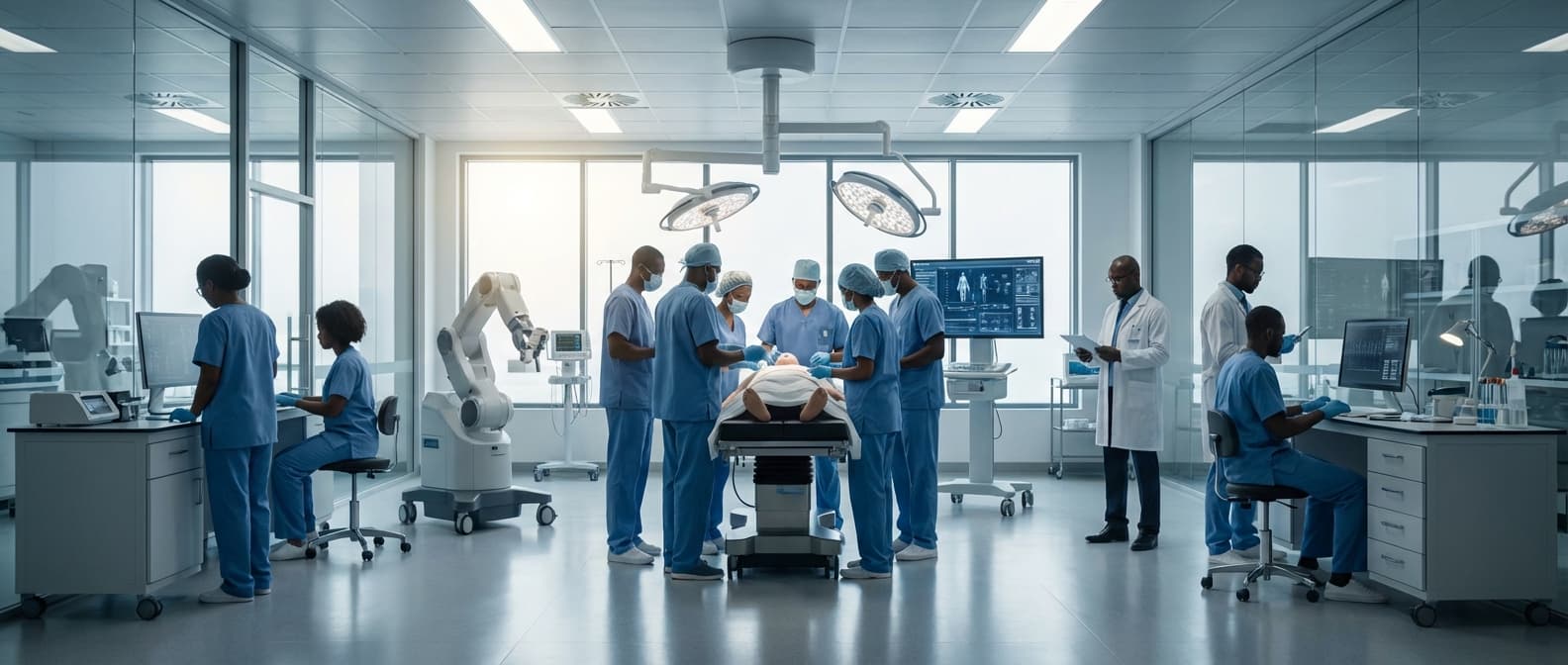
Biomedical Staffing Augmentation in Nigeria
Engineering Excellence & Technical Support
Onsite biomedical engineers and PACS administrators High-standard technical execution following OEM protocols and local regulatory frameworks.
Specialized Diagnostic Expertise
We provide highly skilled laboratory technologists and radiographers with specialized certifications and experience in areas like molecular diagnostics, advanced imaging, and pathology, addressing critical gaps in local diagnostic capacity and improving patient outcomes.
On-Demand Clinical Support Teams
Gain immediate access to augmented clinical teams, including registered nurses, nurse anesthetists, and specialized medical officers, to bolster hospital staffing during peak seasons, unexpected surges, or for the launch of new medical services, ensuring continuous high-quality patient care.
Project-Based Healthcare Professionals
Secure experienced healthcare professionals for specific project durations, such as implementing new health information systems, conducting public health campaigns, or supporting specialized medical missions, ensuring project success with adaptable and qualified human resources.
What Is Biomedical Staffing Augmentation In Nigeria?
Biomedical Staffing Augmentation in Nigeria refers to the strategic practice of supplementing a healthcare facility's existing biomedical engineering and technical workforce with qualified external professionals on a temporary or project-specific basis. This service aims to address critical gaps in specialized skills, manage fluctuating workloads, facilitate the deployment of new technologies, and ensure the optimal operational status of medical equipment. It involves a comprehensive process of identifying the specific staffing needs, sourcing, vetting, and deploying competent biomedical personnel, and managing their integration into the facility's workflow. The service can range from short-term contract assignments for routine maintenance and repairs to longer-term engagements for complex installations, validation, and training initiatives. It is particularly relevant in contexts where there is a shortage of highly skilled biomedical technicians and engineers, or where institutions face budget constraints that preclude the permanent hiring of a full complement of in-house staff.
| Stakeholder/Entity | Need for Biomedical Staffing Augmentation | Typical Use Cases |
|---|---|---|
| Public Hospitals | Limited internal capacity for specialized equipment maintenance, installation, and calibration; aging medical infrastructure requiring upgrades; budget constraints for permanent staff hiring. | Onboarding new imaging modalities (e.g., MRI, CT scanners); managing backlog of preventive maintenance; specialized repair of complex diagnostic equipment; support during capital equipment procurement and installation phases. |
| Private Healthcare Facilities | Rapid expansion of services requiring immediate technical support; need for specialized expertise not readily available in-house; peak demand periods for equipment uptime assurance. | Deployment of advanced surgical equipment; validation and calibration of critical care monitoring systems; short-term technical support for specialized clinics (e.g., cardiology, oncology); proactive maintenance programs for high-availability equipment. |
| Medical Equipment Manufacturers/Distributors | Need for skilled personnel to support product installations, commissioning, and post-sales service in diverse geographical locations; scaling service operations to meet market demand. | On-site installation and training for new product lines; third-party service and repair contracts; providing remote diagnostic and troubleshooting support; augmenting local technical teams during product launches. |
| Research Institutions & Universities | Requirement for highly specialized technical support for advanced research instrumentation; managing the lifecycle of complex laboratory equipment; facilitating interdisciplinary research projects requiring unique technical skills. | Maintenance and repair of sophisticated scientific instruments (e.g., mass spectrometers, electron microscopes); custom modification or integration of research equipment; providing technical expertise for grant-funded projects; training research staff on equipment operation and maintenance. |
| NGOs and Humanitarian Organizations | Operating in resource-limited settings with minimal in-house technical expertise; ensuring the functionality of critical medical equipment in remote or emergency response scenarios. | Setting up and maintaining medical facilities in underserved areas; providing technical support for essential diagnostic and therapeutic equipment; training local health workers on basic equipment maintenance; supporting mobile clinics and field hospitals. |
Key Components of Biomedical Staffing Augmentation:
- Needs Assessment: Thorough evaluation of the facility's current biomedical technical capabilities and identification of skill deficiencies or capacity limitations.
- Talent Sourcing & Vetting: Recruitment and rigorous screening of qualified biomedical engineers, technicians, and specialists with relevant certifications and experience.
- Deployment & Integration: Seamless placement of augmented staff into existing operational structures, ensuring adherence to facility protocols and standards.
- Scope Definition: Clearly outlining the responsibilities, deliverables, and duration of the augmentation engagement.
- Performance Monitoring & Reporting: Continuous evaluation of augmented staff performance and provision of regular progress reports to the client.
- Knowledge Transfer & Training: Facilitating the transfer of expertise and training to in-house personnel where applicable, promoting long-term sustainability.
Who Needs Biomedical Staffing Augmentation In Nigeria?
Biomedical staffing augmentation in Nigeria addresses the critical need for skilled professionals within the healthcare sector to ensure the efficient operation, maintenance, and advancement of medical technology. This service provides flexible access to specialized talent, bridging gaps caused by staff shortages, project demands, or the need for niche expertise. It empowers healthcare facilities to maintain optimal service delivery, respond effectively to evolving healthcare needs, and leverage new technologies without the long-term commitment of permanent hires.
| Department | Specific Needs Addressed by Augmentation | Examples of Augmented Roles |
|---|---|---|
| Biomedical Engineering Department | Maintenance backlog, specialized repair needs, implementation of new technology, project management, regulatory compliance checks. | Senior Biomedical Engineers, Equipment Specialists, Calibration Technicians, Project Managers |
| Radiology/Imaging Department | Installation and calibration of new imaging equipment (MRI, CT, X-ray), specialized maintenance, on-call support for critical equipment. | Imaging Equipment Technicians, X-ray Service Engineers, MRI Technicians |
| Surgical & Anesthesia Departments | Maintenance and calibration of surgical robots, anesthesia machines, patient monitoring systems, specialized equipment during high-demand periods. | Anesthesia Machine Technicians, Surgical Equipment Specialists, Patient Monitor Technicians |
| Laboratory Services | Maintenance of complex diagnostic analyzers, biosafety cabinets, incubators, and other critical laboratory equipment. | Clinical Laboratory Equipment Technicians, Diagnostic Analyzer Specialists |
| IT & Medical Informatics | Integration of medical devices with hospital information systems (HIS) and electronic health records (EHR), cybersecurity for medical devices. | Medical IT Integration Specialists, Biomedical Data Analysts |
| Procurement & Logistics | Technical evaluation of new medical equipment, vendor management for technical services. | Technical Procurement Specialists, Vendor Liaison Officers |
Target Customers & Departments for Biomedical Staffing Augmentation in Nigeria
- Hospitals & Healthcare Facilities:
- Public Hospitals: Often face budget constraints and staffing shortages, making augmentation crucial for maintaining essential services.
- Private Hospitals: Seeking to enhance service quality, expand specialized offerings, and manage peak workloads.
- Teaching Hospitals: Require a robust biomedical engineering department to support training, research, and advanced patient care.
- Specialty Clinics (e.g., Dialysis Centers, Diagnostic Imaging Centers): Need specific technical expertise for their specialized equipment.
- Tertiary Healthcare Centers: Dealing with complex technologies and high patient volumes.
- Medical Device Manufacturers & Distributors:
- Local Branches/Representatives: Requiring skilled technicians for installation, maintenance, and repair of their devices.
- Service Partners: Offering outsourced maintenance and repair services who may need to scale their workforce.
- Research & Development Institutions:
- Medical Research Labs: Needing support for the operation and calibration of sophisticated research equipment.
- Universities with Medical Programs: For technical support in their medical engineering and allied health departments.
- Government Health Agencies & Ministries:
- Regulatory Bodies: May require expert input on medical device compliance and standards.
- Public Health Initiatives: Needing technical staff for deployed medical equipment in various regions.
Biomedical Staffing Augmentation Process In Nigeria
The Biomedical Staffing Augmentation Process in Nigeria outlines a structured approach for healthcare institutions to acquire specialized biomedical personnel to supplement their existing teams. This process ensures qualified professionals are deployed efficiently, addressing staffing gaps and enhancing the operational capacity of healthcare facilities. The workflow begins with a formal inquiry from a healthcare institution and culminates in the successful placement and integration of augmented staff.
| Stage | Description | Key Activities | Responsible Parties | Deliverables/Outcomes |
|---|---|---|---|---|
| The healthcare institution identifies a need for augmented biomedical staff and initiates contact with a staffing provider. | Formal request for services, detailed specification of required roles, skill sets, experience levels, and duration of need. | Healthcare Institution (Client), Staffing Provider (Agency) | Clear understanding of staffing requirements, documented needs assessment. |
| The staffing provider develops and submits a comprehensive proposal outlining their understanding of the needs and proposed solutions. | Review of requirements, service model definition, pricing structure, proposed timelines, and key personnel from the agency. | Staffing Provider (Agency) | Formal proposal document, including cost estimates and service level agreements. |
| Both parties negotiate the terms and conditions of the staffing agreement. | Discussion and agreement on rates, payment terms, contract duration, termination clauses, insurance, and legal compliance. | Healthcare Institution (Client), Staffing Provider (Agency) | Signed staffing augmentation contract. |
| The staffing provider actively searches for and vets suitable biomedical professionals. | Database search, external recruitment, background checks, skills assessment, reference verification, interviews (technical and behavioral). | Staffing Provider (Agency) | Shortlist of qualified and pre-vetted candidates for client review. |
| Once candidates are selected by the client, the onboarding and deployment process begins. | Facilitating any necessary pre-deployment training, documentation completion (contracts, compliance), logistical arrangements, and introducing staff to the client's facility. | Staffing Provider (Agency), Healthcare Institution (Client) | Augmented biomedical staff deployed and integrated into the client's operations. |
| Continuous support and monitoring to ensure the success of the augmented staff and the partnership. | Regular check-ins with deployed staff and client, performance reviews, addressing any issues or concerns, providing ongoing training if needed. | Staffing Provider (Agency), Healthcare Institution (Client) | Successful integration and sustained performance of augmented staff, client satisfaction. |
| Upon completion of the contract period, the engagement is formally closed, and feedback is collected. | Final performance review, contract closure documentation, invoice settlement, and collection of feedback from both parties for continuous improvement. | Staffing Provider (Agency), Healthcare Institution (Client) | Completed contract, performance data, and insights for future engagements. |
Biomedical Staffing Augmentation Process Workflow in Nigeria
- Inquiry & Needs Assessment
- Proposal Development & Submission
- Contract Negotiation & Agreement
- Candidate Sourcing & Vetting
- Onboarding & Deployment
- Ongoing Support & Performance Monitoring
- Contract Close-out & Feedback
Biomedical Staffing Augmentation Cost In Nigeria
Biomedical Staffing Augmentation in Nigeria involves strategically bringing in skilled biomedical professionals to supplement existing healthcare teams, address temporary or specialized needs, and improve overall healthcare delivery. The cost of such augmentation is influenced by a variety of factors, leading to a range of pricing within the Nigerian market. These factors include the specialization and experience of the biomedical staff, the duration and intensity of the engagement, geographical location within Nigeria, and the reputation/size of the staffing agency. Understanding these elements is crucial for healthcare institutions planning to augment their biomedical workforce.
| Staffing Role (Example) | Estimated Daily Rate Range (NGN) | Estimated Monthly Rate Range (NGN) | Notes |
|---|---|---|---|
| Biomedical Technician (Entry-Level/General) | 30,000 - 60,000 | 600,000 - 1,200,000 | Focus on basic maintenance, calibration, and repair of common medical equipment. |
| Biomedical Technician (Experienced/Specialized) | 50,000 - 100,000 | 1,000,000 - 2,000,000 | Expertise in specific equipment types (e.g., imaging, laboratory), advanced troubleshooting, and preventive maintenance. |
| Senior Biomedical Engineer/Specialist | 70,000 - 150,000+ | 1,400,000 - 3,000,000+ | Involves complex system management, project oversight, strategic planning for biomedical assets, and specialized repair. |
| Medical Equipment Service Consultant (Short-Term Project) | 80,000 - 200,000 (per day) | N/A | Hired for specific projects like equipment assessment, new installation guidance, or complex repair diagnosis. Often charged daily. |
| Emergency/On-Call Biomedical Support | 40,000 - 80,000 (per call/day) | Varies | Higher rates due to immediate response and potential disruption of personal time. May have retainer fees. |
Key Pricing Factors for Biomedical Staffing Augmentation in Nigeria
- Specialization and Skill Level: Highly specialized roles (e.g., advanced diagnostic imaging technicians, specialized medical equipment engineers) command higher rates than general biomedical technicians. The level of experience, certifications, and advanced training directly impacts pricing.
- Duration and Intensity of Engagement: Short-term, project-based assignments or emergency coverage will generally have a higher hourly or daily rate compared to longer-term contracts. The number of hours per week or the intensity of the service required also plays a role.
- Geographical Location: Staffing costs can vary significantly between major metropolitan areas like Lagos and Abuja (which tend to have higher costs of living and demand) and more rural or less developed regions. Relocation or travel allowances may also be factored in for staff deployed to remote areas.
- Staffing Agency Fees: Recruitment agencies typically add a margin to the base salary of the biomedical professional. This margin covers their recruitment costs, administrative overhead, vetting processes, and profit. Larger, more established agencies might charge a higher percentage.
- Benefits and Allowances: The cost can also be influenced by whether the staffing provider includes benefits such as health insurance, housing allowances, transportation, or per diem for remote assignments. These are often bundled into the overall package.
- Demand and Supply: High demand for specific biomedical skills coupled with a limited supply of qualified professionals will drive up costs. Conversely, in areas with a surplus of a particular skill set, rates might be more competitive.
Affordable Biomedical Staffing Augmentation Options
Finding cost-effective ways to augment biomedical staff is crucial for research institutions, hospitals, and biotech companies. This can involve leveraging external expertise for specific projects, filling temporary gaps, or acquiring specialized skills without the long-term commitment of full-time hires. Understanding "value bundles" and implementing smart cost-saving strategies can significantly reduce expenditure while maintaining high-quality scientific and technical support.
| Value Bundle Example | Components | Cost-Saving Rationale | Typical Application |
|---|---|---|---|
| Project-Based Research Support | Senior Scientist + Research Assistant + Data Analyst | Bundled rate offers economies of scale; shared overhead; focused expertise speeds up project completion. | Short-term research projects, clinical trial support, assay development. |
| Lab Operations & Maintenance | Lab Technician + Equipment Calibration Service + Consumables Management | Integrated services reduce administrative burden; preventative maintenance minimizes costly downtime; bulk purchasing of consumables. | Routine laboratory operations, multi-user lab facilities, biotech startups. |
| Specialized Technical Skill Augmentation | Bioinformatics Specialist (Part-Time) + Project Manager | Access to niche expertise without full-time salary; project management ensures efficient utilization of specialist's time. | Genomic sequencing analysis, computational biology, clinical data management. |
| Interim Leadership/Management | Experienced Department Head (Contract) + Administrative Support | Provides immediate leadership during transitions; avoids disruption; benefits from external perspective; lower cost than permanent hire with recruitment fees. | Maternity/paternity leave coverage, departmental restructuring, leadership gaps. |
| On-Demand Scientific Consulting | Expert Consultant (Hourly/Daily Rate) + Virtual Assistant for scheduling/logistics | Pay only for expertise needed; avoids long-term commitment; leverages virtual support for administrative tasks. | Troubleshooting complex experiments, strategic planning, regulatory guidance. |
Affordable Biomedical Staffing Augmentation Options
- {"title":"Value Bundles Defined","description":"Value bundles are pre-packaged service offerings that combine multiple resources or services at a discounted rate compared to procuring them individually. In staffing augmentation, this could mean bundling a senior researcher with a junior technician for a project, or combining lab support services with specialized data analysis."}
- {"title":"Benefits of Value Bundles","description":"They offer predictable costs, streamlined procurement, and often include a higher level of integrated expertise, leading to improved project efficiency and outcomes. This approach simplifies budgeting and resource management."}
- {"title":"Cost-Saving Strategies","description":"Implementing strategic approaches can significantly reduce the overall cost of staffing augmentation. These strategies focus on optimizing resource utilization, leveraging flexible engagement models, and seeking out cost-effective providers."}
Verified Providers In Nigeria
In Nigeria's evolving healthcare landscape, discerning reliable and qualified medical professionals is paramount for individuals seeking quality care. Verified providers, particularly those with strong credentials like Franance Health, stand out as the best choice. Franance Health's commitment to excellence is underpinned by rigorous credentialing processes, adherence to international best practices, and a dedication to patient-centered care. This ensures that their network comprises only highly skilled and ethical healthcare professionals, offering peace of mind and superior health outcomes to their clients.
| Provider Type | Franance Health Verification Criteria | Benefits for Patients |
|---|---|---|
| Doctors | Valid medical license, verifiable qualifications (MBBS, MD, specialization), clean disciplinary record, ongoing professional development. | Access to specialists with proven expertise, accurate diagnoses, effective treatment plans, and ethical patient management. |
| Nurses | Registered Nurse (RN) or equivalent certification, demonstrable practical experience, adherence to nursing ethics and protocols. | Reliable and compassionate care, effective patient monitoring, administration of treatments, and vital support during recovery. |
| Specialists (e.g., Surgeons, Cardiologists) | Board certification in their specialty, extensive experience in their field, proven track record of successful procedures and patient outcomes. | Access to highly skilled professionals for complex medical conditions and surgical interventions, leading to better prognoses. |
| Hospitals & Clinics | Accreditation from relevant health bodies, adherence to safety and hygiene standards, availability of necessary medical equipment and facilities, qualified medical and administrative staff. | Safe and equipped environments for diagnosis, treatment, and recovery, with access to a range of medical services and emergency care. |
Why Franance Health Providers Are the Best Choice:
- Rigorous Vetting and Credentialing Process
- Commitment to International Standards of Care
- Specialized Expertise and Advanced Training
- Patient-Centered Approach and Compassionate Service
- Access to Modern Medical Technology and Facilities
- Transparent and Ethical Medical Practices
Scope Of Work For Biomedical Staffing Augmentation
This Scope of Work (SOW) outlines the requirements for biomedical staffing augmentation services to support [Client Name]'s operational needs. The objective is to secure qualified and experienced biomedical professionals to supplement existing teams, ensuring the efficient maintenance, repair, and management of medical equipment. This augmentation will focus on critical areas and projects as defined by the client, addressing potential resource gaps and enhancing overall service delivery. The following sections detail the technical deliverables and standard specifications expected from the augmented staff.
| Technical Deliverable | Standard Specification | Key Performance Indicators (KPIs) | Reporting Requirements |
|---|---|---|---|
| Equipment Maintenance & Repair Reports | Detailed logs of all preventive maintenance (PM) and corrective maintenance (CM) activities. Include device identification, date of service, nature of work performed, parts used, technician's name, and time spent. Reports must adhere to established PM schedules and CM response time SLAs. | PM completion rate (%), CM response time (hours), CM resolution rate (%), Average downtime per device (hours). | Weekly summary reports detailing PM and CM activities, identification of recurring issues, and recommendations for process improvement. Monthly comprehensive reports including trend analysis and equipment performance metrics. |
| Calibration Certificates | Official documentation certifying that medical equipment has been calibrated against traceable standards. Certificates must include device details, calibration date, next calibration due date, acceptable tolerance ranges, and technician's signature/identification. | Calibration adherence to schedule (%), Accuracy of calibration within specified tolerances (%). | As-completed calibration certificates provided within 24 hours of service completion. Periodic (monthly/quarterly) reports on calibration status and compliance. |
| Equipment Decommissioning & Disposal Plans | Comprehensive plans for the safe and compliant decommissioning and disposal of medical equipment. Includes asset tag removal, data sanitization (if applicable), environmental impact assessment, and documentation of disposal methods. | Adherence to environmental regulations (%), Successful data sanitization of devices with sensitive data (%). | Project-specific plans submitted for approval prior to decommissioning. Final disposal reports submitted within 7 days of completion. |
| New Equipment Installation & Integration Reports | Documentation of the installation, setup, testing, and integration of new medical equipment. Includes configuration details, functional testing results, user training provided, and verification of network connectivity. | Successful installation and testing rate (%), User satisfaction with training (%), Equipment operational within specified parameters (%). | Pre-installation assessment reports. Post-installation reports detailing the entire process and outcomes. Daily/weekly progress reports during large-scale installations. |
| Biomedical Inventory Management Updates | Accurate and timely updates to the biomedical inventory management system. Includes adding new equipment, updating asset details, recording disposals, and tracking equipment status. | Inventory accuracy rate (%), Timeliness of inventory updates (%). | Real-time updates to the system as activities occur. Weekly reconciliation reports for critical inventory items. |
| Root Cause Analysis (RCA) Reports | In-depth investigations into equipment failures, safety incidents, or recurring problems. Reports should identify contributing factors, assess impact, and recommend corrective and preventive actions. | Number of RCA investigations completed per incident, Timeliness of RCA report submission, Implementation rate of recommended actions (%). | RCA reports submitted within 7 days of initiating an investigation. Quarterly review of recurring issues and RCA findings. |
| Training Material & Session Records | Development of training materials for clinical staff on the safe and effective use of medical equipment. Records of training sessions conducted, including attendee lists and feedback. | Number of training sessions delivered, Post-training knowledge assessment scores (%), Positive feedback from trainees (%). | Training material drafts submitted for review prior to sessions. Session attendance and feedback summaries provided within 48 hours of completion. |
| Compliance & Audit Support Documentation | Preparation and provision of documentation required for internal and external audits of biomedical equipment management. Includes maintenance records, calibration certificates, safety inspection reports, and inventory data. | Audit readiness (%), Successful audit outcomes (%). | On-demand provision of requested documentation. Proactive submission of compliance-related reports as per audit schedules. |
Key Objectives of Biomedical Staffing Augmentation
- Enhance the capacity of the biomedical engineering department to handle increased workloads and complex projects.
- Ensure timely and effective maintenance, calibration, and repair of all medical devices.
- Improve compliance with regulatory standards and safety protocols for medical equipment.
- Facilitate the successful implementation of new medical technologies and equipment.
- Provide specialized expertise in areas where internal resources may be limited.
Service Level Agreement For Biomedical Staffing Augmentation
This Service Level Agreement (SLA) outlines the guaranteed response times and uptime for biomedical staffing augmentation services provided by [Your Company Name] to [Client Company Name]. This SLA is an integral part of the Master Services Agreement (MSA) between the parties, dated [Date of MSA].
| Service Type | Priority Level | Uptime Guarantee | Response Time (Acknowledgement & Initial Action) | On-Site Presence (if applicable) | Notes |
|---|---|---|---|---|---|
| Biomedical Equipment Repair/Maintenance Augmentation | Critical (Patient Life Support, ICU, OR) | 98.0% | 1 hour (Acknowledgement), 4 hours (Initial Diagnosis/Action) | On-call within 2 hours of notification, on-site within 4 hours | Applies to equipment designated as Critical by the client. |
| Biomedical Equipment Repair/Maintenance Augmentation | High (Emergency Department, Operating Rooms) | 97.5% | 2 hours (Acknowledgement), 6 hours (Initial Diagnosis/Action) | On-call within 4 hours of notification, on-site within 8 hours | Applies to equipment designated as High Priority. |
| Biomedical Equipment Repair/Maintenance Augmentation | Medium (General Inpatient Wards, Diagnostic Imaging) | 97.0% | 4 business hours (Acknowledgement), 12 business hours (Initial Diagnosis/Action) | On-site within 24 business hours (as per agreed schedule) | Applies to equipment designated as Medium Priority. |
| Biomedical Equipment Installation/Commissioning Augmentation | All | N/A (Service is scheduled and pre-defined) | 24-48 business hours (for scheduling confirmation/prep) | As per project timeline | Requires client confirmation of equipment readiness and site access. |
| Biomedical Project Support Augmentation (e.g., inventory, recalls) | All | N/A (Service is scheduled and pre-defined) | 24-48 business hours (for resource allocation) | As per project timeline | Requires client provision of all necessary project documentation and resources. |
| Routine Biomedical Support Augmentation (e.g., preventive maintenance) | All | 95.0% | 1 business day (for scheduling confirmation) | As per agreed schedule | Service Window: Monday-Friday, 8:00 AM - 5:00 PM local time (excluding public holidays) |
Definitions
- Augmented Staffing: Temporary assignment of qualified biomedical professionals to support the client's operations.
- Critical Equipment: Biomedical equipment classified by the client as essential for patient care or operational continuity, with defined downtime impact.
- Downtime: The period during which a piece of equipment is non-operational and unavailable for its intended use.
- Emergency: A situation requiring immediate intervention due to a critical equipment failure or an urgent staffing need impacting patient safety or critical operations.
- Response Time: The maximum allowable time from the client's notification of a need (e.g., equipment failure, staffing request) until [Your Company Name]'s augmented staff begins active work or acknowledges the request and provides a resolution plan.
- Scheduled Maintenance: Planned downtime for routine maintenance or repairs, pre-approved by the client.
- Service Window: The agreed-upon hours during which augmented staffing services are expected to be available.
- Uptime Guarantee: The minimum percentage of time that augmented staffing services are expected to be available and functional within the agreed Service Window.
- Working Hours: Hours within the Service Window during which augmented staffing is actively engaged or available for immediate dispatch.
Frequently Asked Questions

Ready when you are
Let's scope your Biomedical Staffing Augmentation in Nigeria project in Nigeria.

Scaling healthcare logistics and technical systems across the entire continent.