
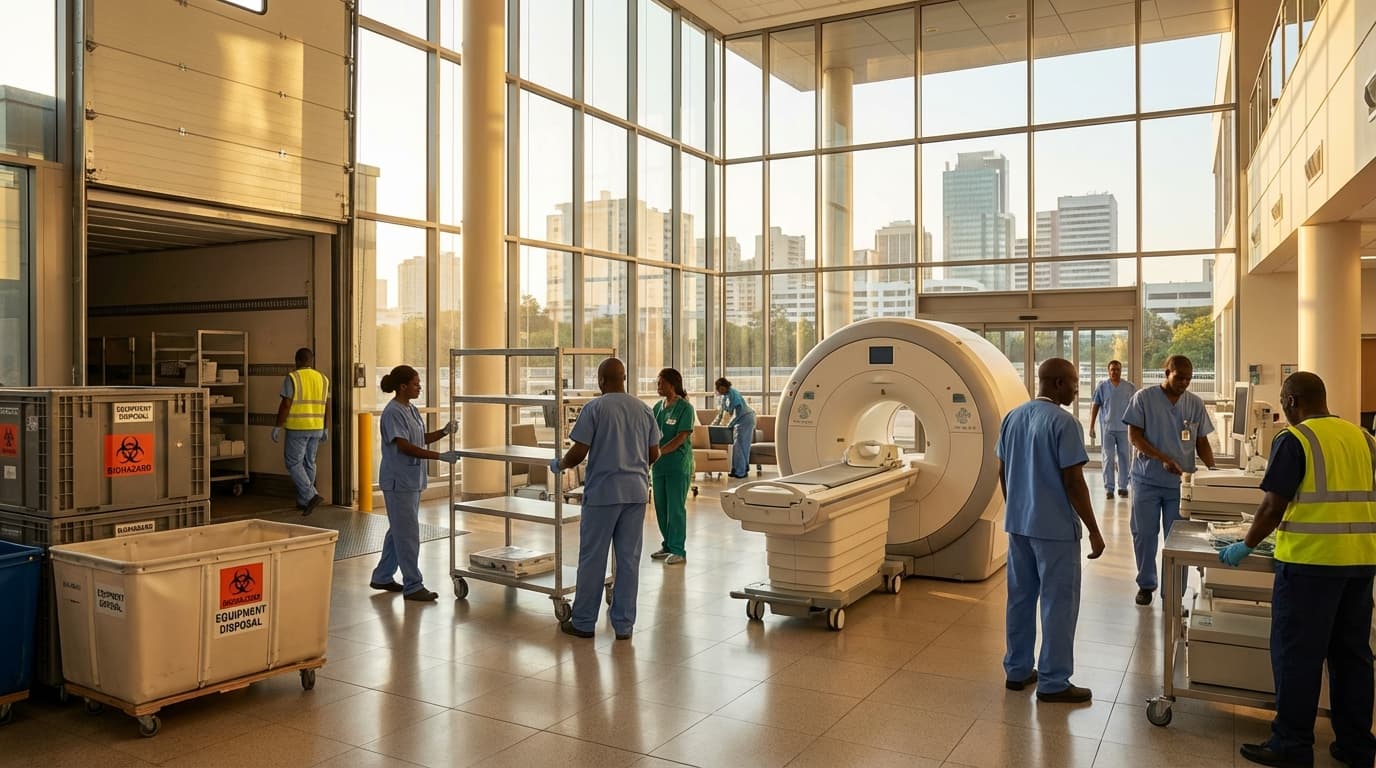
Heavy Medical Equipment De-Installation Service (MRI/CT/Cath Lab) in Niger
Engineering Excellence & Technical Support
Heavy Medical Equipment De-Installation Service (MRI/CT/Cath Lab) High-standard technical execution following OEM protocols and local regulatory frameworks.
Expert MRI/CT Decommissioning
Our certified technicians specialize in the safe and compliant de-installation of high-field MRI and CT scanners in Niger. We adhere to stringent safety protocols, ensuring minimal radiation exposure and environmental impact during the dismantling of complex imaging equipment.
Cath Lab System Removal
We provide meticulous de-installation services for Cath Lab systems, including X-ray generators, image intensifiers, and patient tables. Our team is trained in handling sensitive vascular imaging equipment, ensuring all components are carefully disconnected and secured for transport.
Logistics & Secure Transport Niger
Beyond technical de-installation, we manage the secure and compliant logistics for heavy medical equipment removal across Niger. Our services include careful packaging, specialized transport solutions, and coordination with local authorities to ensure seamless transit from your facility.
What Is Heavy Medical Equipment De-installation Service (Mri/ct/cath Lab) In Niger?
Heavy Medical Equipment De-Installation Service (MRI/CT/Cath Lab) in Niger refers to the specialized process of safely and systematically dismantling, packaging, and preparing large, high-value diagnostic imaging and interventional systems for relocation or disposal. This includes Magnetic Resonance Imaging (MRI) scanners, Computed Tomography (CT) scanners, and Cardiac Catheterization (Cath Lab) systems. These are complex electromechanical devices often integrated with ancillary systems (e.g., cooling, power conditioning, shielding) and require meticulous handling to prevent damage, ensure safety, and comply with regulatory standards.
| Who Needs This Service? | Typical Use Cases | |||
|---|---|---|---|---|
| Hospitals and Medical Centers: Requiring upgrades, renovations, or relocation of existing imaging suites. | Equipment Manufacturers/Distributors: For asset recovery, trade-in programs, or end-of-life equipment removal. | Healthcare Infrastructure Developers: During the construction or commissioning of new medical facilities. | Government Health Ministries: Managing public healthcare assets and facilitating equipment redistribution. | Specialized Medical Equipment Service Providers: Subcontracting for de-installation as part of larger project management. |
| Facility Renovation/Expansion: De-installing equipment to allow for structural changes or upgrades to the imaging suite. | Technology Upgrades: Replacing older MRI, CT, or Cath Lab systems with newer, more advanced models. | Relocation of Services: Moving a hospital department or an entire facility, necessitating the transfer of these large systems. | Equipment Disposal/Scrapping: Safely removing obsolete or non-functional equipment for responsible disposal. | Asset Remarketing: Preparing functional but decommissioned equipment for sale on the secondary market. |
Key Aspects of Heavy Medical Equipment De-Installation Service:
- Disconnection and De-energization: Safe isolation of all power, data, and fluid (e.g., helium for MRI) connections. This involves strict adherence to lockout/tagout procedures and expert understanding of the specific equipment's electrical schematics and fluid systems.
- Component Segregation and Labeling: Careful disassembly into manageable components, with each part meticulously labeled for precise reassembly at the destination. This includes identifying and preserving specialized parts like superconducting magnets, detector arrays, and high-voltage power supplies.
- Shielding and Structural Removal: Where applicable, the de-installation includes the removal of radiation shielding (e.g., lead lining for CT/Cath Lab) or ferromagnetic shielding (for MRI), which may require structural modifications and specialized lifting equipment.
- Crating and Packaging: Utilization of custom-built crates, shock-absorbing materials, and environmental controls (e.g., humidity control for sensitive electronics) to protect components during transport.
- Logistical Coordination: Planning and execution of transportation, often involving specialized heavy-haul carriers, crane operations, and customs clearance within Niger.
- Documentation and Reporting: Comprehensive documentation of the de-installation process, including photographic evidence, component manifests, and safety checklists, for compliance and future reference.
Who Needs Heavy Medical Equipment De-installation Service (Mri/ct/cath Lab) In Niger?
De-installation of heavy medical equipment like MRI, CT scanners, and Cath Labs is a highly specialized and critical process. This service is essential for healthcare facilities undergoing significant upgrades, relocations, or decommissioning of existing imaging and interventional suites. It ensures the safe, compliant, and efficient removal of these complex and valuable assets, preparing the space for new installations or alternative uses. The primary beneficiaries are institutions that are either modernizing their diagnostic and treatment capabilities or are in the process of expanding or relocating their operations within Niger.
| Customer Type | Specific Departments/Areas Involved | Reasons for De-Installation | Key Considerations for De-Installation |
|---|---|---|---|
| Major Public Hospitals | Radiology Department (MRI, CT), Cardiology Department (Cath Lab) | Equipment upgrade, replacement of aging units, facility renovation, relocation of services. | Minimizing downtime, ensuring patient care continuity, adhering to safety regulations, proper disposal/storage of old equipment. |
| Large Private Hospitals and Clinics | Imaging Centers, Cardiology Suites, Diagnostic Departments | Investing in newer, more advanced technology, expanding service offerings, relocating to a new facility. | Maintaining competitive edge, ensuring minimal disruption to high-paying patient services, compliance with international standards. |
| University Teaching Hospitals | Radiology Training Centers, Interventional Cardiology Labs, Research Facilities | Updating training equipment, aligning with advancements in medical technology, preparing for new research projects. | Preserving valuable components for training or resale, ensuring research data integrity, safe handling of potentially sensitive equipment. |
| Regional Diagnostic Centers | Centralized Imaging Facilities | Consolidation of services, upgrading to higher-throughput equipment, decommissioning underutilized sites. | Cost-effectiveness of de-installation, efficient transport and storage logistics, compliance with regional health authority mandates. |
| Government Health Ministries | Public Health Infrastructure Projects, National Health Programs | Building new healthcare facilities, renovating existing national hospitals, implementing national imaging strategies. | Large-scale project management, adherence to national procurement and safety standards, ensuring equitable access to de-installation services across the country. |
| International Health Organizations | Project-based facilities, emergency response units, capacity-building initiatives | Establishing or phasing out specialized medical units, relocating equipment to different project sites, donation or resale of functional equipment. | Adherence to donor requirements, rapid deployment or removal, ensuring equipment is functional for its next intended use. |
Target Customers in Niger Requiring Heavy Medical Equipment De-Installation
- Major Public Hospitals
- Large Private Hospitals and Clinics
- University Teaching Hospitals
- Regional Diagnostic Centers
- Government Health Ministries (for infrastructure projects)
- International Health Organizations operating in Niger
Heavy Medical Equipment De-installation Service (Mri/ct/cath Lab) Process In Niger
This document outlines the workflow for our Heavy Medical Equipment De-Installation Service (MRI/CT/Cath Lab) in Niger, from initial inquiry to project completion. Our process is designed to be efficient, secure, and compliant with all relevant regulations, ensuring minimal disruption and safe transport of your valuable assets.
| Stage | Description | Key Activities | Deliverables | Timeline (Est.) |
|---|---|---|---|---|
| Inquiry & Consultation | Initial contact and understanding of client's needs for de-installation. | Receive client inquiry, conduct initial phone/video consultation, understand equipment type, location, and desired timeline. | Confirmation of service understanding, preliminary scope. | 1-2 Business Days |
| Site Assessment & Planning | Detailed evaluation of the de-installation site and logistics. | On-site visit (if feasible or via detailed remote assessment), assess access routes, power requirements, structural considerations, surrounding equipment, safety protocols, and local regulations. Develop a comprehensive de-installation plan. | Detailed site report, de-installation plan, risk assessment, preliminary logistics plan. | 3-7 Business Days (depending on travel requirements) |
| Quotation & Agreement | Formal proposal and contractual agreement. | Prepare a detailed quotation outlining scope of work, costs, timelines, terms and conditions. Present quotation to client, negotiate terms, and finalize service agreement. | Formal quotation, signed service agreement, payment schedule. | 2-5 Business Days |
| Pre-De-Installation Preparations | Ensuring all prerequisites are met before commencing de-installation. | Coordinate with client on site access, power disconnection, permits (if any), and necessary documentation. Prepare specialized tools, equipment, and trained personnel. Confirm safety measures. | Confirmation of site readiness, personnel and equipment mobilization plan. | Varies (depends on scope and client readiness) |
| Equipment De-Installation | The physical process of safely dismantling and preparing the equipment for transport. | Our certified technicians will meticulously de-install the MRI/CT/Cath Lab system according to manufacturer guidelines and safety standards. This includes disconnection of power, cooling systems, data cables, and safe disassembly of components. | Dismantled equipment, packaged components, safety documentation. | Varies (depends on equipment complexity and size) |
| Logistics & Transportation | Secure and efficient movement of de-installed equipment. | Coordinate specialized transportation (e.g., heavy haul trucks, climate-controlled containers) for the de-installed equipment. Manage customs clearance and transportation within Niger. | Transport manifests, customs documentation, proof of shipment. | Varies (depends on distance and customs processing) |
| Post-De-Installation Support | Concluding the project and providing necessary documentation. | Provide a de-installation completion report, final invoicing, and any requested documentation. Offer support for subsequent re-installation or storage if required. | Final project report, final invoice, client sign-off. | 1-3 Business Days |
Workflow Stages
- Inquiry & Consultation
- Site Assessment & Planning
- Quotation & Agreement
- Pre-De-Installation Preparations
- Equipment De-Installation
- Logistics & Transportation
- Post-De-Installation Support
Heavy Medical Equipment De-installation Service (Mri/ct/cath Lab) Cost In Niger
De-installing heavy medical equipment like MRI, CT scanners, and Cath Labs in Niger is a specialized service requiring meticulous planning, trained personnel, and adherence to strict safety protocols. The cost is influenced by a multitude of factors, leading to a broad price range. This service often involves disassembling complex machinery, safely disconnecting utilities, packaging delicate components, and preparing the equipment for transport. The scale and sophistication of the equipment directly impact the labor hours and expertise needed. Furthermore, geographical location within Niger can play a role due to accessibility, potential logistical challenges, and the availability of specialized technicians. Regulatory compliance and any necessary site preparation or remediation also add to the overall expense.
| Equipment Type | Estimated Cost Range (XOF - West African CFA Franc) |
|---|---|
| MRI Scanner (De-installation) | 2,000,000 - 8,000,000+ |
| CT Scanner (De-installation) | 1,500,000 - 6,000,000+ |
| Cath Lab (De-installation) | 3,000,000 - 10,000,000+ |
| Ancillary/Support Equipment (e.g., power supplies, cooling systems) | 500,000 - 2,000,000+ |
Key Pricing Factors for Heavy Medical Equipment De-Installation in Niger:
- Type and Size of Equipment (MRI, CT, Cath Lab have varying complexity and weight)
- Brand and Model of Equipment (some brands have proprietary de-installation procedures)
- Dismantling Complexity (e.g., number of components, required tools, specialized techniques)
- Condition of Equipment (e.g., if any parts are seized or require extra effort to remove)
- Location of Installation Site (accessibility, remoteness, building access)
- Required Timeframe and Urgency of the Service
- Number of Technicians and Specialists Required
- Specialized Tools and Equipment Needed (cranes, heavy lifting gear, specific diagnostic tools)
- Site Preparation Requirements (e.g., clearing space, reinforcing floors)
- Logistical Challenges (e.g., transport within Niger, border crossings if applicable)
- Safety and Environmental Compliance Measures
- Insurance and Risk Mitigation Costs
- Permits and Approvals (if any are required by local authorities)
- Post-De-installation Services (e.g., basic cleaning, initial site assessment)
- Negotiation and Service Provider Reputation
Affordable Heavy Medical Equipment De-installation Service (Mri/ct/cath Lab) Options
De-installing large medical equipment like MRI, CT scanners, and Cath Labs is a complex and expensive undertaking. Finding an affordable service requires understanding service models, value bundles, and proactive cost-saving strategies. This guide outlines options to help healthcare facilities manage these significant capital expenditures effectively.
| Value Bundle Component | Cost-Saving Strategy | Potential Benefit |
|---|---|---|
| On-site Assessment & Planning | Request a detailed site survey and a comprehensive de-installation plan before receiving a quote. Identify potential logistical challenges early. | Prevents unexpected "change order" fees and ensures efficient workflow, reducing labor hours. |
| Equipment Transportation & Logistics | Negotiate bundled pricing for de-installation and transportation. Explore using the de-installation company's existing shipping contracts. | Streamlined process, potentially leveraging bulk shipping discounts and reducing coordination efforts. |
| Disposal & Recycling Management | Inquire about eco-friendly disposal and recycling options included in the service. Confirm compliance with environmental regulations. | Can reduce landfill costs and potentially offer credits for recyclable materials. Ensures regulatory compliance, avoiding fines. |
| Project Management & Coordination | Seek providers who offer dedicated project management to oversee the entire de-installation process. Ensure clear communication channels. | Minimizes internal resource strain and ensures timely completion, preventing project delays which can accrue costs. |
| De-installation & Re-installation (if applicable) | If the equipment is being moved to another location within your facility or a sister facility, negotiate a bundled quote for both de-installation and re-installation. | Saves on separate quoting and coordination efforts. Ensures a seamless transition and reduces downtime. |
| Cabling & Infrastructure Removal | Bundle the removal of associated cabling, power supplies, and cooling systems with the main equipment de-installation. | Efficiently clears the space and avoids a separate, potentially costly, service call for infrastructure removal. |
Understanding Affordable De-Installation Service Options
- Modular De-Installation: Instead of a single, all-inclusive price, services can be broken down into modules (e.g., disconnection, physical removal, rigging, transportation, disposal). This allows for greater control over costs and the ability to source specific components from different providers if cost-effective.
- Regional Service Providers: Local or regional companies often have lower overhead than national firms, translating to more competitive pricing. They may also have a better understanding of local logistics and regulations.
- Specialized Equipment Movers: While not solely de-installation services, companies specializing in moving heavy medical equipment can be cost-effective partners. They possess the necessary expertise and equipment for safe transport, and can often coordinate with de-installation teams.
- Refurbishment and Resale Integration: If the equipment is being replaced and has resale value, consider de-installation services that can also facilitate its refurbishment or direct sale. This can offset a portion of the de-installation costs.
- "As-Is" De-installation: Opting for a service that de-installs and leaves the equipment on-site for your facility to manage transport and disposal can significantly reduce upfront costs. This is suitable if you have internal logistics capabilities or are planning a phased removal.
- Lease Return Specialists: If the de-installation is part of a lease agreement, some leasing companies offer their own de-installation services. It's crucial to compare their pricing against independent providers.
- Independent Service Organizations (ISOs): Many ISOs that provide maintenance for medical equipment also offer de-installation services. Their existing client relationships and understanding of the equipment can lead to competitive rates.
Verified Providers In Niger
Ensuring access to quality healthcare in Niger is paramount, and identifying verified providers is a critical step. Franance Health stands out as a leading platform dedicated to connecting individuals with reliable and accredited healthcare professionals. Their stringent credentialing process ensures that all listed providers meet high standards of expertise, experience, and ethical practice. This commitment to verification offers peace of mind to patients, assuring them that they are receiving care from qualified individuals. By choosing Franance Health, you are opting for transparency, safety, and a superior healthcare experience in Niger.
| Credential Type | Verification Standard | Provider Benefit | Patient Benefit |
|---|---|---|---|
| Medical Licenses | Valid and active license with the relevant Nigerien medical board. | Ensures legal practice and adherence to professional standards. | Guarantees care from a legally authorized and qualified medical professional. |
| Academic Qualifications | Verified degrees and diplomas from accredited medical institutions. | Confirms foundational medical knowledge and training. | Provides assurance of the provider's educational background. |
| Specialty Certifications | Proof of completion of recognized residency programs and certifications in specialized fields. | Validates advanced knowledge and skills in a specific medical area. | Allows access to specialized care from experts in their respective fields. |
| Professional Experience | Verification of previous employment and practice history. | Demonstrates practical application of knowledge and skill. | Offers insight into the provider's practical experience and track record. |
| Continuing Medical Education (CME) | Evidence of ongoing professional development and training. | Ensures providers stay updated with the latest medical advancements and practices. | Guarantees that patients receive care informed by current medical knowledge. |
Why Franance Health Providers are the Best Choice:
- Rigorous Verification Process: Franance Health employs a multi-faceted approach to verify every provider's credentials, including academic qualifications, licenses, certifications, and work history.
- Specialized Expertise: Access a diverse network of specialists and general practitioners, each carefully vetted for their specific areas of expertise.
- Patient-Centric Approach: Verified providers are committed to patient well-being, offering compassionate care and personalized treatment plans.
- Transparency and Trust: Franance Health's commitment to transparency builds trust, allowing you to make informed decisions about your healthcare.
- Convenient Access: Easily find and book appointments with trusted healthcare professionals across Niger through the Franance Health platform.
Scope Of Work For Heavy Medical Equipment De-installation Service (Mri/ct/cath Lab)
This Scope of Work (SOW) outlines the requirements for the professional de-installation of heavy medical imaging equipment, specifically Magnetic Resonance Imaging (MRI) scanners, Computed Tomography (CT) scanners, and Cardiac Catheterization (Cath Lab) systems. The service provider will be responsible for the safe, efficient, and compliant removal of the specified equipment from its current location to a designated point of egress. This includes all necessary dismantling, disconnection, rigging, and preparation for transport. The service provider must adhere to all manufacturer guidelines, safety regulations, and site-specific protocols.
| Technical Deliverable | Standard Specification/Requirement | Notes/Considerations |
|---|---|---|
| Detailed De-installation Plan | A comprehensive plan including sequence of operations, safety procedures, equipment required, and timeline. Must be submitted and approved by the client prior to commencement. | Must account for site-specific constraints and equipment model. |
| Qualified Personnel | All technicians and supervisors must possess relevant certifications (e.g., electrical, rigging, medical equipment handling) and have demonstrated experience with MRI/CT/Cath Lab de-installation. | Proof of qualifications and experience required. |
| Manufacturer-Specific Procedures | Adherence to all de-installation manuals and technical bulletins provided by the equipment manufacturer. | If manufacturer procedures are unavailable, best industry practices will be followed with client approval. |
| Electrical Disconnection | Safe and complete disconnection of all power, control, and data cables. Isolation and lockout/tagout procedures strictly enforced. | Verification of power removal by qualified electrician. |
| Plumbing/Cooling System Disconnection | Safe disconnection and draining of any integrated cooling systems (e.g., cryogens for MRI), water lines, or other fluid connections. | Proper handling and disposal of any fluids. |
| Shielding Management | Removal of lead shielding, RF shielding, or other protective materials in a safe and environmentally compliant manner. | Disposal of shielding according to local environmental regulations. |
| Rigging and Lifting Plan | Development and execution of a detailed rigging plan using appropriate equipment (cranes, forklifts, dollies, etc.) for safe lifting and movement of heavy components. | Third-party certified rigging plan may be required. |
| Component Dismantling | Systematic dismantling of the equipment into manageable components, ensuring no damage to individual parts or surrounding structures. | Use of specialized tools and techniques. |
| Equipment Securing | All de-installed components must be properly secured and stabilized for safe movement and transport. | Use of appropriate blocking, bracing, and wrapping materials. |
| Site Cleanup | Removal of all debris, tools, and equipment from the work area, leaving the site in a clean and safe condition. Includes removal of any residual contaminations. | Verification of site condition by client representative. |
| Waste Disposal | Environmentally responsible disposal of all waste materials generated during the de-installation process, including hazardous materials. | Documentation of waste manifest and disposal certificates. |
| De-installation Report | A comprehensive report detailing the de-installation process, including dates, personnel involved, any issues encountered, and confirmation of equipment removal. Photographic evidence may be required. | Submitted within 7 days of completion. |
| Insurance and Liability | Service provider must carry adequate general liability, professional liability, and workers' compensation insurance. | Proof of insurance to be provided upon request. |
| Safety Compliance | Strict adherence to all local, state, and federal safety regulations (e.g., OSHA), as well as client-specific safety policies. | Daily safety briefings and adherence to permit-to-work systems. |
| Coordination with Site Management | Regular communication and coordination with the client's facilities and IT departments to minimize disruption and ensure smooth workflow. | Designated point of contact from the client side. |
Key Service Areas
- Site assessment and planning
- Equipment de-installation and dismantling
- Electrical and plumbing disconnection
- Shielding removal and disposal (if applicable)
- Rigging and lifting
- Securing equipment for transport
- Waste management and environmental compliance
- Post-de-installation site cleanup
- Documentation and reporting
Service Level Agreement For Heavy Medical Equipment De-installation Service (Mri/ct/cath Lab)
This Service Level Agreement (SLA) outlines the response times and uptime guarantees for the de-installation of heavy medical equipment, specifically MRI, CT, and Cath Lab systems. This agreement aims to ensure minimal disruption and efficient service delivery during the de-installation process.
| Service Component | Response Time (During Business Hours) | Response Time (Outside Business Hours) | Uptime Guarantee (N/A for De-installation) |
|---|---|---|---|
| Critical Equipment Failure (e.g., inability to begin de-installation due to site access issues) | 2 Business Hours | 4 Business Hours (within 24-hour cycle) | N/A |
| Request for Scheduled De-installation Slot | Confirmation within 2 Business Days | N/A | N/A |
| On-Site Commencement of De-installation (after scheduled slot confirmation) | As per agreed schedule (typically within 5-10 business days of confirmation) | N/A | N/A |
| Unforeseen Technical Issues During De-installation (requiring vendor intervention) | 4 Business Hours (for initial assessment) | 8 Business Hours (for initial assessment) | N/A |
| Completion of Standard De-installation (dependent on equipment complexity and site readiness) | To be defined per project, based on equipment type and scope (e.g., MRI: 3-5 days, CT: 2-4 days, Cath Lab: 2-3 days) | N/A | N/A |
Scope of Service
- De-installation of MRI, CT, and Cath Lab equipment.
- Safe and compliant disconnection of all power, data, and cooling systems.
- Disassembly of major components as per manufacturer specifications and industry best practices.
- Preparation of equipment for transportation (packaging and crating may be separate, to be clarified in a separate addendum).
- Site cleanup and restoration to a safe and reasonable state post-de-installation.
Frequently Asked Questions

Ready when you are
Let's scope your Heavy Medical Equipment De-Installation Service (MRI/CT/Cath Lab) in Niger project in Niger.

Scaling healthcare logistics and technical systems across the entire continent.