
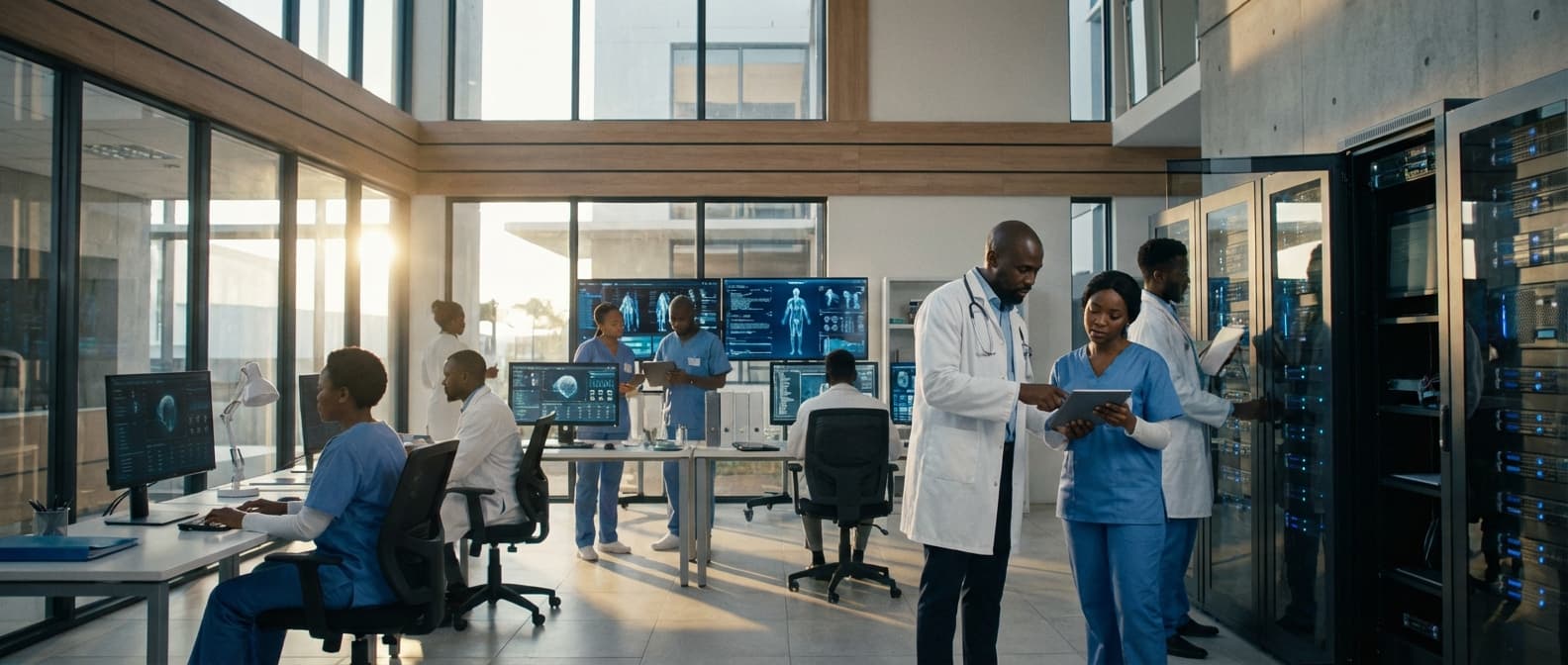
Tele-Radiology in Niger
Engineering Excellence & Technical Support
24/7 access to certified radiologists providing rapid, accurate remote interpretation of diagnostic imaging studies. High-standard technical execution following OEM protocols and local regulatory frameworks.
Remote Diagnostic Power
Leveraging high-speed satellite internet, tele-radiology platforms connect remote clinics in Niger to expert radiologists globally, enabling rapid and accurate diagnosis of critical imaging studies, reducing turnaround times for patient care, and bridging the gap in specialized medical expertise.
Digital Image Archiving & Sharing
Secure cloud-based PACS (Picture Archiving and Communication System) solutions allow for the seamless digitization, storage, and sharing of medical images across different locations. This ensures that patient data is readily accessible for consultations, follow-ups, and educational purposes, even in resource-limited settings.
Mobile Diagnostic Accessibility
Implementation of portable digital X-ray and ultrasound devices that transmit images wirelessly to tele-radiology hubs. This empowers frontline healthcare workers in rural and underserved areas of Niger to capture diagnostic quality images on-site, facilitating immediate remote expert review and enabling timely clinical decisions.
What Is Tele-radiology In Niger?
Tele-radiology in Niger refers to the practice of transmitting radiological images (such as X-rays, CT scans, MRIs, and ultrasounds) from a healthcare facility in Niger to a radiologist located elsewhere, for interpretation and reporting. This service leverages telecommunications technology to bridge geographical distances, enabling remote diagnosis and consultation.
Definition: Tele-radiology involves the digital acquisition of medical images, their secure transmission over a network, and the subsequent interpretation by a radiologist who is not physically present at the point of image acquisition. The final report is then communicated back to the referring physician.
| Who Needs Tele-Radiology in Niger? | Typical Use Cases |
|---|---|
| Remote and Underserved Areas: Facilities in regions of Niger with a critical shortage of trained radiologists. | Emergency Department Triage: Rapid interpretation of trauma scans (e.g., head CTs, chest X-rays) to guide immediate patient management, especially outside of regular working hours. |
| Specialized Imaging Interpretation: Access to sub-specialty radiologists (e.g., neuroradiology, interventional radiology) for complex cases where local expertise is unavailable. | Screening Programs: Facilitating large-scale screening initiatives (e.g., tuberculosis detection via chest X-rays) by centralizing interpretation. |
| Outpatient Clinics and Rural Health Centers: Enabling these facilities to offer diagnostic imaging services that would otherwise require patient referral to larger urban centers. | Post-Operative Follow-up: Remote monitoring of patients undergoing surgical procedures, such as post-surgical CT scans to assess complications or healing. |
| Training and Education: Providing opportunities for junior radiologists or technologists to learn from experienced remote interpreters. | Overcoming Workload Imbalances: Distributing the interpretation workload from high-volume centers to radiologists in areas with lower demand. |
| Disaster Relief and Humanitarian Crises: Deploying mobile imaging units and utilizing tele-radiology to provide diagnostic support in emergency situations where infrastructure is compromised. | Second Opinions: Obtaining expert opinions on challenging or ambiguous cases from radiologists in different locations. |
Key Components and Stakeholders of Tele-Radiology in Niger
- Image Acquisition Modalities: Digital X-ray machines, CT scanners, MRI scanners, ultrasound machines equipped with PACS (Picture Archiving and Communication System) or direct digital output capabilities.
- Network Infrastructure: Reliable internet connectivity (wired or satellite), VPN (Virtual Private Network) for secure data transmission, and robust IT infrastructure at both originating and receiving sites.
- PACS/RIS: A Picture Archiving and Communication System for storing, retrieving, and distributing medical images, often integrated with a Radiology Information System (RIS) for workflow management.
- Radiologists: Board-certified radiologists, potentially in other regions of Niger, neighboring countries, or internationally, who provide interpretation services.
- Referring Physicians: Clinicians in Niger who order radiological examinations and rely on the tele-radiology reports for patient management.
- Healthcare Facilities: Hospitals, clinics, and diagnostic centers in Niger that lack on-site radiological expertise or capacity.
- Technology Providers: Companies supplying tele-radiology software, hardware, and networking solutions.
Who Needs Tele-radiology In Niger?
Tele-radiology offers a vital solution for improving diagnostic imaging services in Niger, a country facing significant challenges in accessing specialized medical expertise. This technology can bridge the gap in areas where qualified radiologists are scarce, enabling remote interpretation of X-rays, CT scans, and MRIs. This leads to faster diagnoses, more accurate treatment planning, and ultimately, better patient outcomes. The implementation of tele-radiology in Niger is crucial for its healthcare system's advancement, especially in supporting underserved populations and enhancing the capacity of existing medical facilities.
| Target Customer/Department | Specific Needs Addressed by Tele-Radiology | Impact and Benefits |
|---|---|---|
| Public Hospitals & Health Centers (Regional/District) | Lack of in-house radiologists, limited access to advanced imaging modalities, long turnaround times for diagnostic reports, need for specialized consultations for complex cases. | Improved diagnostic accuracy and speed, reduced patient travel for consultations, enhanced capacity for managing a wider range of medical conditions, support for primary and secondary care. |
| University Hospitals & Medical Schools | Need for teaching and training opportunities for medical students and residents in radiology, access to a broader range of subspecialty interpretations for research and complex patient management, potential for remote teaching and case review. | Enhanced medical education and training, development of local radiology expertise, improved quality of care for complex patient cases, contribution to medical research and knowledge dissemination. |
| Private Clinics & Diagnostic Centers | Limited availability of specialized radiologists, desire to offer a wider range of diagnostic services to attract more patients, need for rapid reporting to maintain competitive advantage. | Increased service offerings, improved patient satisfaction through faster results, potential for business growth by expanding diagnostic capabilities, cost-effectiveness compared to hiring full-time specialists. |
| NGOs with Healthcare Initiatives | Operating in remote or underserved areas with limited infrastructure, need for cost-effective and scalable diagnostic solutions, supporting mobile health clinics or outreach programs. | Extending healthcare reach to remote populations, providing essential diagnostic services in resource-limited settings, enabling effective management of public health programs and disease surveillance. |
| Military & Security Forces Healthcare Facilities | Ensuring timely and accurate diagnoses for personnel, especially in challenging or deployed environments, need for specialized interpretations for trauma and occupational health-related injuries. | Rapid response to medical needs of personnel, improved health and readiness of forces, access to expert opinions for complex medical scenarios, continuity of care regardless of location. |
Target Customers and Departments for Tele-Radiology in Niger
- Public Hospitals and Health Centers
- University Hospitals and Medical Schools
- Private Clinics and Diagnostic Centers
- Non-Governmental Organizations (NGOs) with Healthcare Initiatives
- Military and Security Forces Healthcare Facilities
Tele-radiology Process In Niger
Tele-radiology, the practice of interpreting medical images remotely, offers a significant solution for improving access to diagnostic radiology services in regions with a shortage of trained radiologists, such as Niger. The workflow typically begins with an inquiry from a healthcare facility, leading to image acquisition, transmission, interpretation, and finally, the delivery of a diagnostic report back to the requesting physician. This process is crucial for timely and accurate diagnosis, especially in remote or underserved areas.
| Step | Description | Key Stakeholders | Technologies/Tools Involved | Challenges in Niger |
|---|---|---|---|---|
| A healthcare facility (e.g., clinic, hospital) identifies a need for radiological interpretation of a patient's imaging study. | Requesting Physician, Referring Healthcare Facility | Phone, Secure Messaging Apps, Basic Internet Connectivity | Lack of reliable communication infrastructure, limited awareness of tele-radiology services. |
| The patient undergoes imaging (X-ray, CT, MRI, Ultrasound) at the local facility. | Technologist, Radiographer, Local Healthcare Provider | Imaging Modalities (X-ray, CT, MRI, Ultrasound machines), PACS (Picture Archiving and Communication System) or DICOM viewers | Outdated or non-existent imaging equipment, inconsistent image quality, lack of trained technologists. |
| Acquired medical images are securely transferred from the local facility to a tele-radiology service provider. | Technologist, IT Support (if available), Tele-radiology Service Provider | Internet connectivity (often satellite or mobile), VPN (Virtual Private Network), Secure File Transfer Protocols (SFTP), DICOM send functionality | Unreliable and slow internet, high data costs, power outages affecting transmission, cybersecurity risks. |
| The received images are uploaded into a secure tele-radiology platform, where they are assigned to available radiologists. | Teleradiology Platform Administrator, Radiologist | Web-based Teleradiology Platform, Worklist software, DICOM server | Limited access to robust and affordable tele-radiology platforms, need for efficient worklist management due to potential workload fluctuations. |
| A qualified radiologist reviews the images remotely and provides a diagnostic interpretation. | Remote Radiologist | High-resolution medical monitors, specialized viewing software, telecommunication tools (for consultation) | Shortage of qualified radiologists within Niger and the wider West African region, language barriers, potential for fatigue due to long working hours. |
| The radiologist dictates or types a comprehensive diagnostic report, including findings, impressions, and recommendations. | Remote Radiologist | Speech recognition software, reporting templates, secure document creation tools | Need for standardized reporting templates, ensuring consistency and clarity in reports. |
| The final report is securely sent back to the requesting physician at the local healthcare facility. | Teleradiology Platform, Requesting Physician | Secure email, Teleradiology Platform portal, secure messaging | Ensuring timely delivery of reports, enabling direct communication between the requesting physician and radiologist for clarification. |
| The requesting physician uses the report for patient diagnosis and treatment planning. The data can be integrated into local patient records. | Requesting Physician, Local Healthcare Facility | Electronic Health Records (EHR) systems (if available), patient charts | Lack of integrated healthcare information systems, need for training on how to best utilize tele-radiology reports for improved patient care. |
Tele-Radiology Workflow in Niger: Inquiry to Execution
- Inquiry Initiation
- Patient Examination & Image Acquisition
- Image Transmission
- Teleradiology Platform Access & Worklist Management
- Radiologist Interpretation
- Report Generation
- Report Distribution & Communication
- Follow-up & Integration
Tele-radiology Cost In Niger
Tele-radiology services in Niger, like in many developing nations, are influenced by a complex interplay of factors that dictate their cost. These factors range from the technical infrastructure required to the expertise of the radiologists providing the interpretation. Understanding these elements is crucial for healthcare providers and policymakers seeking to implement or expand tele-radiology initiatives to improve access to diagnostic imaging. The pricing is generally expressed in the local currency, the West African CFA franc (XOF).
| Service Type | Estimated Cost Range (XOF per study) | Notes |
|---|---|---|
| Basic X-ray Interpretation | 10,000 - 30,000 | Standard turnaround time. May vary based on radiologist's specialization. |
| CT Scan Interpretation | 25,000 - 75,000 | For standard diagnostic CTs. Complex cases or specialized protocols can be higher. |
| MRI Scan Interpretation | 35,000 - 100,000 | Generally more expensive due to complexity and longer scan times. Higher for specialized MRI sequences. |
| Ultrasound Interpretation | 15,000 - 40,000 | Can vary significantly based on the anatomical region and complexity (e.g., obstetric vs. abdominal). |
| On-Demand Urgent Interpretation | +20% to +50% of base rate | Premium charged for immediate or expedited reporting. |
| Subscription-Based Model (per facility/month) | Varies widely (e.g., 200,000 - 1,000,000+) | Often includes a certain volume of studies or unlimited access, depending on the contract. Infrastructure support might be included. |
Key Pricing Factors for Tele-Radiology in Niger
- {"title":"Technical Infrastructure and Connectivity","description":"The cost of reliable internet connectivity is a significant determinant. Areas with more robust and stable internet are generally less expensive to operate in than remote regions requiring satellite or more specialized, costly solutions. This also includes the cost of hardware like computers, scanners, and image storage solutions at both the referring site and the reporting center."}
- {"title":"Radiologist Expertise and Availability","description":"The availability of qualified radiologists, both locally and internationally, directly impacts pricing. Highly specialized radiologists command higher fees. The model of service also matters: whether it's a dedicated service with full-time radiologists or a service on-demand with part-time availability."}
- {"title":"Volume of Scans and Contractual Agreements","description":"Larger healthcare facilities or networks that can commit to a higher volume of scans often negotiate lower per-scan rates. Long-term contracts also tend to offer better pricing than ad-hoc services."}
- {"title":"Type and Complexity of Imaging Modality","description":"The cost of interpreting different types of imaging studies varies. For example, a simple X-ray interpretation will typically be less expensive than a complex MRI or CT scan requiring detailed analysis and comparison with previous studies."}
- {"title":"Reporting Turnaround Time (TAT)","description":"Urgent requests with a faster TAT often incur a premium. Standard reporting times are generally more cost-effective."}
- {"title":"Software and Platform Costs","description":"The tele-radiology platform itself, including the Picture Archiving and Communication System (PACS) and Vendor Neutral Archive (VNA) solutions, comes with licensing, maintenance, and update costs that are factored into the overall pricing."}
- {"title":"Regulatory and Compliance Costs","description":"Adhering to any local or international data privacy and security regulations can add to the operational costs."}
- {"title":"Administrative Overhead","description":"This includes costs associated with managing the service, customer support, billing, and any necessary training for local staff."}
Affordable Tele-radiology Options
Tele-radiology offers a cost-effective solution for medical imaging interpretation by connecting healthcare providers with remote radiologists. This model significantly reduces overhead associated with in-house radiology departments and can improve turnaround times. Key to maximizing affordability are value bundles and strategic cost-saving measures.
| Strategy | Description | Cost-Saving Benefit |
|---|---|---|
| Volume-Based Pricing | Fees are directly tied to the number of studies interpreted. | Pay only for services utilized, preventing overspending on underused capacity. |
| Subscription Models | A fixed monthly or annual fee for a predetermined number of studies or unlimited access within certain parameters. | Predictable budgeting and potential discounts for commitment. |
| Managed Service Agreements | Comprehensive packages including interpretation, IT support, and potentially quality assurance. | Streamlines operations and can be more cost-effective than piecing together individual services. |
| Geographic Arbitrage | Leveraging radiologists in regions with lower overhead costs. | Reduced operational expenses passed on as lower interpretation fees. |
| Strategic Partnerships | Collaborating with multiple healthcare facilities to aggregate volume for better negotiation power. | Increased bargaining power leads to more competitive pricing. |
Key Value Bundles and Cost-Saving Strategies
- On-Demand Interpretation: Pay-per-study or per-volume models are common, allowing practices to scale their radiology needs without fixed costs.
- Dedicated Radiologist Services: For practices with consistent high volumes, contracting with a dedicated radiologist or team can offer preferential rates.
- Subspecialty Coverage: Accessing subspecialty expertise (e.g., neuroradiology, musculoskeletal) on demand eliminates the need to hire multiple in-house specialists.
- Technology Integration: Utilizing platforms that integrate seamlessly with existing PACS (Picture Archiving and Communication System) and EMR (Electronic Medical Record) systems reduces implementation costs and training burdens.
- Quality Assurance Programs: Reputable tele-radiology providers include robust QA processes as part of their service, which is often bundled into the overall cost.
- After-Hours and Weekend Coverage: Essential for 24/7 patient care, bundled tele-radiology services can be more economical than maintaining in-house coverage.
- Reduced Infrastructure Costs: Eliminates expenses related to office space, equipment maintenance, IT support, and benefits for in-house radiologists.
- Improved Workflow Efficiency: Faster report turnaround times can lead to quicker patient diagnoses and treatment initiation, potentially reducing overall patient care costs.
- Tiered Service Agreements: Providers may offer different service levels with varying response times and pricing, allowing practices to choose based on their budgetary constraints and clinical needs.
- Long-Term Contracts: Negotiating longer-term contracts can often secure more favorable pricing due to guaranteed volume.
Verified Providers In Niger
Ensuring access to quality healthcare is paramount in Niger. Identifying Verified Providers is crucial for individuals and families seeking reliable medical services. Franance Health stands out as a premier choice due to its rigorous credentialing process and commitment to upholding the highest standards of medical care. This commitment translates into a network of healthcare professionals and facilities that have undergone thorough vetting, ensuring competence, ethical practice, and patient safety.
| Credentialing Area | Franance Health Standard | Benefit for Patients |
|---|---|---|
| Medical Education & Training | Verified degrees, certifications, and completion of accredited programs. | Ensures providers possess the foundational knowledge and skills required for competent practice. |
| Professional Experience | Thorough review of past practice history, including documented experience in relevant specialties. | Confirms practical application of knowledge and ability to handle complex medical situations. |
| Licensure & Board Certification | Verification of current, unrestricted medical licenses and relevant board certifications. | Guarantees adherence to regulatory requirements and a high level of specialized expertise. |
| Peer Review & Reputation | Inclusion of evaluations from peers and review of professional reputation. | Provides an objective assessment of clinical performance and ethical conduct. |
| Background Checks & Disciplinary History | Comprehensive checks for any history of malpractice claims or disciplinary actions by regulatory bodies. | Safeguards against the engagement of practitioners with a history of compromised patient care. |
Why Franance Health Credentials Represent the Best Choice:
- Rigorous Vetting Process: Franance Health employs a multi-faceted approach to credentialing, going beyond basic licensing to include verification of educational background, professional experience, peer reviews, and absence of disciplinary actions.
- Commitment to Quality Care: Certified providers are dedicated to delivering patient-centered care, adhering to evidence-based practices, and maintaining a high standard of clinical excellence.
- Patient Safety Focus: The credentialing process prioritizes patient safety by identifying providers with a proven track record of safe practices and a commitment to minimizing risks.
- Ethical Practice Standards: Franance Health ensures that all verified providers adhere to strict ethical guidelines, fostering trust and integrity within the healthcare system.
- Access to Specialized Services: Through its network, Franance Health connects patients with a diverse range of specialists, ensuring comprehensive care for various health needs.
- Continuous Monitoring: Credentialing is not a one-time event. Franance Health implements ongoing monitoring mechanisms to ensure continued compliance with their standards.
Scope Of Work For Tele-radiology
This Scope of Work (SOW) outlines the requirements for a Tele-Radiology service, detailing technical deliverables and standard specifications. The aim is to establish a robust, efficient, and secure system for remote radiological image interpretation.
| Category | Technical Deliverable | Standard Specifications/Requirements | Description |
|---|---|---|---|
| Image Acquisition & Transmission | DICOM Image Transmission Gateway | HL7 v2.x or FHIR compatibility, DICOM conformance statement, secure transmission protocols (e.g., TLS 1.2+), bandwidth utilization optimization. | Software/hardware to receive, anonymize (if required), and securely transmit DICOM images from imaging modalities to the Tele-Radiology platform. |
| Image Acquisition & Transmission | Secure Image Storage | PACS/VNA integration, audit trails, data redundancy, disaster recovery plan, compliance with data retention policies. | A secure and reliable storage solution for DICOM images, ensuring data integrity and accessibility. |
| Tele-Radiology Platform | Web-based Reporting Portal | Intuitive user interface, role-based access control, customizable templates, integration with RIS/EMR, audit trails. | A portal for radiologists to access images, dictation tools, and generate reports. |
| Tele-Radiology Platform | Image Viewing & Manipulation Tools | Advanced DICOM viewer (windowing, leveling, zoom, pan, measurements), multi-planar reconstruction (MPR), 3D rendering (optional), integration with AI tools (optional). | Software functionality enabling radiologists to effectively view and analyze medical images. |
| Tele-Radiology Platform | Voice Dictation & Transcription System | High accuracy speech recognition, multiple language support, integration with reporting portal, secure audio storage. | System for radiologists to dictate reports, which can be transcribed automatically or by human transcriptionists. |
| Tele-Radiology Platform | Report Distribution & Archiving | Secure report delivery to referring physicians (e.g., secure email, portal download), seamless integration with EMR/RIS, long-term archiving. | Mechanism for securely distributing finalized reports to the appropriate parties and archiving them. |
| Security & Compliance | Data Encryption | Encryption at rest (AES-256) and in transit (TLS 1.2+), compliance with HIPAA Security Rule or equivalent. | Protection of patient data from unauthorized access during storage and transmission. |
| Security & Compliance | Access Control & Authentication | Multi-factor authentication (MFA), role-based access control (RBAC), audit logs of all user activities, regular security audits. | Ensuring only authorized personnel can access the system and specific data based on their roles. |
| Security & Compliance | Privacy Safeguards | De-identification/anonymization capabilities (if required), compliance with GDPR, HIPAA, and other relevant privacy regulations. | Measures to protect patient privacy throughout the workflow. |
| Infrastructure & Performance | Network Connectivity | High-speed, reliable internet connection with sufficient bandwidth, redundant network paths. | Ensuring seamless and uninterrupted data flow between sites. |
| Infrastructure & Performance | System Uptime & Availability | 99.9% or higher uptime SLA, scheduled maintenance windows, robust monitoring and alert systems. | Guaranteeing the system is available and operational when needed. |
| Infrastructure & Performance | Scalability | Ability to handle increasing volumes of studies and users, modular architecture for future expansion. | The system should be able to grow with the organization's needs. |
| Support & Maintenance | Technical Support | 24/7 support availability, defined response and resolution times for critical issues, dedicated account manager. | Assistance for any technical issues encountered with the platform and associated services. |
| Support & Maintenance | System Updates & Upgrades | Regular software updates and security patches, planned upgrade schedule, minimal downtime during updates. | Keeping the system up-to-date with the latest features and security measures. |
| Support & Maintenance | Training | Comprehensive training for all user roles (radiologists, technologists, administrators), ongoing training for new features. | Ensuring users are proficient in operating the Tele-Radiology system. |
Key Objectives of the Tele-Radiology Service
- Improve access to expert radiological interpretation, especially in underserved areas.
- Enhance turnaround times for diagnostic reports.
- Increase diagnostic accuracy through subspecialty consultation.
- Optimize workflow efficiency for radiologists and referring clinicians.
- Ensure data security and patient privacy in compliance with relevant regulations (e.g., HIPAA, GDPR).
- Provide a scalable and reliable solution to meet evolving healthcare demands.
Service Level Agreement For Tele-radiology
This Service Level Agreement (SLA) defines the performance standards for the tele-radiology services provided by [Your Company Name] (hereinafter referred to as "Provider") to [Client Name] (hereinafter referred to as "Client"). This SLA specifically addresses response times for image interpretation requests and guarantees uptime for the tele-radiology platform.
| Service Metric | Target | Measurement Period | Definition/Clarification |
|---|---|---|---|
Definitions
- {"item":"<b>Uptime</b>: The percentage of time the tele-radiology platform and its associated services are available and operational for use by the Client.","description":"Excludes scheduled maintenance and events beyond the Provider's reasonable control."}
- {"item":"<b>Response Time</b>: The time elapsed from when a complete and valid image study is received by the Provider's system to when the final diagnostic report is made available to the Client."}
- {"item":"<b>Critical Study</b>: A study designated by the Client as requiring immediate attention due to the potential for rapid deterioration of the patient's condition or significant impact on immediate clinical decision-making (e.g., stroke, pulmonary embolism, trauma)."}
- {"item":"<b>Routine Study</b>: Any study not classified as Critical."}
- {"item":"<b>Emergency Study</b>: A study flagged as an emergency by the Client, requiring immediate radiologist review and reporting within the shortest possible timeframe, often outside of standard business hours."}
- {"item":"<b>Scheduled Maintenance</b>: Pre-announced periods during which the tele-radiology platform may be temporarily unavailable for updates, upgrades, or routine maintenance."}
Frequently Asked Questions

Ready when you are
Let's scope your Tele-Radiology in Niger project in Niger.

Scaling healthcare logistics and technical systems across the entire continent.