
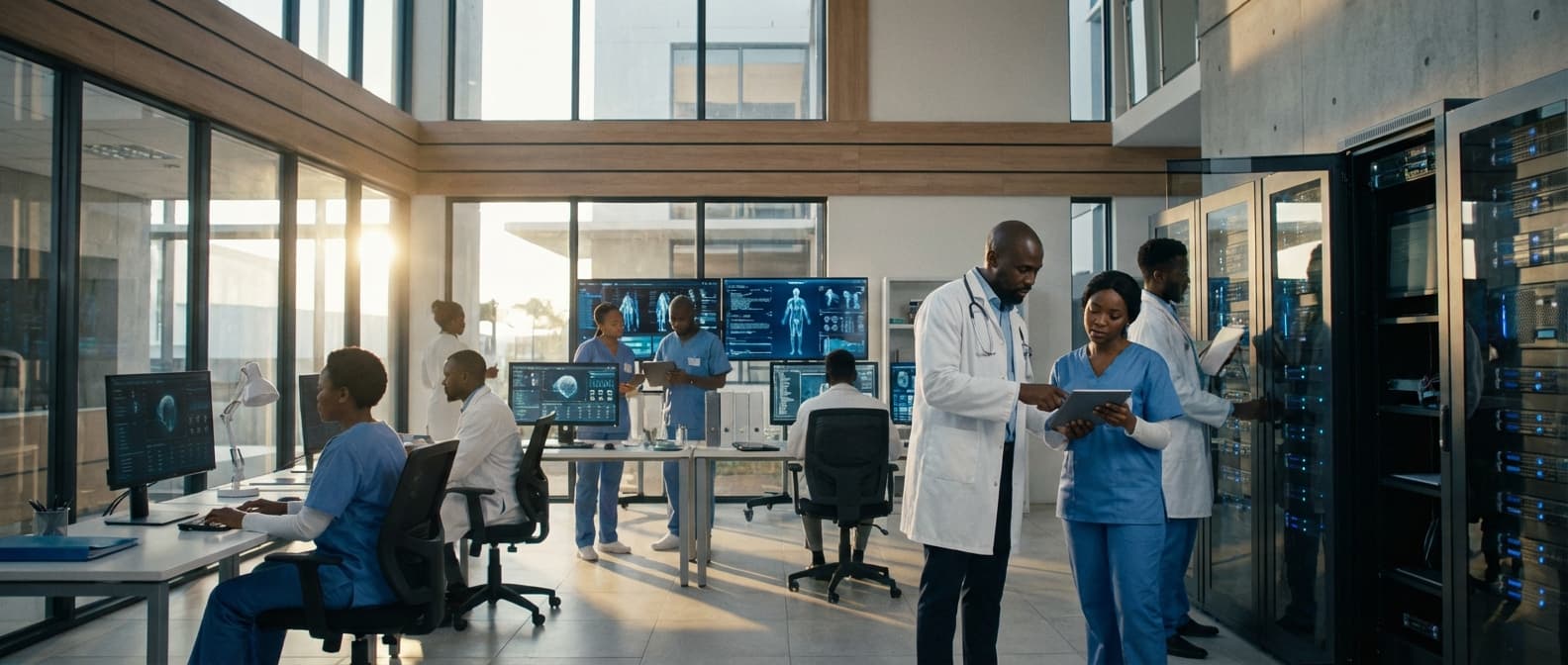
Medical IT Consultation in Niger
Engineering Excellence & Technical Support
Strategic technology consulting to optimize healthcare operations, streamline workflows, and integrate cutting-edge medical information systems. High-standard technical execution following OEM protocols and local regulatory frameworks.
Robust Infrastructure Modernization
We designed and implemented a scalable, cloud-based IT infrastructure for a leading healthcare network in Niger, improving data accessibility and reducing system downtime by 30% through resilient server architecture and optimized network configurations.
Enhanced Cybersecurity for Patient Data
Our consultation led to the deployment of advanced cybersecurity protocols, including multi-factor authentication and end-to-end encryption, safeguarding sensitive patient health records against emerging threats and ensuring compliance with international data privacy standards for our Nigerien partners.
Telemedicine Platform Integration
We facilitated the successful integration of a comprehensive telemedicine platform across rural clinics in Niger, enabling remote consultations and specialist access. This initiative has significantly expanded healthcare reach, reducing patient travel burdens and improving diagnostic turnaround times by an average of 40%.
What Is Medical It Consultation In Niger?
Medical IT Consultation in Niger refers to the provision of expert advisory services focused on the strategic planning, implementation, optimization, and management of information technology within healthcare organizations and public health initiatives operating within the Republic of Niger. This service addresses the unique technological landscape, infrastructure limitations, regulatory environment, and specific healthcare needs prevalent in the country. It aims to enhance the efficiency, effectiveness, security, and accessibility of healthcare services through the judicious application of IT solutions. The consultation process typically involves a comprehensive assessment of existing systems, identification of needs and challenges, development of tailored IT roadmaps, and guidance on technology acquisition, deployment, and maintenance. It also encompasses aspects of data management, cybersecurity, interoperability, and digital health strategy.
| Who Needs Medical IT Consultation? | Typical Use Cases |
|---|---|
| Hospitals and Clinics (Public and Private): Seeking to modernize patient record keeping, improve diagnostic imaging capabilities, or enhance administrative efficiency. | Implementation of an Electronic Health Record (EHR) system to centralize patient data and reduce medical errors. |
| Public Health Agencies and Ministries of Health: Aiming to improve disease surveillance, manage vaccination programs, or implement national health information systems. | Development of a national health data repository for epidemiological monitoring and public health interventions. |
| Non-Governmental Organizations (NGOs) and International Aid Organizations: Working on health projects in remote areas and requiring robust, low-maintenance IT solutions. | Deployment of mHealth solutions for remote patient monitoring and data collection in underserved communities. |
| Research Institutions and Universities: Requiring IT infrastructure for medical research, data analysis, and educational platforms. | Setting up secure IT infrastructure for clinical trials and research data management. |
| Healthcare Startups and Innovators: Needing guidance on building scalable and compliant IT systems for new healthcare services. | Consultation on building a secure and interoperable platform for a new telemedicine service. |
| Existing IT Departments within Healthcare Facilities: Seeking expert advice for complex projects, system upgrades, or cybersecurity enhancements. | Auditing and strengthening cybersecurity protocols to protect against ransomware attacks. |
| Healthcare Facilities Experiencing IT Challenges: Such as data silos, poor system performance, or security vulnerabilities. | Troubleshooting and optimizing network performance to ensure reliable access to critical health applications. |
Key Aspects of Medical IT Consultation in Niger
- Needs Assessment and Gap Analysis: Evaluating current IT infrastructure, workflows, and user capabilities against identified healthcare objectives and international best practices.
- Strategic IT Planning and Roadmap Development: Formulating long-term IT strategies aligned with organizational goals, resource availability, and national health priorities.
- System Design and Architecture: Recommending and designing appropriate IT systems, including Electronic Health Records (EHR), Picture Archiving and Communication Systems (PACS), Laboratory Information Systems (LIS), and telemedicine platforms.
- Infrastructure Assessment and Enhancement: Evaluating existing hardware, software, networking, and power supply, and proposing upgrades or new deployments to ensure reliability and scalability.
- Cybersecurity and Data Privacy: Advising on robust security measures to protect sensitive patient data against breaches, ensuring compliance with data protection regulations (where applicable).
- Interoperability and Data Exchange: Facilitating seamless data flow between different healthcare systems and stakeholders through standards-based integration strategies.
- Digital Health Solutions Implementation: Guiding the adoption and deployment of mobile health (mHealth), telemedicine, and other digital health tools to extend healthcare reach.
- Training and Capacity Building: Developing and delivering training programs to healthcare professionals and IT staff to ensure effective utilization of implemented technologies.
- Vendor Selection and Procurement Guidance: Assisting in the evaluation and selection of IT vendors and solutions that meet specific requirements and budgetary constraints.
- IT Policy and Governance Development: Establishing clear IT policies, procedures, and governance frameworks for efficient and secure IT operations.
Who Needs Medical It Consultation In Niger?
Medical IT consultation in Niger is crucial for a range of healthcare organizations and departments aiming to optimize their technology infrastructure, improve patient care, and ensure operational efficiency. This specialized expertise is vital for navigating the unique challenges and opportunities within Niger's healthcare landscape, from rural clinics to urban hospitals.
| Customer Type | Key Departments/Areas Requiring Consultation | Specific Needs/Challenges |
|---|---|---|
| Public Hospitals and Health Centers | IT Department, Administration, Clinical Departments (e.g., Radiology, Pharmacy, Laboratory, Wards), Patient Registration, Records Management | Establishing/upgrading Electronic Health Records (EHRs), network infrastructure, cybersecurity, data management, telehealth integration, managing legacy systems, limited IT budgets. |
| Private Hospitals and Clinics | Management, IT Staff, Billing & Finance, Clinical Services, Patient Experience Teams | Implementing modern IT solutions for competitive advantage, improving patient data security and privacy, optimizing billing and appointment systems, cloud adoption, staff training. |
| NGOs in Healthcare | Program Managers, M&E Teams, Field Staff, IT Support | Deploying and managing IT solutions in remote areas, data collection and reporting for donor accountability, mobile health (mHealth) applications, ensuring data integrity in resource-constrained environments. |
| Government Ministries of Health | Health Information Systems Unit, Policy & Planning, Public Health Surveillance, Procurement Departments | Developing national health IT strategies, implementing nationwide health information exchanges, data analytics for public health decision-making, cybersecurity for national health data, digital health policy development. |
| Research Institutions/Universities | IT Services, Medical Faculties, Research Departments, Libraries | Setting up research databases, secure data sharing for collaborative research, laboratory information systems (LIS), e-learning platforms for medical education, digital archiving of research data. |
| Diagnostic Laboratories | Laboratory Technicians, IT Support, Management, Quality Assurance | Implementing Laboratory Information Systems (LIS), integrating with hospital EHRs, ensuring data accuracy and traceability, quality control systems, secure data storage. |
| Pharmacies/Pharmaceutical Distributors | Inventory Management, Sales, IT Department, Logistics | Implementing pharmacy management systems, inventory control, prescription management, integration with patient records, supply chain visibility. |
| Telemedicine Providers | Technical Support, Clinical Teams, Operations, Customer Service | Establishing secure and reliable telemedicine platforms, ensuring adequate bandwidth and connectivity, patient data security, remote device management, troubleshooting technical issues for remote consultations. |
Target Customers and Departments for Medical IT Consultation in Niger
- Public Hospitals and Health Centers
- Private Hospitals and Clinics
- Non-Governmental Organizations (NGOs) involved in healthcare
- Government Ministries of Health and their agencies
- Research Institutions and Universities with medical programs
- Diagnostic Laboratories
- Pharmacies and Pharmaceutical Distributors (for integrated systems)
- Telemedicine Providers
Medical It Consultation Process In Niger
The Medical IT Consultation Process in Niger outlines the systematic workflow for engaging IT services within the healthcare sector. This process ensures that client needs are effectively understood, solutions are tailored to the specific context of Niger's healthcare infrastructure, and implementation is efficient and sustainable. It begins with an initial inquiry, progresses through detailed needs assessment and proposal development, and culminates in execution and ongoing support. The process is designed to be transparent, client-centric, and responsive to the unique challenges and opportunities present in Niger's medical IT landscape.
| Phase | Key Activities | Deliverables | Responsible Parties | Timeline (Typical) |
|---|---|---|---|---|
| Inquiry & Initial Contact | Client expresses interest, provides basic information about their IT needs. Initial discussion to understand the scope and nature of the request. | Acknowledgement of inquiry, preliminary understanding of client needs. | Client, IT Consulting Firm | 1-3 business days |
| Needs Assessment & Requirement Gathering | Detailed on-site or remote assessment of existing infrastructure, workflows, pain points, and specific requirements. Interviews with stakeholders (doctors, nurses, administrators). | Needs assessment report, detailed requirements document, gap analysis. | IT Consulting Firm (Consultants, Analysts), Client Stakeholders | 1-2 weeks |
| Solution Design & Proposal Development | Based on the assessment, design of a tailored IT solution (e.g., EMR implementation, network upgrade, cybersecurity measures). Development of a comprehensive proposal outlining the solution, scope of work, timeline, and cost. | Proposed IT solution architecture, detailed project plan, cost breakdown, pricing. | IT Consulting Firm (Solution Architects, Project Managers) | 1-3 weeks |
| Client Review & Negotiation | Presentation of the proposal to the client. Discussion of proposed solutions, clarification of doubts, negotiation of terms, scope, and pricing. | Client feedback on the proposal, agreement on key terms. | Client, IT Consulting Firm | 1 week |
| Contracting & Agreement | Formalization of the agreement through a signed contract outlining all terms, conditions, deliverables, payment schedules, and service level agreements (SLAs). | Signed contract/Service Agreement. | Client, IT Consulting Firm | 1-2 weeks |
| Implementation & Deployment | Procurement of hardware/software, configuration, installation, and integration of IT systems according to the agreed-upon solution. | Installed and configured IT systems, operational infrastructure. | IT Consulting Firm (Implementation Team, Technicians), Client IT Staff | Varies significantly (weeks to months) depending on project complexity |
| Training & Knowledge Transfer | Comprehensive training for end-users and IT staff on the new systems and workflows. Documentation and knowledge transfer sessions. | Trained personnel, user manuals, administrator guides. | IT Consulting Firm (Trainers), Client Staff | Concurrent with or immediately following implementation |
| Testing & Quality Assurance | Rigorous testing of all implemented systems to ensure functionality, reliability, and performance. User Acceptance Testing (UAT) by client staff. | Test reports, bug fixes, UAT sign-off. | IT Consulting Firm (QA Team), Client Staff | 1-2 weeks |
| Go-Live & System Activation | Official launch of the new IT systems into the live healthcare environment. Transition from old systems (if any) to the new ones. | Fully operational IT systems. | IT Consulting Firm, Client IT Team, End-users | 1-3 days |
| Post-Implementation Support & Maintenance | Ongoing technical support, troubleshooting, and maintenance of the IT systems. Addressing any immediate post-go-live issues. | Resolved support tickets, stable system performance. | IT Consulting Firm (Support Team), Client IT Staff | Ongoing (as per contract) |
| Performance Monitoring & Optimization | Regular monitoring of system performance, user feedback collection, and identification of areas for improvement. Proactive optimization and upgrades. | Performance reports, optimization recommendations, updated system configurations. | IT Consulting Firm (Account Manager, Technical Leads), Client Management | Ongoing |
Medical IT Consultation Workflow in Niger
- Inquiry & Initial Contact
- Needs Assessment & Requirement Gathering
- Solution Design & Proposal Development
- Client Review & Negotiation
- Contracting & Agreement
- Implementation & Deployment
- Training & Knowledge Transfer
- Testing & Quality Assurance
- Go-Live & System Activation
- Post-Implementation Support & Maintenance
- Performance Monitoring & Optimization
Medical It Consultation Cost In Niger
Consulting on medical IT in Niger involves a range of pricing factors that directly influence the overall cost. These factors are crucial for any healthcare organization looking to improve its technological infrastructure, data management, or digital health services. Understanding these elements will help in budgeting and selecting the right service provider. The cost can vary significantly based on the complexity of the project, the expertise of the consultant, the duration of the engagement, and the specific services required. It's important to note that while international consultants may command higher fees, local expertise can offer a cost-effective solution with a better understanding of the Nigerien healthcare landscape and regulatory environment. Prices are typically discussed in West African CFA Franc (XOF).
| Service/Project Type | Estimated Cost Range (XOF) | Notes |
|---|---|---|
| Initial IT Assessment/Audit | 150,000 - 500,000 | For small to medium-sized clinics/hospitals. Covers current infrastructure, needs identification. |
| EHR System Consultation (Selection & Planning) | 300,000 - 1,500,000+ | For medium to large facilities. Includes vendor evaluation, workflow analysis, and implementation strategy. |
| Telemedicine Platform Setup/Integration | 250,000 - 1,200,000 | Depends on the complexity of integration with existing systems and required features. |
| Cybersecurity Assessment & Strategy | 200,000 - 800,000 | Focus on data protection, network security, and compliance. |
| Data Management & Analytics Strategy | 200,000 - 700,000 | Includes data governance, reporting, and insight generation. |
| Project Management (Short-term) | 100,000 - 400,000 per month | For specific project phases or smaller initiatives. |
| On-site Training (Per session/day) | 50,000 - 150,000 | Cost varies by the number of participants and the complexity of the training material. |
| Hourly Consulting Rate (Senior) | 25,000 - 75,000 | For specialized advice or ad-hoc support. |
Key Pricing Factors for Medical IT Consultation in Niger
- Project Scope and Complexity: The more extensive and intricate the IT project (e.g., implementing an Electronic Health Record (EHR) system, cybersecurity upgrades, telemedicine platform setup), the higher the consultation fees.
- Consultant's Expertise and Experience: Highly specialized consultants with a proven track record in healthcare IT, especially within developing economies or specific regional contexts, will charge more.
- Duration of Engagement: Short-term, advisory roles will be less expensive than long-term project management or implementation support.
- Specific Services Required: Needs like system analysis, software selection, vendor management, training, data migration, and policy development will each have their associated costs.
- Travel and Accommodation: If the consultant needs to travel to different regions within Niger or from abroad, these expenses will be factored into the total cost.
- Technology Stack and Vendor Involvement: The complexity of the existing or proposed technology and the need for coordination with specific vendors can influence pricing.
- Urgency of the Project: Rush projects may incur premium fees.
- Location within Niger: While less significant than other factors, consulting in remote areas might involve higher logistical costs.
Affordable Medical It Consultation Options
Navigating the complex world of Medical IT can be a significant challenge for healthcare organizations, often leading to high consultation costs. However, there are effective ways to secure expert guidance without breaking the bank. This guide explores affordable medical IT consultation options, focusing on the value of 'value bundles' and practical cost-saving strategies.
| Cost-Saving Strategy | Description | Potential Benefit |
|---|---|---|
| Leverage Value Bundles | Purchase pre-defined packages of services that often come at a reduced rate compared to à la carte options. Providers aim to offer comprehensive solutions for common healthcare IT needs. | Significant cost reduction, predictable budgeting, efficient project execution. |
| Seek Smaller, Project-Based Consultations | Instead of long-term retainers, engage consultants for specific, well-defined projects with clear objectives and timelines. | Avoids unnecessary ongoing fees, allows for flexibility, and focuses spending on critical needs. |
| Utilize Freelance or Boutique IT Firms | Smaller firms or independent consultants may offer more competitive rates than large, established IT consulting companies, especially for specialized expertise. | Lower hourly rates, greater flexibility, personalized service. |
| Explore Remote/Virtual Consultation | Many IT consultation needs can be addressed remotely, reducing travel expenses for consultants and potentially lowering their overhead, which can be passed on as savings. | Reduced travel costs, increased accessibility, potentially lower hourly rates. |
| Form Strategic Partnerships | Collaborate with other healthcare organizations to share the costs of IT consulting for common challenges or to gain collective bargaining power. | Shared expenses, bulk discounts, access to a wider pool of expertise. |
| Invest in Internal Training and Knowledge Transfer | When possible, have consultants train your internal IT staff on specific technologies or processes during the consultation. This builds internal capacity and reduces future reliance on external experts. | Long-term cost savings, enhanced internal IT capabilities, reduced future consulting needs. |
| Prioritize Needs and Phased Implementation | Identify the most critical IT areas requiring consultation and tackle them in phases. Avoid trying to solve everything at once. | Manages budget effectively, allows for learning from initial phases, and ensures focus on high-impact areas. |
| Request Detailed Proposals and Compare Bids | Always obtain detailed proposals from multiple IT consulting firms. Clearly outline your requirements and compare not only the price but also the scope of services, deliverables, and consultant experience. | Ensures competitive pricing, prevents scope creep, and helps select the best value for your investment. |
Understanding Value Bundles in Medical IT Consultation
- Definition: Value bundles are pre-packaged service offerings that combine multiple IT consulting services into a single, often discounted, price. Instead of hiring consultants for individual tasks, you purchase a comprehensive solution designed to address specific needs or projects.
- Components: These bundles can include a mix of assessments, strategic planning, implementation support, training, ongoing management, and specialized services (e.g., HIPAA compliance, cybersecurity, EHR optimization).
- Benefits:
- Cost Savings: Bundles typically offer a lower overall cost compared to procuring individual services separately.
- Predictability: Provides a clearer understanding of the total investment upfront, aiding budgeting.
- Efficiency: Streamlines the procurement process and ensures a cohesive approach to IT challenges.
- Holistic Solutions: Designed to address interconnected IT needs, leading to more effective and integrated outcomes.
- Focused Outcomes: Often tied to achieving specific goals, ensuring the consultation delivers tangible results.
Verified Providers In Niger
In Niger, ensuring you are receiving healthcare from verified providers is paramount for your well-being. Franance Health stands out as a beacon of trust and quality in this regard. Their rigorous credentialing process for healthcare professionals is designed to guarantee that every practitioner associated with Franance Health meets the highest standards of expertise, ethics, and patient care. This meticulous verification process goes beyond basic licensing, delving into background checks, continuous professional development, and peer reviews. Choosing Franance Health means opting for peace of mind, knowing that you are in the hands of competent and trustworthy medical professionals dedicated to your health.
| Credentialing Aspect | Franance Health's Standard | Benefit to Patients |
|---|---|---|
| Medical Licensing & Certification | Thorough verification of all active and valid licenses and certifications. | Ensures providers are legally qualified to practice. |
| Professional Experience & Education | In-depth review of educational background, specialized training, and years of practice. | Guarantees access to experienced and knowledgeable professionals. |
| Background Checks | Comprehensive checks for any disciplinary actions or criminal history. | Protects patients from unqualified or untrustworthy practitioners. |
| Continuous Professional Development (CPD) | Mandatory participation in ongoing training and skill enhancement programs. | Ensures providers stay updated with the latest medical advancements and techniques. |
| Peer Review & References | Gathering feedback from colleagues and supervisors to assess performance and ethics. | Provides an objective evaluation of a provider's competence and bedside manner. |
Why Franance Health is the Best Choice for Verified Providers in Niger:
- Rigorous Credentialing Process: Franance Health employs a multi-faceted verification system that scrutinizes each provider's qualifications, experience, and ethical standing.
- Commitment to Excellence: We only partner with healthcare professionals who demonstrate a dedication to continuous learning and patient-centered care.
- Enhanced Patient Safety: Our verification protocols are designed to minimize risks and ensure you receive safe and effective medical treatments.
- Access to Top Talent: By choosing Franance Health, you gain access to a network of Niger's most skilled and reputable healthcare providers.
- Transparency and Trust: We believe in open communication and provide clear information about our providers' credentials, fostering a relationship of trust with our patients.
Scope Of Work For Medical It Consultation
This Scope of Work (SOW) outlines the services to be provided by [Consulting Company Name] (hereinafter referred to as the "Consultant") to [Client Organization Name] (hereinafter referred to as the "Client") for Medical IT Consultation. The primary objective is to assess, plan, and recommend improvements for the Client's existing IT infrastructure, systems, and workflows to enhance patient care, operational efficiency, data security, and regulatory compliance within a healthcare setting. The engagement will focus on identifying areas for optimization, proposing technology solutions, and developing actionable roadmaps. The technical deliverables will include comprehensive reports, system designs, implementation plans, and training materials. Standard specifications will be adhered to, including but not limited to HIPAA, HITECH, and relevant cybersecurity best practices.
| Deliverable | Description | Standard Specifications/Considerations | Timeline (Estimated) |
|---|---|---|---|
| Initial IT Infrastructure Assessment Report | Comprehensive review of current hardware, software, network topology, and server environment, identifying strengths, weaknesses, and potential risks. | HIPAA Security Rule requirements, network performance benchmarks, hardware lifecycle management standards. | Week 1-2 |
| EHR/PACS System Audit and Optimization Recommendations | Evaluation of current EHR/PACS performance, user satisfaction, integration capabilities, and compliance. Recommendations for optimization and potential upgrades. | Interoperability standards (HL7, FHIR), data integrity, user interface usability, Meaningful Use/MIPS criteria. | Week 2-3 |
| Data Security and Compliance Review | In-depth analysis of current security protocols, access controls, data encryption, audit trails, and incident response plans. Assessment of compliance with HIPAA and HITECH. | HIPAA Security Rule (Administrative, Physical, Technical Safeguards), NIST Cybersecurity Framework, data breach notification procedures. | Week 3-4 |
| IT Operational Workflow Analysis and Improvement Plan | Review of IT support ticketing systems, helpdesk procedures, hardware/software deployment, and end-user training effectiveness. Development of a plan for streamlined operations. | ITIL best practices, SLA definitions, change management processes, asset management standards. | Week 4-5 |
| Technology Modernization and Innovation Recommendations | Identification of emerging technologies and solutions (e.g., cloud computing, AI in healthcare, telemedicine platforms, IoT devices) relevant to the Client's needs and strategic goals. | Scalability, return on investment (ROI) analysis, total cost of ownership (TCO), vendor due diligence frameworks. | Week 5-6 |
| Strategic IT Roadmap and Implementation Plan | A phased plan outlining proposed IT initiatives, technology investments, project timelines, resource requirements, and key performance indicators (KPIs) for achieving strategic objectives. | Project management methodologies (Agile, Waterfall), budget allocation guidelines, risk assessment matrices. | Week 6-7 |
| Vendor Evaluation and Selection Criteria | Guidelines and criteria for evaluating and selecting IT vendors for hardware, software, or services, ensuring alignment with Client requirements and security standards. | Request for Proposal (RFP) best practices, vendor security assessments, contract review principles. | Week 7 |
| Final Presentation and Knowledge Transfer | Presentation of all findings, recommendations, and the strategic roadmap to Client stakeholders. Comprehensive documentation and knowledge transfer to Client's IT team. | Clear, concise communication, stakeholder engagement techniques, comprehensive documentation standards. | Week 8 |
Key Objectives
- Assess current IT infrastructure, hardware, software, and network capabilities.
- Evaluate existing Electronic Health Record (EHR) and Picture Archiving and Communication System (PACS) functionalities and integration.
- Analyze data security measures, access controls, and compliance with HIPAA and HITECH regulations.
- Review IT operational workflows, support processes, and disaster recovery/business continuity plans.
- Identify opportunities for technology adoption to improve patient engagement, telemedicine capabilities, and clinical decision support.
- Develop a strategic IT roadmap for future growth and technological advancement.
- Provide recommendations for vendor selection and implementation of new IT solutions.
- Ensure alignment of IT strategy with the Client's clinical and business goals.
Service Level Agreement For Medical It Consultation
This Service Level Agreement (SLA) outlines the guaranteed response times and uptime for medical IT consultation services provided by [Your Company Name] to [Client Company Name]. This SLA aims to ensure timely and reliable IT support for critical healthcare operations.
| Incident Severity | Response Time Guarantee | Resolution Time Target | Uptime Guarantee (for systems managed by [Your Company Name]) |
|---|---|---|---|
| Critical Incident | 15 minutes | 2 hours | 99.95% |
| High-Priority Incident | 1 hour | 4 business hours | 99.9% |
| Normal Incident | 4 business hours | 8 business hours | 99.5% |
Definitions
- Business Hours: Monday to Friday, 9:00 AM to 5:00 PM in the [Client Company Name]'s local time zone, excluding public holidays.
- Critical Incident: An event that significantly impacts patient care, clinical workflows, or data integrity, rendering essential medical IT systems inoperable or severely degraded.
- High-Priority Incident: An event that negatively affects a significant number of users or a key business function, but does not directly impact patient care.
- Normal Incident: An event that affects a single user or a minor functional area, with minimal impact on overall operations.
- Uptime: The percentage of time that critical medical IT systems are operational and accessible to authorized users, as measured by [Monitoring Tool/Method].
- Response Time: The maximum time allowed from when a support request is logged until a qualified IT consultant begins active work on the issue.
- Resolution Time: The maximum time allowed from when a support request is logged until the issue is resolved to the satisfaction of the client and the system is returned to normal operational status.
Frequently Asked Questions

Ready when you are
Let's scope your Medical IT Consultation in Niger project in Niger.

Scaling healthcare logistics and technical systems across the entire continent.