
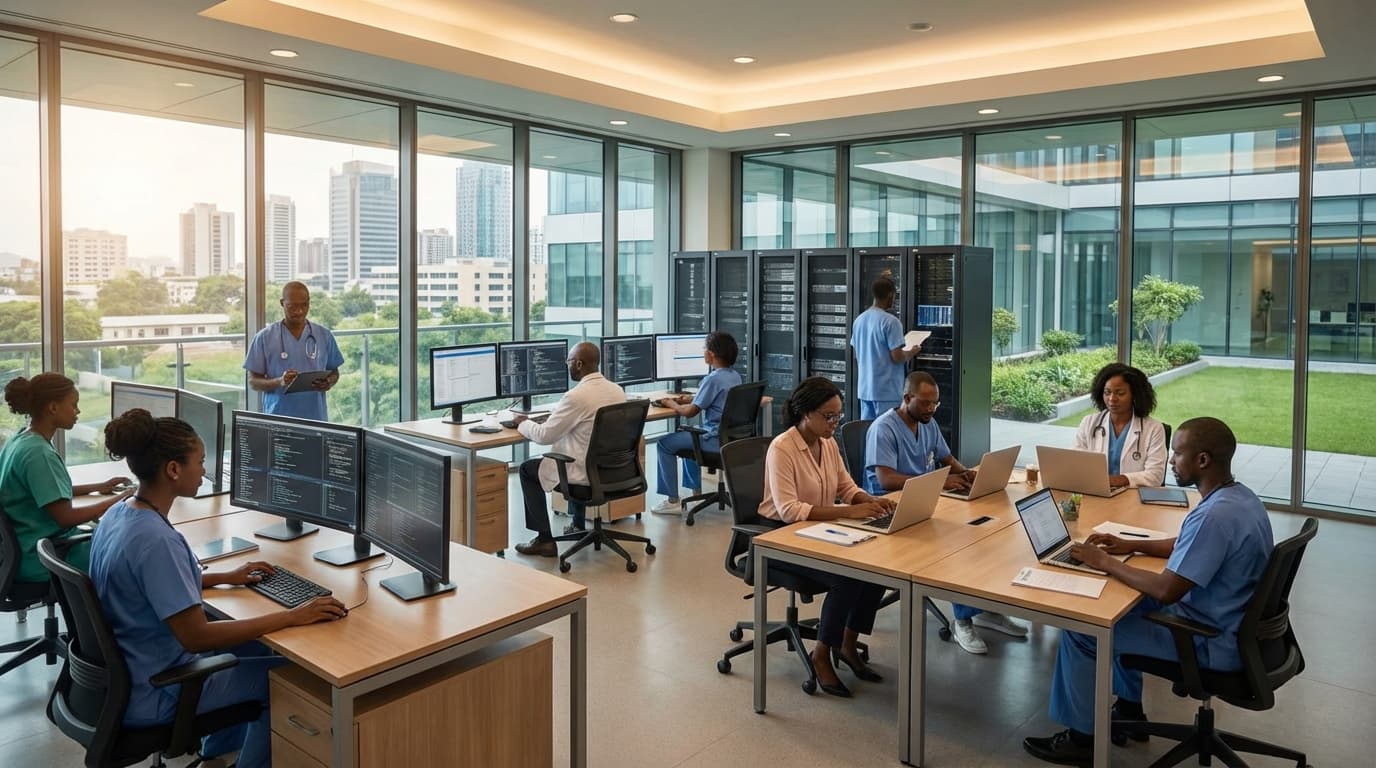
Radiology Reader & Reporting Support in Niger
Engineering Excellence & Technical Support
Remote radiology reading and reporting services High-standard technical execution following OEM protocols and local regulatory frameworks.
Enhanced Image Interpretation Workflow
Empowering radiologists with AI-driven tools for faster, more accurate interpretation of X-rays and ultrasounds, improving diagnostic turnaround times and reducing missed findings in remote areas.
Standardized Reporting and Data Management
Providing structured reporting templates and a centralized digital archive to ensure consistent, high-quality radiology reports, facilitating data analysis and epidemiological tracking for public health initiatives.
Remote Consultations and Second Opinions
Enabling seamless tele-radiology capabilities for remote consultations and expert second opinions, bridging geographical barriers and expanding access to specialized radiology services for underserved populations.
What Is Radiology Reader & Reporting Support In Niger?
Radiology Reader & Reporting Support in Niger refers to the provision of specialized services aimed at enhancing the efficiency, accuracy, and accessibility of radiological diagnostic interpretation and reporting. This service leverages trained professionals, advanced technological solutions, and established workflows to assist healthcare facilities in delivering high-quality medical imaging services, particularly in regions where local expertise or infrastructure may be limited.
| Who Needs Radiology Reader & Reporting Support? | Typical Use Cases in Niger | |||||
|---|---|---|---|---|---|---|
| Hospitals and Clinics in Remote or Underserved Areas: Facilities lacking sufficient on-site radiologists, especially subspecialists. | Emergency Department Coverage: Providing urgent interpretations of critical findings (e.g., stroke, trauma) outside of local working hours. | Public Health Initiatives: Supporting large-scale screening programs (e.g., for tuberculosis) requiring high-volume interpretation. | Tertiary Care Centers: Supplementing existing radiology departments with specific subspecialty expertise or to manage increased workloads. | Training Hospitals: Enhancing educational programs by providing access to a wider range of interpreted cases and expert feedback. | Private Imaging Centers: Improving turnaround times and expanding service offerings through external reading services. | Mobile or Field Hospitals: Facilitating diagnostic imaging in temporary healthcare settings during crises or outreach programs. |
Key Components of Radiology Reader & Reporting Support:
- Remote Reading Services (Teleradiology): Interpretation of medical images (X-rays, CT scans, MRIs, ultrasounds, etc.) by qualified radiologists located remotely, often in different geographical areas or countries. This addresses shortages of subspecialty radiologists.
- Reporting Assistance: Support in generating comprehensive, standardized, and timely radiology reports. This can involve dictation services, AI-powered natural language processing (NLP) for report structuring, or quality assurance checks on existing reports.
- Quality Assurance and Peer Review: Implementing processes for reviewing interpreted studies and reports to ensure diagnostic accuracy, adherence to guidelines, and consistency in reporting standards.
- Workflow Optimization: Streamlining the entire imaging process from image acquisition to report delivery, often through Picture Archiving and Communication Systems (PACS) and Radiology Information Systems (RIS) integration, or by providing guidance on efficient worklist management.
- Subspecialty Consultations: Providing access to radiologists with specific expertise in areas such as neuroradiology, musculoskeletal radiology, pediatric radiology, or interventional radiology, which may not be available locally.
- Training and Capacity Building: Offering educational programs for local radiographers, technologists, and even general practitioners on image interpretation basics or specific imaging modalities, to build local capacity.
- Technology Integration and Support: Assisting with the setup, maintenance, and optimization of imaging equipment and associated IT infrastructure, including PACS/RIS, for seamless remote access and data management.
Who Needs Radiology Reader & Reporting Support In Niger?
Radiology Reader & Reporting Support services are crucial in Niger to address a significant gap in specialized medical imaging expertise. These services aim to assist healthcare facilities by providing remote or on-site interpretation of radiological images and generating comprehensive diagnostic reports. This is particularly vital in a country where access to qualified radiologists is limited, especially in remote or underserved areas. By leveraging these support systems, Niger's healthcare sector can improve diagnostic accuracy, expedite patient care, and enhance the overall quality of medical services, thereby contributing to better health outcomes for the population.
| Department/Specialty | Specific Needs Addressed | Types of Imaging Modalities Supported |
|---|---|---|
| Emergency Department | Rapid interpretation of critical findings (e.g., trauma, acute abdomen), reducing turnaround time for life-saving decisions. | X-ray, CT Scan, Ultrasound |
| Internal Medicine | Diagnosis of various conditions affecting internal organs (e.g., pneumonia, liver disease), providing detailed diagnostic reports. | X-ray, CT Scan, MRI, Ultrasound |
| Surgery (General & Specialized) | Pre-operative planning, post-operative assessment, and diagnosis of surgical complications. | X-ray, CT Scan, MRI, Ultrasound |
| Pediatrics | Interpretation of imaging studies in children, requiring specialized knowledge of pediatric anatomy and pathology. | X-ray, Ultrasound, CT Scan (with appropriate protocols) |
| Orthopedics | Diagnosis and monitoring of bone fractures, joint injuries, and musculoskeletal conditions. | X-ray, CT Scan, MRI |
| Obstetrics & Gynecology | Fetal imaging, diagnosis of gynecological abnormalities, and monitoring of pregnancy-related conditions. | Ultrasound, MRI |
| Oncology | Staging and monitoring of cancer, assessment of treatment response, and identification of metastatic disease. | CT Scan, MRI, PET-CT (if available), Ultrasound |
| Infectious Diseases | Diagnosis and follow-up of infectious conditions, particularly in areas with endemic diseases (e.g., tuberculosis). | X-ray, CT Scan, Ultrasound |
Target Customers and Departments in Niger Requiring Radiology Reader & Reporting Support
- {"title":"Hospitals (Public & Private)","description":"Hospitals are primary beneficiaries, especially those lacking a sufficient number of in-house radiologists. This includes general hospitals, district hospitals, and specialized medical centers."}
- {"title":"Polyclinics and Health Centers","description":"Mid-level healthcare facilities that may have basic imaging equipment (e.g., X-ray) but lack dedicated radiologist staff for interpretation."}
- {"title":"Mobile & Outreach Clinics","description":"Facilities that provide healthcare services in remote or rural areas where permanent radiology infrastructure is scarce. These often rely on mobile units for diagnostic imaging."}
- {"title":"Diagnostic Imaging Centers","description":"Dedicated centers offering various imaging modalities that may experience high patient volumes or require specialized interpretations."}
- {"title":"Non-Governmental Organizations (NGOs) & Humanitarian Organizations","description":"Organizations providing medical aid and services, especially in areas affected by conflict or natural disasters, where access to expert radiology is often compromised."}
Radiology Reader & Reporting Support Process In Niger
The Radiology Reader & Reporting Support Process in Niger outlines the structured workflow for accessing and utilizing radiology reading and reporting services. This process ensures that diagnostic imaging studies are interpreted accurately and efficiently, leading to timely and effective patient care. The workflow begins with an inquiry, progresses through case assignment and review, and culminates in the generation and delivery of a comprehensive radiology report. Each step is designed to be clear, traceable, and to facilitate collaboration between referring physicians and radiologists.
| Step | Description | Key Actors | Outputs | Notes/Considerations |
|---|---|---|---|---|
| A referring physician or healthcare provider submits a request for radiology interpretation, often accompanied by patient clinical information and the imaging study itself (e.g., DICOM files). | Referring Physician/Healthcare Provider, Radiographer/Technologist | Completed Request Form, Imaging Study Data | Ensuring all necessary clinical details are provided is crucial for accurate interpretation. |
| The received requests are reviewed to determine urgency based on clinical context (e.g., emergency cases, critical findings). This ensures that time-sensitive interpretations are addressed promptly. | Triage Coordinator/Lead Radiologist | Prioritized Case List | Clear prioritization criteria are essential to manage workload effectively. |
| Cases are assigned to an appropriate subspecialty radiologist based on the type of imaging modality (X-ray, CT, MRI, Ultrasound) and suspected pathology, or to a general radiologist if no specific expertise is required. | Triage Coordinator/Lead Radiologist, Radiologist | Assigned Case to Radiologist | Consider radiologist availability, workload, and expertise. |
| The assigned radiologist meticulously reviews the imaging study, correlating findings with the provided clinical information. This involves identifying abnormalities, measuring lesions, and formulating a differential diagnosis. | Radiologist | Preliminary Findings, Interpretation Notes | Access to PACS (Picture Archiving and Communication System) and EMR (Electronic Medical Record) is vital. |
| The radiologist dictates or transcribes their findings and conclusions into a structured radiology report. This typically includes sections for clinical indication, technique, findings, impression, and recommendations. | Radiologist, Dictation/Transcription Staff (if applicable) | Draft Radiology Report | Standardized reporting templates should be used for consistency and clarity. |
| The drafted report is reviewed by the reporting radiologist or a senior radiologist to ensure accuracy, completeness, and adherence to reporting standards. This may involve a second read for complex cases. | Radiologist, Senior Radiologist (for QA) | Validated Radiology Report | Includes checking for typos, grammatical errors, and ensuring the impression accurately reflects the findings. |
| The finalized radiology report is securely transmitted to the referring physician or healthcare provider. This can be done electronically via EMR integration, secure fax, or a dedicated reporting portal. | Reporting System, IT Support, Referring Physician/Healthcare Provider | Finalized Radiology Report | Timely delivery is critical for patient management. Ensure HIPAA/data privacy compliance. |
| If the referring physician has further questions or requires clarification, they can communicate with the radiologist. The radiologist may also initiate follow-up if significant or unexpected findings require immediate attention or further imaging. | Referring Physician/Healthcare Provider, Radiologist | Clarifications, Follow-up Recommendations | Establishing clear communication channels is essential for effective patient care continuity. |
Radiology Reader & Reporting Support Process Workflow
- Inquiry & Request Initiation
- Case Triage & Prioritization
- Radiologist Assignment
- Image Review & Interpretation
- Report Generation
- Report Validation & Quality Assurance
- Report Distribution
- Follow-up & Communication
Radiology Reader & Reporting Support Cost In Niger
Providing radiology reader and reporting support in Niger involves a range of costs influenced by several factors. These include the complexity and volume of studies, the required turnaround time, the qualifications and experience of the radiologists, and the specific technology or platform used for remote reading and reporting. Local currency (Nigerian Naira, NGN) pricing will fluctuate based on these elements, as well as the prevailing economic conditions and the provider's operational overhead. For smaller clinics or basic radiology needs, the cost might be more standardized, while large hospitals with high-volume, complex caseloads requiring specialized expertise will naturally incur higher expenses. The geographical location within Niger can also play a minor role due to logistical considerations for on-site support or data transfer, though remote reading largely mitigates this.
| Service Level | Description | Estimated Price Range (NGN per study) | Estimated Price Range (NGN per hour for consultation) |
|---|---|---|---|
| Basic Read & Report | Standard interpretation of common modalities (X-ray, Ultrasound) with basic reporting. | 15,000 - 30,000 | Not typically applicable (priced per study) |
| Intermediate Read & Report | Interpretation of CT, MRI, and more complex cases with detailed reports. | 30,000 - 75,000 | 50,000 - 100,000 |
| Advanced/Specialized Read & Report | Subspecialty reporting (e.g., Neuroradiology, Musculoskeletal) or high-volume acute cases requiring urgent turnaround. | 75,000 - 150,000+ | 100,000 - 200,000+ |
| On-Demand Consultation | Ad-hoc expert consultation on complex cases. | Not typically applicable (priced per hour) | 75,000 - 150,000 |
| Retainer/Subscription | Pre-negotiated volume of studies or dedicated radiologist time. | Variable, often with volume discounts | Variable |
Key Pricing Factors for Radiology Reader & Reporting Support in Niger:
- Volume and Complexity of Imaging Studies
- Turnaround Time (TAT) Requirements
- Radiologist Qualifications and Specializations
- Technology and Platform Used (e.g., PACS integration, AI tools)
- Provider's Overhead and Operational Costs
- Contractual Agreements (e.g., per study, per hour, retainer)
- Geographical Location (less significant for remote services)
Affordable Radiology Reader & Reporting Support Options
Finding affordable radiology reader and reporting support is crucial for practices looking to optimize costs without compromising diagnostic quality. This involves understanding the different service models available and implementing smart strategies to reduce expenses. Value bundles, which often combine multiple services for a single price, and strategic outsourcing are key to achieving cost savings.
| Value Bundle Option | Included Services | Cost-Saving Strategy | Ideal For |
|---|---|---|---|
| Basic Teleradiology Package | Off-hours emergency reads, routine overnight coverage | Reduces need for expensive in-house overnight staff, leverages economies of scale of teleradiology providers | Smaller practices, hospitals with limited overnight radiology staff |
| Subspecialty Support Bundle | On-demand reads from neuroradiology, musculoskeletal, breast imaging specialists | Avoids hiring expensive subspecialists, provides access to expertise as needed | Practices lacking specific subspecialty expertise, high-volume imaging in specific modalities |
| AI Integration & Support Package | AI software license, initial setup, ongoing training, basic AI-assisted reporting features | Increases radiologist throughput, reduces missed findings, potentially lowers overall reporting time | Practices looking to improve efficiency and accuracy, especially with high volumes of common scans |
| Comprehensive Workflow Solution | Teleradiology reading (day/night/subspecialty), AI decision support tools, integrated reporting platform | Holistic cost reduction by streamlining multiple aspects of radiology workflow, predictable monthly costs | Medium to large practices and hospitals seeking a complete outsourced or hybrid solution |
Affordable Radiology Reader & Reporting Support Options
- On-Demand Reading Services: Pay-per-read models offer flexibility, ideal for fluctuating workloads. This avoids fixed overhead costs associated with full-time radiologists.
- Teleradiology Partnerships: Outsourcing reads to specialized teleradiology groups can be more cost-effective than maintaining in-house teams, especially for niche subspecialties or off-hours coverage.
- AI-Powered Decision Support: Integrating AI tools can enhance radiologist efficiency by flagging potential abnormalities, reducing interpretation time, and improving accuracy. While there's an initial investment, AI can lead to significant long-term cost savings.
- Hybrid Models: Combining in-house reading for routine cases with outsourced or AI support for complex cases or high volumes offers a balanced approach to cost and efficiency.
- Reporting Template Optimization: Streamlining reporting templates using standardized language and structured reporting can reduce dictation and transcription time, leading to faster turnaround and lower costs.
Verified Providers In Niger
In Niger, ensuring access to reliable and high-quality healthcare is paramount. When seeking medical services, identifying verified providers is crucial. Franance Health stands out as a leading platform for connecting individuals with accredited and trustworthy healthcare professionals. Their rigorous credentialing process guarantees that all listed providers meet stringent standards for education, experience, and ethical practice. This commitment to verification offers peace of mind to patients, assuring them they are receiving care from qualified and competent practitioners. Choosing a Franance Health verified provider means prioritizing safety, efficacy, and a patient-centered approach to healthcare.
| Credential Category | Verification Standard | Impact on Patient Care |
|---|---|---|
| Medical Licenses | Verified against official national and international licensing boards. | Confirms legal authorization to practice medicine and adherence to regulatory requirements. |
| Educational Background | Confirmation of degrees and diplomas from accredited institutions. | Ensures providers have received foundational and specialized medical training. |
| Specialty Certifications | Validation of board certifications in specific medical disciplines. | Guarantees expertise in a particular area of medicine for targeted treatment. |
| Professional Experience | Review of work history and previous practice affiliations. | Indicates practical application of knowledge and accumulated skill. |
| Reputation and Ethics | Background checks and consideration of peer reviews (where applicable). | Promotes care from practitioners with a history of ethical conduct and positive patient interactions. |
Why Franance Health Credentials Matter:
- Rigorous Vetting: Franance Health employs a multi-faceted verification process to confirm provider qualifications, licenses, and certifications.
- Ensured Expertise: Access to healthcare professionals with proven track records and specialized knowledge in their respective fields.
- Patient Safety: Reduced risk of encountering unqualified or fraudulent practitioners, ensuring a safer healthcare experience.
- Quality Assurance: Commitment to upholding high standards of medical care and ethical conduct.
- Trust and Reliability: Building confidence in the healthcare system by providing a trusted platform for finding reputable doctors and clinics.
Scope Of Work For Radiology Reader & Reporting Support
This Scope of Work (SOW) outlines the requirements for providing Radiology Reader & Reporting Support services. The primary objective is to ensure accurate and timely interpretation of medical imaging studies and the generation of comprehensive radiology reports. This SOW details the technical deliverables and standard specifications expected from the service provider. The support will encompass various radiology modalities and subspecialties as required by the client's operational needs.
| Technical Deliverable | Standard Specification | Acceptance Criteria |
|---|---|---|
| Radiology Interpretation Services | Interpretation of diagnostic imaging studies (e.g., X-ray, CT, MRI, Ultrasound, Nuclear Medicine) performed by qualified radiologists. | All interpretations must be performed by board-certified or eligible radiologists with appropriate subspecialty training where applicable. A minimum of 95% of studies reviewed and interpreted within the agreed-upon turnaround time (TAT). |
| Radiology Report Generation | Generation of comprehensive, structured radiology reports including findings, impression, and recommendations. Reports to be dictated or transcribed using a recognized templating system. | Reports must be clear, concise, and clinically relevant. 100% of reports must be finalized within the specified TAT. Reports to adhere to established reporting guidelines (e.g., ACR, RCR). |
| PACS/EHR Integration | Secure, bi-directional integration with the client's PACS and EHR systems for seamless workflow. This includes image retrieval, report upload, and potentially order management. | Successful integration validated through test cases. Real-time or near real-time data exchange. Compliance with HIPAA/GDPR and other data privacy regulations. |
| Turnaround Time (TAT) Compliance | Adherence to agreed-upon TAT for preliminary and final reports based on study type and clinical urgency (e.g., STAT, Urgent, Routine). | Key Performance Indicators (KPIs) for TAT adherence to be tracked and reported monthly. Minimum 98% compliance for STAT/Urgent reports and 95% for Routine reports. |
| Quality Assurance (QA) | Implementation of a robust QA program for all interpretations and reports. This may include peer review, internal audits, and feedback mechanisms. | Regular QA reports demonstrating identification and resolution of discrepancies. Compliance with client's QA protocols. Minimal rate of reportable errors (e.g., < 1% major discrepancies). |
| Security and Confidentiality | Strict adherence to all data security and patient confidentiality regulations (e.g., HIPAA, GDPR). Secure transmission and storage of all patient data. | Regular security audits and penetration testing. Confirmation of encrypted data transmission. Signed Business Associate Agreement (BAA) or equivalent. |
| System Uptime and Availability | Provision of services with high availability and minimal downtime. Redundant systems and disaster recovery plans. | Guaranteed uptime of 99.9% for interpretation and reporting services. Clearly defined service level agreements (SLAs) for downtime and restoration. |
| Communication and Reporting | Establishment of clear communication channels for urgent findings, queries, and service updates. Regular performance reporting. | Designated primary points of contact for both client and provider. Monthly performance reports including KPIs, QA metrics, and service utilization. |
Key Objectives
- To provide expert radiology interpretation services for a diverse range of medical imaging studies.
- To generate accurate, concise, and clinically relevant radiology reports in a timely manner.
- To ensure compliance with all relevant medical, legal, and ethical standards.
- To integrate seamlessly with the client's existing Picture Archiving and Communication System (PACS) and Electronic Health Record (EHR) systems.
- To maintain high levels of service availability and responsiveness.
Service Level Agreement For Radiology Reader & Reporting Support
This Service Level Agreement (SLA) outlines the guaranteed response times and uptime for Radiology Reader & Reporting Support services. It defines the responsibilities of both the service provider and the client to ensure consistent and reliable support. This SLA applies to all services provided for radiology image interpretation and report generation.
| Service Level | Severity Level | Response Time Target | Resolution Time Target | Uptime Guarantee |
|---|---|---|---|---|
| Radiology Reader & Reporting Support | Critical (System Outage, Major Data Integrity Issue) | 15 minutes | 4 hours | 99.9% |
| Radiology Reader & Reporting Support | High (Significant performance degradation, limited functionality) | 1 hour | 8 business hours | 99.5% |
| Radiology Reader & Reporting Support | Medium (Minor functional issue, non-critical performance impact) | 4 business hours | 24 business hours | 99.0% |
| Radiology Reader & Reporting Support | Low (General inquiry, feature request, non-urgent issue) | 1 business day | 7 business days | 98.0% |
Key Performance Indicators (KPIs)
- Response Time: The time taken to acknowledge a support request or initiate action on a reported issue.
- Resolution Time: The time taken to fully resolve a reported issue, restoring normal service operations.
- Uptime Guarantee: The percentage of time the radiology reader and reporting systems are available and operational.
- Availability: The ability of the systems to be accessed and used when needed by authorized personnel.
Frequently Asked Questions

Ready when you are
Let's scope your Radiology Reader & Reporting Support in Niger project in Niger.

Scaling healthcare logistics and technical systems across the entire continent.