
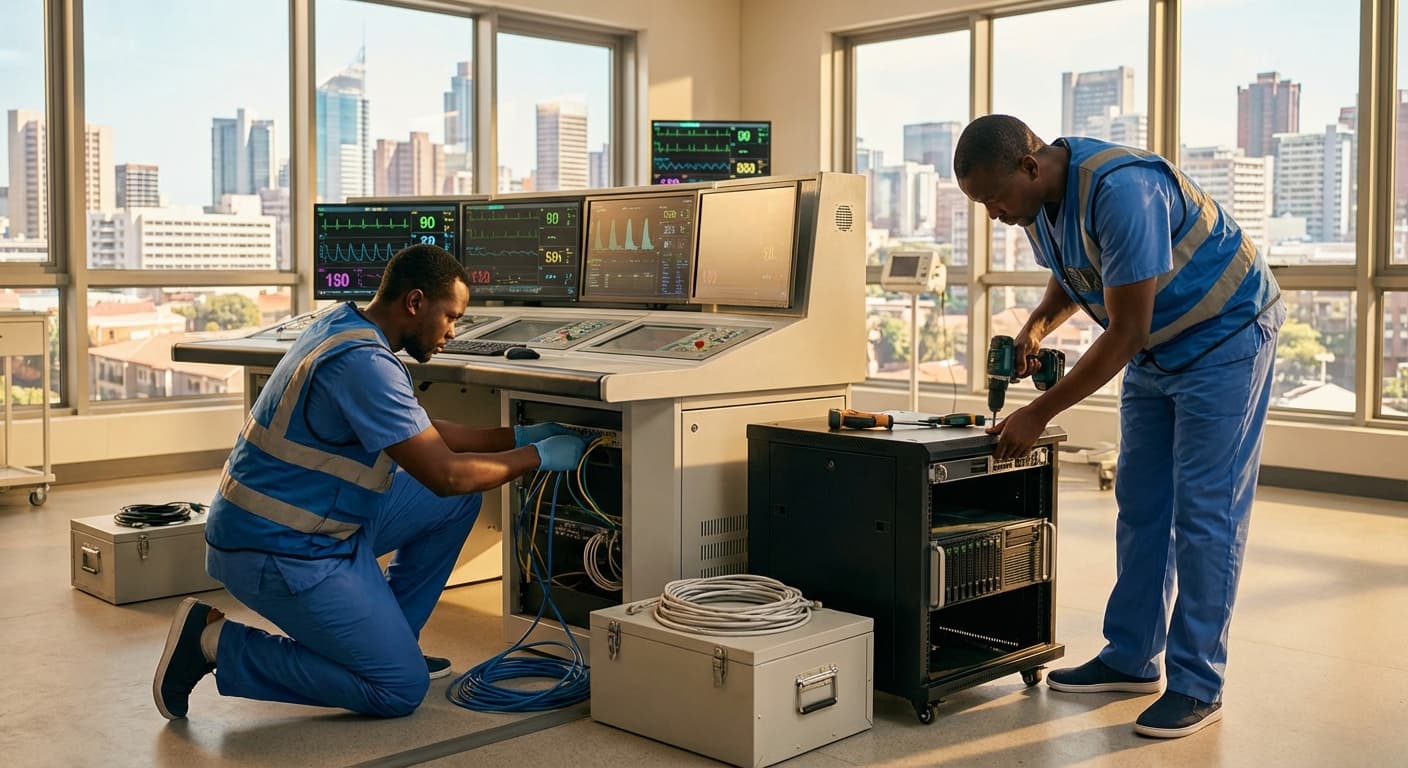
ICU Central Monitoring Station Installation Service in Niger
Engineering Excellence & Technical Support
ICU Central Monitoring Station Installation Service High-standard technical execution following OEM protocols and local regulatory frameworks.
Robust Centralized Data Hub
We implement resilient server infrastructure and secure network architecture to ensure uninterrupted data flow from all ICU monitoring devices, providing a stable and reliable central monitoring station for critical patient information in Niger.
High-Availability Network Integration
Our installation service focuses on establishing redundant and high-bandwidth network connectivity, utilizing advanced switching and routing protocols to guarantee seamless real-time data transmission from diverse ICU equipment to the central monitoring station, even in challenging environments.
Advanced Security Protocols
We deploy state-of-the-art cybersecurity measures, including data encryption, access control, and intrusion detection systems, to safeguard sensitive patient data within the ICU central monitoring station, ensuring compliance and utmost privacy in Niger.
What Is Icu Central Monitoring Station Installation Service In Niger?
ICU Central Monitoring Station Installation Service in Niger refers to the comprehensive process of setting up, configuring, and commissioning a centralized monitoring system for Intensive Care Units (ICUs) within healthcare facilities in Niger. This service ensures that critical patient physiological data, collected from various bedside monitors, is aggregated, displayed, and managed at a central console, enabling real-time oversight and rapid response by medical personnel. The installation encompasses the physical deployment of hardware, network integration, software configuration, system testing, and personnel training.
| Who Needs It | Typical Use Cases |
|---|---|
| Hospitals and Healthcare Facilities in Niger with Intensive Care Units (ICUs) or High-Dependency Units (HDUs). | Enhanced Patient Surveillance: Real-time monitoring of multiple critically ill patients from a single location, allowing for immediate detection of physiological deterioration. Improved Clinical Decision-Making: Access to comprehensive patient data trends and vital signs facilitates quicker and more informed treatment adjustments. Optimized Staff Workflow: Reduces the need for continuous physical checks at each bedside, freeing up nursing staff for direct patient care and complex interventions. Efficient Alarm Management: Centralized alarm notification and prioritization help prevent alarm fatigue and ensure critical alerts are addressed promptly. Data Archiving and Research: Enables systematic collection and storage of patient data for clinical audits, quality improvement initiatives, and research purposes. Remote Consultation (Potential): In advanced implementations, the central station can facilitate remote consultation with specialists by providing access to real-time patient data. Disaster Preparedness: A robust central monitoring system can be crucial during public health emergencies or mass casualty events for managing large numbers of critically ill patients. |
Key Components and Stages of ICU Central Monitoring Station Installation:
- Site Survey and Assessment: Evaluating existing infrastructure, power supply, network capabilities, and physical space requirements for the central station and bedside monitor connectivity.
- Hardware Installation: Procuring and installing the central monitoring server, display consoles (workstations), network switches, routers, cabling, and associated power/UPS systems.
- Bedside Monitor Integration: Ensuring compatibility and establishing reliable network connections between existing or newly installed bedside patient monitors (e.g., for ECG, SpO2, NIBP, IBP, EtCO2) and the central station.
- Network Configuration: Setting up secure and robust local area network (LAN) or wireless local area network (WLAN) infrastructure to facilitate data transmission, ensuring appropriate bandwidth and redundancy.
- Software Deployment and Configuration: Installing and configuring the central monitoring software, including patient database management, alarm settings, data archiving, trend analysis tools, and user access controls.
- System Testing and Calibration: Thoroughly testing all aspects of the system, including data acquisition, transmission accuracy, alarm functionality, and data integrity, followed by calibration of connected devices.
- User Training and Handover: Providing comprehensive training to ICU physicians, nurses, and biomedical engineers on system operation, data interpretation, alarm management, and basic troubleshooting.
- Documentation and Support: Delivering detailed system documentation, including network diagrams, configuration manuals, and warranty information, along with establishing post-installation support protocols.
Who Needs Icu Central Monitoring Station Installation Service In Niger?
The installation of ICU Central Monitoring Station services is crucial for healthcare facilities in Niger aiming to enhance critical care capabilities, improve patient outcomes, and optimize resource management. These advanced systems centralize vital signs monitoring for multiple Intensive Care Unit (ICU) beds, allowing a dedicated team to observe, analyze, and respond rapidly to patient status changes. This not only improves the efficiency of nursing staff but also enables earlier detection of deteriorating conditions, potentially saving lives and reducing the length of hospital stays.
| Department/Service Area | Specific Needs Addressed by Central Monitoring Stations |
|---|---|
| Intensive Care Unit (ICU) | Real-time, continuous monitoring of multiple patients' vital signs (heart rate, blood pressure, oxygen saturation, respiration, etc.) from a central location. This allows for proactive intervention, early detection of adverse events, and optimized nurse-to-patient ratios. |
| Critical Care Units (CCU) | Similar to ICU, providing a consolidated view of patient data for immediate assessment and response, crucial for managing complex cardiac or respiratory conditions. |
| Post-Anesthesia Care Unit (PACU) / Recovery Room | Monitoring patients recovering from surgery, ensuring stability and enabling quick detection of complications. |
| Emergency Department (ED) / Trauma Centers | In facilities with dedicated critical care bays within the ED, central monitoring can aid in managing critically ill or injured patients awaiting transfer to the ICU. |
| Cardiology Departments (with critical care capabilities) | Monitoring patients with severe cardiac conditions requiring intensive observation. |
| Nephrology Departments (with critical care capabilities) | Monitoring critically ill patients with renal failure or undergoing complex treatments. |
| Pediatric Intensive Care Units (PICU) | Tailored monitoring solutions for infants and children requiring critical care, ensuring their delicate physiological parameters are closely watched. |
| Neonatal Intensive Care Units (NICU) | Specialized monitoring for premature infants and newborns with critical health issues, demanding highly sensitive and accurate data acquisition. |
| Medical Records & IT Departments | Integration of monitoring data into electronic health records (EHRs) for historical analysis, research, and administrative purposes. Ensuring data security and system interoperability. |
| Biomedical Engineering Department | Responsible for the installation, calibration, maintenance, and troubleshooting of the central monitoring systems and associated devices. |
Target Customers for ICU Central Monitoring Station Installation Service in Niger:
- Public Hospitals: Government-funded hospitals, particularly those serving as regional or national referral centers, are prime candidates. They often have the highest patient volumes and the greatest need for advanced critical care infrastructure.
- Private Hospitals and Clinics: Growing private healthcare sector institutions in Niger that are investing in state-of-the-art medical technology to offer specialized and high-quality patient care.
- Teaching Hospitals: Institutions affiliated with medical schools require advanced equipment for both patient care and training future medical professionals. Central monitoring systems are essential for an effective ICU learning environment.
- Non-Governmental Organization (NGO) Hospitals: Healthcare facilities operated by NGOs, especially those focused on maternal and child health, emergency medicine, or trauma care, may benefit from the enhanced monitoring capabilities.
- Military Hospitals: Healthcare facilities serving military personnel and their families, which often require robust and reliable medical infrastructure.
- Emerging Healthcare Hubs: Any facility or region within Niger looking to establish itself as a leading center for critical care services.
Icu Central Monitoring Station Installation Service Process In Niger
This document outlines the comprehensive workflow for the installation service of an ICU Central Monitoring Station in Niger. The process is designed to be transparent, efficient, and client-focused, ensuring a successful deployment from initial inquiry to final handover.
| Phase | Key Activities | Description | Timeline (Estimated) |
|---|---|---|---|
| Phase 1: Inquiry & Consultation | Initial Contact, Requirements Gathering | Client contacts the service provider with their need for an ICU Central Monitoring Station. A preliminary discussion is held to understand the scope, desired features, patient capacity, existing infrastructure, and specific requirements of the healthcare facility in Niger. This may involve initial data collection forms or a preliminary call. | 1-3 Business Days |
| Phase 2: Site Assessment & Planning | On-site Survey, Technical Feasibility Study | A qualified technical team visits the proposed installation site in Niger to conduct a detailed assessment. This includes evaluating electrical infrastructure, network connectivity, available space, environmental conditions (temperature, humidity), and potential integration points with existing systems. A comprehensive site plan is developed. | 3-7 Business Days |
| Phase 3: Quotation & Agreement | Proposal Generation, Contract Negotiation | Based on the site assessment and gathered requirements, a detailed quotation is prepared. This includes the cost of equipment, installation labor, training, and any associated services. The quotation is presented to the client for review. Upon agreement, a formal contract is drafted and signed by both parties. | 2-5 Business Days |
| Phase 4: Equipment Procurement & Logistics | Ordering, Shipping, Customs Clearance | The necessary ICU Central Monitoring Station components and related hardware are procured from manufacturers or distributors. The logistics of shipping to Niger are managed, including handling customs clearance, import duties, and transportation to the final site. This is often the most time-consuming phase due to international shipping and local regulations. | 4-12 Weeks (variable depending on lead times and shipping method) |
| Phase 5: Installation & Configuration | Hardware Setup, Network Integration, Software Installation | Upon arrival of the equipment, the installation team begins the physical setup. This involves mounting monitors, central station hardware, and connecting sensors. Network infrastructure is established or integrated. The monitoring software is installed and configured to meet the specific clinical workflows of the ICU. | 5-10 Business Days |
| Phase 6: Testing & Commissioning | System Functionality Checks, Performance Validation | The installed system undergoes rigorous testing to ensure all components are functioning correctly. This includes verifying data acquisition from bedside monitors, alarm functionality, data logging, network communication, and user interface responsiveness. Performance is validated against established benchmarks and client requirements. | 2-4 Business Days |
| Phase 7: Training & Handover | User Training, Documentation, Final Sign-off | Comprehensive training is provided to the hospital's medical staff, IT personnel, and biomedical engineers on operating and maintaining the ICU Central Monitoring Station. User manuals and technical documentation are provided. A formal handover of the system and documentation is conducted, with client sign-off signifying successful installation. | 2-3 Business Days |
| Phase 8: Post-Installation Support | Warranty, Remote Monitoring, On-site Support (if applicable) | Following the successful handover, the service provider offers ongoing support, typically including a warranty period. This may involve remote troubleshooting, software updates, and scheduled maintenance. In cases of critical issues, on-site support may be arranged as per the service agreement. | Ongoing (as per service agreement) |
ICU Central Monitoring Station Installation Service Process in Niger
- Phase 1: Inquiry & Consultation
- Phase 2: Site Assessment & Planning
- Phase 3: Quotation & Agreement
- Phase 4: Equipment Procurement & Logistics
- Phase 5: Installation & Configuration
- Phase 6: Testing & Commissioning
- Phase 7: Training & Handover
- Phase 8: Post-Installation Support
Icu Central Monitoring Station Installation Service Cost In Niger
Installing an ICU Central Monitoring Station in Niger involves a range of costs influenced by several key factors. These include the complexity and size of the hospital's ICU, the specific brand and model of monitoring equipment chosen, the number of patient monitoring units required, the integration needs with existing hospital infrastructure, and the technical expertise of the installation team. The "central monitoring station" itself can vary from a simple console with basic displays to a sophisticated system with advanced data analysis and remote access capabilities. Installation services typically encompass site assessment, hardware setup, software configuration, network integration, and staff training. Due to the specialized nature of this equipment and service, costs can be significant, and it's essential to obtain detailed quotes from reputable suppliers and installers operating in Niger.
| Service Component | Estimated Cost Range (XOF) | Notes |
|---|---|---|
| Central Monitoring Console (Hardware & Software) | 5,000,000 - 25,000,000+ | Varies significantly by features, brand, and capacity. |
| Bedside Patient Monitors (per unit) | 1,500,000 - 6,000,000+ | Depends on parameters monitored (ECG, SpO2, NIBP, etc.) and brand. |
| Installation Labor & Project Management | 2,000,000 - 8,000,000+ | Based on complexity, duration, and number of technicians. |
| Network Cabling & Integration | 500,000 - 2,000,000 | Depends on the size of the ICU and existing network infrastructure. |
| Software Configuration & Customization | 500,000 - 3,000,000 | For specific reporting needs, EHR integration, etc. |
| Staff Training | 300,000 - 1,500,000 | For nurses, doctors, and IT personnel. |
| Site Assessment & Preparation | 200,000 - 1,000,000 | Includes minor electrical or network adjustments. |
| Import Duties & Taxes (Estimated) | 10% - 30% of equipment value | Highly variable based on import regulations and equipment origin. |
| Total Estimated Project Cost (for a modest ICU) | 15,000,000 - 70,000,000+ XOF | This is a very broad estimate. A detailed quote is essential. |
Key Pricing Factors for ICU Central Monitoring Station Installation in Niger:
- Scope of the ICU: The number of ICU beds and the associated patient monitoring points directly impact the quantity of equipment and installation complexity.
- Equipment Brand and Model: Premium brands with advanced features will generally be more expensive than basic or mid-range options. This includes the central console, bedside monitors, and any associated software.
- Number of Patient Monitoring Units: Each patient requires a bedside monitor. The total number needed is a primary cost driver.
- Software and Data Management Features: Advanced software for data archiving, trend analysis, remote access, and integration with Electronic Health Records (EHR) will increase costs.
- Integration with Existing Infrastructure: Connecting the new monitoring system with the hospital's existing IT network, power supply, and potentially other medical devices can add complexity and cost.
- Installation and Technical Expertise: The experience and reputation of the installation company, along with the complexity of the installation itself (e.g., cabling, network setup), will affect labor costs.
- Site Preparation: Any necessary modifications to the ICU environment, such as power outlets, network ports, or structural changes, will add to the overall expense.
- Training: Comprehensive training for medical staff on operating and maintaining the system is usually part of the installation service and contributes to the total cost.
- Warranty and Support: Long-term maintenance agreements and warranties are often bundled or offered as an add-on, influencing the initial investment.
- Import Duties and Taxes: Depending on the origin of the equipment and local regulations in Niger, import duties and taxes can significantly impact the final price.
Affordable Icu Central Monitoring Station Installation Service Options
Installing an Intensive Care Unit (ICU) central monitoring station is a critical investment for any healthcare facility, ensuring continuous patient vital sign surveillance and enabling rapid response to critical events. While the technology itself can be expensive, various service options and strategic approaches can make the installation process more affordable without compromising on quality or functionality. This guide explores value bundles and cost-saving strategies for affordable ICU central monitoring station installation.
| Cost-Saving Strategy | Description | Potential Savings |
|---|---|---|
| Phased Implementation | Instead of a full-scale installation, consider a phased approach. Start with essential monitoring capabilities and expand over time as budget allows and needs evolve. | Up to 30-40% on initial outlay |
| Request for Proposal (RFP) Process | Issue a detailed RFP to multiple vendors. This encourages competitive bidding and allows you to compare pricing, features, and service offerings objectively. | 10-25% through competitive bidding |
| Negotiate Service Level Agreements (SLAs) | Carefully review and negotiate SLAs for ongoing maintenance and support. Understanding the terms and potentially bundling support with the initial purchase can lead to better rates. | 5-15% on recurring support costs |
| Leverage Existing Infrastructure | Assess if your current network infrastructure can support the new monitoring system. Upgrading networking components can be a significant cost, so utilizing what you have can be beneficial. | Variable, depending on existing infrastructure |
| Training & Skill Development | Invest in training your in-house IT and biomedical engineering staff to handle basic maintenance and troubleshooting. This can reduce reliance on external support contracts. | 20-30% on outsourced support |
| Bulk Purchasing & Long-Term Contracts | If your facility plans multiple installations or upgrades over time, inquire about discounts for bulk purchases or multi-year service contracts. | 5-10% for bulk orders or long-term commitments |
| Third-Party Integration Expertise | If your chosen monitoring system requires integration with existing Electronic Health Record (EHR) systems, explore the option of using a third-party integration specialist if it proves more cost-effective than vendor-provided services. | Variable, depending on integration complexity |
| Consider Open-Source or Less Feature-Rich Software (with caution) | While rare for critical ICU systems, explore if there are viable, well-supported open-source or less feature-rich software solutions that meet your core needs and are significantly cheaper. This requires thorough due diligence on security and reliability. | Potentially significant savings, but requires extensive validation |
Understanding Value Bundles
- Integrated Hardware & Software Bundles: Many vendors offer packages that combine the central monitoring station hardware (servers, displays, workstations) with the necessary software licenses and basic configuration. These bundles often come at a discounted price compared to purchasing components separately.
- Service & Support Packages: Look for bundles that include installation, on-site training for staff, and a period of post-installation technical support. This holistic approach can streamline the process and prevent costly unforeseen issues.
- Scalability & Future-Proofing Bundles: Some providers offer bundles designed with future expansion in mind. This might include slightly larger capacity than immediately needed or modular components that can be upgraded or added later, avoiding costly replacements down the line.
- Partnership & Preferred Vendor Programs: If your facility already uses other medical equipment from a specific vendor, inquire about their central monitoring station offerings. Loyalty programs or bundled deals with existing equipment can lead to significant savings.
- Refurbished & Certified Pre-Owned Options: For budget-conscious facilities, consider bundles that include certified refurbished or pre-owned central monitoring station hardware. These systems are typically tested, warrantied, and offer a substantial cost reduction.
Verified Providers In Niger
Finding reliable and trustworthy healthcare providers is paramount, especially in regions where access to quality care can be challenging. In Niger, "Verified Providers" signifies a commitment to a higher standard of medical practice, often backed by stringent credentialing processes and a focus on patient well-being. Franance Health stands out as a leading example of an organization that prioritizes these verified providers, ensuring that individuals seeking medical attention have access to competent and ethical professionals. Their rigorous credentialing process is not just a formality; it's a critical step in building trust and confidence for patients. This dedication to verification means that healthcare professionals associated with Franance Health have met specific educational, licensing, and experience benchmarks, often including background checks and ongoing professional development requirements. Choosing a provider vetted by Franance Health offers significant advantages, ranging from assured medical expertise to a commitment to ethical patient care and adherence to best practices. This assurance is invaluable for individuals and families navigating their healthcare journeys.
| Credentialing Area | Franance Health Verification Standard | Patient Benefit |
|---|---|---|
| Medical License and Registration | Mandatory and actively confirmed with relevant Nigerien authorities. | Ensures legal and authorized practice. |
| Educational Background | Verification of degrees, certifications, and specialist training from accredited institutions. | Confirms foundational knowledge and specialized skills. |
| Clinical Experience | Assessment of prior work experience, including types of cases handled and duration of practice. | Indicates practical competence and familiarity with common medical issues. |
| Professional References | Contact with previous employers or peers to assess work ethic and clinical performance. | Provides an independent evaluation of the provider's capabilities and conduct. |
| Background Checks | Screening for any disciplinary actions or ethical concerns. | Safeguards against malpractice and ensures patient safety. |
| Continuing Medical Education (CME) | Requirement for documented participation in ongoing training and professional development. | Ensures providers stay updated with the latest medical advancements and techniques. |
| Specialty Board Certification (where applicable) | Verification of any additional board certifications in specialized fields. | Confirms advanced expertise and recognized proficiency in a specific area of medicine. |
Why Franance Health Verified Providers are the Best Choice in Niger
- Rigorous Credentialing: Franance Health employs a multi-faceted verification process that goes beyond basic licensing.
- Proven Expertise: Verified providers demonstrate a strong track record of successful patient outcomes and specialized knowledge.
- Ethical Practice: Commitment to patient safety, confidentiality, and respectful treatment is a core tenet of verification.
- Adherence to Standards: Providers meet and often exceed national and international healthcare best practices.
- Enhanced Patient Trust: The verification process builds confidence and reduces anxiety for individuals seeking care.
- Access to Quality Care: Connects patients with a network of pre-vetted, high-quality healthcare professionals.
- Continuous Professional Development: Many verified providers are committed to ongoing learning and skill enhancement.
Scope Of Work For Icu Central Monitoring Station Installation Service
This Scope of Work (SOW) outlines the requirements for the installation of an ICU Central Monitoring Station (CMS) service. It details the technical deliverables, standard specifications, and expected outcomes to ensure a successful and compliant implementation. The project aims to establish a robust and reliable CMS to enhance patient monitoring capabilities within the Intensive Care Unit (ICU).
| Technical Deliverable | Description | Standard Specification / Requirement | Acceptance Criteria |
|---|---|---|---|
| CMS Server and Workstations | Installation and configuration of the central monitoring server and attendant workstations within the ICU control room. | Server hardware meeting specified performance requirements (CPU, RAM, Storage). Workstations with high-resolution displays (minimum 24-inch, 1920x1080 resolution). | Server operational, workstations connected and displaying real-time patient data. Successful login and basic navigation confirmed. |
| Network Infrastructure Integration | Integration of the CMS with the existing hospital network infrastructure, including secure data transmission protocols. | IEEE 802.3 Ethernet standards. Secure data encryption (e.g., TLS 1.2 or higher). Adequate bandwidth allocation for real-time data. | Network connectivity established. Data flow validated between bedside monitors and CMS. No data loss or corruption observed. |
| Bedside Monitor Connectivity | Establishment of reliable data links between individual ICU bedside monitors and the CMS. | Compatibility with existing bedside monitor models (specified in Appendix A). Use of appropriate cabling and network interfaces (e.g., Ethernet, Wi-Fi as applicable). | All designated bedside monitors successfully connected. Real-time physiological data (ECG, SpO2, BP, etc.) displayed on CMS for each connected patient. |
| Software Installation and Configuration | Installation and configuration of the CMS software, including patient demographic integration, alarm management, and data archiving. | Latest stable version of CMS software. Integration with hospital's Electronic Health Record (EHR) system (if applicable, specified in Appendix B). Configurable alarm thresholds and priorities. | Software fully installed and functional. Patient data populates correctly. Alarm notifications triggered and managed as per configuration. Data archiving system operational. |
| Alarm Management System | Configuration and testing of the CMS alarm management system to ensure timely and accurate alerts. | Configurable alarm types (e.g., physiological, technical). Prioritization of alarms. Audible and visual alerts on CMS workstations and potentially remote devices. | All critical alarms tested and confirmed to trigger appropriate alerts. Silence/suspend functionality tested. Alarm log is accurately maintained. |
| Data Archiving and Retrieval | Implementation of a robust data archiving solution for long-term storage of patient monitoring data. | Sufficient storage capacity for [specify duration, e.g., 5 years] of data. Compliance with relevant data retention regulations (e.g., HIPAA, GDPR). User-friendly interface for data retrieval. | Data archiving process successfully initiated. Test retrieval of historical patient data is accurate and complete. |
| User Training | Comprehensive training for ICU clinical staff and IT support personnel on the operation and maintenance of the CMS. | Training modules covering system features, alarm management, troubleshooting, and data retrieval. Hands-on practical sessions. | All designated users demonstrate proficiency in operating the CMS and responding to alerts. Competency assessment completed. |
| System Documentation | Provision of complete technical and user documentation for the installed CMS. | System architecture diagrams, installation guides, configuration manuals, user manuals, and troubleshooting guides. All documentation in [specify language, e.g., English]. | All required documentation is delivered, accurate, and readily accessible. |
| Performance Monitoring and Reporting | Configuration of system monitoring tools to track CMS performance and identify potential issues. | Real-time performance dashboards. Automated reporting on system uptime, data throughput, and error rates. | Performance monitoring tools are active and generating reports as specified. System meets defined performance benchmarks (e.g., data latency < X ms). |
Key Project Phases
- Planning and Design
- Procurement and Delivery
- Installation and Configuration
- Testing and Validation
- Training and Handover
- Post-Installation Support
Service Level Agreement For Icu Central Monitoring Station Installation Service
This Service Level Agreement (SLA) outlines the response times and uptime guarantees for the installation of the ICU Central Monitoring Station (CMS) services provided by [Your Company Name] to [Client Name]. This SLA is an integral part of the overall contract for the CMS installation.
| Severity Level | Description | Initial Response Time | Resolution Target Time |
|---|---|---|---|
| Critical (Severity 1) | Complete failure of the CMS preventing any monitoring. Significant risk to patient safety or disruption to critical ICU operations. | 1 Hour (within Service Hours) | 4 Hours (within Service Hours) |
| High (Severity 2) | Partial loss of CMS functionality affecting a significant number of patients or a critical monitoring feature. Moderate risk to patient safety or operational efficiency. | 2 Hours (within Service Hours) | 8 Hours (within Service Hours) |
| Medium (Severity 3) | Degradation of CMS performance or failure of a non-critical component, impacting a limited number of patients or features. Minimal risk to patient safety or operational efficiency. | 4 Hours (within Service Hours) | 24 Hours (within Service Hours) |
| Low (Severity 4) | Minor functional issue, cosmetic defect, or request for information that does not impact core CMS functionality or patient safety. | 8 Business Hours (within Service Hours) | As per mutually agreed schedule or next planned maintenance window |
Key Definitions
- {"term":"CMS","definition":"Central Monitoring Station, referring to the integrated system for monitoring patient vital signs and other critical data within the ICU."}
- {"term":"Installation Service","definition":"The end-to-end process of setting up, configuring, testing, and commissioning the CMS, including hardware, software, and network integration, as per the agreed scope of work."}
- {"term":"Service Hours","definition":"The hours during which support and maintenance services are available. For this SLA, Service Hours are defined as Monday to Friday, 8:00 AM to 5:00 PM [Client's Time Zone], excluding national holidays."}
- {"term":"Downtime","definition":"Any period during which the CMS, as a whole or a critical component thereof, is unavailable for use by authorized personnel, preventing it from performing its core monitoring functions. Scheduled maintenance is excluded from Downtime."}
- {"term":"Incident","definition":"Any event that causes or may cause a disruption or reduction in the quality of the CMS installation service."}
- {"term":"Severity Level","definition":"A classification of an Incident based on its impact on the CMS installation service and patient care."}
Frequently Asked Questions

Ready when you are
Let's scope your ICU Central Monitoring Station Installation Service in Niger project in Niger.

Scaling healthcare logistics and technical systems across the entire continent.