
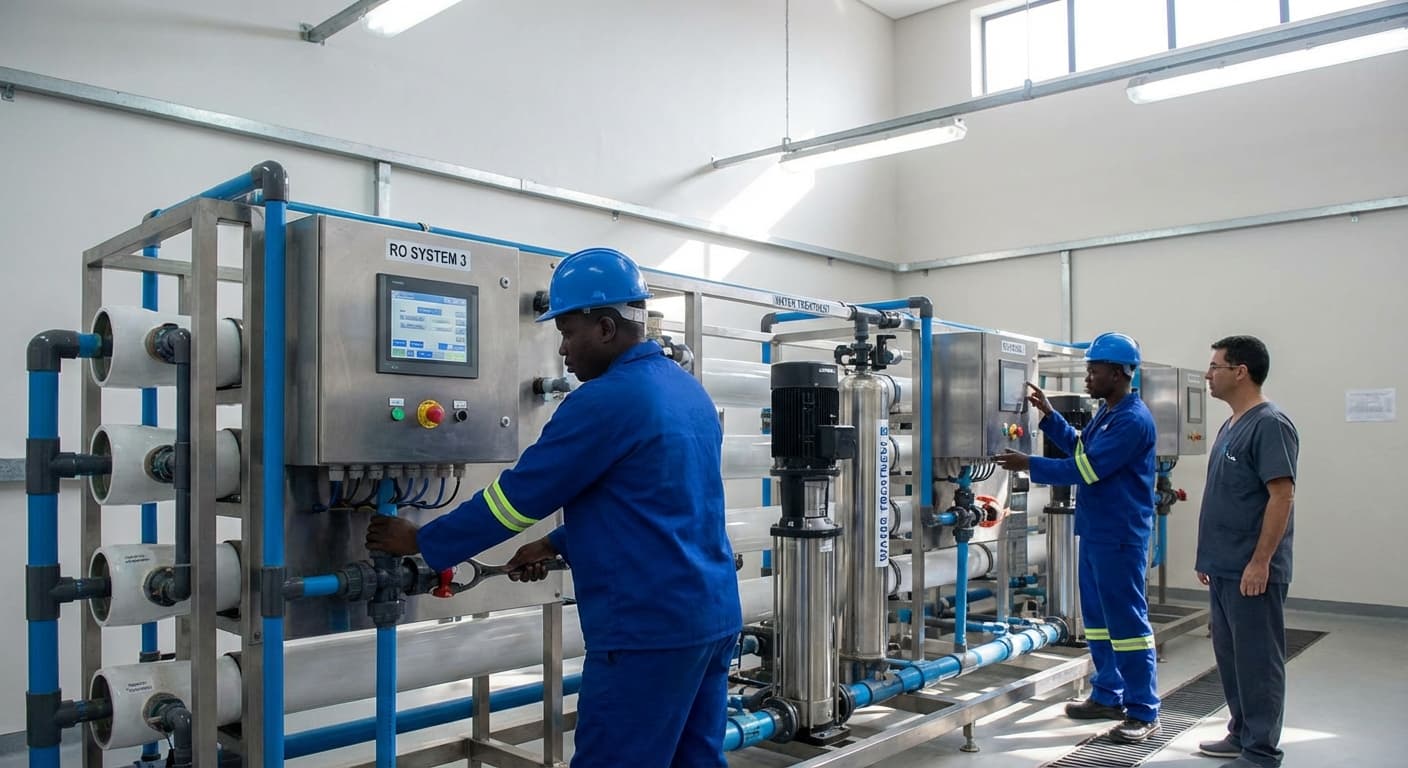
Dialysis RO/Water Treatment Plant Installation Service in Niger
Engineering Excellence & Technical Support
Dialysis RO/Water Treatment Plant Installation Service High-standard technical execution following OEM protocols and local regulatory frameworks.
Optimized Flow Rate Design
We engineer RO/Water Treatment plant systems in Niger for optimal flow rates, ensuring consistent and reliable purified water supply crucial for dialysis operations. Our designs minimize pressure drops and maximize membrane efficiency, even with challenging source water conditions prevalent in the region.
Robust Equipment Sourcing & Integration
Leveraging extensive experience, we source and integrate high-quality, durable RO membrane elements, pumps, and filtration components specifically suited for Niger's climate and infrastructure. Our installation prioritizes easy maintenance and long-term operational stability.
Low Power Consumption Solutions
Understanding Niger's energy landscape, our installations focus on energy-efficient RO/Water Treatment systems. We implement smart control strategies and select low-power components to reduce operational costs and environmental impact, providing sustainable dialysis water solutions.
What Is Dialysis Ro/water Treatment Plant Installation Service In Niger?
Dialysis RO/Water Treatment Plant Installation Service in Niger refers to the specialized process of designing, sourcing, assembling, commissioning, and validating Reverse Osmosis (RO) and associated water treatment systems specifically for dialysis centers and healthcare facilities in Niger. This service ensures the provision of ultra-pure water, a critical prerequisite for hemodialysis, to prevent complications arising from impure water. The scope encompasses initial site assessment, system selection based on water quality and patient volume, civil and mechanical installation, electrical integration, water quality testing and certification, operator training, and ongoing maintenance planning. The objective is to establish a reliable, compliant, and efficient water purification infrastructure to support safe and effective renal replacement therapy within the Nigerian healthcare landscape.
| Who Needs It? | Typical Use Cases | Key Considerations in Niger |
|---|---|---|
| New Dialysis Centers | Establishment of greenfield dialysis facilities requiring a complete water purification system. | Logistical challenges for equipment import, availability of skilled local technicians, grid power stability. |
| Existing Dialysis Centers Requiring Upgrades or Replacements | Expansion of existing facilities, replacement of aging or non-compliant water treatment systems. | Integration with existing infrastructure, adherence to evolving national/international water quality standards. |
| Hospitals with Dialysis Units | Hospitals providing hemodialysis services as part of their comprehensive patient care. | Ensuring continuity of water supply during potential power outages, integration with hospital's water management protocols. |
| Non-Governmental Organizations (NGOs) and Humanitarian Organizations | Deployment of mobile or fixed dialysis units in underserved or emergency settings. | Robustness of the system for remote locations, ease of maintenance with limited technical expertise, cost-effectiveness. |
| Government Health Initiatives and Public Health Programs | Establishment of public dialysis facilities to increase access to care. | Scalability of installations, long-term operational cost considerations, training of government-employed technicians. |
Key Components of Dialysis RO/Water Treatment Plant Installation Service
- Site Assessment and Water Quality Analysis
- System Design and Engineering
- Procurement of Equipment and Components
- Civil and Mechanical Installation
- Electrical Wiring and Control Integration
- Pre-treatment System Setup (e.g., sand filters, carbon filters, water softeners)
- Reverse Osmosis (RO) Unit Installation
- Post-treatment System Setup (e.g., UV disinfection, sub-micron filtration)
- Piping and Plumbing Network Installation
- System Commissioning and Performance Testing
- Water Quality Validation and Certification
- Operator Training and Handover
- Documentation and As-Built Drawings
- Post-Installation Support and Maintenance Planning
Who Needs Dialysis Ro/water Treatment Plant Installation Service In Niger?
Dialysis centers and hospitals with a significant number of kidney patients require a reliable and high-quality source of purified water for their hemodialysis treatments. This purified water is essential for diluting dialysate concentrates and ensuring patient safety by removing contaminants that could cause adverse reactions or infections. The installation of a Dialysis RO/Water Treatment Plant is a critical infrastructure investment for these facilities.
| Target Customer Type | Relevant Departments/Units | Key Needs/Considerations |
|---|---|---|
| Public Hospitals | Nephrology Department, Renal Unit, Biomedical Engineering, Procurement Department | Ensuring adequate supply of purified water for a large patient base, cost-effectiveness, long-term sustainability, compliance with international standards, maintenance and technical support. |
| Private Hospitals | Nephrology Department, Renal Unit, Facility Management, Procurement Department | High-quality water to meet patient expectations and regulatory requirements, reliable system operation, advanced technology for efficiency, specialized after-sales service. |
| Dedicated Dialysis Centers | Clinical Operations, Biomedical Engineering, Administration, Procurement | Primary focus on dialysis treatment, necessitating a robust and dedicated water purification system, adherence to strict water quality standards, minimal downtime, efficient space utilization. |
| Medical Clinics with Nephrology Departments | Nephrology Department, Facility Management, Technical Support | Smaller-scale requirements compared to large hospitals, but still demanding high purity water, reliable and easy-to-maintain systems, space-efficient solutions. |
| International Aid Organizations | Healthcare Program Management, Logistics, Technical Implementation Teams | Deploying healthcare infrastructure in resource-limited settings, requiring robust, transportable, and easily maintainable systems, training for local staff, donor compliance. |
| Government Health Ministries | Public Health Infrastructure Division, Procurement Agency, Technical Standards Committee | Developing national healthcare infrastructure, setting water quality standards for dialysis, procuring systems for public facilities, capacity building for local technicians, long-term planning and budgeting. |
Target Customers for Dialysis RO/Water Treatment Plant Installation Service in Niger
- Public Hospitals
- Private Hospitals
- Dedicated Dialysis Centers
- Medical Clinics with Nephrology Departments
- International Aid Organizations providing healthcare services
- Government Health Ministries (for public health infrastructure projects)
Dialysis Ro/water Treatment Plant Installation Service Process In Niger
This document outlines the comprehensive service process for the installation of Dialysis Reverse Osmosis (RO) / Water Treatment Plants in Niger. The workflow is designed to ensure a smooth and efficient project lifecycle, from initial client inquiry to successful system commissioning and handover.
| Phase | Stage | Key Activities | Deliverables/Outcomes | Key Personnel Involved | Estimated Timeline (Indicative) |
|---|---|---|---|---|---|
| 1 | Inquiry & Consultation | Initial contact from client (phone, email, referral). Detailed discussion of client's needs, existing infrastructure, water source quality, and dialysis unit capacity. Preliminary information gathering on local regulations and standards. Initial technical consultation and clarification of project scope. | Understanding of client requirements. Initial assessment of project feasibility. Identification of potential challenges. Client engagement and relationship building. | Sales Representative Technical Consultant Client Representative | 1-3 Business Days |
| 2 | Site Assessment & System Design | On-site visit to assess available space, power supply, water source, drainage, and existing plumbing. Detailed water quality analysis of the source. Development of a tailored RO/Water Treatment system design based on site conditions, water analysis, and dialysis unit requirements (e.g., flow rate, purity standards - AAMI/ISO). Preparation of P&IDs (Piping and Instrumentation Diagrams) and technical specifications. | Comprehensive site assessment report. Detailed system design proposal. Bill of Materials (BOM). Project timeline and resource allocation plan. | Project Manager Mechanical Engineer Electrical Engineer Water Treatment Specialist Client Representative | 3-10 Business Days |
| 3 | Proposal & Contract Negotiation | Submission of a detailed technical and commercial proposal to the client, including design specifications, equipment list, pricing, installation plan, warranty, and after-sales support. Review and negotiation of the proposal terms and conditions. Formalization of the contract and agreement. | Approved proposal. Signed contract. Advance payment/Letter of Credit (if applicable). | Sales Representative Project Manager Legal Counsel Client Representative | 5-15 Business Days |
| 4 | Procurement & Logistics | Ordering of all necessary equipment, components, and materials as per the BOM. Coordination of international or local shipping and customs clearance for imported goods. Ensuring all components are delivered to the designated site in Niger. Quality control checks during procurement and before shipment. | Procured equipment and materials. Cleared customs documentation. Delivery confirmation at the site. | Procurement Manager Logistics Coordinator Warehouse Staff Customs Broker | 2-8 Weeks (depending on lead times and shipping) |
| 5 | Pre-installation & Site Preparation | Site preparation activities as per design requirements: electrical wiring, plumbing connections, foundation work (if needed), water source preparation. Unpacking and initial inspection of delivered equipment. Coordination with local utility providers (power, water). Securing necessary permits (if any). | Prepared installation site. Accessible utilities. Ready for equipment installation. | Project Manager Site Supervisor Local Construction Crew Client's Maintenance Team | 1-3 Weeks |
| 6 | Installation & Commissioning | Assembly and installation of the RO/Water Treatment plant components according to the design and manufacturer's guidelines. Electrical and plumbing connections. System testing and flushing. Performance testing and validation against specified parameters (e.g., water purity, flow rate, pressure). Troubleshooting and adjustments to optimize system performance. | Fully installed and functional RO/Water Treatment plant. Commissioning report with test results. Validation of water quality meeting dialysis standards. | Project Manager Installation Engineers Water Treatment Technicians Client's Biomedical Engineers | 2-4 Weeks |
| 7 | Training & Handover | Comprehensive training for the client's technical and operational staff on system operation, routine maintenance, troubleshooting, and safety procedures. Provision of O&M manuals, spare parts list, and warranty documents. Formal handover of the installed system to the client. | Trained operational staff. Complete documentation package. Signed handover certificate. | Project Manager Installation Engineers Technical Trainers Client's Operational Staff | 3-7 Business Days |
| 8 | Post-installation Support | Ongoing technical support and troubleshooting. Scheduled preventative maintenance visits (as per contract). Provision of spare parts and consumables. Remote monitoring and assistance (if applicable). Periodic performance reviews. | Optimized system performance. Minimized downtime. Long-term operational efficiency. Client satisfaction. | Technical Support Team Field Service Engineers Client's Maintenance Team | Ongoing (as per contract) |
Dialysis RO/Water Treatment Plant Installation Service Process in Niger
- Phase 1: Inquiry & Consultation
- Phase 2: Site Assessment & System Design
- Phase 3: Proposal & Contract Negotiation
- Phase 4: Procurement & Logistics
- Phase 5: Pre-installation & Site Preparation
- Phase 6: Installation & Commissioning
- Phase 7: Training & Handover
- Phase 8: Post-installation Support
Dialysis Ro/water Treatment Plant Installation Service Cost In Niger
Installing a Reverse Osmosis (RO) and water treatment plant for dialysis in Niger is a significant investment, with costs influenced by a variety of factors. These factors determine the overall complexity, scale, and quality of the system required to meet the stringent standards for dialysis water purity. The pricing is typically presented in local currency, the West African CFA franc (XOF).
| System Size/Capacity | Estimated Cost Range (XOF) | Notes |
|---|---|---|
| Small Dialysis Unit (e.g., 1-5 Dialysis Machines) | 15,000,000 - 40,000,000 | Basic pre-treatment, standard RO, modest flow rate. Assumes relatively good source water. |
| Medium Dialysis Center (e.g., 6-15 Dialysis Machines) | 40,000,000 - 80,000,000 | More robust pre-treatment, higher capacity RO, potentially dual-pass RO for enhanced purity. Accounts for moderate contaminants. |
| Large Dialysis Facility (e.g., 16+ Dialysis Machines) | 80,000,000 - 200,000,000+ | Comprehensive multi-stage pre-treatment, high-flow RO, advanced monitoring and control, potentially multiple RO trains for redundancy. Designed for challenging water sources and high demand. |
| Custom/Advanced Systems (e.g., for remote locations, highly contaminated water) | 150,000,000+ | Includes specialized pre-treatment modules, advanced disinfection, automation, and robust construction for demanding environments. |
Key Pricing Factors for Dialysis RO/Water Treatment Plant Installation in Niger
- {"title":"System Capacity and Flow Rate","description":"The volume of purified water the plant needs to produce per hour or day directly impacts the size and cost of the RO membranes, pumps, and other components. Larger capacity systems naturally incur higher installation costs."}
- {"title":"Water Source Quality","description":"The initial quality of the raw water source (e.g., well water, municipal supply) is a critical determinant. Water with high levels of contaminants (salinity, hardness, organic matter, microbial load) will require more advanced pre-treatment stages (e.g., multimedia filters, activated carbon filters, UV sterilization, ion exchange resins), increasing the overall system complexity and cost."}
- {"title":"Technology and Components Used","description":"The specific technologies and brands of RO membranes, pumps, filters, control systems, and monitoring equipment chosen will significantly affect the price. High-end, durable, and energy-efficient components often come at a premium."}
- {"title":"Pre-Treatment Requirements","description":"As mentioned, the extent of pre-treatment needed is a major cost driver. This can include sediment filters, activated carbon filters, water softeners, de-aerators, and potentially specialized filters for specific contaminants found in Niger's water sources."}
- {"title":"Installation Labor and Expertise","description":"The cost of skilled labor for installation, including technicians experienced in RO and water treatment systems, can vary. Access to specialized engineers for design and commissioning also adds to the expense. Transporting materials and personnel to potentially remote locations in Niger can also increase labor costs."}
- {"title":"Site Preparation and Infrastructure","description":"This includes costs associated with preparing the installation site, such as constructing a dedicated housing, ensuring adequate power supply, drainage, and water storage facilities. Any modifications to existing infrastructure will also add to the bill."}
- {"title":"Ancillary Equipment and Services","description":"This can encompass costs for water storage tanks, distribution piping, monitoring and testing equipment, chemical dosing systems for cleaning and disinfection, and initial water quality testing. After-sales support, maintenance contracts, and operator training are also important considerations that influence the total cost."}
- {"title":"Permits and Regulatory Compliance","description":"Obtaining necessary permits and ensuring compliance with local health and environmental regulations can incur administrative fees and may require specific documentation and testing, adding to the overall project cost."}
- {"title":"Logistics and Shipping","description":"The cost of shipping equipment and materials to Niger, considering import duties and taxes, will be a significant factor, especially for larger or specialized components."}
Affordable Dialysis Ro/water Treatment Plant Installation Service Options
Access to clean and reliable water is paramount for dialysis patients. Affordable Dialysis RO/Water Treatment Plant Installation Services aim to make this essential infrastructure accessible to healthcare facilities and patients alike. These services focus on providing cost-effective solutions without compromising on water quality standards crucial for dialysis. Understanding value bundles and implementing smart cost-saving strategies are key to making these installations economically viable.
| Cost-Saving Strategy | Description | Benefit for Dialysis RO Installation |
|---|---|---|
| Value Bundles | Combining multiple services and components into a package deal, often at a discounted price compared to individual purchases. This can include the plant itself, installation, initial maintenance, and training. | Provides a predictable, all-inclusive cost, simplifies procurement, and can offer significant upfront savings. |
| Modular Design | Using pre-assembled modules that can be easily transported and connected, reducing on-site assembly time and labor costs. | Faster installation, reduced labor expenses, and easier scalability or upgrades. |
| Energy-Efficient Components | Selecting pumps, membranes, and control systems that consume less electricity. | Lower operational costs over the lifespan of the plant, contributing to overall affordability. |
| Standardized Component Sourcing | Utilizing widely available and standardized parts rather than highly specialized or custom-made ones. | Reduced procurement costs, easier availability of replacements, and simplified maintenance. |
| Phased Installation | Breaking down a large installation into smaller, manageable phases, especially for larger facilities or budget-constrained projects. | Spreads the initial capital expenditure over time, making it more manageable for smaller budgets. |
| Preventive Maintenance Packages | Opting for bundled maintenance contracts that include regular check-ups and part replacements to avoid costly breakdowns. | Minimizes unexpected repair costs and downtime, ensuring consistent water quality and prolonging the life of the equipment. |
| Bulk Purchasing Power | For larger projects or for organizations installing multiple plants, negotiating discounts for bulk orders of components or entire systems. | Direct reduction in the cost of materials and equipment. |
| Remote Monitoring and Support | Utilizing technology to monitor system performance remotely, allowing for early detection of issues and reducing the need for frequent on-site visits. | Lower service call costs and faster troubleshooting. |
Key Components of Dialysis RO/Water Treatment Plants
- Reverse Osmosis (RO) Membrane: The core of the purification process, removing dissolved solids and impurities.
- Pre-filtration System: Multi-stage filters (sediment, carbon) to protect the RO membrane and remove larger particles.
- Post-filtration System: Activated carbon filters for taste and odor improvement, and potentially UV sterilization for microbial control.
- Water Softener: Essential for preventing scale buildup in the RO system and dialysis machines, especially in areas with hard water.
- Storage Tanks: For purified water, ensuring a consistent supply.
- Monitoring and Control Systems: To track water quality parameters and system performance.
- Piping and Plumbing: Food-grade materials to maintain water purity.
- Installation and Commissioning: Professional setup and testing of the entire system.
Verified Providers In Niger
In Niger, securing reliable healthcare access is paramount. "Verified Providers" in the context of Franfinance Health signifies a crucial distinction, representing healthcare facilities and professionals who have undergone rigorous vetting and meet specific quality and ethical standards. Franfinance Health's credentialing process is designed to ensure that patients receive safe, effective, and professional medical care. By choosing providers accredited by Franfinance Health, individuals can have greater confidence in the quality of services rendered, reduced risk of malpractices, and access to a network committed to patient well-being. This verification is not merely a formality; it’s a commitment to excellence in healthcare delivery.
| Feature | Benefit for Patients | Why it's the Best Choice |
|---|---|---|
| Franfinance Health Credentialing Process | Assurance of quality and safety in healthcare services. | Eliminates the guesswork in finding trustworthy medical professionals and facilities. |
| Skilled and Competent Practitioners | Receiving accurate diagnoses and effective treatments from qualified experts. | Reduces the likelihood of medical errors and ensures appropriate care. |
| Ethical Standards and Practices | Trustworthy interactions and transparent billing practices. | Promotes a patient-centered approach and protects against exploitation. |
| Compliance with Regulations | Services meet established legal and medical benchmarks. | Guarantees that providers operate within legal and safe frameworks. |
| Network of Trusted Facilities | Access to well-equipped and reputable healthcare institutions. | Provides peace of mind knowing you are receiving care in a reliable environment. |
Key Aspects of Franfinance Health Verification:
- Rigorous quality control measures.
- Adherence to ethical medical practices.
- Demonstrated competence and professionalism of practitioners.
- Compliance with national healthcare regulations.
- Commitment to patient safety and satisfaction.
Scope Of Work For Dialysis Ro/water Treatment Plant Installation Service
This Scope of Work (SOW) outlines the services required for the installation of a Dialysis Reverse Osmosis (RO) / Water Treatment Plant. It details the technical deliverables, standard specifications, and responsibilities of all parties involved to ensure a successful and compliant installation that meets all relevant healthcare and water quality standards.
| Phase | Activities | Technical Deliverables | Standard Specifications / Requirements | Responsibility |
|---|---|---|---|---|
| Review of final design drawings, P&IDs, electrical schematics, and equipment specifications. | Approved Design Package, Bill of Materials (BOM). | Compliance with current applicable local, national, and international codes, standards (e.g., AAMI, ISO, WHO), and facility specific requirements. Review of existing site conditions. | Contractor, Facility Representative |
| Sourcing, procurement, and delivery of all RO/Water Treatment Plant components, piping, electrical equipment, and consumables. | Delivered Equipment and Materials (with Certificates of Conformance). | All equipment to be new, of high quality, and certified by reputable manufacturers. Secure and timely delivery to the project site. | Contractor |
| Preparation of the installation area, including ensuring adequate space, ventilation, power supply, drainage, and water inlet connections. | Ready Installation Area (certified by facility). | Compliance with safety regulations, sufficient structural support, and access for maintenance. | Facility, Contractor |
| Assembly and installation of RO membrane modules, pre-filters, post-filters, storage tanks, pumps, piping, valves, and fittings. | Installed RO/Water Treatment Plant Skid, Piping Network. | Material compatibility (e.g., NSF-certified plastics for potable water), proper jointing techniques (e.g., fusion welding for HDPE), leak-free connections, and adherence to P&IDs. | Contractor |
| Installation of electrical control panels, wiring, sensors (pressure, flow, conductivity, temperature), actuators, and communication interfaces. | Connected Control Panel, Wired Instrumentation, Functional Electrical System. | Compliance with electrical codes (e.g., NEC), proper grounding, use of appropriate cable types, and secure termination of all connections. | Contractor |
| Integration of all components, functional testing of individual units, and full system operational tests. | Pre-commissioning Test Report, Functional Test Reports. | Verification of all interlocks, alarms, and safety features. Testing under various operational loads. | Contractor |
| Start-up of the RO/Water Treatment Plant, adjustment of operational parameters, and validation of water quality through rigorous testing. | Commissioning Report, Water Quality Analysis Reports (meeting dialysis standards), Performance Verification. | Operating the system to achieve specified permeate water quality (e.g., conductivity < 2 µS/cm, bacterial count < 10 CFU/mL, endotoxin levels < 0.25 EU/mL) as per AAMI standards or equivalent. Calibration of all sensors. | Contractor, Facility Representative (for sampling/witnessing) |
| Comprehensive training for facility biomedical and maintenance staff on system operation, routine maintenance, troubleshooting, and emergency procedures. | Training Manuals, Trained Personnel. | Hands-on training sessions covering daily checks, filter changes, membrane cleaning procedures, alarm response, and basic troubleshooting. | Contractor |
| Provision of all final documentation, including O&M manuals, as-built drawings, test reports, warranties, and spare parts list. | Complete Project Documentation Package, Certificate of Handover. | All documentation to be clear, accurate, and easily accessible. Warranties for all equipment and workmanship to be provided. | Contractor |
| Warranty support, troubleshooting assistance, and potential maintenance contracts. | Continued System Reliability. | Defined warranty period, response times for service calls. | Contractor |
Key Objectives of the Installation
- To successfully install and commission a fully operational Dialysis RO/Water Treatment Plant.
- To ensure the installed system meets all specified performance criteria and water quality standards for dialysis.
- To provide comprehensive training to facility staff on the operation and maintenance of the new system.
- To deliver all required documentation, including manuals, schematics, and commissioning reports.
- To minimize disruption to existing facility operations during the installation process.
Service Level Agreement For Dialysis Ro/water Treatment Plant Installation Service
This Service Level Agreement (SLA) outlines the response times and uptime guarantees for the installation services of Dialysis Reverse Osmosis (RO) and Water Treatment Plants. This SLA is effective from the date of service commencement and remains valid until the successful completion and handover of the installation.
| Service Component | Response Time (Business Hours) | Resolution Target (Business Hours) | Uptime Guarantee (Post-Commissioning) |
|---|---|---|---|
| Initial Site Assessment & Planning | 48 Hours | N/A | N/A |
| Equipment Delivery Confirmation | 24 Hours | N/A | N/A |
| Installation Commencement (Post-Delivery) | 5 Business Days | N/A | N/A |
| Critical System Fault (During Installation) | 4 Business Hours | 24 Business Hours | N/A |
| Non-Critical System Fault (During Installation) | 8 Business Hours | 48 Business Hours | N/A |
| Commissioning & Testing | As per agreed project timeline | Within 2 Business Days of issue identification | N/A |
| Post-Installation Support (First 30 days) | 8 Business Hours | 48 Business Hours | 98% |
| Routine Operational Uptime (Post-30 days, for agreed warranty period) | N/A (Service requests to be logged) | 72 Business Hours | 99% |
Scope of Service
- Installation of new Dialysis RO/Water Treatment Plant systems.
- Commissioning and testing of the installed systems.
- Initial training for client's operational staff.
- Troubleshooting and resolution of installation-related defects.
Frequently Asked Questions

Ready when you are
Let's scope your Dialysis RO/Water Treatment Plant Installation Service in Niger project in Niger.

Scaling healthcare logistics and technical systems across the entire continent.