
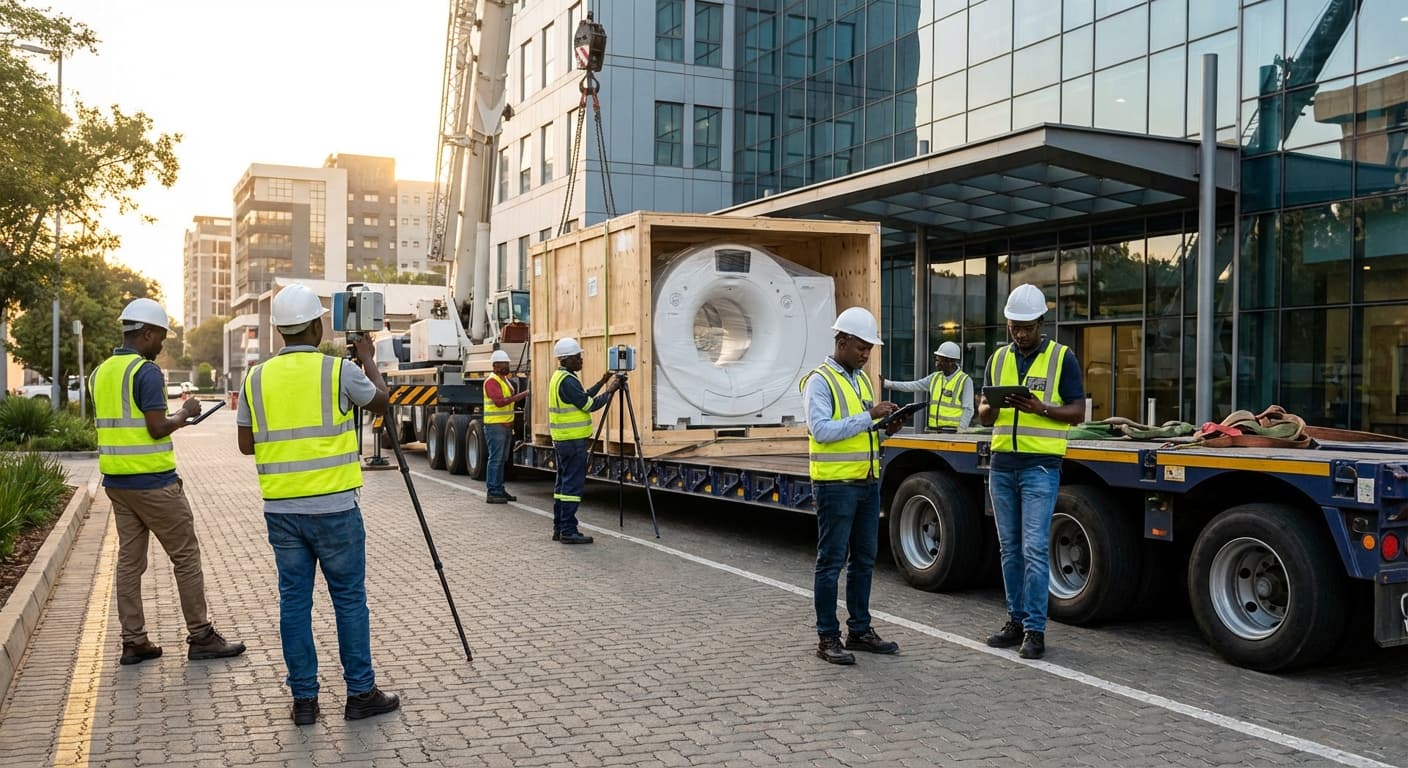
Route Survey & Rigging Plan Service for Heavy Medical Equipment in Niger
Engineering Excellence & Technical Support
Route Survey & Rigging Plan Service for Heavy Medical Equipment High-standard technical execution following OEM protocols and local regulatory frameworks.
Precision Route Mapping for Critical Access
Leveraging advanced GPS and GIS technologies, our service meticulously maps optimal transport routes for heavy medical equipment across Niger. We identify and mitigate potential obstacles like challenging terrain, unpaved roads, and seasonal flooding, ensuring safe and efficient delivery to remote healthcare facilities.
Specialized Rigging & Load Securing Expertise
Our certified rigging specialists employ state-of-the-art equipment and methodologies for the secure lifting, loading, and bracing of sensitive and oversized medical machinery. We develop custom rigging plans that account for weight distribution, center of gravity, and potential environmental factors to prevent damage during transit and installation.
Risk Mitigation & Contingency Planning
We conduct comprehensive on-site surveys to identify and assess all potential risks associated with heavy equipment transportation and installation in Niger's unique operational environment. Our service includes detailed contingency plans, emergency response protocols, and stakeholder coordination to ensure the project's integrity and the well-being of personnel.
What Is Route Survey & Rigging Plan Service For Heavy Medical Equipment In Niger?
Route Survey & Rigging Plan Service for Heavy Medical Equipment in Niger refers to a specialized engineering and logistics process designed to ensure the safe and efficient transportation and installation of large, high-value, and often delicate medical apparatus within Niger. This service encompasses a comprehensive evaluation of the entire logistical chain, from the point of origin (port of entry or manufacturing site) to the final installation location within a healthcare facility. The 'route survey' component meticulously assesses and maps the physical path the equipment will traverse, identifying potential obstacles, structural limitations, and environmental factors. The 'rigging plan' component details the precise methodologies, equipment, and personnel required for the lifting, maneuvering, and securing of the heavy medical equipment during transit and installation. This integrated service is critical for mitigating risks such as damage to the equipment, infrastructure, or personnel, as well as minimizing operational downtime for the healthcare facility.
| Who Needs This Service? | Typical Use Cases in Niger |
|---|---|
| Healthcare Providers & Institutions: Hospitals, clinics, diagnostic centers, and specialized medical facilities in Niger that are acquiring new, heavy medical equipment, relocating existing large apparatus, or undergoing facility upgrades. | Medical Equipment Manufacturers & Suppliers: Companies exporting and installing complex medical machinery, requiring assurance of safe delivery and setup in Niger. |
| Government Health Ministries & Agencies: Public health bodies involved in equipping national healthcare infrastructure or managing large-scale medical projects. | International Aid Organizations & NGOs: Entities implementing health-focused projects that involve the deployment of advanced medical technology in Niger. |
| Construction & Infrastructure Companies: Firms involved in building or renovating healthcare facilities who need to integrate the installation of heavy medical equipment into their project timelines. | Logistics & Heavy Haulage Companies: Specialized transport providers contracted for the movement of oversized and overweight cargo, requiring expert planning for medical equipment. |
Key Components of Route Survey & Rigging Plan Service:
- Route Assessment: Detailed analysis of all potential transit routes, including road conditions, bridge load capacities, overhead clearances, turning radii, and geographical terrain.
- Infrastructure Evaluation: Inspection of ingress/egress points at the destination facility, including doorways, corridors, elevator capacities, and structural integrity of floors and walls.
- Obstacle Identification & Mitigation: Identification of any permanent or temporary obstructions (e.g., utilities, construction, traffic patterns) and development of strategies for their circumvention or removal.
- Weight & Dimension Analysis: Precise determination of the equipment's weight, dimensions, and center of gravity.
- Rigging Equipment Selection: Specification of appropriate lifting devices (cranes, hoists), dollies, skids, and securing materials based on equipment specifications and site conditions.
- Method Statement Development: Creation of a detailed, step-by-step procedure for each lifting and moving operation, including safety protocols and contingency plans.
- Personnel Planning: Identification and allocation of skilled rigging crews, engineers, and site supervisors with relevant experience.
- Risk Assessment & Management: Comprehensive identification of potential hazards and the implementation of control measures to minimize risks.
- Permitting & Authorization: Assistance with obtaining necessary permits and approvals from relevant authorities for transportation and site access.
- Documentation: Provision of detailed reports, drawings, schematics, and checklists for all aspects of the survey and rigging plan.
Who Needs Route Survey & Rigging Plan Service For Heavy Medical Equipment In Niger?
When transporting and installing large, specialized medical equipment in Niger, meticulous planning is not just beneficial, it's essential. This is where comprehensive Route Survey & Rigging Plan Services become indispensable. These services ensure that heavy medical equipment, from MRI machines to CT scanners and advanced surgical suites, can be safely and efficiently delivered from point of entry to their final installation site, overcoming the unique logistical challenges present in Niger. This includes navigating diverse terrain, assessing road conditions, identifying potential obstacles, and planning the precise rigging and lifting operations required for installation. The primary goal is to minimize risk of damage to the equipment, prevent injuries to personnel, and adhere to strict timelines, especially critical for life-saving medical technology.
| Customer Type | Specific Departments/Roles Involved |
|---|---|
| Hospitals and Clinics (Public and Private) | Facilities Management, Biomedical Engineering Department, Procurement Department, Project Management Teams, Hospital Administrators |
| Diagnostic Imaging Centers | Operations Management, Technical Directors, Imaging Technologists, Facilities Managers |
| Medical Equipment Manufacturers and Suppliers | Logistics and Supply Chain Department, Installation and Commissioning Teams, Project Managers, Sales and Technical Support |
| International Aid Organizations and NGOs | Logistics and Operations Department, Program Managers, Procurement Officers, Medical Project Coordinators |
| Government Health Ministries and Agencies | Procurement and Tendering Department, Project Implementation Units, Public Health Infrastructure Division, Logistics and Supply Chain Management |
| Construction and Infrastructure Companies | Project Management Office, Logistics Department, Site Supervisors, Engineering Departments |
Target Customers for Route Survey & Rigging Plan Service for Heavy Medical Equipment in Niger
- Hospitals and Clinics (Public and Private)
- Diagnostic Imaging Centers
- Medical Equipment Manufacturers and Suppliers
- International Aid Organizations and NGOs
- Government Health Ministries and Agencies
- Construction and Infrastructure Companies involved in healthcare projects
Route Survey & Rigging Plan Service For Heavy Medical Equipment Process In Niger
This document outlines the comprehensive workflow for our Route Survey & Rigging Plan Service for Heavy Medical Equipment Process in Niger. Our service ensures the safe and efficient transport and installation of critical medical machinery, from initial client inquiry to final execution and handover. We meticulously plan every step, considering the unique logistical challenges of operating in Niger.
| Stage | Description | Key Activities | Deliverables |
|---|---|---|---|
| Inquiry & Initial Consultation | The client contacts us with their requirement for heavy medical equipment transport and installation. | Understanding project scope, equipment details, destination, and timeline. Initial risk assessment. | Project brief, preliminary quote/proposal. |
| Site Assessment & Route Survey | Thorough on-site evaluation of the destination, surrounding areas, and potential transport routes. | Detailed site inspection (access points, obstacles, ground conditions, building structural integrity). Route reconnaissance (road conditions, bridge capacities, overhead clearances, traffic patterns, security). | Route survey report with maps, photographs, GPS data, identified hazards, and recommended routes. |
| Rigging & Lifting Plan Development | Creation of a detailed, engineered plan for the safe lifting and positioning of the equipment. | Equipment weight & center of gravity analysis. Selection of appropriate lifting equipment (cranes, forklifts, jacks). Calculation of load capacities, sling angles, and rigging configurations. Development of detailed lift plans with diagrams and safety procedures. | Comprehensive rigging and lifting plan document including engineering calculations, equipment specifications, and risk mitigation strategies. |
| Permitting & Approvals | Securing all necessary permissions from local authorities and stakeholders. | Identifying required permits (transport, road closures, special movement, environmental). Liaising with relevant government agencies, local municipalities, and community leaders. Submission and follow-up on permit applications. | All necessary permits and official approvals secured. |
| Equipment Preparation & Pre-Move Checks | Ensuring the medical equipment is ready for safe transport and installation. | Disassembly (if required). Securing components. Crating and packaging. Pre-transport inspections. Communication with equipment manufacturer for specific handling requirements. | Equipment ready for transport, with all components securely packaged. |
| Transport & Logistics Execution | The physical movement of the heavy medical equipment to the designated site. | Mobilization of specialized transport vehicles. Execution of the approved transport route. Coordination with security personnel (if required). Real-time tracking and communication. | Equipment safely delivered to the project site. |
| On-Site Rigging & Installation | The skilled execution of the rigging plan for precise placement of the equipment. | Deployment of lifting equipment. Execution of the rigging plan according to specifications. Controlled lifting and maneuvering of the equipment. Precise positioning and alignment within the facility. | Equipment successfully positioned and installed in its final location. |
| Testing & Commissioning | Verification that the equipment is functioning correctly and safely post-installation. | Performing functional tests. Ensuring all connections are secure. Collaboration with client's technical team or equipment manufacturer for full commissioning. | Confirmation of operational readiness and functionality. |
| Documentation & Handover | Formal transfer of responsibility and provision of all relevant project documentation. | Compilation of all reports, plans, permits, and test results. Final site inspection and client sign-off. Provision of a comprehensive project file. | Complete project documentation package and formal handover to the client. |
| Post-Installation Support (Optional) | Continued assistance after the official handover, if agreed upon. | Troubleshooting. Addressing any immediate post-installation queries. Providing maintenance recommendations. | Client satisfaction and successful integration of the equipment. |
Workflow Stages
- Inquiry & Initial Consultation
- Site Assessment & Route Survey
- Rigging & Lifting Plan Development
- Permitting & Approvals
- Equipment Preparation & Pre-Move Checks
- Transport & Logistics Execution
- On-Site Rigging & Installation
- Testing & Commissioning
- Documentation & Handover
- Post-Installation Support (Optional)
Route Survey & Rigging Plan Service For Heavy Medical Equipment Cost In Niger
The cost of route survey and rigging plan services for heavy medical equipment in Niger is influenced by a variety of factors, leading to a broad price range. These services are critical for ensuring the safe and efficient transportation and installation of specialized, high-value equipment like MRI machines, CT scanners, or large X-ray units. The complexity of the route, the specific type and weight of the equipment, the required expertise, and logistical challenges all play a significant role in determining the final cost. Understanding these elements is essential for accurate budgeting. The pricing is typically quoted in local currency, the West African CFA franc (XOF).
| Service Component | Estimated Cost Range (XOF) | Notes |
|---|---|---|
| Initial Route Survey & Assessment | 250,000 - 750,000 XOF | Covers initial site visits, route mapping, and basic infrastructure assessment. |
| Detailed Rigging Plan Development | 500,000 - 1,500,000 XOF | Includes detailed engineering calculations, equipment selection, and safety protocols for lifting and placement. |
| Permit & Approval Facilitation | 100,000 - 400,000 XOF | Fees associated with obtaining necessary regulatory approvals and permits. |
| On-site Supervision (Survey & Rigging) | 150,000 - 500,000 XOF (per day) | Covers the presence of experienced personnel during the physical survey and rigging operations. |
| Contingency Planning & Risk Management | 100,000 - 300,000 XOF | Cost allocated for proactive identification and mitigation of potential issues. |
| Comprehensive Project Management | 750,000 - 2,500,000 XOF+ | For larger, more complex projects, encompassing all aspects from planning to execution oversight. |
Key Pricing Factors for Route Survey & Rigging Plan Services in Niger
- Equipment Size and Weight: Larger and heavier equipment requires more specialized planning, potentially larger lifting machinery, and more robust transport solutions, significantly increasing costs.
- Route Complexity and Distance: Navigating challenging terrain (unpaved roads, steep inclines, narrow passages), crossing borders, and the overall distance of the transport route directly impact planning and execution expenses.
- Infrastructure Assessment: The condition of roads, bridges, and the availability of suitable access points at both origin and destination are crucial. Upgrades or temporary modifications to infrastructure may be necessary, adding to the cost.
- Specialized Rigging Requirements: The need for custom-designed lifting frames, specialized dollies, or specific anchoring systems for the equipment will influence the budget.
- Permits and Approvals: Obtaining necessary permits from local authorities, transport ministries, and potentially environmental agencies can involve fees and administrative overhead.
- Security and Escort Services: For high-value or sensitive equipment, security escorts and specialized transport arrangements may be mandatory, adding to the overall cost.
- Site Survey and Access: The feasibility of accessing the installation site, including the need for temporary road construction, widening of entrances, or dismantling of existing structures, will be factored in.
- Risk Assessment and Contingency Planning: Thorough risk assessments and the development of contingency plans to address unforeseen challenges (e.g., weather, equipment malfunction) contribute to the service cost.
- Expertise and Experience: The level of specialization and experience of the survey and rigging team, including engineers and technicians, will influence their rates.
- Time Constraints and Urgency: Rush projects or tight deadlines may incur premium charges.
- Insurance: Adequate insurance coverage for the equipment during transit and rigging operations is a necessary cost component.
- Logistics and Coordination: The complexity of coordinating multiple stakeholders, including transport providers, crane operators, site personnel, and customs agents, will impact the service fee.
Affordable Route Survey & Rigging Plan Service For Heavy Medical Equipment Options
Our Affordable Route Survey & Rigging Plan Service is designed to provide crucial planning and safety assurance for the installation of heavy medical equipment. We understand that budget is a key consideration for healthcare facilities, and our service offers significant value through comprehensive planning that minimizes risks and prevents costly errors during transport and installation. We offer flexible value bundles to suit different project needs and budgets, alongside proactive cost-saving strategies that leverage our expertise.
| Cost-Saving Strategy | Description | Benefit |
|---|---|---|
| Early Intervention | Engaging our service early in the project lifecycle allows for proactive identification of potential issues and avoids costly last-minute changes. | Prevents delays, reduces the need for emergency modifications, and minimizes downtime. |
| Preventative Damage Control | Thorough planning and rigging protocols are designed to prevent damage to both the expensive medical equipment and the facility's infrastructure. | Avoids costly repairs or replacement of damaged equipment and structural elements. |
| Optimized Equipment Selection | Our expertise can inform decisions about the most suitable rigging equipment and transport methods, potentially reducing rental costs. | Ensures the right tools for the job, avoiding over-expenditure on unnecessarily specialized or oversized equipment. |
| Streamlined Logistics | A well-defined route and rigging plan minimizes confusion and inefficiency on the day of installation. | Reduces labor hours and associated costs by ensuring a smooth, well-coordinated operation. |
| Bundle Discounts | Purchasing integrated route survey and rigging plan services as part of a value bundle offers a reduced overall cost compared to individual service procurement. | Provides a more economical solution for comprehensive planning needs. |
Key Service Components & Value Bundles
- Comprehensive Route Survey: Detailed assessment of transport pathways, including access points, internal corridors, elevators, and final placement areas. Identifies potential obstacles, structural limitations, and necessary modifications.
- Detailed Rigging Plan: Expert development of a step-by-step plan for safe lifting, moving, and positioning of heavy medical equipment. Includes equipment specifications, load calculations, required personnel, and safety protocols.
- Risk Assessment & Mitigation: Proactive identification of potential hazards and development of strategies to prevent damage to equipment, infrastructure, and personnel.
- Documentation & Compliance: Provision of all necessary documentation for regulatory compliance and insurance purposes.
- Value Bundle 1: Basic Planning Package: Includes a standard route survey and a foundational rigging plan for straightforward installations. Ideal for facilities with less complex infrastructure or for less specialized equipment.
- Value Bundle 2: Standard Planning Package: Combines a detailed route survey with a comprehensive rigging plan, including minor structural assessment and preliminary equipment specification review. Suitable for most common heavy medical equipment installations.
- Value Bundle 3: Premium Planning Package: Offers an in-depth route survey, advanced rigging plan with detailed structural engineering consultation (if required), multi-option transport strategies, and on-site supervision recommendations. Best for highly complex, large-scale, or specialized equipment installations.
- Add-on Services: Options for site visits, on-site supervision during rigging, detailed CAD drawings, and vendor coordination.
Verified Providers In Niger
Finding reliable and credentialed healthcare providers is paramount for ensuring quality care. In Niger, the landscape of healthcare services is continually evolving, and understanding which providers are officially recognized and possess robust credentials can be a complex undertaking. This document aims to shed light on the importance of verified providers, specifically focusing on Franance Health, and explain why their credentials position them as a leading choice for healthcare services in Niger.
| Credential Type | Description | Significance for Patients in Niger |
|---|---|---|
| Medical Licenses | Official authorization from the Ministry of Public Health or equivalent body to practice medicine in Niger. This confirms the provider has met the minimum educational and competency requirements. | Ensures the provider is legally permitted to offer medical services and has passed foundational knowledge and practical assessments. |
| Specialty Certifications | Advanced training and examination in a specific medical field (e.g., cardiology, pediatrics, surgery). These are often awarded by national or international recognized bodies. | Indicates a higher level of expertise and specialized knowledge in a particular area of medicine, leading to more accurate diagnoses and effective treatments for complex conditions. |
| Professional Association Memberships | Membership in reputable medical associations (e.g., national medical association, specialized international societies). This often requires adherence to a code of ethics. | Suggests the provider is committed to ongoing professional development, ethical practice, and staying updated with advancements in their field. |
| Continuing Medical Education (CME) Records | Documentation of participation in regular educational programs, workshops, and conferences to maintain and update medical knowledge and skills. | Guarantees that the provider is actively engaged in lifelong learning, ensuring their practices are current and informed by the latest medical research and techniques. |
| Accreditation (for Facilities) | Official recognition for healthcare facilities (hospitals, clinics) that meet stringent quality, safety, and operational standards set by accrediting bodies. | Confirms that the facility is well-equipped, operates under strict safety protocols, and provides a high standard of care in terms of infrastructure and service delivery. |
What are Verified Providers and Why Do They Matter?
- {"title":"Definition of Verified Providers","description":"Verified providers are healthcare professionals and institutions that have undergone a rigorous official vetting process. This process confirms their legitimate qualifications, licensing, and adherence to established professional and ethical standards. Verification is typically conducted by recognized regulatory bodies, professional associations, or credentialing organizations."}
- {"title":"Importance of Verification","description":"Choosing verified providers offers several critical benefits:\n\n* Patient Safety: Verification ensures that practitioners have the necessary training and are licensed to practice, minimizing risks associated with unqualified individuals.\n* Quality of Care: Credentialed providers are more likely to adhere to best practices and evidence-based medicine, leading to better health outcomes.\n* Trust and Accountability: Verification systems build trust by establishing a clear line of accountability for providers.\n* Insurance and Reimbursement: Many insurance providers and government health programs only recognize and reimburse services from verified practitioners."}
Scope Of Work For Route Survey & Rigging Plan Service For Heavy Medical Equipment
This document outlines the Scope of Work (SOW) for Route Survey and Rigging Plan Services required for the safe and efficient transportation and installation of heavy medical equipment. The services include a comprehensive site assessment, detailed route analysis, development of rigging and transportation methodologies, and production of all necessary technical deliverables.
| Activity | Description | Key Deliverables | Standard Specifications/Considerations |
|---|---|---|---|
| Route Survey & Assessment | Conduct a thorough survey of all potential transportation routes from the delivery point to the final installation location. This includes assessing road conditions, bridge capacities, overhead clearances, turning radii, ground bearing pressures, and traffic management requirements. | Route Survey Report, Detailed Route Maps, Clearance Diagrams, Obstacle Identification Log | Minimum road width, maximum gradient, bridge load limits (e.g., AASHTO, local DOT standards), overhead utility clearance (e.g., national electrical safety code), turning radii calculations, ground stability assessments (e.g., geotechnical reports where applicable). |
| Rigging Plan Development | Develop a comprehensive rigging plan for lifting, moving, and positioning the heavy medical equipment within the facility. This includes specifying lifting equipment, rigging gear, load calculations, lifting points, and sequence of operations. | Rigging Plan Document, Lift Plans, Equipment Specifications, Load Charts, Safety Procedures | Crane load charts, sling/shackle safe working load (SWL) ratings, center of gravity (CG) determination, rigging configurations (e.g., spreader bars, lifting frames), personnel safety protocols (e.g., OSHA standards), communication protocols. |
| Transportation Plan | Outline the methodology for transporting the equipment from the initial point of entry to the installation site. This includes specifying transport vehicles, securing methods, escorts, and any required traffic management. | Transportation Plan Document, Vehicle Specifications, Securing Procedures, Traffic Management Plan (if required) | Trailer load capacities, weight distribution, securing strap/chain SWL, permit requirements (e.g., oversized load permits), escort vehicle requirements, pilot car procedures. |
| Risk Assessment & Mitigation | Identify potential hazards and risks associated with each phase of the operation and develop appropriate mitigation strategies. | Risk Assessment Matrix, Mitigation Strategies Report | HAZOP studies, Job Safety Analysis (JSA), consequence analysis, contingency planning. |
| Documentation & Reporting | Compile all findings, plans, and recommendations into a comprehensive set of technical deliverables. | Final Project Report, As-Built Drawings (if applicable), Sign-off Documentation | Professional Engineer (PE) stamped drawings and reports where required, adherence to client-specific reporting formats. |
| Site Inspection & Verification | Perform on-site inspections during key phases of the operation to ensure adherence to the approved plans and to address any unforeseen issues. | Inspection Checklists, Site Visit Reports | Pre-lift inspection checklists, post-move verification, sign-off by designated personnel. |
Objectives
- To identify and mitigate all potential risks associated with the movement of heavy medical equipment.
- To develop a detailed and safe rigging plan for lifting, positioning, and securing the equipment.
- To create a precise transportation plan, including route selection and necessary permits.
- To ensure compliance with all relevant safety standards and regulations.
- To provide clear and actionable technical documentation for all project stakeholders.
Service Level Agreement For Route Survey & Rigging Plan Service For Heavy Medical Equipment
This Service Level Agreement (SLA) outlines the guaranteed response times and uptime for the Route Survey & Rigging Plan Service provided for heavy medical equipment. This SLA ensures timely and reliable support to minimize disruptions and facilitate successful installation of critical medical equipment.
| Service Component | Response Time Guarantee | Uptime Guarantee |
|---|---|---|
| Initial Route Survey Request Acknowledgement | Within 2 business hours of submission. | N/A (Service is event-driven) |
| On-site Route Survey Scheduling Confirmation | Within 1 business day of initial request acknowledgement. | N/A (Service is event-driven) |
| Delivery of Preliminary Route Survey Report | Within 3 business days of on-site survey completion. | N/A (Service is event-driven) |
| Development & Delivery of Final Rigging Plan | Within 2 business days of approval of preliminary report (or addressing any requested revisions). | N/A (Service is event-driven) |
| Urgent Support for Rigging Plan Amendments (e.g., unforeseen site changes) | Within 4 business hours for remote consultation and initial assessment. On-site support within 24 business hours (subject to availability and location). | N/A (Service is event-driven) |
| Availability of Survey/Rigging Team for Pre-Installation Verification | Scheduled at mutually agreed-upon time. If a scheduled verification is cancelled by the service provider with less than 24 hours notice, a new slot will be prioritized within 48 business hours. | N/A (Service is event-driven) |
Scope of Services
- On-site route survey to identify optimal pathways for equipment transport.
- Development of detailed rigging plans, including equipment, personnel, and safety protocols.
- Coordination with site personnel for access and clearance.
- Pre-installation site verification and confirmation of the rigging plan.
Frequently Asked Questions

Ready when you are
Let's scope your Route Survey & Rigging Plan Service for Heavy Medical Equipment in Niger project in Niger.

Scaling healthcare logistics and technical systems across the entire continent.