
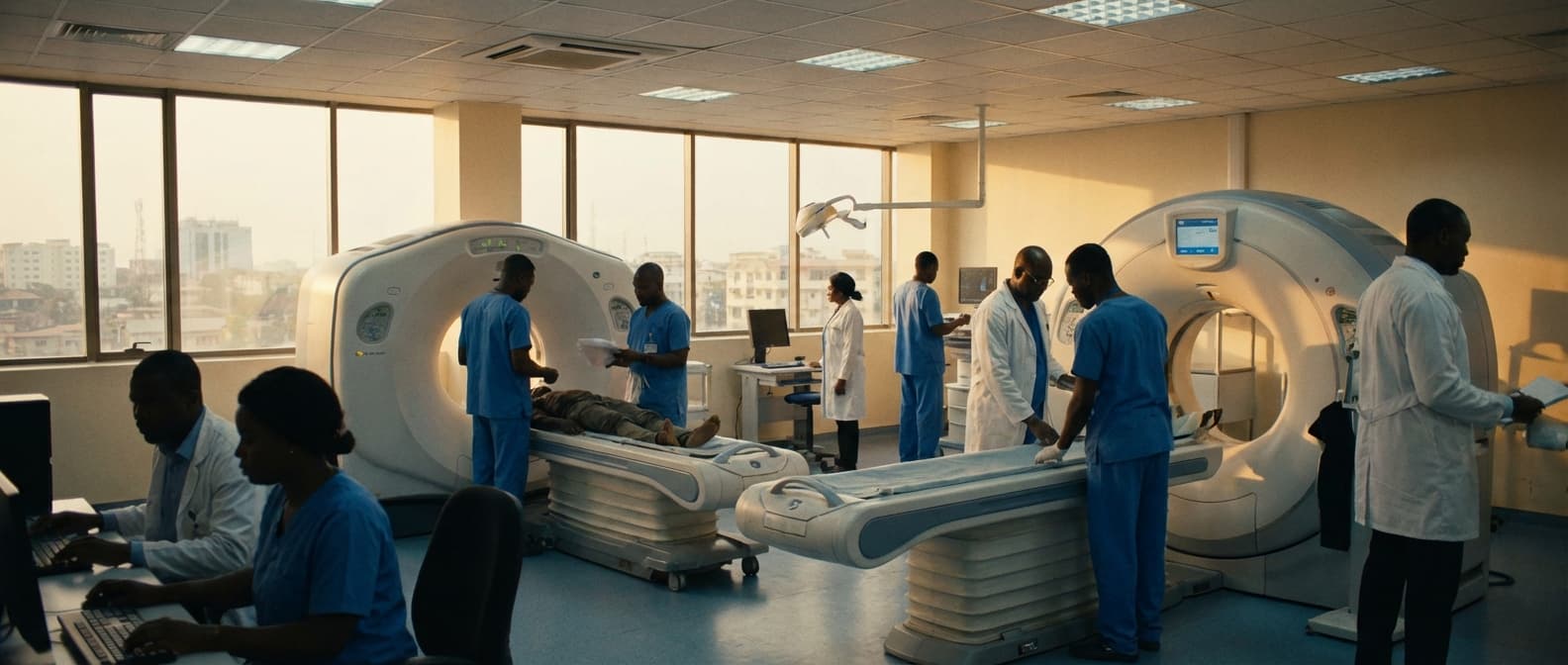
Imaging Acceptance Testing & QA in Niger
Engineering Excellence & Technical Support
Commissioning and periodic QA for CT/MRI/X‑ray/US/Mammo. High-standard technical execution following OEM protocols and local regulatory frameworks.
Ensuring Diagnostic Accuracy
Rigorous acceptance testing of new imaging equipment (X-ray, Ultrasound, CT) ensures compliance with international standards, guaranteeing accurate diagnostic capabilities for critical patient care in Niger's healthcare facilities.
Optimizing Image Quality & Workflow
Implementing comprehensive QA protocols for existing imaging systems identifies and rectifies image artifacts, dose optimization issues, and workflow inefficiencies, leading to improved patient outcomes and reduced resource waste.
Building Sustainable Imaging Infrastructure
Establishing robust acceptance testing and ongoing QA programs for imaging modalities contributes to the long-term reliability and maintainability of Niger's healthcare imaging infrastructure, ensuring consistent access to essential diagnostic services.
What Is Imaging Acceptance Testing & Qa In Niger?
Imaging Acceptance Testing (IAT) and Quality Assurance (QA) in Niger refers to the systematic verification and validation processes employed to ensure that imaging systems and their associated software perform according to specified requirements and standards within the Nigerien context. This encompasses a broad range of activities from initial hardware and software configuration checks to end-to-end workflow validation, ensuring diagnostic accuracy, data integrity, and operational efficiency. The service is crucial for healthcare providers, research institutions, and government health initiatives operating or deploying imaging modalities within Niger, aiming to mitigate risks, optimize resource utilization, and adhere to both international best practices and local regulatory considerations.
| Stakeholder Group | Need for Imaging Acceptance Testing & QA | Typical Use Cases |
|---|---|---|
| Hospitals and Clinics (Public & Private) | Ensuring diagnostic accuracy and patient safety; optimizing operational efficiency; meeting regulatory compliance; maximizing return on investment for capital equipment. | Validation of new X-ray, CT, MRI, or Ultrasound installations; pre-deployment testing of PACS/RIS upgrades; post-maintenance verification; ensuring compliance with national health standards. |
| Diagnostic Imaging Centers | Maintaining high-quality imaging services; ensuring efficient patient throughput; guaranteeing data integrity for reporting; competitive differentiation. | Acceptance testing of new imaging modality acquisitions; validation of PACS network performance; QA checks for routine image quality; testing of remote interpretation workflows. |
| Research Institutions & Universities | Ensuring data quality and reproducibility for research studies; validating specialized imaging protocols; adhering to ethical research standards. | Testing of advanced imaging sequences for research; validation of image analysis software for research purposes; ensuring standardized imaging for multi-center studies. |
| Government Health Ministries & Agencies | Ensuring equitable access to quality diagnostic imaging services; standardizing imaging protocols across the public health system; overseeing procurement and deployment of medical equipment. | Acceptance testing for government-funded imaging infrastructure projects; developing and enforcing national imaging QA guidelines; evaluating vendor compliance with tender specifications. |
| Medical Equipment Vendors & Integrators | Demonstrating system compliance and performance to clients; fulfilling contractual obligations; ensuring successful system deployment and client satisfaction. | Performing pre-installation site surveys; conducting factory acceptance testing (FAT); executing site acceptance testing (SAT) with clients; providing post-installation support and QA services. |
Key Components of Imaging Acceptance Testing & QA in Niger
- Hardware Verification: Functional testing of imaging equipment (e.g., X-ray, CT, MRI, Ultrasound) to confirm all components are operational and calibrated according to manufacturer specifications and local environmental conditions.
- Software Validation: Assessment of Picture Archiving and Communication Systems (PACS), Radiology Information Systems (RIS), Electronic Health Records (EHR) integration, and imaging workstation software for functionality, performance, security, and adherence to DICOM standards.
- Image Quality Assessment: Objective and subjective evaluation of image fidelity, artifact reduction, contrast-to-noise ratio (CNR), and spatial resolution to ensure diagnostic utility.
- Workflow Analysis: End-to-end testing of the imaging chain, from patient registration and scheduling to image acquisition, processing, interpretation, reporting, and archiving, ensuring seamless data flow and user experience.
- Interoperability Testing: Verification of seamless data exchange with other healthcare IT systems (e.g., Laboratory Information Systems, Pharmacy Systems) using established protocols like HL7 and DICOM.
- Performance Benchmarking: Measurement of system response times, throughput, and resource utilization under various load conditions.
- Security Audits: Evaluation of data protection mechanisms, access controls, and compliance with relevant data privacy regulations.
- Documentation Review: Verification of user manuals, training materials, and maintenance logs for accuracy and completeness.
- Training Verification: Assessment of end-user proficiency in operating the imaging systems and associated software.
Who Needs Imaging Acceptance Testing & Qa In Niger?
Imaging Acceptance Testing & Quality Assurance (QA) are crucial for any organization that relies on digital imaging for its operations. In Niger, while the adoption of advanced imaging technologies might be in its early stages compared to some developed nations, the need for these services is equally, if not more, pronounced to ensure the reliability, accuracy, and security of critical data. This is particularly true for sectors undergoing digital transformation or those where image-based data is fundamental to decision-making and service delivery. Without proper testing and QA, organizations risk incorrect diagnoses, inefficient workflows, data loss, and ultimately, compromised outcomes.
| Target Customer Group | Key Departments/Units | Specific Imaging Needs & Testing Focus |
|---|---|---|
| Healthcare Providers (Hospitals, Clinics, Diagnostic Centers) | Radiology Departments, Pathology Labs, PACS Administrators, IT Departments | Image quality, diagnostic accuracy, DICOM compliance, PACS integration, workflow efficiency, data integrity, security. |
| Ministry of Health | Public Health Programs, Medical Training Institutions | Standardization of imaging equipment, training material accuracy, public health data reliability. |
| Ministry of Public Works/Infrastructure | Roads, Bridges, Buildings Departments | Geospatial imaging (satellite, aerial), construction site surveys, asset condition monitoring, data accuracy for planning. |
| Ministry of Environment/Natural Resources | Land Management, Forestry, Water Resources | Satellite imagery analysis, GIS data integrity, environmental monitoring accuracy. |
| Ministry of Interior/Security | Police, Border Control, Intelligence Agencies | Surveillance imagery, forensic imaging, facial recognition systems, evidence integrity. |
| Telecommunications Companies | Network Operations, Field Engineering | Site survey images, infrastructure inspection imagery, accuracy of network mapping. |
| Mining and Oil Exploration Companies | Geology Departments, Operations, Safety & Environmental | Seismic imaging, well log imaging, drone-based inspection imagery, environmental impact assessment imagery. |
| Universities and Research Institutes | Medical Schools, Engineering Faculties, Science Departments | Microscopy imaging, scientific imaging equipment calibration, data reproducibility, research data integrity. |
| Banks and Financial Services | Operations, Compliance, IT | Document scanning quality, check processing imaging, fraud detection system input accuracy. |
Target Customers and Departments in Niger for Imaging Acceptance Testing & QA
- {"title":"Healthcare Sector","description":"The largest and most immediate beneficiary. As healthcare providers in Niger increasingly adopt digital imaging systems (X-ray, CT, MRI, Ultrasound, PACS), ensuring these systems function correctly and produce accurate, interpretable images is paramount for patient care."}
- {"title":"Government Agencies","description":"Departments involved in infrastructure, land management, security, and disaster response often utilize imaging for surveying, mapping, surveillance, and evidence collection."}
- {"title":"Telecommunications","description":"Mobile network operators and internet service providers may use imaging for network planning, site surveys, and infrastructure maintenance."}
- {"title":"Energy and Mining Sector","description":"Companies involved in oil, gas, and mineral exploration and extraction frequently use specialized imaging techniques for geological surveys, asset inspection, and safety monitoring."}
- {"title":"Educational and Research Institutions","description":"Universities and research centers employing imaging for scientific studies, medical training, and technological development."}
- {"title":"Manufacturing and Industrial Sector","description":"As manufacturing capabilities grow, quality control processes may involve imaging for product inspection and defect detection."}
- {"title":"Financial Institutions","description":"For document scanning, archival, and fraud detection purposes, ensuring the integrity and legibility of scanned images is vital."}
Imaging Acceptance Testing & Qa Process In Niger
This document outlines the Imaging Acceptance Testing and Quality Assurance (QA) process in Niger, detailing the workflow from initial inquiry to final execution. This structured approach ensures that all imaging systems and related services meet predefined standards, regulatory requirements, and user expectations before deployment or ongoing operation.
| Phase | Key Activities | Key Stakeholders | Deliverables | Tools & Technologies |
|---|---|---|---|---|
| Phase 1: Inquiry & Requirements Gathering | Initial contact, clarification of needs, definition of scope, identification of specific imaging modalities (e.g., X-ray, CT, MRI, Ultrasound), software requirements, integration points, and performance expectations. Understanding local context, infrastructure limitations, and relevant national health policies. | Client (Hospital/Clinic), IT Department, Radiology Department, Procurement Office, Vendor/Supplier, Ministry of Health (if applicable). | Project Scope Document, Detailed Requirements Specification, Use Case Scenarios, Preliminary Risk Assessment. | Meetings, Documentation Review, Interviews, Site Visits (if possible). |
| Phase 2: Planning & Preparation | Development of a comprehensive test plan, including test objectives, test strategy, test cases, test schedule, resource allocation (personnel, equipment), test environment setup, data preparation, and definition of acceptance criteria. Risk mitigation planning. | QA Lead/Manager, Test Engineers, Project Manager, Technical Experts, Vendor. | Test Plan, Test Cases, Test Scripts, Test Data, Test Environment Setup Checklist, Communication Plan. | Test Management Tools (e.g., Jira, TestRail), Documentation Tools, Collaboration Platforms. |
| Phase 3: Test Execution | Performing functional testing, performance testing, usability testing, security testing, integration testing, and compliance testing as per the approved test plan. This includes installation verification, system configuration checks, image quality assessment, data integrity verification, and user workflow validation. | Test Engineers, End Users (Radiologists, Technicians), IT Support, Vendor Support. | Executed Test Cases, Raw Test Results, Defect Logs, Performance Metrics. | Imaging Hardware, Imaging Software, PACS/RIS Systems, Test Data, Monitoring Tools, Diagnostic Equipment. |
| Phase 4: Reporting & Review | Documenting all test results, including successful tests, failed tests, and identified defects. Categorizing defects by severity. Generating summary reports and detailed defect reports. Presenting findings to stakeholders for review and decision-making. | Test Engineers, QA Lead/Manager, Project Manager, Client Representatives, Vendor. | Test Summary Report, Defect Reports, Go/No-Go Recommendation. | Reporting Tools, Presentation Software, Email. |
| Phase 5: Remediation & Re-testing | Addressing identified defects by the vendor or development team. This involves bug fixing, configuration adjustments, or re-engineering. Subsequent re-testing of corrected issues to ensure they are resolved and have not introduced new problems. Regression testing. | Vendor/Development Team, Test Engineers, IT Support. | Resolved Defects, Re-tested Functionality, Updated Test Results. | Defect Tracking System, Debugging Tools, Version Control Systems. |
| Phase 6: Final Acceptance & Closure | Formal sign-off by the client acknowledging that the system meets all agreed-upon acceptance criteria. This phase includes final documentation handover, training completion, and official project closure. Post-implementation review and lessons learned. | Client Representatives, Project Manager, Vendor. | Signed Acceptance Certificate, Final Project Report, Lessons Learned Document. | Digital Signatures, Project Management Software, Knowledge Management Systems. |
Imaging Acceptance Testing & QA Workflow in Niger
- Phase 1: Inquiry & Requirements Gathering
- Phase 2: Planning & Preparation
- Phase 3: Test Execution
- Phase 4: Reporting & Review
- Phase 5: Remediation & Re-testing
- Phase 6: Final Acceptance & Closure
Imaging Acceptance Testing & Qa Cost In Niger
Imaging Acceptance Testing & QA costs in Niger are influenced by a variety of factors, making it difficult to provide precise, fixed pricing. These costs are generally localized and depend heavily on the specific requirements of the imaging project, the chosen testing methodologies, the experience level of the QA team, and the overall scope of work. Therefore, it's crucial for organizations to conduct detailed needs assessments and solicit multiple quotes from local service providers to get accurate figures.
| Service Component | Potential Pricing Range (XOF) | Notes |
|---|---|---|
| Hourly Rate for QA Engineer | 30,000 - 75,000 | Varies significantly based on experience, specialization, and location. |
| Daily Rate for QA Team (2-3 individuals) | 150,000 - 400,000 | Often more cost-effective for larger projects. Includes a lead engineer and support staff. |
| Basic Image Quality Assessment (per image) | 500 - 2,000 | Focuses on fundamental image characteristics. Bulk discounts may apply. |
| Comprehensive DICOM Conformance Testing | 50,000 - 250,000 per modality | Involves testing against DICOM standards. Complexity depends on the modality and conformance level. |
| Workflow Integration Testing (per scenario) | 75,000 - 300,000 | Tests the seamless flow of images through the entire healthcare ecosystem. |
| Data Integrity and Security Testing | 100,000 - 500,000 | Focuses on the accuracy and security of stored and transmitted image data. |
| Project Management Fee (percentage of total) | 10% - 20% | For larger or more complex projects requiring dedicated management. |
| Travel and Accommodation (if applicable) | Variable | Dependent on the location of the testing site relative to the QA provider. |
Key Pricing Factors for Imaging Acceptance Testing & QA in Niger:
- Project Scope and Complexity: The sheer volume of images to be tested, the number of imaging modalities involved (e.g., X-ray, CT, MRI, Ultrasound), the types of tests required (e.g., image quality, DICOM compliance, workflow integration, data integrity), and the complexity of the underlying imaging system all significantly impact cost.
- Testing Methodology: Different QA approaches, such as manual visual inspection, automated testing tools, or a hybrid model, will have varying cost implications.
- Team Expertise and Experience: The level of skill and experience of the QA engineers and technicians will directly influence their hourly or project rates. Specialized knowledge in medical imaging standards and regulations is often a premium.
- Equipment and Infrastructure: The availability and cost of testing equipment, software licenses for QA tools, and secure testing environments can add to the overall expense.
- Location within Niger: While Niger is a single country, costs can vary between major urban centers (like Niamey) and more remote regions due to differences in operational overhead, transportation, and labor availability.
- Reporting and Documentation Requirements: The level of detail, frequency, and format of QA reports can affect the time and resources allocated to documentation, thus influencing cost.
- Regulatory Compliance: Adherence to specific national or international medical imaging regulations (if applicable) may necessitate more rigorous testing protocols and specialized expertise, increasing costs.
- Time Constraints and Urgency: Projects with tight deadlines or requiring immediate turnaround may incur premium charges.
- Third-Party Integrations: If the imaging system needs to be tested in conjunction with other healthcare IT systems (e.g., PACS, RIS, EMR), the integration testing complexity will add to the cost.
- Service Provider's Overhead and Profit Margin: Like any business, the operational costs and profit expectations of the QA service provider will be factored into their pricing.
Affordable Imaging Acceptance Testing & Qa Options
In the realm of medical imaging, ensuring the accuracy and reliability of equipment is paramount. Acceptance Testing (AT) and Quality Assurance (QA) are critical processes for verifying that imaging systems meet established performance standards before patient use and continue to operate optimally over time. However, these essential services can represent a significant cost for healthcare facilities. This document explores affordable imaging acceptance testing and QA options, focusing on the value derived from well-structured service bundles and outlining effective cost-saving strategies.
| Value Bundle Type | Description | Cost-Saving Benefits | Ideal For |
|---|---|---|---|
| Comprehensive AT/QA Package | Includes initial acceptance testing and a pre-defined period of routine QA, often bundled with preventive maintenance. | Volume discounts, streamlined scheduling, reduced administrative overhead, predictable budgeting. | Facilities acquiring multiple new systems or seeking long-term, integrated service contracts. |
| Regional Service Provider Network | Leverages a network of accredited technicians to provide services across multiple sites within a geographic area. | Reduced travel costs, localized support, potentially lower hourly rates due to market competition. | Multi-site healthcare organizations with facilities in close proximity. |
| Tiered Service Levels | Offers different levels of AT/QA services based on criticality, system age, or usage, allowing for customization. | Pay only for necessary services, avoiding overspending on less critical equipment, flexible budgeting. | Facilities with diverse imaging fleets and varying needs for different modalities. |
| Remote Monitoring & Diagnostics Integration | Combines on-site testing with remote monitoring of system performance for early anomaly detection. | Reduced frequency of on-site visits, proactive issue resolution, minimized downtime. | Facilities with IT infrastructure capable of supporting remote data transfer and analysis. |
Key Components of Imaging Acceptance Testing & QA
- Initial Performance Verification (IPVA): Performed on new or relocated equipment before clinical use.
- Routine Quality Control (QC): Regular tests to monitor system performance and identify deviations.
- Mammography-Specific Testing: Compliance with MQSA (Mammography Quality Standards Act) requirements.
- CT & MRI Dose Monitoring: Ensuring patient safety and compliance with regulatory limits.
- Image Quality Assessment: Evaluating spatial resolution, contrast, noise, and artifact levels.
- System Functionality Checks: Verifying all operational features are working correctly.
- Documentation and Reporting: Comprehensive records for regulatory compliance and performance tracking.
Verified Providers In Niger
Navigating the landscape of healthcare providers in Niger can be a challenge. Ensuring you access reliable and qualified medical professionals is paramount for your well-being. This guide highlights the importance of verified providers and specifically focuses on Franance Health credentials, demonstrating why they represent the best choice for your healthcare needs in Niger.
| Franance Health Credentials | What They Mean for You | Why They Represent the Best Choice |
|---|---|---|
| Accreditation by the Nigerien Ministry of Public Health | This signifies official recognition and compliance with national healthcare standards and regulations. | Ensures legal operation and adherence to the highest levels of public health policy in Niger. |
| Certification by International Healthcare Standards Boards (e.g., ISO standards related to healthcare management) | Demonstrates commitment to globally recognized best practices in quality management, patient safety, and operational efficiency. | Guarantees a consistent and high level of care that meets international benchmarks, fostering confidence and trust. |
| Verification of Medical Practitioner Licenses and Qualifications | Confirms that all physicians and specialists working with Franance Health possess legitimate and up-to-date medical licenses and have earned their degrees from reputable institutions. | Ensures you are treated by qualified and experienced medical professionals who are legally authorized to practice. |
| Robust Background Checks and Ethical Audits | Involves thorough screening of personnel and regular audits to ensure ethical conduct and adherence to patient rights and privacy. | Provides assurance of a safe, respectful, and professional healthcare experience where your well-being and data are protected. |
| Partnerships with Reputable International Medical Organizations | Indicates collaboration and knowledge sharing with leading global healthcare entities, promoting access to advanced medical insights and technologies. | Leverages global expertise and best practices, potentially offering access to specialized treatments and a broader network of medical knowledge. |
Why Choose Verified Providers?
- Trust and Reliability: Verified providers have undergone rigorous checks to confirm their qualifications, licenses, and adherence to ethical standards. This offers peace of mind.
- Quality of Care: Verification often includes assessments of clinical expertise, patient safety protocols, and the availability of necessary medical resources.
- Reduced Risk: Choosing unverified providers can expose you to misdiagnosis, inadequate treatment, and potential financial or personal risks.
- Accountability: Verified entities are typically accountable to regulatory bodies, ensuring a higher standard of service delivery and recourse in case of issues.
Scope Of Work For Imaging Acceptance Testing & Qa
This Scope of Work (SOW) outlines the requirements for Imaging Acceptance Testing and Quality Assurance (QA) for the [Project Name/System Name] project. The objective is to ensure that all imaging functionalities meet the defined technical specifications, performance criteria, and quality standards prior to deployment or handover. This SOW details the testing activities, deliverables, and standard specifications applicable to this phase of the project.
| Phase | Activities | Deliverables | Standard Specifications/Criteria |
|---|---|---|---|
| Develop Test Plans and Test Cases. Define Test Environments and Data. Identify and assign testing resources. | Imaging Test Plan. Imaging Test Cases. Test Environment Configuration Report. | Test Plan covers all functional and non-functional requirements. Test cases are traceable to requirements. Test environment mirrors production as closely as possible. |
| Test image acquisition (e.g., camera resolution, color accuracy, focus). Test image processing (e.g., filters, transformations, enhancement). Test image display and rendering. Test image annotation and manipulation. Test integration with other systems (e.g., PACS, EHR). | Functional Test Results Report. Defect Log. Retest Reports. | All functional requirements met as per design documents. Image artifacts are minimized or eliminated. Display fidelity matches source image quality. |
| Measure image loading and display times. Test image saving and retrieval speeds. Assess system responsiveness under load. Evaluate bandwidth utilization for image transfer. | Performance Test Results Report. Load Test Scenarios and Results. | Image loading within acceptable latency thresholds (e.g., < 3 seconds for typical images). System performance meets specified benchmarks. Scalability to handle expected user load. |
| Verify image compression ratios and their impact on quality. Conduct user acceptance testing (UAT) with end-users. Perform regression testing after defect fixes. Review system logs for imaging-related errors. | User Acceptance Testing (UAT) Report. Regression Test Results. Final QA Report. | Compression standards (e.g., JPEG, DICOM) applied correctly without significant visual degradation. UAT sign-off from key stakeholders. No critical or major defects outstanding. |
| Finalize all test documentation. Prepare test summary reports. Handover test artifacts and knowledge transfer. | Final Imaging Acceptance Test Report. Test Summary. Knowledge Transfer Documentation. | Comprehensive reporting of all testing activities and outcomes. Clear documentation of any residual risks or limitations. |
Key Objectives of Imaging Acceptance Testing & QA
- Verify that all imaging functionalities perform as per requirements and design specifications.
- Ensure the accuracy, integrity, and quality of captured, processed, and displayed images.
- Validate the performance of image acquisition, storage, retrieval, and manipulation processes.
- Confirm adherence to relevant industry standards and best practices for medical imaging (if applicable).
- Identify and document defects, and track their resolution to ensure a stable and reliable imaging system.
- Provide confidence that the imaging system is ready for production use.
Service Level Agreement For Imaging Acceptance Testing & Qa
This Service Level Agreement (SLA) defines the performance and availability commitments for Imaging Acceptance Testing & Quality Assurance (QA) services. It outlines the agreed-upon response times for issues and the guaranteed uptime for the imaging QA platform.
| Severity Level | Description | Response Time Target | Resolution Time Target | Uptime Guarantee |
|---|---|---|---|---|
| Critical (Severity 1) | Complete system outage or major functionality failure impacting all users. No workaround available. | 15 minutes | 4 business hours | 99.9% |
| High (Severity 2) | Significant functionality degradation or performance issues impacting a large number of users. A partial workaround may exist. | 30 minutes | 8 business hours | 99.9% |
| Medium (Severity 3) | Minor functionality issues or performance degradation impacting a subset of users. A reasonable workaround exists. | 2 hours | 2 business days | 99.9% |
| Low (Severity 4) | Cosmetic issues, documentation errors, or minor feature requests with no impact on core functionality. | 4 business hours | 5 business days | 99.9% |
Key Service Metrics
- Response Time: The time it takes for the support team to acknowledge and begin working on a reported issue.
- Resolution Time: The time it takes to resolve a reported issue, depending on its severity.
- Uptime Guarantee: The percentage of time the imaging QA platform is expected to be operational and accessible.
- Severity Levels: Classification of issues based on their impact on service delivery.
Frequently Asked Questions

Ready when you are
Let's scope your Imaging Acceptance Testing & QA in Niger project in Niger.

Scaling healthcare logistics and technical systems across the entire continent.