
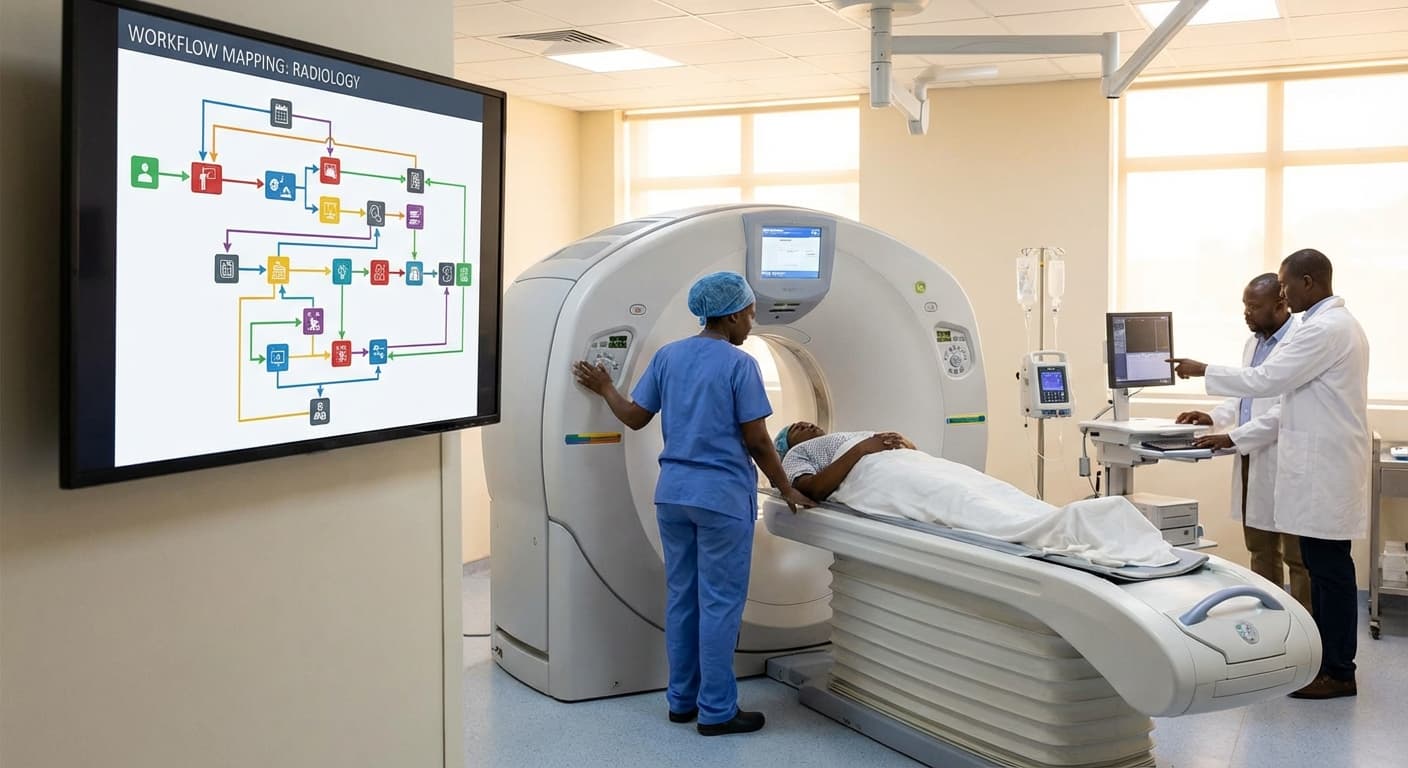
Department Workflow Mapping Service (Radiology/ICU/OT/Lab/Dialysis) in Niger
Engineering Excellence & Technical Support
Department Workflow Mapping Service (Radiology/ICU/OT/Lab/Dialysis) High-standard technical execution following OEM protocols and local regulatory frameworks.
Streamlined Radiology Throughput for Faster Diagnoses
Our service meticulously maps the entire radiology workflow in Niger, from patient registration and imaging acquisition to report generation and physician review. By identifying bottlenecks and inefficiencies, we implement optimized protocols and digital integration solutions to significantly reduce turnaround times for critical diagnostic imaging, leading to earlier interventions and improved patient outcomes.
Enhanced Critical Care Resource Allocation in ICUs
We provide a comprehensive workflow mapping of Intensive Care Units (ICUs) across Niger, focusing on patient flow, equipment utilization, and staff coordination. Our analysis identifies areas for improved patient monitoring, efficient bed management, and optimized multidisciplinary team communication, ensuring critical resources are deployed effectively and patient care is delivered seamlessly during high-pressure situations.
Optimized Operating Theatre Scheduling and Resource Management
Our service delves into the intricate workflows of Operating Theatres (OTs) in Niger, analyzing scheduling, surgical team coordination, instrument sterilization, and post-operative patient handoffs. We implement data-driven strategies and technology integration to minimize downtime, maximize surgical slot utilization, and ensure the safe and efficient delivery of surgical care, directly impacting patient recovery times and hospital capacity.
What Is Department Workflow Mapping Service (Radiology/icu/ot/lab/dialysis) In Niger?
Department Workflow Mapping Service (Radiology/ICU/OT/Lab/Dialysis) in Niger refers to a specialized consultancy and implementation process focused on systematically analyzing, documenting, and optimizing the operational processes within critical healthcare departments in Nigerien medical facilities. This service aims to identify bottlenecks, inefficiencies, and areas for improvement in patient flow, resource utilization, information management, and inter-departmental communication to enhance service delivery, patient outcomes, and operational cost-effectiveness. It is a data-driven approach to understanding and redesigning how work is accomplished within these high-demand clinical settings.
| Who Needs This Service? | Typical Use Cases | ||||
|---|---|---|---|---|---|
| Hospitals and Clinics (Public and Private): Specifically those with dedicated Radiology, Intensive Care Units (ICU), Operating Theatres (OT), Laboratories, and Dialysis Units seeking to improve efficiency, reduce wait times, and enhance patient care. | Government Health Ministries/Agencies: To standardize processes across public healthcare facilities, identify areas for investment in infrastructure and technology, and improve the overall quality of specialized healthcare services nationwide. | International Development Organizations and NGOs: Involved in healthcare improvement projects in Niger, requiring a systematic approach to optimize the functionality of critical departments within partner facilities. | New Healthcare Facility Development: For the design and initial setup of new departments or entire healthcare facilities to ensure optimal workflow from inception. | Facilities Experiencing Increased Patient Load or Operational Challenges: Those facing overcrowding, long patient queues, high staff burnout, or frequent service delivery disruptions. | |
| Radiology: Optimizing patient scheduling for imaging procedures, streamlining image acquisition and interpretation processes, improving reporting turnaround times, and enhancing PACS/RIS integration. | ICU: Improving patient admission and discharge protocols, optimizing nurse-to-patient ratios and task allocation, ensuring timely availability of critical equipment and medications, and enhancing communication between medical teams. | OT: Streamlining surgical scheduling and pre-operative patient preparation, optimizing operating room utilization, ensuring efficient instrument and supply management, and improving post-operative care handoffs. | Laboratory: Accelerating sample processing and analysis, reducing turnaround times for diagnostic results, improving quality control procedures, and integrating LIS with EHR systems. | Dialysis: Optimizing patient scheduling for dialysis sessions, ensuring efficient machine maintenance and availability, streamlining medication administration, and improving patient monitoring and safety protocols. | Inter-Departmental Handoffs: Analyzing and improving the flow of patient information and care coordination between departments (e.g., from Radiology to Physician, from ICU to Ward). |
Key Components of Department Workflow Mapping Service:
- Current State Analysis: Detailed observation and documentation of existing workflows, including patient journeys, staff roles and responsibilities, equipment usage, information transfer points, and decision-making processes.
- Process Visualization: Creation of graphical representations (e.g., flowcharts, swim lane diagrams, value stream maps) to illustrate current workflows, making them easily understandable and identifiable for stakeholders.
- Bottleneck Identification: Quantitative and qualitative analysis to pinpoint areas of delay, congestion, excessive waiting times, or resource underutilization.
- Root Cause Analysis: Investigation into the underlying reasons for identified inefficiencies, which may include system issues, training gaps, communication breakdowns, or policy limitations.
- Future State Design: Collaborative development of optimized workflows that address identified issues, incorporating best practices, technological advancements, and local resource constraints.
- Standard Operating Procedure (SOP) Development/Revision: Creation or updating of clear, concise SOPs that reflect the redesigned workflows, ensuring consistency and adherence.
- Technology Integration Assessment: Evaluation of existing or potential technology solutions (e.g., Picture Archiving and Communication Systems (PACS), Laboratory Information Systems (LIS), Electronic Health Records (EHR), patient monitoring systems) to support optimized workflows.
- Staff Training and Change Management: Development and delivery of training programs to equip staff with the skills and knowledge required for the new workflows and facilitate adoption of changes.
- Performance Measurement Framework: Establishment of key performance indicators (KPIs) and mechanisms for ongoing monitoring and evaluation of the implemented workflow improvements.
Who Needs Department Workflow Mapping Service (Radiology/icu/ot/lab/dialysis) In Niger?
In Niger, healthcare institutions grappling with inefficiencies, bottlenecks, and a desire to elevate patient care quality can significantly benefit from a Department Workflow Mapping Service, especially within critical departments like Radiology, Intensive Care Units (ICUs), Operating Theatres (OTs), Laboratories, and Dialysis Units. This service is crucial for understanding current processes, identifying areas for improvement, and implementing streamlined, optimized workflows. The target customers are healthcare facilities in Niger that are seeking to enhance their operational effectiveness and patient outcomes. The departments most likely to benefit are those with complex, multi-step processes, high patient throughput, and a critical need for accuracy and timeliness.
| Department | Why They Need Workflow Mapping | Specific Challenges Addressed | Key Benefits of Mapping | ||||||||||||||||
|---|---|---|---|---|---|---|---|---|---|---|---|---|---|---|---|---|---|---|---|
| Radiology | To optimize patient flow from appointment scheduling to image interpretation and reporting, ensuring timely diagnosis and treatment initiation. | Long waiting times for scans, inefficient reporting turnaround, potential for lost or misplaced images, inter-departmental communication breakdowns. | Reduced patient wait times, faster report generation, improved resource utilization (equipment and personnel), enhanced diagnostic accuracy. | Intensive Care Unit (ICU) | To standardize critical care protocols, improve team communication, and ensure seamless patient transitions, leading to better patient outcomes and reduced mortality. | Communication gaps between shifts, delays in critical interventions, medication errors, inefficient patient monitoring, staff burnout. | Improved patient safety, enhanced critical care delivery, better staff coordination, reduced adverse events, optimized resource allocation. | Operating Theatre (OT) | To streamline surgical scheduling, patient preparation, surgical procedures, and post-operative care, minimizing delays and ensuring patient safety. | Delays in scheduling, incomplete pre-operative assessments, inefficient instrument sterilization and availability, prolonged recovery times, staff shortages. | Increased OR utilization, reduced surgical cancellations, improved patient safety during procedures, faster patient recovery, optimized staff deployment. | Laboratory | To ensure accurate, timely, and efficient sample processing, analysis, and reporting, supporting accurate diagnoses and treatment decisions. | Sample contamination, delayed test results, errors in sample handling and processing, inefficient equipment calibration and maintenance, data integrity issues. | Increased accuracy and reliability of test results, faster turnaround times for critical tests, improved sample integrity, better resource management. | Dialysis | To optimize patient scheduling, treatment delivery, and post-treatment monitoring, ensuring consistent and high-quality dialysis care. | Long waiting lists, inefficient patient throughput, potential for treatment errors, inadequate inventory management of supplies, challenges in patient monitoring. | Improved patient access to dialysis, more efficient use of dialysis machines, enhanced patient safety during treatments, better management of medical supplies. |
Who Needs Department Workflow Mapping Service in Niger? (Target Customers & Departments)
- Hospitals (Public and Private)
- Specialty Clinics
- Diagnostic Centers
- Referral Hospitals
Department Workflow Mapping Service (Radiology/icu/ot/lab/dialysis) Process In Niger
This document outlines the Department Workflow Mapping Service for Radiology, ICU, OT, Lab, and Dialysis departments in Niger. This service aims to comprehensively map and analyze existing departmental processes to identify inefficiencies, bottlenecks, and areas for improvement, ultimately leading to enhanced patient care, resource optimization, and operational effectiveness. The workflow encompasses several distinct phases, from initial inquiry to the final execution and reporting of findings.
| Phase | Description | Key Activities | Involved Parties | Deliverables |
|---|---|---|---|---|
| Phase 1: Inquiry and Scoping | Initiation of the service and definition of project scope. | Initial contact and discussion with the requesting department/hospital. Understanding of immediate concerns and objectives. Agreement on the specific departments to be mapped (Radiology, ICU, OT, Lab, Dialysis). Definition of the scope of work (e.g., specific patient pathways, operational processes, administrative workflows). Estimation of resources and timeline. | Hospital/Department Management, Service Provider Representatives | Project Charter, Scope of Work Document, Initial Project Plan |
| Phase 2: Data Collection and Analysis | Gathering detailed information about current departmental processes. | Conducting site visits and observations. Interviewing key personnel (doctors, nurses, technicians, administrators). Reviewing existing Standard Operating Procedures (SOPs), patient charts, equipment logs, and resource utilization data. Understanding patient flow and departmental resource allocation. Identifying key performance indicators (KPIs) relevant to each department. | Department Staff, Service Provider Analysts | Interview Transcripts, Observation Notes, Raw Data (logs, charts, etc.), Preliminary Data Analysis Report |
| Phase 3: Workflow Mapping and Documentation | Visualizing and documenting the current state of departmental workflows. | Developing detailed process flowcharts for each department and key patient journeys. Using standardized notation (e.g., BPMN). Documenting roles and responsibilities at each step. Identifying inputs, outputs, and decision points within each process. Creating clear and concise textual descriptions of each workflow. | Service Provider Workflow Specialists, Department Subject Matter Experts | As-Is Workflow Maps (visual diagrams), Detailed Workflow Descriptions |
| Phase 4: Identification of Bottlenecks and Recommendations | Analyzing the mapped workflows to pinpoint inefficiencies and propose solutions. | Analyzing workflow maps for delays, redundancies, missing steps, and resource constraints. Identifying potential areas for automation or streamlining. Benchmarking against best practices (where applicable). Developing specific, actionable recommendations for process improvement. Prioritizing recommendations based on impact and feasibility. | Service Provider Analysts, Department Management | Bottleneck Analysis Report, Prioritized List of Improvement Recommendations |
| Phase 5: Reporting and Presentation | Communicating findings and recommendations to stakeholders. | Compiling a comprehensive report detailing the methodology, findings, current state workflows, identified bottlenecks, and proposed recommendations. Presenting the findings and recommendations to hospital leadership and relevant department heads. Facilitating discussion and gathering feedback. | Service Provider Project Team, Hospital/Department Leadership, Department Staff | Final Project Report, Presentation Slides, Meeting Minutes |
| Phase 6: Implementation Support and Follow-up | Assisting with the implementation of recommendations and monitoring progress. | Providing guidance and support during the implementation phase of approved recommendations. Developing metrics for tracking the impact of implemented changes. Conducting follow-up assessments to evaluate the effectiveness of the implemented solutions. Refining workflows based on ongoing feedback and results. | Service Provider Consultants, Department Staff, Hospital Management | Implementation Plan, Monitoring Reports, Post-Implementation Review Report |
Workflow Phases and Key Activities
- Phase 1: Inquiry and Scoping
- Phase 2: Data Collection and Analysis
- Phase 3: Workflow Mapping and Documentation
- Phase 4: Identification of Bottlenecks and Recommendations
- Phase 5: Reporting and Presentation
- Phase 6: Implementation Support and Follow-up
Department Workflow Mapping Service (Radiology/icu/ot/lab/dialysis) Cost In Niger
Accurately determining the cost of Department Workflow Mapping Services for critical hospital departments like Radiology, ICU, OT, Lab, and Dialysis in Niger requires a nuanced understanding of several pricing factors. These services are vital for optimizing efficiency, patient flow, resource utilization, and ultimately, patient care within these high-demand and specialized areas. The cost will vary based on the complexity of the department, the scope of the mapping exercise, the experience and reputation of the service provider, and the specific deliverables required. While precise figures can fluctuate, we can outline the general pricing considerations and provide estimated ranges in Niger's local currency, the West African CFA Franc (XOF).
| Department Type | Estimated Cost Range (XOF) |
|---|---|
| Radiology Department | 1,500,000 - 4,000,000 |
| Intensive Care Unit (ICU) | 1,800,000 - 4,500,000 |
| Operating Theatre (OT) | 1,700,000 - 4,200,000 |
| Laboratory Services | 1,200,000 - 3,500,000 |
| Dialysis Unit | 1,300,000 - 3,800,000 |
Key Pricing Factors for Department Workflow Mapping Services in Niger:
- Department Complexity and Size: Larger and more intricate departments (e.g., a comprehensive radiology department with multiple imaging modalities, or a high-volume ICU) will naturally require more extensive mapping and analysis, thus incurring higher costs.
- Scope of Services: This includes the depth of analysis (e.g., process mapping, bottleneck identification, data analysis, simulation, technology integration assessment), the number of staff interviewed, and the extent of observation required.
- Provider's Expertise and Reputation: Established consulting firms or experienced healthcare process improvement specialists with a proven track record in similar healthcare settings will command higher fees than newer or less specialized providers.
- Deliverables: The specific outputs expected, such as detailed process maps, performance dashboards, recommendations reports, implementation roadmaps, and training materials, will influence the overall cost.
- Duration of Engagement: The time commitment required for data collection, analysis, and reporting will directly impact the pricing. Longer projects generally cost more.
- Technology and Tools Used: If the service provider utilizes specialized software for process modeling, simulation, or data analysis, these costs might be factored into the overall price.
- Geographic Location within Niger: While not a primary driver, significant travel and accommodation expenses for the consulting team to remote or less accessible regions might add to the final cost.
- Level of Stakeholder Involvement: The extent to which hospital management and staff are engaged in the process can influence the time and resources needed.
- Customization vs. Standardized Approach: Highly customized solutions tailored to the unique needs of a specific department will generally be more expensive than using pre-defined methodologies.
Affordable Department Workflow Mapping Service (Radiology/icu/ot/lab/dialysis) Options
Our Affordable Department Workflow Mapping Service offers a comprehensive solution for optimizing operations within Radiology, ICU, OT, Lab, and Dialysis departments. We help you visualize, analyze, and streamline your existing processes to identify inefficiencies, reduce bottlenecks, and improve patient care. Our service focuses on delivering tangible value through cost-saving strategies and tailored solutions.
| Value Bundle | Description | Included Services | Target Departments | Estimated Cost Range (USD) | Cost-Saving Strategies Highlighted |
|---|---|---|---|---|---|
| Essential Workflow Assessment | A foundational service providing a clear overview of your current department processes. | Initial workflow diagramming, identification of top 3-5 bottlenecks, basic recommendations. | Radiology, Lab | $1,500 - $3,000 | Reduced duplicate tasks, streamlined data entry, faster turnaround times. |
| Integrated Department Optimization | Focuses on improving the flow of patients and information between related departments. | In-depth mapping of inter-departmental workflows, bottleneck analysis across multiple units, prioritized recommendations. | ICU, OT, Radiology, Lab | $3,000 - $6,000 | Minimized patient transfer delays, optimized equipment utilization, improved staff handoffs. |
| Comprehensive Operational Enhancement | A holistic approach to maximizing efficiency and patient satisfaction across your entire department. | Full workflow mapping, advanced bottleneck analysis, identification of technology integration opportunities, development of standard operating procedures (SOPs), ROI analysis of proposed changes. | Radiology, ICU, OT, Lab, Dialysis | $5,000 - $10,000+ | Reduced operational costs through process automation, minimized waste of resources (staff, equipment, consumables), improved patient satisfaction leading to potential for increased referrals and revenue. |
| Lean Workflow Rapid Improvement | A focused, time-bound project to address specific, high-impact inefficiencies. | Targeted workflow mapping for a single critical process, rapid analysis, immediate implementation recommendations, post-implementation review. | Any Department (e.g., Dialysis patient scheduling, OT pre-op preparation) | $2,000 - $4,000 | Quick wins leading to immediate cost reductions, enhanced patient experience in a specific area. |
Key Features and Benefits
- Detailed visualization of current workflows.
- Identification of bottlenecks and areas for improvement.
- Recommendations for process optimization and efficiency gains.
- Enhanced communication and collaboration among departments.
- Improved patient throughput and reduced wait times.
- Data-driven insights for better resource allocation.
- Customizable mapping based on specific department needs.
Verified Providers In Niger
In the dynamic landscape of healthcare in Niger, identifying reliable and accredited medical services is paramount for individuals and organizations. Franance Health stands out as a leading credentialing body, meticulously vetting healthcare providers to ensure they meet the highest standards of quality, safety, and ethical practice. Their rigorous evaluation process goes beyond simple licensing, encompassing a comprehensive review of qualifications, infrastructure, patient care protocols, and adherence to international best practices. Choosing a Franance Health verified provider in Niger offers a significant advantage, guaranteeing access to competent medical professionals and facilities committed to delivering exceptional patient outcomes.
| Aspect of Verification | Franance Health Scrutiny | Benefit for Patients |
|---|---|---|
| Medical Professional Qualifications | Verification of degrees, licenses, certifications, and specialized training. | Ensures treatment by qualified and competent doctors and specialists. |
| Clinical Infrastructure & Equipment | Assessment of facility readiness, availability of essential medical equipment, and adherence to maintenance standards. | Provides access to well-equipped facilities capable of handling diverse medical needs. |
| Patient Care Protocols | Review of patient management pathways, emergency response procedures, and quality improvement initiatives. | Guarantees standardized and effective patient care processes. |
| Hygiene and Infection Control | Evaluation of sanitation practices, sterilization methods, and adherence to infection prevention guidelines. | Minimizes the risk of hospital-acquired infections. |
| Ethical Conduct and Governance | Assessment of ethical guidelines, patient rights policies, and professional conduct. | Promotes patient-friendly, respectful, and transparent healthcare interactions. |
Why Franance Health Credentials Matter:
- Uncompromising Quality Assurance: Franance Health's verification process ensures that providers meet stringent benchmarks for medical expertise and operational excellence.
- Patient Safety First: Verification confirms that providers adhere to robust safety protocols and maintain appropriate infection control measures.
- Ethical Practice Commitment: Franance Health scrutinizes providers for their commitment to ethical conduct and patient-centered care.
- Access to Competent Professionals: Verified providers are staffed by qualified and experienced medical personnel.
- Enhanced Trust and Reliability: A Franance Health credential signifies a provider's dedication to transparency and trustworthiness.
- Alignment with International Standards: Franance Health's evaluations often align with globally recognized healthcare standards.
Scope Of Work For Department Workflow Mapping Service (Radiology/icu/ot/lab/dialysis)
This Scope of Work (SOW) outlines the services to be provided by [Service Provider Name] for the Department Workflow Mapping of [Specific Department: Radiology/ICU/OT/Lab/Dialysis] at [Client Facility Name]. The primary objective is to thoroughly analyze, document, and visualize existing departmental workflows to identify inefficiencies, bottlenecks, and areas for improvement, ultimately leading to enhanced operational efficiency, patient care, and resource utilization. The service includes a series of detailed analyses, documentation, and final deliverables in a structured format.
| Phase | Activities | Deliverables | Standard Specifications |
|---|---|---|---|
| Phase 1: Discovery & Data Gathering | Initial stakeholder interviews (e.g., department heads, senior clinicians, IT, administrative staff). Observation of current processes in real-time. Collection of existing process documentation (if any). Review of departmental policies and procedures. Identification of key workflow actors, systems, and touchpoints. | Stakeholder interview summaries. Raw data collection logs. Initial workflow actors and systems list. Preliminary process overview document. | Interviews conducted in person or via video conference. Observations documented with timestamps and key events. Data collected in standardized templates. Confidentiality agreements signed. |
| Phase 2: Workflow Analysis & Modeling | Detailed breakdown of each identified workflow into sequential steps. Identification of decision points, handoffs, and dependencies. Analysis of resource allocation and utilization. Identification of pain points, delays, and error-prone steps. Development of visual workflow diagrams (e.g., BPMN, flowcharts). | Detailed step-by-step workflow descriptions. Identified bottlenecks and inefficiencies report. Preliminary workflow diagrams (e.g., Visio, Lucidchart). Decision point and handoff matrices. | Workflows modeled using industry-standard notation (e.g., BPMN 2.0 for business processes). Diagrams clearly labeled with actors, tasks, and systems. Analysis metrics defined (e.g., cycle time, wait time, throughput). Peer review of diagrams by internal stakeholders. |
| Phase 3: Optimization & Recommendations | Brainstorming sessions for process improvement. Development of proposed optimized workflows. Simulation or 'what-if' scenario analysis (if applicable). Cost-benefit analysis of proposed changes. Development of best practice recommendations for workflow execution. | Proposed optimized workflow diagrams. Report on identified improvement opportunities with recommendations. Prioritized list of recommended changes. Potential impact assessment report. | Recommendations aligned with evidence-based practices and healthcare standards. Proposed workflows aim to reduce errors, improve efficiency, and enhance patient experience. ROI calculations based on quantifiable benefits. |
| Phase 4: Final Deliverables & Knowledge Transfer | Compilation of all documentation into a comprehensive final report. Finalization of all workflow diagrams. Presentation of findings and recommendations to key stakeholders. Training on how to interpret and utilize workflow documentation. Handover of all source files and templates. | Comprehensive Workflow Mapping Report (including executive summary, detailed analysis, recommendations). Finalized, high-resolution workflow diagrams (digital and printable formats). Presentation slides. Training materials. All source files (e.g., Visio, Excel, Word). | Report formatted professionally with clear headings, tables, and figures. Diagrams are interactive (where applicable) and easily navigable. Training session tailored to the needs of the audience. Source files organized logically for easy access and future updates. |
Key Objectives:
- To accurately map and document current departmental workflows.
- To identify bottlenecks, redundancies, and inefficiencies within existing processes.
- To propose optimized workflow solutions and best practices.
- To facilitate knowledge transfer and empower internal teams with workflow visualization tools and documentation.
- To provide a baseline for future process improvement initiatives and technology integration.
Service Level Agreement For Department Workflow Mapping Service (Radiology/icu/ot/lab/dialysis)
This Service Level Agreement (SLA) outlines the performance standards for the Department Workflow Mapping Service provided by [Your Department/Team Name] for Radiology, Intensive Care Unit (ICU), Operating Theatre (OT), Laboratory, and Dialysis departments. This SLA defines response times for requests and uptime guarantees for the service.
| Service Component | Response Time Target | Uptime Guarantee |
|---|---|---|
| Initial Request Acknowledgment (for new workflow mapping projects) | Within 4 business hours | N/A (Project-based) |
| Request for minor workflow adjustments or clarifications | Within 8 business hours | N/A (Task-based) |
| Availability of the workflow mapping platform/tools (if applicable) | N/A (Continuous) | 99.5% during business hours (Monday-Friday, 8 AM - 6 PM) |
| Availability of the workflow mapping team for consultation | Within 24 business hours (for scheduled consultations) | N/A (Scheduled) |
Scope of Service
- Workflow mapping for Radiology department processes.
- Workflow mapping for Intensive Care Unit (ICU) patient journeys and administrative tasks.
- Workflow mapping for Operating Theatre (OT) scheduling and procedure management.
- Workflow mapping for Laboratory sample handling, processing, and reporting.
- Workflow mapping for Dialysis patient treatment and resource management.
Frequently Asked Questions

Ready when you are
Let's scope your Department Workflow Mapping Service (Radiology/ICU/OT/Lab/Dialysis) in Niger project in Niger.

Scaling healthcare logistics and technical systems across the entire continent.