
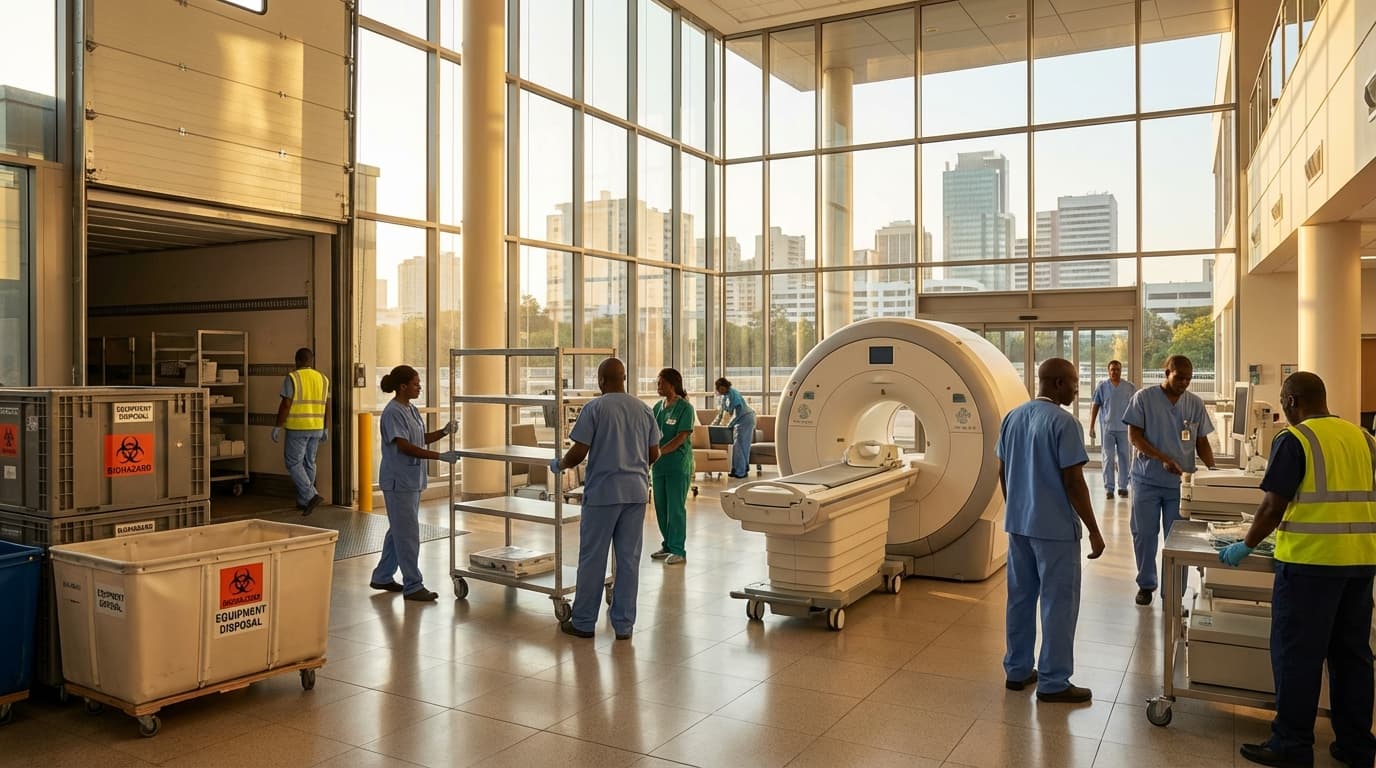
Medical E-Waste Handling & Recycling Coordination Service in Namibia
Engineering Excellence & Technical Support
Medical E-Waste Handling & Recycling Coordination Service High-standard technical execution following OEM protocols and local regulatory frameworks.
Secure Handling of Biohazardous Materials
Our service employs certified protocols and trained personnel for the safe segregation, packaging, and transportation of medical waste, including sharps, pharmaceuticals, and biohazardous materials, ensuring compliance with national and international safety standards and minimizing public health risks.
Advanced Recycling and Resource Recovery
We partner with specialized facilities to maximize the recycling of non-hazardous medical waste components, such as plastics and metals. This not only diverts waste from landfills but also promotes a circular economy by recovering valuable resources and reducing the environmental footprint of healthcare providers.
Traceable Chain of Custody and Compliance
Our robust system provides end-to-end tracking of medical waste from generation to final disposal or recycling. We ensure meticulous documentation and reporting to guarantee full regulatory compliance, offering healthcare facilities peace of mind and demonstrating their commitment to responsible waste management.
What Is Medical E-waste Handling & Recycling Coordination Service In Namibia?
Medical e-waste handling and recycling coordination services in Namibia refer to the organized and managed processes for the collection, transportation, treatment, and disposal or recycling of electronic and electrical equipment (EEE) originating from healthcare facilities and related sectors within the country. This encompasses a broad spectrum of devices, including diagnostic equipment (e.g., X-ray machines, MRI scanners), laboratory instruments, patient monitoring systems, IT hardware (servers, computers, printers), and communication devices. The service's primary objective is to ensure that these hazardous and often valuable materials are managed in an environmentally sound and compliant manner, mitigating risks to human health and ecosystems while maximizing resource recovery.
| Service Recipient | Need for Service | Typical Use Cases |
|---|---|---|
| Hospitals and Clinics (Public & Private) | Compliance with environmental regulations, reduction of hazardous waste liabilities, prevention of health risks associated with improper disposal of medical devices containing hazardous materials. | Disposal of decommissioned diagnostic imaging equipment (e.g., old X-ray machines), end-of-life patient monitoring systems, retired laboratory analysers, obsolete IT hardware used in healthcare management, and damaged medical electronics. |
| Diagnostic Laboratories and Research Institutions | Safe management of specialized scientific equipment containing potentially hazardous components, adherence to waste disposal protocols for sensitive research materials. | Recycling of old spectrophotometers, centrifuges, PCR machines, and other laboratory instrumentation with integrated electronic components, as well as associated computer systems. |
| Medical Equipment Suppliers and Manufacturers | Facilitating take-back programs for old equipment, ensuring responsible end-of-life management for products sold in Namibia. | Coordinating the collection and recycling of replaced medical devices under extended producer responsibility (EPR) schemes, managing the lifecycle of leased medical equipment. |
| Government Health Agencies and Ministries | Development and oversight of national e-waste management strategies, ensuring public health and environmental protection, procurement of compliant waste management services. | Implementing national policies for medical e-waste, managing waste from public health facilities, and establishing frameworks for private sector involvement in e-waste recycling. |
| Waste Management Companies and Recyclers | Access to specialized knowledge, infrastructure, and networks for handling and processing complex medical e-waste streams, obtaining necessary licenses and permits. | Developing specialized medical e-waste treatment facilities, providing collection and transportation services for healthcare providers, and offering certified recycling and resource recovery solutions. |
Key Components of Medical E-Waste Handling & Recycling Coordination Services in Namibia
- Regulatory Compliance and Policy Adherence: Ensuring all handling and recycling activities strictly adhere to Namibian environmental regulations, waste management legislation, and international best practices for hazardous waste.
- Inventory and Assessment: Conducting comprehensive audits to identify and categorize the types and quantities of medical e-waste generated within healthcare facilities.
- Collection and Segregation Strategies: Developing and implementing tailored collection protocols that ensure proper segregation of medical e-waste from general waste and other hazardous waste streams at the point of generation.
- Secure Transportation Logistics: Establishing safe and secure transportation networks from healthcare facilities to authorized treatment and recycling facilities, utilizing specialized vehicles and trained personnel to prevent spillage and exposure.
- Treatment and Dismantling: Overseeing the initial processing of e-waste, which may involve manual dismantling, shredding, or other methods to separate components and recover valuable materials or prepare waste for further processing.
- Hazardous Component Management: Identifying and safely managing hazardous components within the e-waste, such as cathode ray tubes (CRTs), mercury switches, leaded glass, and batteries, according to strict protocols.
- Recycling and Resource Recovery: Coordinating with certified recycling facilities that employ advanced technologies to recover valuable metals (e.g., gold, silver, copper), plastics, and other materials for reuse in manufacturing.
- Environmentally Sound Disposal: Ensuring that any residual waste that cannot be recycled is disposed of in specialized, licensed hazardous waste landfills that meet stringent environmental standards.
- Data Management and Reporting: Maintaining detailed records of waste streams, quantities, treatment methods, and disposal sites, providing regular reports to regulatory bodies and stakeholders.
- Stakeholder Engagement and Training: Facilitating communication and collaboration among healthcare providers, waste management companies, recyclers, and government agencies. Providing training to healthcare personnel on proper e-waste handling procedures.
Who Needs Medical E-waste Handling & Recycling Coordination Service In Namibia?
The growing volume of medical waste in Namibia presents a significant environmental and public health challenge. Proper handling, treatment, and recycling of this waste are crucial to prevent the spread of infections, protect natural resources, and comply with regulations. A dedicated Medical E-Waste Handling & Recycling Coordination Service is essential for numerous stakeholders across the healthcare and related sectors.
| Customer Segment | Key Needs & Roles | Potential Impact of Service |
|---|---|---|
| Healthcare Facilities | Safe disposal of infectious waste, sharps, expired medications; compliance with regulations; reduced health risks. | Improved patient safety, reduced environmental contamination, operational efficiency in waste management. |
| Government Ministries (MoHSS, MEFT) | Policy enforcement, public health protection, environmental regulation, sustainable waste management strategies. | Effective regulatory oversight, enhanced public trust, achievement of national health and environmental goals. |
| Local Authorities | Waste collection infrastructure, landfill management, public health services, local environmental compliance. | Improved public sanitation, reduced burden on landfills, cleaner communities. |
| Waste Management Companies | Specialized equipment, training, licensing, safe transportation and treatment methods for medical waste. | Expanded service offerings, compliance with specialized waste streams, contribution to a circular economy for medical materials. |
| Educational Institutions | Safe handling of laboratory waste, training of future healthcare professionals in waste management. | Responsible research practices, knowledgeable future workforce in healthcare and environmental management. |
| NGOs & International Agencies | Support for health programs, advocacy for environmental best practices, funding for waste management infrastructure. | Strengthened health systems, increased awareness and adoption of sustainable practices, improved public health outcomes. |
| Manufacturers & Suppliers | Product stewardship, take-back programs, responsible disposal of end-of-life products. | Enhanced corporate social responsibility, reduced environmental footprint of products, circular economy integration. |
Target Customers & Departments for Medical E-Waste Handling & Recycling Coordination Service in Namibia:
- {"title":"Healthcare Facilities","departments":["Hospitals (Public & Private)","Clinics & Health Centers","Doctor's Offices","Dental Practices","Veterinary Clinics","Laboratories (Diagnostic & Research)","Blood Banks","Pharmacies"],"description":"The primary generators of medical waste. This includes a wide range of institutions and professionals who produce waste that requires specialized management."}
- {"title":"Government & Public Sector","departments":["Ministry of Health and Social Services (MoHSS)","Ministry of Environment, Forestry and Tourism (MEFT)","Namibian Standards Institution (NSI)","Local Authorities & Municipalities (e.g., City of Windhoek, Walvis Bay Municipality)","Waste Management Regulatory Bodies"],"description":"Entities responsible for public health, environmental protection, and waste management policy and implementation."}
- {"title":"Waste Management & Recycling Companies","departments":["Licensed Medical Waste Haulers","Waste Treatment Facilities","Recycling Companies (specializing in or capable of handling medical materials)"],"description":"Businesses involved in the collection, transportation, treatment, and recycling of various waste streams, including medical waste."}
- {"title":"Educational & Research Institutions","departments":["Universities & Colleges (Medical & Science Departments)","Research Institutes","Medical Training Centers"],"description":"Facilities that generate specific types of medical waste through teaching, research, and development activities."}
- {"title":"Non-Governmental Organizations (NGOs) & International Agencies","departments":["Health-focused NGOs","Environmental Advocacy Groups","International Development Partners (e.g., WHO, UNICEF, GIZ)"],"description":"Organizations involved in health initiatives, environmental conservation, and sustainable development in Namibia."}
- {"title":"Manufacturers & Suppliers of Medical Devices & Pharmaceuticals","departments":["Medical Device Manufacturers","Pharmaceutical Companies","Medical Supply Distributors"],"description":"Companies that produce or distribute medical equipment and medicines, which can lead to waste at various stages of their lifecycle."}
Medical E-waste Handling & Recycling Coordination Service Process In Namibia
This document outlines the workflow for the Medical E-Waste Handling & Recycling Coordination Service Process in Namibia, from initial inquiry to successful execution. The service aims to ensure the safe, compliant, and environmentally sound management of medical electronic waste.
| Stage | Description | Key Activities | Responsible Party | Deliverables/Outcomes |
|---|---|---|---|---|
| The process begins with a client (healthcare facility, laboratory, etc.) contacting the service provider to discuss their medical e-waste management needs. | Receive and log inquiry, conduct preliminary needs assessment, discuss service scope, introduce the process and regulations. | Client, Service Provider Representative | Understanding of client needs, initial service scope defined, agreement to proceed to next stage. |
| A detailed evaluation of the client's premises and the types of medical e-waste generated. | On-site visit, identification of waste generation points, categorization of e-waste (e.g., imaging equipment, diagnostic devices, IT equipment), assessment of storage conditions, identification of potential hazards. | Service Provider Technician/Consultant | Detailed inventory of medical e-waste, risk assessment report, identification of specific handling and recycling requirements. |
| Based on the assessment, a tailored proposal is presented to the client. | Development of a comprehensive proposal outlining services, estimated costs, timelines, compliance measures, and recycling partners; negotiation and signing of service agreement. | Service Provider | Formal service agreement, detailed scope of work, pricing, and contractual obligations. |
| Meticulous planning for the safe and efficient collection of the identified medical e-waste. | Scheduling of collection, coordination with client on access and preparation, identification of appropriate collection containers and vehicles, confirmation of trained personnel availability. | Service Provider Logistics Coordinator | Collection schedule, confirmed client readiness, appropriate equipment allocation, designated collection team. |
| Safe and compliant transport of the medical e-waste to designated processing facilities. | Loading of waste using trained personnel and appropriate equipment, secure packaging and labeling, adherence to all transportation regulations (e.g., hazardous materials handling if applicable), tracking of shipments. | Service Provider Collection Team, Certified Transporters | Safely transported medical e-waste at the processing facility, chain of custody maintained. |
| The medical e-waste is processed and recycled by accredited and licensed facilities in Namibia. | Dismantling of equipment, segregation of materials (metals, plastics, circuit boards, etc.), shredding or other appropriate processing methods, material recovery for recycling, adherence to environmental and safety standards. | Certified Recycling Facility Partner | Recovered recyclable materials, breakdown of waste components, environmentally sound processing. |
| For devices containing sensitive data, secure data destruction is performed. | On-site or off-site data wiping or physical destruction of storage media, issuance of data destruction certificates. | Certified Recycling Facility Partner, Service Provider | Verified data destruction, data destruction certificates for relevant equipment. |
| Comprehensive reporting on the entire process is provided to the client. | Generation of a final report detailing waste quantities, types, recycling rates, environmental impact, and compliance documentation; provision for client audits. | Service Provider | Final service report, proof of compliant disposal and recycling, transparency in waste management. |
| Any residual hazardous or non-recyclable components are disposed of according to Namibian regulations. | Segregation of non-recyclable materials, liaison with authorized hazardous waste disposal facilities, compliant transportation and disposal of residues. | Service Provider, Licensed Disposal Facilities | Environmentally responsible disposal of all waste streams, full compliance with regulations. |
Service Workflow Stages
- Inquiry & Initial Consultation
- Site Assessment & Waste Profiling
- Proposal & Agreement
- Logistics & Collection Planning
- Secure Transportation
- Processing & Recycling at Certified Facilities
- Data Destruction & Certification
- Reporting & Auditing
- Disposal of Non-Recyclable Components
Medical E-waste Handling & Recycling Coordination Service Cost In Namibia
The cost of medical e-waste handling and recycling coordination services in Namibia is influenced by several key factors, leading to a range of pricing structures. These services are crucial for ensuring the safe, environmentally sound, and compliant disposal of electronic waste generated by healthcare facilities, laboratories, and other medical entities. The pricing reflects the complexity of the materials, the required safety protocols, transportation logistics, and the chosen end-of-life processing methods. Understanding these elements is vital for accurate budgeting and selection of service providers in Namibia.
| Service Component | Estimated Price Range (NAD) | Notes |
|---|---|---|
| Consultation & Site Assessment | 300 - 1,000 | Initial assessment of e-waste volume and type. |
| Collection & Transportation (per kg/unit) | 15 - 75 | Varies based on distance, volume, and type of waste. May include specialized transport for hazardous items. |
| Segregation & Sorting (per kg) | 5 - 20 | Cost for manual or automated separation of different electronic components. |
| Data Destruction (per device/drive) | 50 - 500 | Includes certified data wiping or physical shredding of storage media. |
| Hazardous Material Treatment/Disposal (per kg/unit) | 50 - 250+ | Significant variation based on the specific hazardous substance and its concentration. Mercury-containing devices will be at the higher end. |
| Recycling & Downstream Processing Fees (per kg) | 20 - 100 | Cost passed on from certified recycling facilities for materials recovery. |
| Certification & Reporting | 100 - 500 (per service/batch) | Issuance of certificates of destruction/recycling and detailed waste manifests. |
| Full Coordination Service (Monthly/Quarterly Contract) | 1,500 - 10,000+ | Comprehensive package including scheduled collections, reporting, and compliance management. Highly dependent on the volume and complexity of waste. |
Key Pricing Factors for Medical E-Waste Handling & Recycling Coordination in Namibia
- Type and Quantity of Medical E-Waste: Different electronic components within medical equipment (e.g., screens, batteries, circuit boards, mercury-containing devices) have varying levels of hazardousness and recycling complexity. Larger volumes generally lead to lower per-unit costs, but significant initial setup or transportation fees may apply.
- Hazardous Material Content: Medical e-waste often contains hazardous substances like lead, mercury, cadmium, and brominated flame retardants. The presence and concentration of these materials significantly increase handling, segregation, and disposal costs due to specialized treatment requirements and regulatory compliance.
- Data Security and Destruction: Medical facilities handle sensitive patient data. Services that include certified data wiping or physical destruction of storage media add to the overall cost, as they require specialized equipment and stringent procedures.
- Transportation and Logistics: The distance from the medical facility to the designated recycling or disposal facility, accessibility of the location, and the need for specialized transport (e.g., secure, temperature-controlled vehicles for certain items) are major cost drivers. Namibia's vast geography can impact these expenses.
- Recycling/Disposal Method: The choice between on-site dismantling, transport to a specialized medical e-waste recycler, or a general e-waste facility (if approved for certain components) will affect costs. Highly specialized recycling processes for specific medical electronics will be more expensive.
- Regulatory Compliance and Certification: Ensuring adherence to Namibian environmental regulations, obtaining necessary permits, and providing certificates of destruction or recycling are essential services that contribute to the overall price.
- Service Provider Expertise and Accreditation: Companies with specialized certifications, extensive experience in handling medical waste, and established relationships with certified downstream recyclers often command higher prices due to their reliability and adherence to best practices.
- Service Level Agreements (SLAs) and Contract Duration: Long-term contracts and comprehensive SLAs covering regular pick-ups, emergency services, and detailed reporting can sometimes offer cost savings through bulk discounts or predictable pricing.
- Pre-processing and Segregation: If the medical facility can pre-segregate e-waste according to material types, it can potentially reduce the service provider's handling costs. However, if the provider needs to perform extensive segregation, this will be factored into the price.
Affordable Medical E-waste Handling & Recycling Coordination Service Options
Our Affordable Medical E-Waste Handling & Recycling Coordination Service is designed to provide cost-effective and compliant solutions for healthcare facilities. We understand the unique challenges of managing sensitive medical electronic waste, including data security, regulatory adherence, and environmental responsibility. Our service simplifies this process by coordinating with certified and specialized e-waste recyclers, ensuring a seamless and affordable experience.
| Strategy | Description | Potential Savings |
|---|---|---|
| Consolidated Pick-ups | By coordinating multiple facilities or scheduling pick-ups in conjunction with other services, we can optimize logistics and reduce transportation costs. | 10-20% on transportation fees |
| Volume-Based Pricing Tiering | Our value bundles are structured with tiered pricing, offering discounts for higher volumes of e-waste processed through our service. | Up to 15% discount on recycling fees for larger volumes |
| Long-Term Contract Agreements | Committing to a service agreement for a set period can unlock preferential pricing and dedicated resource allocation. | 5-10% additional discount on bundled services |
| Proactive Waste Management Planning | Our team can help you forecast and plan for e-waste generation, allowing for more efficient scheduling and negotiation with recyclers. | Reduced emergency pick-up fees, better recycler rates |
| Data Destruction Verification | Ensuring proper data sanitization upfront minimizes the risk of data breaches and associated fines, which can be significantly more costly than recycling. | Avoidance of potential regulatory fines (can be hundreds of thousands of dollars) |
| Partnership with Certified Recyclers | Our curated network of certified recyclers ensures competitive pricing and efficient processing, avoiding the overhead of managing multiple vendor relationships independently. | Reduced administrative costs, access to bulk processing rates |
Our Value Bundles:
- Basic Compliance Package: Ideal for smaller clinics or those with lower volumes of e-waste. This bundle includes scheduled pick-up coordination, basic documentation of waste streams, and access to our network of certified recyclers. Focuses on essential regulatory compliance and responsible disposal.
- Standard Sustainability Package: A balanced option for mid-sized practices or hospitals. Offers everything in the Basic package, plus enhanced data destruction verification, detailed recycling reports, and a carbon footprint estimation for the recycled e-waste. Emphasizes both compliance and environmental impact.
- Comprehensive Care Package: Our premium offering for large hospitals, research institutions, or facilities with high volumes and strict data security needs. Includes all features of the Standard package, with priority pick-up scheduling, on-site waste assessment and consultation, advanced data sanitization auditing, and custom sustainability reporting. Designed for maximum peace of mind and environmental leadership.
- On-Demand & Ad-Hoc Services: For facilities with unpredictable e-waste generation, we offer flexible on-demand pick-up coordination and specialized handling for unique items. This can be added to any bundle or utilized independently.
Verified Providers In Namibia
Navigating the healthcare landscape in Namibia can be challenging, but a commitment to quality and patient well-being is paramount. Verified providers stand out for their adherence to stringent standards, ensuring that you receive safe, effective, and ethical medical care. Franance Health has consistently demonstrated this commitment, earning a reputation for excellence. Their accreditation and rigorous internal quality assurance processes are hallmarks of a trusted healthcare partner. Choosing Franance Health means opting for a provider that prioritizes your health with a foundation of verified expertise and unwavering dedication.
| Credential Type | Franance Health's Compliance | Patient Benefit |
|---|---|---|
| National Health Regulatory Board Accreditation | Fully Accredited and Compliant | Guarantees adherence to national medical standards and best practices. |
| International Quality Standards (e.g., ISO certification) | Pursuing/Achieved [Specify if known] | Demonstrates a commitment to globally recognized quality management systems. |
| Practitioner Licensing and Continuous Professional Development | All staff are licensed and actively engaged in CPD | Ensures medical staff possess up-to-date knowledge and skills. |
| Patient Feedback and Grievance Mechanisms | Robust and Transparent System | Provides avenues for patient concerns to be addressed effectively and professionally. |
| Infection Control Protocols | Exemplary Adherence | Minimizes risk of hospital-acquired infections, ensuring patient safety. |
| Medical Malpractice Insurance | Comprehensive Coverage | Offers financial protection and recourse for patients in unforeseen circumstances. |
Why Franance Health is the Top Choice:
- Rigorous Accreditation and Certifications
- Highly Qualified and Experienced Medical Professionals
- Commitment to Patient Safety and Ethical Practices
- State-of-the-Art Facilities and Technology
- Comprehensive Range of Specialized Services
- Positive Patient Testimonials and Reputation
Scope Of Work For Medical E-waste Handling & Recycling Coordination Service
This Scope of Work (SOW) outlines the requirements for a Medical E-Waste Handling & Recycling Coordination Service. The service will encompass the safe collection, transportation, and environmentally sound recycling of medical electronic waste (e-waste) generated by healthcare facilities. This document details the technical deliverables and standard specifications expected from the service provider.
| Deliverable | Description | Technical Specifications / Standards |
|---|---|---|
| Waste Identification & Segregation Plan | A detailed plan for identifying, categorizing, and segregating medical e-waste from other waste streams. | Must align with established medical waste and e-waste classification systems (e.g., EPA hazardous waste codes, R2, e-Stewards standards). Specific categories to include: Diagnostic equipment, imaging devices, patient monitoring systems, laboratory equipment, IT equipment (computers, servers, etc.). |
| Collection & Transportation Protocol | Procedures for safe, secure, and compliant collection and transportation of medical e-waste. | Vehicles must be appropriately licensed and equipped for hazardous/regulated waste transport. Drivers must be trained in waste handling and emergency response. Use of sealed, leak-proof containers with proper labeling (DOT, EPA compliant). Secure chain of custody documentation throughout transit. |
| Recycling & Disposal Procedures | Detailed methods for the recycling and/or environmentally sound disposal of collected medical e-waste. | Prioritize recycling and material recovery. All recycling partners must be certified (e.g., R2, e-Stewards). Data destruction protocols for all devices containing personal identifiable information (PII) or protected health information (PHI) to NIST 800-88 Rev. 1 standards or equivalent. Certificates of data destruction and recycling completion required. |
| Tracking & Reporting System | A comprehensive system for tracking medical e-waste from point of origin to final disposition, including all handling and processing steps. | Real-time tracking capabilities. Digital manifest system. Regular reports (monthly/quarterly) including waste volume, types of waste, recycling rates, disposal locations, and compliance documentation. Secure online portal for clients to access reports and track shipments. |
| Regulatory Compliance Management | Assurance of adherence to all applicable environmental, health, and safety regulations. | Provider must demonstrate current licenses and permits for all waste handling and disposal activities. Regular audits by the provider to ensure internal compliance. Proactive monitoring of regulatory changes and adaptation of protocols. Detailed records of all regulatory filings and inspections. |
| Emergency Response Plan | A robust plan to address spills, accidents, or other emergencies during collection, transport, or processing. | Clearly defined roles and responsibilities. Availability of trained personnel and necessary equipment for spill containment and cleanup. Established communication protocols with local emergency services and regulatory agencies. Regular drills and training exercises. |
| Client Training & Support | Provision of training to healthcare facility staff on proper e-waste identification, segregation, and preparation for collection. | On-site or virtual training sessions. Development of educational materials (posters, guides). Dedicated point of contact for client inquiries and support. |
| Auditing & Certification Records | Documentation of all audits (internal and external) and relevant certifications held by the service provider and their downstream partners. | Copies of current R2, e-Stewards, ISO 14001, or equivalent certifications for the provider. Proof of certification for all downstream recycling and disposal facilities. Records of third-party audits conducted on the provider's operations. |
Key Objectives of the Medical E-Waste Handling & Recycling Coordination Service:
- Ensure compliance with all local, state, and federal regulations pertaining to medical waste and e-waste management.
- Minimize environmental impact through responsible handling and recycling practices.
- Provide secure and auditable tracking of all medical e-waste from generation to final disposition.
- Optimize cost-effectiveness of the e-waste management process.
- Maintain the confidentiality and integrity of any data contained within disposed medical e-waste.
Service Level Agreement For Medical E-waste Handling & Recycling Coordination Service
This Service Level Agreement (SLA) outlines the response times and uptime guarantees for the Medical E-Waste Handling & Recycling Coordination Service provided by [Your Company Name] (hereinafter referred to as the 'Provider') to [Client Company Name] (hereinafter referred to as the 'Client'). This SLA aims to ensure efficient, secure, and compliant management of medical electronic waste.
| Service Component | Service Level Objective (SLO) | Measurement Metric | Reporting Frequency |
|---|---|---|---|
| Request Acknowledgment (Standard Collection Request) | Acknowledge receipt of a standard medical e-waste collection request within 4 business hours. | Timestamp of request receipt vs. timestamp of acknowledgment. | Monthly |
| Escalated Incident Response | Initiate investigation and response to escalated incidents (e.g., collection delay, compliance concern) within 1 business hour. | Timestamp of incident reporting vs. timestamp of initial response/investigation. | As needed / Monthly |
| Coordination Platform Uptime | 99.5% uptime for the online portal/system used for submitting requests, tracking progress, and accessing documentation. | Percentage of uptime calculated as (Total Minutes in Month - Downtime Minutes) / Total Minutes in Month. | Monthly |
| Communication Channel Availability | 99.0% availability of dedicated support phone line and email for urgent inquiries during business hours. | Percentage of availability during business hours. | Monthly |
| Scheduled Maintenance Notification | Provide at least 7 days' advance notice for all scheduled maintenance that may impact service availability. | Confirmation of notification delivery and timing. | As per scheduled maintenance events |
| Post-Recycling Reporting | Provide confirmation of waste disposal and recycling certificates within 10 business days of collection completion. | Timestamp of collection completion vs. timestamp of report delivery. | Per collection batch |
Definitions
- Medical E-Waste: Electronic waste generated from medical devices and equipment, which may contain hazardous materials requiring special handling and disposal.
- Coordination Service: The Provider's role in managing and facilitating the collection, transportation, and recycling of medical e-waste on behalf of the Client, including vendor selection and oversight.
- Response Time: The maximum allowable time for the Provider to acknowledge and initiate action on a service request or critical incident.
- Uptime: The percentage of time the Provider's coordination platform and associated communication channels are operational and accessible for the Client to submit requests and receive updates.
- Critical Incident: Any event that significantly disrupts the coordination of medical e-waste handling or poses an immediate compliance or environmental risk.
- Scheduled Maintenance: Planned downtime for system updates, upgrades, or preventive maintenance, communicated to the Client in advance.
Frequently Asked Questions

Ready when you are
Let's scope your Medical E-Waste Handling & Recycling Coordination Service in Namibia project in Namibia.

Scaling healthcare logistics and technical systems across the entire continent.