
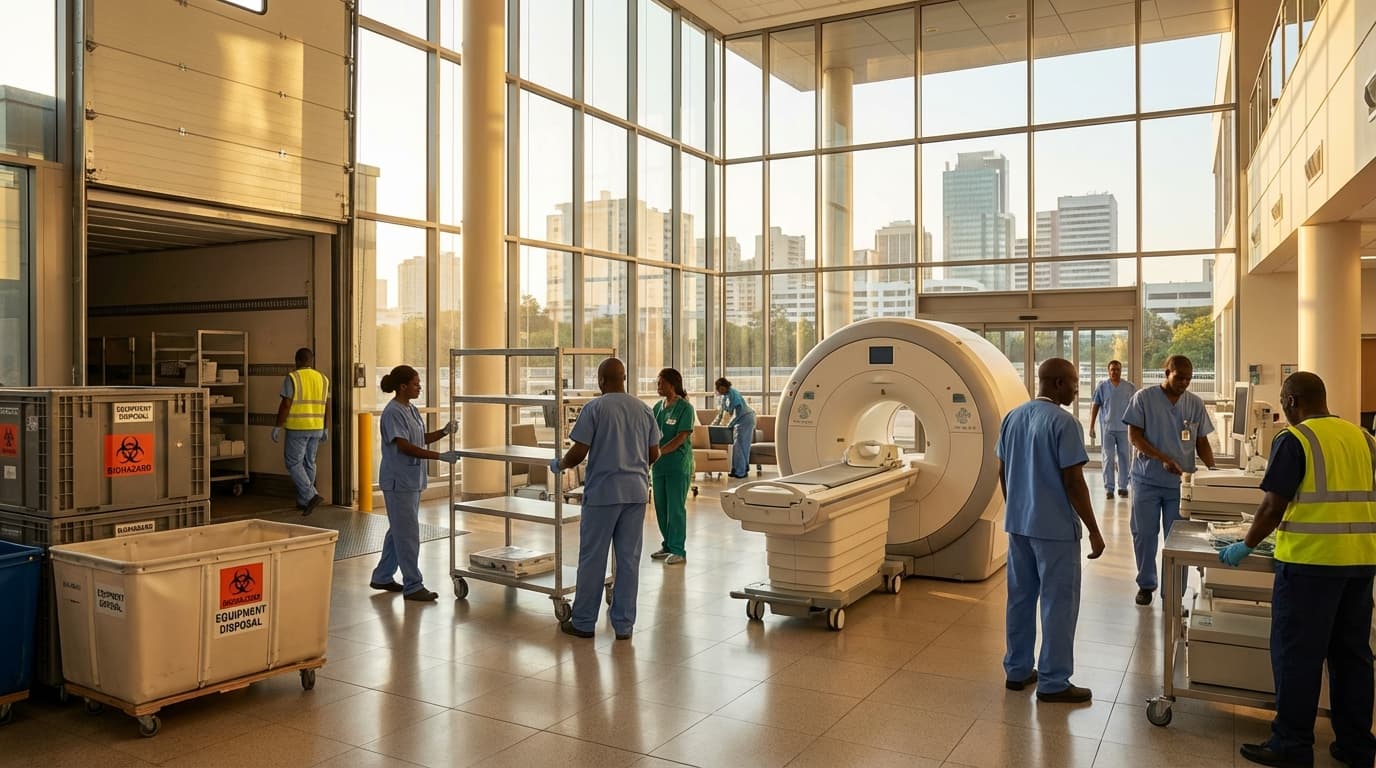
Heavy Medical Equipment De-Installation Service (MRI/CT/Cath Lab) in Namibia
Engineering Excellence & Technical Support
Heavy Medical Equipment De-Installation Service (MRI/CT/Cath Lab) High-standard technical execution following OEM protocols and local regulatory frameworks.
Specialized De-Installation Expertise
Our certified technicians possess deep technical knowledge and specialized tools for the precise and safe de-installation of complex medical imaging equipment, including MRI, CT scanners, and Cath Labs, adhering to manufacturer specifications and local Namibian regulations.
Risk Mitigation & Compliance
We prioritize the safety of your facility and personnel. Our de-installation process incorporates rigorous safety protocols, environmental handling procedures, and meticulous documentation to ensure full compliance with Namibian health and safety standards.
Logistics & Relocation Coordination
Beyond de-installation, we offer comprehensive logistics support, including expert packing, coordination with specialized transport providers, and secure handling of heavy medical equipment for seamless relocation within Namibia or for export.
What Is Heavy Medical Equipment De-installation Service (Mri/ct/cath Lab) In Namibia?
Heavy Medical Equipment De-Installation Service (MRI/CT/Cath Lab) in Namibia refers to the specialized process of safely and systematically dismantling, disconnecting, and preparing large, complex, and often high-value medical imaging and interventional equipment for relocation, disposal, or storage. This service is crucial for healthcare facilities undertaking infrastructure upgrades, facility closures, equipment replacements, or consolidation of services. It necessitates a deep understanding of the intricate engineering, electrical, and fluid systems inherent to Magnetic Resonance Imaging (MRI), Computed Tomography (CT), and Cardiac Catheterization (Cath Lab) suites, as well as strict adherence to safety protocols and regulatory requirements specific to Namibia.
| Who Needs This Service? | Typical Use Cases | |||
|---|---|---|---|---|
| Hospitals (Public and Private) | Upgrade or replacement of existing MRI, CT, or Cath Lab equipment. | Relocation of an entire imaging department or suite. | Facility closure or consolidation of services. | Transitioning to new technology with different infrastructure requirements. |
| Diagnostic Imaging Centers | End-of-lease equipment returns. | Expansion or downsizing of facilities. | Scheduled maintenance or major component upgrades requiring temporary removal. | |
| Medical Equipment Manufacturers and Vendors | Retrieval of equipment for refurbishment or resale. | Installation of new units that require the removal of older models. | Decommissioning of demonstration or rental units. | |
| Government and Public Health Agencies | Decommissioning of equipment in underutilized or closed public health facilities. | Transfer of critical medical assets between different regional healthcare centers. | ||
| Specialized Medical Service Providers (e.g., mobile imaging units) | Dismantling and reassembly of equipment for transport between mobile units and fixed locations. |
Key Components of Heavy Medical Equipment De-Installation Service:
- Site Assessment and Planning: Detailed evaluation of the equipment's installation environment, access routes, and power/utility requirements. Development of a comprehensive de-installation plan, including risk assessment and mitigation strategies.
- System Disconnection: Expert disconnection of all power supplies (high voltage and low voltage), data network cables, coolant lines (e.g., helium for MRI), pneumatic lines, and any other integrated systems.
- Component Dismantling: Careful disassembly of the equipment into manageable components, often requiring specialized tools and lifting equipment. This includes the gantry, patient table, power conversion units, cryogen systems, and control consoles.
- De-energization and Purging: Safe de-energization of all electrical components and, where applicable, purging of hazardous substances such as refrigerants or helium according to environmental regulations.
- Packaging and Protection: Meticulous packaging of individual components using protective materials to prevent damage during transit.
- Logistics and Transportation Coordination: Planning and coordination of specialized transportation for oversized and heavy components, ensuring compliance with road weight and dimension regulations within Namibia.
- Documentation: Comprehensive record-keeping of the entire de-installation process, including photographs, asset tagging, and detailed inventories of removed components.
- Site Remediation: Restoration of the de-installation site to its original or agreed-upon condition, including removal of ancillary equipment and basic structural repairs if necessary.
Who Needs Heavy Medical Equipment De-installation Service (Mri/ct/cath Lab) In Namibia?
In Namibia, the need for specialized heavy medical equipment de-installation services, particularly for sophisticated systems like MRI, CT scanners, and Cath Labs, arises from several key scenarios. These services are crucial for ensuring safe, efficient, and compliant removal, relocation, or disposal of complex and high-value medical technology. This requires a deep understanding of the equipment's intricate components, power requirements, cooling systems, and shielding, as well as adherence to strict safety protocols and regulatory guidelines.
| Scenario | Reason for De-Installation | Relevant Departments |
|---|---|---|
| Equipment Upgrade/Replacement | Installing newer, more advanced technology. | Radiology, Cardiology, Facilities Management, Procurement |
| Facility Renovation/Expansion | Clearing space for structural changes or new layouts. | Facilities Management, Estates, Project Management |
| Facility Closure/Consolidation | Decommissioning a site or merging services. | Administration, Asset Management, Government Health Ministries |
| Equipment Relocation (within or between facilities) | Moving functional equipment to a different location. | Logistics, Facilities Management, Technical Support |
| End-of-Life Equipment Disposal/Sale | Disposing of or selling old equipment. | Asset Management, Disposal Companies, Procurement |
| Technological Obsolescence | Equipment is no longer supported or is outdated. | Radiology, Cardiology, Technical Support |
Target Customers and Departments in Namibia Requiring Heavy Medical Equipment De-Installation:
- {"title":"Hospitals (Public and Private)","departments":["Radiology/Imaging Departments","Cardiology Departments","Surgical Departments","Facilities Management/Estates Departments","Procurement/Asset Management Departments"],"description":"The primary customers for these services. Hospitals often undergo renovations, equipment upgrades, or closures that necessitate the de-installation of existing MRI, CT, and Cath Lab systems."}
- {"title":"Specialized Diagnostic Imaging Centers","departments":["Imaging Services","Administration","Technical Operations"],"description":"Standalone centers focused on diagnostic imaging services, particularly those offering advanced modalities like MRI, CT, and interventional cardiology procedures."}
- {"title":"Medical Equipment Manufacturers and Distributors","departments":["Field Service/Technical Support","Sales and Logistics"],"description":"Companies that sell, install, and maintain medical equipment may require de-installation services for trade-ins, upgrades, or when a client decides to decommission a unit."}
- {"title":"Government Health Ministries/Agencies","departments":["Healthcare Infrastructure Planning","Procurement and Logistics","Public Health Services"],"description":"Responsible for managing public healthcare infrastructure and may oversee the decommissioning or relocation of equipment in public hospitals or clinics."}
- {"title":"Healthcare Real Estate Developers and Investors","departments":["Project Management","Asset Management"],"description":"When developing new healthcare facilities or redeveloping existing ones, they might need to clear space or prepare for new installations."}
- {"title":"Asset Disposal and Recycling Companies","departments":["Operations","Logistics"],"description":"Firms specializing in the disposal or recycling of medical equipment, especially those focusing on remarketing or responsible e-waste management."}
- {"title":"Research Institutions and Universities (with medical programs)","departments":["Medical Research Departments","Biomedical Engineering","Facilities Management"],"description":"Institutions that utilize advanced imaging equipment for research or medical training may require de-installation during facility upgrades or program changes."}
Heavy Medical Equipment De-installation Service (Mri/ct/cath Lab) Process In Namibia
This document outlines the comprehensive workflow for the heavy medical equipment de-installation service, specifically for MRI, CT, and Cath Lab systems, within Namibia. The process is designed to be meticulous, safe, and compliant with all relevant regulations, ensuring minimal disruption to the client's operations while safeguarding the integrity of the valuable equipment. The workflow spans from the initial client inquiry to the final handover of the de-installed equipment.
| Stage | Description | Key Activities | Responsible Parties | Deliverables/Outcomes |
|---|---|---|---|---|
| Inquiry and Initial Consultation | The client contacts the service provider to request de-installation services for their medical equipment. | Initial discussion of equipment type, location, desired timeline, and specific requirements. Understanding the client's operational needs and constraints. | Client, Service Provider Sales/Consultation Team | Basic understanding of the project scope, identification of potential challenges. |
| Site Assessment and Planning | A detailed on-site inspection to gather all necessary information for a safe and efficient de-installation. | Measuring access routes (doorways, corridors, elevators), assessing structural integrity, identifying utility disconnections (power, cooling, data), documenting current equipment condition, and developing a detailed de-installation plan. | Service Provider Engineering Team, Project Manager, Client Representative | Detailed de-installation plan, risk assessment report, required tooling and personnel list, preliminary timeline. |
| Quotation and Agreement | Based on the site assessment, a formal proposal and contract are presented to the client. | Preparation of a comprehensive quotation outlining costs, timelines, terms, and conditions. Negotiation and finalization of the service agreement. | Service Provider Project Manager, Client | Signed service agreement, confirmed budget, agreed-upon timeline. |
| Pre-De-installation Preparation | All necessary preparations are made to ensure a smooth and safe de-installation process. | Scheduling of specialized technicians and engineers, procurement of necessary tools and materials, coordination with facility management for access and utility shutdowns, preliminary disconnection of non-critical systems, securing the work area. | Service Provider Project Manager, Engineering Team, Logistics Coordinator, Client Facility Management | Work schedule finalized, all resources mobilized, permits obtained (if applicable), work area prepared. |
| Equipment De-installation | The systematic and careful dismantling of the medical equipment. | Power down and safe disconnection of all utilities, disassembly of components according to manufacturer specifications, labeling and packaging of parts, careful removal from the installation room. | Service Provider Certified Technicians and Engineers | Equipment safely dismantled and ready for transportation, all components accounted for. |
| Post-De-installation and Site Clearance | Ensuring the work area is left in a safe and clean condition. | Removal of debris and packaging materials, any necessary minor repairs to the site (e.g., patching small holes), final inspection of the de-installation site. | Service Provider Site Supervisor, Client Representative | Clean and safe work area, sign-off on site clearance. |
| Logistics and Transportation | Safe and secure transportation of the de-installed equipment to its designated location. | Arrangement of specialized transport vehicles, secure packing and loading of equipment, transportation to the new site or storage facility, adherence to all Namibian transport regulations. | Service Provider Logistics Coordinator, Specialized Transport Company | Equipment safely transported to its destination. |
| Final Handover and Documentation | Formal completion of the service and provision of all relevant documentation. | Final inspection and sign-off by the client, handover of all de-installation records, inventory lists, and any relevant service reports. Issuance of final invoice. | Service Provider Project Manager, Client Representative | Client satisfaction confirmed, all project documentation finalized and delivered. |
Key Stages of Heavy Medical Equipment De-Installation in Namibia
- Inquiry and Initial Consultation
- Site Assessment and Planning
- Quotation and Agreement
- Pre-De-installation Preparation
- Equipment De-installation
- Post-De-installation and Site Clearance
- Logistics and Transportation
- Final Handover and Documentation
Heavy Medical Equipment De-installation Service (Mri/ct/cath Lab) Cost In Namibia
The cost of de-installing heavy medical equipment such as MRI, CT scanners, and Cath Labs in Namibia is a complex undertaking that involves specialized expertise, logistical challenges, and adherence to strict safety protocols. Pricing is not standardized and can vary significantly based on several key factors. These services are typically provided by specialized biomedical engineering firms or logistics companies with experience in handling sensitive and large-scale medical machinery. The process often involves dismantling the equipment, safe packaging, transportation, and sometimes temporary storage, all while ensuring the integrity and potential for re-installation of the machinery.
| Equipment Type | Estimated Cost Range (NAD) | Notes |
|---|---|---|
| CT Scanner (De-installation Only) | NAD 50,000 - NAD 150,000+ | Excludes transportation and re-installation. Varies with model size and complexity. |
| MRI Scanner (De-installation Only) | NAD 100,000 - NAD 300,000+ | Significant cost due to magnet handling, cryogen management, and large components. |
| Cath Lab (De-installation Only) | NAD 75,000 - NAD 200,000+ | Involves delicate imaging systems, patient tables, and associated infrastructure. |
| Ancillary Heavy Medical Equipment (e.g., Linear Accelerators, large X-ray units) | NAD 60,000 - NAD 250,000+ | Highly dependent on the specific equipment's size, weight, and hazardous components. |
Key Factors Influencing De-Installation Costs:
- Type and Size of Equipment: MRI machines, CT scanners, and Cath Labs vary greatly in size, weight, complexity, and the number of components that need to be dismantled. Larger and more intricate systems will naturally incur higher costs.
- Accessibility and Site Conditions: The ease of access to the de-installation location (e.g., hospital floor, room layout, elevator availability, road access for transport) significantly impacts labor and equipment required. Difficult access can lead to increased time and specialized lifting equipment, thus raising costs.
- Dismantling Complexity: The degree of disassembly required depends on the equipment model and the transportation method. Some components may need to be separated down to very small parts, while others can be moved in larger modules.
- Specialized Tools and Equipment: De-installation requires specific tools, lifting gear (cranes, forklifts), and transport vehicles capable of handling the weight and dimensions of the equipment. The cost of renting or owning these is factored in.
- Labor Expertise and Man-Hours: This is a critical component. Highly skilled biomedical engineers and technicians with experience in handling high-value medical equipment are essential. The number of personnel and the time spent on the project directly influence the cost.
- Packaging and Crating: Proper packaging and crating are crucial to protect the equipment during transit. Custom-built crates or specialized protective materials add to the overall expense.
- Transportation Logistics: The distance to the new location (within Namibia or for export), the mode of transport (truck, sea freight), and any necessary permits or insurance for transportation will affect the final price.
- Decommissioning and Site Restoration: Some services may include the decommissioning of the equipment (e.g., draining coolants in MRI machines) and the restoration of the installation site to its original condition. These add to the scope and cost.
- Time Constraints and Urgency: Rush jobs or projects with tight deadlines can often command premium pricing.
- Geographic Location within Namibia: While less significant than other factors, variations in local labor rates and logistical costs between major cities (e.g., Windhoek) and more remote areas might exist.
Affordable Heavy Medical Equipment De-installation Service (Mri/ct/cath Lab) Options
Navigating the complex and often expensive process of de-installing heavy medical equipment like MRI, CT scanners, and Cath Labs requires careful planning and cost-conscious strategies. This service is critical for relocations, upgrades, or facility closures, and it's essential to understand the available options and how to maximize value without compromising safety and compliance. Our affordable de-installation services focus on providing transparent pricing, efficient execution, and tailored solutions to meet your specific needs.
| Value Bundle Option | Included Services | Ideal For | Estimated Cost Savings Potential |
|---|---|---|---|
| Basic De-Installation & Removal | Standard de-installation of equipment (e.g., MRI, CT, Cath Lab), disconnection from utilities, basic packaging, and removal from the site. | Facilities undergoing minor upgrades or partial closures where immediate relocation isn't the primary concern. | 15-20% (by avoiding unnecessary add-ons) |
| Full Service De-Installation & Logistics | Comprehensive de-installation, detailed labeling of components, professional crating/packaging, coordination with transport, and site clean-up. | Relocations requiring a seamless transition, minimizing downtime at both the origin and destination. | 10-15% (through bundled efficiency and reduced risk of delays) |
| De-Installation with Component Reuse/Resale Support | All services from 'Full Service' plus expert assessment of reusable components, basic refurbishment, and assistance with connecting with resale markets. | Organizations looking to recoup some costs from older equipment or seeking sustainable disposal solutions. | 25-40% (depending on the value of resalable components) |
| Emergency De-Installation & Site Restoration | Rapid response de-installation, immediate utility disconnection, and basic site stabilization to ensure safety and prevent further damage. | Urgent facility closures, unexpected equipment removal due to damage or lease termination. | Value-based pricing, but avoids significant penalties or further repair costs associated with delayed action. |
Key Components of Affordable De-Installation Services
- Expert De-Installation Teams: Certified technicians with specialized training in handling sensitive and heavy medical equipment.
- Specialized Tools & Equipment: Access to a range of hydraulic lifts, heavy-duty dollies, and rigging equipment to ensure safe and controlled dismantling.
- Compliance & Safety Protocols: Adherence to all relevant industry regulations, safety standards, and manufacturer guidelines.
- Logistics & Coordination: Comprehensive planning and management of the de-installation timeline, site access, and coordination with other stakeholders.
- Disposal & Recycling Options: Environmentally responsible disposal or recycling of components that are no longer needed.
- Documentation & Reporting: Detailed records of the de-installation process for your records and compliance purposes.
Verified Providers In Namibia
In Namibia, ensuring you're receiving healthcare from verified providers is paramount. This not only guarantees quality of care but also peace of mind. Franance Health stands out as a leading entity, meticulously vetting its network of healthcare professionals. This commitment to credentialing means that every provider associated with Franance Health has undergone rigorous checks, verifying their qualifications, experience, and adherence to ethical standards. Choosing Franance Health's network signifies opting for a level of assurance and trust in your healthcare journey.
| Franance Health Credentialing Aspect | What it Ensures for Patients |
|---|---|
| License and Registration Checks | Confirms providers are legally permitted to practice in Namibia. |
| Educational and Professional Qualifications | Guarantees providers have the necessary training and expertise. |
| Experience Verification | Ensures providers have practical, real-world experience. |
| Background Checks | Undertakes due diligence to ensure trustworthy practitioners. |
| Professional References | Validates a provider's reputation and work ethic. |
Why Franance Health Credentials Matter
- Rigorous Verification Process: Franance Health employs a multi-stage verification process, scrutinizing educational backgrounds, professional licenses, and certifications.
- Experience Validation: Beyond qualifications, Franance Health assesses the practical experience of its providers, ensuring they have a proven track record.
- Ethical Compliance: All credentialed providers are committed to upholding the highest ethical standards in patient care and professional conduct.
- Continuous Monitoring: Franance Health maintains an ongoing relationship with its providers, ensuring continued compliance and quality.
- Patient Safety Focus: The core of their credentialing is to prioritize patient safety and deliver reliable healthcare services.
Scope Of Work For Heavy Medical Equipment De-installation Service (Mri/ct/cath Lab)
This Scope of Work (SOW) outlines the requirements for the professional de-installation of heavy medical equipment, specifically Magnetic Resonance Imaging (MRI) scanners, Computed Tomography (CT) scanners, and Cardiac Catheterization (Cath Lab) systems. The objective is to safely and efficiently dismantle, disconnect, and prepare these complex systems for relocation or disposal, adhering to all relevant safety regulations, manufacturer guidelines, and industry best practices. This service includes the complete removal of all associated components, cabling, and ancillary equipment, leaving the designated area in a clean and ready state.
| Technical Deliverable | Description | Standard Specifications / Requirements |
|---|---|---|
| Pre-De-installation Site Survey Report | Detailed assessment of the installation site, including physical access, power requirements, cooling infrastructure, potential hazards, and site-specific challenges. | Includes floor plans, photographic evidence, detailed measurements, and a risk assessment. Must be submitted and approved by the client prior to commencement of de-installation. |
| De-installation Plan | A comprehensive step-by-step plan detailing the sequence of operations, personnel required, tools and equipment needed, safety protocols, and timeline. | Must align with manufacturer's de-installation manuals and include contingency plans. Submitted for client review and approval. |
| Equipment Disassembly | Safe and systematic disassembly of the MRI, CT, or Cath Lab system into manageable components. | Follow manufacturer's approved procedures. Utilize specialized tools and lifting equipment. Minimize potential for damage to equipment components. Proper labeling of all disassembled parts. |
| Electrical Disconnection | Safe and complete disconnection of all electrical power sources and control wiring. | Adhere to local electrical codes (e.g., NEC, IEC). Ensure power is safely isolated and terminated. Verification of power disconnection by a qualified electrician. |
| Cooling System Disconnection | Disconnection and draining of any integrated or external cooling systems (e.g., chillers, fluid lines). | Follow manufacturer's specific procedures for fluid management and disposal. Containment of any fluids. Proper flushing and cleaning of lines where applicable. |
| Ancillary Equipment Removal | Removal of all associated peripheral equipment, including workstations, power supplies, patient monitoring systems, and imaging acquisition devices. | All cables and connections must be safely disconnected and coiled. Components to be clearly labeled and segregated. |
| Component Segregation and Labeling | Organized segregation of all removed components based on type, size, and destination. | Each component and sub-assembly to be clearly labeled with unique identifiers, equipment type, and de-installation date for easy identification and tracking. |
| Packaging and Protection | Appropriate packaging and protection of all components to prevent damage during transit or storage. | Use of industry-standard packaging materials (e.g., custom crating, foam padding, protective wrapping). Compliance with any specific manufacturer requirements for delicate components. |
| Site Cleanup | Thorough cleaning of the de-installation area, removing all debris, dust, and residual materials. | Leave the site in a clean, safe, and presentable condition. Removal of all waste materials to an approved disposal facility. |
| De-installation Completion Report | A comprehensive report detailing the completion of the de-installation process, including a manifest of all removed components, photographic evidence of the site post-completion, and any issues encountered. | Must include certifications from qualified personnel confirming safe disconnection. Signed by client representative. |
| Manufacturer's De-installation Manual Compliance | Strict adherence to the specific de-installation procedures outlined in the original equipment manufacturer's documentation. | Verification of compliance required. Deviations only permitted with documented client and manufacturer approval. |
| Safety Protocols and Compliance | Adherence to all relevant health, safety, and environmental regulations (e.g., OSHA, local environmental laws). | Implementation of lockout/tagout procedures, use of appropriate Personal Protective Equipment (PPE), and adherence to lifting safety standards. Documented safety briefings for all personnel. |
Key Service Areas
- Site assessment and planning
- De-installation and disassembly of medical equipment
- Electrical and cooling system disconnection
- Component handling and segregation
- Packaging and preparation for transport
- Site cleanup and restoration
- Documentation and certification
Service Level Agreement For Heavy Medical Equipment De-installation Service (Mri/ct/cath Lab)
This Service Level Agreement (SLA) outlines the response times and uptime guarantees for the de-installation of heavy medical equipment, specifically MRI, CT scanners, and Cath Labs. It is intended to ensure efficient and timely service, minimizing disruption to healthcare operations. This SLA is a legally binding document between [Your Company Name] (hereinafter referred to as 'Service Provider') and [Client Name] (hereinafter referred to as 'Client').
| Service Type | Response Time (Business Hours) | Response Time (Outside Business Hours/Weekends) | Uptime Guarantee & Remediation |
|---|---|---|---|
| Scheduled De-installation (MRI/CT/Cath Lab) | Within [Number] Business Hours of confirmation | Within [Number] Business Hours of the start of the next Business Day | If de-installation is delayed by more than [Number] hours from the scheduled start due to Service Provider's fault, Client will receive a [Percentage]% discount on the de-installation fee for that specific service. Extended delays may be subject to further negotiation. |
| Emergency De-installation (MRI/CT/Cath Lab) | Within [Number] Hours of notification | Within [Number] Hours of notification | If de-installation is delayed by more than [Number] hours from the agreed-upon emergency start time due to Service Provider's fault, Client will receive a [Percentage]% discount on the de-installation fee for that specific service. Extended delays may be subject to further negotiation. |
Key Definitions
- De-installation: The process of safely and systematically dismantling, disconnecting, and preparing heavy medical equipment for relocation or disposal.
- Scheduled De-installation: De-installation services requested and agreed upon by both parties at least [Number] business days in advance.
- Emergency De-installation: De-installation services required due to unforeseen circumstances, equipment failure necessitating immediate removal, or urgent facility changes, as determined by the Client.
- Business Hours: Monday to Friday, [Start Time] to [End Time] [Time Zone], excluding public holidays.
- Response Time: The maximum allowable time from the initial notification of a service request by the Client to the commencement of active work by the Service Provider.
- Uptime Guarantee: Applicable to situations where the de-installation process is interrupted due to the Service Provider's negligence or failure to adhere to the agreed-upon schedule and process, impacting the Client's operational readiness for subsequent stages (e.g., facility preparation for new equipment). This guarantee is not for the equipment's operational status but for the timely completion of the de-installation phase to avoid downstream delays.
- Force Majeure: Events beyond the reasonable control of either party, including but not limited to, natural disasters, acts of war, terrorism, pandemics, labor strikes, or governmental actions.
Frequently Asked Questions

Ready when you are
Let's scope your Heavy Medical Equipment De-Installation Service (MRI/CT/Cath Lab) in Namibia project in Namibia.

Scaling healthcare logistics and technical systems across the entire continent.