
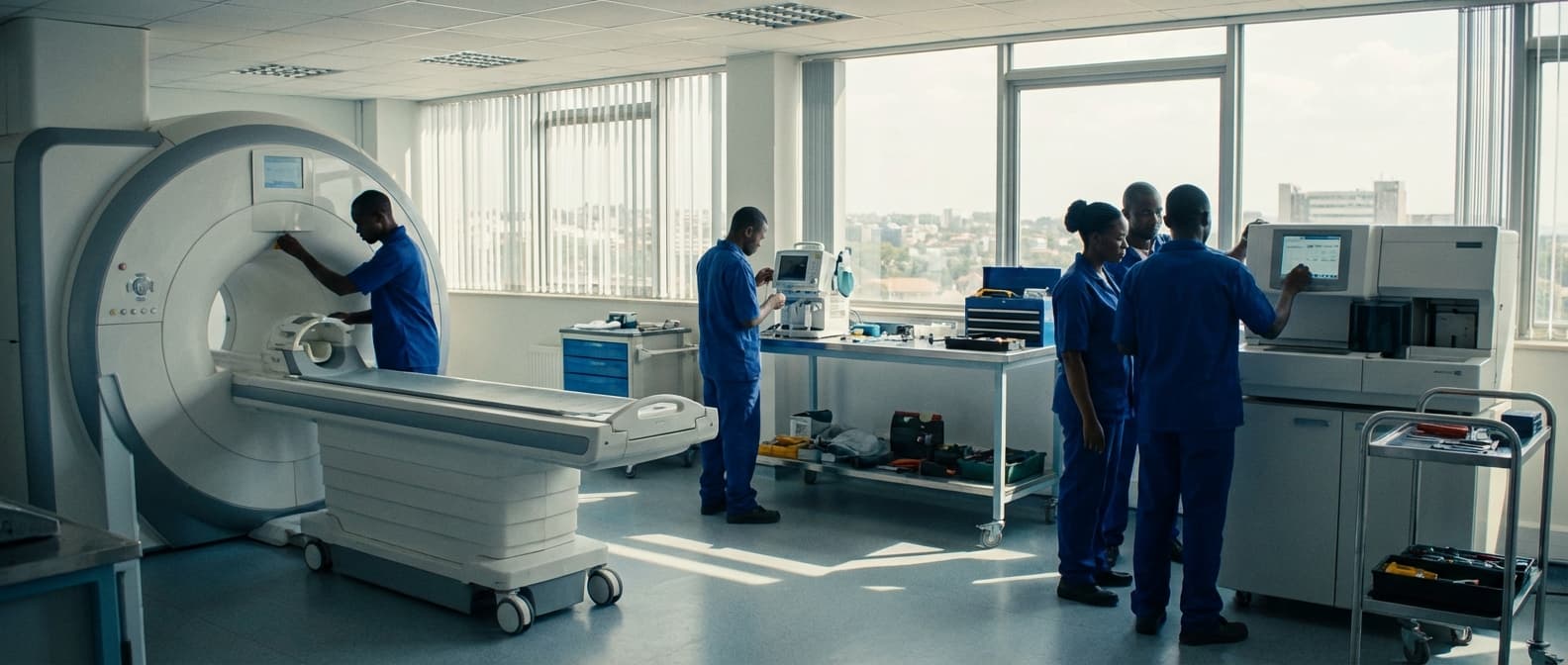
Uptime, Downtime & Root-Cause Analysis Reporting Service in Namibia
Engineering Excellence & Technical Support
Uptime, Downtime & Root-Cause Analysis Reporting Service High-standard technical execution following OEM protocols and local regulatory frameworks.
Real-Time Uptime Monitoring & Instant Alerts
Leverage our advanced Uptime monitoring service to gain immediate visibility into your Namibian infrastructure's availability. Receive instant alerts via SMS/email for any service disruptions, ensuring proactive response and minimizing business impact.
Comprehensive Downtime Tracking & Performance Metrics
Our Downtime reporting service meticulously logs every outage, providing granular data on duration, frequency, and affected services across Namibia. Gain deep insights into performance trends and identify recurring issues before they escalate.
Automated Root Cause Analysis & Remediation Pathways
Go beyond just identifying downtime. Our Root-Cause Analysis reporting automatically pinpoints the underlying issues, providing actionable insights and suggested remediation steps to prevent future occurrences, optimizing your IT operations in Namibia.
What Is Uptime, Downtime & Root-cause Analysis Reporting Service In Namibia?
In Namibia, Uptime, Downtime, and Root-Cause Analysis (RCA) Reporting Services are critical for ensuring the operational integrity and efficiency of IT infrastructure and business-critical systems. These services aim to quantify system availability, identify periods of unavailability, and systematically investigate the underlying causes of such disruptions. This proactive approach minimizes future occurrences and optimizes system performance.
Uptime refers to the period during which a system, service, or network is fully operational and accessible. It is typically measured as a percentage of the total operational time (e.g., 99.999% uptime).
Downtime is the antithesis of uptime, representing the period during which a system, service, or network is unavailable or non-functional. This can range from minor service interruptions to complete system failures.
Root-Cause Analysis (RCA) is a structured methodology used to identify the fundamental reason(s) for a problem or an incident. It goes beyond addressing the immediate symptoms to uncover the originating cause, enabling the implementation of corrective and preventive actions to avoid recurrence. This involves detailed investigation, data collection, and logical deduction.
Reporting Services in this context refer to the systematic collection, analysis, and presentation of data related to uptime, downtime, and the findings of RCA investigations. These reports provide actionable insights for stakeholders.
| Use Case Category | Specific Application | Benefit of RCA Reporting |
|---|---|---|
| Network Infrastructure | Router/Switch failures, ISP outages, firewall misconfigurations | Identify recurring network bottlenecks, optimize network redundancy, improve firewall rule efficacy. |
| Server and Application Performance | Application crashes, database unresponsiveness, server hardware failures | Pinpoint software bugs, optimize resource allocation, improve hardware lifecycle management. |
| Cloud Service Availability | Virtual machine downtime, storage service interruptions, API errors | Enhance cloud provider SLA adherence, optimize application architecture for cloud resilience, mitigate vendor-specific issues. |
| Security Incidents | DDoS attacks, unauthorized access leading to service disruption | Strengthen security protocols, identify vulnerabilities, improve incident response playbooks. |
| Power and Environmental Issues | UPS failures, HVAC malfunctions impacting data center operations | Optimize data center infrastructure maintenance schedules, improve power and cooling redundancy. |
| Software Deployments and Updates | Faulty deployments causing service outages | Refine deployment processes, implement robust rollback strategies, improve testing procedures. |
Who Needs Uptime, Downtime & Root-Cause Analysis Reporting Services in Namibia?
- Information Technology (IT) Departments: Essential for managing servers, networks, cloud services, and applications to ensure business continuity.
- Telecommunications Providers: Critical for maintaining network availability and service delivery to customers.
- Financial Institutions (Banks, Insurance Companies): High availability is paramount due to the sensitive nature of transactions and data.
- Government Agencies: Ensuring public services remain accessible and operational.
- Healthcare Providers: Downtime can have life-threatening consequences, making uptime and rapid RCA crucial.
- E-commerce and Retail Businesses: Continuous availability is directly linked to revenue and customer satisfaction.
- Cloud Service Providers: Obligated to provide measurable uptime guarantees to their clients.
- Manufacturing and Industrial Operations: Ensuring production lines and control systems are consistently operational.
- Any organization reliant on digital infrastructure for its core business functions.
Who Needs Uptime, Downtime & Root-cause Analysis Reporting Service In Namibia?
In today's increasingly digital Namibian business landscape, reliable IT infrastructure is no longer a luxury but a necessity. Disruptions, whether planned or unplanned, can have significant financial and reputational consequences. Businesses across Namibia are seeking robust solutions to monitor their systems, understand the impact of downtime, and pinpoint the root causes of any issues to prevent future occurrences. This is where an Uptime, Downtime & Root-Cause Analysis Reporting Service becomes invaluable. This service provides comprehensive insights into IT system availability, identifies the duration and impact of outages, and facilitates swift and accurate root-cause analysis, empowering organizations to maintain optimal performance and minimize business interruption.
| Industry Sector | Key Departments Benefiting from Reporting |
|---|---|
| Information Technology (IT) | IT Operations, Infrastructure Management, Network Operations Center (NOC), Service Desk, IT Security |
| Finance & Banking | IT Operations, Risk Management, Compliance, Business Continuity Planning, Customer Service |
| Telecommunications | Network Operations, Service Assurance, Engineering, Customer Support |
| Government & Public Sector | IT Departments, Service Delivery Units, Disaster Management, Strategic Planning |
| Mining & Energy | IT Operations, Operations Management, Safety & Security, Maintenance & Reliability |
| Retail & E-commerce | IT Operations, E-commerce Management, Customer Experience Teams, Logistics |
| Healthcare | IT Departments, Clinical Operations, Information Management, Patient Services |
| Hospitality | IT Departments, Operations Management, Guest Services, Revenue Management |
| Manufacturing | IT Operations, Production Management, Quality Control, Plant Maintenance |
| Education | IT Departments, Academic Administration, Student Services |
Target Customers in Namibia
- Large Enterprises with complex IT infrastructures
- Medium-sized Businesses relying heavily on digital operations
- Government Agencies and Parastatals with critical service delivery
- Financial Institutions (Banks, Insurance Companies) requiring high availability
- Telecommunication Providers dependent on network uptime
- E-commerce Businesses where every minute of downtime equals lost revenue
- Mining and Energy Companies with remote and critical operations
- Healthcare Providers needing uninterrupted access to patient data
- Hospitality Sector (Hotels, Resorts) where guest experience is paramount
- IT Service Providers and Managed Service Providers (MSPs) looking to offer enhanced services to their clients
Uptime, Downtime & Root-cause Analysis Reporting Service Process In Namibia
This document outlines the standard operating procedure for the Uptime, Downtime & Root-Cause Analysis Reporting Service offered in Namibia. The process is designed to be efficient, transparent, and comprehensive, ensuring clients receive timely and actionable insights into their system performance and reliability issues.
| Stage | Description | Key Activities | Responsible Parties | Deliverables/Outputs | Estimated Timeline |
|---|---|---|---|---|---|
| The initial contact point where a potential client expresses interest in the Uptime, Downtime & RCA Reporting Service. | Initial consultation, needs assessment, service proposal, contract negotiation and signing. | Client, Service Provider Sales/Account Manager | Service Agreement, Client Onboarding Information | 1-3 Business Days |
| Setting up the necessary tools and configurations to collect real-time performance and availability data from the client's systems. | Installation and configuration of monitoring agents, network probes, log collectors, API integrations. | Service Provider Technical Team, Client IT Team (for access) | Active Monitoring Infrastructure, Initial Baseline Data | 2-5 Business Days (depending on complexity) |
| Proactive identification of deviations from expected system performance or availability. | Continuous monitoring of predefined metrics, triggering alerts based on thresholds and anomaly detection. | Service Provider Monitoring System, Service Provider Operations Team | Automated Alerts (e.g., email, SMS, ticketing system integration) | Real-time |
| A rapid evaluation of detected incidents to determine their severity, scope, and potential impact. | Analyzing alert details, correlating events, classifying incident severity (e.g., critical, major, minor). | Service Provider Operations Team | Incident Ticket, Preliminary Severity Assessment | 15-60 Minutes per incident |
| The systematic investigation to identify the underlying cause of an incident, preventing recurrence. | Deep dive into logs, system configurations, network traffic, user actions; employing RCA methodologies (e.g., 5 Whys, Fishbone diagram). | Service Provider RCA Specialist, Client Technical Experts (if required) | Detailed RCA Findings, Identified Root Cause(s) | 2-24 Business Hours (depending on incident complexity) |
| Compiling comprehensive reports detailing the incident, its impact, the identified root cause, and actionable recommendations. | Generating standardized RCA reports, documenting solutions, suggesting preventative measures, estimating remediation effort. | Service Provider RCA Specialist, Service Provider Reporting Team | Formal RCA Report, Remediation Plan Outline | 1-2 Business Days after RCA completion |
| Presenting the RCA report to the client for their review, feedback, and validation of findings. | Scheduled review meetings, Q&A sessions, discussion of report contents and recommendations. | Service Provider Account Manager/RCA Specialist, Client Management & Technical Teams | Client Feedback, Report Sign-off (or request for revisions) | 2-5 Business Days |
| Assisting the client in implementing recommended solutions and monitoring the effectiveness of corrective actions. | Guidance on remediation, post-implementation monitoring, verification of issue resolution, periodic performance reviews. | Client IT Team, Service Provider Technical/Account Management Team | Resolved Incidents, Improved System Uptime, Prevented Recurrence | Ongoing (based on remediation plan) |
Workflow Stages
- Inquiry & Service Activation
- Data Collection & Monitoring
- Incident Detection & Alerting
- Initial Assessment & Triage
- Root-Cause Analysis (RCA)
- Reporting & Recommendations
- Client Review & Validation
- Implementation & Follow-up
Uptime, Downtime & Root-cause Analysis Reporting Service Cost In Namibia
Providing comprehensive Uptime, Downtime, and Root-Cause Analysis (RCA) reporting services in Namibia involves several key factors that influence cost. These services are crucial for businesses to understand system reliability, identify and resolve performance issues, and ultimately improve operational efficiency. The pricing will vary based on the complexity of the systems being monitored, the depth of analysis required, the frequency of reporting, and the vendor's expertise. We will explore these pricing factors and provide estimated cost ranges in Namibian Dollars (NAD).
| Service Level/Scope | Estimated Monthly Cost (NAD) |
|---|---|
| Basic Uptime/Downtime Monitoring (Limited Systems, Standard Reports): | NAD 3,000 - NAD 7,000 |
| Intermediate Uptime/Downtime & Basic RCA (More Systems, Weekly/Monthly Reports): | NAD 7,000 - NAD 15,000 |
| Comprehensive Uptime/Downtime & In-depth RCA (Extensive Systems, Customized Reports, Data Retention): | NAD 15,000 - NAD 35,000+ |
| Enterprise-Level Solutions (24/7 Monitoring, Advanced RCA, Dedicated Support, Large-Scale Deployments): | NAD 35,000 - NAD 100,000+ |
Key Pricing Factors for Uptime, Downtime & RCA Reporting Services in Namibia
- Scope of Services: The breadth of monitoring (e.g., web servers, databases, network infrastructure, applications) and the depth of RCA (e.g., basic incident reporting vs. in-depth forensic analysis) will directly impact the price.
- Number of Systems/Assets Monitored: A higher number of servers, applications, or network devices to track will generally lead to a higher cost.
- Data Volume and Retention: The amount of historical data collected and the duration it needs to be retained for analysis will influence storage and processing costs.
- Reporting Frequency and Customization: Standard weekly or monthly reports will be more cost-effective than highly customized, daily, or real-time reporting dashboards.
- Level of Automation: Services with higher levels of automated data collection, initial anomaly detection, and report generation will be more efficient and potentially more affordable.
- Vendor Expertise and Reputation: Established vendors with proven track records and specialized RCA methodologies may command higher prices.
- Service Level Agreements (SLAs): The guaranteed uptime and response times for the reporting service itself can affect the cost, especially for mission-critical operations.
- On-site vs. Remote Services: While most reporting is remote, any required on-site assessment or consultation will add to the expense.
- Integration with Existing Systems: The complexity of integrating the reporting service with a company's current IT infrastructure and monitoring tools can impact implementation costs.
- Specific Technologies Monitored: Monitoring legacy systems or highly specialized technologies might require more niche expertise and thus higher pricing.
Affordable Uptime, Downtime & Root-cause Analysis Reporting Service Options
This service provides comprehensive reporting for uptime, downtime, and root-cause analysis (RCA) to help organizations understand and improve their system reliability. We offer flexible value bundles designed to meet diverse needs and budgets, alongside cost-saving strategies to maximize your investment.
| Value Bundle | Description | Key Features Included | Target Audience | Estimated Monthly Cost Range |
|---|---|---|---|---|
| Basic Uptime Monitoring | Entry-level package focused on essential uptime tracking. | Uptime percentage reporting, basic downtime alerts, historical uptime data. | Small businesses, startups, or teams needing fundamental visibility. | $25 - $75 |
| Standard Reliability Suite | Comprehensive monitoring and analysis for reliable operations. | Uptime/downtime reporting, automated incident alerts, basic RCA reports, customizable dashboards. | Medium-sized businesses, IT departments managing critical services. | $75 - $200 |
| Advanced Performance & RCA | In-depth analysis for complex systems and proactive problem resolution. | All features of Standard Reliability Suite, advanced RCA with trend analysis, performance metrics, integration support, dedicated support. | Large enterprises, organizations with high-availability requirements, DevOps teams. | $200 - $500+ |
| Custom Enterprise Solution | Tailored reporting and analysis for unique organizational needs. | Fully customizable features, dedicated account management, bespoke integrations, advanced security options. | Organizations with highly specific or complex monitoring requirements. | Quote-based |
Key Features and Benefits
- Real-time uptime and downtime monitoring with detailed historical data.
- Automated incident detection and alerting.
- In-depth root-cause analysis reports to identify underlying issues.
- Actionable insights for proactive problem-solving and system enhancement.
- Customizable dashboards and reporting formats.
- Integration with existing IT infrastructure and monitoring tools.
Verified Providers In Namibia
In Namibia's evolving healthcare landscape, identifying reliable and accredited healthcare providers is paramount for individuals and businesses seeking quality medical services. This document focuses on 'Verified Providers in Namibia,' highlighting the crucial role of credentials and specifically examining why Franance Health stands out as a premier choice. Ensuring that your healthcare partners are properly credentialed not only guarantees a higher standard of care but also provides peace of mind, knowing you are receiving services from qualified and accountable professionals.
| Credential/Attribute | Description | Franance Health's Commitment |
|---|---|---|
| Accreditation & Licensing | Official recognition by national and international health bodies, signifying compliance with rigorous operational and quality standards. | Franance Health actively seeks and maintains accreditations from reputable bodies, ensuring all facilities and professionals meet and exceed Namibian healthcare regulations. |
| Professional Qualifications | Verification of medical degrees, certifications, and ongoing training of all healthcare practitioners. | Franance Health employs a stringent vetting process for all medical staff, ensuring they possess valid qualifications, are registered with relevant professional councils, and engage in continuous professional development. |
| Clinical Excellence & Protocols | Adherence to evidence-based medical practices, standardized treatment protocols, and quality improvement initiatives. | Franance Health is committed to clinical excellence, implementing robust quality management systems and adopting best practices in all its service offerings. |
| Patient Experience & Feedback | Mechanisms for collecting and acting upon patient feedback to continuously improve services and address concerns. | Patient satisfaction is a cornerstone of Franance Health's philosophy. They actively solicit and analyze patient feedback to refine their services and ensure a positive healthcare journey. |
| Ethical Standards & Transparency | Upholding the highest ethical principles in patient care, billing, and operational practices, with clear communication and accountability. | Franance Health operates with unwavering integrity, prioritizing ethical conduct, transparency in all dealings, and patient-centric care. |
| Technological Integration | Investment in and effective utilization of modern medical equipment and health information systems for accurate diagnosis and efficient treatment. | Franance Health embraces technological advancements, investing in state-of-the-art equipment and digital systems to enhance diagnostic accuracy and streamline patient care. |
Key Benefits of Choosing Verified Healthcare Providers in Namibia
- Guaranteed quality of care and adherence to international standards.
- Enhanced patient safety and reduced risk of medical errors.
- Access to specialized expertise and advanced medical technologies.
- Improved patient outcomes and overall satisfaction.
- Peace of mind and trust in the healthcare services received.
- Compliance with regulatory requirements for businesses and insurers.
Scope Of Work For Uptime, Downtime & Root-cause Analysis Reporting Service
This document outlines the Scope of Work (SoW) for the Uptime, Downtime & Root-Cause Analysis (RCA) Reporting Service. This service is designed to provide comprehensive insights into system availability, identify the causes of disruptions, and inform strategies for improvement.
| Technical Deliverable | Description | Standard Specifications & Metrics | Frequency |
|---|---|---|---|
| Uptime/Downtime Report | A detailed report outlining periods of system availability and unavailability. Includes total uptime percentage, total downtime duration, and breakdown by component/service. | Uptime Percentage (e.g., 99.9%, 99.99%). Downtime Duration (e.g., minutes, hours). Categorization of downtime (e.g., planned, unplanned, maintenance). Availability per service/application. | Weekly, Monthly, Quarterly |
| Root-Cause Analysis (RCA) Report | A comprehensive report detailing the underlying cause(s) of identified downtime events. Includes problem description, timeline, affected systems, impact, root cause identification (using methods like 5 Whys, Fishbone diagram), and recommended corrective actions. | Clear problem statement. Chronological timeline of events. Identification of direct and contributing causes. Evidence-based conclusions. Specific, measurable, achievable, relevant, and time-bound (SMART) action items. Assignee and due date for each action item. | Per significant downtime event (defined threshold, e.g., > X minutes downtime) |
| Availability Trend Analysis | Analysis of uptime and downtime trends over time to identify patterns, potential risks, and areas for proactive improvement. | Graphical representation of uptime/downtime over time. Identification of recurring issues. Predictive analysis of potential future downtime. | Monthly, Quarterly |
| Recommendation Tracking Report | A report that tracks the implementation status of recommendations provided in RCA reports. | Status of each recommendation (e.g., Open, In Progress, Completed, Deferred). Verification of effectiveness. Metrics demonstrating impact of implemented recommendations. | Monthly |
| Performance Dashboards | Visual representation of key uptime, downtime, and RCA metrics, providing real-time or near real-time insights into system availability. | Configurable dashboards with customizable widgets. Real-time data updates. Drill-down capabilities for detailed analysis. Key Performance Indicators (KPIs) displayed prominently. | Real-time / On-demand |
Objectives of the Service
- Accurately track and report system uptime and downtime.
- Conduct thorough root-cause analysis for all significant downtime events.
- Provide actionable recommendations to prevent recurrence of downtime.
- Enhance overall system reliability and availability.
- Establish clear metrics and reporting standards for performance monitoring.
Service Level Agreement For Uptime, Downtime & Root-cause Analysis Reporting Service
This Service Level Agreement (SLA) outlines the guaranteed uptime, acceptable downtime, and root-cause analysis reporting procedures for the Uptime, Downtime & Root-Cause Analysis Reporting Service (hereinafter referred to as "the Service"). This SLA aims to ensure the reliability and transparency of the Service's performance.
| Service Metric | Guarantee/Response Time | Definition | Impact/Consequence |
|---|---|---|---|
| Monthly Uptime Guarantee | 99.9% | The percentage of time within a Reporting Period that the Service is available and operational. | Failure to meet this guarantee may result in Service Credits as defined in a separate section (not included in this JSON). |
| Maximum Scheduled Maintenance per Month | 4 hours (pre-announced) | Total duration of planned maintenance activities within a Reporting Period. All Scheduled Maintenance will be communicated at least 48 hours in advance. | Downtime during Scheduled Maintenance does not count against the Uptime Guarantee. |
| Maximum Unscheduled Downtime per Month | 43.2 minutes (equivalent to 99.9% uptime) | Total duration of unexpected Service unavailability within a Reporting Period. | Each instance of Unscheduled Downtime exceeding 15 minutes will trigger an RCA report. |
| Incident Detection Time | 15 minutes | The maximum time for the Service to detect and flag a significant incident that impacts its availability or performance. | Affects the time to resolution and subsequent RCA reporting. |
| Root-Cause Analysis (RCA) Report Delivery (for Unscheduled Downtime > 15 mins) | Within 24 business hours of incident resolution | The time to deliver a comprehensive RCA report detailing the incident, its cause, and remediation steps. | Ensures timely communication and corrective action. |
| Root-Cause Analysis (RCA) Report Content | Comprehensive | Each RCA report will include, but not be limited to: Incident timeline, Impact assessment, Root cause identification, Resolution steps taken, Preventative measures proposed/implemented. | Provides transparency and actionable insights. |
Key Definitions
- Uptime: The period during which the Service is fully operational and accessible to users, meeting all defined performance metrics.
- Downtime: The period during which the Service is unavailable, inaccessible, or not performing according to the agreed-upon metrics.
- Scheduled Maintenance: Pre-announced periods during which the Service may be temporarily unavailable for planned updates, upgrades, or maintenance. This downtime is excluded from Uptime calculations.
- Unscheduled Downtime: Any downtime that is not classified as Scheduled Maintenance.
- Root-Cause Analysis (RCA): A structured method for identifying the underlying causes of incidents or failures, enabling preventative measures to be implemented.
- Reporting Period: A calendar month for which Uptime and Downtime are measured and reported.
Frequently Asked Questions

Ready when you are
Let's scope your Uptime, Downtime & Root-Cause Analysis Reporting Service in Namibia project in Namibia.

Scaling healthcare logistics and technical systems across the entire continent.