
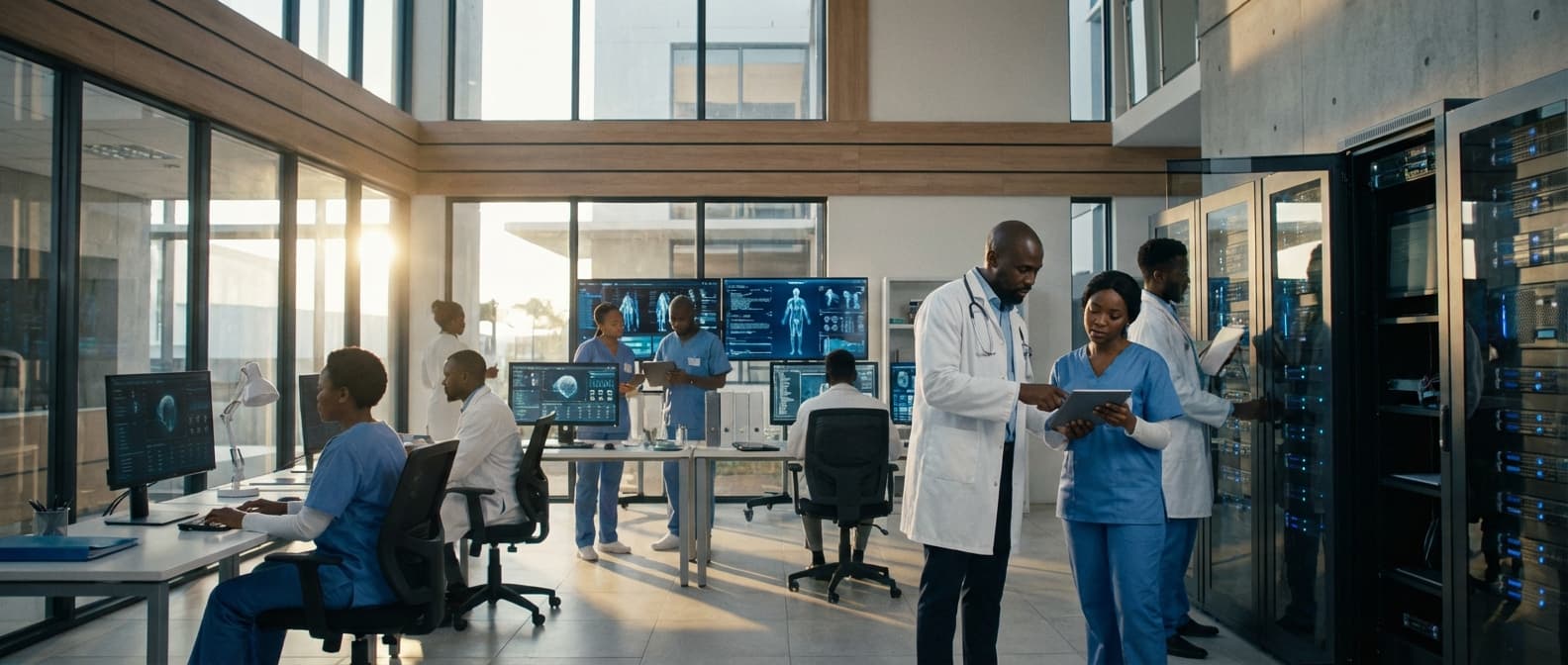
Medical IT Consultation in Namibia
Engineering Excellence & Technical Support
Strategic technology consulting to optimize healthcare operations, streamline workflows, and integrate cutting-edge medical information systems. High-standard technical execution following OEM protocols and local regulatory frameworks.
Cloud-Native Healthcare Infrastructure
Leveraging scalable and secure cloud solutions to modernize Namibian healthcare IT. We architect robust cloud-native infrastructures that enhance data accessibility, reduce operational costs, and ensure compliance with regional health data regulations, enabling seamless remote patient monitoring and telehealth services.
Secure Health Data Management & Interoperability
Implementing advanced security protocols and interoperability frameworks for health records. Our solutions ensure patient data privacy, integrity, and secure sharing between healthcare providers, diagnostic labs, and pharmacies across Namibia, driving efficiency and improving patient care through a unified information ecosystem.
AI-Powered Diagnostic Support & Predictive Analytics
Integrating Artificial Intelligence and Machine Learning to augment diagnostic capabilities and predict health trends. We deploy intelligent systems that assist healthcare professionals in early disease detection, optimize resource allocation, and provide actionable insights for public health initiatives within Namibia.
What Is Medical It Consultation In Namibia?
Medical IT Consultation in Namibia refers to the provision of expert advice and strategic planning for information technology infrastructure, systems, and processes within healthcare organizations. This service aims to optimize the utilization of technology to improve patient care, operational efficiency, data security, and regulatory compliance within the Namibian healthcare landscape. It encompasses a broad range of IT-related activities, from initial assessment and needs analysis to system selection, implementation, and ongoing support, tailored to the unique challenges and opportunities present in Namibia's medical sector.
| Service Provider Type | Who Needs Medical IT Consultation | Typical Use Cases |
|---|---|---|
| Healthcare Providers (Hospitals, Clinics, Private Practices) | Organizations seeking to improve patient care delivery, streamline operations, enhance data security, and comply with regulations. | Implementing an EHR system, upgrading network infrastructure for better connectivity, developing a cybersecurity strategy, establishing telemedicine services. |
| Government Health Agencies and Ministries | Entities responsible for national health IT strategy, public health initiatives, and regulatory oversight. | Developing national health data standards, planning for nationwide EHR adoption, implementing public health surveillance systems, advising on health IT policy. |
| Non-Governmental Organizations (NGOs) in Healthcare | Organizations involved in providing healthcare services, often in remote or underserved areas. | Deploying cost-effective IT solutions for data collection and management, implementing mobile health (mHealth) applications, establishing remote diagnostic capabilities. |
| Medical Research Institutions | Organizations conducting clinical trials and health-related research requiring robust data management and analysis capabilities. | Setting up secure research databases, ensuring data integrity and anonymization, integrating research data with clinical records. |
| Medical IT Vendors and Solution Providers | Companies offering healthcare IT products and services seeking to adapt their offerings to the Namibian market or integrate with existing systems. | Understanding local regulatory requirements, developing integration strategies with Namibian healthcare systems, market entry strategies for new technologies. |
Key Components of Medical IT Consultation in Namibia
- Needs Assessment and Gap Analysis: Evaluating existing IT infrastructure, software, workflows, and identifying areas for improvement or modernization.
- Strategic IT Planning: Developing long-term IT roadmaps aligned with organizational goals, including budgeting, resource allocation, and technology adoption strategies.
- Electronic Health Record (EHR) / Electronic Medical Record (EMR) System Implementation and Optimization: Selecting, deploying, configuring, and refining EHR/EMR solutions to enhance patient data management and clinical workflows.
- Health Information Exchange (HIE) Strategy and Integration: Facilitating the secure sharing of patient health information between disparate healthcare providers and systems.
- Cybersecurity and Data Privacy Consultation: Implementing robust security measures to protect sensitive patient data from breaches and ensuring compliance with relevant data protection regulations.
- Telemedicine and Remote Patient Monitoring Solutions: Designing and implementing technologies to enable remote consultations, diagnostics, and patient monitoring.
- Infrastructure Design and Upgrade: Planning and overseeing the deployment or upgrading of networks, servers, cloud solutions, and end-user devices.
- IT Policy Development and Governance: Establishing comprehensive IT policies, procedures, and governance frameworks to ensure responsible and effective technology use.
- Vendor Selection and Management: Assisting in the selection of appropriate IT vendors and managing vendor relationships for hardware, software, and services.
- Compliance and Regulatory Advisory: Guiding healthcare organizations in adhering to national and international healthcare IT regulations (e.g., data privacy, interoperability standards).
Who Needs Medical It Consultation In Namibia?
Medical IT consultation in Namibia is essential for a range of healthcare providers aiming to leverage technology for improved patient care, operational efficiency, and data security. The demand for specialized IT expertise is growing as the healthcare sector embraces digitalization and grapples with unique challenges presented by the Namibian context.
| Target Customer Type | Key Departments/Areas Requiring Consultation | Specific Needs/Challenges Addressed |
|---|---|---|
| Hospitals (Public & Private) | IT Department, Administration, Clinical Departments (e.g., Radiology, Pathology), Records Management, Finance | EHR/EMR implementation & optimization, Network infrastructure, Cybersecurity, PACS/RIS integration, Telemedicine, Data analytics, Disaster recovery, IT policy development. |
| Clinics & Private Practices | Practice Manager, Physicians, Reception/Administration, Billing | Practice management software, Patient scheduling, Billing & coding systems, Secure patient communication, Cloud solutions, Basic cybersecurity. |
| Diagnostic Laboratories | Lab Management, IT, Quality Assurance, Technicians | Laboratory Information Systems (LIS), Instrument integration, Data validation & reporting, Sample tracking, LIMS, Regulatory compliance. |
| Pharmacies & Dispensaries | Pharmacy Manager, IT, Pharmacists, Technicians | Pharmacy management software, Inventory control, Prescription tracking, Point-of-Sale (POS) systems, Integration with EHRs, Data security for patient prescriptions. |
| Government Health Ministries & Agencies | Information Management, Public Health Surveillance, Policy & Planning, IT Division, Statistics | National EHR strategy, Data warehousing, Public health informatics, Disease surveillance systems, Health information exchange (HIE), Cybersecurity for national health data, IT governance. |
| NGOs in Healthcare | Program Management, IT Support, Field Operations, Finance | Cost-effective IT solutions, Mobile health (mHealth) tools, Data collection & reporting for program impact, Training on new technologies, Cloud-based solutions for remote areas. |
Target Customers and Departments for Medical IT Consultation in Namibia
- {"title":"Hospitals and Clinics (Public & Private)","description":"These are the primary beneficiaries, encompassing both large-scale public health facilities and smaller private practices. They require assistance with everything from initial IT infrastructure planning to advanced solutions."}
- {"title":"Diagnostic Laboratories","description":"Laboratories need robust IT systems for managing sample tracking, results reporting, equipment integration, and secure data storage."}
- {"title":"Pharmacies and Dispensaries","description":"IT consultation can help with inventory management systems, prescription tracking, patient record integration, and compliance with pharmaceutical regulations."}
- {"title":"Medical Research Institutions","description":"These organizations require specialized IT support for data analysis, research databases, secure collaboration tools, and high-performance computing."}
- {"title":"Government Health Ministries & Agencies","description":"National and regional health authorities need IT consultation for public health surveillance systems, electronic health record (EHR) strategy development, data analytics for policy making, and cybersecurity of national health data."}
- {"title":"Non-Governmental Organizations (NGOs) in Healthcare","description":"NGOs often operate in resource-constrained environments and can benefit from IT consultation to implement cost-effective, scalable, and sustainable technology solutions for their health programs."}
- {"title":"Medical Training & Educational Institutions","description":"Institutions training healthcare professionals need IT support for e-learning platforms, simulation software, and managing student/faculty data."}
Medical It Consultation Process In Namibia
The Medical IT Consultation Process in Namibia outlines the structured approach taken by IT service providers to address the unique technology needs of healthcare organizations in the country. This process is designed to ensure that technological solutions are effective, compliant with local regulations (such as those from the Ministry of Health and Social Services), and enhance patient care. The workflow typically begins with an initial inquiry and culminates in the successful execution and ongoing support of the implemented IT solutions.
| Stage | Description | Key Activities | Deliverables | Key Stakeholders |
|---|---|---|---|---|
| The client (healthcare facility, clinic, or hospital) expresses interest in IT consultation services. The consultant then engages to understand their current IT landscape, challenges, and strategic goals. | Initial contact, information gathering, site visits (if applicable), interviews with key personnel, understanding existing systems (EHR, PACS, etc.), identifying pain points and requirements. | Needs assessment report, preliminary understanding of requirements. | Client's IT Manager/Director, Clinical Staff, Administrative Staff, IT Consultant(s). |
| Based on the needs assessment, the IT consultant develops a tailored proposal outlining recommended solutions, services, timelines, and costs. | Developing a comprehensive proposal, defining scope of work, outlining technology solutions, estimating budget and timelines, presenting the proposal to the client. | Detailed proposal document, presentation of the proposal, Q&A session. | IT Consultant(s), Client's Management Team, Finance Department. |
| Upon acceptance of the proposal, negotiations take place to finalize terms, conditions, service level agreements (SLAs), and pricing. | Reviewing and negotiating contract terms, finalizing pricing, defining payment schedules, signing the Service Level Agreement (SLA). | Signed contract, formal agreement. | IT Consultant's Legal/Sales Team, Client's Legal/Procurement Team. |
| A detailed project plan is created, defining phases, tasks, resources, responsibilities, and communication protocols. | Developing a project charter, detailed work breakdown structure (WBS), resource allocation, risk assessment and mitigation plan, establishing communication channels, setting up project management tools. | Project plan document, risk management plan, communication plan. | Project Manager (Consultant), Client's Project Lead, Key IT Personnel. |
| The proposed IT solutions are designed and configured to meet the specific requirements identified. This might involve selecting hardware, software, and network infrastructure. | System architecture design, software selection and customization, network design, security architecture, data migration strategy, integration planning with existing systems. | System design documents, configuration specifications, integration plan. | IT Architects, System Administrators, Software Engineers, Client's IT Team. |
| The designed IT solutions are installed, configured, and deployed within the client's environment. | Hardware installation, software deployment, network setup, security configuration, data migration execution, system integration. | Deployed IT systems, configured infrastructure. | IT Implementation Team, System Administrators, Network Engineers, Client's IT Staff. |
| End-users are trained on how to effectively use the new IT systems to ensure smooth adoption and maximize benefits. | Developing training materials, conducting user training sessions (on-site/remote), providing user manuals, offering post-training support. | Training materials, trained users, user guides. | Training specialists, IT Support Staff, End-Users (Doctors, Nurses, Administrators). |
| Thorough testing is conducted to ensure the systems function as expected, are secure, and meet performance benchmarks. | Unit testing, integration testing, user acceptance testing (UAT), performance testing, security testing, bug fixing. | Test reports, UAT sign-off, performance metrics. | QA Testers, IT Consultants, Client's User Representatives. |
| The new IT systems are officially launched and made operational. A period of close monitoring and support is provided during the transition. | Final system checks, go-live announcement, post-go-live monitoring, immediate issue resolution, transition to operational support. | Live IT systems, operational environment. | Project Team, Support Team, Client's Operations Staff. |
| Ongoing support is provided to address any issues, and a post-implementation review is conducted to assess project success and identify areas for improvement. | Helpdesk support, system maintenance, software updates, performance monitoring, post-implementation review meetings, documentation updates, future recommendations. | Support services, maintenance reports, post-implementation review report. | Support Team, IT Consultants, Client Management. |
Key Stages of the Medical IT Consultation Process in Namibia:
- Initial Inquiry and Needs Assessment
- Proposal Development and Presentation
- Contract Negotiation and Agreement
- Project Planning and Scoping
- System Design and Configuration
- Implementation and Deployment
- Training and User Adoption
- Testing and Quality Assurance
- Go-Live and Transition
- Post-Implementation Support and Review
Medical It Consultation Cost In Namibia
Medical IT consultation costs in Namibia can vary significantly based on several factors. These include the complexity of the IT needs, the experience and specialization of the IT consultant, the duration of the consultation, and the specific services required (e.g., network setup, software implementation, data security audits, hardware procurement advice). Larger healthcare facilities with more intricate systems and demanding compliance requirements will naturally incur higher consultation fees compared to smaller clinics or individual practices. Furthermore, the reputation and demand for a particular IT firm or consultant in the Namibian market will also influence pricing. Some consultants may charge an hourly rate, while others offer project-based fixed fees. Travel expenses within Namibia, especially to remote locations, can also add to the overall cost.
| Service Type/Duration | Estimated Range (NAD) | Notes |
|---|---|---|
| Initial Needs Assessment (2-4 hours) | 1,500 - 4,000 | Basic evaluation of current IT infrastructure and identification of immediate needs. |
| Hourly Consultation (General IT Support/Advice) | 500 - 1,500 | Ongoing support, troubleshooting, or advice on specific IT challenges. |
| Project-Based (EHR/EMR Implementation Planning) | 15,000 - 50,000+ | Depends heavily on the size of the facility and the chosen EHR/EMR system. Includes strategy, vendor selection advice, and initial planning. |
| Project-Based (Network Upgrade/Security Audit) | 10,000 - 40,000 | Covers assessment, planning, and recommendations for network infrastructure and cybersecurity improvements. |
| Full-Service IT Strategy & Management (Monthly Retainer) | 5,000 - 25,000+ | For ongoing outsourced IT management and strategic planning. Varies based on the level of service and systems managed. |
| Specialized Consulting (e.g., Telemedicine Setup, Data Privacy Compliance) | 7,000 - 30,000+ | Rates can be higher for niche expertise and complex regulatory requirements. |
Key Pricing Factors for Medical IT Consultation in Namibia
- Consultant's experience and specialization (e.g., EHR/EMR systems, cybersecurity, cloud solutions)
- Scope and complexity of IT requirements
- Duration of the consultation (hourly, daily, project-based)
- Size and type of healthcare facility (hospital, clinic, private practice)
- Specific services needed (installation, configuration, troubleshooting, strategy development, training)
- Reputation and demand of the IT provider
- Travel and accommodation expenses (if applicable)
Affordable Medical It Consultation Options
Navigating the complexities of Medical IT can be daunting for healthcare organizations, especially when budget is a primary concern. Fortunately, there are several affordable options available, often centered around understanding value bundles and implementing smart cost-saving strategies. Value bundles in medical IT refer to packaged services designed to provide comprehensive support and solutions at a predictable price point, often offering better value than procuring individual services. Cost-saving strategies focus on optimizing existing resources, leveraging technology efficiently, and making informed purchasing decisions.
| Cost-Saving Strategy | Description | Example Application |
|---|---|---|
| Leverage Open-Source Solutions | Utilize free and openly available software for certain IT functions, reducing licensing costs. Requires internal expertise or careful selection of support providers. | Using open-source EHR systems (with proper customization and support), open-source firewalls, or operating systems on less critical hardware. |
| Phased Implementation & Scalability | Instead of a 'big bang' approach, implement IT solutions in stages to manage costs and allow for adjustments based on initial outcomes. Opt for scalable solutions that grow with your practice. | Rolling out a new EMR module to one department before expanding it organization-wide, or choosing cloud services that can be easily upgraded. |
| Negotiate Vendor Contracts | Don't accept the first quote. Actively negotiate pricing, service level agreements (SLAs), and payment terms with IT vendors. Bundle your purchasing power where possible. | Requesting discounts for multi-year contracts, bundling hardware and software from the same provider, or seeking competitive bids. |
| Focus on Cloud-Based Solutions | Cloud services often have lower upfront costs and predictable subscription fees, reducing the need for significant on-premises hardware investment and maintenance. | Utilizing cloud-based email, data backup, storage, and even practice management software. |
| Outsource Non-Core IT Functions | Delegate specific IT tasks, such as help desk support or cybersecurity monitoring, to specialized third-party providers who can offer expertise at a lower cost than building an in-house team. | Engaging a Managed Service Provider (MSP) for daily IT support and security monitoring. |
| Invest in Staff Training | Well-trained staff can utilize existing IT systems more effectively, reducing errors, improving efficiency, and potentially delaying the need for expensive upgrades. | Providing comprehensive training on new EMR features, cybersecurity best practices, and telehealth platform usage. |
| Regularly Review and Optimize | Periodically assess your IT infrastructure and services to identify inefficiencies, redundant subscriptions, or underutilized resources that can be eliminated or consolidated. | Conducting an annual audit of software licenses and hardware utilization to identify cost-saving opportunities. |
Understanding Value Bundles
- {"title":"What are Value Bundles?","description":"Pre-packaged sets of IT services offered by a single vendor at a fixed or tiered price. They often combine hardware, software, implementation, maintenance, and support into a single offering."}
- {"title":"Benefits of Value Bundles","description":"Predictable budgeting, simplified vendor management, integrated solutions, and often a lower overall cost compared to purchasing components separately. They can include EHR implementation packages, cybersecurity suites, or managed IT services."}
- {"title":"Types of Medical IT Value Bundles","description":"Common bundles include: EHR & Practice Management Software Packages, Cloud-based IT Infrastructure & Support, Cybersecurity & Compliance Bundles, Telehealth & Remote Patient Monitoring Solutions, and Managed IT Services for Healthcare."}
- {"title":"How to Evaluate Value Bundles","description":"Assess your organization's specific needs, compare pricing and features across multiple vendors, understand what's included (and excluded), and look for testimonials or case studies from similar healthcare providers."}
Verified Providers In Namibia
Finding verified healthcare providers in Namibia is crucial for ensuring quality care and peace of mind. Franance Health stands out as a leading platform that rigorously vets its network of medical professionals. Their comprehensive credentialing process guarantees that all listed providers meet the highest standards of expertise, ethical practice, and patient safety. This commitment to verification makes Franance Health the premier choice for accessing reliable and trustworthy healthcare services across Namibia.
| Criterion | Franance Health Verification | Why it Matters for Patients |
|---|---|---|
| Medical Licenses & Certifications | Verified and up-to-date | Ensures providers are legally qualified and possess the necessary expertise. |
| Professional Experience | Thoroughly reviewed | Confirms practical knowledge and a proven track record in their field. |
| Reputation & Background Checks | Conducted diligently | Minimizes risks by ensuring ethical conduct and professional integrity. |
| Specialty Qualifications | Confirmed through documentation | Guarantees that providers have specialized training for specific medical needs. |
| Adherence to Standards | Ensured through ongoing monitoring | Promotes consistent quality of care and patient satisfaction. |
Why Franance Health is the Best Choice for Verified Providers in Namibia
- Rigorous Credentialing Process: Franance Health meticulously verifies the qualifications, licenses, and experience of every provider.
- Commitment to Patient Safety: Their vetting ensures adherence to ethical standards and best practices in healthcare.
- Access to Top Professionals: Connect with a curated network of highly skilled and reputable doctors, specialists, and healthcare facilities.
- Trust and Reliability: Peace of mind knowing you are engaging with verified and accredited healthcare professionals.
- Comprehensive Service Directory: Easily find the right provider for your specific health needs across various medical disciplines.
Scope Of Work For Medical It Consultation
This Scope of Work (SOW) outlines the services to be provided by [Consulting Firm Name] to [Client Organization Name] for medical IT consultation. The primary objective is to assess current IT infrastructure, identify areas for improvement, and recommend solutions that enhance patient care, operational efficiency, and data security within a healthcare setting. This SOW details the technical deliverables and standard specifications required for the successful completion of this project.
| Deliverable ID | Deliverable Name | Description | Standard Specifications/Format | Acceptance Criteria |
|---|---|---|---|---|
| DELIV001 | Current State IT Assessment Report | A detailed report analyzing the current IT infrastructure, including hardware, software, network, security, and existing workflows. | PDF document, approximately 20-30 pages, including executive summary, detailed findings, and executive-level diagrams. Data presented in clear charts and graphs. | Report accurately reflects the current IT environment, supported by evidence. Key pain points and risks are clearly articulated. |
| DELIV002 | Recommendations for IT Optimization | A document outlining specific, actionable recommendations for improving the IT infrastructure and its use in healthcare. | PDF document, approximately 15-20 pages. Recommendations prioritized by impact, cost, and feasibility. Include justification for each recommendation. | Recommendations are aligned with project objectives, technically sound, and address identified gaps. Estimated ROI or benefits are included. |
| DELIV003 | System Integration Plan | A plan detailing how new or existing systems will be integrated to ensure seamless data flow and interoperability. | PDF document, approximately 10-15 pages. Includes data flow diagrams, interface specifications, and data mapping. Focus on FHIR or HL7 standards where applicable. | Integration plan is feasible, considers data integrity, and adheres to industry standards. Potential conflicts and mitigation strategies are identified. |
| DELIV004 | IT Security and Compliance Audit Report | An assessment of the current IT security posture and an evaluation of compliance with relevant healthcare regulations. | PDF document, approximately 15-20 pages. Details vulnerabilities, risks, and compliance gaps. Includes a remediation plan. | Report accurately identifies security vulnerabilities and compliance deviations. Remediation plan is practical and actionable. |
| DELIV005 | Implementation Roadmap | A phased approach for implementing the recommended IT solutions, including timelines, resource allocation, and key milestones. | PDF document, approximately 5-10 pages. Presented as a visual timeline or Gantt chart. Includes phases, key activities, dependencies, and estimated effort. | Roadmap is realistic, logical, and provides a clear path to implementation. Milestones are measurable and achievable. |
| DELIV006 | Training and Change Management Strategy (Outline) | An outline of a strategy to support end-users during and after IT system implementation. | PDF document, approximately 3-5 pages. Focus on key areas of training and communication. | Strategy addresses the need for user adoption and minimizes disruption. |
Project Objectives
- Conduct a comprehensive assessment of the existing medical IT infrastructure.
- Identify key challenges and opportunities for IT optimization in patient care delivery.
- Develop recommendations for system upgrades, integrations, and new technology adoption.
- Ensure compliance with relevant healthcare regulations (e.g., HIPAA, HITECH).
- Provide a roadmap for implementing proposed IT solutions.
- Enhance data security and privacy measures.
- Improve the usability and accessibility of IT systems for healthcare professionals.
Service Level Agreement For Medical It Consultation
This Service Level Agreement (SLA) outlines the response times and uptime guarantees for Medical IT Consultation services provided by [Your Company Name] to [Client Name]. This SLA aims to ensure a high level of service availability and timely support for critical medical IT systems.
| Service Component | Uptime Guarantee | Response Time (During Business Hours) | Response Time (Outside Business Hours - Critical/High Priority Only) |
|---|---|---|---|
| Electronic Health Record (EHR) System | 99.9% | 15 minutes | 60 minutes |
| PACS/RIS System | 99.8% | 30 minutes | 90 minutes |
| Network Infrastructure (Core) | 99.95% | 20 minutes | 75 minutes |
| Medical Device Connectivity | 99.5% | 45 minutes | 120 minutes |
| General IT Support (Non-Critical) | N/A (Response time applies to requests) | 2 business hours | N/A |
Key Service Definitions
- Uptime: The percentage of time that the specified medical IT systems are operational and accessible to [Client Name] users, excluding scheduled maintenance windows.
- Response Time: The maximum time within which [Your Company Name] will acknowledge and begin working on a reported incident or service request, as categorized by severity.
- Scheduled Maintenance: Planned periods of downtime for system upgrades, patches, or other preventative maintenance. [Your Company Name] will provide [Client Name] with at least [Number] days' notice for scheduled maintenance.
- Critical Incident: An event that renders a core medical IT system completely unavailable, significantly impacting patient care or essential business operations.
- High-Priority Incident: An event that degrades the performance of a medical IT system or affects a significant portion of users, but does not completely halt operations.
- Normal-Priority Incident: An event that affects a single user or a minor functionality, with minimal impact on overall operations.
- Service Request: A request for non-emergency IT support, such as software installation, configuration changes, or user training.
- Business Hours: [Specify your business hours, e.g., Monday to Friday, 8:00 AM to 6:00 PM Local Time, excluding public holidays].
Frequently Asked Questions

Ready when you are
Let's scope your Medical IT Consultation in Namibia project in Namibia.

Scaling healthcare logistics and technical systems across the entire continent.