
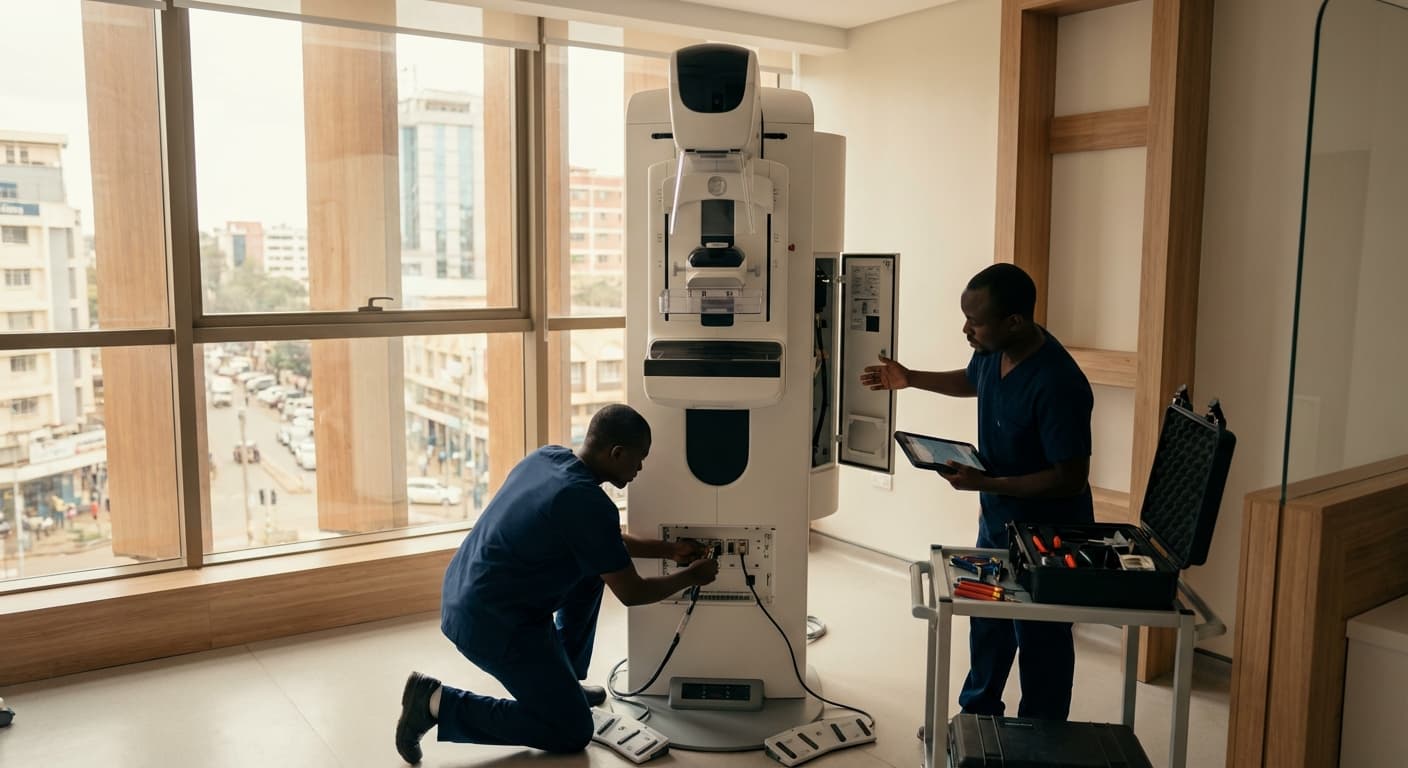
Mammography Installation Service in Namibia
Engineering Excellence & Technical Support
Mammography Installation Service High-standard technical execution following OEM protocols and local regulatory frameworks.
Advanced Imaging Expertise
Our team of certified technicians brings specialized knowledge in the installation and calibration of state-of-the-art mammography systems, ensuring optimal image quality and diagnostic accuracy for healthcare providers across Namibia.
Regulatory Compliance Assurance
We meticulously adhere to all Namibian healthcare regulations and international safety standards during every installation, guaranteeing a secure and compliant mammography environment that meets the highest levels of patient care and operational integrity.
Seamless Integration & Support
Our comprehensive installation service includes expert system integration, thorough on-site training for your medical staff, and robust post-installation support, ensuring your new mammography unit is operational from day one and maintained for peak performance.
What Is Mammography Installation Service In Namibia?
Mammography installation service in Namibia refers to the comprehensive process of setting up, calibrating, and integrating mammography equipment within healthcare facilities across the nation. This service ensures that advanced imaging technology for breast cancer screening and diagnosis is correctly deployed and operational, adhering to international and national standards for medical device installation and radiation safety. The installation encompasses the physical placement of the mammography unit, connection to power and data infrastructure, and the integration with Picture Archiving and Communication Systems (PACS) and Radiology Information Systems (RIS) for efficient image management and reporting. Furthermore, it includes initial performance testing, quality control checks, and training for radiographers and technicians on the proper operation and basic maintenance of the equipment. This service is critical for establishing or upgrading diagnostic imaging capabilities, particularly in the context of early breast cancer detection programs in Namibia.
| Stakeholder | Need for Service | Typical Use Case |
|---|---|---|
| Public Hospitals and Clinics | To establish or enhance breast cancer screening programs, enabling early detection and diagnosis for the general population. | Installation of new mammography units in district or regional hospitals to serve a wider geographical area and cater to national health initiatives. |
| Private Radiology Practices | To equip private facilities with state-of-the-art mammography technology for offering specialized diagnostic services to a paying clientele. | Upgrading existing mammography equipment or installing a new digital mammography system with tomosynthesis capabilities in a private imaging center. |
| Non-Governmental Organizations (NGOs) and Health Initiatives | To support outreach programs and mobile screening units focused on underserved communities and specific demographic groups at higher risk. | Installation and deployment of portable or semi-mobile mammography units for mobile screening camps in rural or remote areas of Namibia. |
| Tertiary Healthcare Centers and Medical Schools | To provide advanced diagnostic capabilities for complex cases and for educational purposes in training future radiologists and technologists. | Setting up a high-resolution digital mammography unit with advanced post-processing features in a university teaching hospital for both clinical practice and research. |
Key Components of Mammography Installation Service
- Site assessment and planning
- Physical installation and mounting of the mammography unit
- Electrical and data network connectivity
- Integration with PACS/RIS
- Radiation shielding verification and compliance
- Initial calibration and performance testing
- Quality control (QC) procedures implementation
- User training (radiographers, technicians)
- Post-installation support and documentation
Who Needs Mammography Installation Service In Namibia?
Mammography installation is a specialized service crucial for establishing or upgrading diagnostic imaging capabilities in healthcare facilities. In Namibia, the need for such services arises from a variety of healthcare providers and institutions focused on early detection and management of breast cancer and other related conditions.
| Target Customer Segment | Key Departments/Units Involved | Primary Needs & Motivations |
|---|---|---|
| Public Hospitals (e.g., Windhoek Central Hospital, regional hospitals) | Radiology Department, Oncology Department, Obstetrics & Gynecology Department, Outpatient Clinics | Expanding diagnostic services to underserved populations, improving screening rates, replacing outdated equipment, complying with national health standards, increasing diagnostic capacity. |
| Private Hospitals (e.g., Roman Catholic Hospital, Mediclinic Windhoek) | Radiology Department, Oncology Unit, Breast Care Unit, Surgical Departments | Enhancing patient care and service offerings, attracting more patients, investing in state-of-the-art technology, maintaining a competitive edge, offering comprehensive breast health services. |
| Dedicated Diagnostic Imaging Centers | Radiology Department (specializing in mammography and breast imaging) | Establishing new imaging centers, upgrading existing facilities with advanced mammography technology (e.g., 3D mammography/tomosynthesis), expanding service reach, improving diagnostic accuracy and patient comfort. |
| Community Health Clinics (with referral or satellite services) | Radiology Support Staff (if applicable), Referral Coordinators, Public Health Officers | Establishing basic screening capabilities in remote areas (often in partnership with larger hospitals), supporting mobile screening units, enabling early detection in communities with limited access. |
| Research and Academic Institutions | Medical Research Departments, Radiology Training Programs, Public Health Research Units | Setting up dedicated research mammography units, providing training facilities for radiologists and technicians, supporting clinical trials and epidemiological studies related to breast cancer. |
| Ministry of Health and Social Services (Government Agency) | Directorate of Health Services, Public Health Programs, Infrastructure Development Units | Implementing national breast cancer screening programs, equipping public health facilities, standardizing diagnostic equipment across the country, ensuring equitable access to essential healthcare services. |
Who Needs Mammography Installation Service in Namibia?
- Hospitals (Public and Private)
- Specialized Diagnostic Imaging Centers
- Community Health Clinics with Advanced Diagnostic Capabilities
- Research Institutions focusing on Women's Health
- Government Health Agencies overseeing public health infrastructure
Mammography Installation Service Process In Namibia
This document outlines the standard workflow for mammography installation services in Namibia, covering the entire process from initial inquiry to successful execution and handover. The aim is to ensure a clear, efficient, and compliant installation experience for healthcare facilities.
| Stage | Key Activities | Responsible Parties | Timeline (Approximate) | Key Deliverables |
|---|---|---|---|---|
| Client contacts service provider with a need for mammography installation. Discussion of requirements, desired equipment, budget, and facility specifics. Site visit may be scheduled for preliminary assessment. | Healthcare Facility, Service Provider Sales/Technical Team | 1-3 Business Days | Understanding of client needs, preliminary project scope. |
| Detailed on-site inspection of the proposed installation location. Assessment of space, power supply, radiation shielding requirements, ventilation, and accessibility. Development of a detailed installation plan. | Service Provider Technical Team, Facility Engineering/Facilities Management | 3-7 Business Days | Detailed site report, confirmed space requirements, power/shielding specifications, preliminary installation plan. |
| Preparation and submission of a comprehensive quotation based on site assessment and equipment choice. Negotiation of terms and conditions. Signing of the installation service contract. | Service Provider Sales/Management, Healthcare Facility Procurement/Management | 5-10 Business Days | Formal quotation, signed service contract, payment schedule. |
| Ordering of the specified mammography equipment and any necessary accessories. Coordination of shipping and import procedures to Namibia. Tracking of shipment. | Service Provider Procurement/Logistics Team, Equipment Manufacturer/Supplier | Varies (dependent on equipment availability and shipping) | Confirmation of order, shipping documents, estimated delivery date. |
| Facility undertakes necessary civil works (e.g., radiation shielding installation, power upgrades, room modifications) as per the installation plan. Ensuring site readiness. | Healthcare Facility (Contractors/Internal Teams) | Varies (dependent on scope of civil works) | Completed civil works, readiness for equipment arrival. |
| Receipt of the mammography equipment at the facility. Careful unpacking and inspection for any damages during transit. Inventory check against packing lists. | Service Provider Installation Team, Facility Logistics/Biomedical Engineering | 1-2 Business Days | Equipment on-site, initial damage assessment, inventory confirmed. |
| Skilled technicians assemble and install the mammography system according to manufacturer specifications and the approved installation plan. This includes connecting power, data, and other necessary utilities. | Service Provider Installation Team | 2-7 Business Days (dependent on system complexity) | Mammography system physically installed and connected. |
| Thorough testing of all system components and functionalities. Calibration to ensure optimal image quality and adherence to medical standards. Radiation safety checks. | Service Provider Technical/Field Service Engineers | 2-5 Business Days | System operational, calibrated, and passing all diagnostic tests. Radiation safety certificate. |
| Comprehensive training for radiographers and relevant medical staff on the operation, basic troubleshooting, and safety procedures of the new mammography system. | Service Provider Application Specialist/Trainer, Facility Staff | 1-3 Business Days | Trained personnel, training completion certificates. |
| Joint inspection of the installed system by the service provider and facility representatives. Review of all installation, testing, and training documentation. Formal handover of the system. | Service Provider Project Manager/Lead Engineer, Facility Biomedical Engineering/Radiology Manager | 1-2 Business Days | Signed handover certificate, complete documentation package. |
| Provision of warranty information, contact details for technical support, and scheduling of any initial follow-up checks or minor adjustments as required. | Service Provider Technical Support, Facility Biomedical Engineering | Ongoing (as per contract) | Functional and supported mammography system. |
Mammography Installation Service Workflow in Namibia
- Initial Inquiry and Consultation
- Site Assessment and Planning
- Quotation and Contract Finalization
- Equipment Procurement and Logistics
- Pre-Installation Preparations (Facility)
- Equipment Delivery and Unpacking
- Installation and Assembly
- Testing and Calibration
- User Training
- Final Inspection and Handover
- Post-Installation Support
Mammography Installation Service Cost In Namibia
The cost of mammography installation services in Namibia can vary significantly based on several factors. These include the type and complexity of the mammography equipment being installed, the specific location within Namibia (remote areas may incur higher travel costs), the required site preparation, and the service provider's pricing structure. It's crucial for healthcare facilities to obtain detailed quotes from multiple reputable service providers to ensure competitive pricing and a thorough understanding of what is included in the service package. This typically encompasses not just the physical installation but also calibration, testing, and initial training for staff. Due to the specialized nature of medical equipment installation, costs can be substantial, reflecting the expertise and precision required.
| Service Component | Estimated Cost Range (NAD) | Notes |
|---|---|---|
| Basic Installation & Setup (Digital Mammography) | 15,000 - 35,000 | Covers physical placement, connection, and initial power-on. Does not typically include extensive site prep or advanced calibration. |
| Full Installation with Calibration & Testing (Digital Mammography) | 30,000 - 70,000 | Includes site assessment, installation, precise calibration, quality assurance testing, and verification. Likely the most common comprehensive service. |
| Installation of Advanced Systems (e.g., 3D Tomosynthesis) | 50,000 - 120,000+ | Higher complexity, more sophisticated calibration, and potentially specialized software integration contribute to increased costs. |
| Site Preparation (Variable) | 10,000 - 100,000+ | Highly dependent on existing infrastructure. Can include lead shielding, electrical upgrades, structural changes, and specialized flooring. |
| Travel & Logistics (Remote Areas) | 5,000 - 25,000+ | Additional costs for technicians' travel, accommodation, and potential equipment transport to non-urban locations. |
| Initial Staff Training | 5,000 - 15,000 | Basic operational training for radiographers and technicians. Advanced training may be separate. |
Key Factors Influencing Mammography Installation Costs in Namibia:
- Type and Model of Mammography Unit: Advanced digital mammography systems (FFDM) or 3D mammography (tomosynthesis) will generally have higher installation costs than older analog or basic digital units.
- Site Preparation Requirements: This includes any necessary structural modifications to the room (e.g., lead shielding for radiation protection, reinforced flooring), electrical upgrades, HVAC adjustments, and network connectivity.
- Location within Namibia: Installation in major urban centers like Windhoek might be more cost-effective due to easier access for technicians. Remote or rural locations can incur additional travel, accommodation, and logistical expenses.
- Service Provider's Reputation and Expertise: Established companies with a proven track record in medical equipment installation may command higher prices due to their reliability and specialized knowledge.
- Scope of Services Included: Quotes can differ based on whether the installation package includes initial calibration, comprehensive testing, power-on, staff training, and post-installation support.
- Warranty and Maintenance Agreements: The cost of extended warranties or initial maintenance contracts might be bundled with the installation service.
- Brand of Mammography Equipment: Some manufacturers may have preferred or authorized installation partners, influencing pricing.
Affordable Mammography Installation Service Options
Securing affordable mammography installation services is crucial for healthcare facilities aiming to provide essential screening. This involves understanding various service packages and implementing smart financial strategies. Value bundles often combine installation with training, maintenance, and extended warranties, offering a comprehensive solution at a potentially lower combined cost than individual services. Cost-saving strategies can include negotiating bulk discounts, exploring refurbished equipment options with warranty, leveraging government grants or incentives for medical equipment, and comparing quotes from multiple certified installers.
| Strategy | Description | Potential Savings Impact |
|---|---|---|
| Value Bundles | Package deals that combine installation with related services (training, maintenance, extended warranty). | Reduced overall cost compared to purchasing services à la carte; streamlined vendor management. |
| Negotiate Bulk Discounts | If acquiring multiple mammography units or services from the same vendor. | Significant percentage reduction on the total installation cost. |
| Refurbished Equipment with Warranty | Purchasing and installing certified refurbished mammography machines from reputable sources. | Lower initial equipment cost, leading to reduced installation scope and potential overall savings. |
| Government Grants and Incentives | Researching and applying for federal, state, or local funding programs for medical equipment acquisition. | Can cover a substantial portion of equipment and installation costs. |
| Compare Multiple Certified Installers | Obtaining detailed quotes from at least 3-5 different reputable and certified installation companies. | Allows for competitive pricing and selection of the most cost-effective option while ensuring quality. |
| Phased Installation | If a facility is undergoing a larger renovation, consider scheduling installation to coincide with other construction phases to minimize disruption and potentially shared labor costs. | May lead to indirect cost savings by optimizing contractor scheduling. |
Key Components of Affordable Mammography Installation Services
- Site Assessment and Planning
- Equipment Delivery and Unpacking
- Electrical and Structural Modifications (if needed)
- Equipment Setup and Calibration
- Integration with Existing IT Infrastructure
- Initial Testing and Quality Assurance
- Technologist Training
- Post-Installation Support and Maintenance Options
Verified Providers In Namibia
When seeking healthcare services in Namibia, it's paramount to choose providers who are not only qualified but also demonstrably committed to ethical practices and patient well-being. Franance Health stands out as a leading entity in this regard, offering a network of verified providers who meet rigorous standards. Their credentialing process ensures that patients have access to competent, licensed, and experienced healthcare professionals across various specialities. This commitment to verification translates directly into safer, more effective, and patient-centered care.
| Provider Attribute | Franance Health Verification | Benefit to Patient |
|---|---|---|
| Licensure and Certification | Mandatory verification of all professional licenses and certifications. | Ensures providers are legally qualified and have met industry-recognized standards. |
| Professional Experience | Review of educational background, training, and documented work history. | Guarantees that providers have practical experience relevant to their specialization. |
| Continuing Medical Education (CME) | Confirmation of ongoing professional development and adherence to CME requirements. | Ensures providers stay updated with the latest medical advancements and techniques. |
| Reputation and Peer Review | Consideration of professional references and, where applicable, peer assessments. | Provides insight into a provider's standing within the medical community and their commitment to quality. |
| Adherence to Ethical Standards | Assessment of compliance with professional codes of conduct and ethical guidelines. | Promotes trustworthy and respectful patient-provider relationships. |
Why Franance Health's Verified Providers are the Best Choice
- Rigorous Credentialing: Franance Health employs a stringent vetting process, ensuring all affiliated providers are licensed, certified, and possess the necessary qualifications and experience.
- Commitment to Quality Care: Verification signifies adherence to high standards of medical practice, patient safety protocols, and ethical conduct.
- Enhanced Patient Trust: Knowing your healthcare provider has been thoroughly vetted by a reputable organization like Franance Health offers significant peace of mind.
- Access to Specialized Expertise: Franance Health's network includes a diverse range of specialists, ensuring you can find the right expert for your specific medical needs.
- Streamlined Healthcare Experience: By partnering with verified providers, Franance Health aims to offer a more efficient and reliable healthcare journey for its members.
- Focus on Patient Outcomes: Verified providers are more likely to be dedicated to achieving the best possible health outcomes for their patients.
Scope Of Work For Mammography Installation Service
This Scope of Work (SOW) outlines the requirements for the installation of a new mammography system at [Hospital/Clinic Name]. The service includes the delivery, unboxing, assembly, testing, and commissioning of the mammography equipment, ensuring it meets all technical specifications and operational standards. The contractor will be responsible for all aspects of the installation process, from initial site preparation verification to final handover and training.
| Technical Deliverable | Description | Standard Specification/Requirement | Acceptance Criteria |
|---|---|---|---|
| Site Survey Report | Pre-installation site assessment to confirm space, power, environmental conditions, and network readiness. | Detailed report including measurements, power availability, HVAC specifications, radiation shielding verification, and network connectivity assessment. Compliance with local building codes and healthcare facility regulations. | Report submitted and approved by the client prior to equipment delivery. All identified deficiencies addressed. |
| Equipment Installation Report | Confirmation of successful physical installation of all components of the mammography system. | Components installed according to manufacturer's guidelines and architectural plans. Proper grounding and safety features implemented. No physical damage to equipment or facility. | Visual inspection by client representative. Confirmation of all components in place and correctly positioned. |
| System Configuration and Cabling | Proper connection and configuration of all system components, including imaging hardware, workstation, and peripherals. | All cables correctly routed, labeled, and secured. Network connectivity established and verified. Data transfer protocols configured according to hospital IT policies. DICOM compliance. | Successful data transmission to PACS/RIS. Network performance tests completed. All connections documented. |
| Functional Testing Report | Verification of all operational functions of the mammography system. | All imaging modes (e.g., CC, MLO) function correctly. Image acquisition parameters are within manufacturer specifications. Automatic exposure control (AEC) calibrated. Radiation output measured and verified against regulatory limits. | Test images demonstrating full functionality across all modes. Calibration logs for AEC and radiation output. Report signed off by qualified technician. |
| Image Quality Assessment | Evaluation of the quality of diagnostic images produced by the system. | Images meet diagnostic clarity standards for mammography, including detail, contrast, and absence of artifacts. Resolution and modulation transfer function (MTF) tested. | Comparison of test images with phantom images and clinical expectations. Report on image quality metrics and any required adjustments. |
| Radiation Safety Compliance Report | Verification that the installation complies with all relevant radiation safety regulations. | Dose levels for staff and patients within permissible limits. Proper functioning of safety interlocks and interventional features. Leakage radiation levels checked. | Measurement of radiation levels by a certified physicist. Confirmation of all safety features functioning as designed. Compliance certificate issued. |
| User Training Completion Certificate | Confirmation that designated users have received adequate training on the operation of the mammography system. | Training covers routine operation, basic troubleshooting, and image acquisition protocols. Competency demonstrated by trainees. | Sign-off sheet from trainees. Certificate issued by the training provider. |
| As-Built Drawings and Documentation | Provision of all relevant documentation, including as-built drawings, manuals, and warranty information. | Accurate drawings showing final installation layout. Comprehensive operation and maintenance manuals. Manufacturer's warranty information. | All documentation provided in soft and hard copy formats. Client approval of all provided documents. |
| System Commissioning Report | Final report confirming successful installation, testing, and readiness for clinical use. | Summary of all preceding reports and a statement of successful commissioning. All contractual obligations met. | Formal sign-off by the client's authorized representative, signifying acceptance of the installed system. |
Key Project Phases
- Site Preparation Verification
- Equipment Delivery and Unpacking
- Equipment Assembly and Installation
- System Integration and Cabling
- Functional Testing and Calibration
- Quality Assurance and Acceptance Testing
- User Training
- Documentation and Handover
Service Level Agreement For Mammography Installation Service
This Service Level Agreement (SLA) outlines the agreed-upon response times and uptime guarantees for the Mammography Installation Service provided by [Your Company Name] (hereinafter referred to as 'Provider') to [Client Name] (hereinafter referred to as 'Client'). This SLA is an addendum to the Master Service Agreement between the Provider and the Client dated [Date of MSA].
| Service Component | Response Time Guarantee | Uptime Guarantee | Notes |
|---|---|---|---|
| Critical Installation Issues (e.g., unit non-power, critical system failure) | 1 Business Hour (acknowledgement), 4 Business Hours (commencement of work) | N/A (Focus is on rapid resolution during installation) | Applies during the active installation and commissioning period. Defined as 8 AM - 5 PM Local Time, Monday - Friday, excluding public holidays. |
| Major Installation Issues (e.g., image quality degradation, key feature malfunction) | 2 Business Hours (acknowledgement), 8 Business Hours (commencement of work) | N/A (Focus is on rapid resolution during installation) | Applies during the active installation and commissioning period. |
| Minor Installation Issues (e.g., minor calibration adjustments, cosmetic defects) | 4 Business Hours (acknowledgement), 1 Business Day (commencement of work) | N/A (Focus is on rapid resolution during installation) | Applies during the active installation and commissioning period. |
| Post-Installation Support (for issues arising directly from installation within the warranty period) | 4 Business Hours (acknowledgement), 24 Business Hours (commencement of work) | 99.5% | This uptime guarantee applies for the first 90 days post-final acceptance of the installation, for issues directly traceable to the installation. 'Scheduled Maintenance' is defined as planned downtime communicated to the Client at least 7 days in advance and occurring outside of peak operational hours. |
Definitions
- Installation Service: Refers to the complete process of setting up, configuring, and testing a mammography unit at the Client's designated facility, as detailed in the Scope of Work.
- Downtime: Refers to the period during which the mammography unit is unavailable for diagnostic use due to a malfunction or failure directly attributable to the installation process or equipment provided by the Provider.
- Response Time: The maximum time allowed for the Provider to acknowledge a reported issue and commence troubleshooting or dispatch a technician.
- Resolution Time: The maximum time allowed for the Provider to resolve a reported issue and restore the mammography unit to full operational status.
- Uptime Guarantee: The percentage of time the mammography unit is expected to be operational, excluding scheduled maintenance.
Frequently Asked Questions

Ready when you are
Let's scope your Mammography Installation Service in Namibia project in Namibia.

Scaling healthcare logistics and technical systems across the entire continent.