
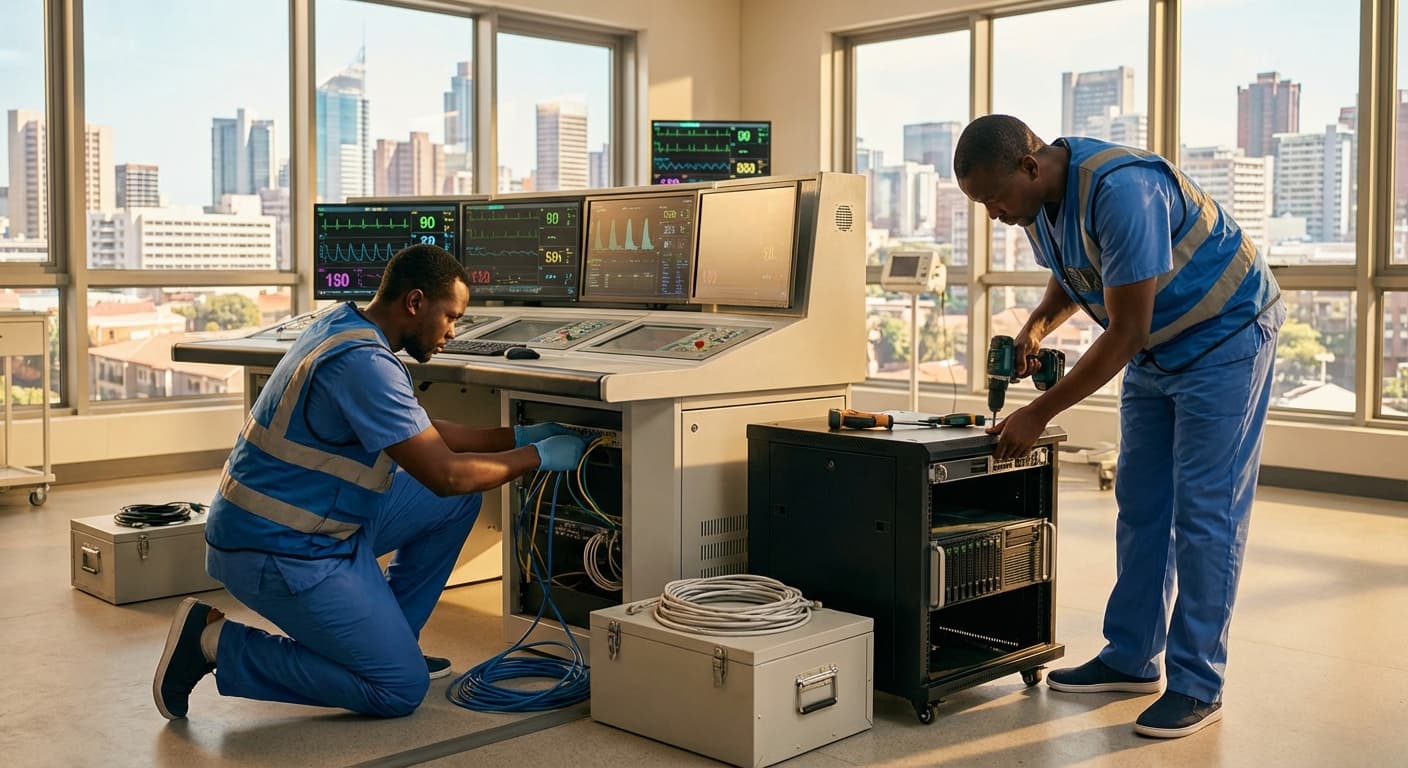
ICU Central Monitoring Station Installation Service in Namibia
Engineering Excellence & Technical Support
ICU Central Monitoring Station Installation Service High-standard technical execution following OEM protocols and local regulatory frameworks.
Seamless Network Integration
Our expert technicians ensure robust and reliable network infrastructure for your ICU central monitoring station, guaranteeing uninterrupted data flow and real-time patient information access across your Namibian facility.
Optimized Server & Software Setup
We specialize in the precise installation and configuration of high-performance servers and specialized monitoring software, tailored to the unique demands of critical care environments in Namibia for maximum efficiency and data integrity.
Secure & Redundant Systems
Prioritizing patient safety, we implement advanced security protocols and redundant system architectures, safeguarding sensitive data and ensuring continuous operation of your ICU central monitoring station, even in unforeseen circumstances within Namibia.
What Is Icu Central Monitoring Station Installation Service In Namibia?
ICU Central Monitoring Station Installation Service in Namibia refers to the specialized technical process of setting up and configuring a centralized network of patient monitoring systems within an Intensive Care Unit (ICU) environment. This service encompasses the physical installation, network integration, software deployment, calibration, and validation of a comprehensive system designed to continuously collect, display, and analyze vital physiological data from multiple critically ill patients. The objective is to provide clinicians with real-time, integrated patient information, enabling proactive decision-making, early detection of deterioration, and improved patient outcomes. This service is crucial for modern healthcare facilities aiming to deliver high-quality critical care.
| Stakeholder/Entity | Need for Service | Typical Use Cases |
|---|---|---|
| Hospitals and Healthcare Facilities (Public & Private) | To establish or upgrade critical care infrastructure, comply with medical standards, and enhance patient safety and clinical efficiency in ICUs. | • Continuous surveillance of hemodynamics, respiration, and neurological status. • Real-time trend analysis for early detection of patient decompensation. • Facilitating rapid response to critical events. • Remote monitoring capabilities for specialist consultation. • Data archiving for research, quality improvement, and legal purposes. • Integration with other hospital information systems (e.g., EHR, PACS). |
| ICU Departments | To optimize workflow, improve situational awareness, and enable a higher standard of care for critically ill patients. | • Consolidated view of all monitored patients from a central nursing station. • Configurable alarm parameters tailored to individual patient needs. • Facilitating nurse-to-nurse and nurse-to-physician handovers. • Reducing the need for constant physical bedside checks for routine parameter monitoring. |
| Medical Equipment Suppliers and Installers | To provide end-to-end solutions for medical device implementation, ensuring proper functionality and integration. | • Turnkey installation of comprehensive patient monitoring solutions. • Project management for large-scale ICU technology deployments. • Ensuring adherence to local and international safety and performance standards. |
| Government Health Ministries and Regulatory Bodies | To ensure compliance with healthcare infrastructure standards and promote the adoption of advanced medical technologies for improved public health. | • Setting guidelines for critical care technology requirements. • Overseeing the implementation of national healthcare standards. |
Service Components
- Hardware Installation: Physical mounting and connection of patient monitors (e.g., ECG, SpO2, NIBP, EtCO2, invasive pressure), bedside servers, and the central monitoring station workstation.
- Network Infrastructure Setup: Configuration of patient monitoring networks, ensuring secure and reliable data transmission between bedside devices and the central station. This may involve Ethernet cabling, Wi-Fi infrastructure, and network switches/routers.
- Software Deployment and Configuration: Installation and setup of the central monitoring software platform, including user account management, alarm configuration, data storage parameters, and integration with Electronic Health Records (EHR) systems if applicable.
- Device Integration and Interfacing: Establishing bidirectional communication between various monitoring devices and the central station, ensuring accurate data acquisition and display.
- Calibration and Testing: Performing rigorous calibration of all connected monitoring devices and conducting comprehensive system testing to verify data integrity, alarm functionality, and network performance.
- Training and Handover: Providing technical and operational training to ICU staff on the use, maintenance, and troubleshooting of the central monitoring system.
- Documentation: Supplying detailed technical documentation, including system architecture, configuration guides, and maintenance manuals.
Who Needs Icu Central Monitoring Station Installation Service In Namibia?
The installation of an ICU Central Monitoring Station (CMS) is a critical infrastructure upgrade for any healthcare facility aiming to provide high-level critical care. In Namibia, this service is essential for hospitals that are either establishing new Intensive Care Units (ICUs) or upgrading their existing ones to meet international standards of patient monitoring and management. A CMS allows for the simultaneous and continuous observation of multiple critically ill patients from a centralized location, enabling swift response to changes in patient condition and improving overall patient outcomes.
| Target Customer Group | Specific Departments/Units | Key Needs/Motivations |
|---|---|---|
| Government Hospitals | Intensive Care Unit (ICU), High Dependency Unit (HDU), Emergency Department (ED) with critical care capabilities | Improving patient survival rates, managing high patient volumes, ensuring standardized critical care across the nation, capacity building for medical staff. |
| Private Hospitals and Clinics | Intensive Care Unit (ICU), Coronary Care Unit (CCU), Surgical Intensive Care Unit (SICU), Medical Intensive Care Unit (MICU), Neonatal Intensive Care Unit (NICU) | Enhancing service offerings, attracting complex cases, maintaining a competitive edge, ensuring patient safety and high-quality care, compliance with international accreditation standards. |
| Missions Hospitals and Non-Profit Healthcare Providers | Intensive Care Unit (ICU), Post-operative Recovery Units with critical care needs | Expanding access to life-saving care, improving patient outcomes in resource-limited settings, leveraging donor funding for infrastructure development, training local healthcare professionals. |
| Tertiary and Specialized Medical Centers | Cardiothoracic ICU, Neuro-ICU, Trauma ICU, Pediatric ICU | Precise and real-time monitoring of specialized physiological parameters, facilitating rapid intervention for critical events, supporting advanced medical procedures, research and development in critical care. |
Target Customers and Departments for ICU Central Monitoring Station Installation Service in Namibia:
- Government Hospitals: National referral hospitals and major regional hospitals that serve a large and diverse patient population and are mandated to provide advanced medical services.
- Private Hospitals and Clinics: Healthcare facilities owned and operated by private entities that offer specialized medical services and aim to attract patients seeking premium critical care.
- Missions Hospitals and Non-Profit Healthcare Providers: Organizations that provide healthcare services to underserved communities and are seeking to enhance their critical care capabilities through donations, grants, or strategic partnerships.
- Tertiary and Specialized Medical Centers: Facilities focusing on specific areas of medicine (e.g., cardiac, neurological, trauma) that require advanced monitoring for complex patient cases.
Icu Central Monitoring Station Installation Service Process In Namibia
This document outlines the comprehensive workflow for the ICU Central Monitoring Station Installation Service Process in Namibia, from the initial inquiry stage to the final execution and handover.
| Phase | Description | Key Activities | Deliverables | Responsible Parties | Timeline (Indicative) |
|---|---|---|---|---|---|
| The process begins with a potential client in Namibia expressing interest in an ICU Central Monitoring Station. | Receive inquiry via phone, email, or website form. Schedule and conduct initial consultation to understand basic requirements and objectives. | Initial understanding of client needs. Confirmation of service offering. | Client, Service Provider | 1-3 Business Days |
| A thorough assessment of the existing or planned ICU facility to determine specific technical and logistical requirements. | On-site visit by technical specialists. Detailed inspection of the ICU layout, existing infrastructure (power, network), and patient bed locations. Discussion of specific monitoring needs (e.g., number of beds, types of parameters). | Detailed site survey report. Comprehensive list of required equipment and infrastructure modifications. | Service Provider (Technical Team), Client (ICU Management, IT Department) | 3-7 Business Days |
| Based on the site survey, a detailed proposal and quotation are prepared and presented to the client. | Develop a comprehensive technical proposal outlining the proposed system, components, installation methodology, and project timeline. Prepare a detailed quotation including equipment costs, installation fees, training, and warranty. | Formal proposal document. Itemized quotation. | Service Provider | 5-10 Business Days |
| Formalization of the agreement and initial payment to commence the project. | Client reviews and approves the proposal and quotation. Negotiation and signing of the installation contract. Processing of the initial deposit as per contract terms. | Signed contract. Proof of initial payment. | Client, Service Provider | 5-7 Business Days |
| Sourcing and delivery of all necessary monitoring equipment and related accessories to Namibia. | Order placement with manufacturers/suppliers. Quality control checks. Arrangement of international and local shipping, customs clearance, and delivery to the client's site. | Procured equipment. Delivery confirmation. | Service Provider (Procurement & Logistics) | Variable (dependent on lead times, typically 4-12 weeks) |
| Ensuring the ICU environment is ready for the installation of the central monitoring system. | Preparation of the central monitoring station room. Installation of necessary network cabling, power outlets, and any required structural modifications. Verification of network connectivity and bandwidth. | Ready installation environment. Verified infrastructure. | Client (Facilities Management, IT Department), Service Provider (Installation Team) | 2-5 Business Days (concurrent with equipment delivery) |
| The physical installation and software configuration of the central monitoring station and associated patient monitors. | Installation of the central monitoring station console. Installation and connection of patient monitors at each ICU bed. Network integration of all devices. Software installation and initial system configuration. | Fully installed and connected hardware. Configured software. | Service Provider (Installation & Network Engineers) | 5-15 Business Days (dependent on the number of beds and complexity) |
| Rigorous testing to ensure the system functions accurately and reliably. | Functional testing of all monitoring parameters. Calibration of sensors and alarms. Simulation of various patient scenarios to verify data accuracy and alarm triggers. Network performance testing. | System functionality report. Calibration records. Verified alarm thresholds. | Service Provider (Technical & Clinical Engineers) | 2-4 Business Days |
| Training ICU staff on the operation and basic maintenance of the central monitoring system. | Conduct comprehensive training sessions for doctors, nurses, and biomedical engineers. Provide user manuals and operational guides. Formal handover of the installed system to the client. | Trained staff. User manuals. Handover documentation. | Service Provider (Trainers), Client (ICU Staff) | 2-3 Business Days |
| Ongoing support and maintenance to ensure the continued optimal performance of the system. | Provide warranty support. Offer optional maintenance contracts. Remote monitoring and troubleshooting. Scheduled preventive maintenance visits. Supply of spare parts. | Ongoing system performance. Resolved issues. Maintenance reports. | Service Provider (Support Team), Client (Biomedical Department) | Ongoing (as per contract/warranty) |
ICU Central Monitoring Station Installation Service Process in Namibia
- 1. Initial Inquiry & Consultation:
- 2. Site Survey & Needs Assessment:
- 3. Proposal Development & Quotation:
- 4. Contract Agreement & Payment:
- 5. Equipment Procurement & Logistics:
- 6. Pre-installation Preparation:
- 7. Installation & Configuration:
- 8. System Testing & Calibration:
- 9. Staff Training & Handover:
- 10. Post-Installation Support & Maintenance:
Icu Central Monitoring Station Installation Service Cost In Namibia
Installing an ICU Central Monitoring Station in Namibia involves a range of costs influenced by several factors. These stations are critical for real-time patient data aggregation and analysis, requiring specialized equipment and expert installation. The overall price will depend on the size and complexity of the installation, the specific technology chosen, and the vendor's service package. Understanding these components is key to budgeting for such a vital healthcare infrastructure upgrade. Namibian healthcare facilities should carefully consider these elements when seeking quotes.
| Cost Component | Estimated Range (Namibian Dollars - NAD) | Notes |
|---|---|---|
| Basic Central Monitoring System (e.g., for 4-6 beds) | NAD 150,000 - NAD 300,000 | Includes essential monitoring hardware, basic software, and standard installation. |
| Mid-Range Central Monitoring System (e.g., for 8-12 beds) | NAD 300,000 - NAD 700,000 | Features more advanced bedside monitors, enhanced software capabilities, and potentially higher-resolution displays. |
| Advanced/Comprehensive Central Monitoring System (e.g., for 16+ beds, complex integrations) | NAD 700,000 - NAD 1,500,000+ | Includes state-of-the-art equipment, sophisticated software with analytics, potential integration with HIS/EHR, and extensive training. |
| Hardware (Bedside Monitors, Servers, Displays) | NAD 50,000 - NAD 200,000 per bed/component | Varies significantly based on brand, features, and technological advancements. |
| Software Licensing & Annual Support | NAD 20,000 - NAD 100,000+ per year | Depends on the software provider, number of users, and features. Initial license fees can be substantial. |
| Installation & Configuration Labor | NAD 30,000 - NAD 150,000 | Influenced by project complexity, team size, and duration. Specialized technicians may charge a premium. |
| Training for Staff | NAD 10,000 - NAD 50,000 | Depends on the duration and depth of training required for different user groups. |
| Site Preparation & Cabling | NAD 5,000 - NAD 30,000 | Can vary based on existing infrastructure and any necessary upgrades. |
Key Factors Influencing ICU Central Monitoring Station Installation Cost in Namibia
- Scope of the Installation: The number of ICU beds to be monitored directly impacts the number of sensor modules, displays, and network infrastructure required.
- Technology and Features: Advanced monitoring systems with features like AI-driven alerts, integrated telemedicine capabilities, and extensive data analytics will command higher prices than basic systems.
- Brand and Quality of Equipment: Reputable brands known for their reliability and advanced technology will generally be more expensive.
- Software Licensing and Integration: Costs associated with the central monitoring software, including initial licenses, ongoing subscriptions, and integration with existing hospital information systems (HIS) or electronic health records (EHR).
- Hardware Components: This includes patient monitors (bedside), central processing units, large display screens for the control room, networking equipment (routers, switches, cables), and power backup solutions (UPS).
- Installation Labor and Expertise: The complexity of the installation, the need for specialized technicians with experience in medical equipment, and the duration of the project will affect labor costs.
- Training: Comprehensive training for medical staff and IT personnel on operating and maintaining the new system is often bundled or a separate cost.
- Site Preparation: This might involve electrical upgrades, network cabling installation or modifications, and physical space preparation for the central station.
- Warranties and Support Packages: Extended warranties and comprehensive after-sales support services contribute to the overall cost but offer long-term peace of mind.
- Customization: Any specific customizations required to meet the unique needs of the Namibian healthcare facility will add to the cost.
Affordable Icu Central Monitoring Station Installation Service Options
Installing an ICU Central Monitoring Station is a critical investment for any healthcare facility, but budget constraints can be a significant concern. This service focuses on providing cost-effective installation solutions without compromising on quality or essential functionality. We understand the need for reliable patient monitoring and aim to make it accessible through smart planning and strategic choices.
| Service Component | Standard Cost Estimate (Illustrative) | Cost-Saving Strategy Application | Potential Savings Range |
|---|---|---|---|
| Central Monitoring Workstation (Hardware & Software) | $15,000 - $40,000+ | Value Bundle Inclusion, Refurbished Options, Open-Source Software Integration | 15% - 30% |
| Bedside Monitoring Units (Per Bed) | $5,000 - $15,000+ | Value Bundle Inclusion, Certified Pre-Owned Units, Negotiated Procurement | 10% - 25% |
| Installation Labor & Project Management | $10,000 - $30,000+ | Phased Implementation, Optimized Cabling, Remote Support | 10% - 20% |
| Network Infrastructure & Cabling | $5,000 - $15,000+ | Optimized Cabling Planning, Standardized Component Selection | 5% - 15% |
| Basic User Training | $2,000 - $5,000+ | Value Bundle Inclusion, Remote Training Sessions | 10% - 25% |
| Extended Warranty/Maintenance (Optional) | 10-15% of Hardware Cost (Annual) | Bundled Purchase at Installation | 5% - 10% (if bundled) |
Understanding Value Bundles and Cost-Saving Strategies
- Value Bundles: Instead of piecemeal installations, we offer curated value bundles. These packages combine hardware, software, installation labor, and basic training into a single, often discounted price. Bundles can be tailored to different ICU sizes and functionality needs, ensuring you get the most relevant components for your investment.
- Phased Implementation: For facilities with limited immediate capital, we propose phased installation. This allows you to deploy core monitoring capabilities first and then expand as budget allows, minimizing upfront costs while still achieving immediate patient safety improvements.
- Refurbished or Certified Pre-Owned Equipment: For certain components, sourcing high-quality, refurbished, or certified pre-owned medical devices can significantly reduce hardware expenditure. These items are rigorously tested and come with warranties, offering a reliable and cost-effective alternative to brand-new equipment.
- Open-Source Software Integration: Where feasible and appropriate, integrating with open-source patient data management systems can lower software licensing fees. We ensure these solutions meet security and regulatory requirements.
- Negotiated Hardware Procurement: Leveraging our established relationships with medical equipment manufacturers and distributors, we can often secure better pricing on hardware components, passing these savings onto our clients.
- Remote Installation Support & Training: For certain aspects of the installation and initial training, remote support and virtual sessions can be a cost-effective alternative to on-site personnel, reducing travel and accommodation expenses.
- Optimized Cabling and Infrastructure: Efficient planning of network cabling and electrical infrastructure reduces material waste and labor time, contributing to overall cost savings.
- Extended Warranties & Maintenance Packages: While an upfront cost, purchasing extended warranties or bundled maintenance packages at the time of installation can often be more economical than separate service contracts later, providing predictable operational costs.
- Standardized Component Selection: Opting for standardized, widely compatible components over highly specialized or proprietary systems can lead to lower initial costs and easier long-term maintenance and upgrade paths.
Verified Providers In Namibia
In Namibia's evolving healthcare landscape, identifying trusted and competent medical service providers is paramount. This is where Franance Health stands out, distinguished by its rigorous credentialing process and unwavering commitment to quality care. Franance Health's verified providers are not just practitioners; they are individuals and institutions that have undergone a thorough vetting to ensure they meet the highest standards of medical expertise, ethical practice, and patient safety. This meticulous verification process is what sets Franance Health apart, offering patients peace of mind and access to the best possible healthcare outcomes.
| Franance Health Verified Provider Type | Why They Represent the Best Choice | Key Benefits for Patients |
|---|---|---|
| Certified Medical Doctors | Undergo stringent validation of their medical degrees, specializations, and continuous professional development. Their commitment to evidence-based medicine and patient-centered care is a hallmark. | Access to highly skilled physicians, accurate diagnoses, effective treatment plans, and a trusted relationship built on expertise and integrity. |
| Accredited Healthcare Facilities | Facilities are assessed for their infrastructure, equipment, hygiene standards, and adherence to national and international healthcare regulations. This ensures a safe and effective treatment environment. | Safe and sterile environments for procedures, access to advanced medical technology, and a comprehensive range of services under one roof. |
| Registered Allied Health Professionals (Nurses, Therapists, etc.) | Their qualifications, registrations with relevant professional bodies, and practical skills are meticulously checked. This guarantees competence in their respective fields. | Receiving care from qualified and ethical professionals who contribute significantly to patient recovery and well-being. |
| Specialized Medical Centers | Centers are evaluated for their specialized equipment, the expertise of their medical teams, and their track record in specific medical areas. This ensures advanced and focused care. | Access to cutting-edge treatments and specialized care for complex medical conditions, leading to better prognoses and improved quality of life. |
Key Components of Franance Health's Verification Process:
- Academic and Professional Qualifications Verification
- Licensing and Regulatory Compliance Checks
- Professional Experience and Background Screening
- Clinical Competency Assessments
- Ethical Practice and Disciplinary Record Review
- Patient Satisfaction and Feedback Monitoring
Scope Of Work For Icu Central Monitoring Station Installation Service
This Scope of Work (SOW) outlines the requirements for the installation of an Intensive Care Unit (ICU) Central Monitoring Station (CMS) service. It details the technical deliverables and standard specifications necessary for the successful deployment and integration of the CMS within the hospital's critical care environment. The objective is to ensure a reliable, high-performance, and user-friendly central monitoring system that enhances patient care and operational efficiency in the ICU.
| Category | Item | Description | Standard Specifications |
|---|---|---|---|
| Central Monitoring Station Hardware | Monitoring Consoles/Workstations | High-performance workstations for displaying patient data, alarms, and trends. | Minimum 16GB RAM, 512GB SSD, Intel Core i7 processor or equivalent, dual high-resolution monitors (24" or larger), hospital-grade keyboard and mouse. |
| Central Server | Data Acquisition and Storage Server | Server responsible for collecting, processing, and storing patient data from bedside monitors. | Redundant power supplies, RAID configuration for data storage, sufficient processing power and memory to handle multiple concurrent data streams, robust network interface (1Gbps or higher), enterprise-grade operating system. |
| Network Infrastructure | Network Switches and Cabling | High-bandwidth, low-latency network infrastructure to connect bedside monitors to the central server and workstations. | Managed Gigabit Ethernet switches with PoE+ support, Cat 6a or higher cabling, redundant network paths, VLAN configuration for security and traffic management. |
| Software | Central Monitoring Software | Software platform for real-time patient data display, alarm management, trend analysis, and reporting. | Must support integration with specified bedside monitor models, provide configurable alarm limits and notification strategies, offer secure remote access capabilities, and comply with relevant healthcare IT security standards. |
| Software | Integration Middleware (if required) | Software to facilitate communication and data exchange between the CMS and other hospital information systems. | HL7 compliance, support for relevant protocols (e.g., FHIR, DICOM), secure data transmission capabilities. |
| Power and Backup | Uninterruptible Power Supply (UPS) | Provides continuous power to the CMS hardware in case of power outages. | Sized to provide sufficient runtime for all critical CMS components (server, workstations, network switches) during a typical power interruption, with surge protection. |
| Power and Backup | Surge Protection | Protects CMS equipment from electrical surges and spikes. | Hospital-grade surge protectors for all connected devices. |
| Environmental | Cooling and Ventilation | Ensures optimal operating temperature for server and network equipment. | Adequate cooling capacity in the server room or designated CMS location to maintain recommended operating temperatures. |
| Security | Access Control and Authentication | Secure access to the CMS for authorized personnel. | Role-based access control, strong password policies, integration with hospital Active Directory or similar authentication systems, audit trails for user activity. |
| Security | Data Encryption | Protects patient data in transit and at rest. | Encryption of sensitive patient data using industry-standard algorithms (e.g., AES-256). |
| Alarms and Notifications | Audible and Visual Alarms | Alerts staff to critical patient events. | Configurable alarm sounds and visual indicators on workstations, with escalation protocols and acknowledgement features. |
| Alarms and Notifications | Remote Notification System | Alerts clinical staff on their mobile devices or pagers. | Integration with existing hospital paging system or secure messaging platform, configurable notification rules. |
| Installation | Cabling and Termination | Professional installation of all required network and power cabling. | Adherence to hospital IT standards and best practices for cable management, labeling, and testing. |
| Installation | Hardware Mounting and Setup | Installation and configuration of CMS servers, workstations, and network equipment. | Rack mounting where applicable, proper ventilation, and secure placement. |
| Installation | Software Deployment and Configuration | Installation and configuration of the central monitoring software on servers and workstations. | System configuration, alarm parameter setup, user profile creation, and integration settings. |
| Testing | Unit Testing | Testing individual components of the CMS. | Verification of hardware functionality, software module performance. |
| Testing | Integration Testing | Testing the interaction between different CMS components and with external systems. | Data flow verification, alarm propagation across integrated systems. |
| Testing | System Testing | Comprehensive testing of the entire CMS functionality. | End-to-end testing of all features, including performance and reliability under load. |
| Testing | User Acceptance Testing (UAT) | Testing by end-users (ICU staff) to validate functionality and usability. | Validation against defined use cases and operational requirements. |
| Training | End-User Training | Training for ICU nurses, physicians, and other clinical staff on CMS operation. | Hands-on sessions covering patient monitoring, alarm management, trend analysis, and basic troubleshooting. |
| Training | IT Support Training | Training for IT personnel responsible for CMS maintenance and support. | Sessions on system administration, software updates, basic troubleshooting, and network management. |
Key Deliverables
- Project Management Plan
- System Design and Architecture Document
- Hardware and Software Procurement Documentation
- Installation and Configuration Guides
- Integration Plan with Existing Hospital Systems (HIS, EMR, PACS)
- Testing and Validation Reports (Unit, Integration, System, User Acceptance)
- Training Materials and Sessions for ICU Staff and IT Personnel
- As-Built Documentation and Network Diagrams
- System Maintenance and Support Plan
- Warranty and Service Level Agreements (SLAs)
Service Level Agreement For Icu Central Monitoring Station Installation Service
This Service Level Agreement (SLA) outlines the response times and uptime guarantees for the installation services provided by [Your Company Name] for the ICU Central Monitoring Station. This SLA is an appendix to the Master Service Agreement (MSA) dated [Date of MSA].
| Service Component | Response Time (Business Hours) | Uptime Guarantee (Post-Installation) |
|---|---|---|
| Initial Site Survey & Planning | Within 2 business days of request | N/A |
| Hardware Installation Commencement | Within 5 business days of site readiness confirmation | N/A |
| Software Installation & Configuration | Concurrent with hardware installation, as scheduled | N/A |
| System Testing & Validation | Upon completion of installation, within 1 business day | N/A |
| Critical System Failure (Post-Installation) | Within 2 business hours | 99.9% monthly uptime for the core monitoring system functionality |
| Non-Critical System Issue (Post-Installation) | Within 4 business hours | 99.5% monthly uptime for peripheral monitoring functionalities |
| Emergency Support (On-call after business hours) | Within 4 business hours (for critical system failures) | N/A |
Scope of Service
- Installation of ICU Central Monitoring Station hardware and software.
- Configuration and integration with existing hospital IT infrastructure.
- Basic system testing and validation.
- On-site support during the installation period.
Frequently Asked Questions

Ready when you are
Let's scope your ICU Central Monitoring Station Installation Service in Namibia project in Namibia.

Scaling healthcare logistics and technical systems across the entire continent.