
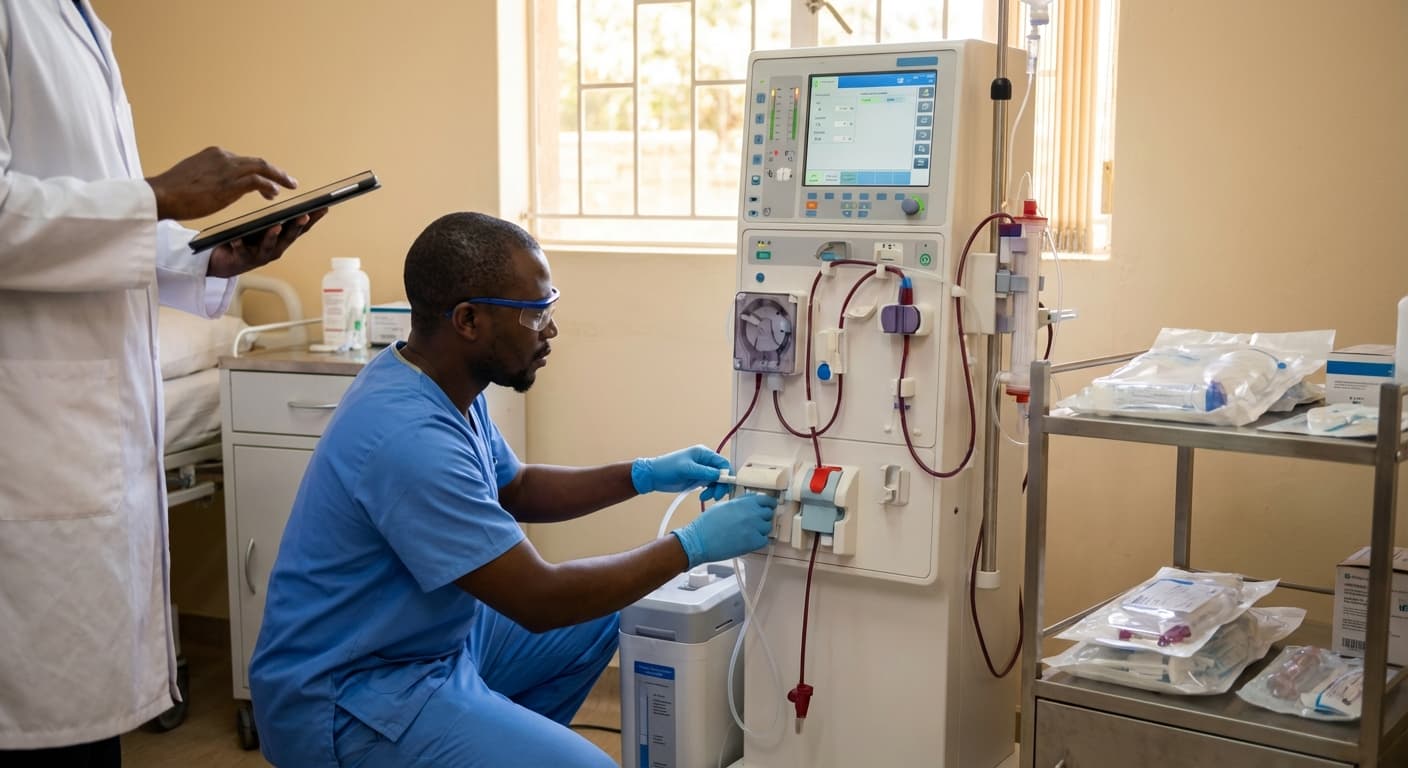
Hemodialysis Machine Installation Service in Namibia
Engineering Excellence & Technical Support
Hemodialysis Machine Installation Service High-standard technical execution following OEM protocols and local regulatory frameworks.
Precision Installation & Calibration
Our certified technicians ensure meticulous installation and precise calibration of your hemodialysis machines, adhering to international standards and Namibian healthcare regulations for optimal performance and patient safety.
Nationwide On-Site Expertise
We provide expert on-site installation services across all regions of Namibia, from urban centers to remote healthcare facilities, guaranteeing seamless setup and minimal disruption to your critical dialysis services.
Comprehensive Training & Handover
Beyond installation, we offer thorough operator training and a complete system handover, empowering your clinical staff with the knowledge and confidence to operate and maintain the hemodialysis machines efficiently and safely.
What Is Hemodialysis Machine Installation Service In Namibia?
Hemodialysis machine installation service in Namibia refers to the professional deployment, configuration, and initial setup of hemodialysis equipment within healthcare facilities. This service ensures that the complex machinery required for renal replacement therapy is integrated seamlessly and safely into the clinical environment, adhering to both manufacturer specifications and Namibian regulatory standards. The process is critical for initiating and sustaining hemodialysis treatment programs, guaranteeing optimal machine performance and patient safety.
| Who Needs Hemodialysis Machine Installation Service? | Typical Use Cases | |||
|---|---|---|---|---|
| New Dialysis Centers: Healthcare facilities establishing new renal dialysis units require comprehensive installation services for their initial equipment procurement. | Expansion of Existing Dialysis Units: Clinics and hospitals expanding their dialysis capacity by adding new machines or upgrading existing ones. | Replacement of Outdated Equipment: Facilities replacing end-of-life or malfunctioning hemodialysis machines with newer models. | Relocation of Dialysis Facilities: Healthcare providers moving their dialysis operations to a new location, necessitating the reinstallation of equipment. | Healthcare Procurement Projects: Government health ministries or large private healthcare groups undertaking significant capital investments in dialysis infrastructure. |
| Public Hospitals: Setting up or upgrading dialysis wards in national and regional hospitals to cater to the general population. | Private Hospitals and Clinics: Establishing or expanding private renal care services for patients requiring hemodialysis. | Non-Governmental Organizations (NGOs): Organizations involved in providing healthcare services, including dialysis, in underserved areas. | Specialized Renal Care Facilities: Dedicated centers focusing solely on the management of kidney disease and providing hemodialysis treatment. | Mobile Dialysis Units: Installation of portable or trailer-mounted hemodialysis machines for outreach programs or temporary deployments. |
Key Components of Hemodialysis Machine Installation Service in Namibia
- Site Assessment and Preparation: Evaluation of the designated installation area, including power supply, water quality and plumbing, waste disposal systems, and structural integrity. Modifications may be recommended or implemented to meet equipment requirements.
- Equipment Delivery and Unpacking: Safe transportation of hemodialysis machines and associated accessories to the facility, followed by careful unpacking and inventory verification.
- Physical Installation and Mounting: Secure placement and anchoring of the hemodialysis machines, including connection to water treatment systems (e.g., reverse osmosis units), power outlets, and drainage.
- Plumbing and Water Line Integration: Connection of the hemodialysis machine to the facility's purified water supply, ensuring appropriate flow rates, pressure, and water quality parameters are met. This often involves integration with a dedicated dialysis water treatment system.
- Electrical Connection and Safety Checks: Professional wiring and connection of the machines to the electrical grid, incorporating surge protection and grounding. Comprehensive electrical safety tests are performed.
- Calibration and Functional Testing: Rigorous calibration of all machine parameters, including dialysate composition, blood pump speed, and ultrafiltration rates. Initial functional tests are conducted to confirm proper operation.
- Disinfection and Sterilization: Thorough disinfection and sterilization of all newly installed components and tubing to prevent contamination.
- User Training and Familiarization: Provision of initial training to biomedical engineers and nursing staff on the operation, basic maintenance, and troubleshooting of the installed hemodialysis machines.
- Documentation and Handover: Generation of installation reports, calibration certificates, and operational manuals. Formal handover of the installed equipment to the facility's designated personnel.
- Compliance Verification: Ensuring that the installation adheres to relevant Namibian health regulations, biomedical standards, and manufacturer guidelines.
Who Needs Hemodialysis Machine Installation Service In Namibia?
In Namibia, the need for hemodialysis machine installation services is primarily driven by healthcare facilities and organizations involved in providing renal care to patients suffering from kidney failure. These services are crucial for setting up and ensuring the proper functioning of hemodialysis units, thereby improving access to life-sustaining treatments for Namibian citizens.
| Customer Type | Primary Need for Installation | Key Decision Makers/Influencers |
|---|---|---|
| Public Hospitals (MoHSS) | Expanding access to renal care, replacing outdated equipment, establishing new dialysis centers. | Ministry officials, Hospital administrators, Head of Nephrology, Biomedical engineers. |
| Private Hospitals and Clinics | Offering comprehensive healthcare services, catering to a growing demand for specialized treatments. | Hospital CEOs, Medical Directors, Heads of Departments, Procurement managers. |
| NGOs (Healthcare-focused) | Establishing or upgrading dialysis facilities in underserved areas, often with donor funding. | Program managers, Project coordinators, Healthcare leads, Biomedical technicians. |
| Standalone Dialysis Centers | Setting up new centers or expanding existing ones to meet patient volume. | Center administrators, Clinical directors, Biomedical engineers, Operations managers. |
| Medical Equipment Suppliers | Providing end-to-end solutions to their clients, including installation and commissioning of purchased machines. | Sales managers, Technical support teams, Installation specialists. |
Target Customers and Departments for Hemodialysis Machine Installation Service in Namibia
- {"items":["Public Hospitals (Ministry of Health and Social Services)","Private Hospitals and Clinics","Non-Governmental Organizations (NGOs) focused on healthcare","Dialysis Centers (standalone facilities)","Medical Equipment Suppliers and Distributors (who may offer installation as part of a package)","Research Institutions with clinical research facilities"],"title":"Target Customers"}
- {"items":["Nephrology Department","Renal Unit/Dialysis Unit","Medical Engineering/Biomedical Department","Procurement Department","Facilities Management Department","Infection Control Department"],"title":"Key Departments within Healthcare Facilities"}
Hemodialysis Machine Installation Service Process In Namibia
This document outlines the typical workflow for Hemodialysis Machine Installation Services in Namibia, from the initial inquiry to the successful execution of the service. It details the key stages involved, responsibilities, and essential considerations.
| Stage | Key Activities | Responsible Party | Typical Timeline |
|---|---|---|---|
| Inquiry & Consultation | Initial contact, needs assessment, preliminary proposal | Client & Service Provider | 1-3 days |
| Site Assessment & Planning | On-site inspection, technical verification, detailed plan | Service Provider (Technical Team) | 2-5 days |
| Procurement & Logistics | Machine ordering, shipping, customs, local transport | Service Provider & Logistics Partners | 2-8 weeks (variable based on import and shipping) |
| Pre-Installation Preparation | Client facility readiness, scheduling confirmation | Client & Service Provider | 1-7 days before installation |
| Installation & Configuration | Physical setup, connections, software installation | Service Provider (Installation Team) | 1-3 days per machine |
| Testing & Commissioning | Functional checks, diagnostic tests, simulations | Service Provider (Technical Team) | 1-2 days per machine |
| Training & Handover | Staff training, documentation, client sign-off | Service Provider (Trainers/Engineers) & Client Staff | 1-2 days |
| Post-Installation Support | Ongoing technical assistance, maintenance | Service Provider | Ongoing |
Hemodialysis Machine Installation Service Workflow in Namibia
- 1. Initial Inquiry & Consultation:
- Client (hospital, clinic, or healthcare facility) expresses interest in hemodialysis machine installation.
- Initial consultation to understand client's needs, existing infrastructure, and specific machine requirements.
- Discussion of machine models, configurations, and any necessary accessories.
- Assessment of site readiness (power, water, drainage, space).
- Provision of preliminary quotation and service agreement outline.
- 2. Site Assessment & Planning:
- Detailed on-site inspection by a qualified technician or engineer.
- Verification of all technical requirements against the chosen machine's specifications (e.g., electrical load, water quality, ventilation, network connectivity).
- Development of a comprehensive installation plan, including logistics, timeline, and resource allocation.
- Identification of any potential challenges or modifications needed.
- Finalization of the quotation and service agreement based on the site assessment.
- 3. Procurement & Logistics:
- Order placement for the hemodialysis machine and any associated equipment/consumables.
- Coordination of shipping and customs clearance into Namibia.
- Arranging for secure transportation of the equipment to the client's facility.
- Ensuring all necessary permits or licenses for importing medical equipment are secured.
- 4. Pre-Installation Preparation:
- Client prepares the designated installation area according to the agreed plan (e.g., ensuring power outlets are correctly wired, water supply is functional).
- Service provider confirms delivery of all required components.
- Scheduling of the installation team and confirmation with the client.
- 5. Installation & Configuration:
- Unpacking and careful handling of the hemodialysis machine and accessories.
- Physical mounting and connection of the machine to power, water, and drainage systems.
- Calibration and configuration of machine settings according to manufacturer guidelines and client specifications.
- Installation of any required software or network connectivity.
- Performing initial system checks and diagnostics.
- 6. Testing & Commissioning:
- Thorough testing of all machine functions, including safety features.
- Running diagnostic tests and simulated dialysis treatments.
- Verifying water quality and flow rates meet required standards.
- Ensuring proper functioning of alarms and error reporting.
- 7. Training & Handover:
- Comprehensive training for the client's medical and technical staff on the operation, maintenance, and basic troubleshooting of the hemodialysis machine.
- Demonstration of key features and functionalities.
- Providing operation manuals, service guides, and warranty information.
- Formal handover of the installed and commissioned machine to the client.
- Obtaining client sign-off on the completed installation.
- 8. Post-Installation Support:
- Provision of ongoing technical support as per the service agreement.
- Scheduling of routine maintenance and service checks.
- Availability for emergency technical assistance.
- Facilitating warranty claims and repairs.
Hemodialysis Machine Installation Service Cost In Namibia
Installing a hemodialysis machine is a critical service for healthcare facilities in Namibia, ensuring the continuity of life-saving treatment for patients with kidney failure. The cost of this service is influenced by a variety of factors, making it essential to understand these components to budget effectively. Factors include the complexity of the installation, the specific type and model of hemodialysis machine, necessary plumbing and electrical modifications, the location of the facility within Namibia, and the reputation and experience of the installation service provider.
| Installation Factor | Typical Cost Range (NAD) |
|---|---|
| Basic Installation (Standard Machine, Minimal Modifications) | 5,000 - 15,000 |
| Intermediate Installation (Advanced Machine, Moderate Modifications) | 15,000 - 35,000 |
| Complex Installation (Specialized Machine, Extensive Modifications, Remote Location) | 35,000 - 75,000+ |
| Water Purification System Installation/Integration | 10,000 - 40,000+ |
| Site Survey and Consultation | 1,000 - 3,000 |
| User Training (Per Session/Group) | 2,000 - 6,000 |
Key Pricing Factors for Hemodialysis Machine Installation in Namibia:
- Machine Type and Complexity: Different hemodialysis machines have varying installation requirements. Advanced or specialized units may require more intricate setup.
- Facility Modifications: This encompasses any necessary plumbing upgrades (water purification systems, drainage), electrical work (dedicated circuits, surge protection), and structural alterations to accommodate the equipment.
- Location of Facility: Installations in remote areas of Namibia might incur higher travel and logistical costs for the technicians compared to facilities in major urban centers like Windhoek.
- Technician Expertise and Experience: Highly skilled and experienced technicians, especially those with specialized certifications, will generally command higher fees.
- Ancillary Services: Costs can also include pre-installation site surveys, post-installation testing and calibration, user training for medical staff, and ongoing maintenance agreements.
- Urgency of Installation: Rush installations may be subject to premium pricing.
- Brand and Model of Machine: Some manufacturers may have preferred or mandatory installation partners, potentially influencing pricing.
- Warranty and Service Level Agreements (SLAs): The level of support and warranty included in the installation package can impact the overall cost.
Affordable Hemodialysis Machine Installation Service Options
Finding affordable hemodialysis machine installation services is crucial for dialysis centers and healthcare facilities aiming to expand or upgrade their capabilities without exceeding budget constraints. This involves understanding the different service options available, the concept of value bundles, and employing effective cost-saving strategies. The initial installation cost can significantly impact operational expenses, making informed choices paramount.
| Service Option | Description | Typical Cost Range (USD) | Value Proposition | Cost-Saving Potential |
|---|---|---|---|---|
| Basic Installation | Includes physical placement of the machine, connection to water and power, and initial testing. | $500 - $2,000 | Lowest initial cost, suitable for facilities with existing infrastructure and skilled in-house technicians. | High, if in-house expertise is available. |
| Standard Installation | Includes basic installation plus calibration, basic staff training on operation, and initial troubleshooting. | $1,500 - $4,000 | Good balance of cost and essential support for new users or facilities with limited technical staff. | Moderate, by reducing the need for external training. |
| Comprehensive Installation & Integration | Includes standard installation, full staff training, integration with existing medical equipment (e.g., patient monitoring), water treatment system setup, and ongoing technical support contract options. | $3,000 - $8,000+ | Provides a complete, turn-key solution, ensuring seamless operation and compliance. Best for new facilities or major upgrades. | Low to Moderate, as the upfront cost is higher, but can reduce long-term operational issues and downtime. |
| Value Bundle: 'Startup Essentials' | Combines installation, initial supply of consumables (dialyzers, tubing), and a 3-month basic maintenance contract. | $2,500 - $6,000 | Offers a package discount, ensuring immediate operational readiness and predictable initial costs. | Moderate, through bundled discounts and reduced separate purchase costs. |
| Value Bundle: 'Full Spectrum Care' | Includes comprehensive installation, extended warranty (1-2 years), preventative maintenance plan for the first year, and advanced staff training on troubleshooting and maintenance. | $5,000 - $12,000+ | Provides peace of mind, minimizes unexpected repair costs, and maximizes machine longevity. | Low to Moderate, due to higher upfront cost but significant long-term savings on repairs and maintenance. |
Key Considerations for Affordable Hemodialysis Machine Installation:
- Types of Installation Services: Understanding the scope of services offered, from basic setup to comprehensive integration.
- Value Bundles: Recognizing how bundled services can offer better pricing and convenience.
- Cost-Saving Strategies: Implementing practical methods to reduce overall installation expenses.
- Vendor Selection: Choosing reputable and cost-effective providers.
- Negotiation: Leveraging negotiation skills to secure favorable terms.
- Long-Term Value: Prioritizing reliability and support alongside initial cost.
Verified Providers In Namibia
In the realm of healthcare, especially in a nation like Namibia where access to quality medical services is paramount, identifying verified providers is crucial. This document outlines the credentials and advantages of Franance Health, positioning them as a leading choice for healthcare solutions in Namibia. Franance Health stands out due to its commitment to stringent quality control, adherence to international standards, and a dedicated team of highly qualified professionals. Their focus on patient-centric care, combined with innovative approaches to healthcare delivery, ensures a superior experience for all beneficiaries.
| Aspect | Franance Health Offering | Benefit to Patients |
|---|---|---|
| Provider Verification | Strict credentialing and background checks for all medical practitioners and facilities. | Ensures access to safe, competent, and ethical medical care. |
| Quality Assurance | Regular audits and performance reviews of network providers. | Consistent delivery of high-quality medical services and positive patient outcomes. |
| Accessibility | Extensive network of diverse healthcare facilities across Namibia. | Convenient and timely access to necessary medical treatments, regardless of location. |
| Cost-Effectiveness | Negotiated rates and transparent pricing structures with network providers. | Reduced out-of-pocket expenses and greater value for healthcare investments. |
| Patient Support | Dedicated customer service and claims processing teams. | Seamless experience from appointment booking to post-treatment follow-up. |
Key Credentials and Advantages of Franance Health:
- Accreditation and Compliance: Franance Health adheres to all relevant Namibian health regulations and international best practices, ensuring a high standard of care.
- Qualified Medical Professionals: A rigorous vetting process guarantees that all healthcare providers associated with Franance Health are licensed, experienced, and continuously upskill through ongoing professional development.
- Comprehensive Service Network: Franance Health partners with a wide array of accredited hospitals, clinics, and specialist centers across Namibia, offering a broad spectrum of medical services.
- Patient-Centric Approach: Emphasis on personalized care plans, clear communication, and responsive support for all patient needs.
- Technology Integration: Utilization of modern healthcare technologies for efficient administration, appointment scheduling, and improved patient outcomes.
- Transparency and Trust: Commitment to open communication regarding treatment options, costs, and expected results, fostering trust and confidence.
Scope Of Work For Hemodialysis Machine Installation Service
This Scope of Work (SOW) outlines the requirements for the professional installation services of hemodialysis machines. The objective is to ensure that each machine is installed correctly, safely, and according to manufacturer specifications and relevant medical equipment standards. This SOW covers technical deliverables, standard specifications, and acceptance criteria for the successful completion of the installation process.
| Component/Activity | Standard Specifications | Technical Deliverable | Acceptance Criteria |
|---|---|---|---|
| Site Preparation | Adequate space (refer to machine manual), appropriate ventilation, stable and level flooring, accessibility for maintenance, adherence to infection control protocols. | Confirmation of site readiness, documented site assessment report. | Site meets all pre-installation requirements as per the machine manufacturer's guidelines and relevant safety regulations. No obstructions hindering installation or operation. |
| Machine Unpacking and Inspection | Machines and accessories delivered in original, undamaged packaging. All components listed in the packing list are present and free from visible damage. | Noted and documented inspection report, including serial numbers of all units. | All machines and accessories received are accounted for and are in pristine condition, free from cosmetic or structural damage. Any discrepancies or damage are immediately reported. |
| Physical Installation | Secure mounting according to manufacturer's instructions, proper orientation, free movement of articulating arms/parts. | Machine securely installed in designated location, verified by visual inspection and stability check. | Machine is stable, level, and positioned correctly as per manual. All protective packaging removed. |
| Electrical Connections | Dedicated, properly grounded circuits. Voltage and amperage as per machine specifications. Use of surge protectors and circuit breakers. | All electrical connections made and verified by a qualified electrician. Electrical safety test report. | Electrical connections are safe, secure, and meet all local electrical codes and manufacturer's requirements. Machine powers on and operates without electrical faults. |
| Plumbing Connections | Use of medical-grade piping, appropriate fittings, backflow prevention devices, compliance with water quality standards (e.g., AAMI/ISO). | Water and drain lines connected and leak-tested. Plumbing integrity report. | All water inlet and drain connections are leak-free, securely fastened, and compliant with medical plumbing standards. Adequate water pressure and flow rate confirmed. |
| Water Treatment System Integration (if applicable) | Proper connection to hemodialysis machine, calibration of water quality sensors, flow rate verification as per treatment needs. | Water treatment system integrated and tested for proper function and water quality output. | Water treatment system is correctly connected, calibrated, and producing water that meets the required purity standards for hemodialysis as per relevant guidelines (e.g., AAMI RD52, ISO 13959). |
| Calibration and Functional Testing | All machine parameters (e.g., blood flow, dialysate flow, temperature, conductivity, pressure) calibrated to manufacturer's specifications. All safety features tested. | Full functional test of the hemodialysis machine, including a simulated dialysis treatment. Calibration certificate and functional test report. | Machine operates within all specified parameters. All safety alarms and features function correctly. Machine passes all diagnostic tests and produces accurate readings. |
| Operator Training and Handover | Basic training on machine operation, safety features, routine checks, and emergency procedures provided to designated staff. | Signed handover form, including confirmation of basic training. | Designated staff demonstrate basic understanding of machine operation, safety protocols, and troubleshooting for common issues. All machine manuals and documentation are provided. |
| Documentation and Reporting | Completion of all installation checklists, test reports, calibration certificates, and a final installation report. | Comprehensive final installation report, including all associated documentation. | All required documentation is complete, accurate, and submitted in a timely manner. Client representative signs off on the final installation report. |
Key Activities and Deliverables
- Site Assessment and Preparation Verification
- Unpacking and Inspection of Hemodialysis Machines
- Physical Installation and Mounting
- Electrical and Plumbing Connections
- Water Treatment System Integration (if applicable)
- Calibration and Functional Testing
- Basic Operator Training and Handover
- Documentation and Reporting
Service Level Agreement For Hemodialysis Machine Installation Service
This Service Level Agreement (SLA) outlines the terms and conditions for the installation services of hemodialysis machines provided by [Your Company Name] (hereinafter referred to as "Provider") to [Client Name] (hereinafter referred to as "Client"). This SLA covers response times for service requests and uptime guarantees for the installed hemodialysis machines. This document aims to ensure the efficient and reliable operation of the hemodialysis equipment, minimizing disruption to patient care.
| Service Component | Response Time Objective | Resolution Time Objective | Uptime Guarantee |
|---|---|---|---|
| Initial response to critical service outage (e.g., complete machine failure impacting patient care) | Within 1 hour of notification | Within 4 hours of initial response (includes diagnosis and commencement of repair) | 98.5% uptime per month (averaged across all installed machines) |
| Initial response to major service issue (e.g., partial machine malfunction, performance degradation impacting multiple parameters) | Within 2 business hours of notification | Within 8 business hours of initial response (includes diagnosis and commencement of repair) | 99.0% uptime per month (averaged across all installed machines) |
| Initial response to minor service issue (e.g., alert notification, non-critical function issue) | Within 4 business hours of notification | Within 24 business hours of initial response (includes diagnosis and commencement of repair) | 99.5% uptime per month (averaged across all installed machines) |
| Scheduled Preventive Maintenance | As per agreed maintenance schedule | Completion within scheduled window | N/A (Scheduled maintenance is planned downtime) |
| New Hemodialysis Machine Installation (End-to-End) | Within 3 business days of confirmed readiness of site and equipment | Completion within 5 business days of commencement of installation (subject to complexity and site conditions) | N/A (Uptime Guarantee applies post-successful installation and acceptance) |
Key Service Level Objectives
- To provide timely and effective installation of hemodialysis machines.
- To ensure rapid response to service requests related to installed machines.
- To guarantee a high level of operational uptime for the installed hemodialysis machines.
Frequently Asked Questions

Ready when you are
Let's scope your Hemodialysis Machine Installation Service in Namibia project in Namibia.

Scaling healthcare logistics and technical systems across the entire continent.