
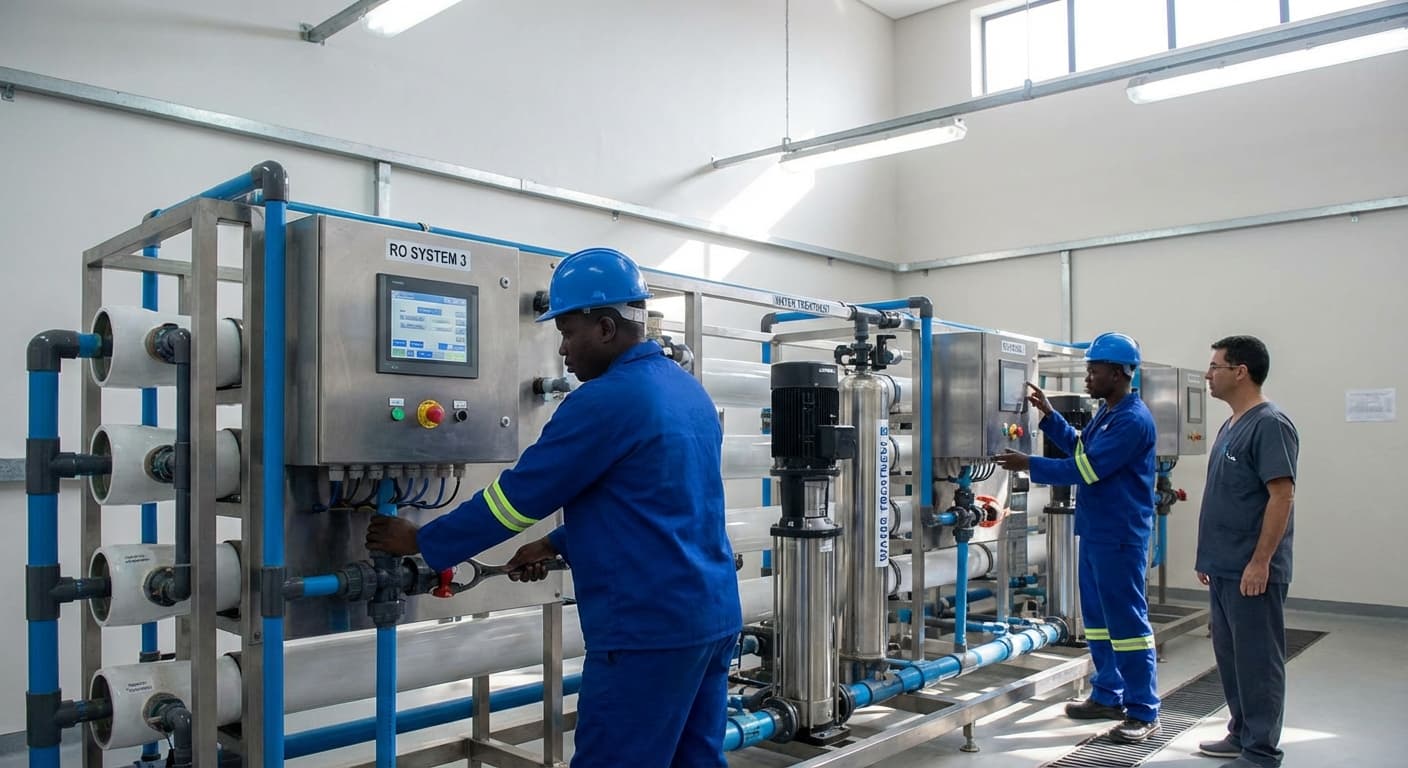
Dialysis RO/Water Treatment Plant Installation Service in Namibia
Engineering Excellence & Technical Support
Dialysis RO/Water Treatment Plant Installation Service High-standard technical execution following OEM protocols and local regulatory frameworks.
Advanced RO Membrane Technology
We utilize cutting-edge Reverse Osmosis (RO) membrane technology specifically optimized for Namibian water sources, ensuring unparalleled purity and removal of dissolved solids, salts, and contaminants, crucial for effective dialysis.
Renewable Energy Integration
Our installations offer seamless integration of solar power solutions, significantly reducing operational costs and ensuring reliable, uninterrupted water treatment even in remote Namibian locations with limited grid access.
Robust & Compliant Design
We design and install robust systems that adhere to stringent international and local Namibian health and water quality standards, guaranteeing the safety, reliability, and longevity of your dialysis water treatment facility.
What Is Dialysis Ro/water Treatment Plant Installation Service In Namibia?
Dialysis RO/Water Treatment Plant Installation Service in Namibia refers to the specialized provision of design, procurement, installation, commissioning, and ongoing maintenance of Reverse Osmosis (RO) and associated water treatment systems specifically for dialysis facilities within the geographical confines of Namibia. These systems are critical for producing ultra-pure water required for hemodialysis treatments, ensuring patient safety by removing impurities that could otherwise lead to serious complications. The service encompasses the entire lifecycle of the water treatment infrastructure, from initial site assessment and system configuration to final operational validation and routine support.
| Who Needs This Service | Typical Use Cases | |||
|---|---|---|---|---|
| Nephrology Units and Dialysis Centers: Public and private healthcare facilities specializing in kidney disease treatment and hemodialysis. | Hemodialysis Water Production: The primary use is to generate the high-purity water essential for diluting dialysate concentrate and for the dialysis process itself. | Medical Research Facilities: Institutions requiring purified water for various medical and biological experiments where water quality is paramount. | Hospitals with Nephrology Departments: General hospitals that offer hemodialysis services as part of their comprehensive patient care. | Water Purification for Other Medical Applications: While primarily for dialysis, similar systems can be adapted for other medical processes requiring highly purified water. |
Key Components and Stages of the Service:
- Site Assessment and Feasibility Study: Evaluating existing water sources, quality, flow rates, and available space to determine optimal system design.
- System Design and Engineering: Developing detailed schematics, equipment specifications, and process flow diagrams tailored to the specific needs of the dialysis unit and regulatory compliance.
- Equipment Procurement: Sourcing and acquiring high-quality RO membranes, pre-treatment filters, pumps, storage tanks, UV sterilizers, deionizers, and control systems.
- Installation and Plumbing: Expert installation of all components, including piping, electrical connections, and control panel integration, adhering to strict sanitary and engineering standards.
- Commissioning and Validation: Thorough testing of the system to ensure it meets all performance specifications, purity standards (e.g., AAMI standards), and operational reliability. This includes water quality testing.
- Operator Training: Comprehensive training for facility staff on the operation, monitoring, and basic maintenance of the installed system.
- Maintenance and Support: Providing scheduled preventative maintenance, emergency repairs, and technical support to ensure continuous optimal performance and compliance.
- Regulatory Compliance: Ensuring the system design and operation adhere to Namibian healthcare and environmental regulations regarding water quality for medical use.
Who Needs Dialysis Ro/water Treatment Plant Installation Service In Namibia?
Dialysis RO/Water Treatment Plant Installation Services in Namibia are essential for a range of healthcare facilities and organizations that provide or support renal care. Ensuring a consistent supply of ultra-pure water is paramount for patient safety and the effective operation of dialysis machines. These services cater to both public and private healthcare providers, as well as research institutions and specialized medical centers. The installation process requires expert knowledge to ensure compliance with stringent medical water quality standards and to optimize the performance and longevity of the water treatment systems.
| Customer Type | Key Departments/Personnel Involved | Primary Need |
|---|---|---|
| Hospitals (Public and Private) | Nephrology Department, Biomedical Engineering, Facilities Management, Procurement Department, Infection Control | Reliable and compliant supply of purified water for hemodialysis, ensuring patient safety and operational efficiency. |
| Renal Dialysis Centers (Standalone) | Clinical Director, Head Nurse (Dialysis Unit), Biomedical Technician, Operations Manager | Specialized water treatment solutions for high-volume dialysis operations, meeting strict regulatory requirements. |
| Clinics with Dialysis Facilities | Clinic Manager, Head Nurse, Technical Staff | Installation and maintenance of compact yet effective RO systems to support limited dialysis services. |
| Medical Research Institutions | Research Heads, Laboratory Managers, Facilities Management | High-purity water for specialized research applications that may involve cell cultures or other sensitive processes, in addition to potential dialysis support. |
| Government Health Ministries/Departments | Director of Public Health, Procurement Officers, Technical Advisors | Establishing and upgrading water treatment infrastructure in public healthcare facilities to expand dialysis access and improve quality of care. |
| Non-Governmental Organizations (NGOs) focused on healthcare | Program Managers, Logistics Coordinators, Healthcare Coordinators | Implementing water treatment solutions in underserved areas or for specific health initiatives that include dialysis services. |
| Military Hospitals and Clinics | Medical Command, Facilities Management, Biomedical Engineering | Ensuring robust and dependable water purification for military personnel requiring dialysis, often in remote or challenging environments. |
Target Customers and Departments for Dialysis RO/Water Treatment Plant Installation Services in Namibia
- Hospitals (Public and Private)
- Renal Dialysis Centers (Standalone)
- Clinics with Dialysis Facilities
- Medical Research Institutions
- Government Health Ministries/Departments
- Non-Governmental Organizations (NGOs) focused on healthcare
- Military Hospitals and Clinics
Dialysis Ro/water Treatment Plant Installation Service Process In Namibia
This document outlines the comprehensive workflow for Dialysis Reverse Osmosis (RO)/Water Treatment Plant Installation Services in Namibia. It details the process from the initial client inquiry to the final handover and ongoing support, ensuring efficient and compliant installation of essential water purification systems for dialysis facilities. The workflow is designed to be transparent, client-focused, and to adhere to Namibian regulatory standards for medical water treatment.
| Phase | Key Activities | Deliverables | Responsible Party | Estimated Timeline |
|---|---|---|---|---|
| Client contacts service provider with requirement for dialysis RO/water treatment plant. Discussion of facility size, patient volume, existing infrastructure, and specific water quality requirements. Understanding of any Namibian regulatory compliance needs. | Initial understanding of client needs, preliminary scope of work. | Client, Service Provider Sales/Technical Team | 1-2 Business Days |
| On-site visit to assess space availability, power supply, water source quality and pressure, drainage, and installation accessibility. Detailed measurement of the installation area. Collection of water samples for laboratory analysis (if necessary). | Comprehensive site survey report, water analysis report (if applicable), confirmation of feasibility. | Service Provider Technical Team | 3-5 Business Days |
| Based on site survey and needs assessment, detailed technical proposal outlining the proposed RO system design, components, and specifications. Detailed quotation including equipment costs, installation labor, training, and any applicable Namibian taxes and duties. | Detailed Technical Proposal, Formal Quotation. | Service Provider Engineering & Sales Team | 5-7 Business Days |
| Client reviews and approves the proposal and quotation. Negotiation of terms and conditions. Signing of a formal installation contract, including scope of work, payment schedule, warranty, and service level agreements. | Signed Installation Contract. | Client, Service Provider Management | 3-5 Business Days |
| Ordering of all necessary RO system components, piping, fittings, electrical materials, and consumables. Arranging for transportation of equipment and materials to Namibia and to the client's site. Customs clearance and import procedures. | All necessary equipment and materials delivered to site. | Service Provider Procurement & Logistics Team | Varies based on lead times (e.g., 2-6 Weeks) |
| Site preparation (if required). Installation of the RO system, pre-treatment filters, pumps, storage tanks, and distribution piping. Electrical connections and integration with facility's power supply. Plumbing connections for inlet and outlet water. | Physically installed RO/Water Treatment Plant. | Service Provider Installation Technicians | 5-10 Business Days (depending on system complexity) |
| Thorough testing of all system components to ensure proper functionality. Flushing and sanitization of the entire system. Water quality testing to confirm it meets dialysis standards (e.g., AAMI, ISO). Adjustments and calibration as needed. Verification of compliance with Namibian health and safety regulations. | Fully functional and commissioned RO/Water Treatment Plant, Water Quality Test Reports, Commissioning Certificate. | Service Provider Technical Team | 2-4 Business Days |
| Comprehensive training for facility staff on system operation, routine maintenance, troubleshooting, and emergency procedures. Provision of operation and maintenance manuals. Formal handover of the installed system to the client. | Trained facility staff, Operation & Maintenance Manuals, Signed Handover Form. | Service Provider Technical Trainers, Client Staff | 1-2 Business Days |
| Provision of warranty support. Scheduled preventative maintenance visits (as per contract). On-call technical support and emergency repair services. Ongoing monitoring and water quality checks. | Reliable water supply, reduced downtime, extended system lifespan. | Service Provider Maintenance & Support Team, Client Facilities Management | Ongoing |
Dialysis RO/Water Treatment Plant Installation Service Process in Namibia
- Initial Inquiry & Needs Assessment
- Site Survey & Technical Evaluation
- Proposal & Quotation Development
- Contracting & Agreement
- Procurement & Logistics
- On-site Installation & Assembly
- System Testing & Commissioning
- Staff Training & Handover
- Post-Installation Support & Maintenance
Dialysis Ro/water Treatment Plant Installation Service Cost In Namibia
Installing a Reverse Osmosis (RO) and Water Treatment Plant for dialysis in Namibia involves several cost factors. These plants are critical for providing safe, purified water essential for hemodialysis, removing impurities like bacteria, viruses, heavy metals, and dissolved solids that can be harmful to patients. The overall cost is influenced by the scale of the facility, the complexity of the treatment required, the specific technologies employed, and the local economic conditions within Namibia.
| Service Component | Estimated Cost Range (NAD) | Notes |
|---|---|---|
| Small to Medium Dialysis Unit (e.g., 5-10 stations) | 150,000 - 400,000 | Includes basic pre-treatment, RO, and post-treatment. Installation complexity can vary. |
| Large Dialysis Center (e.g., 10-20+ stations) | 400,000 - 1,000,000+ | Requires higher capacity systems, more advanced pre-treatment, potentially redundant units, and comprehensive installation. |
| Advanced Pre-Treatment (for difficult water sources) | 50,000 - 200,000+ | Costs for water softening, specialized filtration, chemical dosing systems, etc. |
| Specialized Post-Treatment (e.g., double pass RO, DI) | 30,000 - 100,000+ | For highly sensitive applications or extremely pure water requirements. |
| Installation & Commissioning Labor | 20,000 - 150,000+ | Dependent on project scale, site access, and duration. Includes skilled technicians and engineers. |
| Logistics, Shipping, and Customs (if imported) | 10,000 - 100,000+ | Highly variable based on origin of equipment and import duties. |
| Engineering, Design & Project Management | 15,000 - 75,000+ | For comprehensive planning, site assessment, and oversight. |
Key Pricing Factors for Dialysis RO/Water Treatment Plant Installation in Namibia:
- Plant Capacity and Size: The volume of purified water required per day directly impacts the size and complexity of the RO system, thus affecting the price. Larger facilities or those with higher patient loads will require more robust and expensive systems.
- Pre-Treatment Requirements: The quality of the incoming raw water in Namibia significantly dictates the necessary pre-treatment stages. Water with high levels of sediment, chlorine, or hardness will require additional filtration, softening, or chemical treatment units, adding to the overall cost.
- RO Membrane Technology and Brand: Different RO membrane types and reputable brands have varying costs. High-rejection membranes or those from premium manufacturers will generally be more expensive but offer better performance and longevity.
- Post-Treatment Systems: Beyond RO, additional polishing or sterilization steps might be needed. This can include UV disinfection, post-filters, or even deionization (DI) units, each contributing to the final price.
- Installation and Labor Costs: The complexity of the installation, including plumbing, electrical work, civil preparations (e.g., building a dedicated room or foundation), and the expertise of the installation team, are significant cost components.
- Equipment Sourcing and Logistics: Whether the equipment is manufactured locally or imported will influence costs due to shipping, customs duties, and potential import taxes specific to Namibia.
- Project Management and Engineering: Design, planning, project management, and commissioning services provided by specialized engineers and consultants are crucial and factored into the total cost.
- Maintenance and Service Contracts: While not strictly installation cost, many suppliers offer initial service contracts or warranties that are often bundled or presented at the time of installation, influencing the perceived upfront investment.
- Regulatory Compliance and Certifications: Ensuring the system meets national and international standards for medical water quality may require specific testing and certification, adding to the project expenses.
- Site-Specific Conditions: Factors like accessibility to the site, availability of utilities (power, drainage), and any required modifications to existing infrastructure can impact installation time and cost.
Affordable Dialysis Ro/water Treatment Plant Installation Service Options
Investing in a reliable Reverse Osmosis (RO) and water treatment plant for your dialysis center is crucial for patient safety and effective treatment. This service focuses on providing affordable installation options for these essential systems. We understand that budget constraints are a significant concern for many healthcare facilities, which is why we offer flexible value bundles and implement cost-saving strategies to make high-quality water treatment accessible. Our aim is to ensure your dialysis unit receives purified water that meets all regulatory standards without breaking the bank.
| Value Bundle Option | Description | Included Components (Examples) | Typical Cost-Saving Strategy | Ideal For |
|---|---|---|---|---|
| Basic Essentials | A streamlined package focusing on core RO functionality and essential filtration. | Standard RO unit, sediment/carbon pre-filters, basic post-filter, storage tank. | Bulk purchasing of standard components, simplified installation process. | Smaller clinics or those with existing basic infrastructure. |
| Advanced Purity | Includes enhanced pre-treatment and post-treatment for superior water quality and membrane longevity. | Multi-stage pre-treatment, high-efficiency RO membranes, UV disinfection, advanced post-filters. | Negotiated supplier agreements for advanced components, integrated system design for efficiency. | Medium-sized centers requiring higher water purity standards. |
| Full Spectrum Compliance | A comprehensive solution designed to exceed regulatory requirements with built-in redundancy and advanced monitoring. | Multiple RO trains, redundancy in pre-treatment, ozone disinfection, continuous monitoring systems, automated backwashing. | Modular system design allowing for phased upgrades, energy-efficient components, optimized water recovery. | Larger dialysis centers, hospitals, or facilities with stringent compliance needs. |
| Customized Solutions | Tailored to your specific water source analysis and operational needs. | Variable based on assessment. | Optimized component selection based on water analysis, phased implementation to spread costs. | Facilities with unique water challenges or specific operational demands. |
Key Components of Dialysis RO/Water Treatment Plant Installation
- Pre-treatment Filters (Sediment & Carbon): Removes larger particles and chlorine to protect RO membranes.
- Reverse Osmosis (RO) Unit: The core component that removes dissolved solids, minerals, and contaminants.
- Post-treatment Filters (Polishing/Bacteriostatic): Ensures final water purity and prevents bacterial growth.
- Storage Tank: Holds purified water for immediate use.
- Disinfection System (UV/Ozone): For sterilization and maintaining water quality.
- Monitoring & Control Systems: For performance tracking and alarm management.
- Piping & Installation: Professional setup and connection of all components.
Verified Providers In Namibia
In the competitive landscape of healthcare in Namibia, identifying truly 'verified providers' can be a challenge for individuals seeking quality medical services. Verified providers offer a crucial layer of assurance, indicating that they have met specific standards for competence, ethical practice, and patient care. Franance Health stands out in this regard, distinguishing itself through a rigorous credentialing process that ensures its practitioners are not only qualified but also committed to the highest standards of healthcare delivery. This commitment translates into a superior patient experience and better health outcomes.
| Benefit for Patients | Franance Health's Assurance | Why it Represents the Best Choice |
|---|---|---|
| Access to Competent Professionals | Franance Health rigorously vets academic and professional qualifications. | Ensures you are treated by highly skilled and knowledgeable healthcare practitioners. |
| Trustworthy and Ethical Care | Providers adhere to a strict code of conduct and ethical guidelines. | Guarantees a safe, respectful, and confidential healthcare experience. |
| Up-to-Date Medical Practices | Mandatory continuous professional development keeps providers current. | Ensures you receive the most effective and modern treatment options available. |
| Personalized and Empathetic Treatment | Credentialing includes assessment of communication and patient interaction skills. | Fosters a stronger patient-provider relationship and better understanding of your needs. |
| Peace of Mind | Confirmation of compliance with all relevant regulations. | Provides confidence that you are receiving care from legitimate and accountable professionals. |
Why Franance Health Credentials Matter:
- Rigorous Verification Process: Franance Health employs a multi-faceted approach to credentialing, meticulously checking academic qualifications, professional licenses, and past performance of all healthcare professionals.
- Commitment to Continuous Professional Development: Beyond initial qualifications, Franance Health mandates ongoing training and education for its providers, ensuring they remain at the forefront of medical advancements and best practices.
- Adherence to Ethical Standards: All Franance Health providers are bound by a strict code of ethics, prioritizing patient well-being, confidentiality, and informed consent.
- Patient-Centric Approach: The credentialing process emphasizes not just clinical expertise, but also a provider's ability to communicate effectively, show empathy, and involve patients in their treatment plans.
- Regulatory Compliance: Franance Health ensures all its providers comply with Namibian healthcare regulations and international best practices, offering peace of mind to patients.
Scope Of Work For Dialysis Ro/water Treatment Plant Installation Service
This Scope of Work (SOW) outlines the requirements for the installation services of a Dialysis Reverse Osmosis (RO)/Water Treatment Plant. It details the technical deliverables, standard specifications, and all activities necessary to ensure a fully functional and compliant water treatment system for dialysis purposes. The service provider will be responsible for the complete installation, testing, commissioning, and handover of the RO/Water Treatment Plant.
| Item | Description | Standard Specification/Requirement | Deliverable |
|---|---|---|---|
| 1.0 Site Assessment | Evaluation of the installation site to ensure suitability for the RO/Water Treatment Plant. This includes assessing space, power availability, water supply quality and pressure, drainage, and environmental conditions. | Adherence to manufacturer's site preparation guidelines. Assessment report to be submitted. | Site assessment report. |
| 2.0 Equipment Delivery & Placement | Receipt, inspection, and strategic placement of all RO/Water Treatment Plant components (membranes, pumps, filters, tanks, control panels, etc.) within the designated installation area. | All equipment to be handled with care to prevent damage. Placement to comply with layout drawings and accessibility for maintenance. | Installed RO/Water Treatment Plant components. |
| 3.0 Piping & Plumbing | Installation of all necessary piping and plumbing for water inlet, product water distribution, wastewater/brine discharge, and chemical dosing lines. Includes isolation valves, pressure gauges, flow meters, and air vents. | Materials to be food-grade/medical-grade and compliant with relevant plumbing codes (e.g., NSF/ANSI, ASSE). All connections to be leak-free. Pressure testing of all lines. | Completed and leak-tested piping network. |
| 4.0 Electrical & Control Integration | Connecting the RO/Water Treatment Plant to the facility's main power supply. Wiring of control panels, sensors, actuators, and associated electrical components. Integration with Building Management Systems (BMS) if required. | All electrical work to be performed by qualified electricians according to local electrical codes (e.g., NEC, IEC). Proper grounding and surge protection. Functional testing of all electrical and control elements. | Electrically connected and functioning control system. |
| 5.0 Flushing & Sanitization | Thorough flushing of the entire system to remove debris, construction materials, and any residual contaminants. Sanitization of the system to ensure microbial control. | Flushing procedures to follow manufacturer's recommendations. Water quality testing after flushing. Appropriate sanitizing agents and procedures to be used. | Flushed and sanitized system ready for testing. |
| 6.0 Performance Testing & Validation | Operational testing of the RO/Water Treatment Plant to verify performance against design specifications. This includes testing water purity (TDS, resistivity, microbial count), flow rates, pressure, and recovery rates. | Testing to be conducted according to approved protocols. Water quality parameters to meet or exceed AAMI standards for dialysis water. Validation report to be submitted. | Performance validation report and certificate of compliance. |
| 7.0 Operator Training | Comprehensive training for facility operators on the safe and efficient operation, monitoring, routine maintenance, and troubleshooting of the RO/Water Treatment Plant. | Training to cover system start-up/shut-down, parameter monitoring, basic troubleshooting, filter/membrane replacement, and emergency procedures. | Trained personnel and training materials. |
| 8.0 Documentation & Handover | Provision of all relevant documentation, including as-built drawings, operation and maintenance manuals, test reports, warranties, and certifications. Formal handover of the installed system. | All documentation to be in English and clearly organized. Handover meeting to be conducted. | Complete documentation package and formal system handover. |
Key Stages of Installation Service
- Site assessment and preparation
- Delivery and placement of RO/Water Treatment Plant components
- Piping and plumbing connections (inlet water, product water, drain, chemical dosing)
- Electrical wiring and power connection
- Instrumentation and control system integration
- Pre-commissioning checks and system flushing
- Performance testing and validation
- Operator training and knowledge transfer
- Documentation and handover
Service Level Agreement For Dialysis Ro/water Treatment Plant Installation Service
This Service Level Agreement (SLA) outlines the response times and uptime guarantees for the installation services of a Dialysis Reverse Osmosis (RO)/Water Treatment Plant. This agreement is between [Client Name] (hereinafter referred to as "Client") and [Service Provider Name] (hereinafter referred to as "Provider").
| Service Component | Response Time Target (during Installation Window) | Uptime Guarantee (post-installation, first 90 days) | Definition of Severity |
|---|---|---|---|
| Emergency Site Visit (Critical Issue) | Within 4 hours | N/A (Focus on post-installation support) | RO/Water Treatment Plant is completely non-operational, halting all dialysis treatments. |
| Scheduled Site Visit (Major Issue) | Within 24 business hours | 99.5% | Significant performance degradation or partial system failure impacting a substantial number of dialysis treatments. |
| Remote Support/Troubleshooting (Minor Issue) | Within 8 business hours | 99.9% | Minor functional issues or cosmetic problems that do not impede the primary function of the RO/Water Treatment Plant. |
| Installation Completion | As per agreed project timeline | N/A | Successful and verified operation of the RO/Water Treatment Plant according to manufacturer specifications and client requirements. |
Definitions
- Installation Service: The complete process of setting up, testing, and commissioning a Dialysis RO/Water Treatment Plant at the Client's designated facility.
- Downtime: Any period during which the installed RO/Water Treatment Plant is non-operational or not functioning according to the manufacturer's specifications, preventing its intended use for dialysis.
- Critical Issue: A problem that renders the entire RO/Water Treatment Plant unusable for dialysis, posing an immediate risk to patient care.
- Major Issue: A problem that significantly impairs the performance or functionality of the RO/Water Treatment Plant, but does not completely prevent its use, or affects a substantial portion of its output.
- Minor Issue: A problem that has a minimal impact on the RO/Water Treatment Plant's performance or functionality, or affects a small, non-critical component.
- Installation Window: The agreed-upon period for the initial installation and commissioning of the RO/Water Treatment Plant.
Frequently Asked Questions

Ready when you are
Let's scope your Dialysis RO/Water Treatment Plant Installation Service in Namibia project in Namibia.

Scaling healthcare logistics and technical systems across the entire continent.