
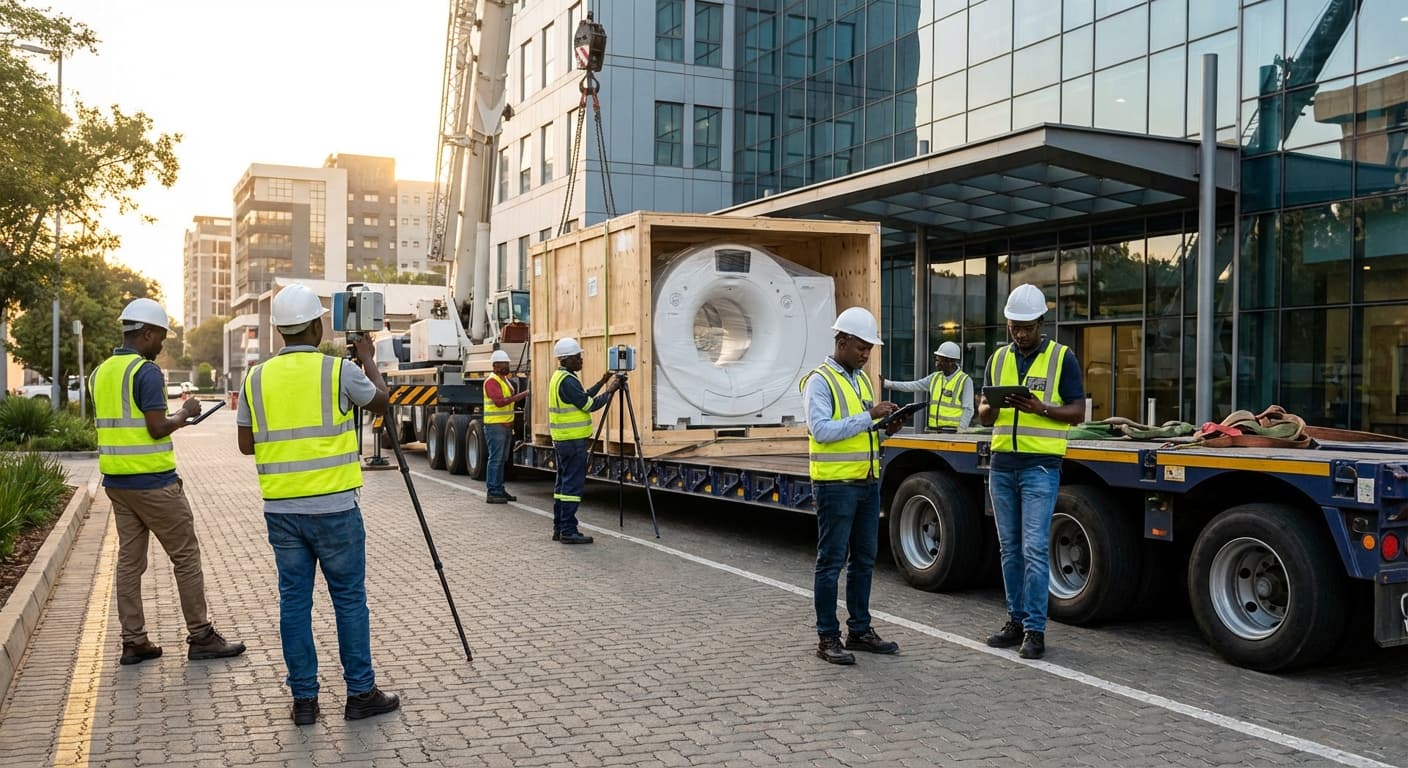
Route Survey & Rigging Plan Service for Heavy Medical Equipment in Namibia
Engineering Excellence & Technical Support
Route Survey & Rigging Plan Service for Heavy Medical Equipment High-standard technical execution following OEM protocols and local regulatory frameworks.
Precision Route Survey for Unrestricted Access
Leveraging advanced GPS and LIDAR technologies, our comprehensive route surveys meticulously map the optimal pathways for heavy medical equipment transport across Namibia's diverse terrain. We identify and mitigate potential obstructions, including low bridges, narrow passages, and restricted load limits, ensuring unimpeded and safe transit from port to installation site.
Expert Rigging & Lift Planning for Sensitive Loads
Our certified rigging engineers develop meticulously detailed lift plans, utilizing specialized equipment and adhering to stringent safety protocols. We conduct thorough load calculations, risk assessments, and site-specific analyses to ensure the secure and controlled positioning of high-value medical equipment, minimizing the risk of damage during critical rigging operations.
Risk Mitigation & Compliance Assurance
We provide end-to-end risk management solutions, encompassing a full spectrum of logistical and operational challenges inherent in transporting sensitive medical machinery. Our services ensure strict adherence to Namibian transportation regulations, environmental considerations, and the manufacturer's specific handling requirements, safeguarding your investment and ensuring operational readiness.
What Is Route Survey & Rigging Plan Service For Heavy Medical Equipment In Namibia?
The Route Survey & Rigging Plan Service for Heavy Medical Equipment in Namibia is a specialized engineering and logistics service focused on the safe, efficient, and compliant transportation and installation of large, heavy, and often sensitive medical apparatus. This service encompasses a comprehensive assessment of the physical path the equipment will traverse from its point of origin to its final destination, coupled with a detailed plan for its lifting, maneuvering, and positioning. It addresses the unique challenges posed by the Namibian context, including infrastructure limitations, geographical terrain, and regulatory requirements.
| Who Needs This Service | Typical Use Cases |
|---|---|
| Hospitals and Healthcare Facilities (Public & Private) | Installation of MRI scanners, CT scanners, Linear Accelerators (LINACs), X-ray machines, Angiography suites, large-scale laboratory equipment, and other high-value, heavy medical imaging and treatment systems. |
| Medical Equipment Manufacturers & Suppliers | Ensuring safe and compliant delivery and installation of their products at client sites in Namibia. |
| Logistics and Heavy Haulage Companies | Subcontracting or partnering for specialized route surveying and rigging planning to handle complex medical equipment transport. |
| Construction and Project Management Firms | Integrating the service into larger hospital construction or renovation projects requiring the installation of significant medical infrastructure. |
| Government Health Departments | Overseeing the procurement and deployment of major medical equipment to public health facilities across Namibia. |
| Specialized Medical Technology Installers | Companies focused on the technical installation and commissioning of advanced medical devices. |
Key Components of Route Survey & Rigging Plan Service:
- Route Assessment:
- Infrastructure Evaluation: Detailed inspection of road networks, bridges, tunnels, and any other public or private infrastructure. This includes assessing load-bearing capacities, height and width clearances, turning radii, and pavement conditions.
- Obstacle Identification: Identification and analysis of potential obstructions such as overhead power lines, low-hanging signage, utility poles, traffic signals, and temporary construction.
- Environmental Considerations: Assessment of environmental factors that may impact transit, including potential weather-related hazards (e.g., heavy rainfall, wind), terrain stability (e.g., sandy or uneven ground), and access for heavy-duty vehicles.
- Permitting & Legalities: Research and procurement of all necessary permits for oversized or overweight transport, road closures, and specialized escorts from relevant Namibian authorities (e.g., Roads Authority, local municipalities).
- Site Accessibility Survey: Evaluation of access points to both the delivery and installation sites, including driveway gradients, gate widths, and any modifications required for entry and exit.
- Rigging Plan Development:
- Equipment Characterization: Thorough understanding of the equipment's dimensions, weight distribution, center of gravity, lifting points, and any specific handling requirements (e.g., vibration sensitivity, shock resistance).
- Lifting & Hoisting Strategy: Design of the lifting and hoisting methodology, specifying the type and capacity of cranes, hoists, slings, shackles, and other lifting accessories required.
- Maneuvering & Positioning Techniques: Development of detailed procedures for navigating tight spaces, inclines, and other challenging maneuvers within the installation environment.
- Securing & Bracing: Planning for the secure fastening and temporary bracing of the equipment during transit and at the installation site to prevent movement and damage.
- De-rigging & Re-assembly: Consideration of the procedures for safely removing any temporary rigging and preparing the equipment for final assembly and commissioning.
- Risk Assessment & Mitigation: Comprehensive identification of potential hazards associated with the rigging operations and the development of strategies to mitigate these risks, including emergency procedures.
- Personnel & Equipment Requirements: Specification of the skilled personnel (e.g., certified riggers, crane operators, engineers) and specialized equipment necessary for the successful execution of the plan.
- Documentation & Reporting:
- Comprehensive Reports: Production of detailed route surveys and rigging plans, including maps, diagrams, photographs, load calculations, and procedural checklists.
- Safety Briefings: Facilitation of pre-operation safety briefings for all involved personnel.
- As-Built Documentation: Record of any modifications made to the route or installation site during the operation.
Who Needs Route Survey & Rigging Plan Service For Heavy Medical Equipment In Namibia?
The specialized service of Route Survey & Rigging Plan for Heavy Medical Equipment is crucial for ensuring the safe, efficient, and compliant transportation and installation of oversized and sensitive medical machinery within Namibia. This service addresses the unique challenges posed by the country's infrastructure, logistics, and the inherent complexity of such equipment.
| Customer Segment | Key Departments Involved |
|---|---|
| Hospitals & Healthcare Facilities | Facilities Management, Biomedical Engineering, Procurement, Clinical Departments (Radiology, Oncology, Surgery) |
| Medical Equipment Manufacturers & Suppliers | Logistics, Installation & Commissioning, Technical Sales Support |
| Government & Public Health Sector | Ministry of Health (Infrastructure, Procurement), Regional Health Directorates |
| Specialized Diagnostic & Treatment Centers | Department Heads, Technical Operations, Facilities Management |
| Logistics & Heavy Haulage Companies | Project Management, Operations, Specialized Transport Teams |
| Construction & Engineering Firms | Project Managers, Site Engineers, Building Services Engineers |
Target Customers & Departments for Route Survey & Rigging Plan Service (Namibia)
- {"title":"Hospitals & Healthcare Facilities","description":"These are the primary beneficiaries, requiring the service for both new installations and the relocation of existing heavy medical equipment. This includes: \n- New Hospital Construction/Expansion Projects: Ensuring the new facilities can accommodate and receive large diagnostic imaging machines (MRI, CT scanners), linear accelerators, and other substantial medical apparatus. \n- Upgrades & Replacements: Facilitating the smooth transition when older, heavy equipment is decommissioned and replaced with newer, potentially larger or differently shaped units. \n- Relocation of Equipment within a Facility: Moving large equipment between departments or buildings on a hospital campus."}
- {"title":"Medical Equipment Manufacturers & Suppliers","description":"Companies that import, sell, and install heavy medical equipment in Namibia need this service to offer comprehensive solutions to their clients. \n- Logistics & Installation Departments: Responsible for the end-to-end delivery and setup, ensuring all site-specific requirements are met before arrival."}
- {"title":"Government & Public Health Sector","description":"National and regional health authorities responsible for public healthcare infrastructure. \n- Ministry of Health and Social Services: For projects involving public hospitals, clinics, and specialized medical centers across Namibia. \n- Procurement & Infrastructure Departments: Overseeing the acquisition and installation of significant medical assets for government-funded institutions."}
- {"title":"Specialized Diagnostic & Treatment Centers","description":"Facilities focusing on specific areas like oncology, radiology, or cardiology that rely on high-impact, heavy machinery. \n- Radiology Departments: For MRI, CT scanners, X-ray machines. \n- Oncology Departments: For linear accelerators and brachytherapy units. \n- Surgical Departments: For large operating tables and associated heavy equipment."}
- {"title":"Logistics & Heavy Haulage Companies","description":"Companies specializing in the transportation of oversized and heavy loads, who may sub-contract this specialized service for medical equipment projects. \n- Project Cargo Divisions: Handling the specific planning and execution for sensitive and high-value medical equipment."}
- {"title":"Construction & Engineering Firms","description":"Companies involved in the construction or renovation of healthcare facilities. \n- Project Management Teams: Collaborating with equipment suppliers to ensure building designs and access routes accommodate the specified medical equipment."}
Route Survey & Rigging Plan Service For Heavy Medical Equipment Process In Namibia
This document outlines the comprehensive workflow for our Route Survey & Rigging Plan Service for the installation of heavy medical equipment in Namibia. Our service ensures a safe, efficient, and compliant process from the initial inquiry to the final execution and handover.
| Phase | Key Activities | Deliverables |
|---|---|---|
| Inquiry & Initial Consultation | Client contact, information gathering, scope definition, proposal/quotation preparation | Detailed Proposal & Quotation |
| Phase 1: Route Survey & Risk Assessment | Site visits, route assessment, obstacle identification, dimensional checks, load capacity assessment, risk assessment | Route Survey Report (incl. photographs, measurements, risk assessment) |
| Phase 2: Rigging Plan Development | Equipment analysis, methodology selection, schematic creation, safety protocol development, resource planning, regulatory research | Detailed Rigging Plan & Schematics, Safety Protocols |
| Phase 3: Pre-Execution & Logistics | Client approval, equipment procurement/rental, team mobilization, site preparation, logistics coordination | Mobilized Team & Equipment, Prepared Site |
| Phase 4: Execution & Installation | Pre-operation briefing, controlled lifting & positioning, continuous monitoring, on-site adjustments (if needed), equipment securing | Successfully Installed Medical Equipment |
| Phase 5: Handover & Documentation | Post-installation inspection, client sign-off, report compilation, debriefing, archiving | Project Completion Report, Client Sign-off Documentation |
Service Workflow
- Inquiry & Initial Consultation:
- Client Contact: Client initiates contact via phone, email, or website submission detailing the project scope, equipment type, installation location(s) in Namibia, and desired timeline.
- Information Gathering: Our team requests preliminary information such as equipment specifications (weight, dimensions, lifting points), site access details, building plans, and any known logistical challenges.
- Scope Definition: We conduct a detailed discussion to clarify project objectives, deliverables, and specific client requirements.
- Proposal & Quotation: Based on the gathered information, we prepare a comprehensive proposal outlining the scope of work, methodology, timeline, and a detailed quotation.
- Phase 1: Route Survey & Risk Assessment
- Site Visit Scheduling: Upon proposal acceptance, we schedule a site visit to the installation location(s) in Namibia.
- Route Identification & Assessment: Our experienced surveyors physically inspect the proposed route from the point of arrival (port, airport, or designated delivery point) to the final installation site.
- Obstacle Identification: We meticulously identify and document all potential obstacles, including but not limited to: narrow doorways, low ceilings, staircases, uneven terrain, overhead obstructions (power lines, trees), building structural limitations, and traffic management requirements.
- Dimensional Checks: Precise measurements of all access points, corridors, and internal spaces are taken to ensure clearance for the equipment.
- Load Bearing Capacity Assessment: Structural engineers may be involved to assess the load-bearing capacity of floors, lifts, and any supporting structures.
- Risk Assessment: A thorough risk assessment is conducted, identifying potential hazards at each stage of the transportation and installation process and developing mitigation strategies.
- Data Collection: High-resolution photographs, videos, and detailed notes are captured for each stage of the route.
- Phase 2: Rigging Plan Development
- Equipment Analysis: A detailed analysis of the medical equipment's weight, center of gravity, lifting points, and any specific handling requirements is performed.
- Methodology Selection: Based on the route survey and equipment specifications, we determine the most appropriate rigging methods, including lifting techniques, equipment (cranes, hoists, dollies, specialized lifting frames), and temporary support structures.
- Detailed Rigging Schematics: Comprehensive diagrams and schematics are created, illustrating the planned rigging configurations, load paths, and equipment placement.
- Safety Protocols & Procedures: Specific safety protocols, emergency procedures, and personal protective equipment (PPE) requirements are defined for each step.
- Resource Planning: Identification and allocation of necessary personnel (riggers, engineers, supervisors), specialized equipment, and materials.
- Permit & Regulatory Compliance: We identify and assist in obtaining any necessary permits or regulatory approvals required by Namibian authorities for heavy lifting and transport.
- Phase 3: Pre-Execution & Logistics
- Client Review & Approval: The developed Route Survey report and Rigging Plan are presented to the client for review and final approval.
- Equipment Procurement/Rental: All required rigging equipment, specialized tools, and materials are sourced or rented.
- Team Mobilization: The qualified rigging team, including supervisors and specialists, is assembled and mobilized to the site.
- Site Preparation: The installation area and access routes are prepared, including any necessary temporary modifications or safety barricades.
- Logistics Coordination: Coordination with transportation providers for equipment delivery to the site.
- Phase 4: Execution & Installation
- Pre-Operation Briefing: A detailed briefing is conducted with the entire team to review the rigging plan, safety procedures, and specific roles.
- Controlled Lifting & Positioning: The medical equipment is carefully lifted, maneuvered, and positioned according to the approved rigging plan.
- Continuous Monitoring & Supervision: The entire operation is under constant supervision by experienced personnel to ensure adherence to the plan and immediate response to any unforeseen issues.
- On-Site Adjustments (if necessary): Minor, safe, and approved adjustments to the plan may be made by the supervisor based on real-time site conditions.
- Equipment Placement & Securing: The equipment is placed in its final designated location and securely installed.
- Phase 5: Handover & Documentation
- Post-Installation Inspection: A final inspection of the installed equipment and surrounding area is conducted.
- Client Sign-off: The client formally accepts the completed installation.
- Project Documentation: A comprehensive project report is compiled, including the final route survey findings, approved rigging plan, executed plan (with any deviations noted), risk assessment, safety records, and photographic evidence.
- Debriefing: A project debriefing session may be held with the client to discuss lessons learned and future recommendations.
- Archiving: All project documentation is securely archived for future reference.
Route Survey & Rigging Plan Service For Heavy Medical Equipment Cost In Namibia
The cost of a route survey and rigging plan service for heavy medical equipment in Namibia can vary significantly based on several key factors. These factors influence the complexity, duration, and expertise required for the service, ultimately impacting the final price. Understanding these elements will help you budget effectively and obtain accurate quotes from specialized service providers in Namibia.
| Service Component | Estimated Cost Range (NAD) | Notes |
|---|---|---|
| Basic Route Survey (Short distance, simple terrain) | 2,000 - 7,000 | Primarily visual inspection, basic measurements. |
| Comprehensive Route Survey (Long distance, complex terrain, detailed analysis) | 8,000 - 30,000+ | Includes detailed mapping, structural assessments, traffic management, permit research. |
| Basic Rigging Plan (Simple lift, standard equipment) | 3,000 - 10,000 | Focuses on straightforward lifting and positioning. |
| Complex Rigging Plan (Heavy/oversized equipment, confined spaces, multiple stages) | 12,000 - 50,000+ | Involves detailed engineering calculations, specialized equipment selection, risk mitigation. |
| Combined Route Survey & Rigging Plan (Standard project) | 6,000 - 20,000 | For moderately complex moves. |
| Combined Route Survey & Rigging Plan (Highly complex project) | 20,000 - 80,000+ | For the most challenging and high-risk operations. |
| Permit Acquisition & Coordination Fees | 1,000 - 10,000+ | Varies greatly depending on the number and type of permits required. |
| On-site Supervision & Project Management (per day) | 2,000 - 6,000 | For dedicated supervision during the planning and survey phases. |
Key Pricing Factors for Route Survey & Rigging Plan Service:
- Equipment Specifications: The weight, dimensions, and fragility of the medical equipment are paramount. Heavier, larger, or more sensitive equipment requires more robust planning, specialized rigging gear, and potentially more personnel, driving up costs.
- Route Complexity: The distance to be traveled, terrain (e.g., paved roads vs. unpaved, inclines, tight turns), and accessibility of the final destination (e.g., limited access points, narrow corridors within a facility) will directly affect the planning and execution time, and therefore the cost.
- Survey Scope: The level of detail required for the route survey. This can range from a basic visual inspection to comprehensive surveys involving detailed mapping, traffic management assessments, structural integrity checks of bridges and roads, and permits acquisition.
- Rigging Plan Detail: The intricacy of the rigging plan. A simple lift and move will be less expensive than a complex multi-stage rigging operation involving specialized lifting equipment, multiple anchor points, and precise maneuvering within confined spaces.
- Personnel Expertise & Time: The number of experienced surveyors, rigging specialists, engineers, and project managers required. The duration of the survey and planning process, which can range from a few days to several weeks for very complex projects, will also be a major cost driver.
- Equipment & Machinery: The cost of specialized survey equipment (e.g., GPS, laser scanners) and rigging machinery (e.g., cranes, hydraulic jacks, specialized dollies). Rental or purchase costs of this equipment will be factored in.
- Permits & Approvals: Obtaining necessary permits from local authorities, road closures, and traffic management plans can add to the cost, both in terms of administrative fees and potential logistical challenges.
- Risk Assessment & Contingency Planning: The inherent risks associated with moving heavy and valuable equipment. Comprehensive risk assessments and contingency plans require dedicated resources and expertise.
- Geographical Location within Namibia: While the factors above are universal, specific logistical challenges and costs associated with remote locations in Namibia (e.g., transportation of personnel and equipment to site) might influence the overall price.
- Insurance: Adequate insurance coverage for the survey, planning, and subsequent rigging operation is crucial and will be a cost component.
- Urgency: Rush jobs or expedited services may incur additional surcharges.
- Provider Reputation & Experience: Established and reputable service providers with a proven track record in handling heavy and specialized lifts may command higher prices due to their expertise and reliability.
Affordable Route Survey & Rigging Plan Service For Heavy Medical Equipment Options
Navigating the complexities of transporting and installing heavy medical equipment requires meticulous planning. Our affordable Route Survey & Rigging Plan Service provides the essential expertise to ensure a safe, efficient, and cost-effective relocation. We understand the unique challenges associated with heavy medical machinery, from intricate pathways within facilities to specialized lifting and securing requirements. Our service goes beyond a simple plan; we deliver peace of mind, minimizing risks of damage to both the equipment and the infrastructure, and avoiding costly delays or rework.
| Cost-Saving Strategy | Description | Benefit |
|---|---|---|
| Early Planning Engagement | Involve our service early in your project lifecycle. The sooner we assess the route and rigging needs, the more opportunities there are for optimization. | Prevents costly last-minute changes, identifies potential bottlenecks before they arise, and allows for bulk purchasing of necessary materials. |
| Bundle Service Packages | Opt for our pre-defined value bundles (Basic, Standard, Premium) which offer discounted rates compared to individual service components. | Reduces overall cost by packaging essential services together, ensuring all critical aspects are covered at a more economical price point. |
| Standardized Equipment Handling | Where possible, utilize standard rigging techniques and equipment identified during the survey. Avoids custom solutions unless absolutely necessary. | Leverages readily available and less expensive rigging gear, and reduces specialized labor requirements. |
| Proactive Obstacle Mitigation | Our detailed surveys identify potential obstructions (e.g., doorways, elevators, ceiling height limitations). Planning for these early minimizes costly modifications or delays. | Saves on unexpected costs for widening pathways, temporary structural support, or specialized transport equipment. |
| Bulk Material & Equipment Sourcing | For larger projects or multiple relocations, we can assist in sourcing necessary rigging materials and equipment in bulk, often securing better pricing. | Lower acquisition costs for rigging hardware, padding, and other essential supplies. |
| Remote Survey Options (where applicable) | For some simpler moves, we may be able to conduct preliminary route assessments remotely using provided facility drawings and video, reducing on-site visit costs. | Decreases travel expenses and on-site personnel time for initial assessments. |
Value Bundles: Comprehensive Solutions for Your Needs
- {"title":"Basic Route Survey & Rigging Outline","description":"Ideal for standard moves with well-defined access. Includes detailed route mapping, identification of potential obstacles, and preliminary rigging recommendations."}
- {"title":"Standard Route Survey & Rigging Plan","description":"Our most popular option, offering a comprehensive assessment. Includes detailed route analysis with obstacle mitigation strategies, a full rigging plan with equipment specifications, and safety protocols. Suitable for most medical equipment installations."}
- {"title":"Premium Route Survey & Rigging Consultation","description":"For highly complex or sensitive equipment, or challenging site conditions. Includes all elements of the Standard package, plus on-site consultation during the survey, advanced rigging solutions for unique situations, and dedicated project support."}
- {"title":"Equipment-Specific Rigging Add-on","description":"For specialized equipment requiring unique lifting or securing techniques (e.g., MRI machines, linear accelerators). This add-on ensures tailored rigging solutions."}
- {"title":"Multi-Location Planning Bundle","description":"Cost-effective solution for organizations with multiple facilities requiring equipment relocation. Includes streamlined planning across all locations."}
Verified Providers In Namibia
In Namibia's evolving healthcare landscape, discerning patients seek reliable and credentialed medical providers. Franance Health stands out as a beacon of trust, meticulously vetting its network to ensure the highest standards of care. This commitment to quality is reflected in their rigorous credentialing process, which goes beyond basic licensing to encompass a holistic evaluation of medical professionals. Choosing a Franance Health-affiliated provider means opting for expertise, ethical practice, and a patient-centered approach, guaranteeing peace of mind and optimal health outcomes. Their dedication to transparency and excellence makes them the premier choice for healthcare in Namibia.
| Provider Type | Franance Health Assurance | Benefits for Patients |
|---|---|---|
| Specialist Physicians | Verified expertise and experience in advanced medical fields. | Access to top-tier specialists for complex health conditions, leading to more accurate diagnoses and effective treatments. |
| General Practitioners | Thorough vetting of primary care physicians for comprehensive and compassionate patient care. | Reliable and trusted first point of contact for all healthcare needs, with a focus on preventative care and early intervention. |
| Hospitals & Clinics | Assessment of facilities for adherence to safety, hygiene, and operational standards. | Assurance of receiving care in a safe, well-equipped, and professionally managed healthcare environment. |
| Diagnostic Centers | Verification of advanced technology and qualified technicians for accurate testing. | Trustworthy results for medical imaging and laboratory tests, crucial for effective diagnosis and treatment planning. |
Key Franance Health Credentialing Criteria:
- Board Certification in their respective specialties.
- Active and unrestricted medical licenses.
- Demonstrated commitment to continuing medical education.
- Adherence to stringent ethical and professional conduct standards.
- Positive patient feedback and satisfaction metrics.
- Proven track record of successful patient outcomes.
Scope Of Work For Route Survey & Rigging Plan Service For Heavy Medical Equipment
This Scope of Work (SOW) outlines the requirements for a Route Survey and Rigging Plan Service for the transportation and installation of heavy medical equipment. This service is crucial to ensure the safe, efficient, and timely movement and placement of sensitive and high-value medical apparatus from its point of origin to its final designated location within a healthcare facility. The scope encompasses detailed planning, site assessment, risk identification, and the development of comprehensive technical documentation.
| Deliverable | Description | Standard Specification/Format |
|---|---|---|
| Route Survey Report | Includes detailed mapping of the entire transport route, identifying all potential obstacles (e.g., doorways, corridors, elevators, stairwells, turns, floor load capacities, ceiling heights, utility lines). The report will document all measurements, clearances, and potential challenges. | PDF document with high-resolution photographs, site diagrams, and measurement logs. GPS coordinates for critical points. |
| Rigging Plan | A comprehensive document detailing the methods, equipment, and procedures required for lifting, maneuvering, and securing the medical equipment. This includes load calculations, sling selection, lifting point identification, center of gravity determination, and step-by-step execution procedures. | PDF document, typically 10-20 pages, including detailed drawings (CAD), equipment specifications, weight distribution diagrams, and safety checklists. |
| Risk Assessment Matrix | Identifies potential risks associated with the route survey and rigging process (e.g., equipment damage, personnel injury, facility damage, delays) and outlines mitigation strategies and contingency plans. | Excel spreadsheet or PDF document formatted with risk likelihood, impact, and mitigation actions. |
| Equipment Specifications and Load Charts | Details of all rigging equipment to be used, including capacity ratings, certifications, and operational guidelines. This also includes the specific weight and dimensional data of the medical equipment being moved. | PDF documents for each piece of rigging equipment. Data sheets for medical equipment. |
| On-site Verification Checklist | A checklist to be used during the execution phase to ensure all pre-defined safety measures and procedural steps are adhered to. | Printable PDF or digital checklist. |
| Final Project Report | A comprehensive summary of the entire project, including the successful execution of the rigging plan, any encountered issues, and lessons learned. This report serves as a record of the completed service. | PDF document, summarizing all previous deliverables and execution outcomes. |
Key Activities and Deliverables
- Detailed Route Survey and Obstacle Analysis
- Development of a Comprehensive Rigging Plan
- Risk Assessment and Mitigation Strategies
- Coordination and Communication with Stakeholders
- Final Report and Documentation
Service Level Agreement For Route Survey & Rigging Plan Service For Heavy Medical Equipment
This Service Level Agreement (SLA) outlines the response times and uptime guarantees for the Route Survey & Rigging Plan Service provided for the delivery and installation of heavy medical equipment. This agreement is designed to ensure timely and efficient execution of critical pre-installation tasks, minimizing disruption and maximizing the operational readiness of the medical facility.
| Service Component | Response Time (Initial Contact) | Uptime Guarantee | Key Performance Indicators (KPIs) |
|---|---|---|---|
| Route Survey Request & Scheduling | Within 2 business hours (acknowledgment), 24 business hours (initial site visit scheduling) | N/A (service delivery is event-based) | Percentage of requests acknowledged within 2 business hours; Percentage of site visits scheduled within 24 business hours. |
| Rigging Plan Delivery (post-survey) | Delivery within 3 business days of completing the route survey | N/A (service delivery is event-based) | Percentage of rigging plans delivered within 3 business days. |
| Emergency Support (during active survey/planning) | Within 1 business hour (for critical issues impacting scheduled work) | N/A (service delivery is event-based) | Response time for critical issues. |
| Communication & Updates | Proactive updates provided at key milestones (survey completion, plan submission) | N/A (service delivery is event-based) | Frequency and clarity of communication. |
Service Components Covered by SLA
- Route Survey: Assessment of the physical path for equipment delivery, including obstacle identification, measurement verification, and identification of potential access challenges.
- Rigging Plan Development: Creation of a detailed plan for the safe and efficient lifting, maneuvering, and placement of heavy medical equipment, including specifications for rigging equipment and procedures.
- On-site Consultation: Expert advice and verification during the survey and planning phases.
Frequently Asked Questions

Ready when you are
Let's scope your Route Survey & Rigging Plan Service for Heavy Medical Equipment in Namibia project in Namibia.

Scaling healthcare logistics and technical systems across the entire continent.