
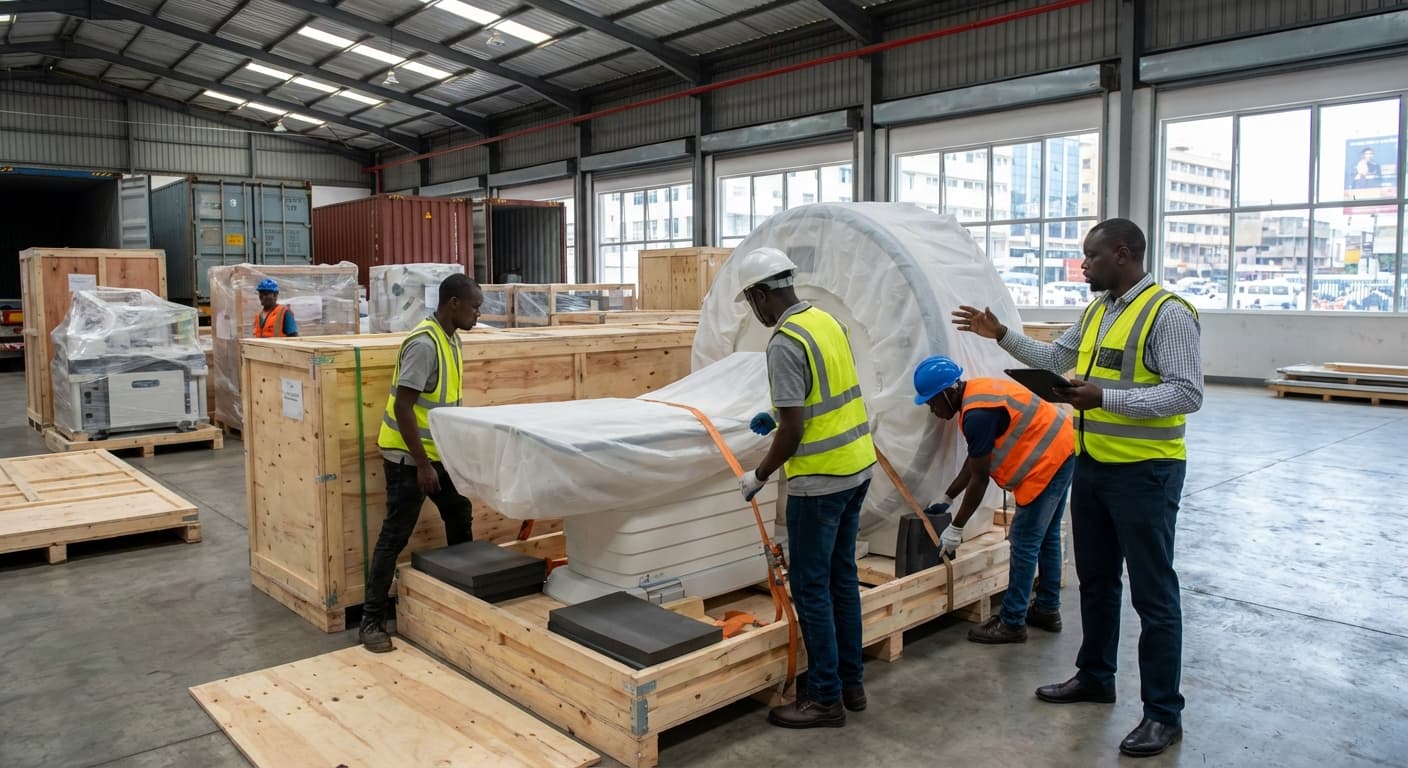
Packaging & Crating Supervision Service for Medical Equipment in Namibia
Engineering Excellence & Technical Support
Packaging & Crating Supervision Service for Medical Equipment High-standard technical execution following OEM protocols and local regulatory frameworks.
Specialized Crate Design for Sterility & Integrity
Our Namibia-based supervisors ensure medical equipment is encased in custom-designed crates adhering to stringent international standards for temperature, humidity, and shock absorption. We implement vapor barrier films and desiccants where necessary, guaranteeing product sterility and preventing damage during transit within Namibia's diverse environmental conditions.
Optimized Loading & Securing for Medical Device Safety
Leveraging advanced load-securing techniques, our supervisors meticulously manage the placement and bracing of medical equipment within transport vehicles. This focus on weight distribution and shock mitigation minimizes vibrational stress, crucial for the delicate internal components of diagnostic and therapeutic devices, ensuring safe arrival at Namibian healthcare facilities.
Rigorous Quality Assurance & Compliance Audits
Our dedicated team conducts comprehensive pre-shipment inspections and post-loading audits in Namibia, verifying compliance with all relevant regulatory requirements (e.g., WHO guidelines, specific manufacturer protocols). We meticulously document each step, providing traceable proof of quality assurance for sensitive medical equipment, including serial number tracking and environmental monitoring data.
What Is Packaging & Crating Supervision Service For Medical Equipment In Namibia?
Packaging & Crating Supervision Service for Medical Equipment in Namibia refers to the specialized oversight and quality control applied to the processes of preparing, protecting, and securing medical devices and associated apparatus for transit or long-term storage within or originating from Namibia. This service ensures that medical equipment, which often possesses intricate functionalities, requires precise handling, and is subject to stringent regulatory requirements (both local and international), is packaged in a manner that preserves its integrity, functionality, and sterility throughout its supply chain journey. The core objective is to mitigate risks of damage, contamination, and loss, thereby safeguarding investments and ensuring the operational readiness of critical healthcare assets upon arrival or retrieval.
| Service Provider | Client Segment | Typical Use Cases | ||||
|---|---|---|---|---|---|---|
| Specialized logistics and freight forwarding companies with medical equipment expertise. | Medical equipment manufacturers and distributors. | Shipment of new high-value diagnostic imaging systems (e.g., MRI, CT scanners). | International relocation of hospital departments or entire facilities. | Export of refurbished or repaired medical devices to overseas markets. | Storage and transit of sensitive laboratory instruments and research equipment. | Deployment of specialized medical equipment for humanitarian aid or disaster relief operations. |
| Independent third-party inspection and quality assurance firms. | Hospitals, clinics, and healthcare providers in Namibia. | Receiving large shipments of critical medical machinery where internal quality control may be insufficient. | Internal transfer of high-value equipment between different hospital sites within Namibia. | Preparation of specialized equipment for return to manufacturers for upgrades or extensive servicing. | Ensuring compliance with insurance requirements for transit damage claims. | Deployment of newly acquired medical technology requiring specialized handling and preservation. |
| Dedicated packaging and crating specialists with medical industry experience. | Third-party logistics (3PL) providers managing medical supply chains. | Exporting Namibian-manufactured medical supplies or diagnostic kits. | Importing complex medical devices that require specific, controlled packaging environments upon arrival. | Ensuring the integrity of temperature-sensitive or sterile-packed medical products during transit. | Managing the packaging of delicate surgical instruments or laboratory consumables. |
Key Components of Packaging & Crating Supervision for Medical Equipment:
- Pre-Packaging Assessment: Detailed inspection of the medical equipment to identify specific vulnerabilities, fragility, and any pre-existing conditions that may influence packaging requirements. This includes assessing dimensions, weight, power requirements, and any sensitive components (e.g., optics, electronics, sterile parts).
- Material Selection and Validation: Ensuring the use of appropriate, often specialized, packaging materials that meet industry standards (e.g., ASTM, ISO) and Namibian regulations. This includes selecting materials that offer adequate shock absorption, vibration dampening, moisture resistance, static protection, and antimicrobial properties where necessary. Verification of material certifications and suitability for the specific equipment type.
- Packaging Methodology Oversight: Supervising the correct application of packaging techniques, including cushioning, bracing, vacuum sealing, inert gas purging, and the use of desiccants or humidity indicators as mandated by the equipment's specifications and transit environment. This ensures that internal components are adequately secured and protected from movement and environmental stressors.
- Crating Design and Construction: Reviewing and approving crating designs to ensure they provide robust structural integrity, adequate ventilation (if required), and proper load distribution. Supervision of the construction process to confirm adherence to approved designs, material quality, and joinery techniques.
- Labeling and Documentation Verification: Ensuring all packaging and crates are clearly and accurately labeled with essential information, including product identification, handling instructions (e.g., "This Way Up," "Fragile," "Static Sensitive"), destination and origin details, and any necessary regulatory markings (e.g., CE, FDA markings for export). Verification of accompanying documentation, such as packing lists, certificates of conformity, and maintenance records.
- Environmental Control: Monitoring and documenting environmental conditions during packaging and crating, especially for sensitive equipment. This may include temperature, humidity, and cleanliness controls within the staging or packaging area.
- Quality Assurance and Inspection: Conducting rigorous visual and instrumental inspections at various stages of the packaging and crating process to identify defects, deviations from standards, or potential risks. This includes post-packaging and pre-shipment final inspections.
- Compliance Verification: Ensuring that all packaging and crating procedures comply with relevant Namibian import/export regulations, international shipping standards, and specific manufacturer or industry guidelines for medical devices.
- Stakeholder Communication: Facilitating clear communication between the equipment owner, logistics providers, and packaging specialists to ensure all requirements are understood and met.
Who Needs Packaging & Crating Supervision Service For Medical Equipment In Namibia?
Packaging and crating supervision services for medical equipment in Namibia are crucial for ensuring the safe, secure, and compliant transit of sensitive and often high-value items. This specialized service mitigates risks of damage, loss, and regulatory non-compliance during transportation, whether it's for installation, relocation, or export. The focus is on meticulous planning, material selection, and execution to protect the integrity of the equipment from origin to destination.
| Customer Type | Key Needs/Reasons for Supervision | Impact of Proper Supervision |
|---|---|---|
| Hospitals and Healthcare Facilities | Relocation of sensitive equipment (e.g., MRI, CT scanners) to new wings or buildings. Installation of new high-value medical devices. Ensuring equipment is protected during internal moves or renovations. | Minimized downtime, reduced repair costs, preserved warranty validity, ensured operational readiness upon relocation/installation. |
| Medical Equipment Manufacturers and Distributors | Exporting specialized equipment to international markets. Receiving large shipments of new inventory. Ensuring brand integrity and customer satisfaction upon delivery. | Compliance with international shipping regulations, prevention of transit damage, positive customer reception, streamlined supply chain. |
| Government Health Ministries and Agencies | Distributing medical equipment to rural or remote health posts. Procuring and deploying large-scale medical infrastructure. Ensuring the longevity and functionality of public health assets. | Effective utilization of public funds, equitable access to healthcare, sustained operational capacity of health facilities. |
| Research Institutions and Laboratories | Transporting delicate scientific instruments and laboratory equipment. Relocating entire lab setups. Maintaining the precision and calibration of sensitive instruments. | Uninterrupted research activities, preservation of experimental data integrity, cost savings on instrument recalibration or replacement. |
| NGOs and Humanitarian Aid Organizations | Deploying essential medical supplies and equipment to crisis zones or underserved areas. Ensuring the functionality of donated medical devices in challenging environments. | Effective delivery of aid, immediate impact on health outcomes, sustained medical support for vulnerable populations. |
Target Customers and Departments for Medical Equipment Packaging & Crating Supervision Services in Namibia
- {"departments":["Procurement/Purchasing Department","Biomedical Engineering Department","Logistics/Warehouse Department","IT Department (for imaging and diagnostic equipment)","Facilities Management"],"customerType":"Hospitals and Healthcare Facilities"}
- {"departments":["Logistics and Supply Chain Management","Operations","Export/International Sales","Quality Assurance"],"customerType":"Medical Equipment Manufacturers and Distributors"}
- {"departments":["Procurement and Tendering","Logistics and Distribution","Public Health Infrastructure Management"],"customerType":"Government Health Ministries and Agencies"}
- {"departments":["Laboratory Management","Procurement","Research Project Coordinators"],"customerType":"Research Institutions and Laboratories"}
- {"departments":["Logistics and Operations","Procurement","Program Management"],"customerType":"Non-Governmental Organizations (NGOs) and Humanitarian Aid Organizations"}
- {"departments":["Practice Management","Procurement"],"customerType":"Private Clinics and Specialist Practices"}
- {"departments":["Clinic Management","Procurement"],"customerType":"Veterinary Clinics and Animal Hospitals"}
Packaging & Crating Supervision Service For Medical Equipment Process In Namibia
Our Packaging & Crating Supervision Service for Medical Equipment in Namibia provides a comprehensive workflow designed to ensure the safe and secure transit of sensitive medical devices. From the initial inquiry to the final execution and documentation, our process is meticulously managed to meet international standards and client expectations. We understand the critical nature of medical equipment and the importance of proper packaging and crating to prevent damage during transportation, especially in the unique logistical landscape of Namibia. This service aims to offer peace of mind to manufacturers, distributors, and healthcare providers by ensuring every step of the packaging and crating process is overseen by experienced professionals.
| Stage | Description | Key Activities | Deliverables/Outcomes | Key Considerations for Namibia |
|---|---|---|---|---|
| Inquiry & Initial Consultation | The client initiates contact to inquire about our services for packaging and crating medical equipment in Namibia. | Understanding client needs, equipment type, destination, timeline, and budget. Providing preliminary service details. | Clear understanding of project scope, initial proposal, and engagement confirmation. | Geographic remoteness of some regions; need for efficient communication and logistics planning. |
| Site Assessment & Risk Evaluation | A site visit or detailed remote assessment is conducted to evaluate the packaging environment and identify potential risks. | Assessing workspace availability, equipment handling capabilities, environmental factors (temperature, humidity), security, and potential transit hazards. | Identified risks and vulnerabilities, environmental control recommendations. | Dust, heat, and potential for rough handling during inter-modal transport. |
| Customized Packaging & Crating Plan Development | Based on the assessment, a detailed, tailored plan for packaging and crating is created. | Selecting appropriate materials (e.g., anti-static, shock-absorbent, moisture-barrier), designing crate specifications (wood type, bracing, internal support), outlining handling procedures, and defining labeling requirements. | Formalized Packaging & Crating Plan document, including material specifications and diagrams. | Compliance with international shipping regulations (e.g., ISPM 15 for wood packaging). |
| Material Sourcing & Quality Assurance | Ensuring all necessary packaging and crating materials are procured and meet quality standards. | Verifying material quality, inspecting wood treatment, checking the integrity of protective padding and sealing materials. | Approved and inspected packaging materials. | Availability of specialized materials; local sourcing options and lead times. |
| On-site Supervision During Packaging & Crating | Our trained supervisors are present to oversee the entire packaging and crating process. | Directing and monitoring personnel, ensuring adherence to the plan, verifying proper placement of equipment, applying protective measures, sealing crates securely, and implementing correct labeling. | Properly packaged and crated medical equipment, ready for transit. | Ensuring local labor understands and follows precise instructions; acclimatization to local working conditions. |
| Documentation & Certification | Thorough documentation is maintained throughout the process, and necessary certifications are obtained. | Recording all steps, taking photographic evidence, generating packing lists, and securing any required fumigation or treatment certificates. | Complete project documentation package, including photos, packing lists, and certifications. | Ensuring all certifications are valid and recognized for international shipment. |
| Handover & Post-Execution Review | The completed, packaged, and crated equipment is handed over to the client or their designated logistics partner, followed by a review. | Formal handover of the crated goods, addressing any final questions, and conducting a post-project review to gather feedback and identify areas for improvement. | Client acceptance of packaged equipment, project closure report, client satisfaction assessment. | Confirming clear lines of responsibility for onward transportation and customs clearance. |
Workflow Overview
- Inquiry & Initial Consultation
- Site Assessment & Risk Evaluation
- Customized Packaging & Crating Plan Development
- Material Sourcing & Quality Assurance
- On-site Supervision During Packaging & Crating
- Documentation & Certification
- Handover & Post-Execution Review
Packaging & Crating Supervision Service For Medical Equipment Cost In Namibia
The cost of packaging and crating supervision services for medical equipment in Namibia can vary significantly based on several key factors. These services are crucial to ensure that sensitive and expensive medical devices are protected during transit, preventing damage and complying with international shipping regulations. Factors influencing the price include the complexity and fragility of the equipment, the required level of specialized packaging (e.g., climate-controlled, shock-absorbent, anti-static), the volume and weight of the items, the geographical location of the pickup and delivery, and the specific expertise and reputation of the service provider. Namibian service providers typically offer these services on an hourly or project basis, with rates influenced by operational overhead, labor costs, and the demand for specialized skills.
| Service Component | Estimated Price Range (NAD) | Notes |
|---|---|---|
| Initial Consultation & Risk Assessment | 200 - 500 | Assessing equipment needs and potential risks. |
| Supervision of Material Sourcing & Preparation | 400 - 900 | Ensuring correct and high-quality packaging materials are used. |
| On-site Supervision of Crating Process (Hourly) | 350 - 750 | Skilled supervision during the actual construction and packing of crates. |
| Specialized Packaging Supervision (e.g., anti-static, climate-controlled) | 500 - 1200 (Hourly) | Additional cost for more complex and sensitive packaging requirements. |
| Documentation & Compliance Checks | 300 - 600 | Ensuring all necessary paperwork and regulatory requirements are met. |
| Project Management & Coordination | 600 - 1500 (Daily/Project-based) | For larger or more complex projects requiring extensive coordination. |
Key Pricing Factors for Medical Equipment Packaging & Crating Supervision in Namibia
- Equipment Complexity & Fragility: Highly sensitive or delicate medical instruments will require more intricate and specialized packaging, increasing labor and material costs.
- Packaging Material Specifications: The need for custom-built crates, specialized cushioning, vapor barriers, or anti-static materials will directly impact the overall price.
- Volume and Weight of Equipment: Larger and heavier items necessitate more robust crates and potentially specialized handling equipment, leading to higher costs.
- Geographical Scope: Intra-city, inter-regional, or international movements will have different logistical costs associated with supervision and coordination.
- Customs & Regulatory Compliance: Ensuring compliance with specific import/export regulations for medical equipment can add to the complexity and cost of supervision.
- Service Provider Expertise & Reputation: Highly experienced and reputable companies with specialized knowledge in handling medical equipment may command higher fees.
- Project Duration & Intensity: The time required for supervision, from initial assessment to final packing, will influence hourly or daily rates.
- Additional Services: Services like insurance, inventory management, and specialized handling instructions can add to the final cost.
Affordable Packaging & Crating Supervision Service For Medical Equipment Options
Our affordable packaging and crating supervision service for medical equipment offers comprehensive solutions to ensure the safe and secure transit of your valuable assets. We understand the unique challenges associated with medical equipment, from delicate instrumentation to bulky diagnostic machines. Our experienced supervisors oversee the entire packaging and crating process, adhering to strict industry standards and best practices. This service is designed to mitigate risks of damage, loss, and compliance issues during transportation. By providing expert oversight, we help prevent costly mistakes and ensure your equipment arrives at its destination in optimal condition, minimizing downtime and repair expenses.
| Cost-Saving Strategy | Description | Benefit |
|---|---|---|
| Preventative Damage Control | Our supervisors identify and rectify potential issues during packing and crating, preventing damage that would otherwise occur during transit. | Reduces repair costs, minimizes equipment downtime, and avoids replacement expenses. |
| Optimized Material Selection | Supervisors can advise on and verify the use of appropriate and cost-effective packaging materials that meet protection requirements without overspending. | Lowers material procurement costs and reduces shipping weight/volume where possible. |
| Reduced Risk of Rejection/Delays | Ensuring compliance with shipping regulations and proper documentation minimizes the risk of shipments being rejected or delayed by customs or carriers. | Saves time and money associated with re-shipping, fines, or expedited handling. |
| Efficient Process Management | Streamlined supervision leads to a more efficient packing and crating process, reducing labor hours and potential inefficiencies. | Lower operational costs and quicker turnaround times for shipments. |
| Negotiating Power with Packers/Craters | Our independent supervision can provide objective insights for contract negotiations with third-party packaging and crating providers. | Potentially secures better pricing for packaging services. |
Value Bundles for Medical Equipment Packaging & Crating Supervision
- {"title":"Basic Oversight Bundle","description":"Includes on-site supervision during packing and crating, visual inspection of materials, and verification of secure closure. Ideal for standard medical devices with moderate fragility."}
- {"title":"Standard Compliance Bundle","description":"Builds upon the Basic Bundle with added checks for compliance with specific shipping regulations (e.g., UN, IATA for hazardous materials), material suitability assessments, and basic documentation review. Suitable for general medical equipment requiring adherence to transport guidelines."}
- {"title":"Premium Protection Bundle","description":"Encompasses all features of the Standard Bundle plus specialized handling instructions verification, environmental control monitoring (if applicable), advanced vibration and shock mitigation checks, and comprehensive pre-shipment documentation review. Recommended for highly sensitive, high-value, or sterile medical equipment."}
- {"title":"Custom Solution","description":"Tailored bundles designed to meet the unique needs of your specific medical equipment and project requirements. Includes a personalized consultation and a dedicated supervision plan."}
Verified Providers In Namibia
When seeking healthcare services in Namibia, it's crucial to engage with Verified Providers. These are healthcare professionals and facilities that have undergone rigorous credentialing and verification processes, ensuring they meet established standards of quality, safety, and ethical practice. Franance Health stands at the forefront of this verification process, offering a robust system that not only identifies but also champions the most competent and reliable healthcare providers across Namibia. Choosing a provider listed by Franance Health means opting for assurance, expertise, and a commitment to patient well-being. Their meticulous vetting process goes beyond basic licensing, delving into qualifications, experience, patient feedback, and adherence to best practices, making them an indispensable partner in navigating Namibia's healthcare landscape.
| Key Verification Areas by Franance Health | What it Ensures for Patients |
|---|---|
| Professional Licensing and Certifications | Confirms legal authorization to practice and specialized training. |
| Educational Background and Academic Credentials | Validates foundational knowledge and the quality of medical education. |
| Clinical Experience and Specialization | Guarantees practical application of skills and expertise in specific medical fields. |
| Peer Reviews and Professional Reputation (where applicable) | Provides insights into a provider's standing within the medical community. |
| Adherence to Namibian Healthcare Regulations | Ensures compliance with national health laws and standards. |
| Continuing Medical Education (CME) Records | Demonstrates commitment to staying updated with the latest medical advancements. |
| Patient Feedback and Satisfaction (where available and relevant) | Offers a perspective on patient experience and provider responsiveness. |
Why Franance Health Credentials Represent the Best Choice for Verified Providers in Namibia:
- Rigorous Vetting Process: Franance Health employs a multi-layered verification system that scrutinizes each provider's qualifications, licenses, certifications, and professional history.
- Commitment to Patient Safety: Verified providers undergo checks that prioritize patient safety, including background screenings and adherence to stringent medical protocols.
- Quality Assurance: The credentials signify a commitment to delivering high-quality healthcare, evidenced by ongoing professional development and adherence to clinical best practices.
- Enhanced Patient Trust: Knowing a provider is Franance Health verified builds confidence and trust, allowing patients to make informed decisions about their health.
- Access to Expertise: Franance Health identifies specialists and general practitioners with proven track records and specific areas of expertise.
- Ethical Standards: Providers are assessed for their adherence to ethical medical conduct and professional responsibility.
- Continuous Monitoring: Franance Health often involves a degree of ongoing monitoring or re-verification to ensure continued compliance with standards.
- Streamlined Healthcare Navigation: Franance Health's platform simplifies the process of finding reliable healthcare professionals, saving patients time and reducing anxiety.
Scope Of Work For Packaging & Crating Supervision Service For Medical Equipment
This Scope of Work (SOW) outlines the services required for the supervision of packaging and crating of medical equipment. The objective is to ensure that all medical equipment is packaged and crated in accordance with established quality standards, industry best practices, and specific client requirements to guarantee safe transit and storage.
| Phase/Activity | Description of Service | Key Deliverables | Applicable Standards/Specifications |
|---|---|---|---|
| Pre-Packaging Assessment | Review of equipment specifications, fragility, dimensions, weight, and transport requirements. Assessment of existing packaging infrastructure and availability of materials. | Equipment assessment report, Material readiness checklist. | Manufacturer's equipment documentation, Client-provided transport requirements, OSHA safety guidelines. |
| Material Inspection & Verification | Inspection of all incoming packaging materials (boxes, crates, cushioning, strapping, labeling) for suitability, damage, and compliance with specified types and quality. | Approved materials list, Material rejection log (if applicable). | ASTM D3951 (Standard Practice for Commercial Packaging), ISO 9001 (Quality Management Systems), Specific client material specifications. |
| Supervision of Packaging Process | On-site oversight of personnel performing the packaging. Ensuring correct application of inner packaging, cushioning, moisture barriers, and void fill. Verification of equipment placement within primary packaging. | Process observation logs, Corrective action reports (if needed). | Internal packaging guidelines, Client-specific handling procedures, Good Manufacturing Practices (GMP) where applicable. |
| Supervision of Crating Process | Oversight of the construction and assembly of crates. Verification of wood type, thickness, joinery, and fastener usage. Ensuring proper blocking, bracing, and internal securing of packaged equipment within the crate. | Crate construction inspection reports, Bracing and blocking verification. | ISPM 15 (International Standards for Phytosanitary Measures, for wood packaging), MIL-STD-2073 (Military Standard for Preservation, Packaging, and Packing of Military Property), Client-specific crate design specifications. |
| Labeling & Marking Verification | Confirmation that all required labels (handling, fragile, orientation, hazardous material, shipping, serial numbers, etc.) are correctly applied, legible, and in the appropriate locations. | Labeling compliance checklist, Photographic evidence of labeling. | IATA Dangerous Goods Regulations (if applicable), ANSI Z535 (Safety Color Codes), Client-specific labeling requirements. |
| Quality Control Checks & Final Inspection | Performing comprehensive quality checks at various stages of the packaging and crating process. Final inspection of the completed units prior to handover. | Final inspection reports, Non-conformance reports (NCRs), Certificates of Conformance (if required). | Client's quality assurance plan, ISO 19001 (Quality Management Systems). |
| Documentation & Reporting | Maintaining detailed records of all supervision activities, including material checks, process observations, inspections, and any deviations or issues. Providing regular progress reports and a final summary report. | Daily/Weekly progress reports, Final supervision report, Photographic and video documentation of critical steps. | Client-defined reporting format, Standard project management reporting practices. |
| Issue Resolution & Recommendations | Identifying and reporting any packaging or crating issues. Providing recommendations for corrective actions and suggesting improvements for future packaging efforts. | Recommendations for improvement log, Root cause analysis of identified issues. | Industry best practices, Lean manufacturing principles. |
Key Objectives
- Ensure adherence to predefined packaging and crating specifications.
- Verify the integrity and suitability of all packaging materials used.
- Oversee the correct application of cushioning, blocking, and bracing techniques.
- Confirm proper labeling and marking for identification, handling, and regulatory compliance.
- Document all packaging and crating activities, including any deviations or issues encountered.
- Ensure the security and containment of the medical equipment throughout the packaging process.
Service Level Agreement For Packaging & Crating Supervision Service For Medical Equipment
This Service Level Agreement (SLA) outlines the response times and uptime guarantees for the Packaging & Crating Supervision Service for Medical Equipment provided by [Your Company Name] to [Client Company Name]. This SLA is an integral part of the Master Service Agreement (MSA) between both parties.
| Service Level / Incident Type | Response Time Target (During Business Hours) | Resolution Target (Best Effort) | Uptime Guarantee | Notes |
|---|---|---|---|---|
| Critical Issue (On-Site Support Required) | 2 Hours | Within 4 Business Hours of arrival | N/A | Client must provide clear and immediate access to the site and relevant personnel. |
| Critical Issue (Remote Support Sufficient) | 1 Hour | Within 2 Business Hours of notification | N/A | Remote access to relevant systems and information is required from the client. |
| Major Issue (On-Site Support Required) | 4 Business Hours | Within 8 Business Hours of arrival | N/A | Client must facilitate access and provide necessary information. |
| Major Issue (Remote Support Sufficient) | 2 Business Hours | Within 4 Business Hours of notification | N/A | Client must provide necessary remote access and information. |
| Minor Issue | 8 Business Hours | Resolved as part of scheduled operations or next available slot | N/A | May be addressed through email or phone support if possible. |
| General Availability of Service | N/A | N/A | 99.5% during scheduled operational periods for packaging and crating activities. | This guarantee applies to the availability of the supervision service itself, not the operational readiness of the client's facilities or equipment. |
Service Definitions
- Packaging & Crating Supervision Service: This service encompasses on-site or remote oversight and guidance provided by qualified personnel to ensure medical equipment is packaged and crated in accordance with industry best practices, regulatory requirements (e.g., ISO, FDA, CE marking), and client-specific instructions for safe transit and storage. This includes verifying materials, packaging methods, labeling, and securing for transport.
- Critical Issue: An incident that renders the medical equipment unusable for its intended purpose, poses an immediate safety risk, or significantly jeopardizes regulatory compliance during the packaging or crating process. Examples include improper sealing leading to potential contamination, damage to sensitive components during handling, or incorrect labeling that could lead to misdirection.
- Major Issue: An incident that negatively impacts the functionality or integrity of the medical equipment but does not immediately render it unusable. Examples include minor cosmetic damage, a delay in the packaging process due to unforeseen circumstances, or minor discrepancies in labeling that can be easily corrected.
- Minor Issue: An incident that is non-critical and does not affect the functionality or integrity of the medical equipment. Examples include aesthetic imperfections in packaging materials or minor logistical inconveniences that do not impact the overall outcome.
- Business Hours: [Specify Business Hours, e.g., Monday to Friday, 9:00 AM to 5:00 PM Local Time, excluding public holidays].
- On-Site Response Time: The time elapsed from the official notification of an issue by the Client to the arrival of a qualified technician at the designated Client site.
Frequently Asked Questions

Ready when you are
Let's scope your Packaging & Crating Supervision Service for Medical Equipment in Namibia project in Namibia.

Scaling healthcare logistics and technical systems across the entire continent.