
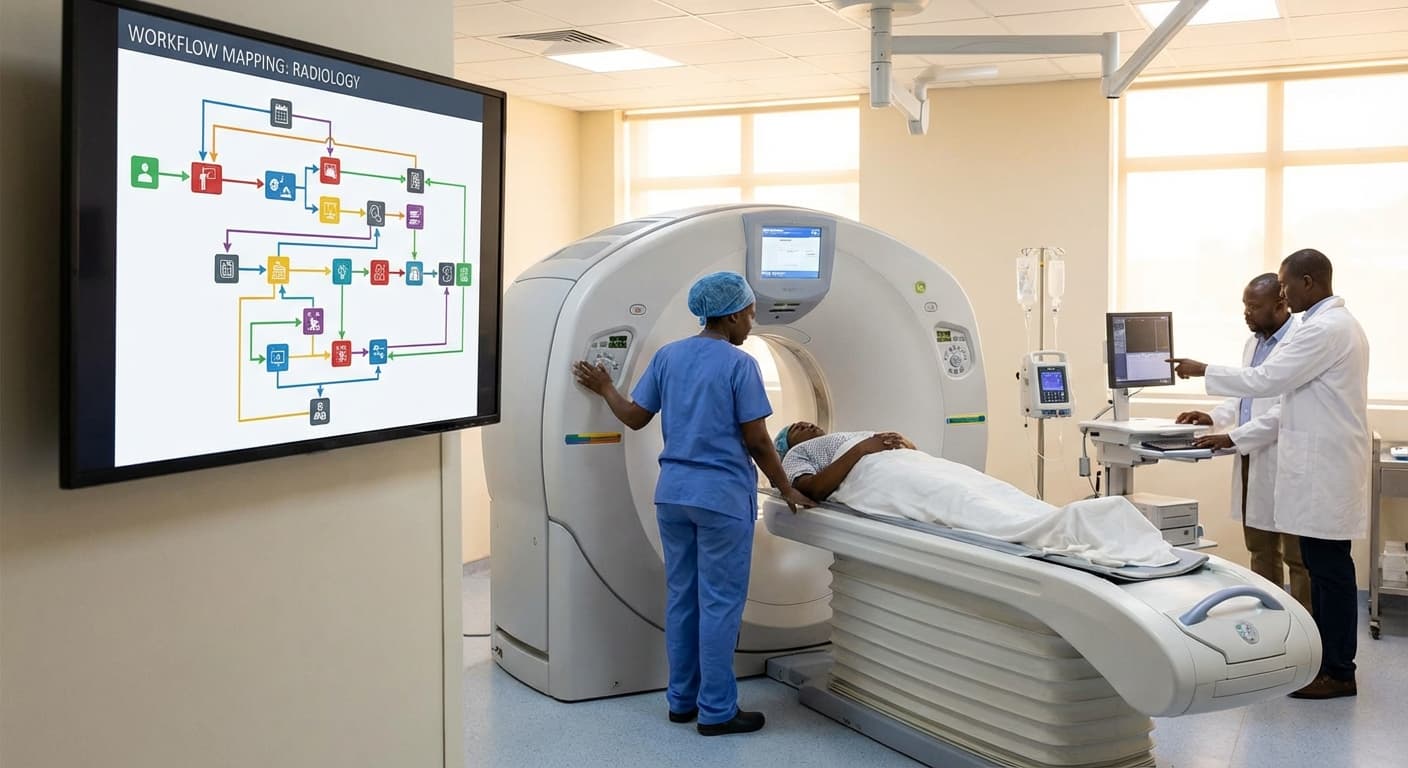
Department Workflow Mapping Service (Radiology/ICU/OT/Lab/Dialysis) in Namibia
Engineering Excellence & Technical Support
Department Workflow Mapping Service (Radiology/ICU/OT/Lab/Dialysis) High-standard technical execution following OEM protocols and local regulatory frameworks.
Optimized Radiology Patient Journey
Streamlined the entire radiology workflow in Namibian hospitals, from patient registration and appointment scheduling to image acquisition, interpretation, and report generation. This dramatically reduced wait times and improved diagnostic turnaround for crucial imaging services.
Enhanced ICU Resource Allocation
Mapped the complex ICU patient flow in Namibian healthcare facilities, leading to more efficient allocation of beds, specialized equipment, and medical personnel. This directly contributed to improved patient outcomes and optimized critical care resource utilization.
Streamlined Operating Theatre Scheduling & Throughput
Developed comprehensive workflow maps for Operating Theatres across Namibia, addressing patient pre-op, intra-op, and post-op phases. This resulted in improved theatre utilization, reduced cancellations, and a more predictable surgical schedule, enhancing patient safety and efficiency.
What Is Department Workflow Mapping Service (Radiology/icu/ot/lab/dialysis) In Namibia?
Department Workflow Mapping Service, within the Namibian healthcare context, refers to the systematic analysis, documentation, and optimization of operational processes within critical hospital departments such as Radiology, Intensive Care Units (ICU), Operating Theatres (OT), Laboratories (Lab), and Dialysis Centers. This service aims to achieve a comprehensive understanding of how tasks, information, and resources flow through these departments to identify inefficiencies, bottlenecks, and areas for improvement. It involves detailed observation, data collection, stakeholder interviews, and the creation of visual representations of current state workflows, followed by the design and proposal of optimized future state workflows. The objective is to enhance patient care delivery, improve resource utilization, increase staff productivity, ensure regulatory compliance, and ultimately reduce operational costs and improve patient outcomes.
| Department | Who Needs This Service | Typical Use Cases |
|---|---|---|
| Radiology | Hospital Administrators, Radiology Department Heads, Imaging Technologists, Radiologists, IT Departments (for PACS/RIS integration) | Optimizing patient scheduling and throughput for imaging procedures (e.g., X-ray, CT, MRI). Streamlining the reporting and communication of imaging findings. Improving workflow for contrast media administration and waste disposal. Enhancing image archival and retrieval processes. Integrating new imaging technologies into existing workflows. |
| Intensive Care Unit (ICU) | Hospital Administrators, ICU Directors/Managers, Critical Care Physicians, ICU Nurses, Respiratory Therapists, Pharmacy, Biomedical Engineering | Improving patient admission and discharge processes. Optimizing nurse-to-patient ratios and task delegation. Enhancing communication protocols between multidisciplinary teams. Streamlining the administration of complex medications and therapies. Improving the management of critical equipment and monitoring systems. Reducing patient length of stay through efficient care pathways. |
| Operating Theatre (OT) | Hospital Administrators, Surgical Department Heads, Anesthesiologists, Surgeons, Operating Room Nurses, Central Sterile Supply Department (CSSD) Staff, Biomedical Engineering | Optimizing surgical scheduling and room utilization. Streamlining patient preparation and handover to the OR. Improving the efficiency of instrument and supply management. Enhancing communication and coordination among the surgical team. Reducing operating room turnaround times between cases. Implementing standardized surgical checklists and protocols. |
| Laboratory (Lab) | Hospital Administrators, Laboratory Directors/Managers, Pathologists, Medical Technologists, Phlebotomists, IT Departments (for LIS integration), Supply Chain Management | Improving specimen collection, handling, and transportation workflows. Optimizing testing turnaround times for various analyses. Streamlining quality control procedures. Enhancing communication of laboratory results to clinicians. Improving inventory management for reagents and consumables. Integrating automation and new diagnostic platforms. |
| Dialysis Center | Hospital Administrators, Nephrology Department Heads, Dialysis Nurses, Nephrologists, Biomedical Engineering, Patient Services Staff | Optimizing patient scheduling for dialysis sessions. Streamlining the pre-dialysis assessment and preparation process. Enhancing the management of dialysis equipment and water purification systems. Improving medication administration during dialysis. Optimizing post-dialysis patient care and discharge. Enhancing infection control protocols within the dialysis unit. |
Key Components of Department Workflow Mapping Service:
- Current State Analysis: Detailed documentation of existing processes, including task sequences, decision points, information exchange, and resource allocation.
- Process Identification and Characterization: Defining key departmental activities, their dependencies, and their contribution to overall service delivery.
- Bottleneck Identification: Pinpointing stages in the workflow that impede efficiency, cause delays, or reduce throughput.
- Data Collection and Measurement: Gathering quantitative and qualitative data on process performance metrics (e.g., turnaround times, patient wait times, resource utilization rates).
- Stakeholder Engagement: Involving all relevant personnel (clinicians, technicians, administrative staff, management) to gain insights and ensure buy-in.
- Future State Design: Developing optimized workflows that address identified inefficiencies and incorporate best practices.
- Technology and System Integration Analysis: Evaluating how existing or proposed technological solutions can support and enhance workflows.
- Risk Assessment and Mitigation: Identifying potential risks within workflows and proposing strategies to mitigate them.
- Training and Implementation Support: Providing guidance and support for the adoption of new or modified workflows.
- Continuous Improvement Framework: Establishing mechanisms for ongoing monitoring and refinement of departmental processes.
Who Needs Department Workflow Mapping Service (Radiology/icu/ot/lab/dialysis) In Namibia?
In Namibia's healthcare landscape, optimizing operational efficiency is paramount, especially in critical departments. A Department Workflow Mapping Service can be invaluable for understanding, analyzing, and improving the intricate processes within Radiology, Intensive Care Units (ICUs), Operating Theaters (OTs), Laboratories, and Dialysis Centers. This service helps identify bottlenecks, reduce waste, enhance patient safety, and ultimately improve the quality of care delivered. Understanding the current state and charting a path for future improvement is crucial for these high-demand, specialized units.
| Target Customer/Department | Why They Need Workflow Mapping | Specific Benefits |
|---|---|---|
| Radiology Departments | High volume of patient scans, diverse imaging modalities, complex scheduling, and reporting procedures. | Reduced patient wait times for scans and results, improved equipment utilization, streamlined report turnaround, enhanced diagnostic accuracy through standardized processes. |
| Intensive Care Units (ICUs) | Critical patient management, rapid decision-making, interdisciplinary collaboration, strict protocols for patient care and monitoring. | Improved patient safety by identifying critical pathway deviations, optimized staff allocation and communication, faster response times to patient needs, reduced risk of medical errors. |
| Operating Theaters (OTs) | Complex surgical procedures, intricate scheduling of surgeons, anesthesiologists, and support staff, stringent sterilization and infection control protocols. | Minimized surgical delays and cancellations, improved operating room utilization, enhanced patient flow pre- and post-surgery, streamlined instrument and supply management, stronger infection control adherence. |
| Laboratories | High throughput of samples, diverse testing methodologies, strict quality control requirements, efficient specimen handling and processing. | Reduced turnaround time for test results, improved sample integrity and tracking, optimized reagent and consumable inventory, enhanced accuracy and reliability of diagnostic results, better compliance with laboratory standards. |
| Dialysis Centers | Scheduled patient treatments, strict adherence to treatment protocols, efficient patient flow, specialized equipment management, and infection prevention. | Smoother patient scheduling and reduced wait times for dialysis sessions, improved efficiency in patient preparation and post-treatment care, optimized staffing for treatment delivery, enhanced infection control practices, better management of dialysis consumables. |
Who Needs Department Workflow Mapping Service in Namibia?
- Public Hospitals (e.g., Windhoek Central Hospital, Oshakati State Hospital)
- Private Hospitals and Clinics
- Specialized Medical Centers
- Government Health Agencies
- Healthcare Management Consultants
Department Workflow Mapping Service (Radiology/icu/ot/lab/dialysis) Process In Namibia
This document outlines the typical workflow for engaging the Department Workflow Mapping Service for Radiology, Intensive Care Unit (ICU), Operating Theatre (OT), Laboratory, and Dialysis departments in Namibia. The service aims to analyze, document, and optimize existing processes within these critical healthcare units. The workflow encompasses the entire engagement lifecycle, from initial inquiry to the final delivery of workflow maps and recommendations.
| Stage | Description | Key Activities | Deliverables | Responsible Parties |
|---|---|---|---|---|
| Inquiry & Initial Consultation | The process begins with a healthcare facility in Namibia expressing interest in workflow mapping services for a specific department (Radiology, ICU, OT, Lab, or Dialysis). | Initial contact via phone, email, or website form. Discussion of needs, objectives, and general scope. Preliminary assessment of department functions. | Acknowledgement of inquiry. Confirmation of interest and next steps. | Client (Healthcare Facility), Service Provider (Workflow Mapping Team) |
| Scope Definition & Proposal | A detailed understanding of the project's boundaries, objectives, and expected outcomes is established. | On-site or virtual meeting to discuss specific departmental processes. Identification of key stakeholders and their roles. Defining the precise areas for mapping (e.g., patient journey, equipment utilization, staff interaction). Development of a detailed project proposal. | Formal Project Proposal including:
| Client (Healthcare Facility), Service Provider (Workflow Mapping Team) |
| Data Gathering & Analysis | Information about the current workflow is collected through various methods. | Observation of daily operations within the department. Interviews with staff at all levels (doctors, nurses, technicians, administrators). Review of existing documentation (SOPs, protocols, patient records). Time studies and process charting. | Raw data from observations and interviews. Initial process notes and observations. | Service Provider (Workflow Mapping Team), Client (Staff & Management) |
| Workflow Mapping & Documentation | The gathered data is translated into visual and textual representations of the current workflow. | Creation of process flow diagrams (e.g., using BPMN or similar notation). Detailed textual descriptions of each step, including roles, inputs, outputs, and decision points. Identification of bottlenecks and inefficiencies. | Current State Workflow Maps. Detailed process descriptions. | Service Provider (Workflow Mapping Team) |
| Review & Validation | The developed workflow maps are presented to the client for verification and feedback. | Presentation of draft workflow maps to key stakeholders. Facilitation of feedback sessions to ensure accuracy and completeness. Incorporation of validated changes into the maps. | Validated Current State Workflow Maps. List of confirmed and unconfirmed findings. | Service Provider (Workflow Mapping Team), Client (Key Stakeholders) |
| Recommendations & Optimization | Based on the validated workflow maps, suggestions for improvement are formulated. | Analysis of identified bottlenecks and inefficiencies. Brainstorming and development of potential solutions. Proposing optimized workflows, revised protocols, or technology integrations. Cost-benefit analysis of proposed changes (if applicable). | Report with detailed recommendations for workflow optimization. Proposed Future State Workflow Maps (optional). | Service Provider (Workflow Mapping Team) |
| Final Report & Handover | The complete project findings, validated maps, and recommendations are compiled into a final report. | Compilation of all deliverables into a comprehensive final report. Presentation of the final report to the client. Handover of all project documentation and assets. | Final Project Report. All project documentation and workflow maps. | Service Provider (Workflow Mapping Team), Client (Management) |
| Follow-up & Support (Optional) | Post-implementation support may be provided to assist with the adoption of new workflows. | Assistance with the implementation of recommended changes. Post-implementation review and adjustments. Training on new processes or tools. | Ongoing support as per agreement. | Service Provider (Workflow Mapping Team), Client (Healthcare Facility) |
Department Workflow Mapping Service Workflow Stages
- Inquiry & Initial Consultation
- Scope Definition & Proposal
- Data Gathering & Analysis
- Workflow Mapping & Documentation
- Review & Validation
- Recommendations & Optimization
- Final Report & Handover
- Follow-up & Support (Optional)
Department Workflow Mapping Service (Radiology/icu/ot/lab/dialysis) Cost In Namibia
The cost of Department Workflow Mapping services for Radiology, Intensive Care Units (ICU), Operating Theatres (OT), Laboratories, and Dialysis departments in Namibia can vary significantly based on several factors. This service involves a detailed analysis and documentation of existing processes, identification of bottlenecks, and recommendations for optimization to improve efficiency, patient care, and resource utilization. The pricing is generally project-based and reflects the complexity and scope of the work involved.
| Department Type | Estimated Cost Range (NAD) | Notes |
|---|---|---|
| Radiology | 15,000 - 50,000+ | Depends on the volume of imaging services, complexity of reporting workflows, and integration with EMR/PACS. |
| Intensive Care Unit (ICU) | 20,000 - 60,000+ | Involves complex patient monitoring, multidisciplinary team coordination, and critical care pathways. Higher end for critical care pathways and resource management. |
| Operating Theatre (OT) | 25,000 - 70,000+ | Focuses on surgical scheduling, patient preparation, intra-operative processes, and post-operative care. Includes staff allocation and equipment utilization. |
| Laboratory | 12,000 - 40,000+ | Covers specimen handling, testing workflows, quality control procedures, and results reporting. Complexity of tests and automation level are factors. |
| Dialysis | 18,000 - 55,000+ | Includes patient scheduling, pre-treatment assessment, dialysis procedure management, and post-treatment monitoring. Focus on patient safety and throughput. |
Key Pricing Factors for Department Workflow Mapping in Namibia:
- Department Size and Complexity: Larger departments with more staff, specialized equipment, and intricate patient pathways will naturally incur higher costs. The number of distinct processes to be mapped also plays a role.
- Scope of the Project: The breadth of the mapping exercise is crucial. This can range from mapping a single, specific process (e.g., patient admission to ICU) to a comprehensive overhaul of an entire department's workflow. Additional services like system integration analysis or training development will increase costs.
- Consultant Experience and Expertise: The reputation, experience, and specialized knowledge of the consulting firm or individual consultant are significant drivers of cost. Consultants with a proven track record in healthcare workflow optimization, particularly within the Namibian context, will command higher fees.
- Duration of the Project: The estimated time required to complete the assessment, analysis, and reporting phases directly impacts the overall cost. Projects requiring longer engagement periods will be more expensive.
- Data Collection and Analysis Intensity: The depth of data required and the methods of collection (e.g., direct observation, interviews, surveys, system data extraction) will influence the effort and therefore the cost.
- Deliverables Required: The format and comprehensiveness of the final deliverables (e.g., detailed process maps, gap analysis reports, implementation roadmaps, training materials) will affect pricing.
- Travel and Accommodation: For consultants not based in the immediate vicinity of the healthcare facility, travel and accommodation expenses within Namibia will be added to the project cost.
- Technology Used: The use of specialized workflow mapping software or analytical tools by the consultant can also influence the pricing.
Affordable Department Workflow Mapping Service (Radiology/icu/ot/lab/dialysis) Options
Our Affordable Department Workflow Mapping Service provides comprehensive analysis and optimization for critical hospital departments, including Radiology, ICU, Operating Theatre (OT), Laboratory, and Dialysis. We aim to identify bottlenecks, streamline processes, improve efficiency, and ultimately reduce operational costs and enhance patient care. Our services are designed to be accessible and deliver tangible value through carefully curated 'value bundles' and strategic cost-saving initiatives.
| Cost-Saving Strategy | Description | Potential Impact |
|---|---|---|
| Bottleneck Identification & Elimination | Pinpointing areas of delay, redundancy, or inefficiency in current workflows. | Reduced patient wait times, increased throughput, optimized resource utilization. |
| Lean Process Implementation | Applying Lean principles to minimize waste (time, resources, movement) in daily operations. | Significant reduction in operational expenses, improved staff productivity. |
| Technology Integration & Automation | Recommending and integrating appropriate technologies (e.g., EMR enhancements, scheduling software, automated equipment) to streamline tasks. | Reduced manual labor, minimized errors, enhanced data accuracy, faster processing. |
| Staff Skill Optimization & Cross-Training | Ensuring staff are optimally utilized and cross-trained to cover various tasks, improving flexibility. | Reduced reliance on specialized staff, improved coverage during absences, enhanced team efficiency. |
| Inventory & Supply Chain Management | Analyzing and optimizing the flow of supplies to reduce waste and ensure availability. | Lowered procurement costs, reduced stockouts, minimized obsolescence. |
| Standardized Operating Procedures (SOPs) | Developing and implementing clear, consistent SOPs for all critical tasks. | Reduced variation in outcomes, improved quality of care, easier training for new staff. |
Our Value Bundles
- {"title":"Basic Workflow Assessment (Entry-Level)","description":"Ideal for departments needing an initial overview. Includes 1-2 department mapping sessions, identification of major pain points, and a high-level optimization report."}
- {"title":"Standard Process Optimization (Mid-Tier)","description":"For departments seeking deeper analysis and actionable insights. Includes 3-4 department mapping sessions, detailed bottleneck analysis, proposed process improvements with potential ROI, and a comprehensive implementation roadmap."}
- {"title":"Comprehensive Department Integration (Premium)","description":"Designed for multi-departmental coordination and enterprise-wide efficiency. Includes mapping of multiple interconnected departments, inter-departmental workflow analysis, advanced technology integration recommendations, change management support, and ongoing monitoring strategy."}
- {"title":"Specialized Department Focus (Add-on)","description":"Tailored solutions for specific departmental needs, such as patient flow optimization in the ICU, turnaround time reduction in the Lab, or sterile processing efficiency in the OT."}
Verified Providers In Namibia
When seeking healthcare in Namibia, ensuring you are engaging with verified providers is paramount. This commitment to quality and authenticity is precisely what Franance Health embodies. Their rigorous credentialing process sets them apart, assuring patients of the highest standards of care, expertise, and ethical practice. Choosing Franance Health means opting for a network of medical professionals who have undergone thorough vetting, guaranteeing you peace of mind and access to the best possible healthcare solutions.
| Credential Type | Verification Process | Benefit to Patient | Franance Health's Commitment |
|---|---|---|---|
| Medical Licenses & Certifications | Cross-referencing with national and international licensing bodies. | Confirms legal and authorized practice. | Mandatory submission and verification of all relevant licenses. |
| Educational Background | Verification of degrees and diplomas from accredited institutions. | Ensures foundational knowledge and training. | Thorough checks of academic transcripts and degrees. |
| Professional Experience | Validation of past employment and roles. | Demonstrates practical application of skills. | Reference checks and verification of work history. |
| Specializations & Fellowships | Confirmation of advanced training and sub-specialty qualifications. | Access to highly specialized medical expertise. | Verification of all specialized training and certifications. |
| Ethical Conduct Records | Background checks for any disciplinary actions or malpractice claims. | Guarantees patient-centric and ethical treatment. | Rigorous checks for any professional misconduct. |
Why Franance Health Credentials Matter
- Patient Safety Assurance: Verified providers have met stringent safety protocols.
- Expertise Validation: Credentials confirm specialized knowledge and skills.
- Ethical Practice Standards: Commitment to professional conduct and patient well-being.
- Trust and Reliability: Peace of mind knowing you are in qualified hands.
- Access to Quality Care: Network of vetted professionals for comprehensive health needs.
Scope Of Work For Department Workflow Mapping Service (Radiology/icu/ot/lab/dialysis)
This document outlines the Scope of Work (SOW) for a Department Workflow Mapping Service, focusing on critical hospital departments: Radiology, Intensive Care Unit (ICU), Operating Theater (OT), Laboratory (Lab), and Dialysis. The service aims to analyze, document, and optimize existing workflows within these departments to enhance efficiency, reduce errors, and improve patient care. The technical deliverables will provide a comprehensive understanding of current processes and actionable recommendations for improvement, adhering to standard specifications.
| Phase | Activities | Deliverables | Standard Specifications |
|---|---|---|---|
| Phase 1: Project Initiation & Planning | Kick-off meeting with stakeholders; Define project scope and objectives; Identify key personnel and subject matter experts (SMEs); Develop project plan and timeline; Establish communication protocols. | Project Charter; Stakeholder Register; Detailed Project Plan; Communication Plan. | Adherence to established project management methodologies (e.g., PRINCE2, Agile); Clear definition of roles and responsibilities; Agreed-upon communication frequency and channels. |
| Phase 2: Current State Analysis & Data Gathering | Conduct interviews with department staff (physicians, nurses, technicians, administrative); Observe workflows in real-time; Collect existing documentation (SOPs, policies, forms); Document current process maps using standardized notation (e.g., BPMN 2.0); Identify pain points, bottlenecks, and inefficiencies. | Current State Workflow Maps (as-is); Process Analysis Report; Data Collection Summary. | Use of standardized flowcharting tools (e.g., Visio, Lucidchart); Consistent use of Business Process Model and Notation (BPMN 2.0) or equivalent; Objective data collection and unbiased observation. |
| Phase 3: Future State Design & Recommendations | Facilitate workshops with SMEs to brainstorm improvements; Design optimized 'to-be' workflows; Develop recommendations for process standardization, technology integration, resource allocation, and training; Prioritize recommendations based on impact and feasibility. | Future State Workflow Maps (to-be); Recommendations Report (including prioritization); Gap Analysis Report. | Focus on Lean principles, Six Sigma methodologies, and best practices for healthcare workflows; Evidence-based recommendations supported by data; Consideration of regulatory compliance (e.g., HIPAA, JCI). |
| Phase 4: Documentation & Reporting | Compile all deliverables into a comprehensive report; Present findings and recommendations to stakeholders; Obtain stakeholder sign-off on the final report. | Final Workflow Mapping Report (including all current and future state maps, analysis, and recommendations); Presentation Slides; Stakeholder Sign-off Document. | Clear, concise, and well-organized report structure; Professional presentation of data and insights; Timely delivery of all documentation. |
Key Departments Covered
- Radiology
- Intensive Care Unit (ICU)
- Operating Theater (OT)
- Laboratory (Lab)
- Dialysis
Service Level Agreement For Department Workflow Mapping Service (Radiology/icu/ot/lab/dialysis)
This Service Level Agreement (SLA) outlines the agreed-upon performance standards for the Department Workflow Mapping Service provided to Radiology, Intensive Care Unit (ICU), Operating Theatre (OT), Laboratory, and Dialysis departments. This SLA ensures consistent service availability and timely support for critical departmental workflows.
| Service Component | Response Time Guarantee (Business Hours) | Uptime Guarantee |
|---|---|---|
| Initial Workflow Mapping Request (New Department/Major Process Change) | 5 Business Days for initial consultation and project plan | N/A (Project-based, scope defined per project) |
| Minor Workflow Update/Revision Request | 2 Business Days for acknowledgment and initiation of work | N/A (Project-based, scope defined per project) |
| Workflow Documentation Access (via designated platform) | 1 Business Hour for system access issues | 99.5% during business hours (08:00 - 18:00, Mon-Fri) |
| Technical Support for Workflow Mapping Platform | 4 Business Hours for non-critical issues, 1 Business Hour for critical issues (affecting access or core functionality) | 99.5% during business hours (08:00 - 18:00, Mon-Fri) |
| Consultation on Workflow Optimization | 3 Business Days for scheduling a consultation after request | N/A (Consultation-based) |
Scope of Service
- The Service includes the analysis, documentation, and visualization of current state workflows within the specified departments.
- The Service also encompasses the identification of inefficiencies and the proposal of optimized future state workflows.
- Ongoing maintenance and updates to documented workflows as per agreed-upon change management processes.
Frequently Asked Questions

Ready when you are
Let's scope your Department Workflow Mapping Service (Radiology/ICU/OT/Lab/Dialysis) in Namibia project in Namibia.

Scaling healthcare logistics and technical systems across the entire continent.