
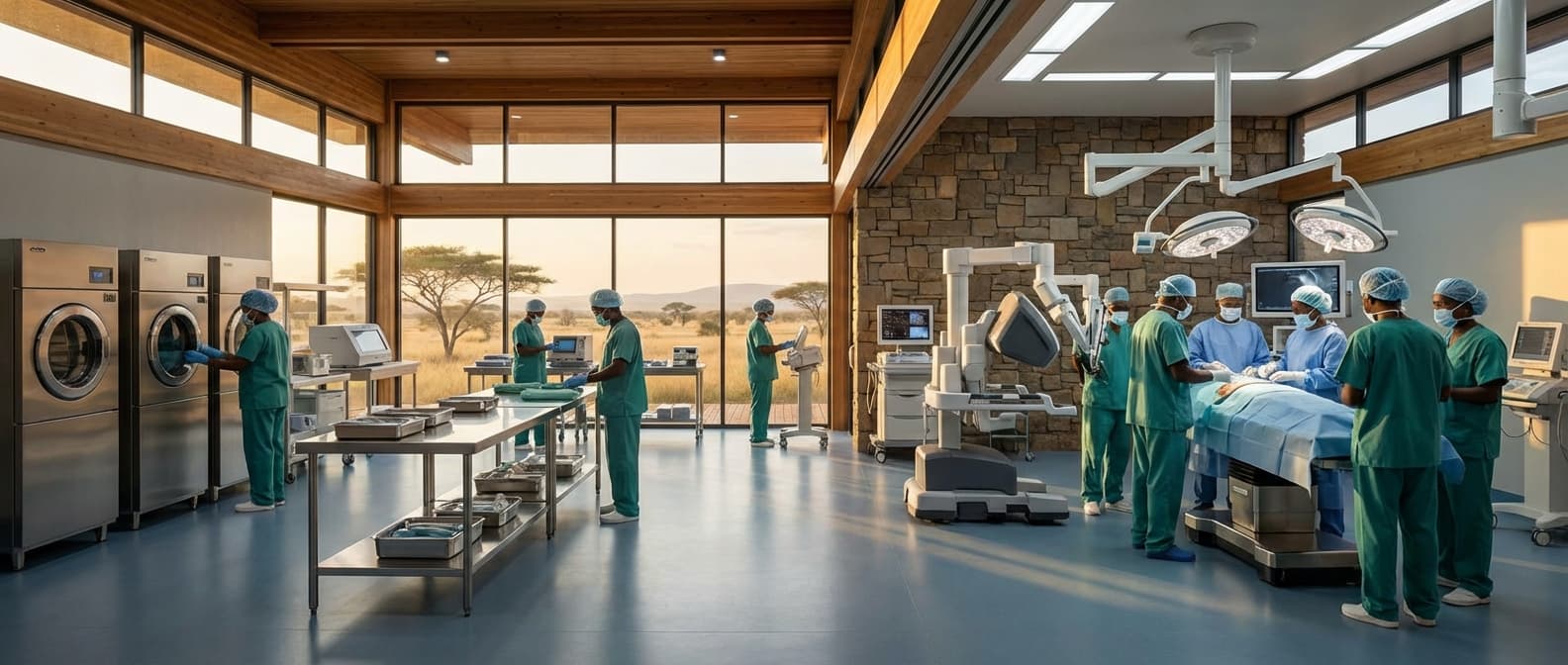
Operating Theatre Turnkey Build in Namibia
Engineering Excellence & Technical Support
Complete OR design, equipment integration and commissioning High-standard technical execution following OEM protocols and local regulatory frameworks.
Advanced Anesthesia Gas Scavenging Systems
Implementation of state-of-the-art anesthesia gas scavenging systems (AGSS) designed for optimal patient and staff safety, adhering to international standards, and ensuring efficient removal of waste anesthetic gases, crucial for sterile environments.
High-Efficiency Particulate Air (HEPA) Filtration Integration
Seamless integration of HEPA filtration systems throughout the operating theatre, creating ultra-clean air environments with controlled airflow patterns (laminar flow) to significantly reduce the risk of surgical site infections and maintain optimal sterility.
Integrated Surgical Workflow Automation Solutions
Deployment of intelligent surgical workflow automation solutions, including advanced lighting systems, integrated imaging displays, and remote consultation capabilities, designed to enhance surgical precision, streamline procedures, and improve overall theatre efficiency for complex interventions.
What Is Operating Theatre Turnkey Build In Namibia?
An Operating Theatre Turnkey Build in Namibia refers to a comprehensive, end-to-end service for the design, construction, equipping, and commissioning of a fully functional operating theatre suite. This approach consolidates all aspects of the project under a single contractor or consortium, ensuring seamless integration and project completion from conceptualization to handover. It eliminates the need for the client to manage multiple vendors and subcontractors, streamlining the process and minimizing potential delays and cost overruns. The service encompasses architectural design optimized for sterile environments, structural modifications, installation of specialized HVAC systems for air filtration and pressure control, medical gas reticulation, electrical infrastructure compliant with healthcare standards, lighting systems, plumbing, and the integration of all surgical equipment and furniture. Quality assurance, regulatory compliance, and validation of all systems are integral components.
| Who Needs It? | Typical Use Cases | ||
|---|---|---|---|
| Hospitals (Public & Private): Seeking to expand or upgrade existing surgical capacity, establish new specialized surgical units, or replace outdated facilities. | Establishment of new surgical departments or centers of excellence. | Replacement of aging or non-compliant operating theatre infrastructure. | Expansion of surgical services to meet increasing patient demand. |
| Specialized Clinics: Facilities focusing on specific surgical disciplines (e.g., cardiac, orthopedic, ophthalmology) that require dedicated, state-of-the-art operating environments. | Development of specialized surgical centers (e.g., day surgery units, minimally invasive surgery suites). | Outfitting of new clinic facilities with integrated surgical capabilities. | |
| Government Health Ministries & Agencies: Responsible for developing or improving public healthcare infrastructure across the nation. | Upgrading national hospital surgical facilities. | Establishing new regional surgical hubs. | Implementing standardized operating theatre designs for national healthcare initiatives. |
| Research & Academic Institutions: Requiring advanced surgical facilities for training, research, and clinical practice. | Setting up training operating theatres for medical professionals. | Integrating research capabilities within clinical surgical environments. |
Key Inclusions in an Operating Theatre Turnkey Build:
- Architectural & Engineering Design (including sterile zone planning, workflow optimization)
- Civil Works & Construction (structural, walls, flooring, ceilings)
- Specialized HVAC Systems (HEPA filtration, laminar flow, pressure differentials)
- Medical Gas Reticulation (oxygen, medical air, vacuum, nitrous oxide)
- Electrical Infrastructure (redundant power, UPS, specialized outlets)
- Lighting Systems (surgical lights, ambient lighting)
- Plumbing & Sanitary Systems (sterilization, waste management)
- Infection Control Measures (antimicrobial surfaces, sealed joints)
- Integration of Surgical Equipment (operating tables, anesthesia machines, imaging devices)
- Installation of Surgical Furniture & Fixtures (storage cabinets, instrument trays)
- IT & Communication Infrastructure (data connectivity, nurse call systems)
- Commissioning & Validation (performance testing, regulatory compliance verification)
- Training of Personnel (equipment operation, maintenance)
- Project Management & Consultancy
Who Needs Operating Theatre Turnkey Build In Namibia?
Operating Theatre Turnkey Build in Namibia refers to the comprehensive service of designing, constructing, equipping, and commissioning a fully functional operating theatre suite. This integrated approach ensures that hospitals and healthcare facilities in Namibia can acquire state-of-the-art surgical environments with minimal disruption and maximum efficiency. Turnkey solutions streamline the complex process of creating a surgical space, from initial architectural plans to the final sterile environment ready for patient care.
| Customer Type | Typical Departments/Needs |
|---|---|
| Public Hospitals and National Health Facilities | General Surgery, Obstetrics & Gynecology, Orthopedics, Emergency Surgery, Ophthalmology, ENT, Urology. |
| Private Hospitals and Clinics | Specialized surgeries (e.g., Cardiology, Neurosurgery, Bariatric Surgery), Advanced General Surgery, Day Surgery Units, Elective Procedures. |
| Specialized Surgical Centers | Focus on specific disciplines like orthopedic implants, cosmetic surgery, or minimally invasive procedures. |
| Rural and Remote Healthcare Facilities | Essential surgical capabilities for trauma, emergency obstetric care, and basic surgical interventions to reduce patient referral distances. |
| Tertiary and Referral Hospitals | Advanced and complex surgical suites to support specialized medical teams and cutting-edge procedures. Often require multiple integrated theatres. |
| Veterinary Hospitals | Dedicated surgical suites for a range of animal surgeries, from routine spays to complex orthopedic or oncological procedures. |
Target Customers and Departments for Operating Theatre Turnkey Builds in Namibia
- Public Hospitals and National Health Facilities
- Private Hospitals and Clinics
- Specialized Surgical Centers
- Rural and Remote Healthcare Facilities
- Tertiary and Referral Hospitals
- Veterinary Hospitals (requiring surgical suites)
Operating Theatre Turnkey Build Process In Namibia
The turnkey operating theatre build process in Namibia encompasses a comprehensive workflow, starting from the initial client inquiry and culminating in the fully functional, operational theatre suite. This meticulous process ensures that all aspects, from design and engineering to construction, equipment installation, and commissioning, are handled efficiently and to the highest standards, adhering to Namibian regulations and international best practices. The objective is to deliver a seamless and ready-to-use surgical environment.
| Stage | Description | Key Activities | Deliverables/Outcomes |
|---|---|---|---|
| The starting point where a client (hospital, clinic, government entity) expresses interest and outlines their requirements for a new or renovated operating theatre. | Receive and review client brief, understand scope, discuss preliminary requirements (size, number of theatres, specializations), initial budget discussions. | Client brief documented, understanding of project scope and preliminary needs. |
| Evaluating the viability of the project based on the identified needs and the proposed site in Namibia. | Site visits, structural assessments, utility availability checks (power, water, medical gases), regulatory compliance review, preliminary risk assessment. | Feasibility report, site assessment findings, preliminary risk register. |
| Developing a high-level design concept and providing an initial cost estimate. | Space planning, basic layout proposals, defining key functional areas, preliminary equipment list, cost estimation based on conceptual design and market rates. | Conceptual design drawings, preliminary budget, project timeline overview. |
| Developing comprehensive architectural, structural, MEP, and specialized theatre design drawings. | Architectural design (layouts, elevations, sections), structural engineering, HVAC design (airflow, pressure differentials), electrical systems (power, lighting, UPS), plumbing, medical gas systems, acoustic design, infection control considerations. | Complete set of detailed design drawings, specifications, Bill of Quantities (BoQ). |
| Securing all necessary permits and approvals from relevant Namibian authorities. | Submitting design documents to municipal councils, Ministry of Health and Social Services, fire safety authorities, environmental impact assessments (if required). | Building permits, occupation certificates, compliance certificates. |
| Sourcing and procuring all materials, equipment, and services required for the build. | Tendering processes, supplier selection, contract negotiation, material sourcing (local and international), logistics planning, quality control of procured items. | Procurement plan, signed supplier contracts, delivered materials and equipment. |
| The physical construction of the operating theatre building or renovation. | Site preparation, foundation work, structural erection, wall construction, roofing, flooring, internal partitioning. | Completed building shell, structural integrity. |
| Installation of all essential building services. | Installation of HVAC systems, electrical wiring, power distribution, lighting, backup power (generators, UPS), water supply, drainage, medical gas pipework. | Functional MEP systems, pre-commissioning checks. |
| Applying finishes and installing specialized components unique to operating theatres. | Wall and ceiling finishes (anti-microbial, seamless), specialized flooring, installation of theatre doors, viewing windows, lighting fixtures, cabinetry, scrub sinks, waste management systems. | Completed interior finishes, ready for equipment installation. |
| Acquiring and installing all surgical and supporting medical equipment. | Surgical lights, operating tables, anesthesia machines, monitors, imaging equipment, sterilization units, essential consumables. | Installed and calibrated medical equipment. |
| Rigorous testing and validation to ensure all systems and equipment function as per design and regulatory standards. | MEP system testing, air quality and pressure differential verification, electrical safety checks, medical gas purity and pressure testing, equipment functional testing, infection control validation. | Commissioning reports, validation certificates, functional performance reports. |
| Training the hospital staff on the operation and maintenance of the new theatre and formally handing over the facility. | User training on medical equipment, building systems (HVAC, lighting), infection control protocols. Project documentation handover, keys, operational manuals. | Trained staff, comprehensive project documentation, officially handed-over operating theatre. |
| Providing ongoing support and maintenance services after the project completion. | Warranty management, scheduled maintenance, troubleshooting, spare parts provision, ongoing technical support. | Sustained operational efficiency, proactive maintenance, client satisfaction. |
Operating Theatre Turnkey Build Process in Namibia: Workflow Stages
- Initial Inquiry & Needs Assessment
- Feasibility Study & Site Assessment
- Conceptual Design & Budgeting
- Detailed Design & Engineering
- Regulatory Approvals & Permitting
- Procurement & Supply Chain Management
- Construction & Civil Works
- MEP (Mechanical, Electrical, Plumbing) Installation
- Specialized Theatre Fit-Out & Finishes
- Medical Equipment Procurement & Installation
- Testing, Commissioning & Validation
- Training & Handover
- Post-Completion Support & Maintenance
Operating Theatre Turnkey Build Cost In Namibia
The cost of a turnkey operating theatre build in Namibia can vary significantly based on several crucial factors. These elements influence the overall price, from the initial design and construction to the installation of specialized medical equipment and finishes. Understanding these pricing factors is essential for accurate budgeting and project planning.
Key pricing factors include:
- Size and Complexity: Larger operating theatres with more complex layouts, requiring specialized infrastructure like laminar flow systems or advanced imaging integration, will naturally incur higher costs.
- Level of Specialization: The intended use of the operating theatre (e.g., general surgery, orthopedics, cardiology, neurosurgery) dictates the specific equipment, sterile environments, and technological integrations required, directly impacting the budget.
- Material and Finish Quality: The choice of durable, anti-microbial, and high-grade materials for walls, floors, and ceilings, along with specialized lighting and cabinetry, contributes to the overall cost. Luxury or premium finishes will increase the price.
- Medical Equipment: This is often the most substantial component of the budget. The type, brand, and quantity of surgical lights, tables, anesthesia machines, monitors, imaging equipment (X-ray, C-arm), sterilization units, and other specialized instruments will heavily influence the final cost.
- HVAC and Sterilization Systems: Advanced HEPA filtration, positive pressure systems, and sophisticated air handling units (AHUs) are critical for maintaining a sterile environment and are a significant investment.
- Electrical and Plumbing Infrastructure: Robust electrical systems with backup power (generators/UPS), specialized medical gas outlets, and specialized plumbing for waste disposal and decontamination are essential and add to the cost.
- Regulatory Compliance and Certifications: Meeting stringent local and international healthcare building codes and obtaining necessary certifications can involve additional design, construction, and inspection costs.
- Architectural and Engineering Design Fees: Professional design services are crucial for planning and ensuring functionality, safety, and compliance. Fees vary based on the complexity and experience of the professionals.
- Construction Labour and Subcontractors: The cost of skilled labour, including specialized trades for medical gas installation, cleanroom construction, and equipment integration, will impact the overall price.
- Project Management: Effective project management ensures smooth execution, timely completion, and adherence to budget. This service has associated costs.
- Geographic Location within Namibia: While not as significant as other factors, regional differences in material availability and labour costs might have a minor impact.
- Turnkey Provider's Margin: Different providers will have varying overheads and profit margins, influencing the final quoted price.
Estimated Cost Ranges in Namibian Dollars (NAD):
It is challenging to provide precise figures without detailed project specifications. However, based on general industry trends and considering the factors above, a rough estimate for a basic to moderately equipped turnkey operating theatre build in Namibia could range from NAD 5,000,000 to NAD 20,000,000 or more. This range can be significantly higher for highly specialized, state-of-the-art facilities with cutting-edge equipment.
Breakdown of Potential Costs (Illustrative - Not Exhaustive):
- Design & Planning: NAD 200,000 - NAD 1,000,000+
- Civil Works & Construction: NAD 2,000,000 - NAD 8,000,000+
- Medical Equipment (Basic to Advanced): NAD 2,500,000 - NAD 15,000,000+
- HVAC & Sterilization Systems: NAD 500,000 - NAD 3,000,000+
- Electrical & Plumbing: NAD 300,000 - NAD 1,500,000+
- Finishes & Fit-out: NAD 400,000 - NAD 2,000,000+
- Project Management & Contingency: Typically 10-20% of the total project cost.
Important Note: These are broad estimates. Obtaining detailed quotes from reputable turnkey providers in Namibia is crucial for an accurate assessment specific to your project requirements.
| Cost Component | Estimated Range (NAD) | Notes |
|---|---|---|
| Design & Planning | 200,000 - 1,000,000+ | Depends on project scope and consultant fees |
| Civil Works & Construction | 2,000,000 - 8,000,000+ | Covers structure, walls, floors, ceilings, and basic infrastructure |
| Medical Equipment | 2,500,000 - 15,000,000+ | Highly variable based on type, brand, and quantity (lights, tables, monitors, etc.) |
| HVAC & Sterilization Systems | 500,000 - 3,000,000+ | Critical for sterile environment, includes filtration and air handling |
| Electrical & Plumbing | 300,000 - 1,500,000+ | Includes specialized medical gas outlets, backup power, and waste management |
| Finishes & Fit-out | 400,000 - 2,000,000+ | Includes specialized flooring, wall coverings, cabinetry, and lighting |
| Project Management & Contingency | 10-20% of Total Project Cost | Essential for oversight, risk management, and unforeseen expenses |
| Total Estimated Project Cost (Basic to Moderate) | 5,000,000 - 20,000,000+ | This is a general estimate; highly specialized theatres will be significantly higher. |
Key Pricing Factors for Operating Theatre Turnkey Builds in Namibia
- Size and Complexity of the Operating Theatre
- Level of Specialization and Intended Use
- Quality of Materials and Finishes Used
- Scope and Type of Medical Equipment Included
- Requirements for HVAC and Sterilization Systems
- Complexity of Electrical and Plumbing Infrastructure
- Adherence to Regulatory Standards and Certifications
- Architectural and Engineering Design Fees
- Costs Associated with Construction Labour and Subcontractors
- Project Management Services
- Geographic Location within Namibia
- Turnkey Provider's Business Model and Margin
Affordable Operating Theatre Turnkey Build Options
Building or upgrading an operating theatre is a significant investment. Fortunately, several affordable operating theatre turnkey build options are available, designed to provide complete, functional spaces without the exorbitant costs often associated with bespoke projects. These options often leverage pre-engineered solutions, standardized designs, and efficient project management to deliver value. Understanding value bundles and implementing cost-saving strategies are crucial to maximizing your budget. Value bundles typically encompass all essential components and services required for a fully operational theatre, simplifying the procurement process and often resulting in better overall pricing. Cost-saving strategies focus on smart choices at every stage, from initial design to material selection and technology integration.
| Value Bundle Type | Included Components/Services | Typical Benefits | Potential Cost Savings |
|---|---|---|---|
| Basic Functional Theatre Bundle | Modular theatre room, standard surgical lights, basic operating table, integrated medical gases, basic HVAC, essential wall/floor finishes, project management. | Rapid deployment, reduced complexity, predictable costs, immediate functionality for standard procedures. | Lower upfront capital expenditure, reduced design fees, faster ROI due to quicker operational readiness. |
| Enhanced Diagnostic & Minor Procedure Bundle | Includes all from Basic Bundle, plus imaging integration capabilities (e.g., basic X-ray or ultrasound mounts), advanced surgical lighting with camera options, adjustable operating table with more features, enhanced infection control measures. | Versatility for a wider range of procedures, improved diagnostic capabilities, better patient safety and ergonomics. | Economies of scale on bundled equipment, reduced costs compared to procuring individual advanced components, streamlined integration of diagnostic tools. |
| Specialized Procedure Outfitting Bundle | Focuses on outfitting existing spaces or modular rooms with specialized equipment for specific disciplines (e.g., orthopedics, laparoscopy). Includes discipline-specific operating tables, advanced lighting, instrument trays, and potential for integrated AV/recording. | Tailored solutions for specific clinical needs, improved efficiency for specialized surgeries, higher patient outcomes. | Bulk purchasing discounts on specialized equipment, optimized workflow design reducing procedure times, avoiding over-specification of non-essential features. |
Key Components of Affordable Turnkey Operating Theatre Builds
- Modular or Prefabricated Construction: Utilizing pre-built modules or prefabricated components significantly reduces on-site construction time and labor costs.
- Standardized Design Packages: Pre-defined theatre layouts and specifications streamline the design process and allow for economies of scale in manufacturing.
- Integrated HVAC and Medical Gases: Turnkey solutions often include the seamless integration of essential air handling and medical gas systems.
- Core Surgical Equipment: This can include essential lighting, tables, and basic instrument stands, often offered in bundled packages.
- Basic Infection Control Systems: Turnkey options typically incorporate fundamental infection control measures like specialized flooring, wall finishes, and air filtration.
- Project Management and Installation: A comprehensive package includes professional project oversight and the complete installation of all components.
- Training and Handover: Often includes basic training on the installed systems and a formal handover process.
Verified Providers In Namibia
Navigating the healthcare landscape in Namibia can be challenging, and ensuring you are receiving care from verified and reputable providers is paramount. Franance Health stands out as a leading organization committed to excellence in healthcare delivery. This document outlines their credentials and explains why they represent the best choice for your health needs in Namibia.
| Credential/Attribute | Description | Why it Matters for You |
|---|---|---|
| Accreditation & Compliance | Franance Health partners with facilities and professionals who meet national and international healthcare standards, including relevant Namibian health regulations. | Ensures that the care you receive is safe, effective, and delivered by compliant practitioners. |
| Expert Medical Network | Access to a curated list of specialists, general practitioners, and allied health professionals with proven expertise and experience. | Guarantees you are connected with qualified individuals best suited to address your specific medical concerns. |
| Service Quality Assurance | Ongoing monitoring and evaluation of partner providers to maintain high standards of patient care and satisfaction. | Provides peace of mind knowing that your healthcare experience is consistently positive and of a high standard. |
| Affordability & Accessibility | Works to make quality healthcare more accessible and affordable through network benefits and streamlined processes. | Reduces financial barriers to receiving necessary medical treatment and ensures you can access care when you need it. |
| Referral Network Management | Efficient and reliable referral systems to ensure seamless transitions between different levels of care or specialists. | Minimizes delays and ensures you receive appropriate care without unnecessary complications or waiting times. |
Franance Health: A Commitment to Excellence
- Rigorous Vetting Process: Franance Health implements a stringent selection process for all its healthcare partners, ensuring adherence to the highest clinical standards and ethical practices.
- Comprehensive Network: They have cultivated a diverse network of healthcare facilities and professionals across Namibia, offering a wide range of specialties and services.
- Patient-Centric Approach: A core tenet of Franance Health's philosophy is prioritizing the patient experience, focusing on accessibility, quality care, and efficient service delivery.
- Technological Integration: They leverage modern technological solutions to streamline administrative processes, improve communication, and enhance the overall efficiency of healthcare services.
- Continuous Quality Improvement: Franance Health is dedicated to ongoing evaluation and improvement of their services, consistently seeking feedback and implementing best practices.
Scope Of Work For Operating Theatre Turnkey Build
This document outlines the Scope of Work (SOW) for a turnkey Operating Theatre (OT) build project. It details the technical deliverables and standard specifications required for the successful design, construction, installation, commissioning, and handover of a state-of-the-art operating theatre facility. The SOW is structured to ensure clarity, comprehensiveness, and adherence to industry best practices and regulatory requirements.
| Category | Standard Specification | Key Features/Requirements |
|---|---|---|
| Construction Materials | Antimicrobial, Seamless, Non-porous Surfaces | Durable, easy to clean, resistant to chemicals and disinfectants (e.g., epoxy flooring, composite wall panels). |
| HVAC System | ISO 14644 Class 7 or 8 (or higher as required) | Positive pressure differential, HEPA filtration (99.97% efficient for 0.3 microns), redundant fan systems, temperature and humidity control (e.g., 20-24°C, 40-60% RH). |
| Lighting | High Color Rendering Index (CRI > 90), adjustable intensity and color temperature | Shadow-free surgical lighting, sufficient ambient lighting for general procedures, emergency lighting with backup power. |
| Medical Gas Pipeline System (MGPS) | BS EN 737-1 / ISO 7396-1 compliant | Nitrous Oxide, Medical Air, Oxygen, Vacuum, etc. with appropriate pressure regulators and alarm systems. |
| Electrical System | Compliance with IEC 60364-7-710 and local electrical codes | Dedicated circuits for medical equipment, medical IT power systems, surge protection, grounding, and emergency power (UPS, generator). |
| Infection Control | Design to minimize microbial load and facilitate terminal cleaning | Smooth surfaces, coved skirting, integrated waste disposal points, UV-C disinfection integration (optional). |
| Acoustics | Noise Reduction Coefficient (NRC) as per acoustic standards | Minimized noise from equipment and external sources, sound-absorbing materials. |
| Safety & Security | Compliance with local building and fire codes, healthcare facility standards | Fire detection and suppression, access control, emergency exits, clear signage. |
| Ergonomics | Designed for optimal workflow and surgeon comfort | Adequate space, strategic placement of equipment, maneuverability for staff and equipment. |
| Waste Management | Integrated disposal points for general, infectious, and sharps waste | Segregation and handling of different waste streams as per regulations. |
Key Technical Deliverables
- Detailed Architectural and Interior Design Drawings
- Structural Engineering Design and Calculations
- MEP (Mechanical, Electrical, Plumbing) Design Drawings and Specifications
- Medical Gas Pipeline System (MGPS) Design and Layout
- HVAC System Design with Laminar Airflow and HEPA Filtration Specifications
- Lighting Design (Surgical Lights, Ambient Lighting, Emergency Lighting)
- Electrical Power Distribution and Backup System Design (UPS, Generator)
- Low Voltage Systems Design (Data, Voice, Nurse Call, AV)
- Medical Equipment Integration Plan and Specifications
- Infection Control Measures and Design
- Acoustic Design and Noise Control
- Safety and Security Systems Design
- Fire Detection and Suppression System Design
- Waste Management System Integration
- Commissioning and Validation Reports
- As-Built Drawings and Documentation
- User Manuals and Maintenance Guides
- Training Plan for End-Users and Maintenance Staff
Service Level Agreement For Operating Theatre Turnkey Build
This Service Level Agreement (SLA) outlines the performance expectations and guarantees for the turnkey build of an operating theatre. It specifically details response times for critical issues and the required uptime of the completed facility and its integrated systems.
| Issue Category | Response Time Guarantee | Resolution Time Guarantee (Initial Diagnosis) | Resolution Time Guarantee (Full Restoration) | Uptime Guarantee (Critical Systems) |
|---|---|---|---|---|
| Critical System Failure | 1 Hour | 4 Hours | 8 Business Hours | 99.5% |
| Major System Malfunction | 2 Business Hours | 8 Business Hours | 24 Business Hours | 99.0% |
| Minor System Issue | 4 Business Hours | 24 Business Hours | 48 Business Hours | N/A (will be addressed during scheduled maintenance if not impacting operations) |
Key Performance Indicators for Operating Theatre Turnkey Build SLA
- Scope: This SLA applies to the operational readiness and ongoing performance of the turnkey operating theatre build, including all integrated medical equipment, HVAC, lighting, power, and communication systems, from the point of Handover and Acceptance.
- Definitions:
- Critical System Failure: Any failure of a core operating theatre system (e.g., surgical lights, main power, critical ventilation) that renders the theatre unusable for patient procedures.
- Major System Malfunction: A significant issue with a non-critical system (e.g., instrument sterilizer, communication system) that impedes but does not completely halt surgical operations.
- Minor System Issue: An anomaly or non-performance of a minor component or system that does not impact surgical procedures.
- Response Time: The maximum time allowed from the reporting of an issue to the initiation of troubleshooting and diagnosis by the service provider.
- Resolution Time: The maximum time allowed from the reporting of an issue to the full restoration of the affected system's functionality.
- Uptime: The percentage of time the operating theatre and its critical systems are fully operational and available for use.
Frequently Asked Questions

Ready when you are
Let's scope your Operating Theatre Turnkey Build in Namibia project in Namibia.

Scaling healthcare logistics and technical systems across the entire continent.