
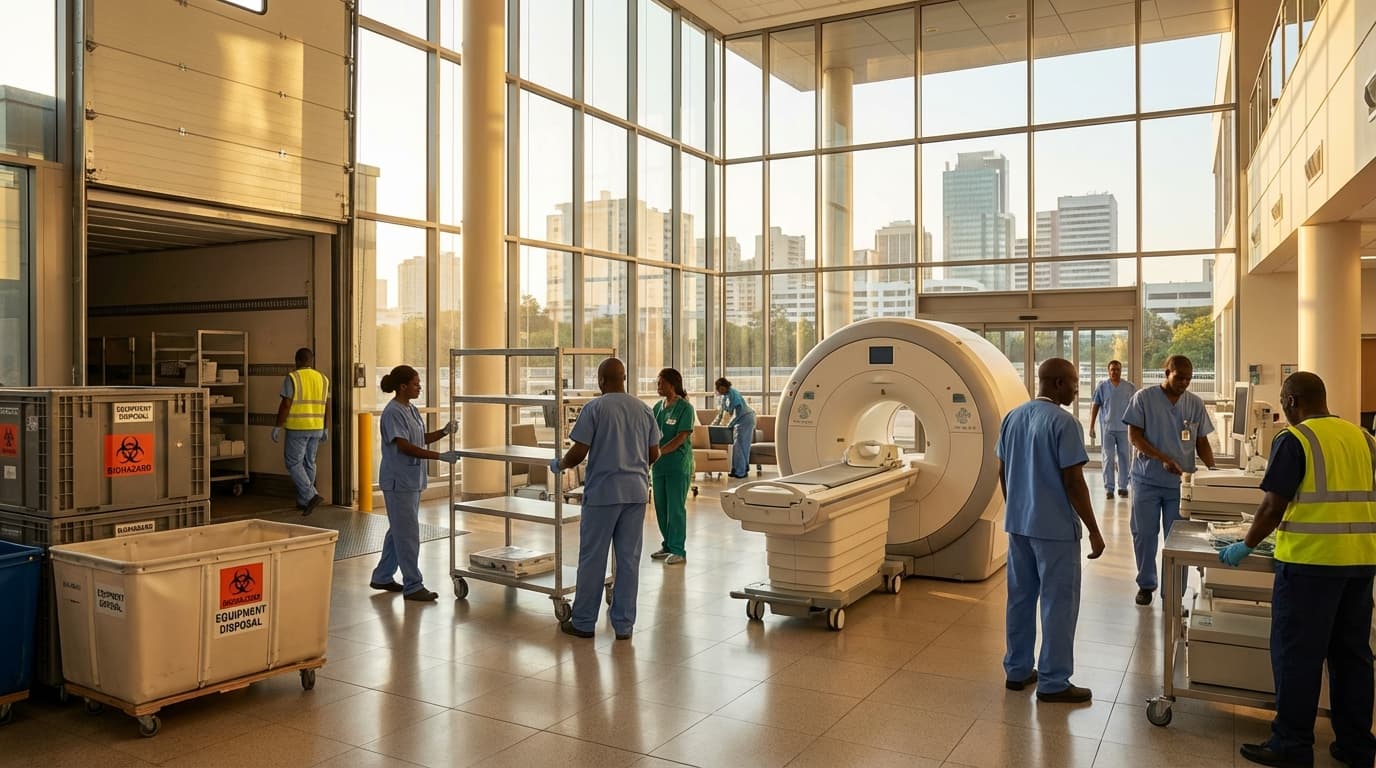
Heavy Medical Equipment De-Installation Service (MRI/CT/Cath Lab) in Mozambique
Engineering Excellence & Technical Support
Heavy Medical Equipment De-Installation Service (MRI/CT/Cath Lab) High-standard technical execution following OEM protocols and local regulatory frameworks.
Regulatory Compliance & Permitting Expertise
Navigating Mozambique's complex regulatory landscape is our specialty. We ensure all de-installations of high-value medical equipment like MRI, CT, and Cath Labs adhere strictly to local and international safety standards and environmental regulations, securing all necessary permits and documentation for seamless project execution and import/export compliance.
Specialized Rigging & Logistics for Sensitive Equipment
Our highly trained technicians are adept at the safe and secure de-installation, dismantling, and packaging of ultra-sensitive medical imaging and interventional radiology equipment. Utilizing state-of-the-art rigging techniques and climate-controlled transport solutions, we guarantee the integrity and preservation of your MRI, CT, and Cath Lab systems throughout the entire logistical chain within Mozambique.
Certified Technicians & Advanced Decommissioning Protocols
We employ certified engineers and technicians with extensive experience in the specific de-installation requirements of MRI, CT, and Cath Lab machinery. Our advanced decommissioning protocols involve precise disconnection, shielding removal, helium recovery (for MRI), and thorough system integrity checks, minimizing downtime and preparing equipment for relocation, refurbishment, or responsible disposal according to global best practices.
What Is Heavy Medical Equipment De-installation Service (Mri/ct/cath Lab) In Mozambique?
Heavy Medical Equipment De-Installation Service (MRI/CT/Cath Lab) in Mozambique refers to the specialized process of safely and systematically dismantling, preparing, and packing large, complex, and often high-value medical imaging and diagnostic systems such as Magnetic Resonance Imaging (MRI) scanners, Computed Tomography (CT) scanners, and Cardiac Catheterization (Cath Lab) systems. This service is crucial for the relocation of existing medical facilities, upgrades to newer equipment, or when equipment reaches its end-of-life and requires removal. The de-installation process necessitates meticulous planning, adherence to stringent safety protocols, specialized tools, and trained personnel with expertise in handling sensitive electronics, powerful magnetic fields (for MRI), and intricate plumbing/electrical systems.
| Service Recipient | Reason for Service | Typical Use Cases |
|---|---|---|
| Hospitals and Clinics (Public & Private) | Facility relocation, equipment upgrade, decommissioning of old systems, expansion projects. | Moving an MRI from an older wing to a newly constructed diagnostic center; replacing an outdated CT scanner with a state-of-the-art model; preparing a Cath Lab suite for renovation or expansion. |
| Medical Equipment Manufacturers/Distributors | Site preparation for new installations (removal of old equipment), product returns, or equipment refurbishment. | Clearing a space for a newly delivered MRI scanner by removing the previous unit; retrieving equipment for off-site servicing or upgrades. |
| Third-Party Service Providers (e.g., Medical Equipment Maintenance Companies) | Contracted de-installation for their clients, asset management, and disposal. | Providing de-installation as part of a larger project for a hospital client; managing the removal and disposal of retired medical imaging systems. |
| Government Health Ministries/Agencies | Consolidation of public healthcare infrastructure, equipment modernization programs, or closure of underutilized facilities. | De-installing CT scanners from regional hospitals undergoing consolidation into larger medical centers; relocating imaging equipment as part of a national healthcare infrastructure upgrade initiative. |
Key Components of Heavy Medical Equipment De-Installation:
- Site Assessment and Planning: Detailed evaluation of the equipment's location, access routes, structural integrity, and environmental conditions. Development of a comprehensive de-installation plan, including timelines, resource allocation, and risk mitigation strategies.
- Disconnection and Isolation: Safely disconnecting all power, data, cooling, and hydraulic lines. Ensuring proper electrical isolation and discharge of any residual energy (e.g., capacitor banks).
- Component Disassembly: Systematic dismantling of the equipment into manageable components, following manufacturer-specific procedures and maintaining component integrity. This often involves specialized tools and techniques to avoid damage.
- Shielding and Packaging: Application of appropriate shielding materials (e.g., lead shielding for CT) and robust packaging to protect sensitive components during transit. This includes vibration dampening and environmental protection.
- Logistics and Transportation Coordination: Planning and overseeing the secure transportation of disassembled components from the site to a new location or disposal facility. This may involve specialized heavy-lift cranes, transport vehicles, and customs clearance procedures.
- Documentation and Reporting: Comprehensive record-keeping of the entire de-installation process, including photographs, checklists, and serial number verification, for audit and warranty purposes.
Who Needs Heavy Medical Equipment De-installation Service (Mri/ct/cath Lab) In Mozambique?
Heavy medical equipment like MRI, CT scanners, and Cath Labs are complex and highly specialized assets. Their de-installation is not a DIY project. It requires expert knowledge, specialized tools, and strict adherence to safety protocols to ensure the equipment is safely dismantled, protected during transport, and ready for re-installation or disposal. This service is crucial for a range of institutions in Mozambique.
| Target Customer | Relevant Departments/Units |
|---|---|
| Public Hospitals | Radiology Department, Cardiology Department, Surgical Department, Central Medical Stores, Procurement Department |
| Private Hospitals | Radiology Department, Cardiology Department, Operations Management, Facilities Management, Finance Department |
| Specialized Diagnostic Imaging Centers | Operations Management, Technical Department, Administration |
| Research Institutions | Research & Development Department, IT Department (for data management), Facilities Management |
| Government Health Ministries | Asset Management Unit, Planning and Infrastructure Department, Procurement and Logistics |
| Medical Equipment Manufacturers/Distributors | Technical Support Department, Sales Department, Logistics and Operations |
| Facilities undergoing renovations/relocation | Project Management Office, Facilities Management, IT Department |
| Asset Disposition Companies | Operations Department, Logistics Department, Sales Department |
Who Needs Heavy Medical Equipment De-Installation Service (MRI/CT/Cath Lab) in Mozambique?
- Hospitals (Public and Private)
- Specialized Diagnostic Imaging Centers
- Research Institutions
- Government Health Ministries (for asset management and relocation)
- Medical Equipment Manufacturers and Distributors (for upgrades, repairs, and relocations)
- Facilities undergoing renovations or relocation
- Companies involved in medical equipment asset disposition
Heavy Medical Equipment De-installation Service (Mri/ct/cath Lab) Process In Mozambique
This document outlines the comprehensive workflow for the Heavy Medical Equipment De-Installation Service of MRI, CT, and Cath Lab systems in Mozambique, from initial client inquiry to the successful completion of the de-installation process. Our service is designed to be thorough, efficient, and compliant with all relevant regulations and safety standards, ensuring minimal disruption to existing operations and safe preparation for transportation or disposal.
| Stage | Description | Key Activities | Deliverables/Outcomes | Responsible Party |
|---|---|---|---|---|
| Inquiry & Initial Consultation | The first point of contact where the client expresses their need for de-installation services. | Receive client request, gather preliminary information (equipment type, location, desired timeline), conduct initial phone or virtual consultation. | Understanding of client requirements, preliminary feasibility assessment. | Client, Service Provider Sales/Inquiry Team |
| Site Assessment & Planning | A detailed on-site evaluation to understand the specific requirements and challenges of the de-installation. | On-site visit by technical experts, detailed survey of equipment room, access routes, power supply, structural considerations, environmental factors, measurement of equipment dimensions. | Comprehensive site assessment report, detailed de-installation plan, risk assessment, identification of specialized tools and personnel required. | Service Provider Technical Team, Client Site Representative |
| Quotation & Contract Finalization | Formal proposal and agreement based on the site assessment. | Development of a detailed quotation outlining costs, timeline, scope of work, terms, and conditions. Negotiation and signing of the service contract. | Signed service contract, agreed-upon quotation. | Service Provider Sales/Contracts Team, Client |
| Permitting & Regulatory Compliance | Ensuring all necessary permissions and adherence to local laws in Mozambique. | Identification of required permits (e.g., environmental, hazardous material handling if applicable), application for and acquisition of permits, adherence to Mozambican health, safety, and environmental regulations. | All required permits obtained, compliance documentation. | Service Provider Project Manager, Local Legal/Compliance Advisors |
| Pre-De-installation Preparations | Setting up the site and preparing the equipment for safe disassembly. | Securing the work area, disconnecting auxiliary systems (e.g., cooling, ventilation), ensuring adequate power isolation, staging of specialized tools and equipment, briefing of the de-installation crew. | Safe and prepared work environment, all necessary tools and equipment on-site. | Service Provider Technical Team, Site Manager |
| Equipment Power-Down & De-energization | Safely shutting down and removing power from the medical equipment. | Following manufacturer's procedures for controlled shutdown, verification of power isolation using multimeters, safe removal of power cables. | Equipment safely powered down and de-energized. | Certified Service Provider Technicians |
| Component Disassembly & Labeling | Careful dismantling of the equipment into manageable components. | Systematic disassembly according to manufacturer specifications, meticulous labeling of all removed components for reassembly or identification, documentation of the disassembly process with photographs and notes. | Dismantled equipment components, clearly labeled for future reference. | Certified Service Provider Technicians |
| Secure Packing & Handling | Protecting the disassembled components for transportation. | Use of appropriate packing materials (e.g., anti-static wraps, custom crates, shock-absorbent foam), secure bracing and padding of components, proper handling to prevent damage during movement. | All components safely packed and ready for transit. | Service Provider Logistics & Technical Teams |
| Logistics & Transportation Coordination | Arranging for the safe and timely movement of the de-installed equipment. | Selection of appropriate transport vehicles (e.g., climate-controlled trucks), coordination with reputable logistics partners, planning of routes, obtaining necessary shipping documentation, ensuring compliance with international shipping regulations if applicable. | Equipment transported to the designated destination (e.g., warehouse, new site, disposal facility). | Service Provider Logistics Manager, Shipping Partners |
| Site Restoration & Handover | Returning the de-installation area to its original or agreed-upon condition. | Removal of debris, minor repairs to the site (if necessary), cleaning of the equipment room, final inspection of the site with the client representative. | Clean and restored de-installation site, signed handover certificate. | Service Provider Site Manager, Client Representative |
| Post-De-installation Support | Follow-up to ensure client satisfaction and address any outstanding issues. | Providing documentation of the de-installation process, addressing any client queries, offering advice on disposal or relocation options for components. | Client satisfaction, complete project documentation. | Service Provider Project Manager, Client |
Key Stages of the De-Installation Process
- Inquiry & Initial Consultation
- Site Assessment & Planning
- Quotation & Contract Finalization
- Permitting & Regulatory Compliance
- Pre-De-installation Preparations
- Equipment Power-Down & De-energization
- Component Disassembly & Labeling
- Secure Packing & Handling
- Logistics & Transportation Coordination
- Site Restoration & Handover
- Post-De-installation Support
Heavy Medical Equipment De-installation Service (Mri/ct/cath Lab) Cost In Mozambique
De-installing heavy medical equipment like MRI, CT scanners, and Cath Labs in Mozambique is a specialized and complex service that involves significant logistical, technical, and safety considerations. The cost of such a service is not fixed and can vary considerably based on several key pricing factors. These factors influence the overall complexity, risk, and duration of the de-installation process, directly impacting the final quotation. It's crucial for healthcare facilities and organizations to understand these elements to budget effectively and select the most appropriate service provider. The local currency in Mozambique is the Metical (MZN).
| Equipment Type | Estimated Cost Range (MZN) | Typical Considerations |
|---|---|---|
| MRI Scanner | 150,000 - 500,000+ | High weight, powerful magnets, complex cryogen handling, extensive disassembly, specialized lifting and transport planning. |
| CT Scanner | 100,000 - 350,000+ | Significant weight, potential for hazardous materials (e.g., X-ray tube), multiple component disassembly, specialized electrical and cooling connections. |
| Cath Lab (Angiography System) | 120,000 - 400,000+ | Multiple interconnected components (C-arm, control consoles, patient table), intricate wiring, heavy shielding, precise alignment considerations for re-installation. |
| Ancillary Heavy Equipment (e.g., Linear Accelerators) | 200,000 - 700,000+ | Extremely heavy, radiation safety protocols, specialized structural considerations, complex power and cooling systems, often requires vendor-specific technicians. |
Key Pricing Factors for Heavy Medical Equipment De-Installation in Mozambique
- Equipment Type and Size: Different modalities have varying complexities. MRI machines, for instance, are extremely heavy and often contain powerful magnets that require specialized handling and safety protocols. CT scanners and Cath Lab equipment, while also heavy, have different component configurations and connection requirements. Larger and more intricate machines naturally incur higher costs.
- Accessibility and Site Conditions: The physical location of the equipment within the hospital or clinic is a major determinant. De-installation in confined spaces, on upper floors, or in areas with limited access for cranes and specialized lifting equipment will be more expensive due to the need for additional planning and potentially more manual labor or specialized rigging techniques.
- Dismantling Complexity: The number of components to be disconnected, the need for specialized tools for disassembly, and the extent of internal component removal (e.g., superconducting magnets in MRI) all contribute to the cost. Some equipment may require extensive pre-disassembly to reduce weight and volume for transport.
- Specialized Personnel and Expertise: This service requires highly trained technicians with specific knowledge of the equipment being de-installed. Their expertise, certifications, and the number of personnel required for the operation are significant cost drivers. This includes engineers, rigging specialists, and safety officers.
- Logistics and Transportation Planning: While de-installation focuses on removal, the planning and preparation for subsequent transportation (even if handled by a separate vendor) can be factored into the de-installation quote. This might include initial assessments of load-bearing capacities of floors and doorways.
- Safety and Environmental Precautions: Strict adherence to safety regulations is paramount. This includes the use of personal protective equipment (PPE), securing the work area, and managing potential hazards like refrigerants (in CT scanners) or radiation shielding. Costs associated with safety protocols and risk mitigation are incorporated.
- Dismantling Documentation and Reporting: Service providers often provide detailed documentation of the de-installation process, including photographic evidence, checklists, and reports. This adds value and can be a factor in the pricing.
- Urgency of the Service: If the de-installation is required on short notice or outside of standard working hours, it will likely incur premium charges.
- Geographic Location within Mozambique: While not as significant as other factors, the specific city or region within Mozambique where the de-installation takes place can slightly influence costs due to variations in local labor rates, availability of specialized equipment, and travel expenses for the technical team.
- Site Preparation and Restoration: The service provider may include costs for minor site preparation (e.g., clearing the immediate area) or, in some cases, basic restoration of the space after equipment removal. This needs to be clearly defined in the contract.
Affordable Heavy Medical Equipment De-installation Service (Mri/ct/cath Lab) Options
When it comes to de-installing heavy medical equipment like MRI, CT, and Cath Lab machines, "affordable" doesn't have to mean "compromised quality." Professional de-installation is crucial for safety, equipment preservation, and compliance. This guide explores value bundles and cost-saving strategies to make this essential service more accessible.
| Cost-Saving Strategy | Description | Potential Impact on Cost |
|---|---|---|
| Early Planning & Booking | Scheduling de-installation well in advance allows for better resource allocation and potentially negotiation of better rates. | Significant Cost Reduction (5-15%) |
| Obtain Multiple Quotes | Compare pricing and service offerings from at least 3-5 reputable de-installation companies. Be clear about your specific needs. | Moderate Cost Reduction (5-10%) |
| Understand Scope of Work | Clearly define what is included in the de-installation. Clarify responsibilities for power down, disconnection, disassembly, rigging, and debris removal. | Avoids Costly Upsells & Hidden Fees |
| Prepare the Site | Ensure the de-installation area is accessible, clear of obstructions, and has adequate power if required for equipment shutdown. This reduces on-site labor time. | Moderate Cost Reduction (3-7%) |
| Leverage Existing Contracts | If your facility has ongoing service contracts with medical equipment vendors, inquire if de-installation services are included or discounted. | Potential for Significant Savings |
| Consider Off-Peak Scheduling | If possible, scheduling de-installation during less busy periods (weekends, evenings) might offer a cost advantage. | Minor Cost Reduction (2-5%) |
| Negotiate Payment Terms | Discuss payment schedules and potential discounts for prompt payment. This can improve cash flow and potentially lead to minor cost savings. | Minor Cost Reduction (1-3%) |
| Utilize In-House Resources (where applicable) | For certain non-critical aspects (e.g., initial power down under supervision), leveraging trained internal staff can reduce external labor costs, but only if safety and expertise are guaranteed. | Variable Cost Reduction (depends on internal capabilities) |
Understanding Value Bundles
- {"title":"Tiered Service Packages","description":"Providers often offer tiered packages. Basic packages cover essential de-installation steps, while premium packages include additional services like secure crating, transportation coordination, or interim storage. Bundling these services often results in a lower per-service cost compared to booking them individually."}
- {"title":"Comprehensive Project Management","description":"Opting for a bundle that includes project management can be cost-effective. This means a single point of contact is responsible for coordinating logistics, scheduling, and ensuring all regulatory requirements are met, reducing the administrative burden and potential for costly errors."}
- {"title":"Equipment-Specific Bundles","description":"Some providers specialize in specific equipment types (MRI, CT, Cath Lab) and offer bundles tailored to the unique needs and challenges of de-installing each. These specialized bundles can streamline the process and avoid unnecessary costs associated with generic approaches."}
- {"title":"Relocation vs. De-installation Only","description":"If your equipment is being moved to a new location, bundles that include both de-installation and transportation are often more economical than separate services. This integration minimizes downtime and potential damage during transit."}
Verified Providers In Mozambique
When seeking healthcare services in Mozambique, it's crucial to partner with verified providers. Franance Health stands out as a premier choice due to its rigorous credentialing process and unwavering commitment to patient well-being. This dedication ensures that all practitioners associated with Franance Health meet the highest standards of expertise, ethical conduct, and professional development, offering you peace of mind and access to exceptional medical care.
| Credentialing Aspect | Franance Health's Approach | Benefit to Patients |
|---|---|---|
| Licensure and Certifications | Verifies all active and valid medical licenses and relevant professional certifications. | Ensures providers are legally qualified and recognized within their specialty. |
| Education and Training Verification | Confirms the authenticity and completeness of medical degrees and specialized training. | Guarantees a strong educational foundation and specialized skills. |
| Professional Experience Review | Assesses a history of successful practice and clinical competence. | Provides access to experienced and capable medical professionals. |
| Background and Reference Checks | Conducts thorough checks to ensure ethical conduct and a clean professional record. | Offers confidence in the integrity and trustworthiness of healthcare providers. |
| Peer Review and Performance Monitoring | May involve ongoing assessment of clinical outcomes and peer feedback. | Upholds consistently high standards of care and identifies areas for improvement. |
Why Franance Health is the Best Choice:
- Rigorous Vetting Process: Franance Health employs a multi-faceted credentialing system that meticulously evaluates each healthcare provider.
- Focus on Expertise: Providers are selected based on their proven clinical experience, specialized training, and up-to-date knowledge in their respective fields.
- Commitment to Ethics: Adherence to strict ethical guidelines and patient-centered care is a fundamental requirement for all Franance Health affiliated professionals.
- Continuous Professional Development: Franance Health encourages and often mandates ongoing training and education for its providers, ensuring they are at the forefront of medical advancements.
- Patient Safety and Quality Assurance: The credentialing process is designed to prioritize patient safety and guarantee the delivery of high-quality medical services.
Scope Of Work For Heavy Medical Equipment De-installation Service (Mri/ct/cath Lab)
This Scope of Work (SOW) outlines the requirements for the de-installation of heavy medical equipment, specifically MRI, CT, and Cath Lab systems. The service includes the safe, efficient, and compliant dismantling, disconnection, and preparation for transportation of these complex imaging and diagnostic systems. The primary objective is to ensure the equipment is de-installed to a state ready for relocation or disposal while adhering to manufacturer specifications, regulatory guidelines, and best practices in medical equipment handling.
| Deliverable | Description | Standard Specifications / Requirements |
|---|---|---|
| De-installation Plan | A detailed plan outlining the sequence of operations, required tools and personnel, safety protocols, and logistics for each equipment type. | Must be approved by the client prior to commencement. Should include risk assessment and mitigation strategies. Refer to manufacturer's de-installation guidelines. |
| Pre-De-installation Site Survey Report | A comprehensive report documenting the existing site conditions, access routes, power availability, ventilation, cooling systems, and any potential obstacles. | Includes photographs and measurements. Must be completed and shared with the client within [Number] days of site visit. Identify any specific site requirements for each equipment type. |
| Equipment Disconnection and Labeling | Safe and complete disconnection of all power, data, cooling, and RF/magnetic shielding connections. | All disconnected cables and components to be clearly labeled to facilitate re-installation. Follow manufacturer-specific disconnection procedures. Utilize appropriate lockout/tagout procedures. |
| Component Dismantling and Removal | Systematic dismantling of the equipment into manageable components for transport, adhering strictly to manufacturer's specifications and safety protocols. | Minimization of damage to equipment components and surrounding infrastructure. Secure handling of heavy and sensitive components (e.g., magnet, gantry). Use of specialized lifting and transport equipment. |
| Shielding De-installation and Removal (MRI/CT) | Careful dismantling and removal of RF and magnetic shielding, if applicable, in a manner that preserves its integrity. | Proper storage of shielding materials to prevent damage. Compliance with any specific disposal requirements for lead or other shielding materials. |
| Cooling System De-installation and Drainage | Safe and complete drainage and disconnection of any dedicated cooling systems (e.g., chillers, water loops). | Proper containment and disposal of any coolant fluids according to environmental regulations. Ensure all lines are sealed. |
| Packaging and Securing of Components | Proper packaging and securing of all de-installed components to prevent damage during transit. | Use of appropriate protective materials (e.g., bubble wrap, custom crates). All components to be clearly marked with equipment ID and component description. |
| Site Restoration | Restoration of the de-installation area to its original or pre-agreed condition. | Removal of all debris, tools, and temporary supports. Repair of minor damages to walls, floors, or ceilings if caused by the de-installation process. |
| De-installation Completion Report | A final report documenting the successful completion of the de-installation, including details of any challenges encountered and their resolutions. | Includes photographic evidence of the de-installed equipment and the restored site. Signed off by client representative. |
| Decommissioning Certificates (if applicable) | Issuance of any required documentation confirming the equipment has been safely de-installed and decommissioned. | Compliance with local, state, and federal regulations. May require specific sign-offs from regulatory bodies. |
| Tooling and Equipment | Provision of all necessary specialized tools, lifting equipment, and safety gear. | Must be calibrated and in good working order. Adequate for the weight and complexity of the equipment being de-installed. |
| Personnel Qualifications | All personnel involved in the de-installation must be experienced, trained, and certified in handling heavy medical equipment. | Proof of training and experience for all technicians and supervisors. Specific manufacturer certifications may be required. |
| Safety Protocols | Strict adherence to all relevant safety regulations, including OSHA and site-specific safety procedures. | Implementation of comprehensive risk assessments, use of personal protective equipment (PPE), and emergency response plans. |
Key Stages of De-Installation Service
- Site Assessment and Planning
- Pre-De-installation Preparations
- Equipment Disconnection and Dismantling
- Component Handling and Packaging
- Site Restoration and Documentation
Service Level Agreement For Heavy Medical Equipment De-installation Service (Mri/ct/cath Lab)
This Service Level Agreement (SLA) outlines the terms and conditions for the de-installation of heavy medical equipment, specifically MRI, CT, and Cath Lab systems. It defines the expected response times for service requests and uptime guarantees during critical periods, if applicable to the de-installation process itself (typically not applicable to de-installation, but included for completeness if a staging or temporary system is involved).
| Service Category | Response Time Objective | Uptime Guarantee (if applicable) | Notes |
|---|---|---|---|
| Scheduled De-installation (Non-Emergency) | Within 48 Business Hours of confirmed appointment. | N/A | Standard de-installation requiring advance scheduling. |
| Expedited De-installation (Customer-Initiated Priority) | Within 24 Business Hours of confirmed Service Request. | N/A | Customer may incur additional fees for expedited service. Subject to technician availability. |
| Emergency De-installation (Critical Project Deadline/Patient Care Impact) | Within 12 Business Hours of confirmed Service Request. | N/A | Service Provider will make commercially reasonable efforts to meet this objective. May incur significant additional charges. Definition of 'Emergency' to be agreed upon in contract. |
Key Definitions
- Service Request: A formal notification from the Customer to the Service Provider requesting de-installation services.
- De-installation: The process of safely disconnecting, dismantling, and preparing a specified heavy medical equipment system for relocation or disposal.
- Response Time: The maximum allowable time between a Service Request being logged by the Service Provider and the initiation of service by a qualified technician.
- Business Hours: Monday to Friday, 8:00 AM to 5:00 PM in the Customer's local time zone, excluding public holidays.
- Emergency Service Request: A Service Request related to an urgent de-installation requirement impacting critical patient care or project timelines.
- Uptime Guarantee (if applicable): The percentage of time a system is expected to be operational. Note: Uptime is generally not applicable to de-installation services, as the system is being removed. This section is included for standard SLA structure and may be adapted if temporary staging or testing is part of the scope.
Frequently Asked Questions

Ready when you are
Let's scope your Heavy Medical Equipment De-Installation Service (MRI/CT/Cath Lab) in Mozambique project in Mozambique.

Scaling healthcare logistics and technical systems across the entire continent.