
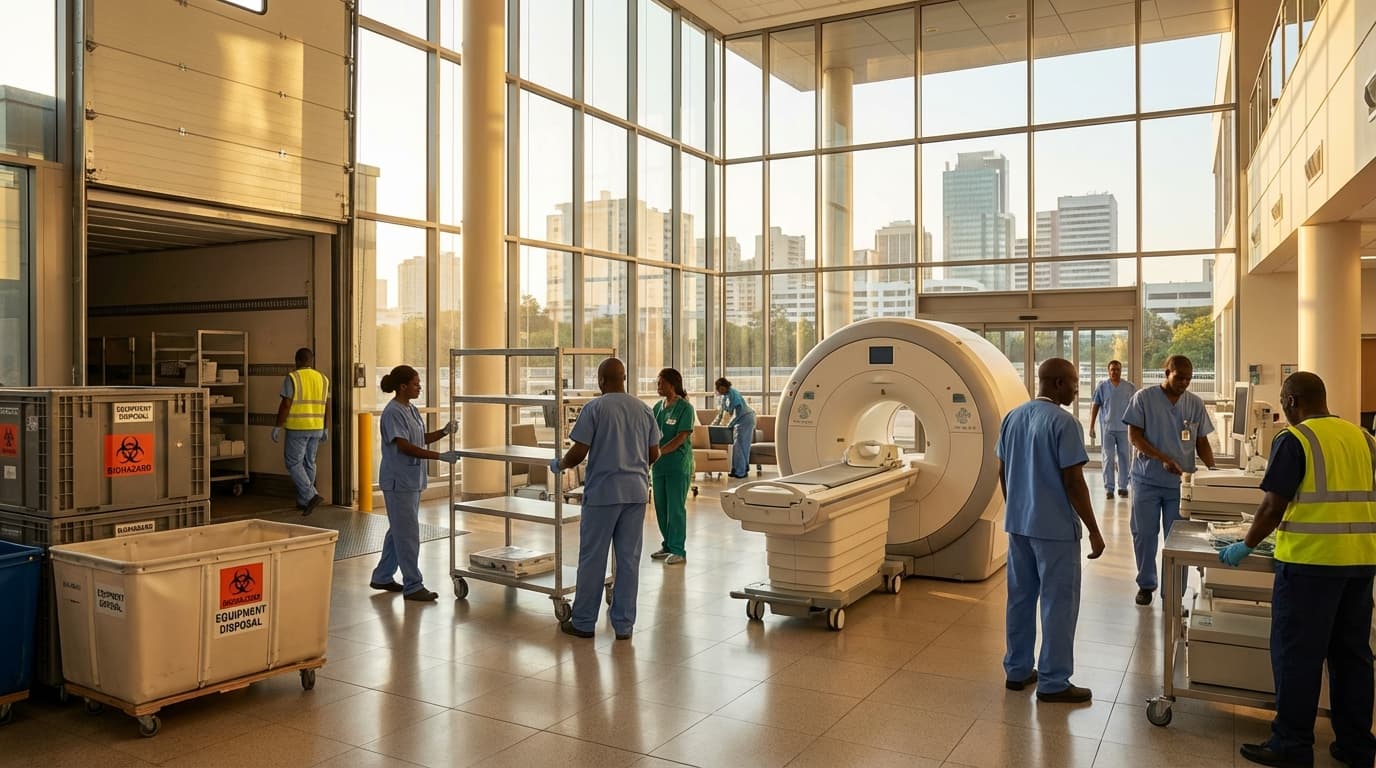
Decommissioning Service for Medical Devices in Mozambique
Engineering Excellence & Technical Support
Decommissioning Service for Medical Devices High-standard technical execution following OEM protocols and local regulatory frameworks.
Safe & Compliant Medical Device Disposal
Ensures environmentally sound and legally compliant decommissioning of all medical devices, from basic equipment to complex imaging systems, adhering to Mozambican healthcare and environmental regulations.
Certified Data Eradication
Provides secure and verifiable data sanitization for all devices with stored patient information, employing certified methods to protect sensitive health data in accordance with international privacy standards.
Comprehensive Asset Lifecycle Management
Offers detailed inventory tracking, documentation, and reporting throughout the decommissioning process, facilitating asset retirement, replacement planning, and regulatory audits for healthcare facilities in Mozambique.
What Is Decommissioning Service For Medical Devices In Mozambique?
Decommissioning service for medical devices in Mozambique refers to the systematic and regulated process of safely and responsibly retiring medical equipment from active service. This involves a comprehensive set of procedures designed to ensure that the device is no longer functional, all sensitive data is securely erased or destroyed, and any hazardous materials are disposed of in an environmentally sound manner, adhering to national and international regulations and best practices. The service aims to mitigate risks associated with obsolete, damaged, or end-of-life medical equipment, including data breaches, environmental contamination, and potential repurposing for unauthorized or unsafe use.
| Who Needs Decommissioning Service? | Typical Use Cases |
|---|---|
| Hospitals and Healthcare Facilities (public and private) | End-of-life equipment reaching its operational lifespan or exceeding repairability. |
| Diagnostic Laboratories | Devices replaced by newer technology or requiring upgrades. |
| Clinics and Health Centers | Equipment damaged beyond repair or deemed unsafe for continued use. |
| Government Health Ministries and Agencies | Devices from decommissioned or consolidated healthcare programs. |
| Medical Device Manufacturers and Distributors (for returns or recalls) | Equipment retired due to obsolescence or discontinuation of support. |
| Research Institutions utilizing medical devices | Devices no longer required for ongoing research projects. |
Key Components of Medical Device Decommissioning in Mozambique
- Asset Inventory and Verification: Accurately identifying and cataloging all devices slated for decommissioning, including make, model, serial number, and location.
- Data Sanitization/Destruction: Implementing secure methods to erase or physically destroy all patient data, personal identifiable information (PII), and any other sensitive data stored on the device's memory or storage media, complying with data privacy regulations.
- Disposal of Hazardous Materials: Identifying and safely removing, storing, and disposing of any hazardous components (e.g., mercury, batteries, radioactive isotopes) in accordance with environmental regulations.
- Physical Disassembly and Disposal/Recycling: Safely dismantling the device, with components either being recycled where feasible or disposed of through certified waste management channels.
- Documentation and Certification: Maintaining detailed records of the entire decommissioning process, including data sanitization logs, disposal certificates, and asset retirement forms, for audit and compliance purposes.
- Regulatory Compliance: Ensuring adherence to all relevant Mozambican laws, ministerial directives, and international standards governing medical device disposal and data protection.
Who Needs Decommissioning Service For Medical Devices In Mozambique?
Decommissioning services for medical devices in Mozambique are crucial for ensuring proper disposal, data security, and regulatory compliance. These services cater to a range of healthcare providers and institutions that have reached the end of a device's lifecycle or are upgrading their equipment. The primary beneficiaries are organizations responsible for managing medical equipment and patient data, aiming to mitigate risks associated with outdated or non-functional technology.
| Customer Type | Key Departments/Personnel Involved |
|---|---|
| Hospitals (Public and Private) | Biomedical Engineering Department, IT Department, Facilities Management, Procurement Department, Clinical Department Heads (for specific equipment), Administration/Management |
| Clinics and Health Centers | Clinic Manager, Head Nurse, IT Support (if applicable), Administrative Staff |
| Diagnostic Laboratories | Laboratory Director, Technical Manager, IT Manager, Quality Assurance Manager |
| Research Institutions | Principal Investigators, Research Project Managers, IT Department, Facilities Management |
| Government Health Ministries and Agencies | Procurement and Logistics Department, Technical Support Units, Health Information Systems Department, Regulatory Affairs |
| Medical Equipment Suppliers and Distributors | Service Department, Logistics and Returns Department, Sales Management |
| Non-Governmental Organizations (NGOs) | Program Managers, Logistics Coordinators, Biomedical Technicians (if employed), Operations Managers |
Target Customers and Departments for Medical Device Decommissioning Services in Mozambique:
- Hospitals (Public and Private)
- Clinics and Health Centers
- Diagnostic Laboratories
- Research Institutions
- Government Health Ministries and Agencies
- Medical Equipment Suppliers and Distributors (for end-of-life management)
- Non-Governmental Organizations (NGOs) involved in healthcare delivery
Decommissioning Service For Medical Devices Process In Mozambique
This document outlines the standard workflow for decommissioning medical devices in Mozambique, from the initial inquiry to the successful execution of the service. The process ensures responsible and environmentally sound disposal or repurposing of medical equipment, adhering to national regulations and international best practices.
| Step | Description | Key Activities | Responsible Party | Deliverables/Outputs |
|---|---|---|---|---|
| The process begins with a request from a healthcare facility or organization needing to decommission medical devices. This stage involves understanding their specific needs and the scope of the project. | Receive inquiry (phone, email, web form), understand device types and quantities, initial needs assessment, preliminary scope definition. | Client, Decommissioning Service Provider | Initial understanding of client needs, preliminary project scope. |
| A thorough assessment of the site where the devices are located is conducted. This involves cataloging all devices to be decommissioned, noting their condition, serial numbers, and any specific handling requirements. | On-site visit, physical inspection of devices, detailed inventory compilation, assessment of accessibility and potential hazards, data security review (for devices with stored data). | Decommissioning Service Provider | Detailed inventory report, site assessment report, identification of potential challenges. |
| Based on the inventory and site assessment, a detailed proposal is presented to the client outlining the scope of work, methodology, timelines, costs, and proposed disposal/repurposing methods. Upon acceptance, a formal agreement is signed. | Develop detailed proposal (including services, costs, timeline, safety plan, disposal/repurposing strategy), present proposal to client, negotiation, contract/service agreement finalization. | Decommissioning Service Provider, Client | Formal service proposal, signed service agreement/contract. |
| Once the agreement is in place, the decommissioning activities are scheduled. This involves coordinating with the client for access, arranging necessary permits, and preparing for safe transportation and disposal. | Develop detailed project schedule, coordinate with client for access dates/times, obtain necessary permits (if applicable), plan for personnel and equipment mobilization, arrange transportation logistics. | Decommissioning Service Provider | Approved project schedule, confirmed access, logistical plan. |
| This is the core operational phase where trained technicians perform the decommissioning. This may include disassembling, cleaning, data wiping, and preparing devices for transport. | On-site execution of decommissioning tasks as per agreed plan, adherence to safety protocols, careful handling of devices, data sanitization (if applicable), minor dismantling/preparation for transport. | Decommissioning Service Provider | Physically decommissioned devices, completed on-site tasks log. |
| Devices are transported to designated facilities for environmentally sound disposal (e.g., recycling, hazardous waste treatment) or prepared for repurposing/donation according to regulations and client preferences. | Secure transportation of devices, processing at licensed disposal facilities (e.g., recycling, incineration, hazardous waste management), or preparation for refurbishment/donation. | Decommissioning Service Provider, Licensed Disposal/Repurposing Facilities | Proof of disposal/recycling certificates, records of repurposed/donated devices. |
| Comprehensive documentation is maintained throughout the process, including inventory records, safety logs, disposal certificates, and a final report summarizing the entire decommissioning activity. | Compile all project documentation, generate final decommissioning report, include evidence of disposal/recycling, provide audit trail. | Decommissioning Service Provider | Final decommissioning report, supporting documentation (certificates, logs). |
| The client reviews the final report and deliverables. Upon satisfaction, the project is formally closed, and final payments are processed. | Client review of final report and deliverables, client sign-off/confirmation of service completion, final invoicing and payment. | Client, Decommissioning Service Provider | Project completion confirmation, final payment. |
Decommissioning Service Workflow for Medical Devices in Mozambique
- Inquiry and Initial Consultation
- Site Assessment and Inventory
- Proposal and Agreement
- Scheduling and Logistics
- On-site Decommissioning Execution
- Waste Management and Disposal/Repurposing
- Documentation and Reporting
- Finalization and Confirmation
Decommissioning Service For Medical Devices Cost In Mozambique
Decommissioning medical devices in Mozambique is a critical but often overlooked service. The cost associated with this process is influenced by a variety of factors, leading to a range of prices in the local currency, the Mozambican Metical (MZN). These factors include the type and complexity of the device, its size and weight, the need for specialized disposal (e.g., for radioactive or biohazardous materials), the location of the facility, and the chosen decommissioning provider. Regulations surrounding medical waste disposal also play a significant role in driving up costs. It's essential for healthcare facilities to budget for these services to ensure compliance and responsible end-of-life management for their medical equipment.
| Device Category | Estimated Cost Range (MZN) | Notes |
|---|---|---|
| Basic Diagnostic Equipment (e.g., Stethoscopes, Blood Pressure Monitors) | 500 - 2,000 | Relatively low cost due to simplicity and lack of hazardous materials. |
| Laboratory Equipment (e.g., Centrifuges, Microscopes) | 1,000 - 5,000 | May involve some specialized cleaning or minor chemical disposal. |
| Imaging Equipment (e.g., X-ray Machines, Ultrasound Units) | 10,000 - 50,000+ | Can involve dismantling, potential hazardous material handling (e.g., old CRT monitors), and transportation of heavy components. MRI/CT scanners will be at the higher end. |
| Surgical Equipment (e.g., Electrosurgical Units, Anesthesia Machines) | 5,000 - 25,000+ | Can involve hazardous fluids, gases, and complex electrical components. |
| Specialized Medical Devices (e.g., Dialysis Machines, Ventilators) | 7,000 - 30,000+ | Complexity and potential for residual fluids or contamination. |
| Large/Heavy Equipment (e.g., Hospital Beds, Operating Tables) | 2,000 - 7,000 | Primarily driven by transportation and labor costs. Disposal method might be simpler. |
| Equipment with Hazardous Materials (e.g., Radioactive Sources, Mercury) | 20,000 - 100,000+ | Significantly higher costs due to specialized disposal protocols and licensing requirements. |
Key Pricing Factors for Medical Device Decommissioning in Mozambique:
- Device Type and Complexity: Simple diagnostic tools will be less expensive to decommission than complex imaging machines (e.g., X-ray, MRI) or surgical robots.
- Size and Weight: Larger and heavier equipment incurs higher transportation and handling costs.
- Hazardous Material Containment: Devices containing radioactive isotopes, mercury, or biohazardous waste require specialized handling and disposal, significantly increasing costs.
- Decommissioning Method: Options range from simple asset removal to full decontamination and certified data destruction (for devices with sensitive information).
- Location of Facility: Remote or difficult-to-access locations will incur higher transportation and logistical expenses.
- Provider's Expertise and Reputation: Established providers with certified personnel and proper disposal facilities may charge more but offer greater assurance.
- Regulatory Compliance: Costs associated with adhering to Mozambican environmental and health regulations for waste disposal.
- Transportation and Logistics: Fuel, vehicle maintenance, and labor for moving the equipment to a disposal site.
- Data Destruction: If the device contains patient data, secure data wiping or physical destruction will add to the cost.
- Certification of Disposal: Obtaining certificates of proper disposal provides an additional layer of security and may have associated fees.
Affordable Decommissioning Service For Medical Devices Options
Decommissioning medical devices is a critical but often overlooked aspect of healthcare operations. Properly decommissioning ensures data security, regulatory compliance, and responsible disposal of equipment. Finding affordable services is key, especially for facilities with budget constraints. This involves understanding various service models and implementing smart cost-saving strategies. Value bundles can offer a comprehensive solution at a reduced price, while strategic planning and vendor negotiation can further optimize expenses.
| Cost-Saving Strategy | Description | Potential Savings Area |
|---|---|---|
| Early Planning and Scheduling | Proactively schedule decommissioning services well in advance of device end-of-life. This allows for better negotiation with providers and avoids rush fees. | Reduced service rates, avoidance of emergency surcharges, optimized logistics. |
| Consolidate Vendors | Engage a single, reputable vendor for all decommissioning needs, rather than using multiple specialized services. This can lead to volume discounts and streamlined communication. | Volume discounts, reduced administrative overhead, simplified billing. |
| Negotiate Contract Terms | Thoroughly review and negotiate pricing, service level agreements (SLAs), and payment terms. Consider longer-term contracts for potential rate reductions. | Lower per-unit costs, favorable payment schedules, clearer service expectations. |
| Prioritize Data Destruction Methods | Understand the security requirements for your data. While enhanced certifications offer peace of mind, ensure you're not overpaying for unnecessary levels of data destruction. | Avoids unnecessary expenses for overly stringent data wiping if not required by policy or regulation. |
| Explore Resale and Donation Options | For functional devices, work with decommissioning services that can facilitate resale or donation. This can offset decommissioning costs or even generate revenue. | Revenue generation from asset recovery, reduced disposal fees. |
| Bundle Services Strategically | Choose value bundles that align with your facility's specific needs. Avoid paying for services you don't require. | Optimized pricing by selecting relevant service components, avoiding unneeded features. |
| Conduct Internal Assessments | Before engaging external services, perform an internal inventory and assessment of devices. Understand what needs to be decommissioned and the associated data sensitivity. | More accurate quoting, avoids over-servicing, better negotiation position. |
Understanding Value Bundles in Medical Device Decommissioning
- Core Decommissioning Package: This typically includes secure data wiping/destruction, physical disassembly, and environmental disposal of non-hazardous components. Often serves as the base offering.
- Enhanced Security Bundle: Builds upon the core package by adding enhanced data destruction certifications (e.g., NIST 800-88), chain-of-custody documentation for sensitive equipment, and specialized disposal for devices with hazardous materials.
- Comprehensive Asset Management Bundle: Integrates decommissioning with asset tracking and inventory management. This can include detailed reporting, asset resale valuation, and donation coordination for functional devices, maximizing residual value.
- Specialty Device Bundle: Tailored for specific types of medical equipment (e.g., imaging machines, surgical robots) requiring specialized handling, de-installation, or disposal processes.
- Multi-site or Volume Discount Bundle: Offers reduced per-unit costs for facilities decommissioning a large number of devices or across multiple locations within a defined timeframe. This incentivizes bulk service agreements.
Verified Providers In Mozambique
In Mozambique, ensuring access to high-quality healthcare is paramount. This is where the role of verified providers becomes critical. When seeking medical services, partnering with credentialed and reputable organizations offers peace of mind and guarantees a higher standard of care. Franance Health stands out as a leading example of such a verified provider, demonstrating a commitment to excellence that sets them apart. Their rigorous credentialing process and dedication to patient well-being make them the premier choice for healthcare needs in Mozambique.
| Credentialing Aspect | Franance Health's Approach | Benefit to Patients |
|---|---|---|
| Provider Qualifications | Thorough vetting of medical licenses, certifications, and educational backgrounds of all healthcare professionals. | Ensures patients are treated by competent and licensed practitioners. |
| Service Quality Assurance | Regular audits and evaluations of facilities, equipment, and treatment protocols to meet or exceed international standards. | Guarantees a high standard of medical care and safety. |
| Ethical Conduct | Strict adherence to a code of conduct, including patient privacy, informed consent, and fair pricing. | Promotes trust and protects patient rights. |
| Continuous Improvement | Ongoing training and professional development for staff, and feedback mechanisms for patient satisfaction. | Ensures the latest medical advancements are utilized and patient needs are met effectively. |
Why Franance Health is the Best Choice:
- Rigorous Credentialing and Verification Process
- Commitment to Patient-Centered Care
- Adherence to International Healthcare Standards
- Experienced and Qualified Medical Professionals
- Comprehensive Range of Medical Services
- Transparent and Ethical Practices
- Focus on Accessibility and Affordability
Scope Of Work For Decommissioning Service For Medical Devices
This Scope of Work (SOW) outlines the requirements for the decommissioning of medical devices. The service provider will be responsible for the safe, secure, and compliant removal, disposal, and/or refurbishment of specified medical equipment. This includes all necessary labor, materials, transportation, and documentation to ensure the complete and documented cessation of use for each device.
| Category | Specification | Verification Method |
|---|---|---|
| Safety | All personnel to wear appropriate Personal Protective Equipment (PPE) as dictated by the device and any hazardous materials involved. | Site observation, safety audits. |
| Data Security | For devices with data storage capabilities, implement sanitization procedures to meet NIST SP 800-88 or equivalent standards. This includes secure erasure, overwriting, or physical destruction of storage media. | Data sanitization reports, media destruction certificates. |
| Environmental Compliance | Dispose of non-hazardous components through certified recycling partners. Hazardous materials must be handled and disposed of by licensed hazardous waste management facilities. | Waste manifests, disposal certificates from licensed facilities. |
| Documentation | Maintain a detailed log of all activities, including device serial numbers, model numbers, date of decommissioning, method of disposition, and responsible personnel. | Review of final decommissioning report and supporting documentation. |
| Asset Management | Provide clear documentation for each asset's final disposition (e.g., sale invoice, donation receipt, recycling confirmation, destruction certificate). | Review of asset disposition records. |
| Transportation | Devices to be transported in a secure manner to prevent damage and unauthorized access. Compliance with transportation regulations for any regulated materials. | Shipping manifests, vehicle inspection (if applicable). |
| Regulatory Compliance | Adherence to all local, state, and federal regulations pertaining to medical device disposal, hazardous waste, and data privacy (e.g., EPA, DOT, HIPAA). | Audit of service provider's compliance records, regulatory review. |
| Service Personnel | All personnel performing decommissioning tasks must be appropriately trained and certified for handling medical equipment and hazardous materials. | Verification of training records and certifications. |
Technical Deliverables and Standard Specifications
- Detailed decommissioning plan submitted for approval.
- Device inventory and status report (pre-decommissioning).
- Chain of custody documentation for all devices.
- Waste manifests and disposal certificates (compliant with local, state, and federal regulations).
- Data sanitization reports (if applicable, meeting HIPAA or equivalent standards).
- Asset disposition records (sale, donation, recycling, or destruction).
- Final decommissioning report summarizing all activities and outcomes.
- Evidence of licensed and certified waste disposal facilities.
- Compliance with all relevant environmental, health, and safety (EHS) regulations.
- Adherence to manufacturer's recommended decommissioning procedures (where available).
- Proper handling and disposal of hazardous materials (e.g., batteries, refrigerants, mercury).
- Secure transportation of devices to designated disposition locations.
- Post-decommissioning site inspection and clearance report (if applicable).
Service Level Agreement For Decommissioning Service For Medical Devices
This Service Level Agreement (SLA) outlines the response times and uptime guarantees for the Decommissioning Service for Medical Devices provided by [Your Company Name] (hereinafter referred to as "Provider") to [Client Company Name] (hereinafter referred to as "Client"). This SLA is an integral part of the Master Service Agreement between the Provider and Client.
| Service Element | Priority Level | Response Time Target | Uptime Guarantee (Monthly) |
|---|---|---|---|
Definitions
- {"item":"Decommissioning Service: The process of safely and securely rendering medical devices inoperable and unusable, including data sanitization, physical destruction, and environmental disposal, in accordance with applicable regulations and manufacturer guidelines."}
- {"item":"Downtime: The period during which the Decommissioning Service, or a critical component thereof, is unavailable to the Client for reasons within the Provider's control."}
- {"item":"Response Time: The maximum time allowed for the Provider to acknowledge and begin addressing a reported issue or request for service after it has been officially logged by the Client."}
- {"item":"Resolution Time: The maximum time allowed for the Provider to resolve an issue or fulfill a request for service to the Client's satisfaction, as defined by the severity of the issue."}
- {"item":"Service Hours: Standard business hours, Monday to Friday, 9:00 AM to 5:00 PM [Client's Time Zone], excluding national holidays."}
- {"item":"Critical Issue: A problem that renders the Decommissioning Service completely unusable or poses a significant risk to patient safety, data security, or regulatory compliance."}
- {"item":"Major Issue: A problem that significantly degrades the performance or functionality of the Decommissioning Service, impacting a substantial portion of its capabilities."}
- {"item":"Minor Issue: A problem that has a minimal impact on the functionality or performance of the Decommissioning Service, or a non-critical request."}
Frequently Asked Questions

Ready when you are
Let's scope your Decommissioning Service for Medical Devices in Mozambique project in Mozambique.

Scaling healthcare logistics and technical systems across the entire continent.