
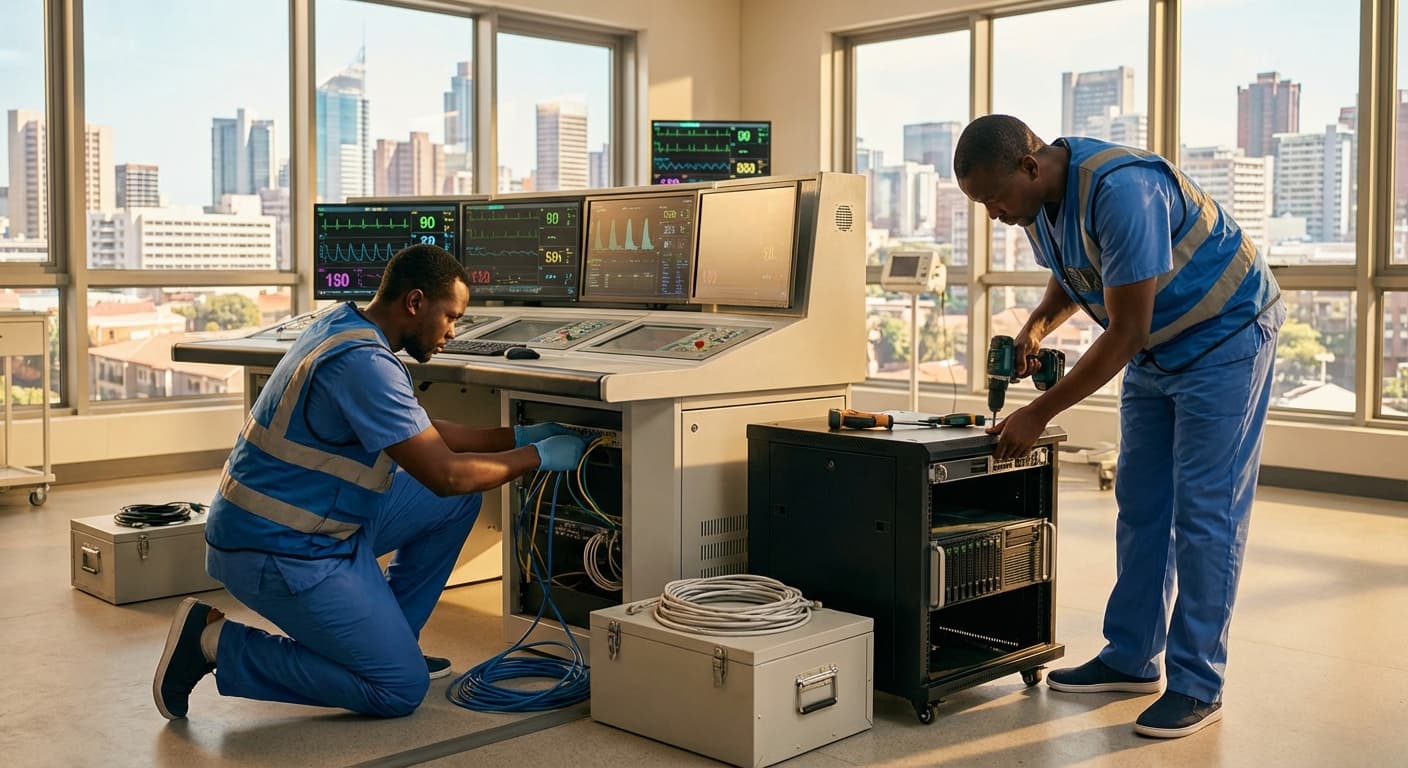
ICU Central Monitoring Station Installation Service in Mozambique
Engineering Excellence & Technical Support
ICU Central Monitoring Station Installation Service High-standard technical execution following OEM protocols and local regulatory frameworks.
Scalable Centralized Monitoring Architecture
We architect and deploy robust, scalable ICU central monitoring systems in Mozambique, integrating advanced server infrastructure and secure network solutions. Our installations ensure seamless data flow from all patient monitoring devices to a central command center, providing real-time critical insights for enhanced patient care and timely interventions.
High-Availability & Redundant Network Design
Our technical expertise guarantees high-availability and redundant network configurations for your ICU monitoring system across Mozambique. We implement fail-safe mechanisms and robust data redundancy to ensure uninterrupted operation and data integrity, even in challenging remote environments, minimizing downtime and maximizing patient safety.
Advanced Integration & Data Analytics Capabilities
We specialize in the seamless integration of diverse patient monitoring devices (ECG, SpO2, NIBP, etc.) with your central station, leveraging cutting-edge protocols and APIs. Our installations empower ICU teams in Mozambique with advanced data analytics and visualization tools, transforming raw patient data into actionable intelligence for optimized clinical decision-making.
What Is Icu Central Monitoring Station Installation Service In Mozambique?
ICU Central Monitoring Station Installation Service in Mozambique refers to the comprehensive process of establishing, configuring, and commissioning a centralized command center designed to remotely monitor critical patient physiological data from multiple Intensive Care Unit (ICU) beds within a healthcare facility. This service encompasses the deployment of network infrastructure, specialized monitoring software, display consoles, and integration with existing medical devices. The objective is to provide a unified view of patient status, facilitate early detection of deterioration, improve response times for critical events, and optimize resource allocation within the ICU.
| Who Needs It? | Typical Use Cases |
|---|---|
| Hospitals and healthcare facilities in Mozambique operating Intensive Care Units (ICUs) or High Dependency Units (HDUs). | Continuous surveillance of patients with severe medical conditions (e.g., sepsis, trauma, post-surgical complications, respiratory failure). Remote monitoring of patients from a central location to allow for better staff-to-patient ratios and improved observation. Early detection of patient deterioration through real-time waveform analysis and intelligent alarm systems. Facilitating interdisciplinary team collaboration and communication regarding patient status. Data logging and trending for retrospective analysis, quality improvement initiatives, and research purposes. Enhancing patient safety by reducing the risk of missed critical events or delayed responses. Optimizing workflow efficiency for ICU nursing and medical staff. |
Key Components of ICU Central Monitoring Station Installation Service
- Network Infrastructure Deployment: Establishing robust and secure wired and wireless networks to transmit real-time patient data.
- Server and Workstation Configuration: Setting up the central server for data aggregation and storage, and configuring operator workstations with display consoles and user interfaces.
- Software Installation and Integration: Deploying specialized ICU monitoring software and integrating it with existing bedside monitors, ventilators, infusion pumps, and other critical care devices via standardized protocols (e.g., HL7, DICOM).
- Data Acquisition and Display Setup: Configuring data acquisition modules and setting up visual dashboards to display vital signs, waveforms, trends, and alerts from multiple patients simultaneously.
- Alarm Management System Implementation: Configuring alarm parameters, notification protocols (auditory, visual, and remote), and escalation pathways to ensure timely intervention.
- System Testing and Validation: Conducting rigorous testing to ensure data accuracy, system reliability, and performance under various load conditions.
- User Training: Providing comprehensive training to clinical staff (physicians, nurses, technicians) on the operation, interpretation of data, and utilization of the central monitoring system.
- Post-Installation Support and Maintenance: Offering ongoing technical support, software updates, and hardware maintenance to ensure continuous operational efficiency.
Who Needs Icu Central Monitoring Station Installation Service In Mozambique?
The installation of ICU Central Monitoring Station services in Mozambique is a critical requirement for healthcare facilities aiming to provide advanced patient care and improve outcomes for critically ill individuals. These stations are essential for real-time, continuous observation of multiple ICU patients' vital signs, enabling swift medical intervention and optimized resource allocation. Several types of healthcare organizations and their specific departments stand to benefit significantly from this service.
| Department/Unit | Key Beneficiaries and Needs | Why Central Monitoring is Crucial |
|---|---|---|
| Intensive Care Unit (ICU) | Critically ill patients requiring continuous physiological monitoring; medical staff responsible for their immediate care. | Real-time, consolidated view of all ICU patients' vital signs (heart rate, blood pressure, oxygen saturation, respiratory rate, etc.), allowing for immediate alerts and interventions by the nursing and medical teams. |
| Critical Care Department | Physicians and nurses specializing in critical care, anesthesiologists, and intensivists. | Centralized data for trend analysis, early detection of deteriorating patient conditions, and informed decision-making for complex cases. |
| Cardiology Department (with ICU) | Patients with severe cardiac conditions, post-cardiac surgery patients, and those requiring hemodynamic monitoring. | Continuous cardiac rhythm monitoring, invasive blood pressure tracking, and management of critically ill cardiac patients. |
| Neurology Department (with ICU) | Patients with stroke, severe head injuries, seizures, and other neurological emergencies requiring close neurological and physiological monitoring. | Monitoring of intracranial pressure (ICP), electroencephalogram (EEG) data integration, and vital sign stability in neurocritical care. |
| Surgical Departments (Post-operative ICU) | Patients recovering from major surgeries (e.g., cardiothoracic, neurosurgery, major abdominal) who require intensive post-operative care. | Close monitoring of recovery, early identification of complications, and ensuring hemodynamic stability after complex surgical procedures. |
| Emergency Departments (if directly connected to ICU) | Patients presenting with life-threatening conditions who are awaiting transfer to the ICU or require stabilization. | Streamlined transfer of critically ill patients from the ED to the ICU with pre-existing monitoring data, facilitating seamless continuity of care. |
Target Customers for ICU Central Monitoring Station Installation in Mozambique:
- Public Hospitals: Government-funded hospitals, particularly those serving larger populations or acting as referral centers, are prime candidates. They often face high patient volumes and a need to maximize the efficiency of their limited resources.
- Private Hospitals: For-profit healthcare providers focused on offering high-quality, specialized medical services are key targets. They often invest in state-of-the-art technology to attract patients and ensure superior care standards.
- Tertiary and Quaternary Care Centers: Facilities designed for complex medical conditions and advanced treatments will invariably require robust central monitoring systems to manage their intensive care units.
- Teaching Hospitals and Medical Schools: Institutions involved in training future medical professionals need advanced monitoring systems to provide comprehensive education and exposure to modern critical care practices.
- Non-Governmental Organization (NGO) Healthcare Initiatives: Organizations operating healthcare projects or clinics in Mozambique, especially those focusing on critical care or specialized treatments, may seek these installation services to upgrade their facilities.
Icu Central Monitoring Station Installation Service Process In Mozambique
This document outlines the standard workflow for the installation of an ICU Central Monitoring Station (CMS) service in Mozambique, covering the process from initial customer inquiry to project completion and handover.
| Phase | Key Activities | Responsible Party (Service Provider) | Responsible Party (Client) |
|---|---|---|---|
| Inquiry and Initial Consultation | Receive inquiry, conduct needs assessment, provide initial information, schedule site visit. | Sales/Technical Representative | Hospital Administration/Clinical Lead |
| Proposal and Planning | Perform site assessment, refine requirements, design solution, develop proposal, negotiate. | Project Manager, Biomedical Engineer, IT Specialist | Clinical Lead, IT Department, Procurement |
| Contract and Pre-Installation | Sign contract, hold kick-off meeting, procure equipment, prepare site, assign team. | Project Manager, Procurement Department | Legal Department, Facilities Management, IT Department |
| Installation and Configuration | Install hardware, deploy monitors, connect network, install/configure software, integrate systems. | Installation Team (Biomedical Engineers, IT Technicians) | Provide site access, ensure power/network availability, oversee installation progress. |
| Testing, Training, and Validation | Conduct system tests, perform UAT, train staff, validate clinically. | Installation Team, Training Specialists | Clinical Staff, IT Department, Biomedical Department |
| Handover and Post-Installation Support | Handover system, provide go-live support, activate warranty, conduct review, offer ongoing support. | Project Manager, Technical Support Team | Accept system, provide feedback, utilize ongoing support services. |
ICU Central Monitoring Station Installation Service Process in Mozambique
- {"steps":["Inquiry Received: Client (hospital, clinic, government health entity) expresses interest in ICU CMS installation services via phone, email, or website portal.","Initial Contact & Needs Assessment: Service provider contacts the client to gather preliminary information about the ICU size, number of beds, existing infrastructure, specific monitoring requirements, and budget expectations.","Information Provision: Provider shares general information about their CMS solutions, installation capabilities, typical timelines, and pricing structures.","Site Visit Scheduling (Optional but Recommended): If a preliminary assessment is insufficient, a site visit is scheduled to evaluate the physical space, power availability, network infrastructure, and other site-specific factors."],"title":"Phase 1: Inquiry and Initial Consultation","description":"This phase focuses on understanding the client's needs and providing initial information."}
- {"steps":["Detailed Site Assessment (if applicable): On-site evaluation of the ICU environment, including electrical systems, network cabling, ventilation, and potential challenges.","Requirement Refinement: In-depth discussion with the client's clinical and IT teams to finalize specific monitoring parameters, alarm configurations, data storage needs, and integration requirements with existing hospital information systems (HIS).","Solution Design: Based on the assessment and refined requirements, the provider designs a tailored CMS solution, including hardware selection, software configuration, and network architecture.","Technical Specification Development: Creation of detailed technical specifications outlining the proposed CMS system, including components, functionalities, and integration points.","Formal Proposal Submission: Presentation of a comprehensive proposal to the client, including detailed system description, scope of work, installation plan, timeline, cost breakdown, warranty information, and terms and conditions.","Proposal Review and Negotiation: Client reviews the proposal, asks clarifying questions, and negotiates terms if necessary. This may involve revisions to the proposal."],"title":"Phase 2: Proposal and Planning","description":"This phase involves detailed assessment, solution design, and formal proposal generation."}
- {"steps":["Contract Signing: Upon acceptance of the proposal, a formal service agreement or contract is signed by both parties.","Project Kick-off Meeting: A meeting with key stakeholders from both the client and service provider to officially launch the project, confirm roles and responsibilities, and reiterate timelines.","Procurement and Logistics: Ordering of all necessary CMS hardware, software licenses, cabling, and accessories. Coordination of shipping and customs clearance to Mozambique.","Site Preparation: Client ensures that the ICU environment meets the agreed-upon pre-installation requirements (e.g., power outlets, network ports, designated space for the central monitoring station).","Installation Team Assignment: The service provider assigns a qualified installation team, including project managers, biomedical engineers, and IT specialists.","Pre-installation Training (Optional): Briefing of client's IT and biomedical staff on the upcoming installation process and initial system overview."],"title":"Phase 3: Contract and Pre-Installation","description":"This phase covers formal agreement and preparation for the installation."}
- {"steps":["Hardware Installation: Physical installation of the central monitoring station console, servers, networking equipment, and any associated infrastructure within the designated ICU space.","Bedside Monitor Deployment: Installation and connection of bedside patient monitors to the network and central monitoring station.","Network Cabling and Connectivity: Installation and testing of all network cabling to ensure reliable data transmission between bedside monitors and the central station.","Software Installation and Configuration: Installation of the CMS software on the central server and workstations. Configuration of system settings, alarm parameters, user accounts, and data logging.","Integration with Existing Systems: If required, integration of the CMS with the hospital's HIS or other relevant systems.","Initial System Testing: Performing basic functional tests to ensure all components are communicating correctly and data is being received."],"title":"Phase 4: Installation and Configuration","description":"This is the core execution phase where the CMS is installed and set up."}
- {"steps":["Comprehensive System Testing: Thorough testing of all CMS functionalities, including alarm generation and management, data display, trend analysis, and reporting.","User Acceptance Testing (UAT): The client's clinical staff validates the system's performance against their operational requirements and identifies any issues.","Biomedical and IT Staff Training: In-depth training for the hospital's biomedical and IT departments on system operation, maintenance, troubleshooting, and basic configuration.","Clinical Staff Training: Training for ICU nurses and physicians on how to effectively use the CMS for patient monitoring, alarm response, and data interpretation.","Clinical Validation: In a controlled environment, the CMS is used to monitor actual patients to confirm its accuracy and reliability in real-world scenarios.","Documentation Review: Review of all system documentation, including user manuals, technical guides, and training materials."],"title":"Phase 5: Testing, Training, and Validation","description":"This phase ensures the system functions correctly and users are proficient."}
- {"steps":["Final System Handover: Official transfer of the installed and validated CMS to the client, including all documentation and training records.","Go-Live Support: The service provider provides on-site or remote support during the initial period after the system goes live to address any immediate issues and ensure a smooth transition.","Warranty Period Activation: Commencement of the warranty period for the installed hardware and software.","Post-Installation Review Meeting: A meeting to gather feedback from the client, discuss the project outcomes, and address any outstanding concerns.","Ongoing Maintenance and Support: Provision of planned preventative maintenance, software updates, and technical support as per the service agreement. This can include remote monitoring and on-site service calls."],"title":"Phase 6: Handover and Post-Installation Support","description":"This phase marks the official completion of the installation and ongoing support."}
Icu Central Monitoring Station Installation Service Cost In Mozambique
The installation of an ICU Central Monitoring Station in Mozambique involves a range of costs influenced by several key factors. These factors determine the overall price, from the initial setup to the ongoing support. Understanding these elements is crucial for healthcare facilities and government agencies budgeting for such essential medical infrastructure. The cost can vary significantly based on the complexity of the system, the specific features and brand of equipment chosen, the size and layout of the hospital, the required integration with existing IT infrastructure, and the level of technical expertise of the installation team. Furthermore, geographical location within Mozambique can also play a role due to logistical considerations and the availability of specialized technicians.
| System Complexity/Scale | Estimated Price Range (MZN) | Notes |
|---|---|---|
| Basic System (e.g., 5-10 beds, standard monitoring) | 50,000,000 - 120,000,000 MZN | Covers essential monitoring parameters, limited data storage. |
| Mid-Range System (e.g., 10-20 beds, advanced parameters, basic integration) | 120,000,000 - 250,000,000 MZN | Includes more advanced monitoring, trend analysis, some EHR integration capabilities. |
| High-End System (e.g., 20+ beds, comprehensive features, full EHR integration, advanced analytics) | 250,000,000 MZN+ | Top-tier equipment, extensive customization, remote capabilities, advanced data management. |
Key Pricing Factors for ICU Central Monitoring Station Installation in Mozambique
- Equipment Costs: This is often the largest component, encompassing the central monitoring server, display units, patient monitors (e.g., ECG, SpO2, NIBP, temperature), and any specialized modules or software required.
- Software Licenses & Features: Advanced features like data archiving, trend analysis, remote access, and integration with Electronic Health Records (EHR) systems often come with additional licensing fees.
- Installation & Labor: This includes the cost of qualified biomedical engineers and IT technicians for site preparation, cabling, equipment mounting, configuration, and initial testing. The complexity of the installation (e.g., retrofitting an existing ward vs. a new build) will impact labor hours.
- Training: Comprehensive training for clinical staff (nurses, doctors) and IT personnel on operating and maintaining the system is essential and adds to the overall cost.
- Infrastructure & Site Preparation: This might involve upgrades to electrical systems, network cabling, server room modifications, and ensuring adequate cooling and security for the equipment.
- Integration with Existing Systems: Connecting the central monitoring station with existing hospital IT infrastructure, such as PACS (Picture Archiving and Communication System) or EHRs, can incur additional costs for custom interface development or middleware.
- Warranties & Maintenance Contracts: While not strictly installation costs, the initial warranty period and the subsequent maintenance contracts are often bundled or factored into the overall project budget.
- Logistics & Transportation: Costs associated with shipping equipment to Mozambique and transporting it to the specific hospital location.
- Brand & Manufacturer: Reputable international brands often command higher prices due to perceived quality, reliability, and advanced features, while local or regional suppliers might offer more budget-friendly options.
Affordable Icu Central Monitoring Station Installation Service Options
Setting up an Intensive Care Unit (ICU) Central Monitoring Station is a critical investment for any healthcare facility. This system allows for real-time observation of multiple patient vital signs, improving patient care, enabling faster response to critical events, and optimizing staff efficiency. While essential, the cost of installation can be a significant concern. This guide explores affordable options, value bundles, and cost-saving strategies to help you make an informed decision without compromising on quality or functionality.
| Value Bundle Components | Description | Potential Cost Savings |
|---|---|---|
| Basic Monitoring Package | Includes essential vital signs monitoring (ECG, SpO2, NIBP, Respiration), central station software, and a limited number of bedside monitors. | Lower initial investment, ideal for smaller ICUs or facilities with budget constraints. |
| Advanced Care Bundle | Expands on the basic package with features like invasive blood pressure monitoring, temperature monitoring, capnography, and advanced waveform analysis. Often includes more bedside monitors and extended warranty. | Bundled pricing often offers a discount compared to purchasing individual components. Streamlined integration and support. |
| Comprehensive ICU Solution | Encompasses all advanced features, plus advanced data management, EMR integration capabilities, patient transport monitoring solutions, and comprehensive training packages. | Highest value for facilities requiring full-featured integration. Discounts on software, training, and potentially hardware. Reduced implementation time due to integrated planning. |
| Hardware & Software Integration Bundle | Focuses on ensuring seamless compatibility between specific bedside monitors and the central station software, often from a single manufacturer. May include necessary cabling and network infrastructure. | Minimizes compatibility issues and troubleshooting costs. Potentially lower procurement costs when buying hardware and software together. |
Understanding ICU Central Monitoring Station Installation Options
- Standalone Systems: Individual monitoring units for each bed, with data sent to a central hub. Offers flexibility but can lead to higher upfront hardware costs.
- Integrated Systems: Solutions where the monitoring hardware is designed to work seamlessly with the central station from the outset. Often more cost-effective in the long run due to optimized compatibility.
- Cloud-Based Solutions: Data is stored and accessed remotely, potentially reducing the need for on-premise server infrastructure and offering subscription-based pricing models.
- Refurbished Equipment: Purchasing certified pre-owned monitoring stations and components can significantly reduce initial capital expenditure.
Verified Providers In Mozambique
Navigating the healthcare landscape in Mozambique requires trust and assurance. When seeking medical services, it's paramount to partner with Verified Providers who adhere to stringent quality and ethical standards. Franance Health stands out as a leading organization committed to ensuring the highest quality of care through a rigorous verification process. Their accreditation signifies a dedication to patient safety, clinical excellence, and transparent practices, making them the definitive choice for reliable healthcare services in Mozambique.
| Service Category | Franance Health Verified Provider Benefits | Patient Assurance |
|---|---|---|
| General Practice | Access to accredited clinics with qualified general practitioners. | Consistent and reliable primary healthcare. |
| Specialist Consultations | Verified specialists in various fields, ensuring expertise and proper diagnosis. | Confidence in receiving specialized medical attention. |
| Surgical Procedures | Hospitals and surgical centers meeting high safety and hygiene protocols. | Peace of mind regarding surgical interventions. |
| Diagnostic Services | Accredited laboratories and imaging centers for accurate testing. | Trustworthy results for effective treatment planning. |
| Emergency Care | Verified emergency departments equipped to handle critical situations. | Rapid and competent response in urgent medical needs. |
Why Franance Health Credentials Matter:
- Rigorous vetting of medical professionals and facilities.
- Commitment to international healthcare standards.
- Enhanced patient safety and quality of care.
- Transparent and ethical medical practices.
- Access to a network of trusted and competent healthcare providers.
Scope Of Work For Icu Central Monitoring Station Installation Service
This Scope of Work (SOW) outlines the requirements for the installation services of an Intensive Care Unit (ICU) Central Monitoring Station (CMS). This includes all necessary hardware, software, and network components, as well as the configuration and testing to ensure a fully functional and integrated CMS. The objective is to provide real-time patient vital sign monitoring to a centralized location within the ICU, enabling enhanced patient care and timely intervention by clinical staff. This SOW details the technical deliverables and standard specifications that will govern the project.
| Category | Item | Standard Specification / Requirement | Notes / Considerations |
|---|---|---|---|
| Hardware | Central Monitoring Workstations | High-performance PCs with large, high-resolution displays (minimum 24-inch, 1920x1080 resolution). | Ergonomic design, sufficient processing power for real-time data visualization and multiple concurrent streams. |
| Hardware | Servers (for data aggregation and management) | Redundant, enterprise-grade servers with sufficient processing power, RAM, and storage capacity. | Scalability to accommodate future growth in patient numbers and data volume. |
| Hardware | Network Switches and Routers | Managed, gigabit Ethernet switches with Power over Ethernet (PoE) capabilities where applicable. Secure, industry-standard routers. | Support for Quality of Service (QoS) to prioritize patient data. |
| Hardware | Cabling and Connectors | High-quality, shielded Cat6a or higher Ethernet cabling. Appropriately rated connectors and patch panels. | Compliance with hospital IT and electrical safety standards. Proper labeling. |
| Software | Central Monitoring Software Platform | Robust, HIPAA-compliant software capable of receiving, displaying, and analyzing data from various bedside devices. Supports HL7 and DICOM standards. | Intuitive user interface, customizable alarm thresholds, trend analysis capabilities, audit trails. |
| Software | Operating System | Latest stable versions of Windows or Linux (as specified by hospital IT). | Regular security patching and updates. |
| Software | Database Management System | Enterprise-grade, secure database (e.g., SQL Server, Oracle) capable of handling large volumes of time-series data. | Regular backups and disaster recovery plan. |
| Integration | Bedside Monitoring Device Connectivity | Compatibility with existing ICU patient monitors (e.g., GE, Philips, Mindray) via standard protocols (e.g., HL7, proprietary APIs). | Testing of data streams from all critical parameters (ECG, SpO2, NIBP, respiration, temperature). |
| Security | Network Security | Implementation of firewalls, intrusion detection/prevention systems, and secure remote access protocols. | Regular vulnerability assessments and penetration testing. |
| Security | Data Encryption | Encryption of data in transit and at rest. | Compliance with relevant data privacy regulations. |
| Performance | Real-time Data Latency | Data displayed on CMS workstations should have a maximum latency of X seconds (e.g., 2-5 seconds) from the bedside device. | This is critical for timely clinical response. |
| Performance | System Uptime | Target uptime of 99.99% for the CMS platform. | Implementation of redundant hardware and failover mechanisms. |
| Compliance | Regulatory Standards | Adherence to all relevant healthcare IT regulations (e.g., HIPAA, GDPR if applicable) and medical device standards (e.g., IEC 60601). | Vendor must provide documentation of compliance. |
| Documentation | As-Built Documentation | Comprehensive documentation including network diagrams, IP address allocation, hardware inventory, software configurations, and cable tracing. | Provided in digital and/or hard copy format. |
| Training | User Training | On-site training for clinical staff and IT support personnel on system operation, alarm management, and basic troubleshooting. | Training materials to be provided. |
Technical Deliverables
- Site Survey and Assessment Report
- Detailed Installation Plan and Schedule
- Procurement and Delivery of all CMS Hardware Components
- Procurement and Delivery of all CMS Software Licenses and Media
- Network Infrastructure Assessment and Remediation (if required)
- Installation and Cabling of all CMS Hardware
- Installation and Configuration of CMS Software
- Integration with Existing Patient Monitoring Devices (e.g., ventilators, ECG monitors)
- Configuration of Alarm Management System
- User Interface (UI) and User Experience (UX) Customization (as per agreed requirements)
- Data Backup and Recovery Solution Implementation
- System Testing and Validation Reports (Functional, Performance, Security)
- User Training Materials and Sessions
- As-Built Documentation (including network diagrams, rack layouts, cable maps)
- Post-Installation Support and Handover Documentation
Service Level Agreement For Icu Central Monitoring Station Installation Service
This Service Level Agreement (SLA) outlines the response times and uptime guarantees for the installation service of the ICU Central Monitoring Station. This SLA is effective as of [Start Date] and remains in effect until [End Date] or until superseded by a new agreement.
| Issue Classification | Response Time (during Service Hours) | Resolution Target (during Service Hours) | Uptime Guarantee |
|---|---|---|---|
| Emergency | 1 hour | 4 hours | 99.9% (for the overall system, excluding scheduled maintenance) |
| Urgent Issue | 2 business hours | 8 business hours | 99.5% (for the overall system, excluding scheduled maintenance) |
| Standard Issue | 4 business hours | 2 business days | N/A (as resolution targets are defined for individual issues) |
Key Definitions
- Service Hours: The hours during which support and maintenance services are available, typically Monday to Friday, 08:00 to 18:00 local time, excluding public holidays.
- Emergency: A critical failure of the ICU Central Monitoring Station that renders it completely inoperable, significantly impacting patient care.
- Urgent Issue: A major malfunction of the ICU Central Monitoring Station that degrades performance but does not render it completely inoperable, potentially impacting a subset of patient monitoring.
- Standard Issue: Any other issue not classified as Emergency or Urgent, including minor malfunctions, performance degradation, or requests for assistance.
- Response Time: The maximum time allowed from the reporting of an issue to the initiation of troubleshooting or diagnostic efforts by the Service Provider.
- Resolution Time: The maximum time allowed from the initiation of troubleshooting to the successful resolution or restoration of service to an acceptable level.
- Uptime Guarantee: The percentage of time the ICU Central Monitoring Station is fully operational and accessible during agreed Service Hours.
- Downtime: Any period during Service Hours when the ICU Central Monitoring Station is not operational or accessible.
Frequently Asked Questions

Ready when you are
Let's scope your ICU Central Monitoring Station Installation Service in Mozambique project in Mozambique.

Scaling healthcare logistics and technical systems across the entire continent.