
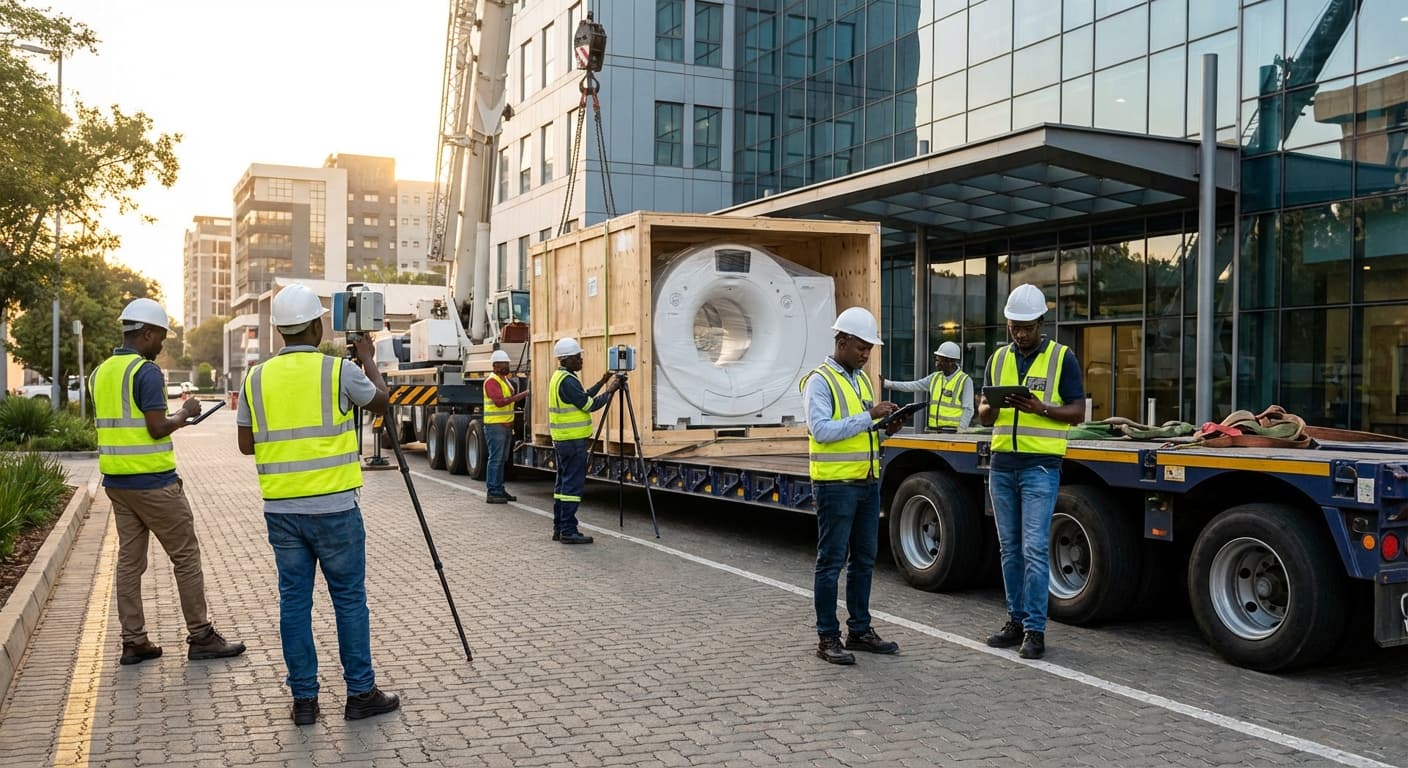
Route Survey & Rigging Plan Service for Heavy Medical Equipment in Mozambique
Engineering Excellence & Technical Support
Route Survey & Rigging Plan Service for Heavy Medical Equipment High-standard technical execution following OEM protocols and local regulatory frameworks.
Precision Route Mapping & Obstacle Analysis
Leveraging advanced GPS and Lidar technologies, we meticulously map the most efficient and safe transport routes for heavy medical equipment across Mozambique. Our comprehensive analysis identifies and mitigates all potential obstacles, including road conditions, bridge load capacities, power line clearances, and traffic patterns, ensuring uninterrupted transit from port to installation site.
Tailored Rigging & Load Securing Strategies
Our expert rigging engineers develop bespoke plans for each heavy medical equipment piece, considering its unique dimensions, weight distribution, and fragility. We employ specialized lifting equipment, custom-fabricated cradles, and advanced lashing techniques to guarantee secure transport and prevent any damage during lifting, loading, transit, and unloading operations.
Comprehensive Risk Assessment & Mitigation
We conduct thorough on-site surveys and develop detailed risk assessment matrices, identifying potential hazards from environmental factors (weather, terrain) to logistical challenges. Our service includes the implementation of proactive mitigation strategies, contingency planning, and real-time monitoring throughout the entire operation, ensuring the highest level of safety and project success for your critical medical equipment.
What Is Route Survey & Rigging Plan Service For Heavy Medical Equipment In Mozambique?
Route Survey & Rigging Plan Service for Heavy Medical Equipment in Mozambique is a specialized logistical undertaking focused on the safe, efficient, and compliant transportation and installation of oversized, overweight, or sensitive medical apparatus within Mozambique. This service encompasses a comprehensive assessment of transportation pathways, identification of potential logistical challenges, and the development of detailed methodologies for lifting, securing, and moving equipment from its point of origin (e.g., port of entry, manufacturing facility) to its final installation site. The process is critical for ensuring the integrity of high-value medical equipment, minimizing transit risks, and adhering to local regulations and infrastructure limitations.
| Stakeholder/Entity | Reason for Needing the Service | Typical Use Cases |
|---|---|---|
| Hospitals and Healthcare Facilities (Public & Private): | Acquisition of advanced medical imaging equipment (MRI, CT scanners), linear accelerators, heavy surgical units, or other large-scale diagnostic and therapeutic devices requires specialized handling to prevent damage during transit and installation, ensuring operational readiness. | Installation of new diagnostic imaging centers, replacement of outdated high-capacity medical machinery, upgrades to radiotherapy departments, and equipping new medical wings or facilities. |
| Medical Equipment Manufacturers & Suppliers: | Ensuring the safe delivery and installation of their products to clients in Mozambique, fulfilling contractual obligations, minimizing product damage, and maintaining brand reputation. Compliance with import and transit regulations is paramount. | Exporting and delivering complex, high-value medical systems to end-users in Mozambique, managing the entire logistics chain from factory to installation site. |
| Logistics and Freight Forwarding Companies: | Subcontracting specialized expertise for the heavy-lift and specialized transport components of a larger project. This allows them to offer comprehensive solutions to their clients without requiring in-house specialized capabilities. | Handling the import and delivery of large medical equipment shipments for their clients, partnering with specialized route survey and rigging firms for specific project phases. |
| Government Agencies & Ministries of Health: | Procurement and deployment of critical medical infrastructure for public health initiatives, often involving large-scale projects and stringent budgetary and timeline requirements. Ensuring public funds are protected by minimizing transit risks. | Establishing or upgrading national medical facilities, equipping rural health centers with advanced diagnostic capabilities, or responding to public health emergencies requiring rapid deployment of heavy medical equipment. |
| Construction and Engineering Firms: | Integrating the installation of heavy medical equipment as part of larger construction projects (e.g., new hospital buildings). Requires coordination between construction timelines and specialized logistical demands. | Building new hospital complexes or expanding existing healthcare infrastructure where the installation of large medical devices is a critical component of the project. |
Key Components of Route Survey & Rigging Plan Service
- Route Identification and Assessment: Detailed examination of all potential transportation routes, considering road conditions, bridge load capacities, overhead clearances (e.g., power lines, underpasses), tunnel dimensions, turning radii, and traffic patterns. This includes preliminary site visits and leveraging GIS data.
- Load Bearing Capacity Verification: Assessment of the structural integrity of all infrastructure along the proposed route, including bridges, viaducts, and temporary support structures, to ensure they can safely support the combined weight of the equipment and transport vehicle.
- Obstacle Identification and Mitigation: Proactive identification of any physical obstructions (e.g., narrow streets, building overhangs, permanent structures) and the development of strategies for their removal, temporary modification, or bypass.
- Permitting and Regulatory Compliance: Navigating and obtaining all necessary permits and authorizations from Mozambican authorities (e.g., Ministry of Transport, local municipalities) for oversized and overweight cargo transport, road closures, and specialized operations.
- Rigging and Lifting Plan Development: Engineering of detailed plans for the safe lifting, securing, and movement of the medical equipment. This includes specifying appropriate lifting equipment (cranes, jacks), rigging gear (slings, shackles), ballast, and handling procedures, considering the equipment's center of gravity, structural limitations, and environmental conditions.
- Transportation Methodology: Selection and configuration of appropriate transport vehicles (e.g., specialized trailers, low-loaders) to accommodate the equipment's dimensions and weight, along with route-specific maneuverability requirements.
- Risk Assessment and Contingency Planning: Comprehensive identification of potential risks (e.g., equipment damage, accidents, weather delays) and the development of robust contingency plans to address unforeseen events.
- On-site Supervision and Execution: Provision of experienced personnel to oversee and execute the rigging, lifting, and transportation operations, ensuring strict adherence to the developed plans and safety protocols.
Who Needs Route Survey & Rigging Plan Service For Heavy Medical Equipment In Mozambique?
For the successful and safe installation of heavy medical equipment in Mozambique, a comprehensive Route Survey & Rigging Plan Service is indispensable. This specialized service ensures that the complex logistics of transporting and positioning large, often sensitive, medical machinery are meticulously managed, mitigating risks and guaranteeing operational readiness. Without proper planning, challenges such as navigating confined hospital spaces, overcoming infrastructure limitations, and preventing damage to both the equipment and the facility become significant hurdles.
| Customer Type | Key Departments Involved | Specific Needs Addressed |
|---|---|---|
| Hospitals & Healthcare Facilities | Facilities Management, Biomedical Engineering, Procurement Department, Operations Management | Safe and efficient installation of new equipment (e.g., MRI scanners, CT scanners, linear accelerators), minimizing disruption to patient care, preventing structural damage during transit and installation. |
| Medical Equipment Manufacturers & Suppliers | Logistics Department, Installation & Commissioning Team, Project Management | Ensuring timely and damage-free delivery to site, providing detailed installation schematics, confirming site readiness for equipment placement, reducing on-site installation time and costs. |
| Government Health Ministries & Agencies | Procurement Division, Infrastructure Planning, Project Oversight | Strategic deployment of medical equipment in national health initiatives, ensuring compliance with safety standards, optimizing resource allocation, managing large-scale public health projects. |
| Construction & Engineering Firms | Project Management, Civil Engineering, Structural Engineering, Site Supervisors | Integrating equipment pathways and installation zones into building designs, ensuring structural integrity for heavy loads, coordinating with installation specialists, meeting project timelines. |
| Logistics & Project Management Companies | Operations Management, Project Coordination, Risk Management, Specialized Rigging Teams | Providing end-to-end logistical solutions, managing complex multi-modal transportation, executing safe rigging operations, mitigating potential delays and unforeseen challenges. |
Target Customers & Departments for Route Survey & Rigging Plan Service in Mozambique
- {"title":"Hospitals & Healthcare Facilities","description":"The primary beneficiaries, including both public and private institutions that are acquiring or upgrading major medical equipment."}
- {"title":"Medical Equipment Manufacturers & Suppliers","description":"Companies that sell and install sophisticated medical devices, requiring specialized logistics for delivery and setup."}
- {"title":"Government Health Ministries & Agencies","description":"Organizations responsible for the procurement, deployment, and maintenance of medical infrastructure across the nation."}
- {"title":"Construction & Engineering Firms","description":"Companies involved in building new healthcare facilities or renovating existing ones, where the integration of heavy medical equipment is a key component."}
- {"title":"Logistics & Project Management Companies","description":"Firms specializing in complex project execution and supply chain management, often contracted for large-scale infrastructure developments."}
Route Survey & Rigging Plan Service For Heavy Medical Equipment Process In Mozambique
This document outlines the comprehensive workflow for our Route Survey & Rigging Plan Service for the transportation and installation of heavy medical equipment in Mozambique. We ensure a meticulous and secure process from the initial client inquiry to the final successful execution, adhering to all safety and logistical requirements specific to the region.
| Phase | Key Activities | Deliverables | Responsible Team |
|---|---|---|---|
| Inquiry & Requirement Gathering | Receive and analyze client needs, equipment specifications, and site details. | Initial Client Brief & Information Request | Client Relations & Project Management |
| Initial Assessment & Proposal | Preliminary risk assessment, scope definition, cost estimation. | Detailed Project Proposal | Project Management & Engineering |
| Site Survey & Data Collection | On-site inspection of route and access points, obstacle identification, measurement of clearances. | Detailed Site Survey Report & Maps | Surveying Team |
| Engineering & Planning | Develop rigging plan, route plan, select equipment, calculate load capacities. | Rigging Plan, Route Plan, Equipment List, Schematics | Engineering Team |
| Permitting & Approvals | Liaise with Mozambican authorities, submit applications, obtain necessary permits. | All Required Permits & Approvals | Logistics & Legal Team |
| Equipment & Resource Mobilization | Source, inspect, and transport specialized equipment and personnel. | Mobilized Equipment & Trained Crew | Logistics & Operations Team |
| Pre-Execution Briefing & Safety Checks | Team briefing, safety protocol review, equipment and site inspections. | Safety Briefing Minutes & Checklist | Operations & Safety Officer |
| Execution - Rigging & Transportation | Implement rigging plan, safe lifting, secure transport of equipment. | Successful Equipment Movement | Rigging Crew & Transport Team |
| Installation & Commissioning Support | Positioning and securing equipment at the destination, handover. | Positioned Equipment Ready for Commissioning | Rigging Crew & Site Supervisors |
| Post-Execution Review & Documentation | Project evaluation, report compilation, client handover. | Final Project Report & Documentation | Project Management & Administration |
Workflow Stages:
- Inquiry & Requirement Gathering: Client submits an inquiry detailing the medical equipment, origin, destination within Mozambique, site access conditions, and any specific project timelines or constraints.
- Initial Assessment & Proposal: Our team reviews the inquiry, conducts a preliminary risk assessment, and provides a detailed proposal outlining the scope of work, methodology, deliverables, timeline, and estimated costs. This may include requests for additional site-specific information.
- Site Survey & Data Collection: Upon proposal acceptance, our expert surveyors visit the origin and destination sites in Mozambique. They conduct a thorough route assessment, including road conditions, bridge capacities, tunnel clearances, potential obstacles (e.g., power lines, trees), traffic patterns, and local regulations. Rigging points, structural integrity of existing infrastructure, and access for specialized equipment are meticulously documented.
- Engineering & Planning: Based on the site survey data, our engineering team develops a detailed rigging plan. This includes selecting appropriate lifting and moving equipment (cranes, dollies, specialized jacks), calculating load capacities, defining lifting procedures, planning securing methods, and creating detailed schematics and 3D models. The route plan incorporates any necessary temporary modifications, escort requirements, and traffic management strategies.
- Permitting & Approvals: We manage the acquisition of all necessary permits and approvals from local authorities in Mozambique for route access, road closures, special transport, and site work. This includes liaising with relevant government agencies and stakeholders.
- Equipment & Resource Mobilization: We source and mobilize specialized rigging equipment, transport vehicles, and trained personnel to the project sites. This includes ensuring all equipment meets international safety standards and is suitable for the Mozambican environment.
- Pre-Execution Briefing & Safety Checks: A comprehensive pre-execution briefing is conducted with all involved personnel. Rigorous safety checks are performed on all equipment, rigging configurations, and the site itself. Emergency response plans are reviewed and finalized.
- Execution - Rigging & Transportation: The rigging and transportation phase is executed according to the approved plan. This involves the careful lifting, securing, and maneuvering of the heavy medical equipment. Our experienced rigging crews oversee all operations, ensuring precision and safety. Escorts and traffic management are implemented as planned.
- Installation & Commissioning Support: Upon arrival at the destination, the equipment is meticulously positioned and secured. We provide support for the installation and commissioning process, ensuring the equipment is placed correctly and safely, ready for integration by the medical facility's technicians.
- Post-Execution Review & Documentation: A post-execution review is conducted to ensure all objectives were met. Final reports, including photographic evidence, survey data, rigging plans, and any incident reports (if applicable), are provided to the client. Lessons learned are documented for continuous improvement.
Route Survey & Rigging Plan Service For Heavy Medical Equipment Cost In Mozambique
The cost of route survey and rigging plan services for heavy medical equipment in Mozambique can vary significantly based on several key factors. These services are critical for ensuring the safe and efficient transport and installation of sensitive and high-value equipment like MRI machines, CT scanners, or large X-ray units. Factors influencing the price include the complexity of the route, the weight and dimensions of the equipment, accessibility of the destination, required specialized equipment, and the experience and reputation of the service provider.
| Service Component | Estimated Cost Range (MZN) | Notes |
|---|---|---|
| Route Survey (Initial Assessment) | 15,000 - 50,000 | Covers site visits, initial route mapping, and preliminary risk assessment for straightforward routes. Larger projects or remote locations will be at the higher end. |
| Detailed Route Survey & Engineering Plan | 50,000 - 200,000+ | Includes detailed topographical surveys, structural assessments of bridges, traffic management planning, and detailed logistical proposals for complex or long-distance routes. |
| Rigging Plan Development (Basic) | 20,000 - 75,000 | For standard equipment and relatively accessible locations, outlining lifting points, equipment needs, and basic safety procedures. |
| Comprehensive Rigging Plan & Engineering | 75,000 - 300,000+ | For very heavy, oversized, or sensitive equipment requiring detailed engineering calculations, stress analysis, and certified plans, especially for challenging installations. |
| Specialized Equipment Rental (e.g., Cranes, Hydraulic Jacks) | 50,000 - 500,000+ (per day/project) | Highly variable based on size, capacity, duration of use, and transport to site. This is a significant cost driver. |
| Labor (Skilled Riggers & Technicians) | 30,000 - 150,000+ (per team/day) | Depends on the number of personnel, skill level, and project duration. Remote locations might incur additional travel and accommodation costs. |
| Project Management & Coordination | 40,000 - 200,000+ | Covers the overall management of the survey, planning, and execution phases, including client communication and stakeholder coordination. |
| Permits & Escorts | 10,000 - 100,000+ | Can vary greatly depending on local regulations, the size of the load, and the need for police or traffic escorts. |
| Contingency (Recommended) | 10-20% of total estimated cost | Essential for unforeseen issues that may arise during transport or installation. |
Key Pricing Factors:
- Equipment Specifications: The weight, dimensions, and fragility of the medical equipment are primary drivers of cost. Larger and heavier items require more robust rigging solutions and specialized transport, increasing labor and equipment rental costs.
- Route Complexity & Distance: The length of the transport route and the challenges it presents (e.g., narrow roads, bridges with weight limits, steep inclines, urban traffic congestion) directly impact planning and execution time, and thus cost.
- Accessibility of Destination: Difficult-to-reach hospital or clinic locations, especially in remote areas, will incur higher costs due to extended travel times, potential need for off-road vehicles, and logistical complexities.
- Required Specialized Equipment: The need for specific cranes, hydraulic jacks, dollies, specialized lifting frames, or custom-built transport modules will add to the overall expense.
- Site Survey Requirements: Thorough site surveys are essential. This includes assessing doorways, elevator capacities, structural integrity of floors, and clearances. The more complex the site, the more time and expertise are needed.
- Rigging Plan Detail & Engineering: The level of detail and engineering rigor required for the rigging plan will influence cost. Highly critical or complex installations may require detailed structural analysis and certified engineering plans.
- Permits & Approvals: Obtaining necessary permits for oversized loads, road closures, or special escorts can add administrative costs and time, impacting the project budget.
- Insurance: Comprehensive insurance for the transit and rigging operations is a crucial but often separate cost that needs to be factored in.
- Service Provider's Experience & Reputation: Established companies with proven track records in handling heavy and specialized equipment typically command higher fees due to their expertise, safety record, and reliability.
- Timelines & Urgency: Expedited services or tight deadlines may incur premium charges.
Affordable Route Survey & Rigging Plan Service For Heavy Medical Equipment Options
Navigating the complexities of transporting and installing heavy medical equipment requires specialized expertise. Our Affordable Route Survey & Rigging Plan Service ensures a safe, efficient, and cost-effective solution, minimizing risks and operational disruptions. We provide comprehensive planning for every stage, from initial assessment to final placement.
| Value Bundle | Description | Cost-Saving Strategies Incorporated | Ideal For |
|---|---|---|---|
| Essentials Bundle | Covers a standard route survey and basic rigging plan for single, moderate-weight equipment. Includes essential documentation. | Streamlined planning process, optimized route selection to avoid costly detours or specialized vehicle requirements. | Smaller clinics, individual equipment installations, straightforward transport. |
| Comprehensive Bundle | Includes in-depth route survey for complex routes, detailed rigging plan with multiple lifting points, on-site consultation, and a full risk assessment report. | Early identification of potential road closures or permit needs reduces last-minute expenses. Efficient rigging design minimizes equipment rental time. | Hospitals, multi-equipment installations, challenging urban environments, long-distance transport. |
| Project Management Bundle | Our most complete offering. Includes all aspects of the Comprehensive Bundle, plus dedicated project management support, stakeholder coordination, and post-installation review. | Integrated logistics management prevents cost overruns due to miscommunication. Proactive problem-solving minimizes downtime and associated financial losses. | Large-scale facility upgrades, new hospital construction, mission-critical equipment installations requiring minimal downtime. |
| Customizable Solution | Tailored service packages designed to meet the unique needs of your specific project. We can combine or exclude specific components based on your requirements. | Pay only for what you need. Avoids unnecessary costs associated with pre-defined bundles that may include services not relevant to your project. | Unique equipment types, unusual site constraints, specialized logistical challenges. |
Key Service Components
- Route Survey: Detailed analysis of transportation paths, identifying potential obstacles, load restrictions, and necessary permits. This includes evaluating road conditions, bridge capacities, turning radii, and overhead clearances.
- Rigging Plan Development: Meticulous engineering of lifting and moving procedures, specifying equipment, lifting points, bracing, and safety protocols. This ensures the stability and integrity of the equipment throughout the process.
- Risk Assessment & Mitigation: Proactive identification of potential hazards and implementation of strategies to prevent accidents, damage, or delays.
- On-Site Supervision: Expert oversight during the critical lifting and moving phases to ensure adherence to the plan and immediate problem-solving.
- Documentation & Reporting: Comprehensive reports detailing the survey, plan, execution, and any deviations or recommendations for future projects.
Verified Providers In Mozambique
In the burgeoning healthcare landscape of Mozambique, identifying reliable and credentialed healthcare providers is paramount for ensuring quality patient care. Franance Health stands out as a leading network committed to rigorous vetting and upholding the highest standards. This commitment translates into a tangible benefit for patients seeking trustworthy medical services. By partnering exclusively with verified providers, Franance Health offers a guarantee of competence, ethical practice, and adherence to established medical protocols.
| Category | Franance Health Provider Attribute | Benefit to Patient |
|---|---|---|
| Qualifications | Verified medical degrees, certifications, and specialist training. | Ensures competence and expertise in their respective fields. |
| Licensing & Registration | Valid and current medical licenses issued by Mozambican authorities. | Confirms legal and regulatory compliance, operating within established frameworks. |
| Professional Experience | Thorough review of past performance and practice history. | Mitigates risk and suggests a track record of reliable service. |
| Continuing Education | Evidence of ongoing professional development and updated knowledge. | Guarantees that providers are current with the latest medical advancements and practices. |
| Facility Standards (if applicable) | Adherence to safety, hygiene, and equipment standards in partner clinics and hospitals. | Provides a safe and well-equipped environment for treatment and procedures. |
| Ethical Conduct | Commitment to patient-centered care, confidentiality, and ethical decision-making. | Fosters a trusting relationship and ensures patient rights are protected. |
Why Franance Health Providers Represent the Best Choice:
- Rigorous Credentialing: Every provider within the Franance Health network undergoes a comprehensive verification process, scrutinizing their qualifications, licenses, and professional history.
- Commitment to Quality: Franance Health partners with facilities and practitioners dedicated to delivering exceptional medical care, evidenced by accreditations and patient satisfaction metrics.
- Ethical Practice: Providers are held to a strict code of conduct, ensuring patient well-being, privacy, and respect are always prioritized.
- Access to Specialized Care: The network encompasses a diverse range of medical specialists, offering comprehensive healthcare solutions for various needs.
- Enhanced Patient Trust: The Franance Health verification mark provides peace of mind, assuring patients they are receiving care from trusted and competent professionals.
Scope Of Work For Route Survey & Rigging Plan Service For Heavy Medical Equipment
This document outlines the Scope of Work (SOW) for Route Survey and Rigging Plan Services for the transportation and installation of heavy medical equipment. The objective is to ensure safe, efficient, and compliant movement and placement of critical medical apparatus from its point of receipt to its final operational location within a healthcare facility. This SOW covers all necessary surveys, planning, documentation, and consultation required for a successful project.
| Service Component | Description | Deliverables | Standard Specifications/Considerations |
|---|---|---|---|
| Initial Site Assessment & Information Gathering | Understanding the equipment's specifications (weight, dimensions, center of gravity, fragility), delivery point, destination, and any known site challenges. Reviewing architectural drawings and facility layouts. | Equipment specification summary, facility layout diagrams, preliminary route identification. | Manufacturer's data sheets, facility blueprints (CAD preferred), site visit reports. |
| Route Survey | Detailed inspection of all proposed transport routes from delivery point (dock, receiving area) to the final installation location. This includes internal corridors, doorways, elevators, stairwells, and external access points if applicable. | Detailed route maps highlighting clearances, obstacles, and potential hazards. Video and photographic evidence of the route. | Minimum clearance requirements (height, width, depth), floor load capacity, door frame dimensions, elevator capacity and dimensions, ramp gradients, ceiling obstructions (pipes, conduits, lighting), surface conditions, potential for static discharge, environmental factors (temperature, humidity). |
| Obstacle Identification & Mitigation Planning | Identification of any structural, architectural, or operational obstacles along the route. Development of strategies to overcome these obstacles, including temporary modifications or alternative routes. | List of identified obstacles and proposed mitigation strategies, including temporary works plans if necessary. | Compliance with building codes, structural integrity assessments, approved temporary modification plans. |
| Rigging Plan Development | Creation of a detailed plan for lifting, maneuvering, and positioning the heavy medical equipment. This includes selection of appropriate rigging equipment, lifting points, and sequence of operations. | Comprehensive rigging plan document including lifting diagrams, equipment specifications, load calculations, and operational procedures. | Industry best practices for heavy lifting (e.g., ASME standards), certified rigging equipment, load charts, experienced rigging personnel, manufacturer's installation guidelines. |
| Equipment Handling & Protection | Specifying methods for protecting the equipment during transit and installation to prevent damage. This includes crating, padding, and securing methods. | Equipment protection protocols, materials specification for padding and securing. | Anti-static measures, shock absorption requirements, securing points, environmental protection (e.g., moisture barriers). |
| Safety Plan & Risk Assessment | Comprehensive safety plan addressing all potential risks associated with the route survey and rigging operations. Includes emergency procedures and personnel responsibilities. | Site-specific safety plan, hazard identification and risk assessment (HIRA) report, emergency contact list. | OSHA regulations, local safety ordinances, competent person designation, lockout/tagout procedures, fall protection, personal protective equipment (PPE) requirements. |
| Stakeholder Coordination & Communication | Liaison with hospital facilities management, IT department, clinical staff, and any other relevant stakeholders to minimize disruption and ensure smooth operations. | Meeting minutes, communication logs, pre-operation briefings. | Defined communication channels, scheduled work windows, noise and vibration control measures. |
| Final Report & Documentation | Consolidation of all survey data, rigging plans, safety assessments, and recommendations into a comprehensive final report. | Final SOW Report, including all preceding deliverables in a consolidated format. | Clear, concise, and well-organized documentation for record-keeping and future reference. |
Key Objectives
- To identify and mitigate all potential route hazards and constraints.
- To develop a comprehensive and detailed rigging plan for safe lifting, maneuvering, and positioning of the equipment.
- To ensure compliance with all relevant safety regulations, industry standards, and manufacturer specifications.
- To provide clear and actionable documentation for all stakeholders involved in the transportation and installation process.
- To minimize disruption to hospital operations during the survey and rigging operations.
Service Level Agreement For Route Survey & Rigging Plan Service For Heavy Medical Equipment
This Service Level Agreement (SLA) outlines the response times and uptime guarantees for the Route Survey & Rigging Plan Service specifically for the installation and relocation of heavy medical equipment. This ensures minimal disruption and timely execution of critical medical equipment services.
1. Service Description:
The Route Survey & Rigging Plan Service encompasses comprehensive planning for the safe and efficient transport and installation of heavy medical equipment. This includes site assessment, route analysis, identification of potential obstacles, development of detailed rigging and lifting plans, and coordination with relevant stakeholders.
2. Service Objectives:
- To provide accurate and detailed route surveys and rigging plans.
- To minimize downtime and disruption to medical facility operations.
- To ensure the safety of personnel and equipment during the entire process.
- To facilitate prompt and efficient execution of installation and relocation projects.
3. Scope of Service:
- Site inspection and assessment of installation/relocation locations.
- Detailed mapping and analysis of potential transport routes.
- Identification and mitigation of any route-specific challenges (e.g., door widths, staircases, elevator capacities, floor load limits, structural integrity).
- Development of comprehensive rigging and lifting plans, including equipment, personnel, and safety procedures.
- Coordination with facility management, building engineers, and other relevant parties.
- Creation of detailed documentation for the route survey and rigging plan.
4. Response Times:
This section defines the maximum acceptable timeframes for initial response and plan delivery after a service request is formally submitted and all necessary information is provided by the client.
5. Uptime Guarantees:
While this service is primarily project-based and not a continuously running system, the 'uptime' is interpreted as the availability of the service team to initiate and execute the survey and planning process within the agreed-upon response times. There are no 'uptime' guarantees in the traditional sense of a continuously accessible online service.
| Service Event | Service Level Objective (SLO) | Measurement Method | Remedy for Failure |
|---|---|---|---|
| Service Request Acknowledgement | Within 1 Business Hour | Timestamp of email/system acknowledgement | A 5% discount on the total service fee for the project. |
| Initial Site Visit Scheduling | Within 2 Business Days of complete information submission | Date of confirmed site visit appointment | A 10% discount on the total service fee for the project. |
| Preliminary Rigging Plan Delivery | Within 5 Business Days of Site Visit Completion | Timestamp of delivery of draft plan | A 10% discount on the total service fee for the project. |
| Final Rigging Plan Delivery | Within 3 Business Days of Client Feedback Receipt | Timestamp of delivery of final plan | A 15% discount on the total service fee for the project. |
| Emergency Response Initiation | Within 4 Business Hours for critical adjustments | Timestamp of commencement of emergency assessment/planning | Waived service fee for the emergency response component. |
Response Time Matrix
- Requests will be acknowledged within 1 business hour of receipt.
- Initial site visit for route survey will be scheduled within 2 business days.
- Preliminary rigging plan draft will be delivered within 5 business days of the site visit.
- Final rigging plan with all revisions and approvals will be delivered within 3 business days of receiving client feedback.
- Emergency response for urgent route re-assessments or plan modifications (due to unforeseen circumstances) will be initiated within 4 business hours.
Frequently Asked Questions

Ready when you are
Let's scope your Route Survey & Rigging Plan Service for Heavy Medical Equipment in Mozambique project in Mozambique.

Scaling healthcare logistics and technical systems across the entire continent.