
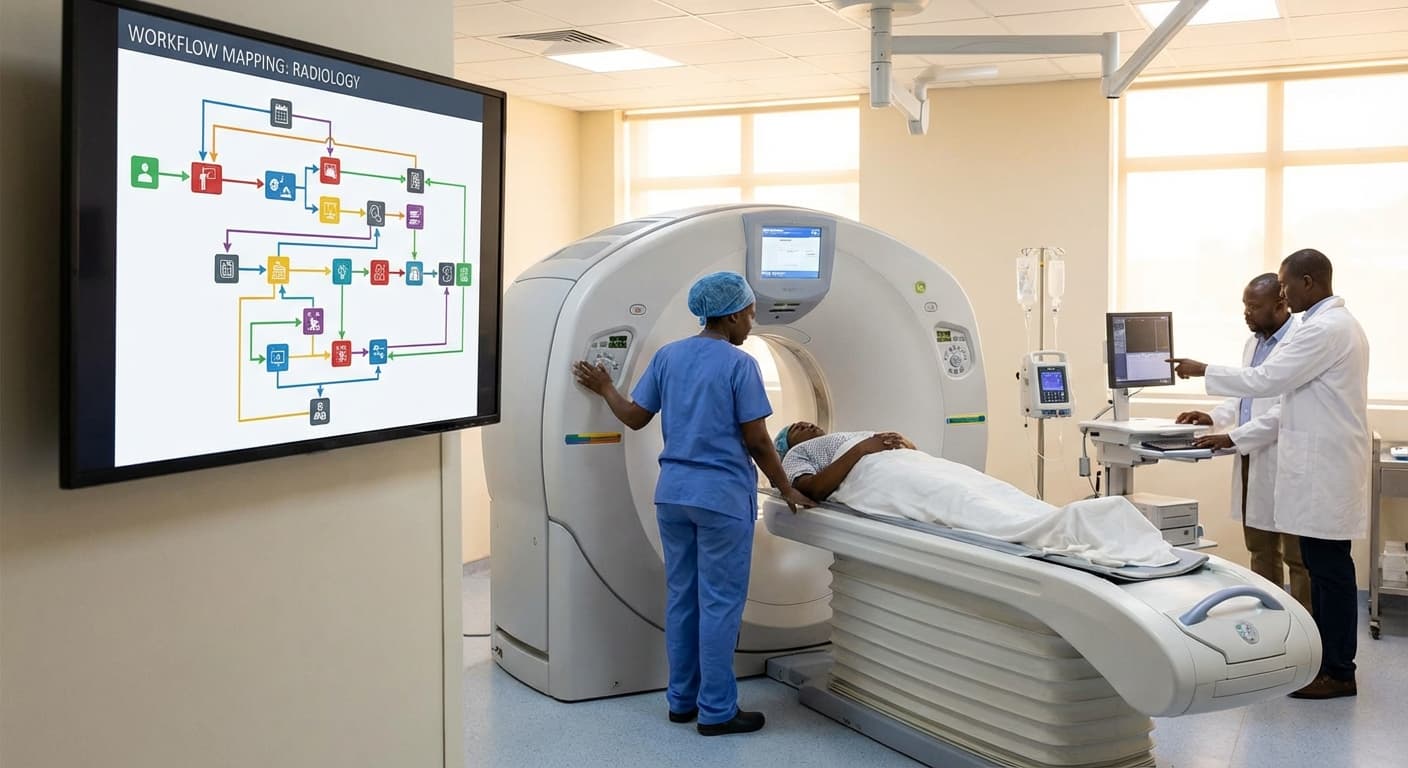
Department Workflow Mapping Service (Radiology/ICU/OT/Lab/Dialysis) in Mozambique
Engineering Excellence & Technical Support
Department Workflow Mapping Service (Radiology/ICU/OT/Lab/Dialysis) High-standard technical execution following OEM protocols and local regulatory frameworks.
Streamlined Patient Flow for Enhanced Throughput
Our workflow mapping services for Mozambican healthcare departments (Radiology, ICU, OT, Lab, Dialysis) identify and eliminate bottlenecks, leading to optimized patient progression, reduced wait times, and increased service capacity.
Improved Resource Allocation and Operational Efficiency
We analyze and visualize existing departmental workflows to pinpoint inefficiencies in resource utilization (staff, equipment, supplies) and recommend data-driven adjustments, maximizing operational effectiveness and cost-efficiency within Mozambique's healthcare infrastructure.
Standardized Protocols for Consistent Quality Care
By mapping out critical processes in key departments, our service facilitates the development and implementation of standardized operating procedures (SOPs) across Mozambican facilities, ensuring consistent, high-quality patient care and reducing the risk of errors.
What Is Department Workflow Mapping Service (Radiology/icu/ot/lab/dialysis) In Mozambique?
Department Workflow Mapping Service, in the context of specialized healthcare departments in Mozambique (Radiology, Intensive Care Unit (ICU), Operating Theatre (OT), Laboratory, and Dialysis), refers to a systematic methodology for documenting, analyzing, and optimizing the sequence of tasks, decision points, information flows, and resource utilization within these critical clinical areas. This service aims to achieve enhanced operational efficiency, improved patient safety, reduced turnaround times, better resource allocation, and standardized care delivery. It involves detailed observation, data collection, stakeholder interviews, and process modeling to visualize the current state (as-is) and design an improved future state (to-be) of departmental operations.
| Department Type | Who Needs the Service | Typical Use Cases |
|---|---|---|
| Radiology | Radiology department managers, hospital administrators, imaging technologists, radiologists. | Optimizing patient scheduling for imaging studies, streamlining report generation and dissemination, improving image acquisition efficiency, reducing radiation exposure through optimized protocols, integrating new imaging modalities, ensuring timely access to diagnostic information. |
| Intensive Care Unit (ICU) | ICU directors, head nurses, critical care physicians, respiratory therapists, hospital quality improvement teams. | Standardizing patient admission and discharge processes, optimizing nurse-to-patient ratios based on acuity, improving communication between multidisciplinary teams, streamlining medication administration, enhancing patient monitoring protocols, reducing infection rates through standardized care pathways. |
| Operating Theatre (OT) | Surgical department heads, OR managers, anesthesiologists, surgical nurses, sterile processing technicians, hospital administrators. | Improving operating room utilization, optimizing surgical scheduling and turnaround times, streamlining instrument sterilization and preparation, enhancing pre-operative patient preparation, reducing surgical site infections, standardizing post-operative care pathways. |
| Laboratory | Laboratory directors, clinical pathologists, laboratory technicians, hospital IT departments, quality assurance personnel. | Expediting sample processing and analysis, optimizing test turnaround times, improving inventory management for reagents and consumables, standardizing specimen collection and handling procedures, integrating automated laboratory systems, ensuring accurate and timely reporting of results. |
| Dialysis | Nephrology department managers, dialysis unit head nurses, nephrologists, dialysis technicians, patient safety officers. | Optimizing patient scheduling for dialysis sessions, streamlining patient preparation and monitoring during dialysis, improving medication management for dialysis patients, enhancing infection control measures, optimizing equipment maintenance and utilization, standardizing emergency protocols for dialysis-related complications. |
Key Components of Department Workflow Mapping Service
- Current State Analysis (As-Is Mapping): Comprehensive documentation of existing processes, including patient journeys, staff activities, equipment usage, information systems interactions, and communication protocols.
- Process Identification & Documentation: Detailed delineation of each step within a workflow, including inputs, outputs, decision rules, and responsible personnel/roles.
- Bottleneck & Inefficiency Identification: Analysis of the mapped workflows to pinpoint areas of delay, redundancy, waste, or suboptimal resource utilization.
- Technology & System Integration Assessment: Evaluation of how existing IT systems (e.g., Picture Archiving and Communication System (PACS), Laboratory Information System (LIS), Electronic Health Records (EHR)) support or impede workflows.
- Stakeholder Engagement: Active involvement of physicians, nurses, technicians, administrative staff, and management to gather insights and ensure buy-in.
- Future State Design (To-Be Mapping): Development of optimized workflows incorporating best practices, technological advancements, and identified improvement opportunities.
- Standardization of Protocols: Creation of standardized operating procedures (SOPs) based on the improved workflows.
- Performance Metrics Definition: Establishment of key performance indicators (KPIs) to measure the effectiveness of the redesigned workflows.
- Training & Implementation Support: Development of training materials and guidance for staff on new or modified workflows.
Who Needs Department Workflow Mapping Service (Radiology/icu/ot/lab/dialysis) In Mozambique?
Department workflow mapping is crucial for optimizing operational efficiency, resource allocation, and patient care within complex healthcare environments. In Mozambique, where healthcare infrastructure and resource management are significant considerations, understanding and improving workflows in key departments can lead to substantial benefits. This service is particularly relevant for departments dealing with high patient volumes, critical care, or specialized diagnostic and treatment processes.
| Target Customer/Department | Description and Need for Workflow Mapping | Specific Departments in Mozambique |
|---|---|---|
Who Needs Department Workflow Mapping Service (Radiology/ICU/OT/Lab/Dialysis) in Mozambique?
- Hospitals and Healthcare Facilities
- Government Health Ministries and Agencies
- Non-Governmental Organizations (NGOs) focused on healthcare improvement
- Private Healthcare Providers
- Medical Training and Research Institutions
Department Workflow Mapping Service (Radiology/icu/ot/lab/dialysis) Process In Mozambique
This document outlines the Department Workflow Mapping Service process for key hospital departments (Radiology, ICU, OT, Lab, and Dialysis) within Mozambique. The service aims to analyze, document, and optimize existing operational workflows to improve efficiency, reduce errors, and enhance patient care. The process spans from the initial inquiry from a healthcare facility to the final delivery of mapped workflows and recommendations.
| Phase | Step | Description | Responsible Party | Deliverables/Outcomes |
|---|---|---|---|---|
| Inquiry & Initial Contact |
| A healthcare facility (hospital, clinic) expresses interest in the workflow mapping service through official channels (email, phone, designated contact person). | Healthcare Facility | Formal inquiry letter/email. |
| Inquiry & Initial Contact |
| A preliminary meeting or call to understand the facility's specific needs, challenges, the departments to be mapped, and desired outcomes. | Service Provider & Healthcare Facility | Understanding of scope, preliminary scope definition. |
| Inquiry & Initial Contact |
| Based on the needs assessment, a detailed proposal is created outlining the scope of work, methodology, timeline, resources required, and associated costs. | Service Provider | Formal proposal document. |
| Inquiry & Initial Contact |
| The facility reviews the proposal, and any necessary negotiations or clarifications occur. Upon agreement, a formal contract or Memorandum of Understanding (MOU) is signed. | Healthcare Facility & Service Provider | Signed contract/MOU. |
| Planning & Preparation |
| An official start of the project, introducing the project teams, reiterating objectives, and outlining communication protocols. | Service Provider & Healthcare Facility | Project team introductions, detailed project plan. |
| Planning & Preparation |
| Development of a plan for collecting information on current workflows, including identifying key stakeholders, types of data to collect (interviews, observation, document review), and ethical considerations. | Service Provider | Data gathering plan. |
| Execution: Data Collection |
| Conducting interviews with key personnel across departments (doctors, nurses, technicians, administrators, support staff) to understand their roles, tasks, and challenges. | Service Provider | Interview transcripts/notes. |
| Execution: Data Collection |
| Directly observing the day-to-day operations within each targeted department to document actual processes, identify bottlenecks, and gather real-time data. | Service Provider | Observation notes, video/photo documentation (with consent). |
| Execution: Data Collection |
| Analyzing existing Standard Operating Procedures (SOPs), guidelines, patient charts, equipment logs, and other relevant documentation. | Service Provider | Summaries of relevant documents. |
| Execution: Data Collection |
| Compiling all collected data, identifying patterns, discrepancies, inefficiencies, and areas for improvement. | Service Provider | Initial data analysis reports. |
| Execution: Workflow Mapping |
| Visually representing the current workflows using standardized notation (e.g., BPMN, flowcharts) for each department, clearly showing steps, decision points, and handoffs. | Service Provider | Detailed workflow diagrams for each department. |
| Execution: Workflow Mapping |
| Highlighting inefficiencies, redundant steps, communication breakdowns, potential for errors, and areas where delays occur within the mapped workflows. | Service Provider | List of identified gaps and bottlenecks. |
| Reporting & Recommendations |
| Developing a comprehensive draft report that includes the mapped workflows, analysis of findings, and proposed recommendations for optimization. | Service Provider | Draft report with workflow maps and initial recommendations. |
| Reporting & Recommendations |
| Presenting the draft report and recommendations to key stakeholders within the healthcare facility for review, validation, and feedback. | Service Provider & Healthcare Facility | Feedback session notes, revised recommendations. |
| Reporting & Recommendations |
| Finalizing the report based on feedback and presenting the finalized workflow maps, analysis, and actionable recommendations to the facility's management. | Service Provider | Final workflow mapping report, presentation slides, implemented recommendations framework. |
| Post-Execution (Optional) |
| Providing ongoing support or training to assist the facility in implementing the recommended changes (if included in the agreement). | Service Provider | Training materials, implementation progress reports. |
| Post-Execution (Optional) |
| Conducting a follow-up assessment after a specified period to evaluate the impact of implemented changes and identify further areas for refinement. | Service Provider | Follow-up assessment report. |
Key Departments Covered
- Radiology Department
- Intensive Care Unit (ICU)
- Operating Theatre (OT)
- Laboratory Services
- Dialysis Unit
Department Workflow Mapping Service (Radiology/icu/ot/lab/dialysis) Cost In Mozambique
Understanding the cost of departmental workflow mapping services in Mozambique requires a nuanced approach. These services are crucial for optimizing efficiency, reducing errors, and improving patient care within critical hospital departments like Radiology, Intensive Care Units (ICU), Operating Theatres (OT), Laboratories, and Dialysis Centers. The pricing is not standardized and depends on several factors. Estimating a precise range is challenging due to the bespoke nature of these projects and the varying operational scales of healthcare facilities in Mozambique. However, we can outline the key determinants influencing the cost and provide a general idea of potential price ranges in the local currency, the Mozambican Metical (MZN).
| Service Component / Department | Estimated Cost Range (MZN) | Notes |
|---|---|---|
| Basic Workflow Mapping (Single Department, e.g., Radiology Imaging Process) | 150,000 - 400,000 MZN | Covers 1-3 core workflows, standard documentation. Suitable for smaller facilities or specific process improvements. |
| Comprehensive Workflow Mapping (e.g., ICU Patient Journey) | 400,000 - 1,000,000+ MZN | Detailed mapping of multiple patient stages, critical care protocols, equipment, and staff roles. Often includes bottleneck analysis and initial recommendations. |
| Advanced Workflow Optimization & Re-engineering (e.g., OT Suite Efficiency) | 800,000 - 2,500,000+ MZN | Includes in-depth analysis, process redesign, identifying areas for automation or significant efficiency gains, and detailed implementation planning. May involve advanced data analytics. |
| Lab Workflow Mapping (e.g., Sample Processing to Reporting) | 200,000 - 600,000 MZN | Focus on sample tracking, testing procedures, quality control, and reporting accuracy. Complexity depends on the range of tests offered. |
| Dialysis Unit Workflow Mapping (Patient Treatment Cycle) | 250,000 - 700,000 MZN | Covers patient scheduling, pre-dialysis assessment, the dialysis procedure itself, post-dialysis care, and equipment management. |
| Consultant Day Rate (Estimated) | 15,000 - 50,000+ MZN per day | This is a very rough estimate. Highly specialized consultants or firms will charge at the higher end. This rate typically excludes project management and reporting overhead. |
Key Pricing Factors for Departmental Workflow Mapping Services in Mozambique
- {"title":"Scope and Complexity of the Department:","description":"Larger departments with more intricate processes, a higher volume of patient throughput, and a greater number of staff involved will naturally command higher mapping costs. For instance, mapping an entire ICU with multiple beds and complex patient monitoring protocols will be more involved than mapping a smaller, specialized laboratory section."}
- {"title":"Number of Workflows to be Mapped:","description":"The more distinct workflows that need to be documented and analyzed, the longer the engagement and thus the higher the cost. This includes initial patient intake, diagnostic procedures, treatment protocols, reporting, and administrative processes."}
- {"title":"Level of Detail Required:","description":"Basic workflow mapping might involve high-level process flows, while more in-depth analysis could require detailed task breakdowns, identification of potential bottlenecks, risk assessments, and data flow analysis. The more granular the requirement, the higher the effort and cost."}
- {"title":"Provider's Expertise and Reputation:","description":"Consulting firms or individual experts with a proven track record in healthcare workflow optimization, particularly within the Mozambican context or similar African healthcare systems, will likely charge more for their specialized knowledge and experience. Local knowledge of regulatory environments and common operational challenges is a significant asset."}
- {"title":"Duration of the Project:","description":"The time it takes to complete the mapping, from initial data gathering and interviews to analysis and final report generation, directly impacts the cost. This is influenced by the scope, the availability of stakeholders for interviews, and the complexity of the existing workflows."}
- {"title":"Deliverables Expected:","description":"The final output can vary. Some projects may only require documented process maps, while others might include recommendations for improvement, implementation roadmaps, training materials, or even the development of new standard operating procedures (SOPs)."}
- {"title":"Technology and Tools Used:","description":"The software or tools utilized for workflow modeling and analysis can also influence pricing. Some providers may use specialized, licensed software that adds to their overhead."}
- {"title":"Location within Mozambique:","description":"While less significant than other factors, travel and accommodation costs for the consultants if the facility is in a remote area might be factored into the overall price. Major cities like Maputo might have a wider pool of consultants, potentially leading to more competitive pricing."}
- {"title":"Customization and Integration Needs:","description":"If the workflow mapping needs to be integrated with existing hospital information systems (HIS) or electronic health records (EHR), this will add complexity and cost."}
Affordable Department Workflow Mapping Service (Radiology/icu/ot/lab/dialysis) Options
Our Affordable Department Workflow Mapping Service offers a comprehensive solution to optimize operations within critical hospital departments. We specialize in analyzing and documenting existing workflows in Radiology, ICU, Operating Theatre (OT), Laboratory, and Dialysis units. By providing clear, actionable insights, we help departments identify bottlenecks, reduce inefficiencies, and improve patient care delivery. Our service is designed to be cost-effective, delivering significant ROI through enhanced productivity and reduced waste. We offer flexible value bundles tailored to the specific needs and budget of each department, alongside strategic cost-saving recommendations.
| Value Bundle Name | Included Services | Department Focus | Estimated Cost Range (USD) | Key Value Proposition |
|---|---|---|---|---|
| Essential Streamline | Basic workflow diagramming, identification of top 3 bottlenecks, preliminary recommendations. | Any single department (Radiology, ICU, OT, Lab, or Dialysis) | $2,500 - $5,000 | Cost-effective entry point for understanding core inefficiencies and gaining initial improvement insights. |
| Comprehensive Optimization | Detailed workflow mapping, bottleneck analysis and prioritization, root cause analysis, development of optimized workflow designs, key performance indicator (KPI) identification. | Any single department (Radiology, ICU, OT, Lab, or Dialysis) | $6,000 - $12,000 | In-depth analysis leading to tangible operational improvements and measurable efficiency gains. |
| Interdepartmental Synergy | Workflow mapping across 2-3 interconnected departments (e.g., OT and ICU, Lab and Radiology), analysis of handoff points, identification of interdepartmental communication gaps, recommendations for seamless transitions. | 2-3 interconnected departments | $10,000 - $20,000 | Optimizes patient flow and communication between critical care areas, improving overall patient journey. |
| Enterprise-Wide Transformation | Full-scale workflow mapping across all specified departments (Radiology, ICU, OT, Lab, Dialysis), comprehensive bottleneck and interdependency analysis, development of integrated operational strategies, implementation support framework. | All specified departments | $25,000+ | Holistic approach to transform hospital-wide operational efficiency, driving significant long-term cost savings and improved patient outcomes. |
Key Benefits of Workflow Mapping
- Identify and eliminate redundant or inefficient steps.
- Improve patient throughput and reduce wait times.
- Enhance communication and collaboration between staff.
- Standardize processes for consistent quality and safety.
- Facilitate effective training and onboarding of new personnel.
- Provide a clear baseline for future process improvement initiatives.
- Support compliance with regulatory requirements.
- Reduce operational costs through optimized resource utilization.
Verified Providers In Mozambique
Navigating the healthcare landscape in Mozambique requires confidence in the providers you choose. Franance Health stands out as a beacon of trust and excellence, offering a curated network of verified healthcare professionals and facilities. This verification process is not merely a formality; it's a rigorous examination of credentials, quality of care, ethical practices, and patient satisfaction. By partnering with Franance Health, individuals gain access to a system that prioritizes their well-being, ensuring that every interaction with a verified provider meets the highest standards of medical expertise and compassionate care. This commitment to verification is what positions Franance Health as the superior choice for accessible and reliable healthcare services in Mozambique.
| Verification Component | Franance Health Standard | Benefit to Patients |
|---|---|---|
| Medical Licenses & Certifications | Thoroughly checked and up-to-date. | Ensures practitioners are legally qualified and competent. |
| Professional Experience | Verified through references and work history. | Confirms practical expertise and skill. |
| Reputation & Patient Feedback | Monitored through formal channels and reviews. | Guarantees providers are respected for their service. |
| Facility Accreditation | Ensures adherence to safety and quality standards. | Provides access to well-equipped and regulated medical environments. |
| Continuing Professional Development | Requirements for ongoing learning and training. | Ensures providers are up-to-date with the latest medical advancements. |
Why Franance Health is the Best Choice:
- Rigorous credential verification of all healthcare professionals.
- Emphasis on quality of care and patient safety.
- Commitment to ethical practices and patient rights.
- Network of accredited healthcare facilities.
- Streamlined access to trusted medical services.
- Enhanced patient trust and confidence in healthcare providers.
Scope Of Work For Department Workflow Mapping Service (Radiology/icu/ot/lab/dialysis)
This Scope of Work (SOW) outlines the services to be provided for the comprehensive workflow mapping of critical hospital departments. The objective is to analyze, document, and visualize existing processes within the Radiology, Intensive Care Unit (ICU), Operating Theatre (OT), Laboratory, and Dialysis departments. This mapping will identify bottlenecks, inefficiencies, and opportunities for optimization and standardization.
| Phase | Activity | Description | Deliverables |
|---|---|---|---|
| Phase 1: Discovery & Analysis | Project Kick-off & Planning | Initial meeting with stakeholders to define project scope, objectives, timeline, and communication protocols. Identify key personnel and stakeholders for each department. | Project Charter, Stakeholder Register, Communication Plan |
| Phase 1: Discovery & Analysis | Current State Workflow Documentation | Conduct interviews, observation sessions, and workshops with departmental staff. Collect existing documentation, SOPs, and process maps. Document each step, decision point, role, and system interaction within the current workflow. | Detailed 'As-Is' Workflow Diagrams (e.g., BPMN, Flowcharts), Raw Data Collection Notes, Process Narratives |
| Phase 1: Discovery & Analysis | Pain Point & Bottleneck Identification | Analyze documented workflows to identify inefficiencies, delays, redundancies, communication gaps, and areas of high risk or error. Quantify impact where possible. | List of Identified Bottlenecks and Inefficiencies, Root Cause Analysis Summary |
| Phase 2: Design & Optimization | 'To-Be' Workflow Design | Collaborate with stakeholders to conceptualize and design optimized future state workflows. Incorporate best practices, lean principles, and technological enablers. Focus on improving patient flow, reducing wait times, enhancing communication, and ensuring patient safety. | Proposed 'To-Be' Workflow Diagrams, Process Improvement Recommendations |
| Phase 2: Design & Optimization | Gap Analysis | Compare the 'As-Is' and 'To-Be' workflows to identify gaps in technology, training, policies, or resources required for implementation. | Gap Analysis Report |
| Phase 2: Design & Optimization | Standard Operating Procedure (SOP) Development | Develop clear, concise, and actionable SOPs for each critical step within the optimized 'To-Be' workflows. Ensure consistency across departments where applicable. | Draft Standard Operating Procedures (SOPs) for each department |
| Phase 3: Validation & Handover | Stakeholder Validation | Present the 'To-Be' workflows and proposed SOPs to stakeholders for feedback and validation. Incorporate revisions based on feedback. | Validated 'To-Be' Workflow Diagrams, Finalized SOPs |
| Phase 3: Validation & Handover | Final Report & Deliverable Handover | Compile all findings, analyses, and developed documentation into a comprehensive final report. Hand over all digital and hard copies of deliverables. | Comprehensive Final Project Report, All Digital Deliverables (e.g., Visio files, PDF, Word documents), Training Material Outline (Optional) |
Service Objectives
- To accurately document the current state of workflows within each specified department.
- To identify and analyze pain points, inefficiencies, and potential risks in existing processes.
- To develop optimized 'to-be' workflows that enhance efficiency, patient safety, and resource utilization.
- To provide a clear and visual representation of both current and future state workflows.
- To establish standardized operating procedures (SOPs) based on the mapped workflows.
- To facilitate informed decision-making for process improvement initiatives and technology adoption.
Service Level Agreement For Department Workflow Mapping Service (Radiology/icu/ot/lab/dialysis)
This Service Level Agreement (SLA) outlines the performance standards and responsibilities for the Department Workflow Mapping Service. This service aims to document, analyze, and optimize workflows within critical hospital departments, including Radiology, Intensive Care Unit (ICU), Operating Theatre (OT), Laboratory, and Dialysis. The SLA defines response times for critical issues and establishes uptime guarantees for the supporting platform and personnel.
| Service Component | Response Time (Critical Issue) | Uptime Guarantee | Notes |
|---|---|---|---|
| Workflow Mapping Platform Access | 1 business hour (for system outages impacting multiple users) | 99.5% | Excludes scheduled maintenance. Downtime for scheduled maintenance will be communicated 48 hours in advance. |
| Workflow Mapping Specialist Availability (for urgent requests) | 4 business hours (for critical process blockers) | N/A (Service is based on scheduled engagement and availability) | Urgent requests require prior agreement on escalation procedures. |
| Report Generation (initial draft) | 5 business days (post-data collection completion) | N/A | Timeline dependent on complexity and scope of the workflow. |
| Review & Feedback Incorporation | 2 business days (per iteration) | N/A | Assumes timely provision of feedback by the department. |
| Support for existing mapped workflows | 1 business day (for minor clarification requests) | N/A | Major re-mapping or analysis will be treated as new requests. |
Key Service Components
- Workflow Documentation & Analysis
- Process Improvement Recommendations
- Technology Integration Support (related to mapping)
- Training & Knowledge Transfer
- Ongoing Consultation
Frequently Asked Questions

Ready when you are
Let's scope your Department Workflow Mapping Service (Radiology/ICU/OT/Lab/Dialysis) in Mozambique project in Mozambique.

Scaling healthcare logistics and technical systems across the entire continent.