
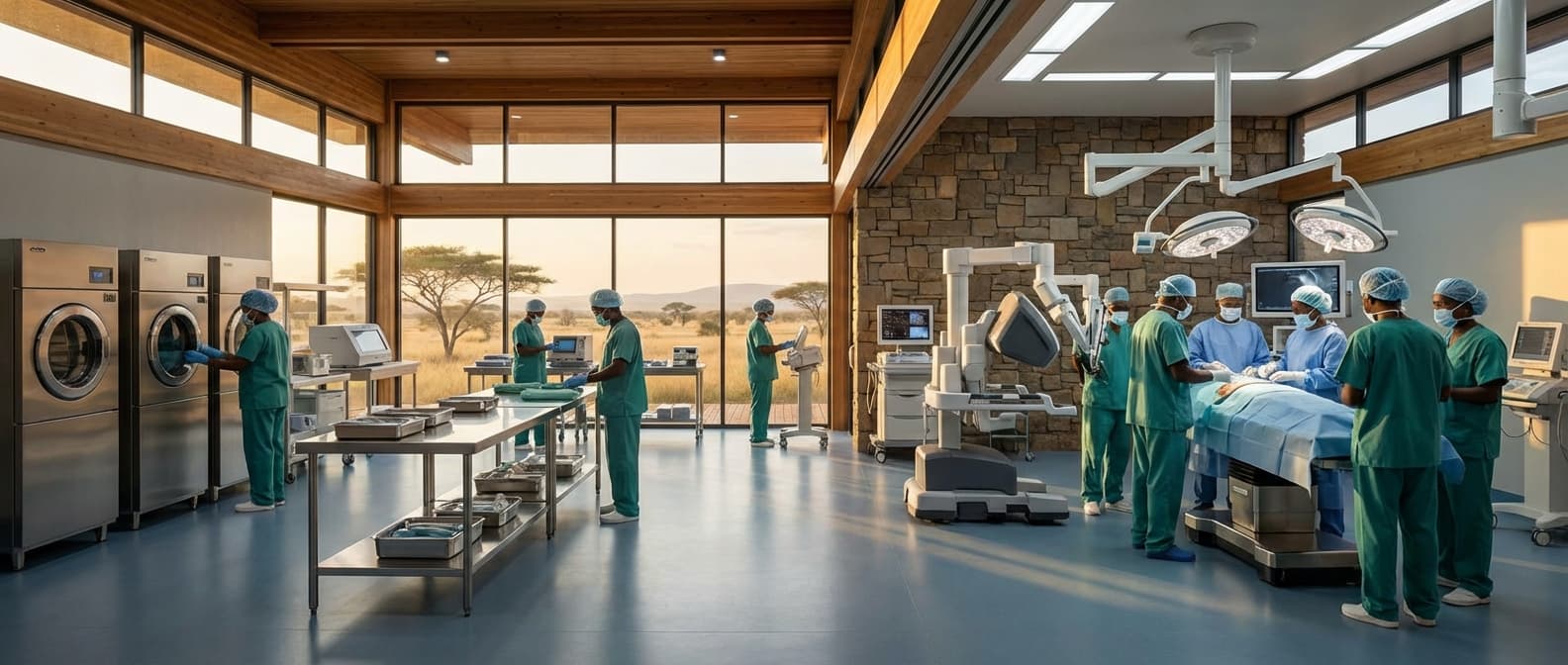
CSSD Design & Validation in Mozambique
Engineering Excellence & Technical Support
CSSD workflow design, validation and process development High-standard technical execution following OEM protocols and local regulatory frameworks.
Validation of Sterilization Processes
Successfully validated steam and low-temperature sterilization cycles according to international standards (e.g., ISO 13485, EN 285), ensuring the efficacy of CSSD operations for critical medical devices in Mozambique's healthcare facilities.
CSSD Layout and Workflow Optimization
Designed and implemented optimized CSSD layouts and workflows for two major Mozambican hospitals, incorporating best practices for unidirectional flow and infection control to enhance efficiency and patient safety.
Performance Monitoring and Quality Assurance
Established robust performance monitoring systems and quality assurance protocols for CSSD equipment and processes, utilizing data analysis to identify trends, troubleshoot issues, and continuously improve sterilization outcomes in challenging environments.
What Is Cssd Design & Validation In Mozambique?
Central Sterilization Supply Department (CSSD) Design & Validation in Mozambique refers to the comprehensive process of planning, constructing, equipping, and subsequently verifying the functionality and performance of a CSSD facility to meet stringent international and national standards for the decontamination and sterilization of medical devices. This service is crucial for ensuring patient safety by preventing healthcare-associated infections (HAIs) transmitted through improperly processed instruments.
| Who Needs CSSD Design & Validation | Typical Use Cases | ||
|---|---|---|---|
| Hospitals and Healthcare Facilities: Public, private, and mission hospitals requiring a functional and compliant CSSD for instrument reprocessing. | Establishing a new CSSD within a greenfield hospital project. | Renovating or expanding an existing CSSD to improve efficiency, capacity, or compliance. | Upgrading sterilization technology or equipment. |
| Specialized Clinics: Surgical centers, dental clinics, and diagnostic imaging facilities with a high volume of reusable instruments. | Addressing recurring issues with instrument sterility or processing failures. | Implementing new sterilization methods or technologies. | Seeking accreditation or certification for their healthcare services. |
| Government Health Ministries & Agencies: Overseeing the quality and safety of healthcare infrastructure in the country. | Developing national guidelines and standards for CSSD operations. | Implementing quality assurance programs for healthcare facilities. | Facilitating infrastructure development and investment in the health sector. |
| International Aid Organizations & NGOs: Involved in healthcare infrastructure development and support in Mozambique. | Designing and implementing CSSD solutions in resource-limited settings. | Providing technical assistance and capacity building for CSSD management. |
What CSSD Design & Validation Involves
- Needs Assessment & Planning: Defining the scope of services, patient load, types of instruments processed, and anticipated future growth. This includes space allocation, workflow analysis, and integration with existing hospital infrastructure.
- Regulatory Compliance: Adhering to Mozambican Ministry of Health regulations, as well as relevant international standards (e.g., ISO 13485, ISO 17665, ISO 11135, AAMI ST series).
- Facility Design & Layout: Optimizing the physical layout to ensure a unidirectional workflow, preventing cross-contamination. This encompasses the decontaminated, clean, sterile, and storage zones, along with consideration for ventilation, lighting, acoustics, and material selection.
- Equipment Specification & Selection: Identifying and specifying appropriate sterilization and decontamination equipment (e.g., washers, disinfectors, autoclaves, low-temperature sterilizers, ultrasonic cleaners) based on device types, throughput, and budget.
- Utility Infrastructure: Designing and verifying adequate supply of clean steam, purified water, electricity, and compressed air, as well as proper drainage and ventilation systems.
- Workflow & Procedure Development: Establishing Standard Operating Procedures (SOPs) for all stages of the CSSD process, including receiving, cleaning, disinfection, inspection, assembly, packaging, sterilization, storage, and distribution.
- Commissioning & Qualification: A multi-stage validation process involving:
- Installation Qualification (IQ): Verifying that equipment is installed correctly according to manufacturer specifications and design intentions.
- Operational Qualification (OQ): Testing equipment to ensure it operates within specified parameters across its intended range.
- Performance Qualification (PQ): Documenting that the entire CSSD system, including equipment, processes, and personnel, consistently performs as intended and produces sterile products meeting defined quality attributes under normal operating conditions.
- Validation Documentation: Creating comprehensive documentation that records all design decisions, installation details, testing procedures, results, and approval signatures for regulatory compliance and future reference.
- Staff Training: Ensuring that CSSD personnel are adequately trained in all aspects of the design, operation, and validation of the facility and equipment.
Who Needs Cssd Design & Validation In Mozambique?
The Central Sterile Services Department (CSSD) is the heart of infection control within any healthcare facility. Effective CSSD design and validation are crucial for preventing the spread of healthcare-associated infections (HAIs) and ensuring patient safety. In Mozambique, as in many developing nations, optimizing these processes is paramount to enhancing the quality and reliability of healthcare services, especially considering potential resource constraints and the unique challenges of the local healthcare landscape.
| Target Customer Segment | Key Departments / Stakeholders Involved | Specific Needs & Benefits of CSSD Design & Validation |
|---|---|---|
| Public Hospitals (e.g., Central Hospitals, Provincial Hospitals) | Infection Control Department, Surgical Departments, Nursing Services, Administration, Biomedical Engineering | Ensuring consistent sterilization of surgical instruments, reducing HAI rates, optimizing workflow for high patient volume, compliance with national standards, extending instrument lifespan, cost-effectiveness through efficient resource utilization. |
| Private Hospitals & Clinics | Management, Clinical Staff (Surgeons, Nurses), Quality Assurance, Infection Control | Maintaining high standards of patient care and safety, building patient trust, attracting medical tourism, efficient use of advanced equipment, regulatory compliance, competitive advantage. |
| Government Health Ministries & Regulatory Bodies | Public Health Departments, Standards and Regulations Units, Procurement Departments | Establishing and enforcing national sterilization standards, ensuring equitable access to safe medical procedures, guiding infrastructure development, training healthcare professionals, monitoring and evaluation of healthcare facilities. |
| Healthcare Infrastructure Development Projects (New Facilities/Renovations) | Architects, Engineers (Civil, Mechanical, Electrical), Project Managers, CSSD Specialists, Facility Management | Designing state-of-the-art CSSD facilities from inception, incorporating best practices in workflow and equipment selection, ensuring compliance with international and national guidelines, future-proofing infrastructure, optimizing space utilization and energy efficiency. |
| NGOs & International Health Organizations | Program Managers, Medical Directors, Procurement and Logistics Teams | Ensuring effective sterilization in projects aimed at improving healthcare access and quality, standardizing practices across multiple sites, training local staff, assessing and improving existing CSSD infrastructure in underserved areas. |
Who Needs CSSD Design & Validation in Mozambique?
- Hospitals (public and private)
- Clinics and Health Centers
- Surgical Centers
- Dental Clinics with sterilization needs
- Specialized Medical Facilities (e.g., dialysis centers, oncology units)
- Government Health Ministries and Regulatory Bodies
- Healthcare Infrastructure Development Projects
Cssd Design & Validation Process In Mozambique
The design and validation process for Central Sterile Services Departments (CSSDs) in Mozambique is a multifaceted undertaking that ensures the safe and effective sterilization of medical instruments. This workflow, from initial inquiry to final execution, adheres to international standards and local regulatory requirements. The process emphasizes meticulous planning, robust engineering, and stringent quality control to guarantee patient safety and prevent healthcare-associated infections.
| Phase | Key Activities | Responsible Parties | Deliverables |
|---|---|---|---|
| Initial contact with the healthcare facility, understanding sterilization needs, patient volume, types of procedures, existing infrastructure, and budget constraints. | Healthcare Facility Management, Ministry of Health (MoH) Representatives, CSSD Consultants. | Needs Assessment Report, Preliminary Requirements Document. |
| Developing high-level layouts, identifying space requirements, preliminary equipment selection, assessing infrastructure needs (water, power, ventilation), and estimating project costs and timelines. | CSSD Consultants, Architects, Engineers, MoH Representatives. | Conceptual Design Drawings, Feasibility Report, Preliminary Budget & Schedule. |
| Developing comprehensive architectural, mechanical, electrical, and plumbing (MEP) drawings. Specifying materials, finishes, workflow paths, infection control measures, and detailed equipment specifications. | Specialized Design Firms (Architects, MEP Engineers), CSSD Consultants, MoH Representatives. | Detailed Design Drawings (CAD), Technical Specifications, Bill of Quantities (BOQ), Project Schedule. |
| Tendering process for construction and equipment. Evaluating bids, selecting suppliers, and ensuring equipment meets international standards (e.g., ISO 13485, HTM 01-01) and is suitable for the Mozambican context. | Procurement Department, Healthcare Facility Management, CSSD Consultants, MoH Representatives, Equipment Suppliers. | Procurement Documents, Signed Contracts, Equipment Purchase Orders. |
| Site preparation, civil works, installation of MEP systems, interior finishing, and installation of sterilization equipment according to approved designs and manufacturer guidelines. | Construction Contractors, MEP Installers, Equipment Installers, Project Managers, CSSD Consultants. | Completed Construction, Installed MEP Systems, Installed Equipment. |
| Testing all installed systems and equipment to ensure they function as designed. Verifying performance parameters against specifications. Includes testing of autoclaves, washer-disinfectors, ultrasonic cleaners, etc. | Equipment Manufacturers, Commissioning Engineers, CSSD Consultants, Healthcare Facility Biomedical Engineers. | Commissioning Reports, Performance Qualification Protocols & Reports, Equipment Test Certificates. |
| Formal validation of the entire CSSD process. This involves Installation Qualification (IQ), Operational Qualification (OQ), and Performance Qualification (PQ) for all equipment and processes. Development of Standard Operating Procedures (SOPs), training manuals, and quality assurance protocols. | Validation Engineers, CSSD Consultants, Quality Assurance Team, Healthcare Facility Management, MoH Representatives. | IQ, OQ, PQ Reports, Validation Master Plan, SOPs, Training Manuals, Risk Assessments. |
| Official handover of the completed and validated CSSD to the healthcare facility. Comprehensive training for CSSD staff on equipment operation, maintenance, infection control protocols, and documentation. | Project Team, CSSD Consultants, Healthcare Facility Management, CSSD Staff. | Handover Certificates, Training Records, Operational Manuals. |
| Continuous monitoring of sterilization processes, equipment performance, and adherence to SOPs. Regular internal audits and scheduled revalidation of equipment and processes to maintain compliance and effectiveness. | CSSD Staff, Biomedical Engineers, Quality Assurance Team, MoH Representatives. | Routine Monitoring Data, Audit Reports, Revalidation Certificates. |
CSSD Design & Validation Process Workflow in Mozambique
- Inquiry & Needs Assessment
- Conceptual Design & Feasibility Study
- Detailed Design & Engineering
- Procurement & Equipment Selection
- Construction & Installation
- Commissioning & Performance Qualification
- Validation & Documentation
- Operational Handover & Training
- Ongoing Monitoring & Revalidation
Cssd Design & Validation Cost In Mozambique
Designing and validating a Central Sterile Supply Department (CSSD) in Mozambique involves a complex interplay of factors that influence overall costs. These costs can vary significantly based on the scope of the project, the size of the facility, the specific equipment chosen, and the prevailing economic conditions. It's crucial to understand these pricing drivers to accurately budget for such an undertaking. The local currency, the Mozambican Metical (MZN), is the primary unit of cost, though some imported components might be priced in USD or EUR, requiring conversion and subject to exchange rate fluctuations.
| Cost Component | Estimated Range (MZN) | Notes |
|---|---|---|
| Design & Consultancy Fees | 500,000 - 2,500,000+ | Varies significantly with the scope and expertise of the consultant. Can be a percentage of the total project cost. |
| Equipment (Basic to Advanced) | 2,000,000 - 15,000,000+ per major unit (e.g., autoclave) | This is the largest variable. Includes autoclaves, washer-disinfectors, ultrasonic cleaners, etc. Prices depend on brand, capacity, and automation level. |
| Minor Equipment & Instruments (Initial Stock) | 500,000 - 3,000,000+ | Trays, baskets, consumables, initial instrument sets. |
| Fit-out & Renovation/Construction | 1,000,000 - 5,000,000+ | Includes flooring, walls, ceilings, lighting, plumbing, electrical, ventilation. Highly dependent on existing infrastructure and size. |
| Validation & Commissioning Services | 300,000 - 1,500,000+ | Covers testing, calibration, documentation, and certification. Can be ongoing. |
| Installation & Training | 200,000 - 1,000,000+ | For complex equipment and staff upskilling. |
| Contingency (10-15%) | Highly variable, added to sub-total | Essential for unforeseen issues and price changes. |
Key Pricing Factors for CSSD Design & Validation in Mozambique
- Facility Size and Scope: The physical footprint of the CSSD, the number of sterilization bays required, and the complexity of the workflow design directly impact labor and material costs for construction and fit-out.
- Equipment Selection: This is a major cost driver. High-end, fully automated equipment (autoclaves, washer-disinfectors, ultrasonic cleaners, packaging machines, etc.) will be significantly more expensive than basic, manual options. The number and type of instruments to be processed also influence equipment requirements.
- Renovation vs. New Construction: Adapting an existing space for a CSSD often involves demolition, structural modifications, and specialized ventilation, which can be more costly than building from scratch where design integration is seamless.
- Regulatory and Compliance Requirements: Adhering to national and international standards (e.g., ISO, local health regulations) may necessitate specific materials, finishes, and validation processes, adding to the expense.
- Consultancy and Design Fees: Engaging specialized CSSD designers, architects, and engineers for the planning and execution phases incurs professional fees. These vary based on the consultant's experience and reputation.
- Validation and Commissioning: This critical phase involves rigorous testing to ensure the CSSD operates according to design specifications and regulatory standards. Costs include testing equipment, consumables, specialized personnel, and documentation.
- Installation and Training: The cost of installing complex equipment and providing comprehensive training to CSSD staff is a significant component.
- Infrastructure and Utilities: Ensuring adequate water supply, drainage, electricity (including backup power), and HVAC systems are essential and can involve substantial upfront investment, especially in areas with less developed infrastructure.
- Material and Finishing: The choice of durable, easily cleanable, and infection-control-friendly materials for walls, floors, and ceilings (e.g., epoxy coatings, stainless steel) will influence costs.
- Geographical Location within Mozambique: Costs for labor, materials, and logistics can vary between major cities (Maputo, Beira) and more remote regions.
- Import Duties and Taxes: For imported equipment and specialized materials, import duties, VAT, and other taxes will add to the overall price.
- Exchange Rate Fluctuations: For components priced in foreign currencies, the prevailing exchange rate between MZN and USD/EUR will directly impact the final cost.
Affordable Cssd Design & Validation Options
Designing and validating a Central Sterile Supply Department (CSSD) is crucial for infection control and patient safety. While often perceived as a significant investment, there are affordable design and validation options that can significantly reduce costs without compromising quality. This involves strategically bundling services and implementing cost-saving measures throughout the process.
| Cost-Saving Strategy | Description | Potential Benefit |
|---|---|---|
| Phased Approach | Implement the CSSD in stages, prioritizing critical areas first and expanding as budget allows. This defers larger capital expenditures. | Reduced upfront investment, manageable cash flow. |
| Standardized Design Templates | Utilize pre-designed, modular layouts proven for efficiency and compliance, rather than entirely custom designs. | Faster design process, lower architectural fees, potentially easier equipment integration. |
| Consolidated Equipment Purchasing | Source multiple pieces of equipment from a single vendor or through group purchasing organizations (GPOs) to leverage bulk discounts. | Significant savings on capital equipment costs. |
| Pre-validated Equipment Options | Select equipment that comes with manufacturer's pre-validation documentation, reducing the scope and cost of on-site validation. | Streamlined validation process, reduced third-party validation fees. |
| Remote Validation Support | Leverage technology for remote monitoring and initial validation assessments where feasible, reducing on-site consultant time. | Lower travel and per diem expenses for validation specialists. |
| In-house Validation Training | Invest in training internal staff to perform certain validation tasks, reducing reliance on external consultants for routine checks. | Long-term cost reduction, increased internal expertise. |
| Leasing vs. Buying Equipment | Explore equipment leasing options for certain high-cost items, which can offer lower upfront costs and predictable monthly expenses. | Improved cash flow, ability to upgrade equipment more frequently. |
| Optimized Workflow Design | Focus on lean principles and efficient workflow to minimize staff time, reduce instrument turnaround, and prevent bottlenecks, indirectly saving on operational costs. | Increased throughput, reduced labor costs, better resource utilization. |
Key Value Bundles for Affordable CSSD Design & Validation
- {"title":"Integrated Design & Planning Packages","description":"Bundling initial design, space planning, and workflow analysis with validation planning services can lead to more cohesive and efficient outcomes. This ensures validation requirements are considered from the outset, preventing costly redesigns."}
- {"title":"Equipment Procurement & Installation Support","description":"Negotiating package deals for essential CSSD equipment (decontamination, sterilization, sterile storage) often comes with discounted pricing. Bundling this with professional installation and initial calibration by the supplier can be more cost-effective than separate arrangements."}
- Validation Protocol Development & Execution Bundles
- Training & Competency Assessment Packages
- Modular & Phased Implementation Options
Verified Providers In Mozambique
In Mozambique's evolving healthcare landscape, identifying reliable and ethically sound providers is paramount for individuals and organizations seeking quality medical services. Franance Health stands out as a leading name, distinguished by its rigorous credentialing process and unwavering commitment to patient well-being. This document outlines why Franance Health's verified providers represent the best choice for healthcare needs in Mozambique.
| Credential Type | Verification Scope | Franance Health Standard |
|---|---|---|
| Medical Licenses & Certifications | Validation of current and active licenses with relevant Mozambican medical boards and international accreditation where applicable. | Mandatory verification of all professional licenses and certifications, with a focus on their validity and relevance to the provider's specialization. |
| Educational Background | Confirmation of degrees and diplomas from accredited institutions. | Thorough review of academic records to ensure authenticity and appropriate level of education for medical practice. |
| Professional Experience | Verification of past employment and clinical experience through reference checks and documentation. | Assessment of practical experience, including duration, roles, and responsibilities, to gauge proficiency and competence. |
| Criminal Background Checks | Screening for any past criminal convictions that could impact patient trust and safety. | Comprehensive background checks conducted to ensure the integrity and trustworthiness of all verified providers. |
| Ethical Compliance & Disciplinary Records | Inquiry into any past disciplinary actions or ethical complaints from professional bodies. | Diligent checks for any history of malpractice, ethical breaches, or disciplinary actions by regulatory bodies. |
| Specialization & Expertise | Confirmation of specialized training and ongoing practice in their declared field. | Ensuring providers possess the documented expertise and continuing education relevant to their specific medical disciplines. |
Why Choose Franance Health Verified Providers?
- Rigorous Vetting Process: Franance Health employs a multi-stage verification system that scrutinizes the credentials, qualifications, and ethical standing of every provider.
- Commitment to Excellence: Verified providers adhere to the highest standards of medical practice, ensuring optimal patient care and outcomes.
- Patient Safety First: Franance Health prioritizes patient safety through stringent background checks and continuous monitoring of provider performance.
- Transparency and Trust: Our verification process fosters transparency, building trust between patients and healthcare professionals.
- Access to Specialized Care: We facilitate access to a diverse network of specialists, ensuring comprehensive healthcare solutions.
- Ethical Practice Assurance: Franance Health ensures all verified providers operate with the utmost integrity and adhere to professional codes of conduct.
- Continuous Improvement: We are dedicated to the ongoing professional development of our network, promoting the latest advancements in medical knowledge and practice.
Scope Of Work For Cssd Design & Validation
This Scope of Work (SOW) outlines the requirements for the design and validation of a Central Sterile Supply Department (CSSD). It details the technical deliverables expected and the standard specifications that will govern the design and operational processes. The objective is to ensure a safe, efficient, and compliant CSSD that meets all relevant international and local healthcare standards.
| Phase | Key Activities | Technical Deliverables | Applicable Standards |
|---|---|---|---|
| Design Phase | Needs Assessment, Functional Programming, Conceptual Design, Detailed Design, Equipment Specification | Architectural Drawings (layout, elevations, sections), Mechanical, Electrical, Plumbing (MEP) Drawings, Equipment Schedule, Material Specifications, Workflow Diagrams, HVAC Design Report | ISO 13485, ISO 14644, HTM 01-01, ASHRAE Standards, Local Building Codes, National Fire Protection Association (NFPA) |
| Equipment Selection & Procurement | RFP/RFQ Preparation, Vendor Evaluation, Equipment Procurement | Tender Documents, Vendor Proposals, Purchase Orders | Manufacturer's Instructions for Use (IFUs), FDA Regulations (if applicable) |
| Installation & Commissioning | Equipment Installation, System Integration, Pre-commissioning Checks, Commissioning Testing | Installation Verification Reports, Commissioning Protocols, Commissioning Reports, As-Built Drawings | Manufacturer's Specifications, NFPA 70, NFPA 99 |
| Validation Phase | Installation Qualification (IQ), Operational Qualification (OQ), Performance Qualification (PQ), Process Validation | IQ Protocol & Report, OQ Protocol & Report, PQ Protocol & Report, Validation Master Plan (VMP), Validation Reports for Cleaning, Disinfection, Sterilization Cycles | ISO 17665, ISO 11135, ISO 11137, FDA Guidance Documents, AAMI Standards |
| Operational Readiness | SOP Development, Staff Training, Emergency Preparedness Planning, Quality Management System (QMS) Implementation | Comprehensive SOP Manual, Training Records, Emergency Response Plan, QMS Documentation | ISO 9001, Joint Commission International (JCI) Standards, Local Health Authority Regulations |
Key Objectives
- To design a CSSD layout optimized for workflow, material flow, and infection control.
- To specify equipment that meets performance, capacity, and regulatory requirements.
- To develop Standard Operating Procedures (SOPs) for all CSSD processes.
- To validate the design and operational effectiveness of the CSSD.
- To ensure compliance with relevant healthcare standards and guidelines.
Service Level Agreement For Cssd Design & Validation
This Service Level Agreement (SLA) outlines the response times and uptime guarantees for Central Sterile Services Department (CSSD) design and validation services. It is designed to ensure efficient project delivery and operational reliability for our clients.
| Service Component | Response Time (Business Hours) | Uptime Guarantee (for validation software/systems) | Notes |
|---|---|---|---|
| Initial Consultation Request | Within 2 Business Hours | N/A | Acknowledgement of receipt and scheduling of initial call. |
| Design Documentation Review (per phase) | Within 4 Business Hours (for initial feedback) | N/A | Feedback on submitted design documents within agreed-upon turnaround time. |
| Validation Protocol Development | Within 1 Business Day | N/A | Delivery of draft validation protocols for review. |
| Validation Execution Support (on-site/remote) | Within 2 Business Hours (for critical issues) | 99.5% | Includes technical support for validation equipment and software. Downtime beyond this guarantee will be addressed with corrective actions and potentially service credit. |
| Validation Report Generation | Within 3 Business Days (post-execution) | N/A | Delivery of comprehensive validation reports. |
| Post-Validation Queries | Within 4 Business Hours | N/A | Clarification and support for any questions arising from validation reports. |
| Emergency Technical Support (Validation System) | Within 1 Business Hour | N/A | For critical system failures impacting validation activities. |
Scope of Services Covered
- Initial CSSD design consultation and concept development.
- Detailed design documentation, including layout, equipment specification, and workflow planning.
- Validation protocol development and execution (IQ, OQ, PQ).
- Post-validation support and documentation review.
- Training material development and delivery related to CSSD operations and equipment.
Frequently Asked Questions

Ready when you are
Let's scope your CSSD Design & Validation in Mozambique project in Mozambique.

Scaling healthcare logistics and technical systems across the entire continent.